Today marks the 74th birthday of Elvis Presley. Elvis made a string of popular but undemanding movies in the 1960s, with the emphasis on the undemanding. This was probably in no small part due to Elvis' manager, "Colonel" Tom Parker, who thought that this was what Elvis fans wanted to see. While Elvis' songs may be enjoyable, the later movies are little more than time capsules thanks to the insipid plots. Elvis did, however, show that he had some real acting chops, with the movies that he made early in his career before being drafted into the Army. TCM showed one of these in King Creole; one that they didn't show is Jailhouse Rock.
In Jailhouse Rock, Presley plays Vince Everett, a young man doing manual labor and living for the weekend. One Friday night, however, he gets in a bar fight thanks to his temper, with the result that the man challenging him to the fight dies in the fight. As a result, Everett gets sentenced to prison on a manslaughter charge. While in prison, Everett is taught guitar by his cellmate, Hunk Houghton (played by Mickey Shaughnessy). This, combined with Elvis' natural singing abilities, stand to serve him in good stead once he's released from prison, as he meets a young lady (Judy Tyler) and gets a singing contract. However, success also goes to his head, which could be disastrous for his relationship with Tyler.Elvis has to play a lot of things here. At first, he comes across as a naïf, and it seems that everybody is going to walk right over him. Later in the movie, though, we learn that he's got a lot more street smarts, getting back at Hunk, who is trying to sponge off of Vince's success. There's also a troubled side to Vince, especially in that he doesn't want to deal with the rich people who are the higher-ups in the entertainment business and who really have classist attitudes toward a man like Vince. Elvis does a pretty good job of displaying all of those contrasts; one wonders if Elvis wasn't dealing with a lot of these very same things in his own life. (Other than the prison, of course.) Still, Jailhouse Rock is a movie that has its high points in the musical numbers. Chief among these is a TV special in which he performs the title song. (If you've ever seen clips of the performance and wondered why the jail doesn't look like a real jail, this explains it. The hypothetical TV producers wouldn't have been striving for reality.) Elvis' dancing, especially the hip-swivelling, is powerful, even though it's nothing like Fred Astaire or Gene Kelly would have done. The singing is arresting, too, and Elvis' presence during the muscial numbers is charismatic. It's easy to see why Col. Parker would want later Elvis movies to focus more on the musical numbers.
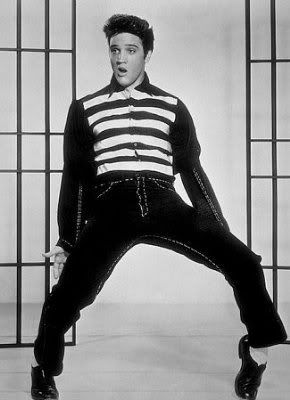
Jailhouse Rock is available on DVD. Even though the plot isn't quite as good as, say, King Creole, it's still passable, with a performance from Elvis interesting enough to give a glimpse into his true acting ability. And don't forget -- Elvis could sing, too.
Thursday, January 8, 2009
The Elvis movie TCM didn't show
Posted by
Ted S. (Just a Cineast)
at
11:45 AM
0
comments
Wednesday, January 7, 2009
Russian Orthodox Christmas
And you thought the holidays were over.... The Russian Orthodox Church celebrates Christmas on January 7. The studio system's treatment of Russia was fairly lousy. In the 1930s, with the Great Depression raging, a lot of academic types thought that the Soviet economic system was going to be the wave of the future, and so filmgoers got an overly romantic look at Russia. Of course, after World War II, Communists were to be feared, so Hollywood gave us a lot of movies with fairly blunt messages about the evils of communism. A lot of these 1950s movies aren't very good; it's as though the studios were only putting these movies out in order to appease the Communist hunters in Washington.
It's not as though the doe-eyed look at Russia in the 1930s is much better. Consider a movie like 1934's We Live Again. It's based on Leo Tolstoy's novel Resurrection. Anna Sten, whom Samuel Goldwyn wanted to make a star, plays the lead, as a servant girl who is the object of the infatuation of one of her masters, a young Army officer played by Fredric March. He knocks her up and leaves her, forcing her to have the baby alone, with ultimately tragic results. First, the baby dies, and then Sten is forced to go to Moscow, where she does whatever she can to survive, even if that results in falling afoul of the law.And here, the story starts to get silly. Sten gets a jury trial -- and March is one of the members of the jury! Still, that doesn't get her out of any punishment (although the movie makes maddeningly clear that she was just an innocent girl caught in the wrong place at the wrong time); she gets sentenced to five years in Siberian exile. March feels bad for the girl, and vows that he'll do anything he can to set matters right. If you thought the story got silly once you saw March on the jury, wait until you see what happens after the trial. Imagine me holding my head in my hand, and you'll get an idea of the direction this movie takes.
I should probably cut a bit of slack to the moviemakers, though. Part of the problem is that they were dealing with a Tolstoy novel. Tolstoy always had one foot firmly in the camp of Russia's peasants, with his books devoting significant chunks of space to paeans to the simpler life of the peasant -- they were closer to nature, and to God, less sinful, and all that stuff. It makes novels like Anna Karenina tough going. And with a story like Resurrection, where the peasant/noble contrast is an integral part of the story, there's not a lot the screenwriters and director could do.
We Live Again has been released to DVD. If you're interested in Russia, or the movies of Fredric March, you may want to give it a try.
Posted by
Ted S. (Just a Cineast)
at
9:35 AM
0
comments
Tuesday, January 6, 2009
Harriet Craig
I briefly mentioned the Joan Crawford movie Harriet Craig back in July. I mentioned then that it was a remake of the 1936 movie Craig's Wife. The two movie are airing back-to-back on January 7. The original, starring Rosalind Russell, airs at 7:45 AM ET; the Joan Crawford remake follows at 9:15 AM.
I personally prefer the Joan Crawford version, if only because Crawford was so good at reaching over the top and playing nasty, shrewish, manipulative characters like Harriet Craig. Crawford seemed to make a career of it after leaving MGM, and while the result is often movies that are campy, if only because of Crawford's acting style, it's also never less than fun.
Harriet Craig is not on DVD, so if you want to watch it, you'll have to tune in tomorrow. If you do want to see more of that over-the-top Crawford, you could do worse than to find the DVD of Queen Bee.
Posted by
Ted S. (Just a Cineast)
at
2:08 PM
0
comments
Lon Chaney silents
Today marks the birthday of Loretta Young, which reminded me of one of her earliest movies, the 1928 silent Laugh, Clown, Laugh, made when Young was a young 13. It's part of a two-disc collection of three of the great Lon Chaney's silents. Laugh, Clown, Laugh is a pretty good movie, although slightly melodramatic. Chaney plays a clown who adopts the orphan Young, only to fall in love with her, with tragic consequences. It's interesting to see Loretta Young at souch an early age; however, Lon Chaney is much more interesting, simply because he always made his movies interesting.
Another interesting in the set is The Unknown, where Chaney plays an armless man who throws knives with his feet. One of the things that makes The Unknown so interesting is the female lead -- a young Joan Crawford. The other is director Tod Browning, who made his movies both shocking and controversial. I won't go into the details of The Unknown largely because I don't want to give away the shock.
Posted by
Ted S. (Just a Cineast)
at
1:47 PM
0
comments
Monday, January 5, 2009
Inaccurate trailers
TCM is airing Executive Suite at 6:15 PM on January 6. If you watch enough TCM, you've probably seen the trailer. What's interesting about the trailer is the melodramatic music that plays constantly in the background. That was added to the trailer, and is not part of the movie. In fact, director Robert Wise eschewed a music score entirely for Executive Suite, instead using only the normal ambient sounds of a city.
As for the movie itself, it's pretty good, although the ending is a bit predictable. As for that lack of a score, it makes the movie much more enjoyable than the trailre. Executive Suite is well worth watching, and it's available on DVD, too.
Posted by
Ted S. (Just a Cineast)
at
9:09 PM
0
comments
Crowded House
TCM are honoring director King Vidor tomorrow, and I'd like to mention one of the movies that has not been released to DVD: the 1928 silent The Crowd, which airs at 6:00 AM ET on January 6.
James Murray stars as John, an everyman who leaves his small town and moves to the big city to try to make it in life. He gets a job behind a desk, and eventually meets Mary (Eleanor Boardman), falls in love with her, and marries her. However, life is not a bed of roses for the two of them, as they face financial problems and other hurdles that threaten to tear their marriage asunder.
The story is somewhat reminiscent of the later The Marrying Kind, in that it tells the story of two people who could be almost anybody. There's nothing particularly special about them, or glamorous about them. There's also nothing particularly happy about the couple. The story is not all that upbeat, although it does end on a hopeful note. As such, it can be a tough go at times. Indeed, the normally very astute Irving Thalberg feared that audiences wouldn't want to see a movie with a downbeat ending, and was very worried about how Vidor would end it. It turned out that the film was a financial success for MGM, however.
If the movie is a story about everyman and isn't particularly happy, then why watch it? There are a bunch of good reasons. One is that Vidor did quite a bit of location shooting in New York, using real people and not actors, as though he were filming a documentary. The footage of New York City as it was in 1928 is a treat. Also, there is some pretty amazing cinematography here. Of particular note is a tracking shot leading up the side of a skyscraper, into it, eventually ending up at Murray's desk. It's a precursor to the opening shot introducing Jack Lemmon at his office desk in The Apartment.
As I said, The Crowd has apparently not been released to DVD yet, and that's a huge shame. The movie has a great deal of artistic merit, and is well worth a viewing by anybody interested in learning more about silent movies, and how visuals tell a story.
Posted by
Ted S. (Just a Cineast)
at
2:18 PM
0
comments
Labels: please release me, Silent
Sunday, January 4, 2009
William McKinley?
Some historical figures, for obvious reasons, appear more often on screen than others: Julius Caesar, Queen Elizabeth I of England, or Abraham Lincoln would be obvious choices for Hollywood movies. Somebody who should be expected to get much less attention is President William McKinley. But he did show up as an important character in one studio era movie: This is My Affair, airing at 6:00 AM ET January 6 on the Fox Movie Channel.
Robert Taylor stars as a young Navy lieutenant at turn of the 20th century. There's been a string of bank robberies in the midwest, and President McKinley brings Taylor in as a special agent to try to infiltrate the gang; Taylor is to report only to McKinley because McKinley thinks one of his advisors might be in cahoots with the gang. Along the way, Taylor falls in love with Barbara Stanwyck, a moll who'd really rather be out of the gang. However, just when it looks as though Taylor is about to crack the case open, McKinley gets assassinated. T he gang gets arrested, with Taylor being sentenced to execution -- unless he can prove his case.
The basic idea behind the story isn't too bad, although it's fairly predictable and been done a number of times. Perhaps because of that predictability, This is My Affair falls flat as a movie. The actors simply go through the motions, as though they're not really trying. It doesn't help that Stanwyck is asked to sing here, and wear ghastly outfits, neither of which really suited her. Even worse, though, is the ham-handed treatment of McKinley's successor, Theodore Roosevelt. We see Roosevelt come up with his "speak softly and carry a big stick" slogan in what is a thoroughly contrived manner.
It is unsurprising then, that despite the two leading stars, that This Is My Affair hasn't made it to DVD. Still, those who are Barbara Stanwyck fans may want to watch. It doesn't show up on the Fox Movie Channel all that often, so this would be a good time to catch it.
Posted by
Ted S. (Just a Cineast)
at
1:59 PM
0
comments
Labels: Barbara Stanwyck, Fox
Saturday, January 3, 2009
Beautiful birthday greetings
On this day in 1905, Ray Milland was born. However, on the very same day, the much better-looking Anna May Wong was born. Wong's films show up on TV less frequently as well, so it is with that (and not her looks) in mind that we celebrate her birthday today.
Wong received a prominent place in TCM's series last June on Asians in Hollywood, and rightly so. Wong was American, but of Chinese descent, so any time the studio needed somebody "exotic" to play an Asian, there she was. Wong was the star of Toll of the Sea, a 1922 retelling of Madame Butterfly, in which an American in China falls in love with Wong, despite his being betrothed to somebody back home, resulting in tragedy for all. Toll of the Sea has the distinction of being the first movie released in two-strip Technicolor, which has held up surprisingly well for a movie so old.
However, Wong's career in Hollywood eventually stalled, leading her to go to Europe. In Britain, she starred in the 1929 silent movie Piccadilly, playing a dishwasher at a nightclub who eventually becomes the star dancing attraction after the boss sees her performing a rather alluring dance for the kitchen staff. Eventually, though, Wong's charms prove to be the melodramatic downfall of her. Technically, Wong wasn't supposed to be the star of Picadilly, but she makes it her own with that dancing.
Both Toll of the Sea and Piccadilly have been released to DVD, but you'd probably be better off renting than buying. This is especially true of Toll of the Sea, which was released only as part of a large collection of "rescued" movies that were all found languishing in various archives.
Wong later returned to Hollywood, where she played opposite the equally lovely Marlene Dietrich in Shanghai Express, about a group of passangers trapped on a train caught up in the Chinese civil war. Surprisingly, however, it's not available on DVD, which is a real shame. Even worse, though, is what happened to Wong's career. She wanted to play the part of Olan in the MGM version of Pearl Buck's novel The Good Earth. However, Paul Muni was playing the male lead, and at the time, the rules on miscegenation in the movies were such that an Asian-American like Wong wouldn't be allowed to play opposite a white man (even if in "yellowface").
Posted by
Ted S. (Just a Cineast)
at
2:11 PM
0
comments
Friday, January 2, 2009
Oscar Micheaux and race movies
January 2 marks the birth anniversary of pioneering black director Oscar Micheaux. TCM showed three of his movies, which are in the genre known as "race" movies: movies with predominantly black casts and crews, made specifically for black audiences at a time when Jim Crow laws were the order of the day and black actors couldn't get good roles in Hollywood.
Although some race movies dealt with topics of particular interest to blacks (especially Micheaux'; he felt with his movies that he was trying to contribute to the advancement of blacks by trying to impart a message on the importance of education), other movies were much closer to being black versions of the sort of movie genres that were popular among white audiences; genres in which white movies were being made for white audiences. There were westerns, mysteries, comedies, and more; one of the more interesting race movies is the 1940 mob movie Gang War.
Gang War is comparable to a lot of the B-movies that the Hollywood studios were putting out in the 1930s. It's a story two rival gangs trying to control the jukebox racket in Harlem. Like Warner Brothers' "socially conscious" movies of the early 1930s, Gang War tries to be "ripped from the headlines", to the extent that it uses the clichéd conceit of using newspaper headlines to frame the scenes and drive the plot. (This isn't a criticism; white B-movies did this sort of stuff too.) There's the typical chase scenes between the police and the mob; however, because race films had extremely limited budgets, Gang War pretty much reused the same footage from one chase scene and showed it over and over. However, it makes the movie look even more zippy in its pacing that it is, which is a big plus.
The one big difference between Gang War and white gangster movies is that Black audiences liked pointless music and variety numbers even more than white audiences. As such, even a movie like Gang War has a few pauses for musical relief that might seem jarring to a viewer used to Hollywood gangster movies. On the other hand, the Black musical talent being showcased here wouldn't have had any other chance to appear on screen. And despite the low budget and concomitant bad production values, Gang War is still well worth watching and comparing to the B crime movies made by Hollywood. Fortunately, it's available on DVD.
Posted by
Ted S. (Just a Cineast)
at
3:41 PM
0
comments
Thursday, January 1, 2009
The Killer That Stalked New York
On New Year's night, TCM are giving us plagues and pestilences; just what you always wanted for the new year. The night kicks off at 8:00 PM ET with the classic King Kong, and is followed at 10:00 PM ET by the previously-recommended Them!. So, I'd like to point out the night's third movie, airing at midnight ET: The Killer That Stalked New York.
This low-budget B-grade crime drama from Columbia Pictures in 1950 stars Evelyn Keyes (who played Scarlett O'Hara's sister Suellen in Gone With the Wind) and a cast of relative unknowns. Keyes plays Sheila, a woman who's part of a ring smuggling uncut diamonds in from Cuba. Because of this, she's well aware that the police are hot on her tail, and has already mailed the diamonds to another member of the ring. What she doesn't know, however, is that diamonds aren't the only thing she's smuggled into the US: she's smuggled in a pretty bad case of smallpox. The Killer That Stalked New York is part crime drama, and that part is relatively predictable. It's obvious that the plot isn't going to go according to plan, in this case meaning that Sheila's unfaithful boyfriend, the other part of the ring, is trying to skip town with the proceeds, forcing an ever-sicker Sheila to leave her apartment to try to find him.
However, it's also part medical mystery, and that is where the movie gets really interesting. In 1950, smallpox was in a state that polio is today: it had been eradicated in the industrialized countries, but still existed in some Third World countries. Most New York doctors wouldn't have seen a smallpox case in their practising careers, and so are confronted with symptoms that at first seem baffling to them. Eventually, of course, an older doctor realizes, much to his horror, what's going on, leading to the desperate search to find out who's spreading smallpox around New York, at the same time trying not to panic the general population. (The doctors and police don't realize until fairly late that they're after the same person.)
The Killer That Stalked New York is, in many ways, typical of the B-movies that were being released by Hollywood in the 1950s. It's competent, with a cast of fairly little-known actors all giving their best. The subject material (it was based on a real incident), however, helps the movie rise a cut above other B-movies. It's certainly nowhere near as good as the great 1950 movies like Sunset Blvd., but it's more than good enough to hold its own with the standard suspense fare that Hollywood is putting out today. Sadly, it's not available on DVD.
Posted by
Ted S. (Just a Cineast)
at
10:07 AM
0
comments
Labels: Crime