Wednesday, April 8, 2009

Life Begins at 80

In last night's Petrified Forest, Bette Davis' grandfather was played by Charley Grapewin. I use the phrase "veteran character actor" quite a bit, and Grapewin is another of the people who fits the bill. Grapewin was one of the many people for whom a new career opened up with the advent of talking pictures. Grapewin was 60 at the time his movie career really began, and he was active into his 80s.

The transition to talkies gave life to other mature actors' careers, too. Some had done work in silents, such as Marie Dressler, but it was really talkies that made her a much bigger name, and she was past 60 when she won her Oscar for Min and Bill. An even older actress, though, was May Robson, who was in her seventies when talkies came around.

Some mature actors didn't come to Hollywood until years later, having spent quite a bit of time on the stage. Charles Coburn and his first wife had a theater troupe, which lasted until her death; it was only after that that Coburn left for Hollywood for a full-time career, starting at the age of 60. Another similar career path was followed by Sydney Greenstreet, who played on stage for over 30 years before, at the age of 62, making a big splash in his first movie, The Maltese Falcon.

Finally, there's Clifton Webb, who had done a few silents back in the 1920s, but spent much of his career on stage until, at the age of 55, made a comeback as spectacular as Greenstreet's debut, earning an Oscar nomination for the movie Laura.

Tuesday, April 7, 2009

Petrified Forest

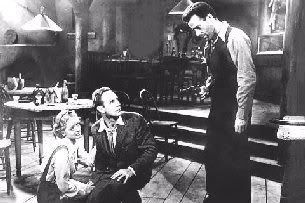
Our next movie takes me back to one of my very first posts. TCM are honoring Leslie Howard tonight in prime time, and kick off the evening with his 1936 movie The Petrified Forest, at 8:00 PM ET.

Based on a Broadway play, The Petrified Forest sees Howard get top billing as a romantic, utopian poet making his way across the US, who stops in at a local watering hole somewhere in the Southwest. The place is manned by Bette Davis and her father. She's only working there because she doesn't have any other economic opportunities; in reality, she's just as much the dreamer and artist as Howard, and would like desperately to get away fro mthis God-forsaken place. And when Leslie Howard walks in, this might finally be her chance.

Sadly, fate steps in. Well, not so much fate, but gangster Duke Mantee, played by Humphrey Bogart, who was still way down the billing list. He and his gang are on the run, and figure that this is the perfect place for them to stop and wait for his woman. Duke and his gang proceed to take over the joint and hold everybody hostage. As I mentioned a year ago, Leslie Howard seemed to get cast as a lot of milquetoast characters, and this one is no exception, although the combination of the hostage crisis, and having a girl he now loves, finally affords him a chance to do the right thing, at least in his own way.... (Well, he also did the right thing in A Free Soul and some other movies, but he always came across as weak.)

Although Leslie Howard is the lead, and Bette Davis does an excellent job without being very over the top. However, Humphrey Bogart steals the show the minute he walks into the joint. He wasn't really even a B star yet: he'd made a few movies, and doing stage work, but this was the movie that got his career going and got him bigger roles playing second behind James Cagney or Pat O'Brien in Warners' late-30s gangster movies. Of all the gin joints in all the world, he had to walk into Bette Davis'.

Petrified Forest is available on DVD, should you miss TCM's showing.

Monday, April 6, 2009

Do you know who I am?

TCM is showing Mister Buddwing early on April 7. James Garner stars as a man with amnesia, who can't remember his identity, and goes through a series of women trying to figure out who the hell he is. It's worth watching -- once -- because it's so ludicrously bad.

I can't help but thinking that a lot of the movies in the "Who am I? Why am I here?" genre don't quite live up to their hype. Another one that comes to mind is Random Harvest, in which Ronald Colman plays a World War I veteran who gets amnesia twice. The first time, he can't remember his old life, and falls in love with Greer Garson; the second time, he suddenly remembers his original life, and can't remember who the hell Greer Garson is. Writing someplace else several years ago, I referred to movies like this as the type of movie that screams "chick flick", and won't shut the hell up. I suppose movies like that could be good -- some chick flicks even won Oscars -- but Random Harvest is so turgid that it makes me want to run from the room screaming.

For something more modern, you could try The Bourne Identity, but it's a typical conspiracy theory-styled spy movie, in which the entire Establishment is up against this one poor put-upon guy who can't even remember who he is. Personally, I find such movies to strain credulity to the breaking point.

May-December relationships

TCM showed Goodbye Again today, in which Ingrid Bergman falls for younger Anthony Perkins. In fact, the age difference between them was only 17 years. There have been lots of movies in which the actors playing the characters have much greater age differences.

Cary Grant was known for playing distinguished older gentleman types later in his career; having been born in 1904, this gave him a well over 20-year difference when starring opposite people like Eva Marie Saint in North By Northwest or Audrey Hepburn in Charade.

Gloria Swanson was 65 when she played Norma Desmond in Sunset Blvd.; William Holden was only in his mid 30s.

And for a more interesting one, there was a good 30-year age difference between millionaire Joe E. Brown, and the object of his affection, Jack Lemmon, in Some Like It Hot.

Sunday, April 5, 2009

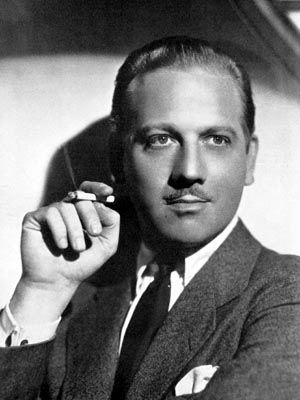
Melvyn Douglas, 1901-1981

Head shot of Jack Carson,

I'm too lazy to write a full-length post on a Sunday morning, so I'll note that today is the birth anniversary of Melvyn Douglas, who won two Best Supporting Actor Oscars later in his career, but never got quite the leading roles he probably deserved. I've recommended at least three of his movies, though:

Captains Courageous, in which Douglas plays father to Freddie Bartholomew. (Interestingly, IMDb lists star Spencer Tracy as being exactly one year older than Douglas.)

Ninotchka, in which Douglas helps Greta Garbo break through her shell.

Mr. Blandings Builds His Dream House, in which Douglas tries to keep Cary Grant and Myrna Loy well-grounded -- although Grant things Douglas is trying to steal his wife!

Saturday, April 4, 2009

Seven Days to Noon

I've mentioned my enjoyment of the "little" British pictures of the post-War era before, and TCM is showing another of them at noon ET on April 5: Seven Days to Noon.

The plot sounds familiar, except that this is one of the first movies to use it. A British research facility is doing scientific work on nuclear weapons. One evening, the people there find that, to their horror, one of the weapons has gone missing. Not only that, but one of the leading researchers has gone missing too. Needless to say, it doesn't take long before the police get the news they must be dreading: a ransom note from the professor. If the UK doesn't stop doing nuclear research, the professor is going to detonate the bomb somewhere in London. It's the ultimate form of unilateral disarmament.

The rest of the movie is good, if a bit predictable: the British authorities go into overdrive in their attempt to find the professor. Meanwhile, the professor has some narrow, coincidentally lucky escapes as he just avoids getting caught. Also, there's the standard-issue romance between the professor's daughter and one of his young assistants, neither of whom want to believe that he could really do such a dastardly thing.... Of course, you know when watching a movie like this that the bomb isn't going to go off, but seeing how the authorities ultimately stop it from happening is what makes the movie so interesting -- particularly watching them engage in a mass evacuation of a significant proportion of London.

Barry Jones plays the professor, and he's pretty darn good here, appropriately clever and slightly mad. The rest of the cast complements him nicely, even if they're not very well-known names. Like many of these small British picutres, Seven Days to Noon is not available on DVD, so you'll have to catch TCM's showing.

Friday, April 3, 2009

Jack Webb and the death of Hollywood's Golden Age

Yesterday was the anniversary of Jack Webb's birth, and I can't help but think that careers like his were partly responsible for the death of classic Hollywood as it existed in the 1930s and 1940s. No, it's not his fault, but people such as him who went into TV had a huge effect on Hollywood.

Generally, this is seen as people staying at home to watch TV instead of going to a movie, with the result that Hollywood had to come up with new gimmicks in the 1950s: these could be all-star blockbusters, like The Greatest Show on Earth, or new forms of presentation like Cinemascope or even the short-lived 3-D craze.

One thing that doesn't seem to get as much mention is the nature of the TV series. One of the digital subchannels I get on TV carries the Retro Television Network, which carries programs from the 1950s through the 1980s. Thanks to them, I've been able to see Webb's work in the 1960s incarnation of Dragnet, which I had never seen before. Frankly, I was surprised at the poor quality of the show. The acting was wooden and one-dimensional, the sets were threadbare, and the plots were formulaic. Still, the show had a lot of charm. Then, it struck me: in watching Dragnet, I was watching the 1960s equivalent of Hollywood's B movie series of the 1930s and 40s. Dragnet is fundamentally no different from Torchy Blane or Dr. Kildare (which was of course later turned into a TV series). Back in the day, the B movies were important in that they provided the second bill of an entire night's entertainment. TV wasn't only taking those away; it was taking away a lot of the production staff and assembly-line capacity to turn out such stuff.

So, when you watch crappy TV shows, just think that you're watching the latter-day equivalent of those fun B movies we know and love. (Or maybe not. The movies back then were much cleaner than TV today. But that's a complaint for another day....)

Thursday, April 2, 2009

On Film Preservation

I heard an interesting report on Radio Japan this morning:

What's believed to be Japan's oldest negative movie film has been found.

The National Film Center of the National Museum of Modern Art in Tokyo says the film depicts a dance performance of renowned kabuki actors of the Meiji era.

It shows Ichikawa Danjuro 9th and Onoe Kikugoro 5th performing a play, Momiji-gari. The actors were active from the mid 19th century to the early 20th century.


The short in question is called Momijigari. According to IMDb, the movie was made in 1897. But a website on Victorian cinema claims that the film was made in November 1899.

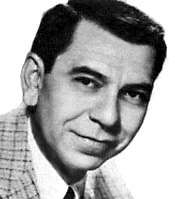
Jack Webb, 1920-1982

Jack Webb, the man best known for playing Sgt. Joe Friday on the TV series Dragnet, was born on this day in 1920. Webb was a movie actor before making the movie to play Joe Friday. Indeed, the genesis for Dragnet came from one of Webb's earliest movies, He Walked By Night. It's a police procedural in which Webb has a small role as a police lab technician, but from this movie, the idea was made to bring a series of police procedural dramatizations to radio, which is what became Dragnet. Dragnet, of course, became enormously popular, spawning the 1950s TV series; a revival in the late 1960s with Webb; two more TV versions, in 1989 and the early 2000s; and at least two movies, the first of which was made in 1954 and starred Webb himself.

Webb did do other work, however. Perhaps the most interesting place you can watch him is as the young assistant director friend of writer William Holden in Sunset Blvd.

Wednesday, April 1, 2009

Favorite dances

TCM kicks off prime time tonight at 8:00 PM ET with Royal Wedding, the movie that has Fred Astaire's famous dance on the ceiling, courtesy of a revolving set. It's certainly one of the best-known dance scenes from Hollywood's golden age, but is it the greatest?

"Greatest", of course, is a matter for debate. MGM, however, picked a different dance to call the best ever when they released That's Entertainment!, saving the Gene Kelly's climactic number from An American in Paris for their finale. (Royal Wedding was also made at MGM, so the producers of That's Entertainment! could have picked it for the finale if they had wished.)

I think that I would have picked a different Gene Kelly dance, myself, namely the extended cadenza near the end of Singin' In the Rain, in which Kelly dances with Cyd Charisse.

Which dance would you pick as the best ever?