Friday, August 17, 2012

That former movie channel

An acquaintance of mine on a game show borad posted this bit of programming news from a former movie channel:


AMC announced today two new unscripted original series: Untitled Taxidermy Series (w/t) and Venice Beach Freakshow (w/t), both working titles.

[...]Untitled Taxidermy Series (w/t) consists of eight, half-hour episodes. It's a hosted competition series between a new contestant and one of the series' immortalizers that face three judges each week. The series features taxidermists pulled from both the rogue and classic schools of taxidermy to create a distinct piece of art that is judged on overall presentation, creativity and technique.


Oh dear. And AMC has the cable rights to some very prominent movies (most notably The Godfather, which I think is locked up until the end of 2019). As somebody who's a fan of both game shows and classic cinema, I have to say that this is the sort of thing that wouldn't particularly interest me even it it were on one of the hunting/outdoor channels elsewhere on the dial where it would probably fit in better with the program. The latter-day nontraditional game shows, based on competitions like cooking, interior decoration (my mom watches HGTV religiously and I know they have such a show), or in this case taxidermy all seem to have fallen into stereotypically obnoxioux contestants and irritating production values among other things. Taxidermy might be an interesting subject for a documentary; not this competition format.


But this blog isn't really about complaining about taxidermy shows. It's sad to see what happens to former movie channels that feel they have to appeal to the "correct" demographic. But once again, it also raises the question of what's going to happen when the fans of today get old if there aren't enough new fans. Sure, TCM has prestige, but I would have thought that AMC had prestige, too. I mean, it was on a bunch of cable systems in the lower-capacity days when it was still a commercial-free channel. There are the premium channels, but in an a la carte universe, how many people are going to pay for any niche channel? And the premium channels are almost all just as focused on bringing original series-style programming even if they started out as movie channels.


I have to admit that I don't have an answer to any of this. And in some ways, that's frustrating. I'd like to think I'm doing what I can to pass on my love of classic movies, but that's not very much. And it's not as if I hold the rights to any of them.

Thursday, August 16, 2012

Phyllis Thaxter has died

The Hollywood Reporter has an obituary for actress Phyllis Thaxter, who died on Tuesday at the age of 90 (some sources say 92). The obituary highlights her role as Clark Kent's mother in the 1978 version of Superman, where she played opposite Glenn Ford as Kent's father.

Those of us who watch old movies may remember her as Robert Ryan's girlfriend in Act of Violence, or as Margaret O'Brien's mother in the Christmas movie Tenth Avenue Angel. Her film career ended in the early 1950s, however, and she switched to the new medium of television, where she apparently had quite steady work in TV anthology series, if no big hit show of her own.

Intolerant of Intolerance

Well, not quite. But I have to admit I was greatly underwhelmed by last night's showing of Intolerance on TCM. The movie purports to tell us how hate and intolerance have been with us throughout the ages, cruelly hurting those who love, and does so by jumping back and forth between a modern-day (1916) story about a poor girl (Mae Marsh) who faces the wrath of the female reformers (referred to here as the Uplifters), and stories from 16th century France, Jesus-era Israel, and Babylon.

The thing is, I only really found myself caring about the modern-day story. In defense of Intolerance, I have to say that the modern-day story would probably have made a good silent movie all by itself. It's one of those great melodramatic formulas that we would see later, in silents such as Street Angel with Janet Gaynor, or any of the incarnations of Madame X or its imitators in the sound era. The sort of intolerance depicted here is still quite relevant today. Just look at how the First Lady bullied a teenage girl on national TV for eating the "wrong" food. Intolerance has also been a theme of some other really good movies I've recommended, such as They Won't Forget.

Praise should also be given to the sets in the Babylon story, which most reviewers claim are spectacular; for 1916 standards they most certainly are, and they look pretty darn good by today's standards too. (Of course, nowadays, a lot of this stuff would probably be CGI.) I wonder if any of them were reused for the silent version of The Ten Commandments. But the Babylon story didn't particularly excite me, at least in that it had an overly long build up. And the Babylon story isn't as uninspiring as the other two historical parts.

I don't think the problem is with a three-hour silent movie, either. Griffith's Birth of a Nation, which was made one year earlier (I include this point only to mention that the problem isn't with 1916 silent film techniques, as opposed to naming later silent epics that had more advanced filmmaking techniques), holds interest well, in spite of (or perhaps because of) its controversial subject matter and the racism used in presenting it. And to be honest, I think that might have something to do with the problems I have with Intolerance. Griffith made Intolerance after he was stung by the criticisms over the racist content of Birth of a Nation. Modern-day critics praise Intolerance, and I get the impression that a good portion of that praise is simply because it's the Not-Birth of a Nation. Heaven forbid you praise Birth of a Nation for its filmmaking techniques and get branded a racist. No; it's much better to go 180 degrees in the other direction and praise the opposite film just because it's the opposite.

That's not to say Intolerance is a bad movie. It's reasonably well made, and certainly influential for its use of having sharply-defined different stories to tell the one overarching point. But I feel that it's also overhyped. It's also available on DVD, if you want to fast-foward through the slow bits.

Wednesday, August 15, 2012

Blow, but no hookers

TCM is spending today with Lillian Gish, who is one of the better-knonw stars of the silent era. One of her last silents is also one that's probably not as well-known as I think it should be. That movie, The Wind, is airing tonight at 11:30 PM.

Gish plays Letty, a young woman from the East who moves to one of those dusty places out west on the encouragement of her cousin Roddy (Montagu Love). She gets there, and finds a harsh environment in more ways than one. One is that Roddy's wife Cora (Dorothy Cumming) doesn't like Letty. Frankly, you can't blame her for having an in-law foisted upon her, but The Wind isn't about Cora. The other big problem, and this is a problem for everybody, is the wind. Sandstorms abound, at times making it impossible for people to get to each other and physically isolating them.

Letty feels not only that physical isolation, but also emotional isolation. To get away from Cora, she marries Lige (Lars Hanson), but it's really a marriage of convenience for the both of them. Letty needs a way to live honestly without her cousin's support, while Lige needs female companionship and wants a family. Trapped in a loveless marriage, Letty is often left alone with only her thoughts to accompany her.... Oh, and with the wind, too. It's enough to drive a woman mad. If that's not enough, Letty gets left alone in a windstorm one more time. Except that this time, it's not just her and the wind; there's another man who's not her husband there! And he tries to take advantage of her!

I have to admit that I might not have done justice to the plot of The Wind. Then again, The Wind is a bit muddled, and the reason to watch it isn't so much for its plot, but for its character study of Letty as she seems to be going slowly mad alone and in this harsh environment. In that manner, the film succeeds quite well, as it's easy to understand by watching just how forbidding Letty's new environs are: she's definitely not of the tough pioneer stock.

The last time TCM showed this, it was a print that had an introduction from Lillian Gish herself, filmed when she presented the movie for British television back in the late 1980s. It's the sort of stuff that would in most other cases on TCM be a Word of Mouth piece shown between movies, but Gish's comments serve as a great introduction. Apparently they shot on location out in the Mojave Desert, and the shoot was difficult, to say the least. The wind machines they used were dangerous, and got the sand into everything. To top that all off, they faced temperatures up to 120 degrees. No wonder Letty goes mad.

The Wind, unfortunately, does not seem to be available on DVD.

Tuesday, August 14, 2012

Primrose Path intro

I watched Primrose Path on Sunday as part of Ginger Rogers' day in Summer Under the Stars. One thing really intrigued me: at the beginning, even before the RKO logo, there was a card from the British film board saying that the movie had been passed for showing, and given a rating of A, for adult audiences. The other classification that seems to show up on films from the UK censors is U for universal. Primrose Path certainly deserves its A based on the subject material, even though the material had to be watered down significantly from the source novel on which it was based in order to pass the Production Code. I didn't pay attention to which of the TV content rating classifications Primrose Path received.

The interesting thing, of course, is that it's the British censors whose rating card appeared at the beginning of the print. Primrose Path is an RKO movie with a fully American cast and crew, and would presumably have been in the Warner Library from the time Ted Turner acquired it. The only thing I can think of is that somewhere along the way, the powers that be were looking for a print to restore the movie -- I'd guess that would date to when the people at the Warner Archive decided to include this movie in the collection; the Warner Archive DVD saw its release in February 2011. In tht case, it would be perfectly reasonable for the best print to be someplace arbitrary other than the rightsholder's archive.

Another example of this is A Man to Remember, although that movie has a different provenance. It's a remake of One Man's Journey. The earlier movie was one that Merian C. Cooper decided to retain the rights to when he left RKO, as part of his severance agreement. A Man to Remember being a remake, it would have had rights issues which resulted in Cooper ending up with the rights to it as well. But apparently the prints also left RKO's possession, and who knows what happened to whatever prints Cooper ended up with? When it came time to disentangle the rights situation, the one surviving print of A Man to Remember was found in the Netherlands, complete with bad 1930s era subtitles. I don't believe, however, that there was any rights situation with Primrose Path.

Monday, August 13, 2012

Note there's no S on the end

A Google search of my blog suggest that I have never blogged about the movie Lady Killer (not to be confused with The Ladykillers) before. It's airing tomorrow morning at 9:00 as part of TCM's Summer Under the Stars day of James Cagney movies.

Cagney plays Dan Quigley, who at the start of the movie is a movie usher. Actually, he's much more than an usher; he's a small-time con artist and gambler to boot, running a dice game in the restroom among other things. One day he meets Myra (Mae Clarke, who had been with Cagney in The Public Enemy, which airs just before Lady Killer at 7:30 AM), just as she's dropping her purse. He picks it up and follows her back to her apartment, where he finds that her brother-in-law Spade (Douglass Dumbrille) is running a poker game. Dan, being the keen gambler, gets in on the poker game, but gets cleaned out. On leaving, however, he finds that he's been scammed, and extorts his money back from his opposing con artists, getting in on the gang in the process. Quigley eventually becomes the leader of the gang, but they're incompetent and accidentally kill somebody during a botched robbery, forcing Dan and Myra to go on the lam to California.

In California, Dan gets arrested but there's not enough evidence to convict him. Free but broke, Quigley gets picked up by a talent scout because the scout thinks Quigley could play the sort of gangster that the movies wanted back in those days in spades. Quigley starts off as an extra, meets leading lady Lois (Margaret Lindsay), and because of his charisma, he immediately becomes romantically involved with her and starts to rise the ladder of fame in Hollywood. Well, he does so by engaging in a con but when has Hollywood ever been authentic. Of course, there's one thing Dan hadn't considered: if he were to become famous, certainly his old gang would recognize him in one of his movies, and come looking for him. Sure enough, that eventually happens.

Lady Killer is a movie that I think would make a good double bill with Picture Snatcher, or possibly The Mayor of Hell. In all three of them, Cagney plays a gangster who tries to go straight, but also has to use his con skills to make it a bit easier to get ahead in honest life as they're the only way he knows how. By 1933, when all three of these movies were made, the moral scolds were getting uncomfortable with the traditional gangster movies, but audiences still loved them, so the studios tried to find different ways to use their gangsters. Having the gangsters go straight was one way. Lady Killer and Picture Snatcher both have a fair bit of comic relief in them, while The Mayor of Hell doesn't have nearly so much. In all three, however, Cagney is charismatic as ever and makes the movie zip forward by leaps and bounds. Lady Killer, like the other two, is certainly not a "prestige" movie, and has the look of a lesser movie. But it's also immensely entertaining and a heck of a lot of fun.

All three of the Cagney movies I mentioned are available on the same Warner Gangster Movie box set.

Sunday, August 12, 2012

Let's thank the Warner Archive again

I was pretty cetain I had recommended The Hucksters before; indeed, I blogged about it back in November, 2010, when Ava Gardner was TCM's Star of the Month. The Hucksters is getting another airing, tomorrow morning at 7:45 AM as part of Deborah Kerr's turn in Summer Under the Stars.

Now, if you'll read the old blog post, you'll see I pointed out that it's not available on DVD. That was accurate at the time, but looking at tomorrow's TCM schedule, it shows a link to purchase the movie on DVD. Sure enough, The Hucksters has gotten a DVD release in the meantime; specifically, last September from the Warner Archive.

Speaking of movies I blogged about in the past which have gotten a DVD release since I blogged about them, I see that TCM is hawking a Forbidden Hollywood, Volume 4 box set, which is apparently going to be released soon, although there's no release date listed as opposed to the page for The Hucksters. That one contains Jewel Robbery and Lawyer Man.

Saturday, August 11, 2012

Not an Essentials Jr. movie

Last week, I suggested that the week's Essentials movie on Saturday night, Some Like It Hot, wouldn't necessarily be a bad choice for Essentials Jr.. (The only other Monroe movie I might suggest for Essentials Jr. is Monkey Businesee.) This week's Essentials selection, Lolita (as always, at 8:00 PM), is an entirely different matter. Lolita, of course, is the movie in which James Mason starts leching after his stepdaughter, who is much too young for him, and really too young for anybody with the possible exception of Roman Polanski.

That having been said, the movie preceding Lolita might not be such a bad choice for Essentials Jr.: Journey to the Center of the Earth, at 5:30 PM. It's based on the Jules Verne novel, and I think a lot of Verne's stuff can work well for younger audiences if adapted correctly. I don't know that the 1950s version of Around the World in 80 Days would be so good for the young ones, but that's only because the film is something close to three hours. I read the story, or at least an abridgement of the story, back when I was in elementary school, and the story is perfectly fine fot children. Same with 20,000 Leagues Under the Sea, and I think the Disney live-action version was an Essentials Jr. choice several years back. (TCM, I believe, no longer have the broadcast rights to the Disney live-action films.) From the Earth to the Moon isn't a bad story, but the movie is problematic because it was made in the death throes of RKO. Fox made a version of Verne's Five Weeks in a Balloon in the early 1960s, and that's another one where I don't think the story is bad, but Fox put in one of the teen idols (Fabian) and the movie has African stereotypes that would probably make some people uncomfortable.

Friday, August 10, 2012

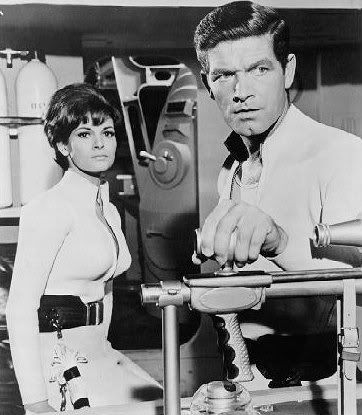
Fantastic Voyage

What's left of the Fox Movie Channel is showing the fun, if not particularly realistic, Fantastic Voyage, tomorrow afternoon at 1:15 PM.

So why is Raquel Welch in the cast anyway?The framing story, which is really a bit of a Macguffin, involves the defection of a Soviet-bloc scientist. It turns out that he knows a lot about miniatuarization. Both the Soviets and the Americans have learned how to miniaturize anything -- including humans -- down to microscopic size. This could be a great weapon, except that to this point, all attempts to control the miniaturization have failed beyond a certain point. They can get things small, but after 60 minutes, everything returns to its original size. The defector, however, has apparently figured out how to control the miniaturization, which would allow the military to shrink things down and then return them to their original size at will. Our Soviet defector has decided to give the information to the Americans, since the Americans are supposedly the good guys and would never do anything wrong with the information. (I suppose I should refrain from all political commentary here.) Before he can do this, however, he's ambushed in a car accident and suffers a blood clot in the brain that threatens to kill him.

Ah, but help is on the way. Our scientist's clot would normally be inopreable, but thanks to the miniaturiazation there is in theory a new way to operate on the patient: miniaturize the surgeons, and send them into the brain to do the operation from the inside! Dr. Duval (Arthur Kennedy) is the scientist who is an expert in brain surgery, and is aided by his buxom assistant Cora (Raquel Welch, who is clearly in the picture for one reason). There's a problem, of course, which is that the government isn't so certain about Dr. Duval's political loyalties. So they impress upon one of their security agents (Stephen Boyd) that he has to be part of the operation as security: make certain nobody sabotages it. The doctors are going to get to the clot in a specially designed submarine injected into the carotid artery, and also along for the operation are a second doctor (Donald Pleasance) and a radio man.

The miniaturization aspect of the story is a bunch of hooey, but once everybody gets injected into the defector's circulatory system, the movie really gets visually interesting. Our doctors face a whole host of problems, from the body's immune system to various injuries to the possibility that somebody is trying to sabotage the mission, and have to complete the entire mission in under an hour in order to get out before they start enlarging back to their original size. Some of the medical issues, such as the fact that the immune system really would be likely to attack them, or having to deal with a fistula, really do seem plausible. Other parts of the surgery seem unlikely, but that's always the case with science fiction. The Cold War-era plot may be dated and trite in its attempt to provide extra suspense, but again, the medical aspect more than makes up for that: the movie would be interesting on its own just for the surgical part of it. Fantastic Voyage is an enjoyable enough movie that deftly intertwines suspense with science fiction.

Thursday, August 9, 2012

TCM and advertising, chapter whatever

I suppose I should be disturbed with Google and its cookies tracking me wherever I go on the internet. I don't know if I opened up TCM's schedule in the same browser tab that had a Google search in it, or whether it's my searching for images of classic movie stars. But in some of the strangest places, I've been getting ads on sites that use Google's pictorial Adsense for TCM's Summer Under the Stars. Some of these sites are based in Europe, so the ads are presumably targeted at me and not the users of the forum in general. On the other hand, I'm also getting the standars online college scam ads on the same forums. As for the Summer Under the Stars ads, they're actually very well made, with a picture of the star in question, and the star's name and date. The problem is, I'm still getting ads for Marilyn Monroe's day on Summer Under the Stars, which took place last Saturday.

TCM is also showing Should Ladies Behave? tomorrow afternoon at 12:15 PM. I briefly mentioned this drawing-room comedy from 1933 back in August 2008. Not for the movie itself, which is OK if you like the early sound-era drawing-room comedy, but because early on in the film is a so-obvious-you-can't-possibly-miss-it ad for Dinner at Eight.