Saturday, December 10, 2022

East of the River

I have a bit less that I've watched saved up to do posts on, only because I recorded a few things I planned to do posts on, only to start them and realized not only had I seen the movie, I'd already done a post on it. With that in mind, I looked through the films on my DVR and selected East of the River, which didn't seem familiar to me, at least not in the sense of realizing I'd seen it before. There are other ways in which it is familiar, of course....

The movie starts off in the late 1920s in New York. Mama Lorenzo (Marjorie Rambeau) is an Italian-American in New York who runs a pasta restaurant and has an adolescent son Joe who's always getting into some sort of trouble or another. This time, however, he's gone too far, and is threatened by the judge (Moroni Olsen in one of his many character actor roles) with being sent to reform school. Mama has an impassioned talk with the judge, who decides to give Joe one more chance. However, Joe got in trouble along with an orphan Nick, who is going to be sent not back to the orphanage, but to that reform school since he doesn't have a family to go home to. So Mama offers to adopt Nick and the judge amazingly enough agrees.

A montage shows that the two boys grow up, with Nick being grateful for his second chance in life, getting straight A's, and going on to college. Joe, for his part, continues his bad ways, eventually getting thrown out of school and heading west to California at 18, where he can continue a life of crime without his mother finding out about it. He's using the proceeds of his crime to help pay his brother's way through college, of course. (Warner Bros. had used this plot device in Invisible Stripes only a year before.

The law catches up with Joe (played as an adult by John Garfield), and he spends a fair bit of time in San Quentin. But he lies to Mama and Nick about where he is, instead getting his girlfriend Laurie (Brenda Marshall) to commit forgery for him so that he can keep sending money home. Eventually, Joe gets out, and just in time, as he's learned that Nick (played as an adult by William Lundigan) is about to graduate from college. So he and Laurie head to New York for the graduation.

Not that Joe is able to escape his life of crime. And he's in trouble, because the two guys who framed him are in New York. Joe is able to turn the tables on them, but this means he's a wanted man by them so he has to head back to California to lay low for a while, telling Mama he has to attend to the "honest" business he left behind. Joe makes the mistake of leaving Laurie behind, and as time passes, Laurie begins to fall in love with Nick, and ultimately decides to marry Nick. Joe finds out, and he's jealous. And a vindictive bastard. He threatens to reveal Laurie's criminal past to Mama (who loves Laurie like the daughter Mama never had) and scupper the wedding between Laurie and Nick if Laurie won't do Joe's bidding.

I've mentioned before that going back to the pre-Code days, Warner Bros. was the studio that was best at doing social issue pictures. East of the River isn't quite that, but it certainly fits into the mold of the lower-class urban drama and crime movies that those social issue pictures evolved into by the end of the 1930s. Of course, in James Cagey, then Humphrey Bogart, and now John Garfield, they had the stars to pull it off more than some of the other studios did.

At the same time, however, it feels like there's no new ground being broken in East of the River, and a sort of sense that this is a movie being made because Warner Bros. needed something to go on the lower half of the bill. There's not exactly anything terribly wrong with it, mind you, other than a decided lack of originality. It's the sort of thing that, a generation later, probably would have been pared down from 74 to 44 minutes and turned into a TV episode for some show.

East of the River isn't the best work of any of the cast members, but I don't think it's anything any of them should be ashamed of, either.

Friday, December 9, 2022

Ernest Saves Christmas

I recorded a good dozen or so movies during the Thanksgiving free preview weekend. One that I hadn't seen in a good 20 years was Ernest Saves Christmas. So when I saw that on the schedule, I recorded it to watch something this Christmas season. It's got several airings before Christmas, starting with tomorrow at 4:50 PM on Showtime Family.

The movie doesn't quite start off with Ernest (Jim Varney), but with a man who looks surprisingly like Santa Claus flying south to Orlando on Dec. 23. The reason he looks a lot like Santa is because, well, he is Santa Claus (played by Douglas Seale). He's even brought the reindeer with him (in cargo; Santa's flying commercial) and has his magic sack of gifts.

Ernest, meanwhile, is a taxi driver working the airport route, which is how he runs into Santa, almost literally. Having run into something else, Ernest has to pick up a passenger, and picks up Santa. Santa is looking for one Joe Carruthers (Oliver Clark), who is a bit of a local celebrity in that he did a kids' show on one of the local channels and does charity work at children's hospitals and the like. The real reason Santa is looking for Joe is that in this version of the Santa Claus story, Santa really does get old. But somehow Santa has some sort of special knowledge that allows him to know who's going to make the perfect next Santa Claus. The current one knows that Joe is the right man for the job.

Not that Joe knows this. He's got an agent who's trying to get him a chance at Hollywood stardom, with a movie script that offers the chance of sequels. And it's not as if most people are going to believe that this guy is Santa Claus. Indeed, Ernest is about the only one who does at first, because he just loves Christmas to the point that he almost makes it obnoxious for the people around him. Anyhow, they find where Joe is supposed to be, but Santa doesn't have any real money on him. That, or ID, so he gets arrested as a vagrant. Which is how Ernest is going to have to save Christmas.

But Ernest can't do it alone. While driving back home through Orlando, he once again nearly runs into someone. This time, it's a young girl named Harmony (Noelle Parker), who in one of those 1980s tropes was a teenage runaway. She doesn't have any place to go after stiffing a restaurant, so she climbs into Ernest's car to get away. Once Ernest finds out what's happened to Santa, Harmony helps him get the man out of jail and then reunited with the reindeer and sleigh as well as Joe to see if Joe won't be the next man to take on the part of Santa Claus.

As I was watching this, I couldn't help but think of Jerry Lewis since I just reviewed one of Lewis' films. Jim Varney's comedy is, like Lewis', a bit of an acquired taste. It would be easy to find him obnoxious. At the same time, however, Ernest is a good-hearted person who just doesn't realize how much he's irritating other people, somewhat like the Ralph Richardson character in The Wrong Box.

Indeed, Ernest Saves Christmas is a movie that, as a whole, has its heart in the right place. It knows that it's not great art by any stretch of the imagination, simply wanting to bring people some cheer for the Christmas season. And for the most part, it succeeds in doing just that.

Thursday, December 8, 2022

Thursday Movie Picks #439: Retro Chic

This being Thursday, it's time for another edition of Thursday Movie Picks, the blogathon run by Wandering Through the Shelves. This week, the theme is "Retro Chic", or movies that are set in the present day -- at least when the movie was made -- but have a strong retro vibe about them. I came up with two examples right away, and had trouble thinking of a third, until I had a flash of inspiration:

The Brady Bunch Movie (1995). A search of the site claims I haven't used this one before, which surprised me. TV's favorite early-70s blended family is back and it's 1995. The only thing is, while it's 1995 for everyone else, the Bradys still act as though its the early 1970s. This gives the writers opportunity to do a lot of fish out of water stuff, while including fan service calling back to various episodes of the original Brady Bunch. The plot involves a developer trying to buy all the land on the Bradys' block to the point of stealing their tax bills, with the kids trying to come up with a way to get the money to pay the overdue property taxes.

Austin Powers: International Man of Mystery (1997). A brief prologue sees Dr. Evil (Mike Myers) cryogenically freezing himself in the late 1960s, with British spy Austin Powers (also Mike Myers) volunteering to do the same in preparation for the day when Dr. Evil has himself unfrozen. Three decades later, and that happens, with Dr. Evil trying to take over the world. Austin Powers comes out of cold storage, acting like it's still Swinging 60s London.

Man of the Century (1999). Johnny Twennies (Gibson Frazier) is a reporter in late 1990s New York reminiscent of Harold Lloyd, who lives as though it were the 1920s. He even gets involved in the sort of scrape that you would expect in a silent-era comedy, while getting the girl at the end because, well, that usually happened in the silent comedies. Once again, there's ample opportunity to use fish out of water humor. This is one that the old IFC used to air when they were commercial-free, and actually aired independent films, which is how I saw this movie.

Wednesday, December 7, 2022

The Family Jewels

Another of the box sets I've got is a ten-film collection of Jerry Lewis comedies, mostly from after he and Dean Martin split up. I'm down to one or two that I hadn't blogged about before, so recently I cracked that set open again in order to watch The Family Jewels.

Jerry Lewis is Willard Woodward, chauffeur and nominal bodyguard to Donna Peyton (Donna Butterworth, a child actress whose acting career never went anywhere). In the film's opening scene, Willard inadvertently foils a robbery. Meanwhile, we learn that Donna has recently become an orphan with the passing of her father, and it's time for the reading of the will. Donna's father had a whole bunch of brothers, it seems, as the will specifies that Donna should go live with five of them for a while, one after the other. After she does that, she gets to decide which of the five will become her new foster father. The five are, in order of their appearance:

James Peyton, the captain of a ferry boat out in the harbor, who has a ridiculous walrus moustache;
Everett Peyton, a clown who has judicously saved up his money in a Swiss bank account and who deep down inside hates children. He plans to retire to Switzerland so he doesn't have to deal with children any more.
Julius Peyton, a commercial photographer who is just a bit too meticulous in his work, making the photo shoots a slog for all of his photographic subjects
"Captain" Eddie Peyton, who has spent his time restoring a commuter-sized airplane at the local airport. During his segment, a group of little old ladies miss their flight to Chicago on the big jet plane, and wind up paying Eddie for passage, which is a problem as Eddie doesn't have many flight hours and the plane may not be totally airworthy; and
Skylock Peyton, a private detective who has an assistant Dr. Matson (Sebastian Cabot).

Now, it doesn't take very long to notice that all five of these uncles are played by Jerry Lewis as well. And, there's also a sixth uncle, "Bugsy" Peyton, also played by Lewis and sporting a painted-on five-o'clock shadow. Bugsy is already a gangster, which is probably why he was written out of the will. He's miffed at that, so he consistently tries to kidnap little Donna and bump off Willard.

It's also fairly easy to see which uncle Donna is going to choose. Or, more accurately, the fact that it's not any of the uncles who is the right man to be the foster father, as nice as four of them (minus Bugsy and Everett) are. It's Willard who is clearly the person who should be the foster father, although that's not allowed in the will. So how is the movie going to get to that conclusion?

The Family Jewels is another of those movies that gives Jerry Lewis the chance to put his own brand of physical and visual comedy on the screen, as he also directed it. And therein lies the problem with the movie. There doesn't seem to have been anybody around to edit out the excessess, or at least edit it in the right way. As a result, the movie is very much hit-and-miss, and unfortunately misses more than many of Lewis' earlier pictures did. Some scenes are good; there's one dealing with the in-flight movie on Eddie's plane (featuring a cameo from Anne Baxter). The plane hits turbulence, and suddenly the dinner scene in the Baxter movie hits the same turbulence. There's also a well-directed and well-choreographed sequence with a ROTC drill team.

On the other hand, some portions, like the Julius segment, go on much too long, and a lot of the gags are telegraphed. So the final result is a movie that might appeal to the people who already like Jerry Lewis, as well as a movie that's nice to have in a box set. But it's not the best of Lewis' work by any means.

Tuesday, December 6, 2022

Briefs for Dec. 6-7, 2022

I haven't been paying attention to the TCM schedule at all, thanks to being swamped with work. I didn't notice until this afternoon that TCM is running a documentary on composer Max Steiner this evening. It's going to be on at 8:00 PM, although I doubt anybody is going to read this post before that. Thankfully, as with a lot of these documentaries getting a premiere on TCM, there will be the first airing at 8:00 PM, one feature movie, and then a second airing of the documentary. With that in mind, we get Casablanca at 10:15 PM, followed by the repeat of the documentary at 12:15 AM.

Tomorrow is December 7, which means Pearl Harbor Day and the anniversary of the entry of the US into World War II. TCM is marking the occasion as always, with a bunch of movies related to the Pacific theater of the war, or at least the war as it affected the west coast. One thing I don't think I've mentioned before is the short Victory Quiz at 10:45 AM. It's a Pete Smith short asking questions about the war and military inventions in general. As one of the IMDb reviewers says, it's probably more interesting if you can watch with other people and see who gets the most right answers.

Slightly more surprisingly, FXM is also running a bunch of military-themed movies tomorrow, although not all of them are World War II related. The day starts with Thunder Birds at 7:10 AM, followed by the interesting Destination Gobi at 8:30 AM. Robert Wagner shows up for Between Heaven and Hell at 10:00 AM. Marines, Let's Go, at 11:40 AM, is set in Tokyo, although it's against the backdrop of the Korean War. Finally, there's Edgar Ulmer's final film, The Cavern, at 1:25 PM.

I was surprised and sadded to read of the passing yesterday of Kirstie Alley, at the age of 71. Alley was of course best known for her role on Cheers, but she was also a star of Look Who's Talking, one of those 80s movies that I have to admit I haven't seen before. She was also Lt. Saavik in the second of the Star Trek movies.

I actually do have movies to blog about for the rest of the week, or at least Wednesday and Friday, considering that I'll be doing a post for the Thursday Movie Picks blogathon on Thursday.

Monday, December 5, 2022

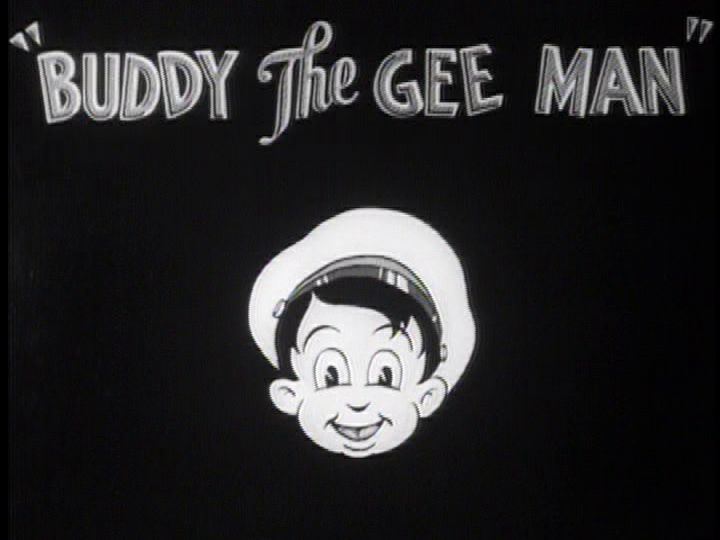
Buddy the Gee Man

I'm still busy, so I broke out one of my Warner Home Video released that I figured would have some extras on it to see if there was a short I hadn't done a post on. I picked the James Cagney film G-Men, and discovered both a one- and a two-reeler that I haven't posted about before. Since the two-reeler stars Bob Hope and I did one of his movies not too long ago, I decided to watch the one-reeler, a cartoon called Buddy the Gee Man.

The short was released in 1935, presumably as a tie-in to the Cagney movie which was released the same year although the print of G-Men we have today is from a re-release. Buddy, on having done a bit of research, was a recurring character who appeared in about two dozen Warner Bros. shorts up through 1935, so before the Looney Tunes characters we remember today. To be honest, I'd never heard of him, and with good reason, as I'll explain later.

In this short, Buddy is a federal agent, who is asked by the Department of Justice to go undercover at "Sing Song" Prison to investigate the conditions there and report back. Buddy takes his trusty dog, in a Sherlock Holmes costume, to the prison, which is populated by a lot of animal-like characters although Buddy seems fully human. Buddy finds that the current warden, Otto B. Kinder (get it?) is treating the prisoners terribly. And when Buddy reports back, Kinder gets fired and replaced by... Buddy!

Buddy then turns the prison into something more resembling a spa, with prisoners getting manicures and ice cream cones on demand, with the result that this is a prison people want to get into now. The end.

As I was watching it, I found it easy to see why Buddy and the other characters who predated Bugs Bunny and the rest aren't remembered. Well, part of it stems from which shorts wound up as part of TV packages. But it also has to do with the fact that, at least from this short, there's just nothing particularly memorable about Buddy. It's not just that these are 30s black and white cartoons; after all, Popeye from that era would become an enduring figure. There's just not much plot structure here, and the gags don't really work.

Having said that, it was interesting to see a forgotten piece of Hollywood's animation heritage. And at only 7 minutes, it's not like you're losing much time if you watch this.

Sunday, December 4, 2022

Scent of a Woman

A movie that I've had sitting on my DVR for quite some time is one that's pushing 30 years old: Scent of a Woman. Recently, I finally sat down to watch it so that I could do a review here and free up some space on my DVR.

The Baird School is one of those tony all-boys schools in New Hampshire which have been around for well over a century and which has the scions of rich alumni making up a good portion of its student body. One person who isn't part of that crowd is Charlie Simms (Chris O'Donnell). He's from Oregon and his mother and step-father run a convenience store; Charlie had to win a scholarship and accept financial aid to be able to attend Baird. Other students, such as George Willis, Jr. (Philip Seymour Hoffman with even worse hair than he'd have later in life, and credited as Philip S. Hoffman), kind of put Charlie down as they're able to go off to a ski resort for Thanksgiving.

Charlie, however, needs to work over the holiday, hoping that he can earn enough to afford a plane ticket home for the Christmas break. To that end, he responds to an ad put up by Karen Rossi, one of the townies. She's looking for somebody to be a companion to her uncle Frank over Thanksgiving. Apparently, the Rossis are planning to visit the husband's family in New York, and Uncle Frank doesn't want to go as it's not his side of the family. But why is Uncle Frank living with his niece and her fairly young family anyway? And why does he need a companion?

Well, even if you didn't already know the plot to the movie, you might be attentive enough to notice that Frank has gone blind, for reasons that will be explained later in the movie. He's also an irascible bastard, although it's probably not the blindness that caused that. Nobody else has wanted to be Frank's companion for the holiday, and Charlie isn't so certain he wants to either. But then, he needs the money.

Meanwhile, back at Baird, Charlie also has some personal problems coming up. A couple of his classmates, who are much closer friends with George, decide to play a prank on the headmaster, Mr. Trask (James Rebhorn), which involves putting up a balloon on a lamppost. Charlie and George see these guys putting up the balloon, as does an older female employee who, because of her bad eyesight, isn't able to figure out what exactly is going on. But when the prank is pulled off, she knows that there were a couple of guys involved and that, more importantly, Charlie and George might be witnesses. So Trask starts putting the screws to Charlie and George to name names. George has a wealthy father and can possibly pull strings to get off, but Charlie doesn't have the power.

And if that's a downer to Charlie's Thanksgiving, it's going to get a whole lot more messy for him. Frank is Lt. Col. Frank Slade, US Army (Ret.), so he has a fierce sense of honor and duty, which includes not necessarily snitching on people. An in addition to being an irascible bastard, he's also a manipulative SOB. So before he knows it, Slade has arranged for a taxi to take the two of them to the airport to take the puddle-jumper to New York for a Thanksgiving weekend on the town that Karen knows nothing about.

And then there's the real reason for the trip to New York. Frank, having lost his eyesight thanks to his negligent handling of hand grenades, has decided that he's going to have one final blowout before shooting himself to death. When Charlie finds out about this, he's understandably horrified. But how can he stop a man determined to kill himself? Of course, this being a Hollywood movie, Charlie and Frank are going to learn from each other and, well, come to some sort of resolution.

The big problem with Scent of a Woman, and one that I see some contemporary reviewers had, is that the movie moves too sedately and goes on way too long. It's a little over 150 minutes before the closing credits roll, but is the sort of story that really should have been written to run under two hours. There's not as much here as the running time might have you think. It may not help, either, that Frank is a fairly obnoxious movie for much of the movie. It's no wonder nobody wanted to be his companion. Pacino won the Oscar, although I can't help but think it's more of a showy role than one that really required acting chops.

Still, there's enough to like about Scent of a Woman to make it worth a watch, especially Chris O'Donnell being appealing as the young man and nice cinematography. It's just that I can't help but think the movie could have been even better.

Saturday, December 3, 2022

The Flanagan Boy

I've mentioned before that there are quite a few British pictures from the 1950s that cast an American in one of the leads, presumably with the expectation that this would make it easier to get a distribution deal in the US. In fact, the Hammer studio worked out a deal with an American producer, Robert Lippert, to produce a bunch of these movies. There are a couple of box sets of the noirish films from this partnership that were released which I picked up. Recently, I watched one of the movies off one of the box sets, Bad Blonde.

American Barbara Payton plays the titular bad blonde, but we don't meet her for a while. The movie starts off at a carnival, possibly at one of those fading seaside resorts like we see in The Entertainer. One of the attractions there is a boxing show where the promoter offers average Joes the chance to earn a nice for early 1950s standards payday by lasting three rounds with one of the promoter's ringers. (Something similar is also a major plot device in the early John Garfield film The Made Me a Criminal.) Accepting that challenge is young Johnny Flanagan (Tony Wright). Johnny is a capable boxer. Well, he's actually more than that, as he knocks out the ringer. This gets the promoters' attention, and the pair of Sharkey (Sid James) and Sullivan (John Slater) decide to train him.

But if they had the ability to train a truly talented boxer for the big time, they wouldn't be toiling away in carnivals. They need money to put up to offer better training conditions and also attract the attention of the real prizefighters. Enter Giuseppe Vecchi (Frederick Valk), an Italian who somehow made it to the UK despite the two countries having been on opposide sides of that little war less than a decade earlier and who has the money. He buys a piece of Flanagan, and Johnny starts training at Vecchi's nice big house somewhere out in the country.

Vecchi has the money to train Johnny, but he's also got something else: a trophy wife Lorna (that's Barbara Payton). She being a Hollywood beauty (the excuse given for her being in the UK is that she was a taxi dancer), she turns heads, and it's not long before she turns Johnny's head. The fact that Mr. Vecchi says he can't dance and encourages Johnny to dance with Lorna only makes matters worse. Things get so bad, in fact, that when Lorna shows up to Johnny's big fight, he can't think about anything but Lorna's presence, and gets knocked out.

Lorna, for her part, married for money and found out that she didn't love the man she married. With that in mind and knowing her power over men, she fairly quickly sets out to get Johnny to murder Giuseppe, as if there were some chance she could get away with it. At least she has a halfway reasonable plan, which involves Johnny heading out from the country house, giving him an alibi, only to make a detour to the isolated outbilding on the pond from where he can scheme to overturn Giuseppe's rowboat, as Giuseppe can't swim. Thanks to the Production Code, however, you know that Lorna and Johnny aren't going to get away with it in the end.

The big problem that Bad Blonde has is how derivative it is. Multiple reviewers on IMDb mention The Postman Always Rings Twice, and there's certainly a lot of resonance between the two movies. There are some other movies mentioned in the IMDb reviews, and I've mentioned some connections in this post myself. The movie is clearly treading very familiar pathways.

Taken on its own merits, however, Bad Blonde isn't really a bad little movie. It holds up well as a programmer, but it's little more than that. It's nice to see the British twist on American noir, as well as the slightly grittier production values these second-tier British productions seemed to have, as those fit a movie like this well. And if you like the genre, I think you'll like the movie. Just don't expect anything groundbreaking here.

Friday, December 2, 2022

The Desperadoes

Randolph Scott made enough westerns in his career that it's easy for a company to put out multiple box sets of his westerns. I got through all of the films on one of the Scott box sets I had, and some time back bought a second. I recently got around to watching one of the movies off that box set, The Desperadoes.

The first thing that surprised me is that the movie is in Technicolor, something I wouldn't have expected from Columbia producing what is really little more than a programmer during the height of World War II. But since Natalie Kalmus' name is on the credits, we know this isn't a colorized movie. Also mildly surprising is the cast, since two of the players were about to go on to bigger things.

Anyhow, as for the plot, it involves the town of Red Valley, Utah, during the Civil War. The local bank gets robbed, causing the settler depositors to question their confidence in the bank. Have no fear, says proprietor Clanton (Porter Hall); he's getting a better safe -- and indeed, there is a scene of the new safe arriving. But we also see in a brief scene where he's talking to livery stable owner Willie McLeod (Edgar Buchanan), this robbery is really an inside job by the two of them and an outlaw gang.

Randolph Scott is not, in fact, a member of that gang. Instead, he's the local sheriff, Steve Upton. He wasn't in town for the robbery because he was trying to catch some wanted criminals. To make matters worse, Steve was waylaid out in the wilderness by Cheyenne Rogers (Glenn Ford). Cheyenne was supposed to be one of the gunmen in the robbery, imported from well away so that nobody would recognize him, but he got delayed by the loss of his horse, and had to steal Steve's instead.

So when Rogers gets to town, using an obviously phony name like Bob or Bill Smith or somesuch, Willie's niece Allison (Evelyn Keyes) immediately figures something is amiss. That's because she recognizes the sheriff's horse, wondering why somebody else would be riding it. Worse for Cheyenne is that the lady who is in charge of the gambling at the saloon, calling herself the Countess (Claire Trever, future Oscar winner) knows Cheynne and knows of his criminal past.

Still, Cheyenne stays in town, in part because the Countess thinks she caused Cheyenne to go bad back in Wyoming. And then there's the Sheriff, who knows Cheyenne and either doesn't know about Cheyenne's past, or doesn't care about it now that Cheynne is trying to get on the right side of the Production Code again. Complicating matters is that the Countess is also in love with Cheyenne, although he and Allison fall in love along the way. And then one of the gang members who actually robbed the bank outs Cheyenne, which puts him and the sheriff in danger.

As I said at the beginning, I was kind of surprised to see The Desperadoes in Technicolor, since for a 1940s western it's little more than standard stuff. At least when they got past 1953 and the introduction of Cinemascope, you can understand the programmer westerns wanting to use color to show off those wide vistas and compete with television, largely in black and white at the time. Although The Desperadoes is fairly standard, that doesn't mean it's a bad movie by any means. In fact, it's quite competently made, and will definitely entertain any fan of the western genre. It's not quite as good as the darker and more psychological westerns of the 1950s, or the A westerns, but it holds its own as a movie to watch on a rainy day or if you want something shorter.

Thursday, December 1, 2022

Thursday Movie Picks #438: Combat Sports

This being Thursday, it's time for another edition of Thursday Movie Picks, the blogathon run by Wandering Through the Shelves. This week's theme is "Combat Sports", which is easy if you include boxing, and obviously much more difficult if it doesn't include boxing. In the end, I went with three cheesy movies that don't go by the Marquess of Queensbury rules:

Best of the Best (1989). A group of Americans (including Eric Roberts and Chris Penn) coached by James Earl Jones travel to South Korea to take on a team of Korean martial artists in a competition. They're heavy underdogs, and go through all the tropes of team-building movies. Hey, I didn't say these movies are any good.

Kickboxer (1989). While my previous selection actually had some good actors (including Louise Fletcher as mother to Eric Roberts), this one stars Jean-Claude Van Damme, as a man who sets out to avenge the injury his brother received at the hands of a Thai kickboxer. Oh so totally original. But it can always get worse, as we get to our final movie:

Mortal Kombat (1995). You probably recall the video game, known for the "Finish him!" cry when one of the fighters was close to death. Somebody (specifically, producer Lawrence Kasanoff -- OMG -- looking through his filmography I see the hilariously awful Blood Diner) had the brilliant idea to take the characters in that game and make a movie out of it. Critics, unsurprisingly, hated it; fans of the game flocked to it in droves.