Tomorrow morning at 6:00 AM ET, the Fox Movie Channel is showing The Forbidden Street.
Maureen O'Hara stars as Addie Culver, a young woman in Victorian London who lives in a middle-class family where the house overlooks the decidedly working-class street Brittania Mews, where good people like her just don't go. Addie falls in love with her art teacher, Mr. Lambert (Dana Andrews), and when her parents disapprove of this, they decide to sell the house to retire to the country. Addie doesn't go with them, instead marrying Lambert, and setting up house in Brittania Mews. Lambert has dreams of being a serious artist, but has to do teaching to pay the bills; bills which eventually begin to pile up, causing tension between the two. Ultimately, the result is a drunken argument in which Lambert falls down the stairs leading up to their apartment (or is he pushed?) and dies. The police rule that Lambert died as the result of an accidental fall, but one old lady, known as the Sow (Sybil Thorndike) claims to have seen Addie push her husband down the stairs and begins to blackmail Addie.
At the same time, one of the witnesses is a would-be solicitor named Gilbert Lauderdale (played by Dana Andrews in a dual role; at least he's not John Lund). He takes a shining to Addie, and discovers that one of the things Lambert bequeathed to Addie is a chest full of marionettes. Gilbert begins to learn how to manipulate the puppets, eventually turning Addie's place on Brittania Mews into a successful theater. Along the way, Gilbert falls in love with Addie, but can't marry her because he's already got a wife who won't grant him a divorce. After a time, Addie's sister visits the theater, and, believing that Addie and Gilbert are married, suggests that they come to the country and make up with her parents....
The Forbidden Street isn't a bad movie, but it's one that's not certain what it wants to do. Addie veers pretty wildly from one episode to the next, although the movie doesn't have the feel of a good episodic movie like I Remember Mama, or any of the anthology movies Fox was making around that time (such as O. Henry's Full House, which is on the FMC schedule for next Thursday at 10:00 AM). Still, O'Hara gives a good performance, and everybody else is at least competent.
The Forbidden Street was originally released under the title Brittania Mews, although it doesn't seem to be available on DVD under either title.
Friday, April 30, 2010
Brittania Mews
Posted by
Ted S. (Just a Cineast)
at
8:53 AM
0
comments
Labels: Fox
Thursday, April 29, 2010
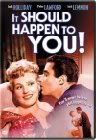
It Should Happen To You!
It's been over two years since I mentioned the delightful comedy It Should Happen To You. I'm please to point out that it's going to be on TCM again, tomorrow (April 30) at 12:45 PM ET. I note that when I posted about it back in February, 2008, I commented that it's available on DVD. Amazon says that the DVD has been discontinued, while TCM says it's not available for purchase on DVD. Netflix, however, does claim to have it, should you have a Netflix subscription.
Posted by
Ted S. (Just a Cineast)
at
9:13 PM
0
comments
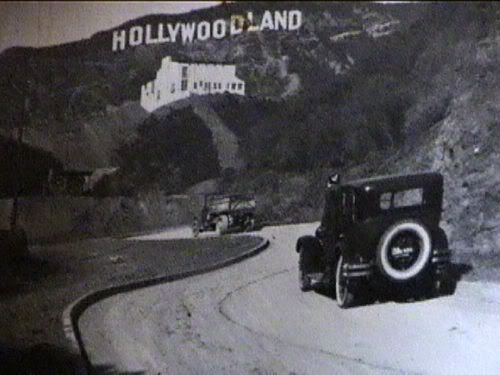
Hollywoodland
The news broke a few days ago that Hugh Hefner is among those who are going to pony up a bunch of money to buy land in the vicinity of the famous Hollywood sign that was slated for development. If the land had been developed, it would have ruined the view of the iconic sign. Not that I want to want to see such an iconic view destroyed, but I find a good deal of irony in all this. After all, the sign was originally erected back in the 1920s to promote... a housing development, called Hollywoodland. The sign originally had four letters more than it does today, and was never meant to be permanent. (By the same token, the Eiffel Tower wasn't intended to be permanent, either.)
I had known about the housing development and the fact that the sign originally had those four extra letters, but in doing a bit of research, I found out a few more things that surprised me, most notably that the sign was originally lighted by thousands of incandescent lights. There are two good pages detailing the history of the sign and the neighborhood here and here.
Or, I suppose, you could get the facts straight from the horse's mouth. Only in Hollywood. (Does the sign have its own agent, too?)
Posted by
Ted S. (Just a Cineast)
at
2:21 PM
0
comments
Wednesday, April 28, 2010
Dorothy Provine, 1935-2010
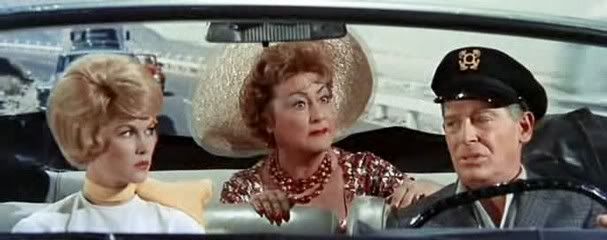
It's a Mad, Mad, Mad, Mad World (1963). From left to right: Dorothy Provine, Ethel Merman, and Milton Berle
The death has been announced of 1960s actress Dorothy Provine. Provine is probably best remembered for appearing in the comedy classic It's a Mad, Mad, Mad, Mad World, as the wife of Milton Berle, daughter of Ethel Merman, and brother of Dick Shawn. Provine retired from Hollywood when she married, and when she died last weekend, she was survived by her husband of 43 years and her son. Dorothy Provine was 75.
Posted by
Ted S. (Just a Cineast)
at
9:06 PM
0
comments
Labels: Obituary
Madame X, Take 3210542184375
I recommended one of the many versions of the movie Madame X back in February, 2009. While I mentioned that Helen Hayes would go on to win an Oscar for a very similar movie, I failed to mention another movie with much the same plot that also won its star an Oscar: To Each His Own, which is airing on TCM overnight tonight, at 1:30 AM ET.
Olivia de Havilland stars as Josephine "Jody" Norris, and at the beginning of the movie we see her in London during the air-raids of World War II. She's unmarried, and so has the time to serve in a civil defense capacity. Being unmarried also gives her the time to look back on life and see how she's gotten to this point. Cue the inevitable flashback... back to World War I. Jody is in a small town somewhere in Middle America. Local boy Alex Piersen (Philip Terry) is in love with her, but she claims she can't marry him, so he marries the wealthy Mary Anderson. Meawhile, the World War I equivalent of the flyboys come to town drumming up support for Liberty Bonds, and Jody falls in love with one of them, a captain played by John Lund. He goes off to France and gets killed in a plane crash, but not before knocking up Jody, leaving her with child -- not widowed.
What's a girl to do? Jody goes off to the big city to have the baby and then claim to adopt it, but the small town isn't having anything of that, so the Piersens wangle custody right from under Jody's nose, which forces Jody to leave town and go into other lines of work. Here is one of the big differences between To Each His Own and the all the Madame X clones: in Madame X, the woman usually winds up descending into a life of crime; after the imposition of strict Code enforcement, Jody ends up in control of a perfume business when she thinks she's going to work legitimately, but is actually working for a bootlegger. (The movie doesn't sufficiently explain how Jody avoids legal trouble.) Jody becomes wealthy, and tries to use her economic power to get custody of her son. Mrs. Piersen, who is insanely jealous, absolutely refuses, and eventually, Jody goes off to England to run the European branch of her business empire.
Fast forward to World War II, and who's in the US Army? Why young little Piersen, who by now has grown up to look remarkably like his biological father. (This is unsurprising, since the character is played by John Lund in a dual role.) Jody sees this as her opportunity to help her biologicial son in a way she couldn't back in America....
To Each His Own is terribly melodramatic, which may color your opinion of the movie: if you don't like this sort of story line, you'll probably be groaning throughout the movie. De Havilland, however, gives a performance that is probably the best of all the Madame X equivalents I've seen. It's too bad the same can't be said for John Lund, who is as wooden here as he was when I recommended The Mating Season. Thankfully, he doesn't take up too much screen time, as his father character dies close to the beginning of the movie, while his son character only appears toward the end.
To Each His Own deserves at least one viewing, but you're going to have to catch the TCM screenings, as it doesn't seem to have been released to DVD. Fortunately, in addition to tonight's showing, it's scheduled for Mothers' Day in a few weeks' time as well.
Posted by
Ted S. (Just a Cineast)
at
8:29 AM
0
comments
Labels: Olivia de Havilland, please release me
Tuesday, April 27, 2010
Walter Lantz, 1899-1984
It was on this day in 1899 that animator Walter Lantz was born. Lantz is best known today for creating the famous character Woody Woodpecker back in 1940. However, Lantz had been making cartoons for quite a few years before this, including making a lot of shorts featuring the character Oswald the Lucky Rabbit. Oswald is probably most famous for being created by Walt Disney when Disney was working at Universal; Disney lost the rights to Oswald when he started his own studio. (The rights to Oswald were eventually obtained a few years back by Disney as part of a deal that allowed sportscaster Al Michaels to jump ship from ABC [owned by Disney] to NBC [owned by Universal]. Ain't media conglomerates grand?) Lantz also created such characters as Andy Panda, Chilly Willy the penguin, and several foils for Woody.
It's fairly well-known that Woody Woodpecker's voice was provided by Grace Stafford, who was also the wife of Lantz. At least, she provided the voice starting in 1950. An interesting fact here is that the first time Stafford voiced Woody was actually as part of a live-action movie, Destination Moon, in which a Woody Woodpecker short is used to explain certain aspects of science. Only having started in 1950, though, Stafford was by no means the first voice. That, surprisingly enough, was Mel Blanc, who voiced a small number of Woody Woodpecker cartoons (distributed by Universal) until he signed an exclusive contract with Warner Bros. to voice all those Looney Tunes and Merrie Melodies characters.
Posted by
Ted S. (Just a Cineast)
at
9:33 AM
0
comments
Labels: Short
Monday, April 26, 2010
Have I never blogged about Gilda before?
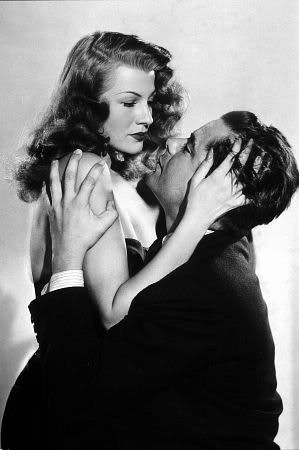
Rita Hayworth and Glenn Ford in a publicity still from Gilda
TCM is showing the classic noir Gilda tomorrow morning at 8:00 AM ET. Looking through the blog archives, it seems as though I've never posted on Gilda, which is a pretty big oversight.
Glenn Ford plays Johny Farrell, a gambler who has ended up in Buenos Aires and is down on his luck. ALthough he's just won some money in a dice game, using loaded dice means that the people he's gambling with are going to attack him -- if it's not for the serendipitous help of a man with a cane that conceals a bayonet. That man, Ballin Mundson (played by George Macready), runs the local underground casino, and figures that he can use a bright guy like Johnny to help manage the place. Things go well until Ballin brings home a trophy wife, Gilda (Rita Hayworth). Ballin might not have realized it at the time, but Gilda and Johnny had had quite a fling back in the States. Joe Breen never met a threesome he didn't like, so you know this relationship can't possibly end well.
Indeed, it doesn't. Ballin isn't just running that casino; he's in the black market for metals as well, and that criminal enterprise results in Ballin killing other criminals partly in self defense, while Johnny and Gilda are all the time having a torrid love/hate relationship. With some dead bodies, however, the police are closing in on Ballin, who gets out of the situation by faking his own death (we viewers realize it's fake, but it's done in a way that not even Johnny and Gilda know it). Ballin has bequeathed the business operation to Johnny, who proceeds to run it ruthlessly. Johnny also marries Gilda, but she's about as faithful to him as she was to Ballin. Eventually, Ballin returns from the dead....
Gilda is quite the movie. Glenn Ford was good at playing characters who were the good guy on the surface, but who had a dark or deeply conflicted streak under the surface; think The Big Heat. Johnny Farrell, despite being the hero here, is by no means a saint, and when Johnny needs to be nasty, Ford has no difficulty portraying it whatsoever. Macready is suitably good as the older man who looks distinguished, but is just as ruthless as Johnny. But it's Rita Hayworth who really makes the movie move. She's as gorgeous as ever, and in fact, this might just be Rita as her most gorgeous. (The competition for that, however, is pretty tough.) It's easy to see why anybody would fall for Gilda, and fall hard. These three excellent performances work to enhance what is a pretty darn good story already.
Seeing how strongly I can recommend Gilda, I find it a surprise that I haven't done so before now. And you don't even have to worry missing the morning showing on TCM. It goes without saying that a movie as important as Gilda has already been released to DVD.
Posted by
Ted S. (Just a Cineast)
at
8:13 AM
0
comments
Labels: Glenn Ford, noir, Rita Hayworth
Sunday, April 25, 2010
The first Hollywood-on-Hollywood movie?
Over a dozen years before the first incarnation of A Star is Born (at least, under that title, since the 1932 movie What Price Hollywood is pretty much the same story), the movie that is TCM's Silent Sunday Night picture for this week: Souls For Sale, at midnight ET tonight.
Eleanor Boardman (probably best known from The Crowd) plays Mem, a small-town girl who wants to see bigger and better things, and when Owen, a man from the big city, comes to town, she jumps at the chance to be with him, despite the fact that her parents think this is a Really Bad Idea. Mem marries Owen, and as they're taking a train west to get to their honeymoon, she discovers that her parents were right after all. So, when the train stops to pick up water, Mem jumps off, although there's not much place for her to go, since it's the desert. She wanders through the desert and walks into serendipity, in the form of a Hollywood "sheik" movie of the genre that was all the rage in the 1920s. After nursing her back to health, the director Frank (Richard Dix, later of Cimarron) gives her a chance to try her hand at acting.
Acting proves to be both a boon and a curse. Mem is pretty good at it, to the point where she's able to become a pretty big star. However, that fame means that her husband is able to find out what's happened to her, and come back into her life. Frank already knows about the marriage, but if word of it got out on a broader scale, it would be scandalous for Mem's career, so Owen blackmails Mem. That's not the only problem for Mem, as she learns that Owes is even worse than just being a blackmailer. All of this leads to the reasonably thrilling finale, on the set of a circus-themed movie....
Souls For Sale stands on its own as a fairly good silent movie. However, the Hollywood subject material also provided the director an opportunity to include quite a few cameos. The two most famous amongst them would be Erich von Stroheim, who here was filming Greed; and Charlie Chaplin, at work on A Woman of Paris. There are a lot more cameos, from the famous (Jean Hersholt) to the nearly forgotten (Marshall Neilan; I've seen his movie The Vagabond Lover which features the screen debut of Rudy Vallee, but would never have recognized the name).
Souls For Sale has made it to DVD as part of the Warner Archive Collection.
Posted by
Ted S. (Just a Cineast)
at
9:55 AM
0
comments
Labels: Richard Dix, Silent
Saturday, April 24, 2010
Jeanne Crain vs. Susan Kohner
TCM is showing the movie Pinky tomorrow morning at 11:00 AM. Like both versions of Imitation of Life, the subject material is that of a light-skinned black person trying to "pass" as white, and the discrimination that comes about as a result.
In Pinky, that mixed-race person is played by the utterly white Jeanne Crain. She's a nurse, who has gone north to study and get her degree, and is only briefly returning south to see her beloved grandmother (Ethel Waters). Unfortunately, events soon begin to conspire against her. She's fallen in love with a white doctor up north (William Lundigan), and hasn't told him about the black part of her ancestry. Perhaps worse, though, is that the property-rich but cash-poor woman for whom Pinky's grandmother works (Ethel Barrymore) has suddenly taken ill.
Eventually, old Miss Barrymore finally kicks the bucket, but there's a twist: sometime after she fell ill and started to be taken care of by Pinky, she amended her will to bequeath the stately old house to Pinky, presumably with the idea that Pinky stay there and start up a school/clinic. Pinky didn't really want the place, but when the other white people start to conspire against her, including Barrymore's cousin, who expected to inherit the place herself. Cut to the probate court trial, with the typical Hollywood ending....
Pinky isn't a bad movie, but there's a lot about it that just seems not quite right. The ending is entirely too pat, for starters. Also, William Lundigan's character is thoroughly implausible. I mean, his fiancée has been lying to him, and when he finds out, he acts almost as though nothing has ever happened. It's a bizarre case of cognitive dissonance. As for the prejudice in general, one has to wonder how much it reflected reality. Fox chief Daryl F. Zanuck was clearly interested in making movies with social messages -- he had already made Gentleman's Agreement two years earlier. Yet, the feeling of racial oppression suffered by the blacks in Pinky feels almost like a caricature. (Admittedly, I wouldn't know what things were really like from the perspective of either side, as a northerner born in the 1970s.) That might have something to do with the Production Code, of course. On the other hand, all three of the female leads give good performances. Nothing less is to be expected from the two Ethels, but even Jeanne Crain is good here. She comes across as restrained; entirely the opposite of Susan Kohner in Imitation of Life.
Pinky is one of those Fox movies that TCM has gotten the rights to show a limited number of times. However, you don't have to worry about TCM eventually losing those broadcast rights, as Pinky has been released to DVD.
Posted by
Ted S. (Just a Cineast)
at
10:42 AM
0
comments
Labels: Fox
Friday, April 23, 2010
Five Graves to Cairo
TCM finally got the broadcast rights to the little-sees Billy Wilder movie Five Graves to Cairo at the beginning of the year, and have run it once or twice already. It's airing again tomorrow afternoon at 2:00 PM ET, and, like anything else Wilder made, is well worth watching.
Franchot Tone stars as John Bramble, a corporal in the British Army in North Africa in World War II. His tank has been shot by the Nazis, killing everybody inside but him. Somehow, he manages to escape, and eventually follows a trail which leads him to a partially bombed-out hotel that still has a skeleton staff working. He's saved.
Or maybe not. Although the owner of the place (Akim Tamiroff) and the one other worker, a French maid named Mouche (played by a young Anne Baxter) look after John a bit, they suddenly have to deal with the return of those nasty Nazis, specifically a group led by Field Marshal Rommel (Erich von Stroheim) himself. If the Nazis find out there's a British soldier here, they're definitely going to kill him. And, they might just kill the hotel staff as well for harboring him. Fortunately, however, there was one other staff member at the hotel, a man with a limp named Paul Davos, and he died in the bombing attack. So, all Bramble has to do is play the part of Paul and serve the Nazis much the way any bellboy would do in a regular hotel. He's saved again.
Or again maybe not. What John fairly quickly learns about Paul is that Paul was a spy -- and Paul was working for the Nazis! Paul obviously knew information that John clearly doesn't, so keeping up the masquerade isn't going to be that easy. Things get even worse when John learns from Rommel that there's a plot about "five graves to Cairo", which has something to do with the Nazis' plan to overrun Egypt, and that Paul was supposed to be sent to Cairo as part of the plot. Can John keep his secret from Rommel, and learn enough about the "five graves to Cairo" to help the British foil Rommel's plans? Along the way, John falls in love with Mouche, despite the fact that she's not such a fan of the British. Then, the British start bombing again, which could threaten to reveal the original Paul's body....
Five Graves to Cairo is one of those films to watch for the great Billy Wilder's plot. The acting is capable, but it's the story here, and that story is quite a good one. It's tense when it needs to be, and also contains a good deal of dark humor on the part of Rommel. There's also some lighter humor, provided by an Italian general whom the Nazis really don't like (Fortunio Bonanova). The only possible negative is that, since historical events provide the backdrop, we know Rommel's plan ultimately won't succeed. But, as with The Day of the Jackal, that really doesn't take away from the movie.
Unfortunately, Five Graves to Cairo doesn't seem to have been released to DVD.
Posted by
Ted S. (Just a Cineast)
at
10:37 AM
0
comments
Labels: Billy Wilder