Showing posts with label Henry Hathaway. Show all posts

Friday, March 29, 2024

How the West Was Won

I mentioned at the start of the week in conjunction with Debbie Reynolds being TCM's Star of the Month for March that there was was at least one of her movies that I've got on my DVR and haven't done a post on before. That movie is the epic How the West Was Won. It's coming up early tomorrow morning (March 30) at 4:30 AM, so now we get the post on it.

Spencer Tracy narrates this movie that at times feels like an anthology, but is really more of an episodic movie since some of the characters appear in multiple segments, and many of the characters who are only in one segment are all part of the same family. Anyhow, Tracy informs us that it hasn't been all that long since the American frontier was conquered, and that in the early days of trying to move west it was particularly difficult, at least until the construction of the Erie Canal (completed in 1825) really made it a good deal easier to get to at least western Missouri. We then cut to 1839 for the first segment....

The first segment, called "The River" deals with one family trying to migrate west in search of more fertile land, although west here more or less means the Ohio Valley, which I'd have though was fairly comprehensively settled by 1839; Wikipedia suggests Cincinnati had already been incorprated for a generation and had a population in the mid-five-figure range. In any case, the family, the Prescotts, consists of father Zebulan (Karl Malden), mom Rebecca (Agnes Moorehead) and daughters Eve (Carroll Baker) and Lilith (Debbie Reynolds). They meet trapper Linus (James Stewart) before all of them get waylaid by some dubious pirates of the river (their leader is played by Walter Brennan). An accident in river rapids kills Mom and Dad; Eve marries Linus and Lilith heads for greener pastures.

Those pastures take her to Saint Louis in 1850, where she's workin as an enterainer who finds out that she's somehow inherited a gold mine out in California. So as with Westward the Women mentioned recently, she has to go west to California to take possession of the mine. She's followed by some suitors, notably professional gambler Cleve Van Valen (Gregory Peck).

Back to Eve's side of the story, when the Civil War comes she's got an adult son Zeb (George Peppard). Linus and Zeb both go off to fight, but when Zeb sees the hell that war truly is, a confederate he meets (Russ Tamblyn) suggests the two of them desert and go off somewhere together. But there's a lot more tragedy to come.

After the Civil War, the Transcontinental Railroad gets built. Zeb is still in the Army, now in the cavalry, trying to keep the peace with the various Indian tribes despite the fact that Mr. King (Richard Widmark), the man from the railroad, wants to get the track laid and who cares what the Indians think.

Finally, after leaving the Army, there's one last segment that reunites the two branches of the Prescott family. Lilith is forced to sell her home in San Francisco, deciding to retire to a ranch in the Arizona territory. But she's old, so she invites her nephew Zeb, by now married (Carolyn Jones playing his wife) to come along and run the place. When they get to Arizona, Zeb runs into Gant (Eli Wallach), an outlaw who's there to try to steal one of the shipments of gold.

It's easy on watching How the West Was Won to see why it was such a massive commercial success when it was released. The story is actually fairly pedestrian, but the movie was made in Cinerama, so I can only imagine how spectacular it must have been to see the movie as it was intended to be seen in the original Cinerama.

Unfortunately, however, most people don't have the sort of curved screen necessary to see Cinerama in its original aspect ratio and presentation format. In days past, this meant that TV presentations would be cut down, and there would be severe crease-like lines where the various segments of the print were supposed to meet up. Nowadays, restorers have tried to solve that problem through the use of the "smilebox" format that attempts to replicate the experience one would have had in the theater where the left and right edges of the screen are closer to the viewer than the middle.

I'm sorry to say that this doesn't quite work. First, I get the impression that the smilebox format is really more curved than it needs to be. Some of the photos I've seen of Cinerama screens do show a clearly evident curve, but not as much as the smilebox format has. The bigger problem, however, is how translating Cinerama to the smilebox distorts motion. I've always felt like there was something off in Cinemascope backgrounds when there are scenes with long panning in that the motion in parts of the background don't look quite right. In the smilebox format, this is much more severe, almost like what you'd see if you were moving around a sphere with stuff being reflected off of it.

But if you're the sort of person who doesn't tend to notice such distortion, or if you ever get the chance to see it in the original Cinerama (I don't know how many Cinerama screens still exist; would it be possible to translate Cinerama to an IMAX screen?), give How the West Was Won a chance. It's certainly a spectacle.

Friday, March 24, 2023

To the Last Man

Another recent watch off the Watch TCM app was To the Last Man. The print TCM ran said that it had been preserved by the Museum of Modern Art; supposedly there's a public domain print out there under the title Law of Vengeance.

The first thing about the movie that's interesting is how it introduces each of the main cast members, putting up the actor's name and character at the bottom of the screen the first time they appear. Now, some early talkies used a convention of showing the main characters with a shot from the movie right at the beginning. And there are also some silent films that would put the name of the actor in an intertitle when introducing a new character. But I hadn't seen it done quite like this before. Randolph Scott is the star here, and it's a bit odd to see his name show up on screen only when he first appears 20 minutes or more into the proceedings.

Anyhow, the plot itself starts off just after the end of the Civil War, with a newspaper etching informing us of Lee's surrender -- I don't think the technology to print photographs in newspapers was around in the 1860s. We then move to Kentucky, where Mark Hayden (Egon Brecher) is returning from the war. Mark's son Lynn (Jay Ward, but not the one who would go on to create Bullwinkle) witnesses Grandpa getting murdered, by one of the Colby gang, patriarch Jed (Noah Beery Sr.). The Colbys and Haydens have been feuding, but Mark doesn't want the violence to go on, having seen too much in the war. So instead of taking blood revenge, Mark gets Jed sent to prison for 15 years. The Haydens go west to Nevada to escape the feud, with Grandma taking care of young Lynn, she refusing to go west.

Those 15 years pass, and Jed is just about to get out of prison. During his time there, he made friends with fellow prisoner Jim Daggs (Jack La Rue), who got out a few months before Jed. Jim has raised a stake for him and the Colbys to go to Nevada to follow the Haydens, as Jed wants revenge for having lost 15 years of his life, not realizing it was his own damn fault. Jed also has an adult daughter, Ellen (Esther Ralston), who follows Dad and Jim out to Nevada.

Jed certainly attempts revenge, but things get complicated thanks to the presence of Ellen. Jim expects that Ellen is going to marry him, but who should show up from back east but a now grown up Lynn Hayden (Randolph Scott, but of course you'll figure that out from the credits). He first runs into Ellen as she's swimming and being menaced by Jim, and he saves Ellen, the two not realizing who each other are. When Ellen finds out this is another Hayden, she's pissed and wants nothing to do with Lynn. But Lynn doesn't want the feuding either even though it's unavoidable, and you can probably guess that Ellen is ging to fall in love with Lynn by the last reel.

What surprised me about To the Last Man was the sort of violence. The climax took an unexpectedly dark turn, and I found that this raised the level of an otherwise standard-issue 1930s western quite a bit. To the Last Man is interesting for a whole bunch of reasons, and definitely worth a watch if you can find it.

Saturday, February 25, 2023

The Shepherd of the Hills (1941)

During the last free preview weekend I had, over Thanksgiving, I recorded a bunch of movies. A lot of them were more recent, but off of StarzEncore Westerns I recorded the 1941 John Wayne version of The Shepherd of the Hills.

The movie is based on a book from the early part of the 20th century and had already been filmed at least once before, as a silent, although Wikipedia says there are substantial plot changes from the book which, in any case, I haven't read. John Wayne plays Matt Matthews, a man in the Ozarks who spends a lot of his time mourning his dead mother, and cursing his absent father, since Dad was nowhere to be found when Mom got sick and died so Matt blames the missing father for Mom's death. But this conflict comes up a bit later in the story.

This being hillbilly country, there's not a whole lot of respect for the government, specifically the revenuers, who harass the poor people for liking the wrong sort of alcohol -- they should drink wine instead like the good rich folk do. Jim Lane is one of the many moonshiners, living with his adult daughter Sammy (Betty Field). He gets shot at by one of the revenuers, but, in a stroke of good luck, another man just happens to be pasing through. That man, Daniel Howitt (Harry Carey), saves Jim's life and decides that he's going to think about settling down in this neck of the woods.

After Matt's mother died, his Aunt Mollie (Beulah Bondi) and Uncle Matt (James Barton) took over the old homestead where young Matt's mom and the rest of that part of the family lived. They haven't done much with it, however, because of young Matt's continuing to mourn for his beloved mother. Aunt Mollie, for her part, tries to point out that she did a lot of the taking care of he sister, since young Matt was too young to do so at the time. But I bring all of this up because when Howitt lets it be known that he'd like to buy some land here, Sammy suggests buying what had been young Matt's home.

This would also serve the purpose of giving young Matt a little bit of money to get started in life, which in Sammy's view would be perfect because she's in love with Matt and this would enable him to marry her. Matt, for his part, is aghast at the idea, because in his mind he can't escape the past and has no intention of ever selling his mom's house. (The one thing you can argue in his defense is that the house might be a good place for newlyweds to start married life, although it would have to be a different set of newlyweds from Matt and Sammy. Matt is going to continue to curse the world, especially Daniel, whom he sees as an interloper.

Everybody else, for their part, sees Daniel as a kind and generous man, willing to overpay for that house and even willing to donate money to see that Granny Becky Matthews (Marjorie Main) can get cataract surgery to restore her eyesight. That brings about the final dramatic conflict of the movie, which you might be able to see (no pun intended) coming a mile away.

The Shepherd of the Hills is a rather different movie for John Wayne. He had spent almost all of the 1930s making B westerns on Poverty Row before being made a star again with Stagecoach. It's easy to see why a movie like The Shepherd of the Hills would wind up on a westerns channel, although it's not a traditional western. There's also a magical nature to the movie that isn't like Wayne's work up to that point. But because of the nature of the story, that unreality -- like a story not bound by place or time -- mostly works.

Wayne, I think, is not quite rightly cast here; he does well with his material but after Stagecoach he always looked a little older than he was and the story really needs somebody younger. Young Matt needs not to have been an adult when his mom died, and the timeline doesn't seem to work here. But again, Wayne does well, as do the other actors. They're also well served by the Technicolor photography, which I think was a first for Wayne.

As I said earlier, I haven't read the book, and I haven't seen any of the other movie versions either. But this version of The Shepherd of the Hills stands on its own and is definitely worth a watch.

Friday, December 24, 2021

Grow Up With the Country

Not having anything ready for a review today and not wanting to do just a briefs post, I decided to put one of the DVDs from my Mae West box set into the DVD player and watch one of the films I hadn't reviewed yet, Go West Young Man.

West plays Mavis Arden, a Hollywood actress traveling the country to promote her latest film. She's got an exclusive five-year contract with the studio, and one of the clauses is that she not get married during those five years, something that poses no small problem for her PR man, Morgan (Warren William), as she's got a whole bunch of male admirers. And while Mavis says all the right things in her public appearances, in private she'd be more than happy to pay attention to at least some of those male admirers if they're good looking enough.

At her current apparance, in Washington DC, one of the men waiting for her after the show is Francis X. Harrigan (Lyle Talbot), who happened to know Mavis back in the day when they were both in Chicago together. He'd like to meet Mavis possibly for more than just old time's sake. This would be a problem for both of them, however, as it's implied that Harrigan may have some sort of past, and this could be used against him as he's now running for Congress. But the two agree to meet at a rooftop restaurant. Morgan, however, invites the press, to try to scuttle both Harrigan and Mavis, although it only appears to make both of them more popular.

Mavis' next engagement is in Harrisburg, PA, so after everything that happens in Washington Mavis and Morgan, along with her dresser and the chauffeur, pile in to her limo to head north. Unfortunately, mechanical problems beset them and there's no good way to get to Harrisburg on time. They're going to have to wait for the car to get fixed.

Fortunately, there's a nice little service station attached to a rooming house that can set them up while they wait and get the car fixed. The rooming house is run by Mrs. Struthers (Alice Brady), who has some of her family as staff, as well as a maid/waitress Gladys (Isabel Jewell), who is a big fan of Mavis'. At the service station, we initally see the more portly Clyde driving the tow truck, but the place is actually run by aspiring inventor Bud Norton (Randolph Scott).

It's not too difficult to figure out that Bud likes Mavis, especially considering he has an invention that he hopes will increase the quality of sound film recording, something that would get him out to Hollywood if anybody could notice him. And Bud being handsome, of course Mavis notices him. This causes problems for Morgan and some of the people at the rooming house, and leads Morgan to do something that probably ought to have landed him in jail except that the plot resolution requires that he evade jail.

Mae West was known for her sexual energy that she exuded on the screen, and the introduction of the Production Code in July 1934 certainly hampered her later movies, of which this is one. Indeed, a fair amount of the plot doesn't make that much sense, such as driving the Rolls Royce across the country, and the relatively short distance between Washington DC and Harrisburg being overlooked. Mae West, however, does about as well as possible with the somewhat neutered script, and makes Go West Young Man eminently watchable.

Saturday, July 1, 2017

The Sons of Katie Elder

I had another movie planned to blog about today, but things came up and so I had to watch The Sons of Katie Elder off a three-film DVD set of John Wayne movies. (It turns out there's a nine-film set available both at Amazon and the TCM Shop that has the three on the set I bought and six others.)

The movie starts off with a train heading towards a town, with opening credits and music that's unmistakeably Elmer Bernstein accompanying. That train stops in the town of Clearwater, Texas, where three men are waiting for a fourth. A man does get off the train, but it's not the one they were expecting, and the one they were expecting isn't on the train at all. It turns out that the three men are the Elder brothers: Tom (Dean Martin), Matt (Earl Holliman), and young Bud (Michael Anderson Jr.); they were expecting eldest brother John (John Wayne) to show up for their mother's funeral. John does show up, although he watches the funeral from afar.

The man who did get off the train, Curley (George Kennedy), goes to a ranch owned by Hastings (James Gregory), who is planning big things for the town. But the ranch used to be owned by the Elders' parents. Dad -- well, we'll learn a bit more as the movie goes on about how the ranch passed from his hands -- suffice it to say that he got shot to death, but the murder is unsolved. Mom had to move off the ranch after Dad died, and she died poor and one would guess of a broken heart.

The four sons begin to investigate, and find out that things aren't quite right, but that nobody will tell them the full truth of what's going on. Having said that, we can guess that Hastings is no good right from his first scene, as he's clearly expecing John Elder to mean trouble. The whole point of bringing Curley in is to deal with John before John can deal with Hastings.

The Sons of Katie Elder is one of those movies that I'd call good, solid entertainment, but it's also not the sort of thing I'd think of as standing out at anything. The movie has a fairly leisurely pace, running a bit over two hours and having a resolution that comes rather abruptly. The plot is one that you'd call "formulaic" if you wanted to denigrate the movie, but is really more of a standard-issue Western theme of revenge. (One of the top IMDb reviews used the word "traditional", which has rather more positive connotations than "formulaic".) There's a fair amount of action in the second half, and reasonably good performances. I just found it hard to find anything special in the film.

Still, the various box sets are relatively low priced. And considering that you're getting The Man Who Shot Liberty Valence and The Shootist at least, it's easy to think of The Sons of Katie Elder as a bonus. Besides, there are other people who will like it even more than I do.

Friday, March 13, 2015

Henry Hathaway, 1898-1985


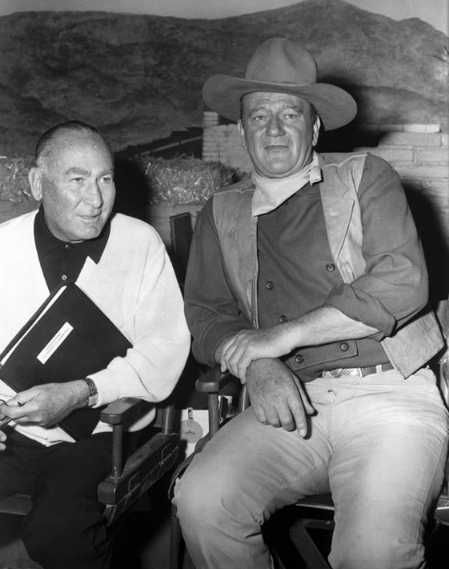
Henry Hathaway and John Wayne, apparently taken on the set of The Sons of Katie Elder

Today marks the birth anniversary of prolific director Henry Hathaway. Hathaway was nominated for a Best Director Oscar fairly early in his career for 1935's Lives of a Bengal Lancer, which turned out to be his only nomination. It was also well before his most fertile period, which came at 20th Century-Fox, especially wortking with a star like Tyrone Power. I think a list of the movies Hathaway made with Power shows a fairly broad range of what Hathaway did: Johnny Apollo is a gangster drama; Brigham Young is a biopic of sorts; The Black Rose is historical adventure, set in medieval Asia; and Rawhide is a straight-up western. Unfortunately, I couldn't find a good photo of Hathaway on the set with Tyrone Power, so I had to substitute one of Hathaway with John Wayne instead. Then again, directing John Wayne to an Oscar isn't so shabby.

It also wouldn't be fair to judge Hathaway just on the basis of the films with Power, or looking at a bunch of westerns. At Fox, he also made the wartime espionage docudrama The House on 92nd Street, the crime docudrama Call Northside 777, and several noirish movies like Kiss of Death. There's even a service comedy in You're In the Navy Now. And there's very few duds among the lot.

I'm not certain which Henry Hathaway movie I'd consider my favorite, and there are still quite a few I haven't seen.