Those with access to FXM Retro will be able to see a movie that doesn't show up very much other than there: Black Sheep, at 6:00 AM.
Edmund Lowe plays John Dugan, a man who has spent the last two decades of his life or so plying the international cruise trade and making a living gambling against the wealthy passengers. But now he's reduced to travelling second-class, which is where he meets Janette (Claire Trevor). She's an actress returning home from England, and she too is travelling second-class. So John decides to be kind to Janette and break the rules by taking her to parts of the ship that are only for first-class passengers. It's there that they meet Fred (Tom Brown) for the first time. He's a troubled young man from a well-to-do famliy, and as we first meet him he's getting his shirt handed to him by a couple of professional gamblers working in tandem (Eugene Pallette and Jed Prouty). John takes pity on the poor boy, and joins the game to win back the money Fred lost.
It turns out that Fred has much bigger problems, ones that lead him to try to climb over the ship's railing and jump overboard! When John and Janette question him about this, we learn that Fred has lost so much gambling that he's severely indebted to his girlfriend, the widow Bath (Adrienne Ames). Except that she's not much of a girlfriend; she's a thief who has been stealing all sorts of jewels from the wealthy people of Europe. Indeed, she's smuggling some of those jewels from Europe even as we speak. In exchange for cancelling the debt, Bath wants Fred to smuggle the jewels through customs.
John is willing to help Fred, but it turns out that there is a big complication. While talking to Fred in Fred's cabin, John sees a picture of Fred and his mom. John immediately recognizes the woman, which is unsurprising considering that John was married to her twenty years earlier and is in fact Fred's father! John was pretty much asked to leave the relationship quietly because, as a man given to gambling, he was entirely unsuited to the social standing of the Curtis family.
So we've got a bunch of things going on here, including one that I haven't mentioned, which is that Janette has taken a liking to John and wants to reform him, getting him to quit plying the cruise ships and settle down with her. There's the jewel heist, which is going to get somebody in trouble at customs. And there's also the relationship between John and Fred, which John understandably doesn't want revealed, even though Fred's mother is definitely going to be there at customs and spot John i he and Fred go through customs together.
All in all, Black Sheep is a movie that I think Fox intended to be a B movie but which rises above that to an extent. There's a lot of the same formula that we can see in different arrangements in all those other 1930s B movies, but something about this one seems to be a bit better. I think I'd put that down to the job Edmund Lowe does. He carries the movie and makes the otherwise well-worn material succeed. Tom Brown doesn't do much here, while the two women are good if not quite as good as Lowe. There's also the presence of all those character actors, which always adds a nice touch.
I don't think Black Sheep has ever received a DVD release, so you're going to have to catch it on FXM Retro before they put it back in their vaults.
Monday, November 9, 2015
Black Sheep


Sunday, November 8, 2015
Kaleidoscope
I apologize for only giving a couple of hours warning about the upcoming airing of Kaleidoscope, which you can catch at noon on TCM. However, it does happen to be available from the Warner Archive Collection.
Warren Beatty plays Barney Lincoln, who at the start of the movie is heading toward an industrial site somehwere in Europe. He gets up on the roof, and breaks in! He goes to the safe, so presumably he's going for the case or some other valuables like jewels. But he just takes out a couple of printing plates, alters them, and leaves. To do something that crazy, somebody has to have a pretty good reason.
And Barney certainly does have a good reason. Those factory was at the company that makes the playing cards for all the great casinos of Europe, and Barney's alterations of the printing plates subtly marked the backs of the cards so that Barney could see what everybody else was holding. This obviously would enable him to defeat the people he was gambling against, and win large sums of money.
Such winnings, unsurprisingly, brought him to public attention, especially from the various authorities, who aren't so stupid that they can't figure out something hinky is going on. Eventually, Inspector McGinnis from Scotland Yard (Clive Revill) pieces everything together and brings Barney in. The bad guys always go down, don't they? Except, that's not what Kaleidoscope is about. McGinnis understands that if the arrest of Barney were made public, along with his scheme to defraud the casinos, it would cause a great loss of confidence that would result in bigger problems than not prosecuting Barney would.
With that in mind, McGinnis gives Barney a different sort of punishment. Serve the authorities by helping bring down Dominion (Eric Porter). Dominion is a smuggler who has made a bundle of money doing that, and has moved into more "legitimate" businesses as well to keep himselve ever so slightly above the law. So McGinnis figures that the way to go after Dominion is financial. Dominion is known for his love of gambling, so what better than to put him up against Barney in a high-stakes poker game? Barney can win Dominion's money since Barney knows the cards are marked, and that money can go to pay back the casinos he defrauded. Of course, there are a couple of problems. One is that along the way, Barney falls for McGinnis' daughter Angel (Susannah York). Another is that at a key point in the poker game, the cards are changed out -- and by this time, the factory figured out what was going on and the new cards are unmarked!
Kaleidoscope is one of those movies that fits in with all the other heist and caper movies of the 1960s. It's stylish to look at, even though there might be even less here than in most of the other films in the genre. But it does succeed in entertaining the viewer, and in that is more than worth a viewing.
Saturday, November 7, 2015
One Sunday Afternoon (1933) vs. The Strawberry Blonde
I've mentioned the movie One Sunday Afternoon a couple of times in the past, although I've only mentioned it is the first film version of the better-known The Strawberry Blonde. I DVR'ed One Sunday Afternoon back when Gary Cooper was in Summer Under the Stars in August, and finally got around to watching it.
For those who don't know the story, Gary Cooper plays Lucius "Biff" Grimes, a dentist in some nondescipt midwestern town at the turn of the last story. He's spending his Sunday afternoon at his home dentist office with his best friend, sign painter Snappy (Roscoe Karns). It's clear from their conversation that Biff is an embittered man, with a wife Amy (Frances Fuller) whom he considers second best, and still thinking about the woman he loved, Virginia (Fay Wray) but lost to his former friend Hugo (Neil Hamilton). It turns out that Hugo is back in town, and it also turns out that he's got a dental emergency that only the town's dentist can handle. Biff has a chance to get back at Hugo....
With that, we get a flashback to how Biff and Hugo, back when they were friends, met Virginia and Amy at the park one day. Biff wanted Virginia, but Amy wanted Biff. Virginia really preferred Hugo, and hugo is at every oppourtunity trying to take Virginia away out of Biff's reach, which obviously does happen eventually and leads to Amy's snookering Biff into a marriage proposal. Hugo goes on to big things, while Biff is still hoping to do his correspondence training to become a dentist. But for that he needs money, so he's doing a series of menial jobs including working for Hugo, which brings the two into more conflict with each other and eventually has Hugo committing perjury to put Biff in jail!
Of course, if you've seen The Strawberry Blonde, you'll know much of the story line. I think that I prefer The Strawberry Blonde, but as with The More the Merrier and Walk, Don't Run, I think both films have their strong points. Gary Cooper is excellent as Biff, the man with a dark past. James Cagney is good and of course played all those gangster roles, but I think it's with good reason that The Strawberry Blonde has a bit lighter tone what with Cagney as the star. That lighter town, however, really helps for the other man. The Strawberry Blonde cast Jack Carson in that role, and he's at his oozy, smarmy best here. Neil Hamilton is a bombast, but often comes across as ill at ease with that bombast. Carson is also a much more effective smooth operator while Hamilton is more direct. Rita Hayworth plays the object of James Cagney's affection, and while it's easy to see when any man would be infatuated with her, I think Fay Wry is better suited to play the sort of woman who would marry a man like Hugo. And as for the story, I think The Strawberry Blonde does it a bit better since it has longer to flesh everything out. I found the ending of One Sunday Afternoon to be a bit abrupt and unsatisfying.
Still, both versions are worth a watch. One Sunday Afternoon was made by Paramount, but it ended up in the Warner Bros. vaults when they purchased the rights to the story to make The Strawberry Blonde, which would explain how One Sunday Afternoon ended up getting a release from the Warner Archive.
Friday, November 6, 2015
The Bowery Boys
TCM showed the last of the Bulldog Drummond movies the week before last, and since last Saturday was Halloween they didn't run either the Batman and Robin serial or any of the movie series they've been running in the 10:30 AM Saturday slot. So they're starting a new series this week, which is the Bowery Boys. I don't know if they'll be running all of the Bowery Boys movies, but if they do, you'll be seeing the boys for ages.
What became the Bowery Boys actually started off back in 1937 is the Dead End Kids, from their memorable roles in the movie Dead End. they were such a hit in that movie that Warner Bros. snapped them up, putting them in relatively prestigious movies like Angels With Dirty Faces and They Made Me a Criminal. Eventually, they would morph into the "East Side Kids", but ended in 1945 when their contract wasn't renewed. So they struck out on their own, rechristened themselves as the Bowery Boys, and made a long series of films, of which Live Wires, tomorrow at 10:30 AM, was the first.
I haven't seen too many of the Bowery Boys movies, but the ones I've seen are all reasonably pleasant B movies, the sort of thing that would be threatened by episodic television once that became a hit a few short years later. There's nothing spectacular here, and the production values are certainly a lot lower than what the major studios were doing.
One thing of note about Live Wires is that it was directed by Phil Karlson very early in his career. Karlson would go on to direct some of the more interesting lower-budget films of the 1950s, notably the noirs Kansas City Confidential and 99 River Street, as well as the docudrama The Phenix City Story.
Thursday, November 5, 2015
TCM Guest Programmer November 2015: Greg Proops
Once again, we've reached that time of the month when TCM gives us its monthly Guest Programmer. This time it's Greg Proops, a comedian I only remember from those snarky list shows like I Love the 80s where they have a bunch of Z-listers make not-very funny comments about whatever set of items they're listing. It's a lazy style of program making, but in this day and age of 500 TV channels plus all the internet streaming options, there's a big need for programming. Anyhow, Proops is on tonight, presumably with Robert Osborne and not Ben Mankiewicz, to discuss four of his favorite movies and discuss them. Those choices are:
Grand Illusion, Jean Renoir's drama about French POWs in a German World War I camp, at 8:00 PM;
The 1973 version of The Three Musketeers at 10:15 PM;
Out of the Past, in which gas-station owner Robert Mitchum has former associates Kirk Douglas and Jane Greer draw him back into their world, at 12:15 AM; and
Dog Day Afternoon at 2:15 AM, starring Al Pacino as a man who robs a bank to pay for his lover's operation.
Wednesday, November 4, 2015
A couple of apologies
First, I should apologize for not realizing that in this month's TCM Spotlight on southern writers, John Grisham would be sitting down with Robert Osborne to be presenting the movies, much in the way Osborne sits down with a Guest Programmer or with Sally Field when he does the Essentials. I'm mildly surprised by this, since I always figured the main point of the monthly spotlight was to have somebody else present it in order to lower Osborne's workload. After all, the guy is 83 years old.
I should also apologize for the lack of full-length posts on movies in the past few weeks. I've been blogging for close to eight years now, which means that a lot of movies that I might like to blog about, I already have. I was also going to write about something earlier this week, but it turned out that the movie I had in mind was one that I thought was going to be on FXM Retro this week, but in fact won't be showing up again until next week. So that post is going to have to wait.
And there are a couple of lesser deaths that probably deserve a passing mention, although they're people who will only get a brife photo in the annual TCM Remembers parade of the dead that will be come on in December. First up is Colin Welland, who died on Monday at the age of 81. Welland won an Academy Award for writing the screenplay to Chariots of Fire. The other one, also a screenwriter, is Melissa Mathison, who was nominated for an Oscar for her screenplay to E.T.: The Extra-Terrestrial. She also wrote the screenplay to The Black Stallion, and is the mother to two of Harrison Ford's children from their 20-year marriage.
An admission
This month's TCM Spotlight is on Wednesdays, so I think we can finally put to rest the idea of the "Friday Night Spotlight" theme that TCM ran for a good two years. That also means tonight is the first night of the new spotlight, on southern writers. It'll be presented by John Grisham, who is probably a good choice considering that he's a southern writer himself, hailing from Mississippi, and has had a lot of his books turned into movies. (I haven't seen him on TV enough to know whether he'll be a good TV presenter, but I have no reason to believe he wouldn't be.)
Anyhow, one of tonight's movies is Gone With the Wind, airing at 9:45 PM. TCM's schedule, for some bizarre reason, likes to break this movie into two parts, with the schedule claiming Part 2 is airing first, followed by Part 1. It never happens that way, of course. The schedule makes mistakes, of which this is one. The other big mistake that's currently going on is that a whole bunch of the movies are listing people a good ways down the cast list as being the stars. My printed copy of the monthly schedule, for example, lists the stars of Gone With the Wind as being... Fred Crane, J.M. Kerrigan, and Wallis Clark. I have no idea what characters they even played!
But now for the admission. I don't think I've ever actually sat through the entire four hours of Gone With the Wind in one sitting. Oh, I've sat down for the start on several occasions, and have come into the middle of the movie on quite a few others. And just as importantly, I read the book 30 years ago. But spend a full four hours with the movie? I don't think I've ever blocked out that much time.
That having been said, I think the 1939 version of Gone With the Wind is just as much a phenomenon in and of itself as it is a movie. And I'm also not the biggest fan of Vivien Leigh. But I'm sure a lot of you will enjoy it, and there are probably people who like the idea of sitting down and spending four hours with Gone With the Wind for the umpteenth time.
Tuesday, November 3, 2015
TCM Star of the Month November 2105: Norma Shearer
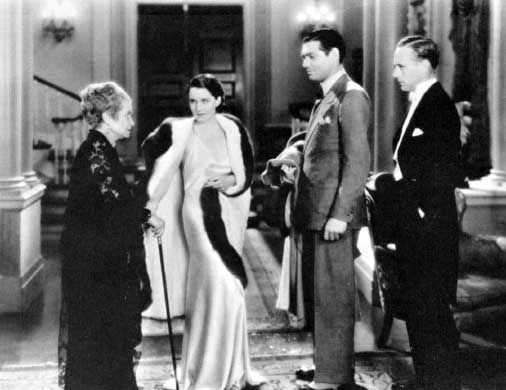
The photo above is from A Free Soul, although that movie isn't airing until next Tuesday at 9:30 PM. This first evening of the Shearer salute sees four of her silents, ending at 12:45 AM with He Who Gets Slapped. Perhaps the most interesting movie of the night for me would be A Lady of Chance at 9:15 PM. This one sees Shearer playing a con artist who uses her feminine charms to get well-to-do men into jams and then walks off with their money. That is, until she falls in love with one of them (future cowboy star Johnny Mack Brown) who, it turns out, isn't wealthy at all.
Monday, November 2, 2015
Fred Thompson, 1942-2015
Politician-turned-actor Fred Thomspon died yesterday at 73. Thompson would probably be better-known for his political career that included eight years in the US Senate and a run at the presidency, but on either side of that he did a fair amount of acting.
Actually, he started his acting career playing himself. Some years back, I mentioned a movie called Marie, about corruption in Tennessee. It's based on the true story of Marie Ragghinati, played by Sissy Spacek, who discoverd that the governor of Tennessee was selling pardons. When she tried to put the kibosh on that, she was fired from her position on the parole board, so she sued for wrongful termination. Fred Thompson was her lawyer in that case, and in the movie, he plays himself. Interestingly, the movie is on the TCM schedule for 10:15 PM Saturday.
Thompson's most remembered film role might be from the Clint Eastwood movie In the Line of Fire. Or, at least, that's the one I recall being mentioned prominently when Thompson was running for Senate the first time in 1994. Thompson obviously took time off from acting when he was elected to the Senate, and after his Senate career spent several years doing one of the many, many versions of the TV franchise Law and Order.
Sunday, November 1, 2015
The US National Park System
I wasn't terribly interested in mentioning any of the movies coming up on TV today or tomorrow morning, so I looked through the list of November 1 birthdays. Today is a day with few if any interesting birth anniversaries, at least from the point of view of the Golden Age of Hollywood. It's one of the few, I'd think, because usually if I'm stumped for an idea to blog about I can look up the birthdays and find somebody interesting to write a post about.
So I turned to my other favorite fallback, the shorts that are airing on TCM. Coming up tonight at about 11:50 PM, or just following The Great Sinner, you can catch Yosemite the Magnificent. You can probably guess from the title of this movie, if you've been to this blog enough times, that it's another Traveltalks short. I written quite a few posts about various shorts from this series, and how I find all of them interesting. With the coming of World War II to Europe, James A. FitzPatrick was pretty much limited to going around the western hemisphere to do his shorts, but that still gave him a lot of opportunities to see interesting places in North and South America.
Off the top of my head, I can think of several national parks that FitzPatrick visited. In addition to the Yosemite short airing tonight, Fitzpatrick started off with Yellowstone, the granddaddy of all the US National Parks, back in 1936. Not long after that came visits to Rocky Mountain National Park (Rocky Mountain Grandeur) as well as a visit to the Grand Canyon, which I think wasn't a National Park yet, in Natural Wonders of the West. This latter short is also interesting because it was made while Mt. Rushmore was still being carved and FitzPatrick discusses that. A visit to Washington state in 1939 brought a visit to Mount Rainier, while a visit to Oregon a few years later also brought a visit to Crater Lake.
Another specific visit to a national park -- two of them in fact -- is 1942's Glacier Park and Waterton Lakes. Waterton Lakes is just across the border from Glacier, in southern Alberta. Back in 1942 the border was quite open (see the opening to Michael Powell's 49th Parallel); I don't know what the events of September 11, 2001 did to the border between the two national parks. That having been said, FitzPatrick visited Alberta's other national parks during the course of making all those Traveltalks shorts. 1935 brought a visit to Beautiful Banff and Lake Louise, while 17 years later, almost at the end of the series, he went to Jasper National Park.
I don't know if all of the Traveltalks shorts survive, but a lot of them do based on how often they show up on TCM. Quite a few of them are on Youtube too.


