Saturday, June 17, 2017

Old Glory


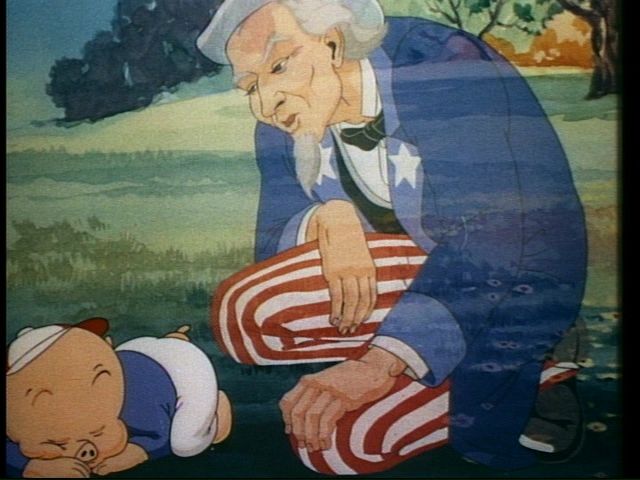
The ghost of Uncle Sam about to teach Porky Pig a lesson in Old Glory (1939)

I have a feature to blog about, but not really the time to write a full-length post on it, so I decided to look through the shorts on some of my DVDs to see if I could find anything worth blogging about. It turns out that on the disc of The Private Lives of Elizabeth and Essex that's part of the box set I bought (the same one with Dodge City), there's the interesting animated short Old Glory>

I was surprised that Warner Home Video would include a Porky Pig short on one of these cheap DVDs, but then this isn't a typical short that would have any of the Looney Tunes characters. Porky Pig starts off trying to memorize the Pledge of Allegiance (no Bellamy salute here) but, being bored with it, decides to take a nap.

Porky then has a dream sequence involving a rotoscoped Uncle Sam (voiced by Shepperd Strudwick), who teaches Porky about parts of American history that made America the bastion of liberty it is today (well, the bastion of liberty it was in 1939). All of these scenes are rotoscoped, and feature Patrick Henry (John Litel, who had played Patrick Henry in Give Me Liberty; that earlier short is in fact the source of Litel's audio here), George Washington, Paul Revere, and the Lincoln Memorial.

The rotoscoping is one of the things that makes this a strange short by Warner Bros. standards. None of the standard Chuck Jones stuff we'd see, even though he did direct. Having said that, the rotoscope animation is excellent and makes the short visually arresting to watch.

The other thing about it that's so strange is the utter lack of humor. That's by design; it's not as if the jokes failed as sometimes seems to happen when watching things 70 or 80 years after they were made. This is a straight-up patriotic history lesson, with obvious propaganda overtones.

The final interesting thing is that this came out in 1939. It's the sort of material that would have been extremely obvious to make three years later, after the attack on Pearl Harbor brought the US into World War II. It would fit in with other shorts like MGM's You, John Jones! But this one was released in July 1939, before the war begain in Europe. Granted, there's no open propaganda about any of America's future enemies. But still, this all seemed a bit out of place.

Not that the short is terrible if you know what you're getting into. As I said above, the rotoscoping is excellent. But if you're looking for Merrie Melodies/Looney Tunes humor, you're not getting it. Then again, Elizabeth and Essex is worth the price, so this extra is a bonus.
John G. Avildsen, 1935-2017

Director John G. Avildsen, who won an Oscar for directing the 1976 movie Rocky, has died aged 81.

Avildsen started his directorial career in the late 1960s, and quickly made a name for himself by directing Jack Lemmon to a second Oscar in Save the Tiger. (Lemmon won the Best Actor Oscar; he had won a Best Supporting Actor Oscar for Mr. Roberts.) In between Save the Tiger and Rocky, there was the quirky little W.W. and the Dixie Dancekings, a movie I really enjoyed but which doesn't seem to be very well remembered.

Avildsen would go on to do three of the Karate Kid movies as well as Rocky V, as if there weren't enough Rocky movies. Apparently he also did Neighbors, John Belushi's last movie and one I could never stand. And he was also supposed to direct Saturday Night Fever. There's an interesting set of movies.

Friday, June 16, 2017

A Scandal in Paris

Another recent watch off my DVR was A Scandal in Paris. It's available on DVD as part of a two-movie set of early Douglas Sirk movies, the other being the excellent Lured. So I'm OK doing a full-length post on it.

A Scandal in Paris is loosely based on the life of Eugène Vidocq (1775-1857), played here by George Sanders. The real-life Vidocq was a criminal in Napoleonic France who went straight, eventually reforming the Paris police force and starting his own private detective agency. That story is made rather more fanciful in this telling, with the later-life part about the detective agency completely ommitted.

The story begins with an exaggerated introduction with voice-over by Sanders, leading up to Vidocq's escape from jail, which is how he meets Émile (Akim Tamiroff) who becomes his lifelong right-hand man. The two make their way to the south of France to serve in Napoleon's army, which is how Vidocq meets Loretta (Carole Landis). She's the late 18th century equivalent of a nightclub singer, and she's got a garter with precious stones that Vidocq is of course going to steal.

After serving in the military, Vidocq and Émile make their way back north to Paris, meeting the Pierremont family. The father Houdon (Alan Napier) is roughly equivalent to an Attorney-General type or a European Minister of the Interior. The women in the house: the grandmother/marquise (Alma Kruger) and daughter Thérèse (Signe Hasso) have lovely jewels, and Vidocq plans to steal those. The theft creates a scandal, and the Prefect of the Parisian police, Richet (Gene Lockhart), is unable to solve it. Of course, Vidocq can. Riche resigns, and Houdon names Vidocq the new Prefect.

Of course, this was all a ruse for Vidocq, Émile, and Émile's family and friends to rob the vault at the Bank of Paris. Along the way to robbing it, however, a couple of things happen. The first is that Vidocq begins to fall in love with Thérèse. Secondly is that one day, Vidocq runs into Loretta in Paris. That would be bad enough. But far worse is that she's married to Richet! Richet knows that something is up with Loretta, and that she must be seeing another man. He sets out to find out who she's seeing, and that of course threatens to unmask Vidocq.

A Scandal in Paris is well-enough made, although it doesn't really seem like what you'd normally think of when you think of Douglas Sirk, that being the combination of lush melodrama and social commentary. This is pretty much a straightforward costume drama. George Sanders is quite good as Vidocq, as the same sort of charm mixed with stealth that he brought to so many roles is something he puts to excellent use here. Everybody else ranges from adequate to the quality you'd expect from the great character actors.

Ultimately, however, there's something I can't quite put my finger on that to me keeps A Scandal in Paris from rising above the good and well-made to the point of greatness. Perhaps Sanders is just a bit too smarmy this time. We're supposed to view him as a hero, and not a threat like his later Addison DeWitt. Hasso is also slightly off. Still, A Scandal in Paris more than succeeds in entertaining and keeping you guessing until the end.

Thursday, June 15, 2017

Thursday Movie Picks #153: Based on a True Story


This being Thursday, it's time for another edition of "Thursday Movie Picks", the blogathon run by Wandering Through the Shelves. This week's theme is movies that are based on true stories. Unfortunately, I used They Won't Forget at the beginning of the year, which is based on the trial of Leo Frank. But I've got three (well, technically four since two are based on the same event and came out within a year of each other) other movies that are worth a mention:

The Gorgeous Hussy (1936). Joan Crawford plays Peggy O'Neal, the daughter of a Washington DC innkeeper who meets and marries a naval officer. He dies at sea and Peggy later remarries Senator Eaton (Franchot Tone). Eaton is named to President Jackson's cabinet, but the other Cabinet wives don't like Peggy and this threatens to cause a scandal.

Hangmen Also Die! (1943) and Hitler's Madman (1943). Both of these movies are based on the assassination of Reinhard Heydrich, who was the Nazi governor of the protectorate of the Czech lands during World War II. The events in these movies might be a bit fresh to fans of more recent movies, because there was another movie Anthropoid released last year about the assassination of Heydrich. Hangmen Also Die! was directed by Fritz Lang, while Hitler's Madman was a low-budget affair directed by Douglas Sirk and released by PRC, the same company that put out Edgar Ulmer's movies.

Compulsion (1959). Based on the thrill killing committed by Leopold and Loeb, the names of the guilty are changed because Leopold was still alive at the time the movie was made. The two killers, college students at the University of Chicago, are played by Dean Stockwell and Bradford Dillman; they're defended at trial by Orson Welles. In the real case Clarence Darrow was the defense attorney; his name is changed too.

Wednesday, June 14, 2017

Man of the World

Another of my recent DVD purchases was the ultra-cheap Carole Lombard Glamour Collection, a box set of six movies on two double-sided DVDs. (I said it was cheap; no extras as far as I can tell.) The first of the movies I watched off it was Man of the World.

The movie is old enough that Lombard isn't the star; that honor goes to William Powell who would become Lombard's future husband. He's seen in the opening scene walking along a Paris boulevard, where he's stopped by an American abroad asking him, "I remember you! Aren't you so-and-so?" Powell insists that no, he's actually Michael Trevor, and not this other guy. And Michael actually has the identification papers to prove who he is. But the exchange foreshadows that Michael Trevor isn't all he's cracked up to be.

The next scene confirms it, or should to anybody with normal intelligence, that Michael isn't the best of people. He meets with another American abroad, Harry Taylor (Guy Kibbee). Apparently, Michael knows of a scandal sheet in Paris that prints stuff about Americans for the benefit of those Americans living in the city. They have some information on Harry that Harry wouldn't want to see in print, and Michael can fix it with the publisher that the story won't get printed. It's just going to take a tidy sum of money.

Any sane person would recognize that this is blackmail, and unsurprisingly, we later learn that Michael is one of the publishers of the scandal sheet. Harry seems too stupid to understand this, however. Not yet related, Harry is in Paris with his niece Mary (that's Carole Lombard), who is engaged to Frank (Lawrence Gray). She's lovely, and interested in learning a bit more about Paris from Michael.

Michael, meanwhile, isn't alone at the scandal sheet. He's got two partners in crime in Irene (Wynne Gibson) and Fred (George Chandler). They find out about Mary, and they want Harry to con her, because there's much more money in conning a young woman than in conning her fiftysomething uncle. Michael doesn't want to do it, but eventually does, only to find himself falling in love with her.

Man of the World is in many ways predictable, at least up until the last reel. I don't know if it's fair to call the movie formulaic if only because it was early enough that this was before there would have been a formula to follow. Still, the movie meanders slowly before getting to its destination, which I found a bit of a problem. It just doesn't sparkle the way many of the other early 30s movies about con artists; it feels a bit flat. All of the actors do a professional job, so I'm not quite certain why everything feels a bit off.

Having said that, though, the movie is one of six on a cheap box set. If you don't care for this one, you're probably going to like at least another of the six.

Tuesday, June 13, 2017

A heads-up on Marlene Dietrich night

Tonight's prime time lineup on TCM is several Marlene Dietrich movies which get varying degrees of airplay on TCM. Universal seems more willing to let TCM get the rights to the Paramounts that Universal has, but not so much the movies Universal produced back before about Universal-International. So we don't get Destry Rides Again, while we do get a couple of Paramounts from the era, including Desire at 8:00 PM and The Song of Songs at 10:00 PM. TCM has two synopses for the first movie, and that's where the heads-up comes in. Apparently the one-sentence synopsis about a rich couple marrying down instead of each other comes from the plot of an earlier movie titled Desire. If you look at Leonard Maltin's brief review when you expand the title, you'll find what IMDb agrees is the plot of the Dietrich Desire, a romantic crime movie.

In between the two features, at about 9:50 PM, is a short that I've never seen before and sounds interesting: Leo Beers, World Renowned Whistling Songster. Well, he's not world-renowned any more. This is an early Vitaphone short from 1928, and I'd guess that the title implies exactly what it's about.

This theater and booze

So the local news on TV last night had a story about how movie theaters are lobbying state government to allow them to sell alcoholic beverages. I couldn't help think of a couple of shorts in which movie theater owners talk about the public service that their theaters provided for their patrons, such as The Case Against the 20% Federal Admissions Tax on Motion Picture Theatres.

Movie theaters, at least here in New York State, aren't allowed to sell alcohol mostly because the US has wacky alcohol laws. For the benefits of non-US readers, when Prohibition was repealed with the 21st Amendment, that amendment clearly left alcohol policy up to the states. (This is why getting the wines from the TCM Wine Club delivered to your home is not an option in some states.) So we have a patchwork of laws depending on whether the producers, the distributors, or the anti-alcohol people have the biggest pull with the government. But in any case, nobody must have thought back in 1933 that people would want to have a drink while they watched a movie. Home viewing wasn't a thing outside Hollywood and the rare print collector, and dinner theater always seems to mean the stage, not a movie.

But why not try to make the movie going experience a little more like watching it at home? Heck, on weekend nights when I'm watching a DVD or something off the DVR I have a drink and some ice cream or something. And what parent forced to take their kid to the latest mind-numbing animated thing wouldn't want to get buzzed to deal with the puerile nature of some children's movies?

Sure, there are potential problems: spilled alcohol is probably just as bad as spilled soda, and the possibility of somebody getting drunk is always there. People talk to each other and yell at the screen as it is when they're quite sober. And I can't imagine the chain sixtyplexes wanting to sell alcohol to patrons anyway.

Monday, June 12, 2017

The Short Point

So I watched La Pointe Courte off my DVR over the weekend. It's available as part of a pricey Criterion Collection set, so I'm reasonably OK doing a full-length post on it.

The movie starts off with a bunch of people in a small fishing village in the south of France going about the daily things they do when they're on shore after having caught their fish; at least, that's what the men are doing. The women don't do the fishing but raise the families with lots of children in tiny homes. To add to the stress of such a life, the government is on their case as apparently they're fishing in an area the government has deemed unsafe.

None of the people in the above scene are professional actors; it's the people of "La Point Courte", which is technically not so much a village as it is a section of the French municipality of Sète, a real city on the western part of France's Mediterranean coast, and nowhere near as glamorous as the Riviera. Their little bit of land forms a lagoon, and it's in the lagoon that they do the fishing. The scenes of La Pointe Courte dealing with the fishermen and their families are pretty much like the Italian neo-realism style.

Into all of this comes a man (Philippe Noiret; his character's name is never given), who stops at the nearby train station to pick up his wife (Silvia Montfort, whose character's name is also not given; the two are referred to as "Him" and "Her"). The man was born in this town but moved north to Paris, which is where he met his wife. However, he's cheated on her and she's thought about cheating on him, to the point that she thinks the love may have gone out of their marriage and she might want to divorce him. He asked her down here to show her where he came from and presumably to help her gain a new perspective on him.

The film alternates between the lives of the villagers, with the married couple talking and talking and talking, sometime joining the two together as when the town has its water jousting festival (which is actually a real thing that still goes on to this day). Eventually the couple comes to an agreement about where their lives are going to go, and leave town while the villagers go on living as before.

La Pointe Courte is a movie that I find difficult to rate. That's largely because it's really two movies in one. Director Agnès Varda had gone down to Sète to take still photographs on an assignment, and found the place so visually arresting that she decided to make her first movie there, and this is the result. The scenes with the villagers are interesting, helped by outstanding cinematography; Varda's early career as a still photographer probably helped out in that regard. There's a lot of striking black-and-white imagery and camera angles.

But then we gets scenes of the married couple. La Nouvelle Vague translates as "The New Wave", and this movie is generally considered a precursor to the French New Wave. But the French vague can mean the same thing as the English vague, and scenes like the ones in this movie with the couple make me think that calling it the French New Vague wouldn't be so inappropriate. These scenes drag the film down and make it tedious to the point that you want them to leave so we can see more of the lives of the villagers.

If the DVD weren't so damned expensive I'd give La Pointe Courte a higher recommendation. But if you can do the streaming thing and it's on Filmstruck (I don't do streaming video thanks to a lack of bandwidth), that might not be such a bad option for watching. Because the movie really is worth at least one viewing.

Sunday, June 11, 2017

Thoughts on Adam West

By now, you've probably heard that Adam West, the actor who played Batman in the 1960s TV series, died on Friday night aged 88. West will always be remembered for that role, and for some of the other TV work that he did, but he also appeared in some serious movies. Chief among these would be a small role in the Paul Newman movie The Young Philadelphians.

West's death makes me think of some other actors who started off doing work in serious movies, but wound up becoming best remembered for roles on TV series. The best-known of these would be William Shatner, although I suppose most of the cast of Star Trek would fit here. Shatner had a smaller supporting role as an adjutant to Spencer Tracy's judge in Judgment at Nuremburg. He does just fine, although to be honest it's not a particularly difficult role. He also played one of the brothers in The Brothers Karamazov. DeForest Kelley had a slightly longer film career before Star Trek came along, mostly because Kelly was several years older.

Carroll O'Connor will be best remembered for playing Archie Bunker, but he had some pretty good film roles before that, probably most notably in Point Blank. His All in the Family co-star Rob Reiner would become a prominent director, much like Happy Days star Ron Howard.

Raymond Burr will probably always be most famous for Perry Mason, but he actually had a very substantial career playing heavies in the decade before Perry Mason, as I've mentioned when blogging about a bunch of his movies -- and he was quite good as the heavy.

It makes me wonder what would have happened to a lot of these actors had TV never come along.

Oshima double feature

Tonight's Silent Sunday Nights lineup is a pair of movies directed by Japanese director Nagisa Oshima. The first of them is Cruel Story of Youth at 2:00 AM. The second movie is Boy at 4:00 AM.

I only saw this one once almost four years ago when TCM ran it as part of the Story of Film series. It's based on a true story of a family in which the father ran a series of scams setting up hit-and-run "accidents" and scamming the innocent drivers into paying hush money to make things go away. The only thing is, the family uses their 10-year-old boy to fake the hit pedestrian.

The lifestyle means that the family has to move from one place to another, leaving the child rootless. Also, Dad treats Mom (actually a stepmother) badly, which further screws up the child. It's a disturbing but fascinating little movie. It also doesn't seem to be available on DVD, so you'll have to catch the TCM showing.