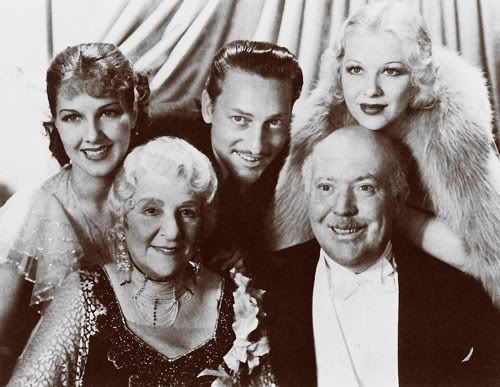
Showing posts with label Guy Kibbee. Show all posts

Sunday, August 25, 2024

Going Highbrow

Next up is another of those Warner Bros. B movies that I recorded in part because I'm always up for Warner's B movies and in part because of the cast. It being at the top of the list of movies I've watched off my DVR but haven't done a post on yet, the movie in question is Going Highbrow.

The movie starts off with an establishing shot of one of those old transatlantic luxury liners on its way back from Europe. The press interview a young Frenchwoman, until an American worms her way into the press conference. That woman is Cora Upshaw (ZaSu Pitts), who is interested in getting interviewed because she and her husband have recently made it in the business world. They're from the midwest, out in Kansas, and it's the sort of place where high society doesn't think of anybody coming from. While in Europe, the Upshaws purchased several pieces of fine are. Cora's husband Matt (Guy Kibbee), however, isn't all that interested in the trappings of wealth, as we can see from his giving his European dress clothing to one of the ship's stewards.

Meanwhile, in New York, we meet Harley Marsh (Ross Alexander). He comes from a family that used to be rich, with his mother (Nella Walker) having inherited an estate when her husband died. However, the Marshes have lost most of their cash on demand thanks to poor investing -- the movie having been released in 1935, there is still a depression on. However, they still have a fair bit of property. The manager of the estate, Augie Witherspoon (Edward Everett Horton), reads an article in the newspaper about the Upshaws, and gets an idea: perhaps the Upshaws might be interested in buying some of the paintings that the Marshes still own.

Matt, not really wanting to take part in Cora's playing for high society, and having gotten rid of the "proper" clothing anyway, he goes to a diner across the street from the Waldorf where they're staying. There he meets Sandy Long (June Martel), the waitress out the counter. She obviously doesn't believe Matt is a millionaire. But then Augie suggests one way to get into high society which Cora wants, is for the Marshes to host a debutante party for their daughter. The problem is that they don't have a daughter. That's when Matt decides that asking Sandy if she'll play the part of their daughter.

Matt takes Sandy out to get her the clothes that will make her look like a debutante, and while they're out Harley runs into her. He falls in love with her, but it takes a while for the feeling to become mutual. There are also all sorts of complications.

Going Highbrow is, somewhat surprisingly, one of the weaker of the B movies that I've seen come out of Warner Bros. Granted, I've seen worse from RKO get shown on TCM, and Growing Highbrow isn't exactly bad. But the plot here feels like the writers just bolted together a whole bunch of different plot points that had appeared in a dozen B movies of the previous half-decade.

Still, with the B-movie constellation of stars in the cast, Going Highbrow is still worth a watch.

Wednesday, April 10, 2024

Talk about bad luck in men

I don't know how many times I've mentioned it, but I'm always up for a pre-Code movie. One that I recorded a while back and thought that I did a post on, although a search of the site says I didn't, is Lilly Turner. With that in mind, I watched it again and now you get the belated post on the movie.

Ruth Chatterton plays the titular Lilly Turner, who as we see almost from the start of the movie has incredible "bad luck" in the sort of boyfriend she chooses, although at least in some cases she doesn't necessarily have much choice. Not with the first guy, however. Rex Durkee (Gordon Westcott) is a magician, and, being on the stage, is the sort of thing that seems to charm Lilly, who lives in one of those small towns that people in movies of this era always seemed to want to get away from. So, thinking Rex has made it big in vaudeville, she basically elopes with Rex against Mom's advice.

Fast-forward six months, and life on the road isn't nearly all that it's cracked up to be, as she's in one of those traveling carnivals that is struggling to make ends meet. Not only that, but Rex seems to be more interested in his assistant Hazel (Mae Busch in a small role). And then when Lilly finds out that she's gotten pregnant, Rex leaves in a hurry. Although, he's got other reasons for leaving, as we see when a process server comes in looking for him, with Mrs. Durkee in tow. Yes, there's already a Mrs. Durkee, which at least means Lilly isn't legally married and can dump him without consequences. (The baby is stillborn as a plot convenience.)

The closest thing Lilly has to a friend is one of the show's assistants, Dave Dixon (Frank McHugh), who cares about Lilly but also has the problem of being an alcoholic. The carnival boss gets fed up with that, so Dave and Lilly both leave the show, eventually winding up with a medicine show run by "doctor" McGill (Guy Kibbee) and his wife.

Part of the show involves showing how McGill's patent medicine works, and to do that, he has a "strongman" in Fritz (Robert Barrat). Fritz is thoroughly interested in Lilly, although the love is unrequited, and that fact is slowly driving Fritz insane. Literally. When taxi driver Bob Chandler (George Brent) shows up in the audience and starts making eyes at Lilly, Fritz gets some sort of "headache" that's diagnosed by a doctor as a precursor to hereditary insanity, sending Fritz to the insane asylum.

Bob takes on the strongman role, because the taxi driving is really beneath him. In fact, he's got a degree as a civil engineer, but with the depression on he hasn't been able to get any jobs in the area he's qualified for. As you can unsurprisingly guess, he and Lilly fall in love with each other. But then Fritz literally breaks out of the asylum, and comes lookin for poor Lilly....

Lilly Turner is a movie that has an absolutely bonkers plot, fitting so much into its 65 minute running time. And just when you think it's about to settle down, it gets even more nuts. Now, to be honest, for some movies that might be a strike against it, and I can't blame anybody who has a problem with Lilly Turner as a result. It probably didn't bear much resemblance to reality even in 1933. But the cast make this one so absurdly fun.

Saturday, March 2, 2024

Don't Bet on Blondes

I've posted quite often how I think Warner Bros. tended to have the best B movies. They're breezy, and often so much fun. One that I recorded because it sounded like a fun plot was Don't Bet on Blondes. Having watched it, I wasn't wrong in my presumption.

The movie starts off with a montage of sporting events, with newspapers informing us how "Odds" Owen (Warren William) sets odds on each of them. He's good at what he does, but since sports betting may not be quite legal, there are always bettors looking to scam the oddsmakers. One such cas occurs when a man comes in looking to put $2500 on a 20-1 shot in a big horse race. When the horse wins, Odds will have to pay out $50K. Except that he figures the bet was placed by the owner of the horse, who had engaged in blood doping. Don't cash the ticket, or Odds will reveal the truth.

Not long after that, Odds reads about Lloyds of London, and how they underwrite insurance policies against all sorts of oddball things. When he asks one of his assistants about this, he realizes that insurance and sports odds have a lot in common. Both of them involve analyzing data, seeing how much something has happened in the past, and then figuring out how likely something is going to happen in the future. It's also presumably more legal than sports books, although a lot more regulated.

But with that in mind, Odds decides he might just get out of the sport book game and get into being the American who sells the policies for the wacky events. (One running joke involves insuring the vocal cords of a champion husband-caller, played by character actress Maude Eburne.) In addition to being lucrative, it also brings Odds a lot of more positive publicity.

And then looking for an insurance policy is Col. Youngblood (Guy Kibbee). He's the grandson of a General Youngblood, who fought for the Confederacy in the Civil War. He's also one of those believers in the "lost cause", thinking that the South never really lost the civil war. And he's going to write a book to prove it. (I guess they had vanity presses even in the 1930s.) But he needs time to write that book, and time is money. He's getting his money from his daughter Mariliyn (Claire Dodd), a prominent actress and also frequently in the papes for her choice of date partners. If she gets married, she's going to retire from the stage, and where would that leave Col. Youngblood? So Youngblood wants to take a policy out that his daughter doesn't get married for another three years.

Odds takes the policy, and then sets about making certain that whoever dates Marilyn once is not going to date her a second time, lest he get ideas about marrying Marilyn. Odds also takes a personal enough interest in the case that Marilyn sees him on more than one occasion. After the second or third time this happens (the date in question being played by Errol Flynn just before he became a star), Odds thinks that perhaps the best strategy is to start dating her himself, with the intention that he can string her along until the policy terms expire.

You can probably guess what happens next. One is that when Marilyn shows up at Odds' office, she happens to see her father paying the premium on an insurance policy, not that she knows what it's about. The other more obvious thing is that Odds begins to find himself falling in love with Marilyn.

Don't Bet on Blondes is predictable, but Warner Bros. was good at making this sort of movie. It's also well cast, with Warren William being suave enough for the lead, and all of the character actors doing well. It only runs 59 minutes, but it doesn't feel too short. So if you can find Don't Bet on Blondes, bet on it being entertaining.

Sunday, October 29, 2023

Winner Take All

I recently recorded a couple of early James Cagney movies that I hadn't seen before. Among them was Winner Take All. I've got enough movies "recorded" to my cloud DVR that it took a while to get around to watching it, and as always, the reviews are getting scheduled a good deal in advance now that I'm more able to watch a whole bunch of movies.

Cagney plays Jimmy Kane, a New York boxer who is loved by the fans. Or a former boxer, as the announcer at the current fight tells the crowd that Kane is going west for a cure, presumably for his heart but just as much because he's been spending too much time with women and illicit booze. So Jimmy goes to a ranch out in New Mexico.

Now, there wouldn't be much of a movie if that were all that happens, so of course Jimmy meets someone of note at the ranch. That someone is Peggy (Marian Nixon), who had worked in Texas Guinan's joint, which is where she briefly met Jimmy. Peggy is in New Mexico with her son Dickie (Dickie Moore), who is really the one who needs to be out there for his health. As you can guess, Jimmy and Peggy become good friends. But Peggy is having trouble paying the bills, leading Jimmy to take up boxing across the border in Mexico to raise the money to pay Peggy's bills.

Jimmy is able to return to New York, and meets Joan (Virginia Bruce), a woman who is of a much higher social class than Peggy could ever hope to be. Jimmy is too darn stupid to realize that Peggy is the right one for him, and decides that he's going to impress Joan by taking elocution and etiquette lessons, as well as getting plastic surgery to get his face fixed, not that this is what Joan wants. She's just slumming and now that Jimmy has a normal nose again, she doesn't like it.

And yet Jimmy is still too stupid to realize that Joan is trouble and should be avoided. He starts fighting again, but does so in a way to try to protect his nose, which isn't what the fans want at all. Jimmy's trainer Pop (Guy Kibbee) brings Peggy back from New Mexico, but even this isn't enough to get Jimmy to see the error of his ways. How is Jimmy going to learn his lesson so that we can all get to the requisite happy ending? For that you're just going to have to watch.

James Cagney had already made The Public Enemy before making Winner Take All, so he was already a star and it's a bit of a surprise that Warner Bros. would put him in a movie with as slight a story as this. I'd assume that the audiences were looking to see Cagney in this sort of role. It's not terrible, but there's a reason Winner Take All is decidedly lesser Cagney. You could do worse, and it's only 67 minutes so it's not like it's a hugh time investment, but you could do a lot better too.

Monday, May 1, 2023

Jimmy Dolan's life

It's been over ten years since I recommended the pretty darn good John Garfield movie They Made Me a Criminal. It's going to be on TCM again tomorrow (May 2) at 11:15 AM. But I mention that more because the movie is a remake of another movie that I recently watched, The Life of Jimmy Dolan.

Obviously, having seen the remake, I pretty much knew the story, although there are some minor changes to the details since this one was made before the code really started cracking down. Douglas Fairbanks Jr. stars as Jimmy Dolan, a boxer who at the start of the movie is winning the light heavyweight championship of the world. Dolan has built a carefully crafted image of an erudite (at least for a boxer) man who loves his mother and lives as good and clean a life as you could expect from a boxer. Of course, none of that's true, as Jimmy goes up to see his floozie of a girlfriend and drink even though it's the Prohibition era.

Somehow, in addition to Jimmy's manager Doc (Lyle Talbot) and Doc's girlfriend Budgie showing up, a reporter shows up as well. That's the big problem, because while Doc will keep Jimmy's hypocrisy a secret, the reporter won't do so. In the heated discussion, Jimmy punches the reporter, who falls backward and hits his head, killing him immediately. Poor Jimmy, up for manslaughter if not worse.

Oh, and there's goin gto be worse. Jimmy is drunk and passes out, so Doc takes Jimmy's watch and girlfriend, and drives off. The police chase, and Doc crashes, killing him and the girlfriend, and burning them beyond recognition. The only issue is that watch, which doesn't get burned beyond recognition. This enables the authorities to make an identification, not having proper dental records, and declare that Jimmy died in the crash. And there's no good way he can come out and say that he's not really dead, because then he'll get arrested for killing the reporter.

Having been screwed over by his manager and his attorney, Jimmy becomes a tramp, heading west to parts unknown where his face won't be recognized and in theory he could get honest work, at least if there weren't a depression going on to go along with Prohibition. Eventually, having run out of money, Jimmy collapses at a small farm somewhere out west.

That farm is run by two women, Peggy (Loretta Young) and her aunt (Aline MacMahon). Peggy's aunt is a widow, having been married to a doctor who was doing charity work by taking custody of orphans who had some sort of paralytic disease (I don't think the disease is mentioned although I'd guess polio), fostering them and trying to show there are ways to nurse these children back to health. The doctor's death, however, means there's not much money left for the two women, and having another mouth to feed -- and and adult male at that -- is going to be an issue.

But at least Jimmy is able to do some of the work. And he might just be able to help the women out with their financial difficulties. A barnstorming boxer blows into town, running the scheme that dumb local schlubs put up entry fees and then get a substantial sum of money for each round they can complete against the heavyweight. Most of the amateurs aren't going to get through even one round, but of course Jimmy is a ringer, and surprisingly one that the barnstormer's manager doesn't recognize.

Still, Jimmy knows that if he goes into the ring there are bound to be people who do recognize him, especially Phlaxer (Guy Kibbee), a detective from back in New York who has been on the case because he knows there was something fishy about that car crash and is convinced it wasn't Jimmy who died in the crash.

The Life of Jimmy Dolan isn't a bad little early 1930s programmer, but I have to admit that I don't think it's quite as good as They Made Me a Criminal. I woud argue that this comes down to the casting for the lead role. As I mentioned back in 2012, John Garfield was exceedingly well cast for a role that requires some moral darkness. Fairbanks, on the other hand, was better suited to light romantic comedies, and comes across as a bit of a phony in the scenes where he's supposed to show his anger. I think the Dead End Kids in the latter film also work better than the too cute for their own good ragamuffins we have here.

Even so, The Life of Jimmy Dolan is definitely worth a watch, and you can see why Warner Bros. would want to trot this property out again for Garfield.

Monday, March 20, 2023

Life joy

Another movie that I watched off of the Watch TCM app was the 1938 romantic comedy Joy of Living.

Irene Dunne stars as Maggie Garret, the elder daughter in a family of actors. Mom and Dad (Alice Brady and Guy Kibbee respectively) spent years toiling in vaudeville, while Maggie's kid sister Selina (Lucille Ball) unfortunately doesn't have quite as much talent as Maggie, although the parents would like her to go into showbiz too. Maggie's the one who's successful, having made it into the starring role of a musical. (Irene Dunne being a singer, it's unsurprising the script would give her a bunch of opportunities to sing.)

Maggie is so successful, in fact, that she routinely has throngs of adoring fans waiting for her outside the theater every night. In that crowd is Dan Webster (Douglas Fairbanks Jr. doing is best Melvyn Douglas impersonation), who is frankly forward enough that it frightens Maggie into thinking he might be a stalker, although apparently in the late 1930s they used the word "masher" instead. But we're getting ahead of ourselves here, as there's one other issue. Despite the fact that Maggie is successful, everybody else in the family has been preying upon her success, to the point that her large even for 2023 salary is about to get attached to pay off all the debts that the family has accrued.

And boy are they an annoying family, in the mold of any number of screwball comedies like My Man Godfrey. That obnoxiousness makes Maggie's next actions nearly plausible. Dan keeps showing up and making life a bit of a pain for Maggie, to the point that she finally decides to press charges. She figures that he's going to get a nominal fine and maybe a restraining order. But the judge shows no mercy and gives Dan a six-month sentence, horrifying poor Maggie. She pleads with the judge, who comes up with the only-in-the-movies scheme to have Maggie serve as a sort of probation officer, keeping Dan responsible in exchange for Dan getting a suspended sentence.

It's fairly obvious where the movie is going to go from here, as Dan and Maggie fall in love, and the movie reaches the climax in which Maggie's relationship with Dan is going to come in conflict with the relationship she has with the rest of her family. It's also fairly obvious which relationship she's going to put first in the finale.

And that's the big problem I had with Joy of Living. The cast is all appealing enough and certainly talented, but they're let down by material that's been done too many times. That, and the script felt like it had scenes that went on much too long so there was even less there than the programmer-length running time would have you believe.

Ultimately, Joy of Living isn't a bad movie; it's just that it's well down the list for all the main players as well as being down the list of screwball comedies. There's just so much better out that that you could show to introduce people to any of the stars or genre.

Sunday, January 29, 2023

Three Comrades

In looking through the movies on my DVR, I noticed something that's coming up on TCM, so I figured I'd watch it now to do a post on it: Three Comrades, which airs at 6:30 AM January 30.

The movie starts off with an establishing shot that has the words "Nov. 11 1918" written in the clouds. Now, if you recall your history, you'll know that this was the day on which World War I ended, although at the time the movie was released it was still known as the Great War because the European theater of World War I was still a year away from kicking off. Als, if you paid attention to the opening credits, you'll have spotted the name Erich Maria Remarque, writer of All Quiet on the Western Front, so you can guess that this is written about Germans. Sure enough, we see a group of German officers and flyboys hoping that real peace can come to the world.

Among the flyboys are three who hope they can keep up their friendshpi and hope that in the new Germany they can put the skills they learned in the military to good use as auto mechanics. Those three are Erich Lohkamp (Robert Taylor), Gottfried Lenz (Robert Young), and Otto Koster (Franchot Tone). They meet up again in early 1920, and Otto actually has a car of his own, so they not only do an auto-repair business, they try to make money on the side by using the car as a taxi. While out for a joyride one day, they get in a race with a car that has a female passenger, Patricia Hollmann (Margaret Sullavan). Patricia was part of one of the pre-war noble families, but the war destroyed all that, and she's reduced to trying to get a sugar daddy (Lionel Atwill) to bankroll her.

All three of the young German friends like Patricia, but it's Erich who really falls in love with her. Eventually, he's convinced by his to try to start a relationship with Patricia, who loves Erich in return, even though Erich thinks his low social class will hurt him with Patricia. But no, she really loves him, so the two decide to get married.

The two go on a honeymoon someplace on the German coast that really looks more like the Northern California coast, but that's beside the point. It's not a happy honeymoon, however, as Patricia collapses with what is presumably tuberculosis although I don't think that's actually named in the movie. Dr. Jaffe (Monty Woolley, who only has a couple of scenes) is called in, and tells Erich that Patricia really needs to get to a sanitarium, the sooner the better.

Not that the three friends have the money for this. And they're also coming up against the political realities of early Weimar Germany. It's a volatile place, what with Germany having been defeated in the war and a lot of people chafing at the reparations, even though the real disasters of the 1923 hyperinflation still hadn't occurred. In any case, there's already political street violence, and it does eventually touch the three men. Gottfried believes in the teachings of a radical pacifist, and that's dangerous, as the proto-Fascists want to shut down such political expression, by force if necessary. (They didn't have social media giants to shut down such speech under the guise of "fake news" back in those days.) Gottfried gets shot and killed, although fortunately this is after Patricia has gone off to the sanitarium so she doesn't know about it.

What she does learn is that she needs an operation, because in those days a vague operation could apparently cure any serious illness other than cancer, which would invariably kill you within months. However, the operation involves her having to remain nearly still for weeks on end, and she may not be able to follow medical instructions....

Three Comrades is one of those movies that has all the gloss MGM could offer, although I couldn't help but feel that it was a bit of a mess. The plot twists of Patricia falling ill and then needing an operation felt more like a soap opera to me than what is supposed to be a serious film. MGM was also never the best studio to handle the sort of serious social commentary that's on offer here with the backdrop of Weimar political violence, so I felt like there was an earnest tone that didn't quite fit the material.

That having been said, there is the MGM gloss, which is definitely a sign of quality production values, while the cast also do the best they can with the material even if some of them are miscast. (Guy Kibbee in a supporting role is most definitely not German, but he's as professional as ever. And there are a lot of people who praise the movie much more highly than I do, so it's definitely worth a watch to judge for yourself.

Tuesday, March 23, 2021

Flying High

Early musicals, at least those before 42nd Street, were often a bit of an odd bird, either way too static or trying to do a little bit of everything. A good example of the latter is Flying High, which is going to be on TCM tomorrow morning at 10:45 AM.

Bert Lahr plays Rusty Krause. He's an aviation tinkerer, in that I don't think the term aerospace engineer had been invented yet. Instead, he's the sort of guy who worked as a mechanic in a small garage, and in his spare time invented something he calls the "aerocopter", which is probably like a precursor to the helicopter or the sort of autogyro you see in It Happened One Night. Rusty is at an air show, where he hopes to show off the aerocopter, but he needs a pilot, and more importantly, money.

Enter smooth-talking promoter Sport Waddell (Pat O'Brien), the sort of man who's liable to wind up in jail for his smooth talking, as one of his marks remarks. Sport might be willing to help out Rusty, but he too doesn't have the money necessary. He meets a Mr. Smith (Guy Kibbee), who could be an investor, except that he admits he has cash flow issues and can't buy the stock just yet. But meeting Mr. Smith brings Sport in contact with Smith's daughter Eileen (Kathryn Crawford), and Sport falls in love with her.

Meanwhile, working at the aerodrome is waitress Pansy Botts (Charlotte Greenwood). She's without a husband, and has just come into a modest inheritance from her uncle, so she'd even be willing to buy a husband. She's so desperate, in fact, that she's thinking of heading off to a logging camp to marry a cook there.

Sport has to work fast, and offers Pansy a husband in the form of Rusty, who is decidedly unwilling to get married. Sport, for his part, shows Pansy a photo of Clark Gable when mentioning Rusty to her, so imagine the surprise of both of them when they meet and realize they're supposed to marry each other. But they get married in time, and Rusty is able to get a pilot's license, which allows him to fly the autocopter himself -- except that Pansy doesn't want him flying off alone, joining him for the flight.

Along the way, there are several musical numbers, including two big pieces which were choreographed by Busby Berkeley, which is why the camerawork shows Berkeley's style a year and change before 42nd Street. Of course, one number in which the dancers spell out various aviators' names, really requires the camera to be overhead. There's also the pilots' license exam number, in which a doctor (Charles Winninger) examines a bunch of scantily clad women before Rusty shows up.

It's a mish-mash which doesn't always work. A little bit of Bert Lahr goes a long way, and there's a lot of Lahr here. Greenwood is underused, and the climax of the autocopter flight is deliberately unrealistic but also unfunny as a result. Hedda Hopper has a small role as Mrs. Smith.

If I were going to introduce Charlotte Greenwood to people who aren't familiar with her work, I'd probably start with The Gang's All Here; others would probably select one of the other Fox movies or maybe even Oklahoma. If I wanted to introduce one of her pre-Code movies, I'd probably pick something like So Long Letty for its bizarre plot and much greater usage of Greenwood. Flying High would be down the list a ways.

Tuesday, February 9, 2021

Big City Blues

It's been a while since I blogged about a pre-Code film. With that in mind, I fired up the DVR to watch the entertaining if imperfect Big City Blues.

Eric Linden plays Bud Reeves, who at the start of the movie is racing to catch the train from his home town of Hoopersville, IN, to go to New York City and make it big there. He was to wait for the next train out of town long enough to have a good talk with the station agent (Grant Mitchell), who himself had gone off to make a fortune in the big city 25-plus years earlier and came back, having done a bunch of different jobs and never making it big. Bud swears things are going to be different, but with a title like Big City Blues, one wonders whether that will be the case.

Bud has a cousin in New York named Gibby (Walter Catless), who frankly seems like the sort of schmoozer everybody ought to be able to see right through. For some reason, however, Bud doesn't see through him, and Gibby starts using Bud's $1100 bankroll to try to set both of them up. Gibby claims to know everybody who matters, but that is of course a load of hogwash, with all he really knows being some bootleggers and some second-rate chorus girls.

Among those chorus girls is Vida Fleet (Joan Blondell), whom Bud first meets in the lobby of the hotel where he's going to be staying. (Doesn't cousin Gibby have an apartment?) Vida has lived in New York for several years, but it turns out she too is from a small town, that being Oneida, NY. As such she understands Bud better than anybody else and even has a lot of sympathy for him, which Gibby clearly doesn't. Bud, for his part immediately falls in love with Vida and is lucky she isn't looking to exploit him.

Gibby wants to introduce Bud to more people, so he organizes a party which will be held in Bud's room. There's bootleg liquor there and a bunch of chorus girls and guys of ill repute there. (Humphrey Bogart is there, uncredited, in an early role as Shep, with his unmistakable voice.) Things get out of hand and punches are thrown, before somebody breaks a bottle of bathtub gin to throw and that kills one of the chorus girls. Everybody beats a hasty escape, with Gibby not bothering to help Bud.

Everybody who was in that room (well, except for the dead girl) is now a fugitive from justice, but Bud is the biggest one. He realizes he can't escape by bus or train, and so he goes lookin for Vida, who still has sympathy for him. Of course, the police eventually find everybody in that room, while hotel detective Hummell (Guy Kibbee) is also trying to solve the case.

Big City Blues is one of those movies that packs a lot into its brief running time of just over 60 minutes. With so many recognizable names as well as Warner Bros.' penchant for making punchy movies, it's unsurprising that the movie is elevated from being strictly a B movie. I shudder to think, for example, of what MGM would have done with the material.

That's not to say the movie is without its flaws. I mentioned early on that Gibby is so obnoxious that I couldn't imagine how anybody would be bamboozled by him, and that's what drives the movie's plot. Everything happening lickety-split also moves the film, even if that too is highly unrealistic. But overall, Big City Blues is definitely worth a watch.

Big City Blues got a DVD release on one of the Forbidden Hollywood sets.

Tuesday, August 4, 2020

The Dark Horse


Another of the movies that I recently watched off of my DVR that's availalbe on DVD courtesy of the Warner Archive Collection is The Dark Horse.

The movie opens at a state Progressive Party's convention, where the convention has been deadlocked for days on end because neither of the two candidates fro governor can get the requisite votes. (It always amazes me that parties back then didn't have rules that after a certain number of ballots, you started eliminating the candidate with the fewest votes until either somebody got a majority or there were only two candidates left.) Among the delegats is Zachary Hicks (Guy Kibbee), who seems more concerned with how tight his shoes are than with political matters of the day.

The handlers for one of the two candidates comes up with the brilliant idea of nominating an outsider from an area that supports the other candidate, so as to split the other candidate's vote and win the party nomination. The other side calls this bluff, however, supporting the "dark horse" candidate, who duly wins the party's nomination. That candidate? You guessed it, Zachary Hicks.

The party bigwigs are shocked when the start talking to Hicks and realize the sort of candidate they have, a complete nonentity who knows nothing about politics. He says one of his positions is the abolition of capital punishment, only to learn that the state abolished it six months ago. How such a man even became a party delegate is beyond me, but then we wouldn't have a movie, would we? At any rate, a secretary working for the party, Kay Russell (Bette Davis), has an idea, as she knows a good PR guy, Hal "Samson" Blake (Warren William).

There's only one problem with Blake. He's currently in jail, not having paid alimony to his ex-wife Maybelle (Vivienne Osborne). But the party bosses go down to the jail anyway and listen to Hal. They're so taken by his speechifying that they pay the back alimoney and spring him from jail to become Hick's campaign manager.

Blake proceeds to put Hicks into a series of public appearances, where Hicks comes up with his tag line, "Well yes, but then again, no", as a way of avoiding difficult questions, which for him is pretty much any question. Hicks might even stand a chance of winning when the Conservative candidate (Berton Churchill) is accused of plagiarism.

But Blake still has woman troubles. He's in love with Kay, but he keeps stringing her along to the point that she's sick of it. She knows about the ex-wife, and when Blake falls behind on the alimony again (why wouldn't the party just pay it off?), Maybelle actually shows up and threatens to have Hal put back in jail. Hicks, for his part, is so stupid that he lets Maybelle see Hal. The Conservatives learn they've got a potential weapon in Maybelle, and plan to use it.

Watching The Dark Horse, it really reminded me of another movie I reviewed several months back, William Powell's High Pressure. It turns out that this is deliberate; apparently, Warner Bros. wanted to use the High Pressure characters again but Powell wasn't interested. The Dark Horse is an interesting movie, and could have been fascinating if it had focused more on the political campaign side of the story. Unfortunately, it winds up being more about Blake, to the movie's detriment, as Blake is one of those annoying smooth operator types.

Still, this being a Warner Bros. movie, you get the good production values, a nice cast of supporting actors (I didn't mention Frank McHugh yet), and still some social commentary even if it's more limited due to the focus on Hal's character. This is early in Davis' career, so even though she's billed second, she doesn't have as much to do as you might think. The Dark Horse is definitely worth a watch.

It would be nice if The Dark Horse were part of a box set, but apparently it only seems to be available as a pricier standalone.

Saturday, August 1, 2020

The Horn Blows at Midnight


Another of the movies that I finally got around to watching in order to do a post on here is The Horn Blows at Midnight, another of those movies that's on DVD courtesy of the Warner Archive collection.

Jack Benny plays the third trumpet in an orchestra that plays for the Paradise Coffee radio show. The shtick of this show is that it's bedtime music, with an announcer hypnotically droning that Paradise is the coffee that puts you to sleep. As you can probably guess, this idiotic announcer puts everybody in the orchestra to sleep, and our third trumpeter starts having a dream sequence.

He's now in heaven, where his real-life girlfriend down on Earth, Elizabeth (Alexis Smith) is a harp-playing angel. One of the functionaries in heaven, the "Chief" (Guy Kibbee) has been looking at earth with a jaundiced eye. The planet hasn't been doing so well, what with all the war and destruction going on (the movie was released in 1945, a week after Franklin Roosevelt died). So heaven has decided that earth is going to be destroyed, by way of a horn being blown at exactly midnight.

However, the two guys who were sent down to destroy it decided they'd rather be human. Elizabeth just knows that her boyfriend (named Athanael up in heaven) is up to the job and it would give him a boost in status in heaven. So he gets sent down to earth to do it.

Naturally, problems ensue. He gets involved in an attempted robbery which, through a series of circumstances, results in a woman named Fran (Dolores Moran) trying to commit suicide. Our angel tries to prevent this and is successful, but in doing so, midnight passes.

Worse, the two guys who were sent down the previous night, the first trumpeter Doremus (John Alexander) and second trumpeter Osidro (Allyn Joslyn) decided that they wanted to stay on earth instead of destroying the planet. They've learned of Athanael's presence, and are determined to stop it by getting a hold of that trumpet.

Up in heaven, they know everything that's going on, and that earth has not been destroyed. Elizabeth offers to go down and help Athanael, and further complications ensue. Of course, as we already know, this is an obvious dream sequence running almost the entire length of the movie, so we know that the earth isn't really going to be destroyed.

Apparently the movie bombed at the box office, leading Jack Benny to joke about it on his radio and TV shows, much the way Johnny Carson would make fun of Bedtime for Bonzo because his Tonight Show director, Fred de Cordova, directed the movie. Benny joked that it was a terrible movie. But in reality, it's not as bad as he made it out to be. Sure, it's a bit of an acquired taste, and I think Benny really needs to be more of a supporting star with stronger leads around him. But it's no worse than a lot of silly plots for 1940s movies.

For people not so familiar with Benny, I'd start off with To Be or Not to Be, and then maybe go on to George Washington Slept Here. But for fans of 1940s movies, certainly give The Horn Blows at Midnight a shot

Friday, June 5, 2020

Maybe they should have tried actually being merry


TCM ran a hodgepodge of 30s movies about odd relatives and living situations some months back, and one of the new-to-me movies I recorded that day was The Merry Frinks, selecting it, because the interesting cast is headlined by Aline MacMahon and Guy Kibbee.

MacMahon plays Hattie Frink, the mother in the family. She's married to Joe (Hugh Herbert), a chronic drunk who is a sportswriter at one of the city's newspapers; which one doesn't matter because he's lost jobs from one after the other. They live with his mother (Helen Lowell), a bitter hypochondriac who wants to boss everybody around.

Worse than that, however, is the Frinks' three adult children. Emmett (Allen Jenkins) is a communist lawyer (complete with portrait of Stalin; imagine Hollywood trying to portray a Nazi lawyer complete with portrait of Hitler with such a gentle touch) who loudly spouts slogans and lost his office for non-payment of rent. Then there's daughter Lucille (Joan Wheeler), who fancies herself a singer and has a sleazy boyfriend she insists is going to get her an audition at the radio station. Finally, there's Norman (Frankie Darro), who technically isn't an adult since he still has to go to school but skips every day.

Into all of this comes Uncle Newt (Guy Kibbee), who is presumably Grandma's brother-in-law. Nobody's seen Newt in decades, and here he is on their doorstep with all of his trunks claiming to have been in New Zealand after a lifetime spent in other places that would have seemed incredibly adventurous back in the early 1930s. Newt likes Hattie as the only relatively normal and nice member of the family.

So it shouldn't be much of a surprise that when New dies suddenly, it's revealed that he rewrote his will. In fact, he had spent all that time in New Zealand and the other places, and has a good half million (in 1930s dollars) in stock, which he leaves entirely to Hattie. But there's a condition that would never have stood up in probate court, I think. She has to abandon the rest of the family, never to see them again.

She's happy to do so, living a life she could never have dreamed of before. And unsurprisingly, the rest of the family falls to pieces without Hattie around, and wants her back.

There's a good premise behind The Merry Frinks, but a serious problem. All of the Frinks other than Hattie are beyond obnoxious, to the point that you want them to suffer and Hattie never to see them again. Their obnoxiousness goes on far too long before Guy Kibbee shows up, and he's not in the movie nearly long enough.

The Merry Frinks is on a double feature DVD with Big-Hearted Herbert, another movie starring MacMahon and Kibbee. That one is far better.

Wednesday, December 4, 2019

While the Patient Slept


Quite a few years back, I mentioned that Warner Bros. put out a series of short mystery films as part of a cross promotion called the "Clue Club" mysteries. The movies aren't related to each other in any other way, but one of those B mysteries showed up on TCM recently: While the Patient Slept.

An elderly businessman is believed to be on the verge of death, and all of his relatives as well as some other important people like his lawyer are at his mansion waiting for him to kick the bucket. He gets a telegram with some unexpected news, and this causes him to have a stroke -- but the stroke doesn't kill him. So the old man's doctor sends over Nurse Keate (Aline MacMahon) to take round-the-clock care of the old guy.

Needless to say, all the man's relatives want to talk to him; they're all cousins to one another. One guy is calling in an outstanding loan; there's also the old guy's lawyer, and so on. The old guy is in bed in a bedroom that seems to have been converted from a library or something because it seems to be way too big and right off the greatroom. So in any case there's a lot of traffic outside his room.

And then, suddenly, a shot rings out! And one of the cousins dies! And pretty much everybody in the house could have been a suspect. The police send over Detective O'Leary (Guy Kibbee), who obviously has a past relationship of some sort with Keate, and not just because MacMahon and Kibbee had starred together in Big Hearted Herbert a year earlier. As O'Leary tries to solve the case, he and Keate trade one-liners, helped by the fact that O'Leary's deputy is played by comedic character actor Allen Jenkins.

To be honest, I'm being a bit vague on the plot largely because the plot isn't the real reason to watch this one. It doesn't really matter who did it, because the real reason to watch it is the banter between MacMahon and Kibbee. They're both in good form, although they'd probably be in better form with a more original plot. The rest of the cast of character actors is professional but not something you're going to remember years from now.

While the Patient Slept is the sort of movie that belongs on a box set, although as far as I can tell it's only available on a standalone DVD from the Warner Archive collection.

Wednesday, October 2, 2019

High Pressure


I mentioned some time back that I picked up a box set of William Powell at Warner Bros. since I hadn't ctually seen any of the movies on it. I recently sat down and watched another selection off of it, High Pressure.

Powell plays a man named Gar Evans doesn't show up at first; instead, his friend Mike Donahey (Frank McHugh) is looking for him on behalf of another man, "Colonel" Ginsburg (George Sidney). It seems as though Gar has been on the bender to end all benders, and nobody knows where he is, especially not his long-suffering girlfriend Francine (Evelyn Brent).

The "Colonel" wants to find Gar because Gar is a business promoter, and Ginsburg has come across a great invention that just needs venture capital: an inventor has figured out a way to take sewage and turn it into synthetic rubber. It's an idea that's guaranteed to make millions, if it will pan out. And one of the catches is that the inventor has gone missing. But more importantly right not, the first thing is setting up a business and making it look as though there's a lot going on.

You see, Gar is a rather less than honest promoter, skirting the edge of illegal activity. As part of that skirting, he does like Warren William in Lady For a Day and hires a bunch of Runyanesque characters to work in executive positions under him, most notably Clifford Gray (Guy Kibbee) to be the president of the new company. There's also a secretary (Evalyn Knapp) who's secretly engaged to a man Gar takes on as a salesman; these of course were the days when women commonly quit working once they got married. As for Francine, she's Gar's good luck charm, but she's finally decided to leave Gar for good and marry another man -- if Gar can't sweet-talk her out of that.

As I said earlier, the inventor is nowhere to be found, so the folks from the natural rubber companies don't believe this ridiculous scheme is real. (To be fair, the movie was made before the invention of nylon, so synthetics outside of the hard plastics weren't quite so well known.) And if they can't get proof, they're going to go to the authorities and have Gar's stock float be stopped as fraudulent.

High Pressure is a movie that's firmly a product of the early 30s, with the Depression going on and get-rich quick schemes and shady stock schemes being things. For me, the movie barely worked, almost entirely thanks to the energetic performance of Powell. This is the sort of material that I'm often not a fan of since Gar is such a shady character. It's not quite what I call the comedy of lies, but it's close. Also, Ginsburg and the inventor (once he's found) are irritating characters. Finally, I would have liked a different ending.

Still, High Pressure is part of a box set, and some of you will probably like it more than I did, so I'd certainly recommend giving the movie a try.

Tuesday, April 16, 2019

Blonde Crazy

A few weeks back Blonde Crazy was on TCM. I was going to do a post on it then as I thought I had it on DVD courtesy of that Warner Gangsters collection I've mentioned several times. It's not in that box set, but it is in one of the Warner Bros.' Forbidden Hollywood pre-code sets, so I DVRed it and watched it to do a post now.

James Cagney plays Bert Harris, who at the start of the movie is a bellhop in a hotel in a smaller city somewhere. Anne (Joan Blondell) comes in looking for a job as a maid, and Bert is so smitten by her beauty that he tries to get her that job despite another bellhop already having put in a good word for his girlfriend. Anne doesn't particularly care for Bert at first, as seen by the fact that she slaps him on multiple occasions! But she gets the job.

Bert is a smooth operator, conning dishonest people and keeping a scrapbook of various con jobs. After conning dirty old traveling salesman Rupert (Guy Kibbee), and getting help from Anne, they move to the bigger time, where they meet Dapper Dan (Louis Calhern). Dan is much more worldly than Bert, and is able to fleece Bert with little difficulty. As a result, Anne leaves Bert when she meets nice stockbroker Joe (Ray Milland), this being the era when stockbrokers were part of high finance.

Bert plots revenge on Dan, and eventually gets it, while Anne learns that Joe isn't as nice as he seemed, having embezzled a large sum of money from the firm's safe. Anne convinces Bert to rob the rest of the items in the safe, the theory being that if everything is missing, then nobody will figure that there were two heists and Joe stole that money. Things don't quite work out as planned....

Blonde Crazy is a lot of fun, although it does begin to lose steam in the second half. The first half has, as I already mentioned, Blondell slapping Cagney. But it's also got a scene of Cagney asking Blondell where her half of the money they've "earned", and her, in the bathtub(!) telling him it's in her brassiere. Cagney then proceeds to examine Blondell's underwear!

If you want to have fun with a pre-Code, you could do a lot worse than James Cagney and Joan Blondell. I prefer some of their other work, but Blonde Crazy isn't bad at all.

Wednesday, June 14, 2017

Man of the World

Another of my recent DVD purchases was the ultra-cheap Carole Lombard Glamour Collection, a box set of six movies on two double-sided DVDs. (I said it was cheap; no extras as far as I can tell.) The first of the movies I watched off it was Man of the World.

The movie is old enough that Lombard isn't the star; that honor goes to William Powell who would become Lombard's future husband. He's seen in the opening scene walking along a Paris boulevard, where he's stopped by an American abroad asking him, "I remember you! Aren't you so-and-so?" Powell insists that no, he's actually Michael Trevor, and not this other guy. And Michael actually has the identification papers to prove who he is. But the exchange foreshadows that Michael Trevor isn't all he's cracked up to be.

The next scene confirms it, or should to anybody with normal intelligence, that Michael isn't the best of people. He meets with another American abroad, Harry Taylor (Guy Kibbee). Apparently, Michael knows of a scandal sheet in Paris that prints stuff about Americans for the benefit of those Americans living in the city. They have some information on Harry that Harry wouldn't want to see in print, and Michael can fix it with the publisher that the story won't get printed. It's just going to take a tidy sum of money.

Any sane person would recognize that this is blackmail, and unsurprisingly, we later learn that Michael is one of the publishers of the scandal sheet. Harry seems too stupid to understand this, however. Not yet related, Harry is in Paris with his niece Mary (that's Carole Lombard), who is engaged to Frank (Lawrence Gray). She's lovely, and interested in learning a bit more about Paris from Michael.

Michael, meanwhile, isn't alone at the scandal sheet. He's got two partners in crime in Irene (Wynne Gibson) and Fred (George Chandler). They find out about Mary, and they want Harry to con her, because there's much more money in conning a young woman than in conning her fiftysomething uncle. Michael doesn't want to do it, but eventually does, only to find himself falling in love with her.

Man of the World is in many ways predictable, at least up until the last reel. I don't know if it's fair to call the movie formulaic if only because it was early enough that this was before there would have been a formula to follow. Still, the movie meanders slowly before getting to its destination, which I found a bit of a problem. It just doesn't sparkle the way many of the other early 30s movies about con artists; it feels a bit flat. All of the actors do a professional job, so I'm not quite certain why everything feels a bit off.

Having said that, though, the movie is one of six on a cheap box set. If you don't care for this one, you're probably going to like at least another of the six.

Sunday, May 28, 2017

Laughing Sinners

Another movie I watched off my DVR because it's available on DVD courtesy of the Warner Archive Collection is Laughing Sinners.

Joan Crawford plays Ivy Stevens, whom we see at the beginning of the movie rushing to catch a train back to one of the midwestern big cities. She's got a job as the lead act in a nightclub. She's also catching the train because her boyfriend Howard (Neil Hamilton), nicknamed "Howdy", is on it. Howdy is a travelling salesman along with several of his friends like Fred (Roscoe Karns) and Cass (Guy Kibbee).

Anyhow, poor Ivy doesn't know that back in his hometown, Howdy has gotten engaged to a wealthy man's daughter, and that Howdy is planning to let her know that he's dumping her for the (only seen in a newspaper photo) rich woman. This devastates Ivy, to the point that she doesn't want to dance any longer despite attempts from her friend Ruby (Marjorie Rambeau) to change her attitude.

Eventually, Ivy decides she's going to end it all by jumping off a bridge, and we see a scene reminiscent of the one at the beginning of Mildred Pierce. Only this time, there's no cop to bank his nightstick against the railing. Instead, there's Carl (Clark Gable), a Salvation Army officer. He sees what Ivy is about to do, and convinces her not to do it. He also tells Ivy that the Salvation Army folks are holding a day out in the park for the disadvantaged kids, and he'd love it if she came along to help. We wouldn't have much of a movie if she didn't help out, and she finds that she likes what the Salvation Army is doing, to the point that she joins herself and starts going from town to town with Carl and the rest of his merry men and women.

Now that Ivy is an itinerant worker of sorts, we know that sooner or later, she's going to wind up in the same town as Howdy. And wow is Howdy a creep when he sees Ivy in the Salvation Army band. He hounds her in her hotel room until she joins him, and he tries to put the moves on her, convinced that she'll start being his mistress again if only she gives him another chance! And surprisingly, she gives in. Can Carl save her soul again?

Laughing Sinners is an odd little movie. Who would ever have expected either Clark Gable or Joan Crawford to play Salvation Army workers? And Neil Hamilton as a creep? Crawford is clearly more in her element when she's the dancer, even though she can't dance to save her or anybody's soul. But she tries, bless her heart, and her dance numbers in any film are worth it for that. This one has her in backless overalls, with detachable legs for the second half that's surprisingly revealing.

The film itself lurches from place to place and the pacing is all wrong, going from tedious to overwrought in the blink of an eye. If it weren't a Clark Gable/Joan Crawford movie, there would really be no reason to watch it. It's too bad that the movie only seems to be available on a standalone DVD as the Warner Archive DVDs are overpriced. This is another one that needs to be part of one of those four-movie sets along with some other dancing Joan Crawford pre-Codes.

Thursday, March 5, 2015

Guy Kibbee in Central Park


That's Guy Kibbee on the bottom right, although Lady For a Day isn't one of the films airing tomorrow

Tomorrow, March 6, marks the brith anniversary of Guy Kibbee, who showed up in lot of movies in the 1930s. TCM will be spending the morning and afternoon with a bunch of those 1930s movies, such as Central Park, at 7:30 AM.

The various studios made a couple of interesting "day in the life" movies back in the early 1930s, in an attempt to cast as many of their stars as possible. MGM did Grand Hotel, while Warner Bros. rushed Union Depot into production. Central Park is somewhat along those lines, with a bunch of intersecting plots set in Central Park, except that it's much more of a programmer than a prestige movie.

Joan Blondell plays Dot, an out-of-work actress looking for food in Central Park -- remember, there's a depression on. She meets Rick (Wallace Ford), an out-of-work transplant from Texas. Guy Kibbee plays Charlie, one of the cops patrolling the park. As for the plots, you know that Dot and Rick are going to fall for each other; what else could a movie like this have them do? But Dot also gets involved with gangsters, at least unwittingly. Dot enters a beauty pageant not knowing that it's really a front for those gangsters. The prize is taking part in a charity event at the Central Park Casino which the gangsters are going to rob; Dot's presence will alert the gangsters as to where the money is.

Rick, meanwhile, gets a job washing to police motorcycles, and being generally helpful to Charlie. This is good news for Charlie, because he's got a secret. He's a week or so away from the proverbial 20 years you need for a pension, but he's going blind, and if hte police find out they'll fire him and he won't get his pension. So he just wants to last one more week. Charlie's life is about to get more difficult, though, when one of the former keepers from the Central Park zoo, who had gone nuts and wound up in a mental asylum, escapes, and lets one of the lions loose!

As you can see, there's a lot going on here in this little picture. Where Grand Hotel is nearly two hours, Central Park is a breezy one hour. The result is a movie that doesn't have a whole lot of character development, but winds up being reasonably entertaining, just because Warner Bros. seemed to have the formula down already. That, and the presence of Joan Blondell and Guy Kibbee.

I don't think Central Park has been released to DVD yet, not even from the Warner Archive.

Thursday, January 1, 2015

Big-Hearted Herbert

TCM is going to be showing a bunch of 1930s B movies tomorrow, and a couple of them are worth mentioning that I haven't blogged about before. The first of these is Big-Hearted Herbert, at 7:15 AM.

Guy Kibbee stars as Herbert Kalness, the patriarch of one of those midwestern small cities that populated movies of the 1930s before everybody migrated to California or the South and the place became the Rust Belt. Herbert started at the turn of the century working at the bottom as a gopher and working his way up to the point that he now runs his own successful plumbing supply business. He did all this without the benefit of a fancy college education, and as such he feels that everybody else can succeed too without going to college. That, and without the benefit of lawyers, whose sole purpose he sees as trying to make him pay more to the rapacious tax man.

Meanwhile, at home, Herbert has a kindly wife Elizabeth (Aline MacMahon) and three kids. All of them are about to present problems for Herbert. Alice (Patricia Ellis) is all grown up, and she's met and fallen in love with Andrew (Philip Reed). They want to marry, and Andrew is about to bring his family over to the Kalness place to make the big announcement, but there's a problem: Andrew is going to become a lawyer! Andrew's parents are also of a rather higher social class than the Kalnesses. Not that this is a problem for them, but for Herbert Kalness it certainly is! Elder son Herbert Jr. (Junior Durkin) is in high school, and Dad is planning for him to go into the family business. However, Junior wants to go to -- gasp! -- college! -- and become an engineer. Younger son Robert threatens to eat Dad out of house and home, or at least so Dad fears.

Andrew and his family come over for dinner, and unsurprisingly, the result is a disaster as Mr. Kalness shows himself to be such a blowhard that Andrew's parents are turned off by Herbert's constant talk about "plain living" and ranting about lawyers and college. Who could blame them? Elizabeth, of course, knows that she's married to a man who really is a good guy deep down inside, it's just that you have to get to him in the right way. That opportunity shows itself a few days later when Herbert announces that he's got an important client in town. He's been going on about plain living, so Elizabeth gets the kids together and decides they're going to show these clients what plain living really means. Ultimately Herbert learns his lesson: this is a comedy, and you can't expect anything less. Everybody lives happily ever after and we fade to the end.

Big-Hearted Herbert is a B comedy all the way, but it's well-made an entertaining. When I first watched it, it felt a lot like watching a TV sitcom from 20 years later, lengthened to push the running time past an hour. Indeed, when Aline MacMahon's character gets the idea ot have her and the kids show Dad real plain living, she gathers the kids together and whispers the plot to them such that the audience cannot hear, something that would become a staple on later sitcoms. I can just imagine Lucy Ricardo whispering like that to Ethel Mertz like that on I Love Lucy. Guy Kibbee is good at playing blustery, although some reviewers might find his bluster a bit too much. MacMahon is the emotional center of the family, and she does a good job of portraying the loving and patient mother. Everybody else is good enough, not detracting from the proceedings. Big-Hearted Herbert may never be mistaken for an all-time great movie, but it's more than worth a watch.

I don't think Big-Hearted Herbert is available on DVD, not even from the Warner Archive.

Edit: I misread the TCM schedule; it turns out that Big-Hearted Herbert is in fact available from the TCM Shop as part of a two-movie Aline MacMahon/Guy Kibbee set.