So I watched The Ear this morning, a Czechoslovak movie about a couple being spied upon that reminded me at times of The Confession. Unfortunately, the movie only seems to be available on DVD in Europe, and I'm not certain if that DVD is even in print. So I can't do a full-length post on it, which is a shame since it's an interesting movie.
Anyhow, tomorrow is the first day of a new month which means some movies back on FXM Retro after an absence. Tomorrow at 7:15 AM, FXM Retro is running Tall, Dark, and Handsome. Cesar Romero plays a 1920s Chicago gangster who meets a pretty lady (Virginia Gilmore) in the park and decides he wants her close to him. However, that would mean hiring her as a governess... and he doesn't have any children. So he hires a boy to play the part of his son, and that boy, well, is a holy terror. And there are the other competing gangsters.
If this sounds familiar, it probably should. Tall, Dark, and Handsome was released in 1941. Nine years later, Fox decided it would remake the property, and I've blogged about that movie, Love that Brute before. I really enjoy Love that Brute, although that may be in part because I'm a Paul Douglas fan. I can't recall whether I've actually seen Tall, Dark, and Handsome before.
Sunday, April 30, 2017
Where Have I Seen This Before?


Saturday, April 29, 2017
Two Way Stretch
I was thinking of what to blog about today, and decided I'd look through my DVDs for something I haven't blogged about before, ultimately deciding on Two Way Stretch, off the same Peter Sellers box set as The Smallest Show on Earth, which I blogged about seven weeks ago.
Sellers plays Dodger Lane, whom we see at the beginning in a relatively cushy prison cell along with cellmates Price (Bernard Cribbins) and Knight (David Lodge). Part of the reason why it's so cushy is because the head of the guards, Jenkins, is a pushover who has an eternally optimistic view of the prisoners and their capability for rehabilitation. To that end, he's aided by the warden, called the Governor in British English (Maurice Denham). The Governor is even bringing in a welfare group to show them how good the prisoners are, unaware that they're taking severe advantage of him.
And then the Governor has a visitor for Lane: Stevens, Lane's vicar from his old parish (Wilfrid Hyde-White). Except that, from the way Lane responds to seeing the vicar, it's clear that the vicar and Lane have some problems in their relationship. Indeed, the vicar isn't a vicar at all, but a fellow criminal in the same gang as Lane, Price, and Knight. And Stevens was the only one with an alibi for the last heist, which is why he's a free man and they're in prison. But he's got a brilliant idea. Some sultan is coming to pick up his diamonds that he stores for safekeeping in the UK, and Stevens and the gang are going to steal the diamonds during transport. There's only one catch: Lane and his cellmates need to break out of prison for the heist, and then smuggle their way back into prison, so that they have an airtight alibi. (The prisoners are scheduled to be released on completion of their sentence soon, but after the transport that will result in the heist.)
With the Governor and Jenkins, getting out will be easy. So of course there's going to be a snag, which is that Jenkins is past retirement age, but has stayed on mostly because there's nobody to replace him. Only now, there is somebody to replace him, and Jenkins will soon be leaving. He's going to be replaced by Crout (Lionel Jeffries), who is an over-the-top martinet and brooks no nonsense from the prisoners in his charge. Getting out under Jenkins' watch would have been a breeze, but under Crout's watch? That's a problem.
There's nothing earth-shattering, ground-breaking, or even of any great significance, in Two Way Stretch. All it is is a jolly good ride. The movie was made in the pre-Strangelove stage of Sellers' career, when his characers weren't the irritating things you want to smack and which make some of the later movies nearly unwatchable. And he's got a wonderful supporting cast of British character actors, to the point that this is almost more of an ensemble cast than a Sellers vehicle. The gags almost uniformly work and don't insult the viewer's intelligence, even if there's relatively little new here. I particularly enjoyed the one involving distracting the guard supervising prison visits.
As I said back in March, the Peter Sellers box set is being sold at a fairly moderate price on Amazon. For that price, the films are more than worth it.
Friday, April 28, 2017
About Mrs. Leslie
Almost a year ago, I briefly mentioned the movie About Mrs. Leslie. It's running on TCM again tonight at midnight, and is worth a watch.
Mrs. Vivien Leslie (Shirley Booth) is a now unmarried woman living in Los Angeles, running a rooming house. Among her roomers are an older couple who are only in town to deal with a relative in hospital, a young woman who wants to make it in Hollywood and seems to be a party girl, and a young man who would probably be better for the young woman, but does he have the gumption to convince her of it? Vivien tries to make everybody's lives a little less humdrum in her own subtle way.
Meanwhile, there's the story of how Vivien wound up in Los Angeles. Fifteen year ago, before World War II, she was working as a nightclub singer in New York (yeah, Shirley Booth of the 1950s as a nightclub siren). Into the nightclub come a couple of businessmen, including George Leslie (Robert Ryan). George is captivated by Vivien, and Vivien seems flattered by the man's erudition. He makes her a strange offer: accompany him on a trip to California for six weeks, and after that time they'll go their separate ways.
Amazingly, she takes him up on the offer, and unsurprisingly, the two fall in love. But there's a catch: George Leslie is only using his first and middle names. His last name would give the game away as he's in the news and once the war comes he's one of those people who serves the government by offering his expertise free of charge, like the Charles Coburn character in The More the Merrier. And he's already married into a prominent family. Of course Vivien finds out eventually, but what will that do to their relationship? And what will happen to the folks in her romming house and the girl next door?
It's with good reason that TCM is running About Mrs. Leslie as part of the Spotlight on post-war melodramas: boy does this one fall into that category. It's actually not a bad little movie however. That probably has a lot to do with the two leads, both excellent actors who could rise above less-than-stellar material. And the material here is at times less than stellar. Most of the screen time is given to Booth, with Ryan close behind; the stories of the rooming house tenants are decidedly secondary, thankfully.
I'm not certain if About Mrs. Leslie has ever been released to DVD, so you'll have to catch the rare TCM showing.
Thursday, April 27, 2017
Thursday Movie Picks #146: Police (TV Edition)

This being Thursday, it's time for another edition of "Thursday Movie Picks", the blogathon run by Wandering Through the Shelves. This week is that week of the month where the theme focuses on TV shows, and this month it's TV shows about cops, and I've picked a couple of older shows:
Ironside (1967-1975). Raymond Burr, who had been the heavy (no pun intended) in a whole bunch of movies in the 1940s and 1950s, and usually excellent in that role, did a volte-face in the late 1950s when he played defense attorney Perry Mason. After that show wrapped, Burr moved on to playing Ironside, the head of the police detectives who solved cases from his wheelchair rather than going on disability. I think I actually learned about Burr from this show before learning about Perry Mason or his movie work, since this was syndicated and we'd watch it when Grandma was babysitting us.
T.J. Hooker (1982-1986). What William Shatner did when he wasn't doing Star Trek movies. The intro above is a very early episode, since Heather Locklear hadn't come on yet; she would be in the cast by the middle of the first season. And what ever happened to Adrian Zmed?
The Dukes of Hazzard (1979-1985). One in which the cops, influenced by corrupt Boss Hogg, are the bad guys. Character actor James Best played Sheriff Roscoe P. Coltrane, and future Congressman Ben Jones played Enos (and got a spinoff series). Of course, the series might be best known for Daisy Dukes, the cut-off short shorts worn by the Catherine Bach character.
Jonathan Demme, 1944-2017
The death has been announced of Oscar-winning director Jonathan Demme. Demme, who won for directing Silence of the Lambs, was 73.
Directing Silence of the Lambs obviously means that Demme directed a couple of actors there to Oscar wins, since the movie took all the big awards that year. But Demme directed other stars to Oscar wins as well. I think the first was Mary Steenburgen in Melvin and Howard, a movie about Howard Hughes' controversial will and the people around Hughes at the end of his life. That came about a decade before Silence of the Lambs.
A couple of years after Silence of the Lambs, Demme directed Tom Hanks to the first of his Oscar wins in Philadelphia, although the less said about that movie the better since I find it terrible: it makes Guess Who's Coming to Dinner look subtle.
I wonder if Demme would have been offended if we celebrated his life with some fava beans and a nice chianti.
Wednesday, April 26, 2017
The Younger Generation
TCM is running a bunch of Ricardo Cortez movies on Thursday. A search of the blog claims that I haven't done a full-length post on The Younger Generation before, and it's a really interesting little movie.
The Goldfishes are a Jewish immigrant family led by patriarch Julius (Jean Hersholt). He's got a wife Tilda and two children, son Morris (Ricardo Cortez) and daughter Birdie. They, like a lot of Jewish immigrants of the early 20th century, live in the tenements of lower Manhattan, where Julius works as a peddler, buying and selling stuff from a push cart.
Immigrant parents want their children to have a better life, and to that end, Morris starts from the bottom in childhood as a paper boy, while Birdie wants to marry her sweetheart Eddie, a budding musician. Morris grows up to become a second-hand dealer, and then a dealer in antiques, making good for himself and being able to move uptown.
There's a catch, however. When you talk about the "polite" society uptown, it really means Gentile society. And the Goldfishes are Jews. Morris is anxious to fit into that society enough that he's willing to change his surname. And then he brings his parents uptown, only for them to find they don't necessarily like polite society. Meanwhile, Eddie is about to get in a legal jam....
The Younger Generation is a very early Frank Capra movie. So early, in fact, that it's only a partial talkie. The movie was conceived back in the silent days, but with the release of The Jazz Singer (a movie with similar themes that also happens to be a partial talkie), studios realized that talking pictures could work. So they did some of the scenes as sound, and the result is a mix of silent and talking picture, something that's always interesting even if it doesn't always work.
In the case of The Younger Generation, it does more or less work, although the themes play almost as tropes and there's a lot of melodrama. I don't think the movie has ever been released to DVD, so you'll have to catch the exceedingly rare TCM showing. It's worth a viewing, too.
Tuesday, April 25, 2017
Another set of new-to-me shorts
Coming up early tomorrow (or overnight tonight depending on your point of view) on TCM, you can catch Holland Sailing at 3:35 AM following Tea For Two (1:45 AM, 96 min). Given the date (1956) and the subject (boat racing in the Netherlands), I figured this had to be another of the RKO Sportscopes I've mentioned on the site before. Sure enough, IMDb says that's what it is. Specifically, they say it's #6 from the 1956-57 season, which makes me wonder just how many of these Sportscopes were made. I'm sure there's a complete list somewhere but up until now I haven't bothered to look for it. I just did a cursory search, and couldn't find much.
I was only going to mention two shorts, but I just noticed earlier in the overnight, at about 1:25 AM, there's Mr. Whitney Had a Notion. From the title and date (1949), my first guess was John Nesbitt's Passing Parade, confirmed by looking at IMDb. (Passing Parade No. 71, no less; my goodness a lot of these were made.) But I mention this one about Whitney's invention of the cotton gin because the part of Eli Whitney is played by... a young Lloyd Bridges.
The other short I had planned to mention is For Your Convenience, at 7:34 AM after Speedy at 6:00 AM. The subject here is inventions that presumably make things more convenient, and since it's from 1939, my conclusion was that it's another Pete Smith short. But it's not. It's from Warner Bros. And it's in color. Unfortunately, the one IMDb reviewer claims it's not any good.
Monday, April 24, 2017
Back on FXM Retro: April 24-25, 2017
For some reason, I thought I had mentioned recently that The Roots of Heaven is bck in the FXM Retro rotation, as it's been running for a month or two. It's going to be on at the end of this morning's FXM Retro block, at 12:50 PM, and then starting tomorrow's at 3:30 AM.
Coming on immediately before today's airing of The Roots of Heaven is Guns at Batasi, at 11:05 AM today. Both movies are overlooked, although you could argue that The Roots of Heaven deserves to remain overlooked.
Both movies have received DVD releases in the past, and The Roots of Heaven even got a Blu-Ray release. It's also available from Amazon's streamin service. I don't think the DVDs are still in print, however.
Sunday, April 23, 2017
L'aveu
This morning I watched The Confession on my DVR, having noticed that it's available on DVD courtesy of the Criterion Collection. You can get it at Amazon and the TCM Shop, although being the Criterion Collection, it is a bit pricey. If it shows up again as a TCM Import, watch it.
The movie starts off in Prague in early 1951. Gérard (Yves Montand), nom de guerre of Artur London, is an undersecretary at one of the Communist government ministries, and a dedicated Communist. The movie is based on the real-life story of Artur London, and in one scene in the movie the character of his wife Lise (played by Simone Signoret) is referred to as Londonová which would be the proper Czech surname for her, but IMDb and my box guide refer to Gérard's actual name as Anton Ludvik. For what it's worth, the character is almost exclusively referred to as Gérard. Anyhow, when Gérard leaves the office for home, he notices he's being followed by another car. And it's been going on for a couple of days.
So that night at his house he meets several other Communists with whom he shares something in common: they all fought in the International Brigades in the Spanish Civil War against the Falangists/Fascists. Although they fought against Fascism, and some of them including Gérard wound up spending time in Nazi concentration camps as a result, they're all in danger. As we learned from the movie Dark Blue World, those who fought Fascism on the western front came back to Czechoslovakia not to be hailed heroes, but considered enemies of the state by the Stalinist Communists. Such was eventually to be the case for the International Brigade members, too.
Gérard finally gets picked up off the street one day and taken to a special prison, where he's subjected to torture in the hopes of extracting a confession from him. He's not the only one, of course, and any time one of them makes a confession, regardless of whether the confession is at all truthful, that material can be used against the others. Artur seems to hold out the longest, because the film implies he was arrested in January 1951, while the show trials were held in November 1952.
We know he survives, however, because halfway through the movie the action briefly switches to France in 1965 and Gérard is seen telling his story and being told he should write a book about it. That did eventually happen and the movie is the result of that book.
The Confession was directed by Costa-Gavras, and as I was watching it I couldn't help but think of the similarites to his previous movie Z. They both deal with political intrigue and totalitarianism, and both of them have a slightly non-linear storytelling process that at times makes you question reality. Having said that, I'd introduce people who aren't well-versed in foreign films to Z first. The reason is that The Confession is unrelentingly brutal, in a way that really made me uncomfortable at times. Oh, the movie is well made, and Montand and Signoret are both quite good; it's just that the totalitarianism is harsher and more disturbing here than in Z, making it a bit harder to watch. At least for me. As I said at the beginning, however, definitely make it a point to watch it if it ever shows up on TCM again or if you can do the streaming thing; Amazon seem to imply it's available from them courtesy of streaming as well as DVD and Blu-Ray. It's too bad that Criterion price their DVD's so expensive.
Saturday, April 22, 2017
Inside the Walls of Folsom Prison
So I watched Inside the Walls of Folsom Prison off my DVR this morning since I saw it's available from the Warner Archive. It's worth a watch, but I don't know that it's worth buy at Warner Archive prices.
The movie starts off with an overview of California's Folsom State Prison, and a narration from the point of view of the prison itself of how conditions were much more inhumane in the past. Cut to the 1920s, and a prison riot in which they take one of the guards and Warden Rickey (Ted de Corsia) hostage. The riot, of course fails, and the warden concludes that the way to get people to stop rioting is to be more brutal, which gets a reporter to show up for one throwaway scene.
That reporter is apparently what leads to the state authorities taking notice of the prison conditions, because they decide to send a new man Benson (David Brian) to head up the prison guards. Benson is a college man, and has "modern" ideas on how to treat prisoners, ideas that mean not being so brutal. Needless to say, this ticks Rickey off to no end, and he tries to undermine Benson at every turn.
Meanwhile, among the prisoners, we get several tropes of the genre, with about the only one I didn't see being the new guy who just doesn't know how to handle prison life. There's Daniels (Steve Cochran), the guy who's planning a breakout, and Red (Philip Carey), who is marking time until he can get out and go back to his wife and kids. They're actually friends, even if they have different ideas on how to get out of the place. As for Red, he's trusted enough to drive with a guard out of the prison to pick up dynamite for the prison's quarry operation. Unfortunately, hiding in the truck is another prisoner (William Campbell), and Red decides to alert the other guards in order to prevent his parole from getting hung up. Of course, he's considered a stool pigeon for this....
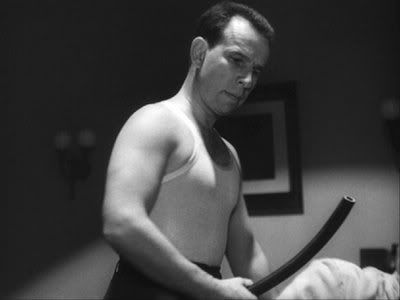
Inside the Walls of Folsom Prison is a perfectly competent movie, and another of those that would probably be best served by being on one of those four-movie TCM box sets -- say, with a prison theme. Unfortunately, it only seems available as a standalone from the Warner Archive collection, with the commensurately higher price that I'm not certain I'd want to pay for what is essentially a B movie.


