Showing posts with label Prison movie. Show all posts

Wednesday, July 29, 2026

Duffy of San Quentin

I didn't mean to watch a couple of movies in close succession that had San Quentin as a major plot point, but then that somehow is the one prison in California that came to prominence, much like Sing Sing in New York was at least before the Attica riots of the early 1970s. In any case, after Southside 1-1000, there's also Duffy of San Quentin.

Duffy here is Clinton T. Duffy, a real person who was the warden of San Quentin between 1940 and 1952 and son of a prison guard meaning he grew up knowing a lot about the prison; Duffy is played by Paul Kelly who apparently in real life served a stretch in San Quentin in the 1920s for manslaughter. As the movie opens, the state administration is on another one of its good government drives, trying to clean up corruption, meaning the current warden has got to go. Duffy at this time is only an assistant to the warden, and he's given the task of being interim warden for one month. Duffy knows the head of the guards, Pierson (Horace McMahon), is corrupt too, but Pierson figures he'll outlast any interim warden. Meanwhile, Duffy's wife Gladys (Maureen O'Sullivan) seems like she'd be OK with Duffy leaving San Quentin.

Duffy immediately sets about trying to effect a series of reforms, although there's a question of how much support he's going to be able to get in a limited amount of time and with institutional obstinacy. One thing Duffy can do is to say nobody's going to be a stool pigeon any longer. He also talks directly with an unorthodox prisoner, Harper (Louis Hayward), nicknamed "Romeo". Romeo doesn't fit the standard profile of a prisoner, and yet here he is, and constantly getting into trouble too. He understandably talks about being set up, but then, all the prisoners do.

Another of the reforms Duffy wants to try is to make the prison hospital experience less bad. One way to go about it is to bring in an outisde nurse -- a female nurse. The eventual hiree is Anne Halsey (Joanne Dru), who is good at what she does, although as you might guess prisoners might not be the most trustworthy people to be around a nurse working as nurse's assistants. Then again, it's also easier work than some of the other details in the prison. Things come to a head when one of the prisoners drinks some "medicinal" alcohol and screws up the treatment of a patient while on duty.

And then, the "good government" brigade shows up again. John Winant (George Macready) is the prosecuting attorney who put Romeo in jail. Not just Romeo, but a whole bunch of other prisoners too. However, it looks like he may have used dishonest and corrupt means to get his convictions, meaning that he's going to face jail time. Putting him in San Quention is a problem since naturally, one might expect there are a lot of prisoners who would like to get their revenge on such a prosecutor much like there are with cops who go to prison. Will Duffy be able to stop people from committing violence against Winant?

Duffy of San Quentin isn't the worst movie out there by any means, although I wonder how accurate this is compared to the real Duffy's time as warden. (Needless to say, I haven't read Duffy's memoirs.) However, the movie also feels relatively formulaic, and as though there's not all that much new going on from all the other prison movies we've seen where the warden is an important character. Duffy of San Quentin is worth one watch, but not much more than that.

Tuesday, July 29, 2025

One can always use another women-in-prison movie

I'm always up for a women-in-prison movie, if only because every time Hollywood makes on, whoever does it can't help but be lurid and exploitative, and even if the movie isn't overall all that good, that luridness makes watching the movie a lot of fun. So when I saw the synopsis for the movie House of Women the last time it showed up on TCM, I just had to record it to do the eventual post on it.

The movie starts off with a woman named Erica Hayden (Shirley Knight) being brought into the women's prison, against her protestations of innocence. They all say they're innocent. As part of the intake, she's given the obligatory physical examination, and like Eleanor Parker's character in Caged, Erica is pregnant. She doesn't want to have the baby be born in prison, which she considers quite the shame, but this is a slightly more progressive prison, in that the authorities let mothers keep custody of their babies at least until the babies turn three. At that point, it's make arrangements for somebody to take custody of the baby, or else have it put up for adoption.

Not that the warden, Frank Cole (Andrew Duggan) likes any of this. Or any type of progressive reform, for that matter. His philosphy seems to be that the same sort of discipline that would be used in men's prison should be used in women's prison. Put a woman in solitary for 10 days? No big deal. Make lights out a half hour earlier, and take away their radios? Also no big deal. The prison doctor, Dr. Conrad (Jason Evers), disagrees with the warden, but as if this prison movie doesn't have enough tropes, Conrad is also an alcoholic.

Fast forward three years. Erica has been a model prisoner, and even gets a job as a maid in the warden's house. But her kid is about to turn three, and the timing of her parole application means that even if the application is accepted, she won't get out of prison until about a month after her daughter's third birthday. She tries to get one of her fellow prisoners who's going to get out before she does to take the child for a month or two, but none of them are able to. The prison welfare officer takes the daughter away one day early, when the prisoners are planning a birthday party for her, and that leads to a riot.

But things are about to get even worse. Somehow, the kids are able to get enough free run of the prison that one prisoner's inquisitive child goes climing staircases that give access to the roofs of various buildings. It's something that's clearly dangerous, and it's also a bit of obvious foreshadowing as to what's going to happen to that kid. That kid's mother starts an even bigger riot in which the prisoner takes one of the members of the parole board hostage.

House of Women doesn't really break any new ground, but when you're watching a women's prison movie, you have to ask yourself whether you really want any new ground broken. The tropes that make up women's movies are fun enough that if you have a prurient interest -- and who doesn't -- you can't help but be entertained by how over the top the stuff is, even if it's formulaic.

Friday, March 15, 2024

Convicted Woman

I'm getting close to the end of all those B movies that TCM ran during the spotlight on B movies back in July or so. Today's selection is a prison movie from Columbia: Convicted Woman.

The movie starts off pleasantly enough, with a young woman named Betty Andrews (Rochelle Hudson) in a city park trying to get her shoe back from a dog. That's not relevant to the plot, other than her being in the park in the middle of the day is a sign that she is currently unemployed and looking for work. She had found a promising want ad in the paper, so she decides to go there and look for a job. That place is a department store, but she has to fill out an application form and then they'll inform her when there's an opening.

Betty goes into the female employees' lounge to fill out that form, and as she's doing so another woman comes in. Surprisingly, that woman looks a lot like Betty, and is even wearing the same dress! The woman then goes out onto the shop floor, where she sees a woman looking for a shop assistant. This other woman sees an opportunity. She takes the customer's $10 bill and claims she's going to make change, but she just disappears. And since Betty is wearing the same dress as the thief, it's unsurprising that the customer identifies Betty as the thief.

The case goes to trial, with a young reporter from the local paper, Jim Brent (Glenn Ford in an early role), covering it. He has quite a bit of sympathy for Betty, but there's not much he can do to help. Betty is found guilty, and despite the fact that the crime was only stealing $10, which seems like petty larceny, she's actually sent to the Curtiss women's prison for an entire year!

Under the direction of Chief Matron Brackett (Esther Dale), it's a tough place, leading one of the woman to commit suicide. Worse, the matron insists that the dead woman had pneumonia and that everybody knows it. Worse, if Betty tries to tell anybody about it, she's going to get in big trouble, like the worst jobs if not getting sent to solitary. Betty is able to get a call out to Jim, who shows up claiming to be her lawyer. When Jim prints the story, it comes to the attention of the Commissioner of Prisons, who appoints Mary Ellis (Frieda Inescort) the new warden. Mary has even more sympathy for Betty, because she was Betty's defense attorney at trial.

Mary sets about doing some Hollywood-standard prison reform, which is even going to involve furloughs, and that's going to lead to the climax over whether any of the women given a furlough is going to violate the terms, even if unwillingly.

Convicted Woman is a B movie, to be sure, but it's not bad as far as B movies go. Glenn Ford was at the beginning of his career and the studios I think didn't yet know what they had in him which is why he's underused here. Rochelle Hudson does well, and the plot, while nothing new even in 1940, works well enough.

I don't know the next time Convicted Woman is going to show up on TCM, but having been released by Columbia, it might show up on their Cinevault Classics channel that's on the Roku Channel app.

Saturday, September 30, 2023

Condemned (1929)

Ronald Colman was honored in Summer Under the Stars this year, and one of his movies that I hadn't seen was the early talkie Condemned!. So, I recorded it and watched it so that I could do a post on it here.

Colman plays Michel, a French thief who has been exiled to Devil's Island because, well, that's what they did with thieves in those days. On the transport with Michel is murderer Jacques (Louis Wolheim), and the two become friends along the way, because you have to have friends in a place like Devil's Island, or else you're not going to survive.

One person who doesn't have friends is Mme. Vidal (Ann Harding). Of course, she's not a prisoner; she's the wife of the prison colony's warden, M. Vidal (Dudley Digges). He's a fairly tough warden who thinks the only way to keep the prisoners in line is with threats and force. As for his wife, she doesn't really like Devil's Island, because who would if you're a woman who dreams of being at least middle-class. Even if there is a colonial "high" society there I can't imagine being exciting or anything like what life in Paris would be like for the wife of a prison warden.

But since being a prison warden should put you in the higher levels of a society run by colonists, the Vidals need the trappings of that good life, which means the servants. Perhaps there's a prisoner who could be rehabilitated enough to work as the hired help for the Vidals. Since one of the few non-violent prisoners is Michel, who being played by Ronald Colman is clearly much too upper-crust for Devil's Island, he gets the plum job of being servant to Mme. Vidal.

Of course, you can guess what happens next. Bored Mme. Vidal finds herself falling in love with Michel, and the feeling is definitely mutual. This puts M. Vidal into a jealous rage, and he responds in two ways: one is to put Michel into solitary confinement, while the other is to threaten to send his wife back to metropolitan France so she can no longer have the one thing she really wants.

Each of the two plan to escape so that they can meet up with each other in Paramaribo, capital of the neighboring colony of Suriname, which is not a French colony. But for Michel, this means having to go through dangerous swamps in an overland journey, all the while having to stay ahead of M. Vidal's men chasing him. And M. Vidal is bound to learn about his wife's perfidy....

Condemned! isn't a bad little early talkie. Supposedly the filmmakers wanted to do some of the filming on location, although I can't imagine any way that would have happened even if there weren't the technical and financial issues in trying to do it back in 1929. As a result, the jungle scenes seem a bit silly and something that would be technically much superior in a latter-day version. But Ann Harding and Ronald Colman both do well in the new medium of talking pictures, giving good performances. The story is a bit old-hat, probably even for 1929, but it's not old-hat in a bad way.

People who prefer their "old" movies to be from the 1970s may not go in for Condemned!, but for anybody who does like movies of early sound era, it's not a bad choice.

Wednesday, January 11, 2023

The Green-Eyed Blonde

There's something about women-in-prison movies that makes them more interesting to watch in an exploitation sense than watching seriously. In the case of The Green-Eyed Blonde, it doesn't help that the plot and dialogue are so nutty.

The movie doesn't start off with the blonde, but instead with brunette Betsy (Linda Plowman). She's just been sent from the juvenile justice system to a girls' reform school/prison that's more like Untamed Youth in that the girls aren't kept in cells, but in some sort of a house with a high fence topped with barbed wire surrounding the whole facility. Betsy, like some of the other girls, has had a baby, something the inmates refer to as "having a kid sister". Betsy is rebellious, hating the warden Mrs. Nichols (Jean Inness) because she's old and stringy!

Among the other girls are Cuckoo (Norma Jean Nilsson), who is perfectly willing to try committing suicide, and has the scars on her arms to prove it; Trixie, the nice black girl; and the titular blonde, nicknamed Green Eyes (Susan Oliver). Green Eyes has a boyfriend in Cliff (Ray Foster), and when he can, he gets down to the fence so that he and Green Eyes can make out through the fence until he can devise a plan to get Green Eyes out of there.

Meanwhile, there's a parental visiting day on Sunday, and Betsy's mom shows up with the baby in tow, ready to give the baby up for adoption. In fact, Mom cares so little about this grandkid that she's left the grandkid out in the car in the parking lot! So Cuckoo goes and kidnaps it so that Betsy can have her son, even though she doesn't particularly care for it. Indeed, all the girls keep the baby hidden away in the walk-in closet off their bedroom, as if nobody will find it or hear it. Not very realistic.

Eventually finding the baby is Maggie Wilson (Sally Brophy), the woman who fits the trope of the well-meaning prison worker who wants what's best for the inmates and hasn't developed enough cynicism to realize that they'll be back, or in a real prison. She actually keeps the baby's presence a secret until another adult finds it. When the kids learn the baby has been taken away, they start a hilarious riot.

Eventually, Green Eyes does get out and runs off with Cliff, at which point the movie has an abrupt denouement, as though the writers (Dalton Trumbo writing this nonsense along with a front) had no idea how to resolve things. Heck, the movie isn't even really about Green Eyes, so why she's the title character is a mystery.

The Green-Eyed Blonde is a mess. It's poorly acted, with bad dialogue and plot holes galore. But it's a fun mess, if you're looking for a movie that's unintentionally funny.

Sunday, November 27, 2022

The Defiant Ones, but with women and exploitation

TCM is running a podcast on Pam Grier, and last month ran a couple of nights of her movies to promote the podcast. This gave me the chance to record a couple of her movies that I hadn't seen before, including Black Mama White Mama.

As you can guess, Pam Grier is the black mama in the movie, a character named Lee Daniels. She's not actually a biological mother, but a prostitute who's been sent to a women's prison in some tropical island country that may or may not be the Philippines. (This one and a couple other Grier movies from the same period were filmed in the Philippines, and there are times when the Philippines flag shows up, but at other times the script seems to want us to believe that the movie is in some unnamed tropical country. And why would there be this many non-Asian people in the Philippines anyway?) Having the movie open up in a women's prison gives the moviemakers the chance to use all the tropes of the genre to good effect, such as food fights or women showering together, as well as the inmates trying to navigate the system.

One of Lee's fellow prisoners is Karen Brent (Margaret Markov), a white woman who is a revolutionary for reasons that aren't quite clear. She's got friends on the outside who can spring her, and she's planning to join up with some gun-runners in order to buy weapons from them to give to her fellow revolutionaries. The authorities would obviously like to know what sort of information Karen has. They transport her to a higher-security place. The warden has a thing against Lee because Lee spurned her sexual advances, so the warden has Lee transferred as well. And since these are two dangers criminals, they're chained together for the transfer.

Of course, you can guess what happens next. Some of Karen's revolutionary friends have found out about the transfer and come up with a scheme to get the convoy stopped so that they can spring Karen. That obviously haven't heard that Karen is chained to another prisoner. And the escape doesn't quite go to plan, either. Oh, the two women escape, but they're not able to hook up with Karen's revolutionaries. So they have to make their own way, while still chained together. This is a problem, because Karen is supposed to get the guns on one side of the island, while Lee has a contact much closer, but in the opposite direction. Karen points out, however, that it's her friends who freed them so perhaps her needs should trump Lee's.

So the two women have understandable reasons to dislike and distrust each other, although it didn't feel to me as though their being different races was as big a deal as it was for Sidney Poitier and Tony Curtis in The Defiant Ones. There's still no getting around the fact that the two are going to have to work together if they can't figure out a way to get those chains off of them, and as they work together, they begin to develop a grudging respect for one another.

But there are still all sorts of people looking for the two women, and those all have competing interests too. The army hires the criminal gang headed by Ruben (Sid Haig) to find the women, while Lee's pimp is looking for her since she's hidden money that she extorted from the pimp.

But to be honest, the plot here is really secondary. This is a straight up exploitation movie, like the other women-in-prison movies Grier made in the Philippines, and we watch for the fighting and the skimpy outfits, not for social issue plots like in The Defiant Ones. As such, Black Mama White Mama succeeds in entertaining, understanding that it's not going to be a great movie by tackling important social issues. Just sit back and enjoy the ride. It's a pretty darn fun one.

Wednesday, January 27, 2021

20,000 Years with John Garfield

I see that I still have a couple of movies left on the DVR from when Ann Sheridan was TCM Star of the Month back in June. Among them is Castle on the Hudson. Sheridan and male lead John Garfield being Warner Bros. contract players, it's unsurprising that this one got a DVD release courtesy of the Warner Archive.

Garfield plays Tommy Gordon, a gangster living the high life who seems to get away with the crimes he commits, except for the fact that he doesn't want to commit any crime on Saturday because that's his unlucky day. (That's a lot of foreshadowing.) Sheridan plays his girlfriend Kay, who'll stick by him through thick and thin.

Unfortunately, Tommy's underlings get him involved in a crime that takes place on a Saturday night, and sure enough, the police pinch him at a high-class nightclub that's presumably a mob front. In any case, Tommy gets convicted and sent up to Sing Sing.

Tommy thinks he'll be able to waltz through prison, especially since he's got a bunch of money. Obviously he'd seen Blackwell's Island and how the gangster prisoners there were able to run the place. But the warden here, Long (Pat O'Brien) isn't about to have any of that nonsense. He's one of those wardens who actually believes in rehabilitation, but is also not a softy. Everybody gets the same level of discipline until they show they deserve more or less, and that discipline is going to rehabilitate them.

In prison, Tommy becomes friends with Steven Rockford (Burgess Meredith), who is planning an escape. Steven sets up the plot such that Tommy should be able to escape with him, but then Tommy realizes that the planned break is on a Saturday. Fat chance of Tommy taking part in it. And sure enough, the plot fails, with Steven getting killed by the guards in the process.

Tommy may not exactly be a model prisoner, but he is at least more docile from the time he spent in solitary and the other indignities that Warden Long visited upon him for not wanting to go along with the prison rules. And Long eventually thinks that perhaps even someone like Tommy is being rehabilitated.

But then poor Kay is the passenger in a car crash that nearly kills her. Tommy gets a telegram, and Long rather bizarrely gives Tommy a one-day furlough -- on the honor system! -- so that Tommy can go to New York and see Kay before she dies. Some of Tommy's enemies see him and set up an attempted hit, which is foiled by... Kay, who shoots Tommy's enemy dead. Not that the authorities are going to believe any of this, even if Kay should survive.

If the plot sounds familiar, that's because Castle on the Hudson is a remake of Warner Bros. pre-Code movie 20,000 Years in Sing Sing. It's basically a programmer for Garfield, who was a rising star at Warner Bros. from the very beginning of his career, as well as for Sheridan, running about 77 minutes.

Even though it's just a programmer, having the cast that it does ensures that it's a pretty good movie. It might be better remembered if it weren't such a close remake of 20,000 Years in Sing Sing, which had even bigger stars, but that's unfair to Castle on the Hudson. It really can stand on its own, and the movie's big fault, that furlough, is a problem in both movies.

So you should probably watch both Castle on the Hudson and 20,000 Years in Sing Sing, and judge for yourself.

Tuesday, August 25, 2020

The Doll House of Size


Another movie that I recently got around to watching is the exploitation film The Big Doll House.

Judy Brown plays Collier, a young woman who, at the start of the movie, is spending her first day at a prison in a tropical third world country that I think isn't mentioned, but a few signs have place names from the Philippines. Collier is put in a cell with five other women, all of whom only use their surnames to address each other. Pam Grier plays "Grear", a lesbian (albeit maybe by convenience) who procures heroin for Harrad (Brooke Mills); Alcott (Robert Collins) and Bodine (Pat Woodell) are dreaming of escape; and Ferina (Gina Stuart) is along for the ride.

The prison is run by warden Dietrich (Christiane Schmidtmer), who is assisted by the chief guard Lucian (Kathryn Loder). Those two use all sorts of torture on the prisoners to punish them, something that concerns new prison doctor Phillips (Jack Davis), although he doesn't know the extent of what's going on, only what he hears from the prisoners he has to see for medical reasons. Dietrich and Lucian suggest the prisoners are creating tall tales, which they obviously have reason to do.

Rounding out this little world are the two guys who have the contract to supply the prison with fresh produce, Harry (Sid Haig) and Fred (Jerry Franks). They seem to have relatively unfettered access to prison, surprisingly so in fact for a place that includes political prisoners among its inmates. They go through the hallways, dealing with the women who want a man's touch not having had it for years in some cases.

Eventually, Alcott and Bodine do put their escape plans into motion. But none of this is why you watch a women in prison movie. Instead, you watch it for the exploitation: the catfights among the women, the guards' sadistic treatment of the prisoners, the food fight, and the sexuality which is clearly much more open than any prison movies made even just a few short years before under the Prodction Code. There's a lot of women's breasts on display here.

If you were looking to do a technical review of The Big Doll House, you'd have to say that it's not very good. It's cheap and tawdry; there's nothing original in the plot; and people like Grier would go on to put in much better performances in later movies. Caged this isn't. But I can certainly recommend this one because it's so much fun for what it does. The mud wrestling scene between Grear and Alcott is one of the highlights; the food fight scene is laughably bad; and there's a well-done torture sequence involving a cobra.

If you want to watch something undemanding that you can just have fun yelling back at the TV screen as you watch it, you could do a lot worse than to watch The Big Doll House. It's avaialble on DVD as part of a three-film box set.

Friday, February 21, 2020

Some dawns I die, some I don't


A few years back I bought a four-film set of James Cagney roles. I did a review of City for Conquest quite some time ago, and recently sat down to watch Each Dawn I die when a search of the blog suggested that I've never done a review of it before.

Cagney plays Frank Ross, an intrepid reporter for a big-city newspaper. He's investigating District Attorney Jesse Hanley (Thurston Hall), who is running for governor but corrupt as all get-out, as Frank spots him and aides burning the evidence late one night in an industrial zone. (Why Frank didn't take pictures is beyond me.) The story pisses Hanley off so much that he decides to frame Ross, much the way that the bad guys in North by Northwest made Cary Grant appear drunk.

Of course, in this case, the "drunk driving" causes a crash that kills three kids, so Frank gets sent up the river for a long time, up to 20 years. Frank's colleagues on the newspaper vow to get him freed, but it's not going to be easy. On the way to prison, Frank meets one of his fellow prisoners-to-be, "Hood" Stacey (George Raft), a big-time gangster who's being sent to prison for 199 years. Stacey, being a gangster, has enemies in this prison from the rival gang, and the prison guards don't much care if the gang members want to bump each other off.

Frank makes a friend in Stacey, however, when he trips a guy who was about to stab Stacey. But one of Stacey's rivals gets stabbed to death during the prison's movie night. This, however, gives Stacey and Frank ideas. Stacey plans an escape which will involved going on trial for the murder that he didn't actually commit, something which will require Frank to finger him. In exchange, Stacey, once on the outside, will look for the folks who were working for Hanley to set Frank up.

It doesn't quite work that way, though. Frank, being a reporter, tips off his newspaper to the escape attempt saying something big is going to happen at the trial. The attempt does succeed, but the press coverage pisses Stacey off, so he decides to renege on his part of the bargain. The prison authorities assume Frank was in on it, so when he won't name names, they put him in solitary confinement. And Frank's girlfriend Joyce (Jane Bryan), pissed that Stacey isn't holding up his end of the deal, begs Stacey to reconsider....

Each Dawn I Die is the sort of movie where it's easy to see why it was so popular back in the day. It has the bite typical of the Warner Bros. movies of the 30s, and Cagney is as good as always. The one odd thing I found, however, was George Raft. His character, despite being a gangster sent up for 199 years, seems rather laid back, frankly unnaturally so. For whatever reason, this bugged me the whole movie.

Not that the movie is bad by any means. It's definitely worth a watch. In addition to the box set at Amazon you can also watch it via Prime Video if you can do the streaming thing.

Monday, March 11, 2019

The Longest Yard (1974)

At the end of December, TCM ran a tribute to Burt Reynolds, who had died earlier in the year. I that I wanted to record and watch again since I hadn't blogged about it before is The Longest Yard.

Reynolds plays Paul "Wrecking" Crew, a former professional quarterback who got drummed out of the league thanks to a point-shaving scandal. He's living with his girlfriend Melissa, and when they get in an argument that involves her throwing a vase at him, he drives off in her sports car. So she calls the police, and eventually, they catch up with Crew, leading to his getting sent to prison.

For some odd reason, the prison warden, Hazen (Eddie Albert), has a semi-pro football team consisting of the prison guards, led by the head of the guards, Capt. Knauer (Ed Lauter). They're not bad, as far as semi-pro teams go, but they could be better. And now that Hazen has an ex-pro in his prison, he figures that he can call on the pro's knowledge to produce a better prison guard team. Of course, Knauer doesn't like this idea, as he absolutely hates Crew.

Crew is unwilling to help at first, which gets him sent to the worst prison work, cleaning out swamps. But he meets some useful people such as "Caretaker" (Jim Hampton), who can help people get anything on the inside. The swamp work is bad enough that Crew finally decides to make a suggestion to Hazen: find a crappy team, and use that as a pre-season warm-up game to get the prison guard team into shape.

So Hazen comes up with a brilliant idea, which is to have the guards play a team of prisoners. The prisoners will be so out of shape that they can't win, and the guards can get away with basically torturing the prisoners during the game. Crew doesn't want to play or coach, but he's blackmailed by being told his parole will be denied if he doesn't play.

Crew organizes a team, with most of them dumb enough to have no idea that they're supposedly going to have no chance to win. But they figure that they'll have the chance to get in a few licks on the guards, legally. (Well, not quite legally; much of what eventually goes on in the game should have gotten more penalty flags than it did.) The big day comes, and the prisoners are actually competitive. At least until Hazen tells Crew to throw the game....

The Longest Yard is pretty good, although I don't know quite how realistic it is. Reynolds had played college football so he's well-suited to playing a washed up player, and making the football look at least halfway authentic. There are still a lot of Hollywood touches, such as some irritating split screens, and a final play that reminded me of the staircase scene at the climax of Alfred Hitchcock's Notorious: Hitchcock needed to draw that scene out, so if you watch carefully you can see they're going down the same steps repeatedly. By the same token, the final play of The Longest Yard's football game looks like the same footage is looped in slow motion.

It's all minor quibbles, however. Reynolds is amiable, and the supporting cast is quite good, making for an enjoyable sports movie for those who like sports movies.

Saturday, April 22, 2017

Inside the Walls of Folsom Prison

So I watched Inside the Walls of Folsom Prison off my DVR this morning since I saw it's available from the Warner Archive. It's worth a watch, but I don't know that it's worth buy at Warner Archive prices.

The movie starts off with an overview of California's Folsom State Prison, and a narration from the point of view of the prison itself of how conditions were much more inhumane in the past. Cut to the 1920s, and a prison riot in which they take one of the guards and Warden Rickey (Ted de Corsia) hostage. The riot, of course fails, and the warden concludes that the way to get people to stop rioting is to be more brutal, which gets a reporter to show up for one throwaway scene.

That reporter is apparently what leads to the state authorities taking notice of the prison conditions, because they decide to send a new man Benson (David Brian) to head up the prison guards. Benson is a college man, and has "modern" ideas on how to treat prisoners, ideas that mean not being so brutal. Needless to say, this ticks Rickey off to no end, and he tries to undermine Benson at every turn.

Meanwhile, among the prisoners, we get several tropes of the genre, with about the only one I didn't see being the new guy who just doesn't know how to handle prison life. There's Daniels (Steve Cochran), the guy who's planning a breakout, and Red (Philip Carey), who is marking time until he can get out and go back to his wife and kids. They're actually friends, even if they have different ideas on how to get out of the place. As for Red, he's trusted enough to drive with a guard out of the prison to pick up dynamite for the prison's quarry operation. Unfortunately, hiding in the truck is another prisoner (William Campbell), and Red decides to alert the other guards in order to prevent his parole from getting hung up. Of course, he's considered a stool pigeon for this....

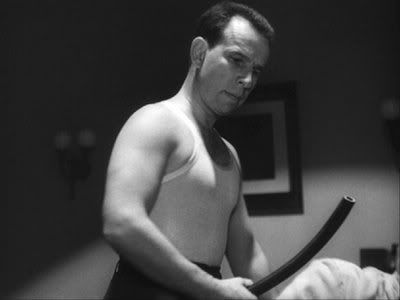
Inside the Walls of Folsom Prison is a movie I found to be standard-issue prison fare. There's nothing new here, and it's all done with a B-list cast. Most if not all the tropes are here; including the ones I've already mentioned there's the brutality of solitary. Indeed, when I was watching one scene of the warden roughing up a prisoner for information, I couldn't help but think of Hume Cronyn and his truncheon in Brute Force. Looking at the IMDb reviews, I'm not the only person to have that thought.

Inside the Walls of Folsom Prison is a perfectly competent movie, and another of those that would probably be best served by being on one of those four-movie TCM box sets -- say, with a prison theme. Unfortunately, it only seems available as a standalone from the Warner Archive collection, with the commensurately higher price that I'm not certain I'd want to pay for what is essentially a B movie.