Showing posts with label Sidney Poitier. Show all posts

Saturday, September 19, 2026

Another Two for One repeat

I mentioned last week how TCM is re-running the spring season of Two for One in the fall, and how this is giving me the opportunity to put up a couple of posts on films that I recorded the first time around and am now able to watch to do these posts. The guest for tonight, Sept. 19, is actress Sheryl Lee Ralph, and one of her selections is one of her first movie roles, in support of Sidney Poitier in A Piece of the Action at 10:00 PM.

An introductory sequence shows Dave Anderson (Bill Cosby), master safe-cracker, getting into the Chicago headquarters of a loan corporation where they keep the safe full of cash. Dave gets into the safe, steals a large sum of money, and is able to get away by jumping out a window into a truck below and driving off.

Cut to a completely unrelated crook, Manny Durrell (Sidney Poitier). He's studied the movements of illegal bookmker Mr. Bruno (Titos Vandis), and uses that to set up what looks like a police raid of Bruno's upscale home where the books and a lot of cash are kept. Bruno fills a briefcase full of cash and gives it to the maid to take to a trusted source. In fact, the maid is working for Manny and she's the one with the cash that Manny is bilking out of Bruno, which would also explain why she didn't get pinched while leaving the house when the police were surrounding it. Those fake police were also working for Burrell.

Meanwhile, during the raid, Bruno calls his mole in the police department to find out what's going on. That mole talks to Det. Joshua Burke (James Earl Jones), which is how Bruno learns it's a fake raid and is going to get whoever is responsible. Meanwhile, Burke is set to retire in a few months. When he does, the first thing he does is write a couple of anonymous letters, to Manny and Dave, as well as a third. Manny and Dave's notes inform them that somebody knows about those jobs we saw at the opening, with a threat to send the two of them to prison if they don't meet the writer at a certain hotel suite. The two men are then directed the next day to a restaurant where they'll learn what their "punishment" entails.

In fact, they don't meet the letter writer, but the recipient of the third letter, Lila French (Denise Nicholas). She runs a community center that is trying to help inner-city youth by doing things such as finding them jobs, even though these are clearly embittered youths. (Sheryl Lee Ralph plays one of the youths.) The letter writer has put Dave's name to the letter, saying that Dave and Manny would be happy to "volunteer" an extremely generous amount of time to the center, which they're forced into doing although Lila doesn't seem bright enough to figure out there's some sort of blackmail going on here.

At this point, the movie really starts to sag as the inner-city youths seem like a bunch of stock character types; I will admit however, that I have no idea whether inner-city adolescents would in fact have acted like that. They come across as being as much of a stereotype as the Sweathogs on Welcome Back, Kotter. But Dave and Manny have an obligation to help them get jobs since that will keep them out of jail. They also use their in at the improvement center to try to figure out who exactly is blackmailing them. Meanwhile, Bruno is busy looking for the people who robbed him out of all that money, and he's going to figure it out in time for the movie's climax....

A Piece of the Action is another of those movies that sounds like a good idea on paper, but doesn't quite work in practice. One is that I've already mentioned how the young people don't quite seem real here. There's also the fact that it's trying to be a drama with some comedy when it should really be a comedy with some drama. I have a feeling that Sidney Poitier, who also directed, wanted to have the movie serve as social commentary on the issues of the inner city. But the biggest flaw is that the film sags at a massive 135 minutes, which is really much too long for the material. It's the sort of film that should really be clocking in at an hour and a half or so.

Still, I'm sure there are people who will enjoy A Piece of the Action more than I did, since it's one of those movies that has its heart in the right place.

Sunday, January 19, 2025

A Raisin in the Sun

Tomorrow, January 20, is Martin Luther King Day here in the US. As always, TCM is programming the day with films from a limited set of movies, since of course in the days before the civil rights movement there weren't lot of Hollywood movies that gave a prominent place to black actors. A movie that shows up a lot is the 1961 version of A Raisin in the Sun. This year, that airing comes on at 3:30 PM.

The movie opens up one Friday morning in a cramped apartment in Chicago. Ruth Younger (Ruby Dee) wakes gets out of bed, and goes to the living room/kitchen to wake up her son Travis, who sleeps on a day bed since the family doesn't have the space to give him a room of his own. Also in the family is Ruth's husband Walter (Sidney Poitier), his sister Beneatha (Diana Sands), and family matriarch Lena (Claudia McNeil). There's no patriarch in the family because Lena's husband recently died, and that in fact is a major part of the story.

The late father Younger had a life insurance policy, and that's about to pay off $10,000, which was a nice chunk of change back in 1961 when the movie was released. Everybody has something they could do with the money. Beneatha is a college student who has hopes of going to medical school, and a portion of that insurance money could really help her in that regard. Walter is forced to work as a chauffeur for a rich white guy, something that's been eating away on him as he thinks this is a horrendous indignity. He's got a couple of friends who would like to go into business together by opening a liquor store; some of that money would go a long way to paying Walter's portion of the down payment. And Lena would like a better house for the family, where Travis can have a room of his own and a yard to play in. And it's her money after all.

Further complicating matters is that this is the America of the early portion of the civil rights era, with all the racial issues that entails. Beneatha has two suitors competing for her affection. George (Louis Gossett Jr.) would be the safe choice, but Beneatha has become more radical on race relations, embracing Africa in a way that previous generations didn't; this is influenced in part by the other suitor, Joseph Asagai (Ivan Dixon), actually being from Nigeria. As for Walter, he finds that Mom is profoundly opposed to using the money for demon alcohol, one of many things driving Walter to drink. Ruth finds out that she's pregnant again, and worries about how they're going to be able to afford another child. She even thinks about getting an abortion, but that's another thing that absolutely horrifies Mom.

So Lena decides to force matters by going down to the bank and using a portion of that money for a down payment on a house in a nice neighborhood, part for Beneatha, and the rest for a checking account in Walter's name. Everybody kind of comes around to the idea of having a house of their own. Well, not quite everybody. The Youngers will be the family integrating the neighborhood, and the neighborhood "improvement association", represented by Mr. Lindner (John Fiedler), tries to put the matter delicately that blacks and whites would be better off living apart.

A Raisin in the Sun is a movie with a lot of cultural imporantance, being based on a play that was one of the first big productions by a black playwright and dealing with the racial issues that it does. For me, the movie is a bit of a mixed bag. Parts of it are quite good but at the same time it feels like the movie takes a while to get to the big conflict over segreagation. And when it does get there, the last half hour or so of the movie has the cast, especially Poitier and McNeil, engage in some shocking overacting. I'm not certain whether that's an issue with the screenplay or the director not reining the actors in, but the histrionics are way over the top.

Still, the significance of A Raisin in the Sun makes it a movie that should be seen; tomorrow's airing is your chance to see it.

Monday, January 15, 2024

Uptown Saturday Night

A few weeks back in the Thursday Movie Picks blogathon I mentioned the movie Uptown Saturday Night. I had it on my DVR from the last time TCM showed it, and having watched it, now I can do a review on it, just by sheer coincidence on Martin Luther King Day here in the States..

Sidney Poitier directed, and also stars, playing Steve Jackson, a blue collar metalworker who is happily married to Sarah (Rosalind Cash) living in a smallish apartment in the city, although the two of them dream of moving out to the country permanently. This is a couple that clearly loves each other. When relatively conservative Steve isn't spending time at home with his wife, he's spending time with his somewhat more adventurous best friend, taxi driver Wardell Franklin (Bill Cosby). Steve has an upcoming vacation, and Wardell suggests they start it off by going to Zenobia's, the elegant if not quite legal gambling house. Steve has never been there, largely because he's too straight-arrow to spend that kind of money.

The two eventually do go to Zenobia's dressed to the nines since that's the dress code, and look like they're enjoying themselves, at least the gambling part of it. Steve would never be seen with a woman of ill repute. Everything goes well, until... a bunch of masked men come in, guns blazing, demanding everyone empty their pockets and even strip down to their undies to show that they're not hiding anything. The thieves then take all the valuables, including Steve's wallet, which is quite a bummer.

If that's a bummer, things are about to get even worse for Steve. The next day, he's reading the newspaper, and sees an announcement of the winning lottery number. Not too long ago, Sarah had taken his coat to the cleaners, and found the lottery ticket. And wouldn't you know, Steve's ticket is the winning ticket, worth $50,000, which is a reasonably nice sum for 1974, at least two or three years' income. Certainly enough to seed moving out to the country. Just produce the ticket. Unfortunately, Steve put the ticket in his wallet for safekeeping.

So Steve accosts Wardell, and insists that the two go looking for that lottery ticket. This leads them to a lot of places, starting with a private detective (Richard Pryor) who turns out to be quite the crook himself. Then they hope they can get help from their local congressman (Roscoe Lee Browne), who is an utter hypocrite. There are also a pair of gang leaders who might know something about the theft, Geechie Dan (Harry Belafonte) and his rival Silky Slim (Calvin Lockhart). Eventually, everybody and the ticket wind up at a church social hosted by the local reverend (Flip Wilson), leading to the car chase.

Uptown Saturday Night is a movie that has a premise that holds the potential for a lot of fun. And the film really has a fine cast of people who mostly can do comedy. Poitier isn't exactly what you'd think of as a comic actor, although like Gregory Peck in Captain Newman MD, he's more than good enough at letting everybody around him be funny. However....

Poitier, as the director, clearly came to the project wanting to give a whole lot of black actors who never got good roles under the studio system the sort of meaty part and a chance to shine that they wouldn't get otherwise. Poitier's direction, however, tends to give each of these actors their cameo at the expense of the story working as well as it otherwise could. The result is a movie that definitely has its share of hits, but is also decidedly uneven.

Uptown Saturday Night is definitely worth a watch, although it really could have been a much better movie.

Tuesday, May 9, 2023

How mawkish can you make a boy and his dog story?

Another movie that I decided to watch because I saw it was about to leave the Watch TCM app and because the synopsis sounded interesting was Goodbye, My Lady. So now you get the review.

In the swamps of southern Mississippi (the TCM synopsis said Georgia, but all the geographic references are obviously Mississippi), young Skeeter (Brandon De Wilde) lives with his uncle Jesse (Walter Brennan, which should be a warning). Skeeter is apparently an orphan as his Mom died some years back and Jesse doesn't ever want to talk about Skeeter's pa which led me to think throughout the movie that Pa was in prison and when there's a stranger coming to town with a dark musical theme that it might be Dad getting out of prison. But despite the negative references to Dad, we never get the full story. Anyhow, the two of them live in a shack in the bayous, where Jesse makes a hardscrabble living cutting wood for Cash Evans (Phil Harris), who also runs the local store that gets all its goods by coordinating people's orders from the Sears catalog. Based on the presence of cars and some other mentions, however, it really sounds like the story is set relatively close to the present day (the movie was released in 1956 but was based on a novel published in 1954 that, in turn, was a fleshing out of a short story from the early 1940s).

One day, while out looking for whatever it is a boy of Skeeter's age looks for in the bayou, he comes across a really strange dog. The dog doesn't bark, instead making a noise that sounds a lot like the laught that Muttley had in the old Dastardly and Muttley cartoons. It's obvious that the dog has been cared for and has escaped from somewhere, but nobody in the area recognizes the dog. So Skeeter takes custody of the dog and raises it, learning that the dog, now named Lady, has a tremendous ability to hunt, something that's quite valuable in the bayou where hunting food can mean extra sustenance and not going hungry.

Cash brings his dog to see Skeeter, Jesse, and Lady, and they all go hunting together, which is how it's confirmed that Lady really is that good of a hunting dog, something that had never been seen in those parts. So news gets out, and that means it should be clear to anybody who isn't pig-ignorant that there's going to be somebody looking for the dog. Indeed, an acquaintance from the other side of the bayou who isn't so ignorant, Gates (Sidney Poitier in a supporting role), has been doing some research in hopes of finding the owner and getting a reward. But since Skeeter was the one able to capture Lady, it'll be him who has to deal with the owner when the owner comes calling for the dog. Skeeter has never had to deal with such a thing, and it's one of those milestones on the way to maturity....

I should have known from seeing Walter Brennan's name in the opening credits, along with the lyrics of the terrible opening song, that Goodbye, My Lady was going to be an incredibly schmaltzy film. And it didn't disappoint in that regard. To be fair, however, the actors do the best with the material they're given. It's more that the material is way too sentimental, and the story, having been extended from a short story, is something that still would have been better suited for episodic television, especially a 30-minute show. One could easily see skilled writers working the material into something that would have been fit for a show like The Rifelman where Lucas could impart an important lesson to young Mark. Extended to 95 minutes, however, the material grows stale fairly quickly.

Saturday, February 19, 2022

TCM's Sidney Poitier tribute

Tomorrow (Feb. 20) would have been the 95th birthday of actor Sidney Poitier, who died last month. I don't recall the original TCM schedule, although I wouldn't be surprised if there had been a couple of Poitier's movies already on the Sunday afternoon schedule. In any case, TCM preempted a fair portion of the schedule in order to create a 24-hour salute to Poitier. That salute kicks off this evening at 8:00 and will feature 12 of Poitier's movies:


In the Heat of the Night, with Poitier playing a Philadelphia police detective pressed into service in the South to solve murder case, starts the salute at 8:00 PM.


Poitier spends a good portion of The Defiant Ones (10:00 PM) handcuffed to Tony Curtis as both of them play chain gang criminals on the run.

At midnight, there's A Warm December, directed by Poitier, about an American who meets and falls in love with an African dignitary suffering from sickle-cell anemia;
Cry the Beloved Country at 2:00 AM is set in the early days of apartheid-era South Africa;
Something of Value at 4:00 AM has Poitier playing a Kenyan during the Mau Mau uprising against Britain;
Goodbye, My Lady at 6:15 AM is one I actually haven't seen;
Edge of the City at 8:15 AM sees Poitier as a longshoreman who gets helped by John Cassavetes against a spurious criminal accusation.


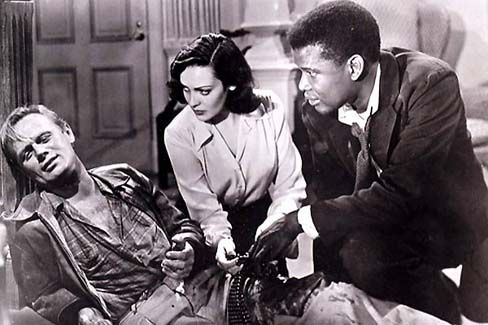
Poitier made his debut in No Way Out at 10:00 AM playing a doctor in a hospital prison ward who has a white patient die on him and the dead guy's criminal brother (Richard Widmark) is a seething racist who vows revenge. Daring for 1950, although some viewers today might take a different opinion.

In The Blackboard Jungle at noon, Poitier is one of many actors too old to be teenagers playing students in Glenn Ford's high school classroom;
Poitier would go on to play the teacher in To Sir, With Love at 2:00 PM, in an inner-city London high school;
Poitier would win the Oscar for Lilies of the Field (4:00 PM), playing a handyman who stops in Arizona and finds himself at a convent where the nuns impress upon him the need to build a chapel for them.


Finally, at 6:00 PM, there's A Patch of Blue, in which Poitier finds poor exploited blind girl Elizabeth Hartman, who falls in love with him, only to have to deal with her terribly racist mom (Shelley Winters, who picked up her second Oscar).

Sunday, April 18, 2021

Gone With the Bayou

Some months back, TCM ran a one-night spotlight on some of the films of actress Yvonne De Carlo. One that I hadn't seen before is Band of Angels, so I DVRed it and recently watched it to do a post on here.

Yvonne De Carlo plays Amantha Starr, daughter of the owner of a plantation in 1850s Kentucky (however, the opening act has Amantha as a child). Mom died years ago, and Dad has doted on Amantha ever since, mortgaging the plantation to send Amantha to a good boarding school up in Cincinnati where she meets northerners like Ethan Sears (Efrem Zimbalist Jr.) who are firmly opposed to slavery.

Bad news comes when Amantha learns that her father has fallen ill; she can't get home soon enough and Dad is quite dead. It's at Dad's burial that Amantha learns about Dad's having mortgaged the farm. But worse, she learns that Dad had consorted with some of the slaves, and that Amantha is the daughter of one of the slaves. Now, you'd think a doting Dad would have provided for Amantha in his will, at least by setting her free, or doing it much earlier in her life. But somehow Dad never got around to it, and Amantha is somehow still technically a slave. With that giant plot hole, the movie immediately began to go off the rails for me.

As a black person who could pass for white, Amantha can obviously command a much higher price at the slave auction, and Rhett Butler shows up to buy her for the princely sum of $5000. OK, it's not Rhett Butler, but you can be forgiven for comparing Band of Angels to Gone With the Wind. It is Clark Gable, 20 years older and playing a character named Hamish Bond. Hamish takes Amantha to New Orleans, where he makes her his new mistress.

I say "new mistress" because Hamish apparently had a previous slave mistress. He's also got a slave who serves as his factotum, Rau-Ru (Sidney Poitier). Hamish had Rau-Ru educated at great personal risk, since black slaves weren't supposed to be educated as they might get ideas above their station. Indeed, Rau-Ru resents Hamish even more than if he hadn't gotten an education and other "good" treatment from Hamish. After all, Rau-Ru is still a slave.

As the movie opened in the early 1850s and Amantha was just a girl then, you know what's coming up in American history. One of Hamish's friends from his days sailing the oceans brings up the secession of Louisiana, although it's not until after Hamish decamps from New Orleans to a plantation upriver that the attack of Fort Sumter occurs and the Civil War begins in earnest.

The North wins the Civil War, of course, and as they're subjugating Louisiana all of the plantation owners decide to burn their cotton crops so as not to give the North anything useful. This even though it's against martial law and makes Hamish and the other plantation owners outlaws. There's also a subplot about another of the owners, Charles de Marigny (Patric Knowles), trying to put the moves on Amantha.

Band of Angels is one big mess. It's an interesting mess, mind you, but a mess nonetheless. It veers from one plot point to another, having some wildly implausible character motivations. There's also all the tropes that Hollywood had in those days of the Romantic South, as well as an impossible ending. So while I didn't hate Band of Angels, I certainly didn't love it either.

Band of Angels is available on DVD courtesy of the Warner Archive, should you wish to watch for yourself.

Sunday, February 21, 2021

Sneakers

Many years ago, when I was in college, I saw Sneakers when somebody was watching it in a dorm lounge. I hadn't seen it since, and when it showed up during one of the free preview weekends, I made it a point to DVR it. It's on TV tomorrow, at 4:51 PM on 5Star Max if you've got the Cinemax package, but it's also available on DVD.

A prologue introduces us to Martin and Cosmo when they were college students in the late 1960s. They're lefty computer science students in the days when computers meant mainframes and time sharing, but they're able to get into the computer lab late at night to use the computer to transer money from Republicans to liberal causes. The police come and arrest Cosmo, but Martin was out getting a pizza, so he's a fugitive now.

Decades pass, and Martin Bishop (Robert Redford) is working a white hat security consultant. That is, he and his firm are hired by businesses specifically to find out the security holes that would enable a computer hacker or other criminal to bilk them out of big bucks. Among his colleagues are Crease (Sidney Poitier), formerly of the CIA; Whistler (David Strathairn), a blind expert in electronics and the sounds various electronics make; "Mother" (Dan Aykroyd), an electronics technician; and Carl (River Phoenix), who does a fair amount of the grunt work.

One day, Martin is approached by a couple of guys who know his past. Dick Gordon (Timothy Busfield) and Buddy Wallace (Eddie Jones). They know about a Czech mathematician named Janek (Donal Logue) who is giving a lecture on large prime numbers, which are a big deal in the field of cryptography because it takes a substantial amount of computing power to figure out the prime factors of very large numbers (assuming, of course, these numbers aren't simply multiples of 2 or 3 or much smaller primes) and these numbers can be used to transpose the digitl 1s and 0s into patterns it's very hard to break. (OK, this is a simplification, but going into all the details would make for a very dry movie.)

Martin goes to the lecture, and from that and using human intelligence -- basic surveillance and confidence games with people around Janek, conning people being a big part of security breaches even today -- he and his colleagues deduce that Janek had figured out a way around the factorization problem and developed a computer chip that could basically hack into any current computer, no matter how good the encryption, meaning that all sorts of computer systems are at risk. Gordon and Wallace are from the NSA, and want Martin's company to get that chip for the Americans, since this is just after the fall of the Iron Curtain, and who knows who Janek is really working for?

So Martin and company are able to get it, but when the handover is to be made, Crease reads a newspaper article about the killing of Janek which makes him realize that Gordon and Wallace may not actually be NSA. Martin goes to the former Soviet, now Commonwealth of Independent States (remember that?) attache to figure out what might be going on, but Gordon and Wallace catch up with them, killing the attaché, framing Martin for it and abducting him, and getting the chip themselves.

It turns out that Gordon and Wallace were working for... Cosmo! Cosmo (Ben Kingsley) claims to be working for some shady organized crime group, except that they really weren't that organized before Cosmo showed up. The chip, at least if you believe Cosmo, would help the Mob stay one step ahead of the government. It doesn't quite add up, though, since why would Cosmo go work for the Mob when he and Martin both had ideals?

So Martin and his friends are going to have to figure out where Cosmo's men took him, and then come up with a way to get that chip back. This leads to the finale, in a Silicon Valley company with high-tech by 1992 standards security, and them tring to figure out how to break that security.

Sneakers is an entertaining enough movie as long as you don't think too hard, something that holds for a lot of the movies at the intersection of spying and heisting. My impression is that they get a fair amount of the technicals right: prime numbers and advanced math really are important for encryption, and conning people to get around security is often more likely to work (think phishing, for example). The presentation of computers is obviously made more visual-friendly if less realistic, and I think there are certain aspects of security the writers overlooked. A lot of the more sensitive computer systems would, I think, have been using air gaps even in the early 1990s, while Cosmo's company likely would have had fingerprint access in addition to badge and voice access. (I'm not certain how far advanced facial recognition was in 1992; it's not mentioned here.)

For a Hollywood look at computers and security back in the day, you could do worse than to watch a movie like Sneakers.

Sunday, November 24, 2019

Buck and the Preacher


I had a couple more Sidney Poitier movies to get through before my old DVR died. There are one or two unwatched, but I did get to see Buck and the Preacher, which was also Poitier's directorial debut.

The scene is a couple of years after the Civil War. The slaves have been freed legally, but southern whites aren't about to lose their grip on power, so they tried to prevent blacks from acquiring land and kept blacks as sharecroppers. Understandably there were blacks who didn't like this and wanted a better life, so they headed west to get the free land that was still being offered under the Homestead Act. Buck (Poitier) is a scout for the wagon trains leading such blacks west.

However, there are people trying to stop the wagon trains. There are Indians, who see that the advance of blacks is no better for them than all the whites settling their historic territories, and they demand tribute from wagon trains in exchange for free passage. There are also "night riders", whites who harass the black wagon trains and try to get them to turn around to go back to the South.

One such band attacks Buck, forcing him to make a hasty escape, to the point that it's going to kill his horse if he doesn't get his horse some needed rest. Thankfully, he runs across another black guy, a phony preacher named Willis (Harry Belafonte), who has taken a break from his itinerant ministry to bathe in a nearby river. So Buck takes it upon himself to take the Preacher's horse!

The Preacher takes Buck's horse and rides into town, where Deshay (Cameron Mitchell), the head of the night riders, questions the Preacher about where Buck is. The Preacher doesn't care about Buck at first, until he joins up with one of the wagon trains and sees the damage that the night riders are doing to black people. They've killed some of the settlers and taken all of their money that they're going to need for passage, and all of this gets the Preacher to form an uneasy alliance with Buck to go after the whites.

However, in the attempt to get the settlers' money back, Buck and the Preacher are going to commit actual crimes that are going to get the local sheriff to join up somewhat with the night riders. Previously, the sheriff's attitude was that none of these people had committed any crimes in the sheriff's jurisdiction. But now, Buck has, and Deshay can use that to his advantage.

Buck and the Preacher is a movie with a good story that I found ultimately wound up being less than the sum of its parts. I think one reason for that is that I've never been a fan of Harry Belafonte the actor, he being the weak link in a lot of the movies he's in. Another ws that the movie needed to take a bit more of a comic tone. There's something about the material that needs a lovable rogue rather than somebody who's deadpan serious playing Buck. The direction is competent, if stuck in the 70s with its zooms.

Still, Buck and the Preacher is certainly worth one watch, and you can get it on DVD.

Saturday, November 2, 2019

The Bedford Incident


Working my way through the Sidney Poitier movies I recorded during his time as TCM's Star of the Month back in September, we're now up to The Bedford Incident.

Poitier plays Ben Munceford, a journalist who in the opening scene of the movie is seen on a helicopter which is landing on a US Navy destroyer, the Bedford, somewhere in the North Atlantic. He's there to do a piece on the destroyer's work, which is to patrol the waters to prevent submarines and fishing boats from getting into the territorial waters of the various NATO members; on board for this particular mission is a West German attaché, Commodore Schrepke (Eric Portman). Munceford picked this particular destroyer because of its captain, Eric Finlander (Richard Widmark).

Capt. Finlander is none too happy about having a journalist on board, in part because he runs an extremely tight ship -- perhaps one that's too tight. One of his idiosyncrasies is that he doesn't see much need for a full doctor in sick bay, which is part of why he doesn't like the new doctor assigned by the Navy, Lt. Cmdr. Potter (Martin Balsam). That, and his idiosyncrasy probably got him overlooked for promotion after a previous incident where his actions could have been controversially praised or panned.

Sick bay isn't examining any patients, but some food waste that was on the surface, waste that was clearly from a Soviet sub, leading to the question of how old that waste is. It also leads Finlander to start a sonar search with the talented Seaman Queffle (Wally Cox) at the sonar station. They eventually find the Soviet sub and start following it; presumably the sub somewhere under the sea knows that it's being followed too.

But then an odd thing happens: the Soviet sub enters the territorial waters of Greenland. This is technically a violation of international law, and Finlander is right to want to force the sub to surface in order to find out what's going on. But the sub doesn't surface, and this being the Denmark Strait between Greenland and Iceland, the waters are dangerous with icebergs around. Still, Finlander continues his pursuit of the sub.

The figuring is that eventually the sub will be forced to surface. It's not a nuclear sub, so it doesn't produce enough power to keep creating fresh oxygen, only being able to do that at the surface. And it's going to have to surface after 24 hours. So Finlander keeps up the search, keeping his crew at general quarters (ie. battle stations) to the point that they may finally crack. Munceford watches and, not being a serviceman himself, comes to rather different conclusions about what to do.

I'll stop there because I don't want to give away the climax. But I will say that The Bedford Incident is an excellent movie. It's in some ways a character study set against the backdrop of a very good and tense story. One of the things I really liked about the story is that we never see the Soviet sub or hear any of the Soviets on the sub or any of the surface ships in the area. (There's one brief shot of a Soviet fishing ship that's believed to be a disguise for the naval vessel to which the sub is associated.) Widmark is quite good as Capt. Finlander, and Balsam also shines. Poitier, despite his second billing, doesn't have quite so much to do here. One of the interesting things is that after 15 years in Hollywood, this was about the first time Poitier got to play a character where being black was not germane to the plot. Finlander and Munceford may clash, but it's not because Munceford is black; it's easy to imagine Finlander clashing with any journalist.

I found the cinematography interesting, too; the ship's tight spaces are very well captured while the black-and-white looks slightly grainy at times, serving to give of a feeling of being there with the participants, like raw documentary footage.

The Bedford Incident is available on DVD should you wish to watch, and is a movie that I can very highly recommend.

Monday, October 14, 2019

The Long Ships


I'm working my way through the movies that TCM ran for Sidney Poitier's turn as Star of the Month back in September. This time out, the entry is The Long Ships.

The actual star here is Richard Widmark, playing Rolfe, the captain of a Viking ship raiding somewhere in the Mediterranean in an opening sequence. The ship gets destroyed in the fog on some shoals, and Rolfe is the only survivor. There's then a non-live-action sequence talking about Rolfe's rescue by some monks who brought him back to health. They were also looking for gold to make a giant bell, which when it is finally cast and rung makes a thunderous sound.

Cut to some Moorish city. Rolfe is in the town square, eking out a living telling fabulous stories, notably the story of that bell, which by now is a legend since nobody really quite knows what happened to that bell if it even existed. But the legend is well known, because the ruler of that town is interested:


Sidney Poitier plays Aly Mansuh, burdened by a desire for that bell and by one of the most horrendous hairdos known to man. He's wanted that bell, and when he hears about Rolfe the storyteller, he puts two and two together to determine that Rolfe must know where the bell is. So he brings in Rolfe, threatening to torture Rolfe if he doesn't reveal where the bell is. Rolfe jumps out a window, and escapes.

Somehow, he makes it back to his home fjord, washing ashore and finding that his family has all sorts of problems. Rolfe would like another boat to go find that bell, but the last boat nearly bankrupted his family, including his father Krok (Oskar Homolka) and brother Orm (Russ Tamblyn). They're making a ship for the king that will be the king's funeral ship, but they're so indebted that the king gives them a measly two gold pieces, saying that's all that's left for them after paying off their debts.

Rolfe gets the idea we all have, which is to steal the king's boat and sail off in search of the bell. To ensure their safety, they kidnap the king's daughter Gerda (Beba Lončar). But it's not going to be easy, and unsurprisingly the boat crashes again, very near where Aly Mansuh is. So he finds Rolfe again. How are the Vikings going to get out of this one?

The Long Ships is one of those sit back and relax movies. There's nothing in this one that would be considered high art, but it entertains. To be honest, some of the entertainment value comes from the misfires, including some terrible dialog as well as that horrendous wig Poitier has to wear. There's also no semblance of historical reality, and don't even think about continuity.

Jack Cardiff directed, which is part of the reason the movie looks nice visually, he having been noted as a cinematographer for the color movies of Michael Powell and Emeric Pressburger. He's also helped by some nice locations; watch the opening credits and you'll see enough foreign names to figure out this was an international co-production filmed in Yugoslavia, which wasn't as closed a Communist society as the rest of the Eastern Bloc.

The Long Ships is available on DVD.

Saturday, June 22, 2019

Paris Blues

Continuing to make my way through the movies I recorded from Paul Newman's turn as Star of the Month on TCM, this time out I watched Paris Blues.

Newman stars a Ram Bowen, an American trombone player living in Paris and working at a jazz club with his friend Eddie (Sidney Poitier). The famed American jazz trumpeter Louis Armstrong (who surprisingly although really playing himself is given a character name of Wild Man Moore) is coming to Paris for some performances, so Ram goes to the train station to meet him since apparently the jazz community is still small enough that everybody knows everybody.

At the station Ram also runs into Connie (Diahann Carroll), a young American who is on a two-week vacation to Paris along with her friend Lillian (Joanne Woodward). When she sees Ram, you can tell the sparks are going to fly between them. Meanwhile, you can probably guess that Connie is going to see Eddie at the club and those two are going to fall in love too. And of course you'd be right.

However, it's not going to be an easy relationship for either pair. Lillian is an independent woman who lives life her way, with two kids and a man out of the picture. (Nothing is said about how young the kids are and why she left them behind to go on a jaunt to Paris.) Ram, for his part, seems married to his music. As for Connie and Eddie, that's even more complicated. Eddie came to Paris to get out of America since he was tired of being a second-class citizen as a black American. Connie sees that a change is coming, if slowly (the movie ws made in 1961), and she doesn't understand how anybody can abandon their home the way Eddie has. Eddie, for his part, is sick and tired of the "race question".

While the two couples are trying to work things about between themselves, there are a couple of other subplots going on. I mentioned that Ram seems married to his music. That's because he's not just a trombonist, but a would-be composer. He thinks he's finally got a good song, and he even gets an interview with promoter/publisher René Bernard (André Luguet). The other subplot involves the guitarist at the jazz club, "Gypsy" (Serge Reggiani), who has a decided cocaine problem. Along the way, Louis Armstrong also comes to the club to do an improv session with Ram and his combo.

The plot of Paris Blues is nothing new, although there will certainly be some historical and cultural interest considering the movie's position at a time when the US civil rights movement was really beginning to gather steam. There's also the Paris location shooting with a paucity of shots of the Eiffel Tower. In some ways it would be nice if this were in color, although the color photography back then would probably make Paris look richer than suits a story like this, which is almost a starving artist story. The performances are good and do nothing to detract from the movie.

To be honest, however, the real reason to watch Paris Blues is for the music, which was written by Duke Ellington and is the star of the show here. If you like jazz, I have a feeling you'll really like this movie. (Now watch the jazz afficionados tell me the movie gets it all wrong. I'm not one of them, so I wouldn't notice.) The music is enjoyable, and Armstrong is as energetic as in any of his other movie performances I've seen.

Sunday, December 9, 2018

A not-so-cold December

Working my way through the backlog of movies that I recorded during TCM's Black Experience on Film spotlight back in October, I'm up to A Warm December.

Sidney Poitier plays Dr. Matt Younger, who at the beginning of the movie is commandeering an ambulence to get to Dulles Airport in Washington DC so he can catch a plane to London on vacation with his daughter Stefanie (Yvette Curtis); he's a widower so Mom is out of the picture. That, and bring his motorbike. When he lands in London, he's met by Dr. Barlow (George Baker). Apparently, Younger started a charity that does medical work in underprivileged areas all around the world, and Barlow works for that charity too. But Matt insists this is a vacation, not a working trip.

On the way to the hotel, we see a black woman being pursued by somebody who is of one of the East Asian nationalities, a pursuit shown in a way that makes it look as if this is going to be some sort of spy movie. The fact that the woman wants Matt to stand between her and the Asian man reinforces this. Matt is intrigued by the beautiful woman, and when he sees her again, this time being watched by an older white guy in a museum, he wants to get to know her. But she's decidedly coy about meeting Matt.

That is, until Matt and Stefanie go to a show of African dance. Among the dignitaries showing up is the Ambassador of Torunda (Earl Cameron) and his niece Catherine (Esther Anderson). Matt realizes that Catherine is the mysterious woman he's kept running into. No wonder she didn't want to see him: she's got official duties.

Eventually, however, she does relent and sees Matt privately, and we can see why she's been of two minds about everything. Not only is she the ambassador's niece, she's on Torunda's economic development council, and has to use her beauty and knowledge of foreign languages to woo various first- and second-world countries for financial aid, and those official duties keep her from seeing people. Like Audrey Hepburn in Roman Holiday, however, she wants to get out, which is why she starts seeing Matt.

Things take a turn for the worse on one of those trysts, however. Catherine starts wincing in pain, claiming nausea, although thanks to the music cues we can tell something more serious is going on. It happens again, and Matt, being a doctor, decides to do an impromptu examination, and confirms his suspicions that Catherine has sickle-cell anemia. It would also explain a lot of the other characters' motivations.

Sickle-cell anemia is treated here as an even more life-shortening disease than it is in real life, although since the movie came out in 1973 things may have changed in the intervening decades. Catherine is only 27, but it's felt that it would be a miracle if she makes it to 35. Matt doesn't seem to care, as he loves Catherine and wants to see her whenever he can. Not only that, but he'd like to take her back to America with him. Catherine begins to fall in love with Matt, and loves Stefanie even more. But she has her official duties, and isn't certain if she's want to die early on the people she loves. Better to leave them now with the good memories and go back to Torunda. Which will she choose?

I found A Warm December to be a nice, unassuming movie that handles its grown-up issues with sensitivity for the most part. I don't know what a sickle-cell attack would look like in real life, but what's shown here in Catherine's climactic attack out in the country left me laughing at a scene that came across melodramatic and overdone. The movie has some other minor flaws, such as the music cues that I already mentioned. Sidney Poitier's direction is also a problem at times, as he's putting more attention on himself than on the story.

Still, I'd recommend A Warm December to anybody who wants an intelligent movie. You can get it on DVD courtesy of the Warner Archive.

Tuesday, September 4, 2012

Pressure Point

Back on Saturday, I mentioned the movie The Cobweb would be airing tomorrow morning. In fact, it's part of a day of movies set in mental institutions. The first of the day's movies is the interesting, if disturbing Pressure Point, at 6:00 AM.

The movie starts in the office of Sidney Poitier, who is the (unnamed; none of the characters seems to have a name) chief psychologist at a mental institution. Into his office walks Peter Falk, who is early in his career as a psychologist, working under Poitier's direction. Poitier has given him a particularly difficult case, and Falk is none too happy about it. It's emotionally taxing, and frankly, Falk doesn't know if he can help the patient. So Poitier decides to tell Falk about a case he had that he thought, just like Falk, he wouldn't be able to help the patient.

Flash back 15 or 20 years. Poitier is a young psychologist working in a prison, and he's been given the case of prisoner Bobby Darin, who can't sleep well and seems to be having nightmares that make him paranoid. The case itself will prove itself to be disturbing, but there's a bigger problem. Darin is a Nazi sympathizer, and fancies himself as a member of the master race, with a black guy like Poitier being clearly inferior and not worth working with. But there's no way Darin is going to win parole if he doesn't work with the psychologist, so the two form an uneasy relationship.

Darin's problems, as I mentioned are kind of disturbing. He was a sensitive child, in part because of the way his mother treated him. Dad, meanwhile, was a butcher, and the boy couldn't stand the sight of blood. Mom, meanwhile, was physically week, but psychologically controlling, and made the son take care of her to the point that he really resented it. So when the time came to become more adult (which in the movie is during the Depression), he ran away from home. Not having any way good way to make his way in the world, he resorted to the only thing that seemed to work: fall in with the physcially powerful, and use the threat of force to intimidate people. The Nazis were good at that sort of thing.

But there are those dreams reminding Darin of his past. Those are the most disturbing part, reminiscent of Gregory Peck's dream sequence in Spellbound gone horribly wrong. The acting is also quite good. You'd expect it from Poitier, but Darin was originally a singer, and it's a revelation to see that he could actually act.

Pressure Point is a movie that's uncomfortable at times, but one that's well worth watching.

Tuesday, August 7, 2012

Edge of the City

TCM's star for today's installment of Summer Under the Stars is Sidney Poitier. Some of today's films I've recommended before; one that I haven't and would really like to mention is Edge of the City, which airs overnight at 12:15 AM. (If you're further west, it's not overnight, but rather earlier this evening.)

Poitier is only second-billed; the star is actually John Cassavetes in one of his earliest movies. He plays Axel Nordmann, a man who somewhat mysteriously shows up around the docks one night, looking for a job. The jobs of course don't come open until morning, so Axel sleeps outside the office and gets spotted in the morning by Tommy (Poitier). Tommy's an outgoing man, and willing to strike up a friendship with Axel, while Axel is rather more guarded and gets assigned to work not with Tommy, but with Charles (Jack Warden). Apparently Charles knows a bit about Axel's past, and is part of the racket to get people like Axel their jobs on the waterfront, and Axel has to pay protection money to Charles.

Tommy thinks this is unjust, and strikes up a deeper friendship with Axel. This is something that Charlie really doesn't like, partly because he doesn't want to lose his control over Alex, but also because he's racist and doesn't like a black guy like Tommy. Tommy, for his part, continues to get gloser to Axel, tries to get Axel assigned to work under him, and even tries to set up Axel and a blind date and go out with Axel, the girl, and his wife (Ruby Dee). Axel is still guarded, and still trying to patch up his relationship with his mother, whom he loves, but from whom he had to run away as his father no longer accepted him.

You can see coming from a mile away that there's going to be a boiling over in the conflict between Tommy and Charlie, and that this is presumably going to help bring a resolution to the conflicts in Axel's life, but in a movie like Edge of the City, part of the reason for watching is seeing how the characters get there. Edge of the City achieves that quite well, mostly down to the strong acting from all of the leads.

The only real problem with the movie is Tommy, and that's not Sidney Poitier's fault. If you've seen the piece on Poitier that TCM runs quite a bit, you'll recall film professor Donald Bogle talking about how Poitier had to play the "perfect" black man; the one sort of black person that could appeal to white audiences. That sort of sharply-drawn character wouldn't be problematic if you need your characters to be archetypes, but when you need more nuanced characters, such a lack of drawing the character's opposite side can be grating. Tommy at times comes across as too perfect and too interested in Axel for no good reason. With the state of race relations as they were in the late 1950s, I can't help but think the real-life Tommy would be closer to the character of Ruby Dee's husband in The Incident, or at least a bit closer to what Poitier played in The Defiant Ones.

Sunday, January 16, 2011

They call me Mr. Cineast!

Martin Luther King Day is tomorrow, and TCM is kicking off the look at race relations a bit early with a couple of Sidney Poitier movies this evening. The second of them is In the Heat of the Night at 8:00 PM ET.

Poitier finally gets top billing as Virgil Tibbs, the black detective from Philadelphia who stops briefly in the town of Sparta, MS, in order to change trains. Unfortunately, during his brief time at the train station, somebody is murdered in town, and when police chief Gillespie (Rod Steiger) finds out, he naturally calls for strangers with no alibi to be brought in for questioning. Det. Tibbs perfectly fits the bill, even though he's completely innocent. Eventually, Chief Gillespie discovers that Tibbs is in fact a detective, and after a phone call to Philadelphia, Tibbs is exonerated but given a new job: help Gillespie solve the murder, since the police departments in the small town don't have anywhere near the resources or police knolwedge to solve such a crime.

Tibbs reluctantly agrees, and frankly Gillespie isn't so enamored of the arrangement, either. After all, Tibbs, if you didn't notice, is black, and the white political structure of Sparta isn't going to be that thrilled with having a black man on the case. Especially not one from the North. As such, it's particularly dangerous for Tibbs to be investigating, something that's made clear to him over and over.

Rod Steiger won the Best Actor Oscar for his portrayal of Chief Gillespie, and to be fair, I think he was more deserving then Poitier. Both of them give excellent portrayals, but Steiger's is a more complex and thus more difficult character to play. Although Poitier is playing on two levels here, having to do his duty but also not liking the obvious racism, it's fairly clear from the beginning of the movie that the story is taking the side of anti-racism. This basically puts Poitier in the situation of being once again the upright black man. Steiger, on the other hand, has to pursue justice, while dealing with his own racist feelings towards a detective who is probably more competent than him (even if only because the big cities have more experience with investigating crime than does a small town like Sparta that probably hadn't seen a murder in years). Further, at the end of the movie, Poitier's Tibbs gets to leave and go back to Philadelphia. Steiger's Gillespie, on the other hand, has to live with the consequences of having let the cat out amongst the pigeons.

In the Heat of the Night, despite some dated views of race relations, is still a great movie, and one that's available on DVD, so you don't have to wait for the next TCM showing.

Saturday, December 6, 2008

Introducing Sidney Poitier

TCM are showing Sidney Poitier's movie début, No Way Out, at 6:00 PM ET tonight. It's a movie that was groundbreaking in its time, and is still fascinating today.

Poitier plays Dr. Luther Brooks, a young resident in the prison ward of the County Hospital. One night, the Biddle brothers are brought in, having been shot during the robbery of a gas station. Dr. Brooks examines them, and determines that one of the brothers has a more serious problem than simply having been shot in the leg -- the young man probably has a brain tumor. Dr. Brooks begins to do the necessary tests, but while performing the tests, the man dies. Unfortunately for Dr. Brooks, the surviving Biddle brother (played by Richard Widmark) is virulently racist, and thinks the black Dr. Brooks has deliberately killd his brother -- and dammit, Dr. Brooks is going to pay for it!

Dr. Brooks tries to prove his innocence, but it's not an easy task. The simplest way to do it would be to perform an autopsy on the dead man, which would reveal whether or not the deceased actually had a brain tumor, but the survivors aren't about to permit this. In the meantime, word has spread amongst the local black population that their black doctor is being given the shaft by The Man, which leads to an entirely different set of problems....

No Way Out is an extremely interesting movie, and one that raises thought-provoking questions to this day. The characters are, for the most part, given believable motivations. Poitier's Dr. Brooks is clearly the hero here, but he's not a pure man, having the natural doubts: what if he were wrong?, he thinks. His immediate boss wants to take his side, but has the understandble problem of trying to maintain funding for the hospital. Despite what this may say about the state of race relations (and the hospital administrators have some of the most badly-dated lines of the movie in that regard), it should be kept in mind that if a similar situation happened today, regardless of the races of the doctor and patient, hospital administrators would have the same thought. The black characters other than Poitier are divided, as well, reflecting the real life difference between the gradualism (of, say, the Booker T. Washington types of the early 1900s, who thought that blacks could advance their situation most effectively by being clean, hard-working, high-achieving types), and the more radical W.E.B. DuBois types who would have felt a more vocal protest necessary. Is this the hill you want to die on? It's not a comfortable question to have to answer. Perhaps the most interesting dilemma is that shown by Linda Darnell, who plays the wife of the deceased. She was clearly born on the wrong side of the tracks, where a bigoted attitude towards blacks was the order of the day, and which has clearly infused all the whites of her social class. As a result, her first thought is what might be in it for her. This leads her to be against the autopsy at first. But, as the surviving Biddle brothers don't treat her well, she begins to be willing to side with those rich people. Interestingly, however, the movie doesn't particuarly look kindly on "those rich people" either, giving them the bad lines about trying to advance race relations. That's one of the things that makes the movie so fascinating.

Everybody is quite good here, especially the three leads. Life is not as clear-cut as it's generally portrayed in the movies, and Poitier and Darnell both do an outstanding job of portraying life's ambiguities. Widmark's character is more one-dimensional, but even his anger at the death of his brother is understandable. People back in 1950 -- especially the less educated -- wouldn't understand why a doctor was checking a gunshot victim for a brain tumor, and when that patient dies, it's not unnatural to think there was something untoward going on on the doctor's part. Still, Widmark's Ray Biddle is portrayed as an unrelenting racist, which is a bit of a shame. Watch also for Ossie Davie and Ruby Dee as Poitier's brother and sister-in-law.

Thankfully, this excellent movie is available on DVD, should you miss TCM's showing. No Way Out was released by Twentieth-Century Fox, which means that it doesn't show up on TCM very often.

Monday, July 21, 2008

The Elvis Mitchell interviews

I've been enjoying this month's TCM interview series Elvis Mitchell: Under the Influence. The only bad thing about them is that they're too short; it would have been nice to spend a full hour with the interviewees instead of just a half-hour. The first two were with the late Sydney Pollack and Bill Murray; tonight's interview, at 8:00 PM ET and repeated at 10:30 PM, is with Laurence Fishburne. In between, TCM will be showing the 1965 movie A Patch of Blue.

This movie was most likely selected for airing tonight because Laurence Fishburne would have been influenced by the movie's star, Sidney Poitier. To be honest, though, Poitier is only the star because he gets top billing. The real star should be Elizabeth Hartman. She plays Selina, a blind girl in a poor family who's been treated pretty badly by her mother Rose-Ann (played by Shelley Winters, who won her second Oscar for her performance). Rose-Ann treats Selina as little more than hired help, leaving her to spend the entire day alone at her meager job, stringing beads. Selina's wish is to be taken to the park to sit under a tree in the warm sun and string her beads there, but her mother hasn't taught her anything about being independent, so she can only go to the park if someone can take her there in the morning, and then pick her up again in the afternoon.

One day, while Selina is in the park, she's met by white-collar worker Gordon Ralfe (that's Poitier), who immediately sees that there's something lousy with Selina's upbringing. He takes an interest in her well-being, showing her such new experiences as pineapple juice and shopping (pick oranges from the top of the pile!), and along the way, Selina develops a crush on Gordon. This crush presents a problem, partly because Gordon doesn't feel the same toward Selina. He's concerned about her, and likes her as a friend, but it's not really love he feels. Second, there's the problem that Gordon is [whispers:] black. Rose-Ann is racist enough to be horrified with the idea of interracial dating, but it's not just the whites who have a problem with the relationship; Gordon's brother takes the view that because whites have been racist towards blacks for so long, Gordon shouldn't be wasting his time trying to help a blind white girl. I don't wish to give away the ending, other than to say that everybody lives, if not ever after, and if not necessarily happily; the story ends both with a decided not of poignancy, and with some optimism for the future.

If there's anything wrong with A Patch of Blue, it might be that Poitier's Gordon Ralfe is just a bit too perfect. It's clear that he's supposed to be the good guy, and in so doing, almost fails to mention that he too would have the same character flaws all of us have. But for the most part, A Patch of Blue is not only high-quality filmmaking; it's intelligent, too. The movie has things to say about the issues of race and class, but doesn't try to bludgeon those points home, and also presents plausible and easily understandable motivations for the positions that those affected by Gordon and Selina's relationship take. Even Rose-Ann has something sympathetic to offer. It helps that the movie is filled with fine portrayals. I've already mentioned Winters' Oscar; the other two leads, Poitier and Hartman also deliver excellent roles. (Hartman was nominated for a Best Actress Oscar, losing to Julie Christie in Darling.) Ivan Dixon is realistic as the more militant brother of Gordon Ralfe. Veteran character actor Wallace Ford makes his final movie appearance as Selina's father; 14 years earlier he played Winters' father in He Ran All The Way. Another veteran character actor who shows up here is John Qualen, playing the part of Selina's boss, Mr. Faber. A Patch of Blue is also available on DVD, and is a fine movie, not to be missed.

Monday, June 2, 2008

TCM's Sydney Pollack tribute

I've been remiss in posting the details of TCM's tribute to the late Oscar-winning director Sydney Pollack. That tribute is airing tonight, and features four of Pollack's movies:
The Slender Thread at 8:00 PM ET;
Three Days of the Condor at 10:00 PM;
Tootsie at midnight; and
Jeremiah Johnson at 2:00 AM.

I commented on Tootsie when Pollack died, so today I'll recommend The Slender Thread instead. Sidney Poitier stars as a psychology student who, as part of his coursework, is manning a crisis hotline. One day, he gets a call from Anne Bancroft, who tells him that not only is she suicidal, she's actually taken the pills necessary to kill herself. It's now a race against time: Poitier has to keep her on the line in order that the phone company can trace the call, but there's another good reason for keeping her on the line, namely, that keeping her talking makes it slightly less likely that the sleeping pill overdose will knock her out and hasten her death. I can imagine this would be a difficult enough situation for an experienced psychologist, and for a student like Poitier's character, it must be extremely nerve-wracking. Of course, Hollywood has a relative amateur put into the situation, as it's a natural part of the formula for creating more tension and suspense. Indeed, the formula had been used before by Hollywood, in movies such as Fourteen Hours, where Paul Douglas plays the part of the inexperienced man trying to prevent a suicide to Richard Basehart's man threatening to jump off a building ledge.

Despite the fact that it may seem formulaic, The Slender Thread delivers an effective dose of tension and suspense. Pollack got excellent performances from the two leading stars, and the rest of the cast is filled with names that should be familiar from watching TV: Telly Savalas plays the professional psychologist who set up the hotline; Ed Asner is a police detective; Steven Hill, who spent many years on one of the "Law and Order" shows, plays Bancroft's husband; and Dabney Coleman has a small role, too. For those living in Seattle, watch for the vintage location shots.

Unfortunately, The Slender Thread does not seem to be available on DVD, so you'll have to catch it tonight.