Showing posts with label Otto Preminger. Show all posts

Sunday, August 23, 2026

Daisy Kenyon

One of those movies that I had seen part of somewhere along the way but never got around to seeing all of -- probably on the old Fox Movie Channel since it's a Fox movie and I can't remember the last time they ran it -- is Daisy Kenyon. So when TCM showed it as part of a night dedicated to director Otto Preminger, I recorded it in order to be able finally to watch it and write up a review. Tomorrow being Dana Andrews day in Summer Under the Stars, and with my realizing that the movie in tomorrow's schedule I was going to do a post on is one that I actually blogged about four years ago (Brainstorm, Aug. 24 at 6:00 PM), I figure that now is a good time to put up this post on Daisy Kenyon even though it's not airing on TCM tomorrow.

Dan O'Mara (Dana Andrews) is a lawyer at a prestigious firm who takes a taxi to what is probably supposed to be Greenwich Village to see fashion artist Daisy Kenyon (Joan Crawford). It fairly quickly transpires that Dan is carrying on a romantic affair with Daisy. There is, however, a fairly serious issue with this in that Dan is married to Lucille (Ruth Warrick) with two kids about to become teenagers. Not only that, but Lucille is the daughter and granddaughter of the founders of the law firm. So, because of family obligations, Dan has to break off the date he had hoped to have with Daisy.

As Dan is leaving the apartment building, he runs into another man who is about to ring to be let in, Peter Lapham (Henry Fonda). Peter is also seeing Daisy, which is possibly a response from Daisy to the less-than-stellar treatment she's been getting from Dan, although to be fair, Daisy really ought to know she's going to get that sort of treatment from a man who's cheating on his wife. Peter isn't cheating on his wife, because his wife is already really quite dead, having died in a car accident some years back. That's one of the things that prompted Peter to leave his Cape Cod home and serve in the US Army during the recently concluded war. Peter is thinking of going back to Europe to serve in the occupation army. So, as we can see, Daisy is going to have to choose between two men.

But then things get more complicated. Dan is approached by a man who wants to hire O'Mara to represent a man in an important legal case: that of a Japanese-American man who served in the army in Europe with some distinction, only to return home and find he had been dispossessed of his farm Bad Day at Black Rock-style. It's important, but not exactly remunerative. It's going to take Dan away from the clients who are paying him the big money; it's going to take him away from his wife and kids; and it's going to take him away from Daisy.

So eventually Dan returns from doing some research work on this case and finds that Daisy has suddenly gotten married to Peter! Dan probably ought to admit defeat and go back to his wife and the kids he really does love despite the way he treats their mom (who, to be fair, does have enough issues where one can understand why Dan might start looking at other women). Instead, he continues to pursue Daisy, to the point that he stupidly calls Daisy from the house and Lucille listens in on the call. She decides to file for divorce and try to get custody of the kids. In theory, this would have left Dan free to marry Daisy if she hadn't already gotten married. It's also a lot more complicated because Daisy could be the co-respondent in the divorce case.

Ben Mankiewicz, in his comments after the movie, commented that the movie didn't have much of a reputation for a long time, to the point that Otto Preminger claimed many years later not to have remembered much about it. Having watched it, I can see the reason for the lack of reputation. Everything about Daisy Kenyon is competent, and definitely not anything that the cast and crew should want to forget about having made. But, at the same time, the plot is a fairly ridiculous melodrama. It's not as extreme in having to jump through hoops to satisfy the Production Code as something like The Great Lie, but there's a lot here that strains credulity. That, and it feels competent, not an all-time great. Also to be fair, there are quite a few other 40s prestige movies that aren't that well-remembered 80 years on.

So definitely give Daisy Kenyon a watch. It's certainly interesting.

Thursday, November 24, 2022

A Royal Scandal

I mentioned last week that A Royal Scandal is one of the movies that recently got added to the FXM rotation and that a search of this blog claims I haven't done a post on before. So I recorded it and recently watched it, since it's going to be on FXM tomorrow (Nov. 25) at 8:05 AM.

The royalty in question is Catherine II, better known as Catherine the Great, Empress of Russia (played by Tallulah Bankhead). Catherine is, or desires to be, an absolute ruler, mostly because of the situation in Russia that got her onto the throne in the first place. Her husband Peter III had been an unpopular emperor, and their marriage was not a happy one, with both partners taking multiple lovers and Catherine keeping up that process after Peter was overthrown and killed in a coup. But the action in the movie takes place some time after that.

Catherine is worried about the people around her plotting possible coups, such as Gen. Ronsky (Sig Ruman); about the only person she trusts is her chancellor, Nicolai Illytch (Charles Coburn). She's also known for her violent temper, and for treating her ex-lovers at least a little bit better than Elizabeth I of England did in that she lets them live, if at least a retirement in internal exile. She's also so dictatorial that she has no problem making people wait interminably to get an audience with her, such as the French ambassador (Vincent Price essaying a ridiculous accent; if you don't recognize him by sight with the wig you'll still recognize the voice even with the accent).

Into all of this walks Lt. Alexei Chernoff (William Eythe, whom Fox was obviously trying to groom for stardom but for reasons that should be obvious on watching this movie didn't quite make it). He's got information about the parlous state of the Russian army and how there are people plotting against Catherine; to that end he has to sneak into the palace to see the Empress which is dangerous since the Chancellor and Catherine are liable to see him as an intruder which he technically is. It turns out that the information Alexei has is the stuff about Ronsky that Catherine already knows. But Catherine finds Alexei handsome, so she lets him stay, even promoting him because she wants him around as her latest lover.

But there are any number of complications. One of the big ones is that Alexei is already engaged to be married. And, the fiancée is one Anna (Anne Baxter), who just happens to be a lady-in-waiting to Catherine. Meanwhile, there's enough palace intrigue that being the new guy in the place, suddenly elevated above one's station, is going to be dangerous for anybody. Alexei doesn't help matters by letting power go to his head and coming up with all sorts of reform plans. The Chancellor doesn't like the proposals and wants to resign, but Catherine doesn't let him. And if Nicolai has made a minor miscalculation in the palace intrigue, Alexei makes major mistakes.

The opening credits list Ernst Lubitsch as a producer, with directing credits going to Otto Preminger. Therein lies what I think is the big problem with the movie. Lubitsch presumably was going to direct, but he fell ill and couldn't do so after rehearsals. It's the same sort of thing that happened with That Lady in Ermine, except that in the latter case Lubitsch actually died. Still, one gets the sense that Lubitsch would have liked this material to be a lighter comedy, and that this is a genre to which Otto Preminger is wholly unsuited. So the final result is a mismatch of styles and an overall mess.

Having said that, I also think that with the movie having been released toward the end of World War II, it was also a victim of changing societal tastes. The "Lubitsch touch" worked well in the 1930s, but I think it was always going to grow old eventually, with World War II hastening that, much as it hastened the retirements of certain stars (Norma Shearer and especially Greta Garbo come to mind). And then there's Eythe, who I think is too lightweight to fit in this role. I'm not certain what actor would have been best for the role; probably the best person I can think of who would have been contemporary was Gregory Peck fresh off of Fox's Keys of the Kingdom.

A Royal Scandal is, however, still an interesting misfire, if in part just to see how it misfires.

Wednesday, September 22, 2021

Tell Me That You Love Me, Junie Moon

TCM had a spotlight on "Body Images in Film" a couple of months ago, which gave me the chance to watch another new-to-me movie, Tell Me That You Love Me, Junie Moon. I recently got around to watching it.

Liza Minnelli plays Junie Moon, who at the start of the movie is in the hospital, having suffered burns on an arm and one side of her face, which have required quite a few skin grafts. Eventually we learn, in flashback, that Junie liked to go out with a bunch of different men, and one of them raped her in a graveyard and deliberately poured battery acid all over her face and arm. But right now, she's getting to the point that there's not much more the doctors can do for her, so she's about to be discharged from the hospital.

During her time in the hospital, she's made a couple of friends. Warren (Robert Moore) is a gay man in a wheelchair, having been paralyzed from the waist down in an accident. Arthur (Ken Howard) has some sort of epilepsy-like disease that results in seizures and a lot of people thinking he's intellectually challenged. Indeed, his parents put him in a state-run institution that was torture for him, and to an extent he was never really able to grow up mentally.

Warren is in some ways a very forward man, in contrast to the introversion of Junie post-rape and especially Arthur. Warren has a plan that he's going to get the three of them on welfare and find them a place to live where the misfits can live together. Junie is the first of the three to get out, and she finds a cottage in nearby Manchester, MA. She's even able to convince the house's owner, Miss Gregory (Kay Thompson) to let the three of them rent it.

Unfortunately, the three of them aren't going to get the chance to live happily ever after. They've got a really nosy neighbor in Mr. Wyner, as well as still having health issues and the need to get a job. You'd think Junie might be able to get something not customer-facing; likewise Warren could do desk work. But it's Arthur who goes looking for work, eventually finding it with bachelor Mario (James Coco), who runs the local fish market. But Wyner tries to sabotage that.

Mario begins to have sympathy for the oddball household, even offering to help them take a vacation, although it's Warren who scams the hoity-toity beach resort out of a free weekend stay. While there, Arthur begins to realize he's falling in love with Junie although she's not so ready; Warren falls in love with one of the bellboy-types (Fred Williamson) whose job it is to make the guests happy.

Tell Me That You Love Me, Junie Moon is an odd little movie, and it's easy to see why it wasn't commercially successful. And indeed, sometimes the movie is too quirky for its own good. It's the sort of movie that you have to be willing to stick with, and by the end you might find out that it's better than the criticism would have led you to believe.

Sunday, September 12, 2021

Exodus

TCM's Monday night lineup is a bunch of Paul Newman movies. Well, not that big of a bunch since some of the movies have long running times. But I've got a movie airing elsewhere early Tuesday that's going to be the subject of tomorrow's post, so I'm posting about a Monday night movie a bit early. That movie is Exodus, at 10:30 PM Monday.

It's 1947 in Cyprus, and Kitty Fremont (Eva Marie Saint) is a widowed nurse visiting as a sort of respite from traveling around the world and ministering to people affected by the war. If you know your history, Cyprus was a British protectorate at the time. General Sutherland (Ralph Richardson) is one of the commanders of the British military garrison. This was also the time when Jews who had survived the Holocaust and were refugees were trying to get to Palestine, still under the British mandate. The British were trying to prevent them from getting to Palestine and screwing up the demographic situation; when they intercepted a ship carrying Jews they brought the Jews to Cyprus.

Ari Ben Canaan (Paul Newman) is the son of Barak Ben Canaan (Lee J. Cobb) who had emigrated to Palestine at the beginning of the 20th century. Barak made a life for himself as a farmer, but Ari has decided to join the Haganah, a group of freedom fighters who are not quite as violent as the Irgun or the Stern Gang, who were the Jewish groups more likely to cross the line into terrorism. There's a big UN vote coming up on whether to partition Palestine into a Jewish state and an Arab state, and Ari wants to make certain that the UN will vote for partition.

With that in mind, he shows up on Cyprus with a daring plan. A ship called the Star of David has recently been intercepted, with 611 Jews on board. Ari and his confidants intend to break those 611 Jews out of the refugee camp and get them on board a ship that will break the British blockade of Palestine. One of those is a teenager named Karen (Jill Haworth), who had been smuggled out to Denmark where she lived with a Christian family. She hopes to go to Palestine in the hopes that her father is there She also has a boyfriend in Dov Landau (Sal Mineo) who survived Auschwitz.

Meanwhile, Kitty, having seen the conditions under which the Jewish refugees are living, has decided that she's going to spend the rest of her "vacation" tending to the people in the refugee camp who are clearly in need of more medical care than the limited number of doctors and nurses there can provide. This is how she meets both Karen and Ari, and decides that she's going to bring Karen to America with her if she can get the paperwork done; perhaps she'll later adopt Karen. So Kitty might not be so happy at first when she learns that Ari is planning to bring Karen to Palestine.

Eventually, Ari gets all the Jews on a boat, but the British find out and blockade the harbor, to which the Jews respond by throwing all their food overboard and going on a hunger strike. Kitty, being a Christian, is the only one who's able to get on and off the boat, and by now is beginning to develop some sympathy for the Jews, helping to get the British to relent and let the ship go to Israel.

But that's not the end of the movie, not by a long shot. There's still the independence drive, which isn't going to be easy. Karen and the other kids are taken to a kibbutz not too far from where Barak Ben Canaan lives. Their land was deeded to them by a local Arab leader, Taha (John Derek), who believes in living in harmony with the Jews. But of course, with partition, that's simply not going to be possible. Dov wants to join the Irgun, claiming to be an explosives expert. And Kitty finds herself falling in love with Ari -- and the future is mutual -- even though their differences cause all sorts of difficulties.

The Irgun carries out terrorist attacks, most notably the bombing of the King David Hotel. But as we know from history, the UN does eventually vote in favor of partition, and the two sides try to get as much territory on the ground so that the UN will be forced to give them more under the de facto partition. The Arabs attack, but the Jews had been defending themselves, and to be fair, both sides were going to want as much of their territory to be contiguous as possible,something that wasn't going to happen at all with the UN partition plan.

As far as I understand it, Exodus gets the big outline of history correct, although once it delves into putting fictional characters into the flow of history, it's going to get things less than correct due to the need for narrative tension. The narrative mostly works here, anchored by strong performances from Paul Newman and Eva Marie Saint

.

If there's a problem, it's that the movie runs 208 minutes, and that's with the intermission stripped out. At least, the last time TCM ran it, there technically was an intermission card, but that ran about 10 seconds, and was well over halfway through the movie, and well into the Israel part of the movie. Quite a few of the characters are only in one of the two story lines, which don't get an equal amount of time. I can't help but think the screenwriters should have come up with a way to make two movies out of this, one dealing with the ship blockade (and flesh that one out to just under two hours), with a second movie dealing with the struggle for Israeli independence -- the story is wrapped up too quickly even for a movie running three and a half hours.

Still, if you haven't seen Exodus before, it's certainly worth a watch, in no small part as a document of how academic and cultural elites still viewed Israel favorably before the revolutions of 1968 led to a complete sea-change in elites' opinions.

Friday, April 6, 2018

Die Frau im Hermelin

A few weeks back FXM Retro ran That Lady in Ermine. It's available from Fox's MOD scheme both as a standalone movie, and as part of a three-movie Betty Grable box set.

Countess Angelina (Grable), is the countess leading the principality of Bergamo in 1861. (There is a real Bergamo in Italy, but I think this Bergamo is supposed to be unrelated.) One morning she gets married to Count Mario (Cesar Romero). That night, Hungarians, led by Colonel Teglas (Douglas Fairbanks Jr.) invade Bergamo, and are on the verge of overrunning the palace. This causes Mario to flee, and Teglas and his men eventually occupy the palace.

The isn't the first time the Hungarians have invaded. It happened 300 years ago, when Angelina's ancestor Francesca was running the place. Francesca looks amazingly like Angelina, as we can see from a portrait in the palace's entrance hall, which contains a bunch of other portraits of similar heroes from 1561. And then all of the figures in the other portraits come to life and implore Francesca to do something to save Bergamo!

Thankfully Teglas is taken by the exotic portrait of Francesca, as she's wearing a much too modern ermine and is also barefoot. And he gets the impression that Francesca is watching him. When he sees Angelina and realizes that Angelina and Francesca are dead ringers for each other (unsurprising since Francesca is also played by Grable), Teglas falls in love with Angelina. But she still has her husband to think of. And Teglas looks surprisingly like the Hungarian duke who invaded back in 1561....

It goes on like this, with Francesca putting ideas in Teglas' head without Teglas necessarily realizing it's Francesca he's dealing with, and Angelina figuring out how to deal with Teglas without being unfaithful to Mario. Meanwhile, we know that Teglas and Angelina are right for each other, but how are they going to satisfy the Production Code?

That Lady in Ermine is a mess for a whole bunch of reasons. The plot is muddled in no small part because of the Production Code. But the far bigger problem is with the direction. Fox hired Ernst Lubitsch to direct, and Lubitsch had the unmitigated chutzpah to suffer a fatal heart attack eight days into production. So Fox did the best the could and brought in the one director who could imitate the "Lubitsch touch": Otto Preminger. (Quentin Tarantino had not yet been born, so he was clearly unavailable.) You'd think they would have learned their lesson when Preminger had already been brought in to replace Lubitsch on A Royal Scandal after Lubitsch fell ill. That's another movie that's a mess because of the direction. The result is a movie that feels like it's had all the fun sucked out of it.

Interestingly, this is one of the rare occasions when a lot of the reviews I've read agree with my finding the movie a mess. But still, you should always judge for yourself. I don't think it's coming up on FXM in the next couple of weeks, but as I said it is available and in print on DVD.

Thursday, September 5, 2013

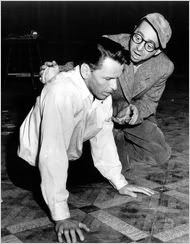
The Man With the Golden Arm

Another movie I thought I had done a blog post about before, but apparently haven't, is The Man With the Golden Arm. It airing tonight at 12:15 AM as part of the first night in the salute to Star of the Month Kim Novak.

The star of the movie isn't Novak, but Frank Sinatra. He plays Frankie Machine, a man who has just gotten out from a six-month stint in a federal prison/hospital. Frankie was a dealer for an illegal card game that was raided, but got only the punishment that he did because of his heroin addiction. His time at the federal facility was supposed to detox him, as well as giving him a new skill so that he could start a new life and leave the old, drug-filled lifestyle behind. That skill is playing the drums, and Frankie is hoping he can get his card from the musicians' guild so that he can join a band. (As if there were no drugs in the world of jazz, but that's another story.)

Anyhow, we quickly see why Frankie was a user in the first place: he's got a lot of problems, and that's putting it mildly. Perhaps chief among these is his wife Zosh (Eleanor Parker). She's confined to a wheelchair, thanks to a car accident suffered when Frankie was driving drunk. And dammit, Zosh isn't about to let Frankie forget what happened, although to be fair, being crippled by your spouse probably would change your outlook on life and that spouse rather significantly. There's also Schwiefka (Robert Strauss), the man who organizes the card game for which Frankie deals. Finally, perhaps as important as Zosh is Loiue (Darren McGavin). He's the man who sold Frankie his heroin, and he would love to get a good customer back.

Trying to help Frankie are two people. First is his good friend Sparrow (Arnold Stang). Sparrow, however, lives on the fringes of the law, and this presents a problem straight off when Sparrow tries to help out Frankie by getting a suit for Frankie to wear to auditions. That suit is shoplifted, and getting Frankie in trouble with the law again is what enables Schwiefka and Louie to sink their claws back into Frankie. The other good person is Frankie's old flame, Molly (Star of the Month Novak). Frankie would be with her if it weren't for what he did to Zosh, and Molly would be willing to be with him if she could be sure that Frankie has really kicked his drug habit. At the same time, Zosh is worried that Frankie is going to leave her for Molly -- not without reason.

The Man With the Golden Arm is about as gritty as you could get for a movie in the mid-1950s, and as far as I can tell is well-acted. I have no idea what heroin addiction is really like, not even second-hand, so I can't really speak to how accurate everything is. But Sinatra's scenes of the effects of the herois use, and especially the withdrawal symptoms, are disquieting. I have a feeling Molly is a bit too perfect, while Sparrow is also a bit too clean-cut for a man in his position. He looks more like the romanticized characters in Damon Runyon stories than a gritty petty criminal, who would probably look old before his time. Those criticisms aside, the story is quite good, although the ending is a bit convenient.

The Man With the Golden Arm is another of those movies that got a DVD release in the past, but seems to be out of print, as it's only available from Amazon, and not the TCM Shop.