Showing posts with label Dana Andrews. Show all posts

Sunday, August 23, 2026

Daisy Kenyon

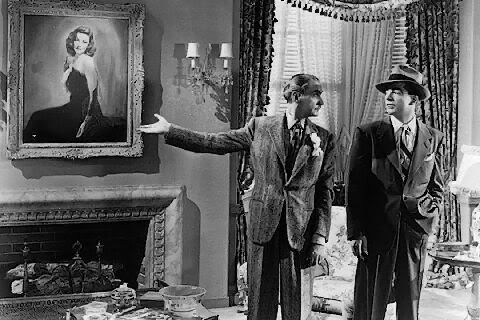
One of those movies that I had seen part of somewhere along the way but never got around to seeing all of -- probably on the old Fox Movie Channel since it's a Fox movie and I can't remember the last time they ran it -- is Daisy Kenyon. So when TCM showed it as part of a night dedicated to director Otto Preminger, I recorded it in order to be able finally to watch it and write up a review. Tomorrow being Dana Andrews day in Summer Under the Stars, and with my realizing that the movie in tomorrow's schedule I was going to do a post on is one that I actually blogged about four years ago (Brainstorm, Aug. 24 at 6:00 PM), I figure that now is a good time to put up this post on Daisy Kenyon even though it's not airing on TCM tomorrow.

Dan O'Mara (Dana Andrews) is a lawyer at a prestigious firm who takes a taxi to what is probably supposed to be Greenwich Village to see fashion artist Daisy Kenyon (Joan Crawford). It fairly quickly transpires that Dan is carrying on a romantic affair with Daisy. There is, however, a fairly serious issue with this in that Dan is married to Lucille (Ruth Warrick) with two kids about to become teenagers. Not only that, but Lucille is the daughter and granddaughter of the founders of the law firm. So, because of family obligations, Dan has to break off the date he had hoped to have with Daisy.

As Dan is leaving the apartment building, he runs into another man who is about to ring to be let in, Peter Lapham (Henry Fonda). Peter is also seeing Daisy, which is possibly a response from Daisy to the less-than-stellar treatment she's been getting from Dan, although to be fair, Daisy really ought to know she's going to get that sort of treatment from a man who's cheating on his wife. Peter isn't cheating on his wife, because his wife is already really quite dead, having died in a car accident some years back. That's one of the things that prompted Peter to leave his Cape Cod home and serve in the US Army during the recently concluded war. Peter is thinking of going back to Europe to serve in the occupation army. So, as we can see, Daisy is going to have to choose between two men.

But then things get more complicated. Dan is approached by a man who wants to hire O'Mara to represent a man in an important legal case: that of a Japanese-American man who served in the army in Europe with some distinction, only to return home and find he had been dispossessed of his farm Bad Day at Black Rock-style. It's important, but not exactly remunerative. It's going to take Dan away from the clients who are paying him the big money; it's going to take him away from his wife and kids; and it's going to take him away from Daisy.

So eventually Dan returns from doing some research work on this case and finds that Daisy has suddenly gotten married to Peter! Dan probably ought to admit defeat and go back to his wife and the kids he really does love despite the way he treats their mom (who, to be fair, does have enough issues where one can understand why Dan might start looking at other women). Instead, he continues to pursue Daisy, to the point that he stupidly calls Daisy from the house and Lucille listens in on the call. She decides to file for divorce and try to get custody of the kids. In theory, this would have left Dan free to marry Daisy if she hadn't already gotten married. It's also a lot more complicated because Daisy could be the co-respondent in the divorce case.

Ben Mankiewicz, in his comments after the movie, commented that the movie didn't have much of a reputation for a long time, to the point that Otto Preminger claimed many years later not to have remembered much about it. Having watched it, I can see the reason for the lack of reputation. Everything about Daisy Kenyon is competent, and definitely not anything that the cast and crew should want to forget about having made. But, at the same time, the plot is a fairly ridiculous melodrama. It's not as extreme in having to jump through hoops to satisfy the Production Code as something like The Great Lie, but there's a lot here that strains credulity. That, and it feels competent, not an all-time great. Also to be fair, there are quite a few other 40s prestige movies that aren't that well-remembered 80 years on.

So definitely give Daisy Kenyon a watch. It's certainly interesting.

Thursday, April 2, 2026

Strange Western on TCM

TCM's lineup tomorrow (Apr. 3) morning and afternoon is a bunch of mid-1950s widescreen stuff that I think is all from Warner Bros. One of the movies is one that I hadn't blogged about before and was on my DVR from the last time TCM ran it. That movie is Strange Lady in Town, airing at 4:00 PM, so as is my way around here I watched the movie in order to be able to put up this post for the upcoming showing.

After the credits, a title card informs us that the scene is the New Mexico territory in 1880, not far from Santa Fe. A wagon is going over the landscape, only to crash, fortunately near a bunch of ranchers. The lady passenger on the wagon is Julia Garth (Greer Garson) from Boston. She's a doctor in an era when lady doctors were uncommon, and out west even less common. But one of the ranchers has some pains so she treats the guy much to their surprise.

The military adjutant coming to pick her up arrives, but the two get waylaid on the way to what's going to be Julia's new house. Several bandit types ask about the military court of inquiry being held, although the adjutant knows knowing, not having been there. The adjutant in question, Martinez-Martinez, is working for Lt. David Garth (Cameron Mitchell), who happens to be Julia's brother, and one of the reasons Julia is coming out to New Mexico. His is also one of the two main plot strands going through the movie.

The other plot strand includes the doctor currently in town, Dr. O'Brien (Dana Andrews). He's got an adolescent niece Spurs (Lois Smith) who is quite the tomboy, and who has a thing for Lt. Garth even though he isn't right for Spurs. Getting back to Dr. O'Brien, he's one of those old-fashioned people who thinks it's not proper for ladies to be doctors, which is going to be an even bigger problem considering that she knows the latest advances in medicine from back east which are going to show her to be right in a bunch of situations Dr. O'Brien wrong. But at some point along the way Dr. O'Brien is going to fall in love with Julia.

As for Lt. Garth, I mentioned that he's not quite right for Spurs, even though she doesn't get that yet. He likes to gamble and is quick-tempered, which are traits liable to get an officer in trouble. There's also that court of inquiry mentioned in the opening. Lt. Garth tells his sister that the court of inquiry is being held because somebody sold the army a bunch of cattle that turned out not to have been owned by the person doing the selling, which equates to cattle rustling and a serious crime. As you can guess, especially considering a comment when Julia mentions not being able to buy a place for her on an officer's salary, Lt. Garth might know more about the rustling than he's letting on.

Finally, for a movie set in 1880 New Mexico, the studio had to insert a couple of historial tropes: Dr. Garth meets Billy the Kid (Nick Adams) when he and another man come in because of a toothache. Later in the movie, Garth treats Civil War general, and by this time territorial governor, Lew Wallace.

Strange Lady in Town combines a lot of different plot stuff into what is in many ways a pastiche of the Old West. It's a movie that's definitely competently made, although it's also one that's rather old-fashioned, in a way that reminds me of another Garson movie Blossoms in the Dust. It's certainly not the first film I'd think to recommend regarding any of the people in the movie, but it's also one that there's not anything particularly wrong with. It just doesn't do anything new. In the days before TV, this would have been enough, but having been made later, it's easy to see why this one has become little remembered.

Friday, September 8, 2023

Sealed Cargo

Another movie that sounded interesting enough to record the last time TCM had it on, which I think was during the Memorial Daywar movie marathon, was Sealed Cargo. Recently, I finally watched it off my DVR.

Although this is a World War II movie, it's got a different focus than a lot of the war movies. In this case, the main focus is on a fishing boat that gets mixed up with the war in a pretty big way. Now, the men who captained fishing boats were, I'm assuming, exempted from the draft because they were producing food for both the home front and even more importantly the fighting men. The ship here is the Daniel Webster, an old fishing vessel sailing out of Gloucester MA and plying the Grand Banks off the coast of Newfoundland, which was a big fishing area until the fishery collapsed a generation or so ago. The Daniel Webster is captained by Capt. Banyon (Dana Andrews).

Andrews has a bit of a rag-tag crew, including a couple of Danish refugee seamen, Konrad and Holger. He also gets approached by a woman, Margaret McLean (Carla Balenda) who is asking for transport to Newfoundland where her family supposedly lives. This ought to set off alarm bells for Capt. Banyon as it's totally against protocal, and with a war on who the hell is taking on strange passengers. But Banyon must be thinking with his little head or something, and takes Margaret aboard.

Sure enough, the radio goes kaput, and there are enough people on board to suspect of sabotage. But the Daniel Webster is about to have bigger problems when it runs across a Danish fishing vessel that's adrift and seemingly damaged. Banyon boards that ship and surmises something might be wrong because the gun damage is not below the waterline, and that's where you'd shoot if you were trying to sink a boat. Further, it's only drifting, but it seems to be abandoned. Well, they do find the captain, Skalder (Claude Rains), and one dead body.

Capt. Banyon is suspicious, but tows the ship to Newfoundland anyway. At least here he finds out that Margaret does have a father living here and working with the Canadian navy. (Technically, Newfoundland was still a separate dominion and wouldn't join Canada until 1949, but I'd have to do some research to see how Newfoundland's defense was handled during World War II.) But as he's still suspicious, he takes the opportunity to board the Danish surreptitiously. Somehow, he happens to find the hidden latch that opens the cargo hold to reveal a second cargo hold, which holds... a bunch of torpedoes! This boat is supplying all those German U-boats that have been plying the North Atlantic!

So Skalder is really German, and you know that he's going to try to figure out a way to overcome Capt. Banyon and get his boat back out on the North Atlantic to resupply those U-boats. Fortunately for Skalder, his crew that "abandoned" ship wound up in the same port, setting up the movie's climax....

Sealed Cargo is a decided B movie, despite the presence of two reasonably big stars in Andrews and Rains. It was also made at RKO, which means that it doesn't quite have the production values that some of the other studios had. Despite this, the story is still effective enough that the movie ultimately works. It's not the greatest movie you'll ever see by any stretch of the imagination, but it's an entertaining enough diversion.

Friday, July 21, 2023

No Hunter Biden jokes, please

Another of the movies I came across when I was browsing through the various streaming channels and that looked like it might be interesting was a mid-1960s disaster movie called Crack in the World. It certainly was interesting, but was it good?

The movie opens up in Tanganyika, which is not the part of Tanzania on the actual continent of Africa; the "zan" in the country name coming from the island of Zanzibar after the two entities merged in 1964. A bunch of scientists, led by Stephen Sorensen (Dana Andrews) are working on the issue of how to unlock the geothermal heat deep in the earth's mantle and core so as to get a nearly limitless source of clean energy. They've been trying to drill all the way through the crust, which various scientific teams have tried to do in real life, but everybody's been stymied by the heat. Further, in the case of this scientific consortium, the scientists have reached a layer of material too dense to drill through.

Dr. Sorenson comes up a brilliant idea: explode your way through the obstacle. The only explosive powerful enough to do it, however, is a hydrogen bomb. Needless to say, the idea sounds at least slightly risky, and Sorensen's fellow scientist, geologist Dr. Rampion (Kieron Moore), doesn't like the idea because it won't work and could have dire consequences. You might guess from the title of the movie that Rampion is more likely to be right in this scientific debate, but you'd also be getting ahead of yourself.

Before that we need to have a back story involving the main characters. Dr. Sorensen is married to Maggie (Janette Scott), but apparently she had a romance with Rampion before getting married to Stephen; now, there's some strain in the relationship. Making matters much worse, however, is that Stephen has some sort of terminal illness which may be part of why he wants to finish this project before he dies. In any case, his dying would allow Maggie and Rampion to get back together.

Rampion tries to get the British government, through liaison Sir Eggleston (Alexander Knox) to shut down the project, but it's too late, because Sorensen has already set off the nuclear explosion. Sure enough, your guess from two paragraphs ago was right, and there are dire consequences. Those consequences involve a change in the plate tectonics, with a new fault line being opened, causing massive earthquakes and tsunamis in its path. Those threaten the entire existence of mankind unless something can be done to stop it.

The scientists come up with an idea, but as in movies like this, the first idea only works temporarily, and they have to go back to the drawing board in a race against time, leading up to the dramatic climax.

Crack in the World is fairly predictable, even if it came about several years before the all-star disaster film craze of the 1970s. Is it good? Well, it's certainly not bad, and the effects aren't bad for the mid-1960s. It's a darn sight better than At the Earth's Core. But it's still a fairly pedestrian movie. It entertains, but it's not something anyone would call great. I'm glad I watched it, but I won't be searching it out on DVD.

Thursday, June 15, 2023

The sun around a walk

One of the movies that TCM seems to show fairly often when they need something for the Memorial Day or Veteran's Day programming blocks is A Walk in the Sun. I hadn't actually seen it before, so this year I made it a point to watch to be able to do a review on it here.

The action takes place in late 1943, as the Allies are about to make the jump to the European continent by invading Sicily after which they will work their way all the way up the peninsula. The story deals with one small platoon's place in that invasion. They're waiting to make the sea crossing, and it's not an easy one since the Axis powers know it's coming and have defensive weaponry ready to try to repel it. Indeed, one of the shots from the shore severely injures the head of the platoon, forcing them to select a new commander, who also gets killed fairly early on. Ultimately Staff Sgt. Tye (Dana Andrews) is going to lead the platoon.

Their objective is a bridge that crosses a river on a key road that the Axis powers have been using to transport troops, so their job is to destroy that bridge until the Allies can secure the area and replace the bridge. However, the bridge is guarded, more or less, by a farmhouse that holds the high ground in the area, and the Germans and Italians are sure to have a lot of men stationed there.

But to be honest, the mission is more of a macguffin as the movie is really about the men themselves and how they react to being in war and the stresses that produces, and how they deal with that stress. If you're looking for action, there's not all that much, although there is an assault on the farmhouse at the end. This may disappoint some viewers.

On the other hand, he have a cast of people who were all relatively early in their careers, with some going on to pretty big things (Lloyd Bridges and Dana Andrews), while others did well but achieved varying degrees of stardom (Richard Conte and John Ireland. Sterling Holloway is probably the veteran of the cast as a medic embedded with the platoon who gets killed off early.

So is A Walk in the Sun a good movie? I'd say it depends on what sort of movie you're looking for. There are those who say that war is a lot of hurry up and wait, with short bursts of action punctuating long periods of nothing much happening. If you're up for that and a movie with an ensemble cast, then I think you'll definitely like A Walk in the Sun.

Saturday, September 3, 2022

Brainstorm (1965)

Dana Andrews was TCM's Star of the Month back in July, and one of his movies that I hadn't seen before was the 1965 Brainstorm. (There's the proably more famous 1983 movie Brainstorm, the movie Natalie Wood was making at the time of her death, that has a completely different plot.) The plot of the 1965 Brainstorm sounded interesting, so I recorded it and just recently watched it to, as always, do a post on it here.

Jeffrey Hunter (billed as Jeff, not Jeffrey) plays Jim Grayam (yes, that's the spelling), who works doing computer analysis of weapons systems for Benson Industries, one of those defense contractors that dot the Southern California landscape. One night, as he's leaving work, he spots a car that's stalled on the train tracks. Worse, there's a woman in there who looks to be unconscious if not dead. And Jim can hear a train coming. Not being able to wake up the woman, Jim breaks one of the windows and gets the car off the tracks just in time.

Jim looks through the woman's belongings for identification, and finds that she's... Lorrie Benson (Anne Francis), the wife of Jim's ultimate boss, Cort Benson (Dana Andrews)! Jim is going to have to break the bad news, and worse, Jim figures out that since the car didn't have any mechanical issues, Lorrie was really trying to commit suicide. Imagine having to be the one to do that with one's boss.

Jim gets to the Benson mansion, and finds that Lorrie is deeply unhappy that Jim saved her, as she feels trapped in a loveless marriage with Cort using his power to prevent any other man from getting close to her -- there have been quite a few men before, apparently. But when Lorrie learns that Jim didn't save her for any sort of monetary or work-related reward, she decides that she's going to try to pursue him romantically.

Cort figures out what's going on, and uses his power as head of the company to make it look as though Jim is going nuts at work. Decidedly not helping Jim in this regard is the fact that he already has a history of mental instability, having suffered a breakdown in college. But this, combined with his increasingly falling in love with Lorrie, gives him a wacky idea that couldn't possibly work in real life, never mind in a movie that was made when there were still some of the restrictions of the Production Code.

Jim decides he's going to kill Cort, but also to try to get himself declared not guilty by reason of insanity, so that he'll be sent to a hospital, from where he can then fairly quickly get himself proved not insane after all. When it comes time for the psychiatrists to determine whether or not Jim is sane or not, the head of the committee examining him is Dr. Larstadt (Viveca Lindfors). Jim seems to be falling in love with her, too....

There's a seed of an interesting plot in Brainstorm, but the movie goes off the rails, I think, in no small part from the script being rather unrealistic. The only thing that it does well -- and I wonder whether this was unintentional -- is to make the viewer wonder at the end whether Jim was ever sane. But Cort is never fully fleshed out, and Lorrie seems one-dimensional in her on instability. The direction (by future TV star William Conrad) was somewhat jarring at times with its cuts and pans, but that may have been a deliberate attempt to keep the viewer off-kilter. (If it was deliberate, it succeeded.)

Brainstorm is an interesting misfire that may leave other viewers as frustrated as it left me. But it probably deserves one viewing, at least, if only to figure out where everything goes wrong.

Sunday, July 18, 2021

Berlin Correspondent

Another of the movies that recently started showing up in the FXM lineup that I hadn't seen before is Berlin Correspondent. It's got another airing tomorrow morning at 4:40 AM, so I sat down to watch it and do a post on it here.

A very young, and surprisingly mustachioed Dana Andrews plays Bill Roberts. He's an American radio correspondent in Berlin in November 1941. If you know your American history, this is about a week and a half before the Japanese attack on Pearl Harbor, based on Bill's comments about Thanksgiving. Bill's Nazi minders make certain that Bill only gives out the propaganda that the Nazis want out there, but in fact Bill is able to get more out, by using coded language that would sound perfectly normal to an unsuspecting listener.

The Nazis quickly realize that somebody is getting secret information out to the west, and since Bill is a foreigner in Berlin, he's somebody that the Nazis are keeping their eye on anyway. They've got a private eye-type who's really working for the Gestapo tailing Bill, but he's one of thoes preternaturally stupid Nazis that populated Hollywood propaganda films during World War II. So Gestapo officer Capt. von Rau (Martin Kosleck) comes up with an idea. He'll have his girlfriend Karen Hauen (Virginia Gilmore) tail Bill and make his acquaintance. Bill will never suspect a woman who's never done intelligence work before.

Capt. von Rau is correct. Bill goes to a dealer in old stamps who just happens to be Karen's father (Erwin Kaiser). The stamps that Mr. Hauen sells to Bill have secret coded messages on the back written in invisible ink that only shows up under strong lights. Again, it's something that normal people wouldn't expect, but but Karen isn't stupid and figures things out. She doesn't realize at first that her father is in on the plot.

So the Nazis arrest Mr. Hauen and, to make getting rid of him easier, send him to an "insane asylum" run by Dr. Dietrich (Sig Ruman). Bill is somehow able to disguise himself as a Nazi psychiatrist working in Hitler's inner circle, which gets him into the facility, and able to free Mr. Hauen. However, Bill has to use his own passport to get Hauen out of the country to Switzerland, which poses serious problems.

Unsurprisingly, Capt. von Rau figures out right away what's happened, and has Bill rounded up and sent to an internment camp for foreigners, something that's easier considering that December 7 has come and the attack on Pearl Harbor has happened. By now Karen's decided that she doesn't want to marry von Rau after what he's done to her father and to nice Bill -- and one can guess that Karen's fallen in love with Bill. Capt. von Rau makes an agreement with Karen that he'll let Bill "escape" if she'll marry him (ie. von Rau). But it would take an idiot not to see that von Rau is lying through his teeth.

Berlin Correspondent is another of those movies with all sorts of plot holes, mostly revolving around the requirement that the Nazis we see have to be so stupid that it's a wonder how they were ever able to come to power, much less bambooze the west into giving up everything they did before Sept. 1939. But for all that obvious propaganda, Berlin Correspondent is actually an excellent example of the sort of B propaganda movie the Hollywood studios were churning out as part of the war effort to keep morale up on the home front. Andrews already shows promise, while Kosleck is good and Ruman provides the comic relief.

Berlin Correspondent is not a great movie by any stretch of the imagination, but as an example of the genre it inhabits, it's a very good example.

Thursday, July 1, 2021

State Fair (1945)

Another of the movies that started showing up in the FXM rotation in the last few months is the 1945 version of State Fair. It's going to be on again tomorrow at 8:50 AM, with another airing on Saturday, and probably more in the not-too-distant future.

I had seen the original 1933 version of State Fair, which Fox produced as a vehicle for star Will Rogers, and knew that the 1945 and later 1962 remakes were both musicals. Although Richard Rodgers and Oscar Hammerstein wrote the songs, as far as I can tell the musical was in fact an original for the silver screen and not a Broadway musical, at least not until much later. In any case, the 1945 film is roughly the same story as the Will Rogers movie, plus the music and minus some of the pre-Code elements.

State Fair tells the story of the Frake family, who are going to be visiting the Iowa State Fair in the upcoming weekend. Father Abel (Charles Winninger) is planning to show off his prize pig in the hopes of winning the big prize, while mom Melissa (Fay Bainter) is entering her pickles and her mince pie in the cooking contests. There are also two adult children who have varying levels of enthusiasm about going to the fair. Wayne (Dick Haymes) has a girlfriend Eleanor who has to beg off going thanks to an illness in the family, while Margy (Jeanne Crain) has a drip of a boyfriend. After all this expository introduction and a lot of singing, we're finally off to the fair.

One reason Wayne wanted to go to the fair is that the previous year, he got cheated by the ring-toss barker (Harry Morgan in a role so early he's still being called "Henry" in the credits). Wayne's been practicing, and he finally gets his revenge on the barker fairly early on. Afterwards, he meets lovely singer Emily Edwards (Vivian Blaine) and has a whirlwind romance with her. This even though he should see the warning signs when she lies about being a policeman's daughter. He also runs into McGee, a song hawker who gets Wayne to promote a song for payola.

Margy has a more complicated time. She decides to go on the roller coaster, and in order to fill up the seats, another passenger, journalist Pat Gilbert (Dana Andrews), there to cover the fair. As you can guess, those two also fall in love, and their love is much more real than the romance between Wayne and Emily. But there's a problem in that at the film's climax, Pat gets a job offer he really can't refuse, that of a columnist in Chicago. He'd have to accept almost right away, which would mean stiffing Margy.

There are also extended scenes of the judging of Ma's pie and pickles, along with the judging of Pa's boar. Unfortunately, these feel more like they're bringing the movie to a halt. I'm guessing I got those feelings because Winninger and Bainter are decided supporting players, and not stars who could carry a movie the way Will Rogers could. There's also a lot of music, and when I say a lot, it seems to be more than most musicals if not to the level of The Umbrellas of Cherbourg.

And ultimately, I think, it's whether or not you like the muisc and the whole musical genre that will determine how much you like State Fair. It's the sort of musical that Fox was quite adept at producing in the 1940s, and I can see why audiences of the day would have flocked to it, wanting something homespun and comforting in the aftermath of World War II.

I'm not the biggest fan of musicals, and to be honest, I prefer Fox's biopic musicals from the same era. But people who like musicals will probably really like State Fair.

Friday, June 25, 2021

Should be on a double bill with The Alligator People

A couple of months back, FXM put a movie into its rotation that was completely new to me: The Frogmen. It's going to be on again tomorrow at 7:50 AM and again Sunday (June 27) at 6:00 AM. So with that in mind, I went and watch the recording I had made of one of the several previous airings.

On an American ship somewhere in the Pacific theater of World War II, one group of guys is trying to relax on the top deck before the regular crew of the ship drives them off having to wash the decks. It turns out that the first group, led by Flannigan (Dana Andrews) are part of the UDT, the Underwater Demolition Team. In short, they're the titular "frogmen", whose job it is to go underwater just off shore of islands and rig things to be blown up, or do other surveillance that can't be done any other way. They're currently on a transport ship captained by Lt. Cmdr. Vincent (Gary Merrill).

From the first scene it seems like Flannigan is the frogmen's commanding officer, but that's not quite true. Their actual CO is Lt. Cmdr. Lawrence (Richard Widmark), who has only recently replaced Cassidy, who died on a mission. So there's a fair amount of enmity between Flannigan and the lower-ranking men, who all really liked Cassidy, and Cmdr. Lawrence, who's more by the books, cold and distant.

The group has three missions during the course of the movie. The first is reconnaissance to determin whether a secondary beach can be a landing point for an American assault on a Japanese-held island. Flannigan gets injured in this mission, and Lawrence thinks the mission is more important than any one man, which leads to even more enmity.

Flannigan might get a chance to prove himself to Lawrence, however. Lawrence gets an injury, having been infected through a scratch on some coral, and is in no position to actually rig the Japanese defenses to be bombed. Unfortunately, Flannigan does something really stupid, which is to have one of his men put up a sign on the beach welcoming the Marines. The man gets shot and fairly seriously injured.

But Flannigan ultimately does redeem himself when the transport ship gets hit by a torpedo that doesn't detonate. Flannigan and Lawrence are going to have to work together to defuse it, all while there's water coming into sick bay where the frogman who had gotten shot is lying, relatively immobile.

Finally, the UDT gets called over to a submarine for a super-secret mission to bomb a Japanese submarine pen. It's a much more dangerous mission, especially once the Japanese discover that the frogmen are right beneath them. One of the frogmen, played by a young Jeffrey Hunter, nearly gets killed.

There's a lot that's fairly standard in a movie like The Frogmen, starting with the whole conflict between the men who have been together a long time and their new commander. But The Frogmen tells its story well enough, with more than competent acting from the leads, and a reasonably good amount of suspense. It's not the greatest war movie made by any stretch of the imagination, but it succeeds at what it set out to do. People who want a war movie they might not have seen before would do well to catch The Frogmen..

Wednesday, January 20, 2021

Torch Song in reverse

I noticed that Torch Song is on the TCM schedule, tomorrow morning at 8:30 AM. Not too long ago, I watched a different movie that reminded me of Torch Song. That one is called Night Song and, not having blogged about it before, now would be a good time to do so.

Merle Oberon plays Cathy Mallory, an unmarried socialite living in San Francisco with her aunt, Miss Willey (Ethel Barrymore) and who is a patron of the arts. She and some of her friends go to the symphony, and after that they go to a little hole-in-the-wall bar off a side street that has a jazz combo playing. The combo has a pianist, Dan Evans (Dana Andrews), and Cathy thinks he's pretty good.

Cathy goes over to the piano to chat up Dan, but he reveals that he's blind, and rather snottily bitter about it too, spurning any advances because after all, who's really going to love a blind guy? They're just going to pity him. Dan's best friend Chick (Hoagy Carmichael) would like to see Dan get better, and go back to working on that concerto that he was composing before he went blind, but who knows if that's going to happen?

So Cathy comes up with a daft idea. Perhaps Chick could arrange for Dan to be somewhere that Cathy could bump into him, like at the beach. Only this time, Cathy is going to pretend to be blind and not well-to-do, so that Dan won't think this new woman he's just met is taking pity on him. Now, of course, the obvious question is what's going to happen when Dan finds out that Cathy is in fact fully sighted. I'd think he'd hate her for lying to him and treating him as the butt of some sort of sick joke.

At any rate, Dan doesn't figure out that this is rich and sighted Cathy Mallory, and becomes friends with the woman he thinks is blind, her aunt in tow because she supposedly needs a sighted companion, too. Cathy hears the concerto and thinks it's good and that Dan should keep working on it. She also learns that this is one of those forms of blindness that might be curable, but it's going to need $5,000 (a fairly substantial sum back in the late 1940s) and a trip east for the operation to do so.

Ah, but Cathy has a solution for that. She has the money to set up a contest to commission a new concerto, with a grand prize of... $5,000! Oh, and Cathy most definitely isn't in any way going to influence the judging to make certain that Dan's concerto wins, no sirree.

So of course we know that Dan is going to win the contest, and the prize also includes the great pianist Artur Rubinstein (a real concert pianist back in the day, playing himself) is going to perform the concerto... in New York in a few months' time, those few months being more than enough time for Dan to go to New York too and get that operation. Of course, once Dan regains his sight, he's not so sure he wants to see the "blind" Cathy any more since he doesn't want her to think he's pitying her. "Sighted" Cathy comes to New York....

Oh boy is the plot to Night Song ridiculous. The acting is good enough, but dammit if all those plot holes about the characters' motivation don't stay in the front of my mind throughout the movie. Fans of classical music will probably enjoy the music, although of course it really pops up at the end so you have to sit through a good 80 minutes or so before you get to it.

Night Song was originally released by RKO, so unsurprisingly it has received a DVD release courtesy of the Warner Archive collection.

Friday, July 20, 2018

No, this isn't the 74th sequel

Part of my last batch of DVD and Blu-ray purchases at Amazon was a four-disc set of the Airport movies. I'd already seen the first of the Airport movies, so last night I popped in the disc of the second, Airport '75 (which actually premiered in theaters in October 1974).

The movie starts off with a lengthy list of stars in the opening credits, some near the top of their career, some who were old enough to retire if they had wanted to, and a few names who became famous later. As for the actual action of the movie, flight attendant Nancy (Karen Black) meeting her boyfriend, pilot instructor Alan (Charlton Heston), at Dulles International Airport just outside Washington DC. Nancy apparently has some Big Issue she wants to discuss with Alan, but he has to get the next plane out to LAX in Los Angeles while Nancy is on the red-eye several hours later.

This being a disaster movie, we then get to see the famous names you should already be watching out for if you paid close attention to the opening credits. In no particular order, there's Mrs. Patroni (Susan Clark), wife of George Kennedy's character from the first Airport movie, a role Kennedy reprises here. There's older nun Martha Scott traveling with more modern nun Helen Reddy(!); little old lady Myrna Loy getting harassed at the airport bar by Jerry Stiller, Norman Fell, and Conrad Janis; Sid Caesar is a bit-part actor who hits on Loy during the flight; and Linda Blair as a kidney transplant patient traveling with her mother (Nancy Olson). Oh, and there's Gloria Swanson playing herself. As for the crew, Efrem Zimbalist Jr. is the pilot, Roy Thinnes the co-pilot, and a young Erik Estrada(!) the navigator.

Now for the disaster. There's thunderstorms and fog all up and west coast meaning that our jet is going to have to land in Salt Lake City while the weather clears. Meanwhile, traveling in a small plane from Albuquerque to his home in Boise is Dana Andrews, who's actually a veteran of air disaster movies, having made Zero Hour! and The Crowded Sky many years earlier. He's desperate to get home because he's got a huge business deal to conclude in Boise the next day, one that's going to fall through if he doesn't get home. He's never going to get home. He suffers a hilariously overacted heart attack, causing him to lose control of his plane and crash into the cockpit of the 747. That crash sucks out Thinnes and Estrada, and leaves Zimbalist with cuts that because of the bleeding, temporarily blind him. Poor Karen Black is going to have to land the plane with help from her boyfriend telling her over the radio what to do. And when that doesn't work, they're going to have to rappel a pilot through that hole into the cockpit to land the plane himself!

To be honest, I find Airport '75 to be a difficult film to give any sort of a grade to. The plot strains credulity to the point that I found myself laughing at the idiocy of it. Most of the characters' story lines don't get any fleshing out because there are just way too many of them. And the characters are pretty much archetypes from all the all-star disaster movies that had preceded it.

Yet I found Airport '75 immensely entertaining. A lot of the characters get terrible dialog, but it's hilariously funny, and not even in a "so bad it's good" way. I suppose Dana Andrews' heart attack isn't dialogue, but that's one good example. The elder nun's distaste of Gloria Swanson, along with Swanson's constant name-dropping about old Hollywood, are another. And then there's Helen Reddy's having to sing an awful song about how you are your own best friend to Linda Blair. Myrna Loy by comparison doesn't acquit herself any worse than her character in From the Terrace, with the exception that this one likes to drink boilermakers, only she doesn't call it that.

Airport '75 may not be as good as the original Airport, but it's a hell of a lot better than things like The Swarm or Beyond the Poseidon Adventure.

Saturday, January 21, 2017

I have mentioned all of these before, haven't I?

I was looking at the TCM schedule, and I saw that the afternoon lineup concludes with a short, Souvenirs of Death, at about 7:49 PM after Bend of the River. It's an interesting idea, and I wasn't certain if I had mentioned it before, but as you can see from the link, I have. Basically, somebody captures a gun off a Nazi in World War II and brings it home, but the bad guys wind up getting it.

Tonight's prime time lineup is dedicated to actor Dana Andrews. Interestingly, TCM is able to get in four movies before going to TCM Underground. First up, at 8:00 PM, is Boomerang!, in which Andrews plays a prosecutor who comes to believe the guy he's supposed to be prosecuting is in fact innocent. It's based on a real-life story in which the prosecutor in question wound up becoming Attorney General in the Franklin Roosevelt administration, although the movie is set in the "modern" day, that of the late 1940s instead of the late 1920s.

Next up, at 9:45 PM, is Fallen Angel at 9:45 PM. I don't think I watched the 2011 TCM airing, and I'm pretty certain I haven't seen it since, so this is one that it's definitely been ages since I've seen.

Then come a pair of movies from a bit later in Andrews' career. At 11:30 PM is While the City Sleeps , a mystery set against the backdrop of a power struggle at a news empire and the various fiefdoms there trying to solve the mystery. It's a lot of fun, and incredibly cynical.

Finally, at 1:15 AM, there's Beyond a Reasonable Doubt, which has Andrews as a journalist who gets into an audacious story with his boss (Sidney Blackmer): frame himself as a murderer, and reveal the evidence only after he's been sentenced to the death penalty! Of course, there are complications, such as the boss dying in a car crash and the evidence going missing with his death.

All four of the Andrews movies are well worth watching.

Wednesday, October 14, 2015

The Purple Heart

A movie that first showed up on FXM Retro a month or two ago is The Purple Heart. It's getting a pair of airings tomorrow, at 4:00 AM and 9:30 AM.

The movie starts off with a bunch of foreign correspondents from various countries assembled at a Shanghai courtroom. This is sometime in late 1942, so it's occupied China and after the US entered the war against Japan and the correspondents are from countries not at war with Japan. (Note that the USSR didn't declare war on Japan until 90 days after the German surrender, so they were still neutral on the Asian front.) Obviously these reporters know that there's something important going on, but what could be so important that Japan would want to assemble all these reporters?

All is made clear when the defenders walk into the courtroom. They're American, led by Capt. Harvey Ross (Dana Andrews). Ross was the pilot and commanding officer on one of the flights that was part of James Doolittle's raid on Tokyo, something that is dramatized in the book and movie Thirty Seconds Over Tokyo. In the movie, the raid is portrayed as having continued westward from Tokyo, with the planes hoping to land in free China. Ross' plane encountered mechanical difficulties and was forced to ditch in a part of China controlled by the Japanese. A friendly local government officer picked them up, but it turned out that the officer was friendly to the Japanese, promptly turning the Americans over to Japan.

And so the Japanese put the men on trial for war crimes, saying that the Americans bombed obviously neutral targets like schools and hospitals. In reality, though, the Japanese want to know where the American planes took off from. The Geneva Convention dictates that captured soldiers only have to give their name, rank, and serial number, so this is what the Americans do. The Japanese obviously don't like this, so they come up with the bright idea of using torture to try to extract the information they want from the Americans. Meanwhile, the trial is still going to go forward.

The Purple Heart is an interesting movie for a whole bunch of reasons. First, it's based on actual events, although the names have been changed. It's not just the Doolittle raid that actually happened; Japan captured some downed air crews and put them on trial. Second, the cast contains a number of young actors who would go onto bigger and better things. In addition to Dana Andrews, there was also Richard Conte and a very young Farley Granger. Third, the movie is interesting as a propaganda piece. Since the movie was released during World War II while the events would still have been fresh in the minds of American audiences, the story is pretty one-sided, depicting the Americans as heroes who would never break under torture, while the Japanese are brutal and sadistic. (There is, however, also a conflict between a Japanese general and admiral over whether the Americans took off from aircraft carriers or from China.)

The overall result is that The Purple Heart winds up being a movie very much of its time. It's good at times, but clearly designed for the benefit of wartime audiences who would have needed a pick-me-up. Watching from the perspective of 70 years of hindsight, it comes across as a bit datedand almost overbearing. (The final scene is particularly heavy-handed, I think.) But The Purple Heart is still worth a watch.

Tuesday, September 15, 2015

December 7

On tonight's third installment of the TCM Spotlight, Five Came Back, Ben Mankiewicz and Mark Harris will be discussing director John Ford. Among the movies airing is the interesting docudrama December 7, at 11:45 PM.

Assuming you all know your history, you should know that December 7 refers to the date in 1941 when Japan attacked the US naval base at Pearl Harbor, Hawaii, an attack which caused the US to enter World War II. But it takes a while before this movie gets to the actual attack. Instead, it starts off with a sequence involving Uncle Sam (Walter Huston), and a "Mr C." (Harry Davenport), who is apparently supposed to be the conscience of Uncle Sam or something. Uncle Sam is enjoying himself on what is for him a Hawaiian vacation, since this sequence is set before December 7, 1941. Mr C., however, gets into a debate with Uncle Sam as to what the "true" nature of the Japanese-Americans in Hawaii is. After all, many of them have apparently reatken Japanese citizenship thanks to a law that allowed them dual citizenship, and they may be spying for Japan against America. As we already learned from Resisting Enemy Interrogation, it's amazing what information the enemy can get just by being patient and listening to people inadvertently drop secrets.

All that out of the way, we then get into the meat of the film, which is a look at how the US could have dropped the ball so badly in allowing Japan to attack Pearl Harbor and inflict so much damage. One of the things mentioned in looking at the attack is that the Americans had radar, but didn't use it (to be fair, it was a relatively new technology at the time). This and other mentions of American incompetence caused problems at the Department of the Navy, which commissioned the film. There were things that they probably wanted to be kept secret, even though this was ostensibly more for the Navy than for the general public. That, and I don't think they liked having their incompetence laid bare in front of the general public. So the Navy Department had what was originally an 80-minute movie, and had it edited down ultimately to a two-reeler. Amazingly, that two-reel version won an Oscar for Best Documentary Short.

Finally, ending the movie is a look at the people who lost their lives in the Pearl Harbor attack, with a very young Dana Andrews at the beginning of his career playing the ghost of one of those dead soldiers.

December 7 is a difficult movie to give a rating to, largely because it doesn't really fit into any genre very well. I called it a docudrama at the beginning, and that's partly right. But it's almost propaganda as much as it is documentary. And the debate between Uncle Sam and Mr. C. is strange, to say the least. All in all, however, the result winds up being something that's quite interesting. The full 80-minute version is now available again, and it is that version which TCM showed last December the last time I saw it on the schedule. It is presumably also that version which will be airing tonight, since the schedule lists it as being about 80 minutes.

Saturday, June 6, 2015

Crash Dive

Earlier this afternoon, FXM Retro ran Crash Dive, a movie that I have to admit was new to me. It's running again tomorrow morning at 11:50 AM if you want to see it.

The movie starts off with an Allied civilian boat of some sort having been torpedoed by the Nazis. Coming to their rescue is a PT boat, captained by Lt. Ward Stewart (Tyrone Power, who was billed in the cast as part of the Marine Corps Reserves). He drops some depth charges, annihilates those damn Nazis, and becomes a hero for it. For his troubles, he gets sent to New London, CT, where there is a submarine base. Apparently, the US submarines are short of officers, and the Navy needs Lt. Stewart on a submarine, even though he's good on the PT and likes it. At any rate, Lt. Stewart gets transferred to the Corsair, captained by Lt. Cmdr. Dewey Connors (Dana Andrews in an early role).

Lt. Cmdr. Connors, for his part, has had a lot on his mind. He's been waiting for the requisite senior officer to join him, and is mildly miffed that Lt. Stewart needs to go to Washington for the weekend to take care of some business before setting out to sea in the submarine. Meanwhile, Connors also has a girl, Jean Hewlett (Anne Baxter), who teaches at the local girls' school. He sees her off at the train station, as she's taking some honors students to Washington.

Unsurprisingly, Hewlett winds up in the same car as Lt. Stewart, who has accidentally occupied her berth. He immediately falls in love with her, not realizing that not only does she have a boyfriend, but that boyfriend is his fellow officer. So he decides that the best way to get the girl is to act like a complete jerk, because there are some women who like such jerks, and because with Power being billed ahead of Andrews in the cast, there's a reasonable expectation that it's his character who is supposed to be with Baxter's, not Andrews' character. Lt. Stewart keeps pursuing Jean, until she finally gives into him. Well, she really gives in to his nice grandmother (Dame May Whitty).

Meanwhile, the submarine goes out and confronts a Nazi mine boat somewhere in the North Atlantic, and they realize that the boat is far enough out that they have to have a base somewhere. Not that there's anywhere in the North Atlantic for them to have a base. The most logical explanation would be if it's hidden in Greenland, except that the comments they make about the climate would imply that the base is someplace further south, if only there were islands far enough south in the Atlantic for them to have a base.

The sub gets back to New London, Lt. Stewart finds that Jean is engaged to be married to Connors, and then Connors finds that Jean and Stewart are in love with each other. All of this at the same time they're about to head back out into the Atlantic to find that Nazi base and destroy it....

There's a fair bit in Crash Dive that's predictable and formulaic, but then this one was made during World War II, when audiences probably wanted something that was more morale-raising than anything else, which means uncomplicated and familiar. Crash Dive, I think, probably would have succeeded for audiences of the day; as for today's audiences I'm not so certain. I thought Power was even more of a jerk than he was in A Yank in the RAF. The climactic raid on the Nazi base is OK, but the print has colors that are muddled, even more than would normally be the case for a nighttime raid. It was to the point that it was sometimes tough to tell what was going on. And then after the raid succeeds -- as I said, this was a morale builder -- there's a tacked on bit about the importance of every type of ship to the war effort.

As I say when there's a movie I don't particularly care for, however, watch and judge for yourself. The movie did get a DVD release, but I don't know if it's still in print.

Monday, May 4, 2015

Beyond a Reasonable Doubt

TCM is running a night of death row-themed movies tonight, including Beyond a Reasonbale Doubt at 12:15 AM.

Dana Andrews stars as Tom Garrett, a writer who's moving up in the world. He's gotten himself engaged to Susan Spencer (Joan Fontaine), who is the daughter of the influential newspaper publisher Austin Spencer (Sidney Blackmer). Mr. Spencer campaigns tirelessly against the death penalty, and has a particular interest in doing so right now since the local prosecutor recently obtained a murder conviction on circumstantial evidence.

To that end, Spencer has an audacious idea. There's been another murder that the cops have been completely unable to solve, so he wants Tom to help him solve the murder for everybody's benefit. Well, they're not really going to solve the murder; they're going to plant evidence that will lead to a murderer, with that murderer being Tom himself. Once they do that, they'll have Tom be arrested, put on trial, and convicted, and hopefully even sent to the gas chamber. Only once all that happens will Spencer produce their documentary proof that the evidence pointing to Tom's involvment in the murder has all been fabricated.

Now, as I wtore the paragraph above, I found myself thinking of one of the TCM "Word of Mouth" pieces that runs every time they're going to be showing the 1960s version of King of Kings. Screenwriter Philip Yordan says he was called by the producer to be a script doctor, and when he flew over to Spain where the movie was being filmed, he saw what passed for a script and said, "This is insane!" Indeed, Spencer's plan for his future son-in-law is nonsensical, and who in his right mind would want to engage in a plan like that? At least Susan is in her right mind. Either that, or she'd spill the beans, so Dad and Tom decide to keep the knowledge of what they're doing from her.

So far, so good. And then the time comes for Spencer to produce the evidence which will exonerate Tom. He gets it from his safe, and then... gets into a car accident, which kills him and in the resulting fire destroys all the evidence! You'd think that if the two men had planned their actions as carefully as they did, they would have made certain to have a second copy of the evidence available somewhere. How will Tom be saved? Do we really want him to be saved, for after all, faking all this evidence is rather criminal in and of itself?

Beyond a Reasonable Doubt is one of those movies that has a really interesting premise, but in which the ultimate payoff isn't quite as good as you'd hope for. If the cops were good enough to solve murders, you'd think they'd be good enough to realize that all this evidence was faked. The plot is full of unbelievable twists, right up until the very end. And it often feels as though everybody is going through the motions. It's the sort of thing where, it it had been a B movie with a bunch of unknowns, we'd probably praise it for being a little-known gem. But it's got fairly big stars and a big director in Fritz Lang, who already did similar stuff before with Fury. The result is a movie that does remain interesting, but winds up slightly disappointing.

Friday, February 20, 2015

The new hucksters

Another movie that's back on the FXM Retro schedule after a long absence is Madison Avenue. It's going to be on again early tomorrow morning at 3:00 AM if you haven't seen it before.

Dana Andrews plays Clint Lorimer, who at the beginning of the movie is working for the Jocelyn ad agency, run by JD Jocelyn (Howard St. John). The agency has as its biggest account the Associated Dairy Company, a conglomerate of dairies from across the country. Brock, the head of the company, suggests that Lorimer is a real up-and-comer. But unfortunately, Lorimer is going to be away from the agency for a few months, while he works on a special campaign for the Defense Department, learning about America's missile bases for a public relations campaign that's going to do... something or other.

It turns out that PR campaign is a macguffin. After the opening scene among Lorimer, Jocelyn, and Brock, the action switches to Wsahington DC, which we figure is going to be Lorimer starting that work with the Pentagon. But when he comes to the Filibuster Bar (yeah, what a dumb name for a bar, but it is Washington DC), we can tell from the cinematography that there's somebody else at the bar who's going to be important. That person is a lady reporter named Peggy Shannon (Jeanne Crain). She reminds Clint that he stood her up three months ago, which is our first indication that this action is at the end of Clint's time in Washington, not the beginning. The next clue is that when Lorimer complains that Jocelyn shafted him on his ideas for the PR campaign. In fact, that's precisely what Jocelyn did, since he was worried that Lorimer was going to take the Associated Dairies contract out from under him. He's firing Lorimer, to boot.

So Lorimer does get the idea to try to take the Associated contract, although that's going to be difficult since he hasn't even got a job. But he just happens to see a milk truck from the Cloverleaf Dairy, on which it's printed that Cloverleaf is a subsidiary of Associated. Lorimer finds out who has the ad campaign for Cloverleaf, and discovers it's the Tremaine agency, so he goes there with his ideas. Sadly for him, he learns that the founder of the agency has died, and it's now being run by the founder's daughter Anne (Eleanor Parker), and has been going to the dogs since Dad died. Lorimer sets out to make over the business, and make over Anne.

The Cloverleaf contract involves two people. Stipe is the guy who's really managing the company, mostly because the man who has the title of preisdent, Ames (Eddie Albert) is flaky. Ames dives a milk route himself and flies remot controlled helicopters. Interestingly, he gets one interesting line when he suggests that in the future, milk will be delivered by larger versions of such helicopters. In real life, drone technology has advanced to the point where companies like Amazon are thinking about delivering things by drone. But this nutcase is the man Lorimer has to build up.

Lorimer sets out to work, and eventually things start going right for him, when Ames becomes an unexpected hit giving a speech at the business. This sets Ames on his rise, eventually to take over Brock's job at Associated when Brock is kicked upstairs. This is just what Lorimer wanted, because it means that now he's sure to get the Associated contract. Or maybe not. Along the way, everybody has started stabbing everybody else in the back, once once Ames leaves for the head office, the plot really gets complicated.

Unfortunately, Madison Avenue fizzles out at the end, giving an ending that just doesn't fit. Everybody tries their best, though, and you can't really fault the acting. But Dana Andrews is already looking a bit haggard, and Jeanne Crain is given some horrendous outfits and hairstyles to wear. Combined with the writing, the result is a movie that's sadly less than the sum of its parts. Still, you should probably give it a watch, if only to judge for yourself. And the good thing is that it only runs 90 minutes. If it were made nowadays, it'd probably be bloated to over two hours.

I'm not certain if Madison Avenue is available on DVD, so you're going to have to catch the FXM showings.

Saturday, April 19, 2014

More Fox premieres on TCM!

This week's TCM Essential is Laura, airing at 8:00 PM this evening. I believe it's a TCM premiere; at least, I have the monthly schedules going back to July of 2007 and a search of them didn't yield any other matches for Laura other than this month's showing. Gene Tierney stars as the beautiful model Laura, whose murder police detective Dana Andrews is brought in to investigate. Laura kicks off a night of movies starring both Tierney and Andrews, with three movies all of which I've blogged about before.

TCM showed Where the Sidewalk Ends back in 2010 when Gene Tierney was one of the stars in Summer Under the Stars; it gets another airing tonight at 9:45 PM.

The last of the three movies is, I think, also a TCM premiere: The Iron Curtain, at 11:30 PM. (Figuring out whether this one was a premiere was a bit more difficult because several movies have the phrase "Iron Curtain" as part of the plot synopsis.) I recommended it before, although didn't do a full-length post on it as I thought I had, for which I apologize.

Wednesday, February 5, 2014

The women of "The Best Years of Our Lives"

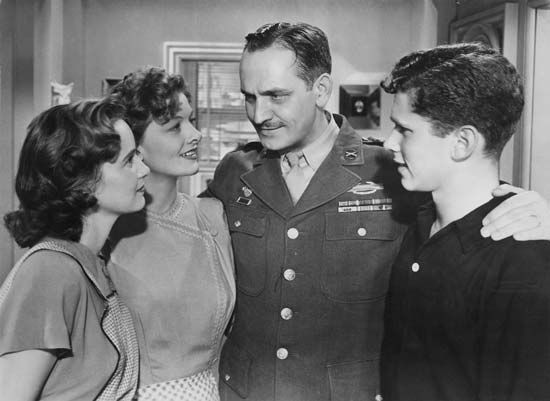
There's a big snowstorm heading for the Catskills which will probably disrupt my Internet access all day today, so I've had to come up with a post early. With yet another airing of The Best Years of Our Lives on tonight at 8:00 PM as TCM honors all of the Best Supporting Actor nominees from 1946, I figured I'd look at the movie again from another angle, this being a movie that stands up to so many repeated viewings. When I blogged about the movie for it airing exactly six years ago, I did a piece contrasting Fredric March's character, Al Stephenson, and the struggles his character faces, with the much greater struggles faced by Dana Andrews' character, Fred Derry. This time I'll spend some time looking at the women in the movie.


Virginia Mayo as Marie Derry I think the easiest of the major female characters. Marie Derry, played by Virigina Mayo, is ultimately a good-time girl who married Fred because he was just so handsome in his uniform, a theme which shows up quite a bit in World War II era movies without really exploring the consequences of what's going to happen to these people after the war. (Judy Garland and Robert Walker in The Clock, I'm talking to you.) Marie Derry probably would have been living it up more or less on the combined payment from her work at the nightclub, and the allotment check she would have received from the military department. After all, it's made quite clear at the beginning of the film that she's earning more than enough to move from the wrong side of the tracks where Fred grew up and where his parents still live, to what looks like a reasonably nice apartment in the center of town. Her character wants to keep living the high life, and when Fred can't or won't provide it, she's perfectly willing to divorce him in favor of somebody who can. And to be fair, since theirs was a quick marriage, it's really for the best for both of them that the two divorce. No offense to Virginia Mayo, but her character is written a bit too one-dimensionally. We're supposed to have sympathy for all Fred went through, and one of the ways to engender that sympathy is to make the wife he comes home to seem like even more of a jerk.


Myrna Loy (second from left) at Milly Stephenson Milly Stephenson was married for years to banker husband Al before World War II came and he went off to fight -- married long enough that by the time he comes home, he's got an elder daughter who's at least in her early 20s even if her exact age isn't given. I stated when I blogged six years ago that I thought Fredric March had the easier character to play than Dana Andrews, something by which I'll still stand. Milly might be tougher to play than Marie Derry, but only because the character isn't as one-dimensional. If the screenplay of The Best Years of Our Lives had wanted to focus on Fred and Marie wanting to make their marriage work, the Marie character would probably be much more complex, on the level of Judy Holliday's character in The Marrying Kind. Still, Milly is a character that has two roles. First and foremost is as the wife to Al. They've been through most of it all, falling in love, having times where they would have thought the marriage was on the rocks, and coming out on the other side with a deep abiding friendship and love. Even though the war changed Al Stephenson, it looks as though he's going to have less of an adjustment than Fred Derry, and a long-term wife to make it all the easier. Milly, though, has a second role, as housewife (which we see at the beginning when she points out that it's been the maid's night out since 1943), and mother, especially to a daughter Peggy (more on her later) with her own problems. This gives Milly a lot more to do, and it's unsurprising that her character is more of a glue to the movie than Marie Derry.

Teresa Wright as Peggy Stephenson Peggy, as I mentioned in the previous paragraph, is the adult daughter of the fairly well-to-do Al and Milly, and did her part for the war effort by becoming a nurse and ministering to sick soldiers. This again is something we see fairly early on. After the Stephensons have to take a drunken Fred Derry home with them, Fred has a nightmare obviously brought on by post-traumatic stress disorder, although back then they didn't know what it was called. Peggy, however, knows the basics of how to deal with it, as she's obviously seen it before, as she tells Fred the next morning. She begins to fall in love with Fred, even though this is a serious problem since he's already married. Peggy is a bit naïve, as she thinks she's just going to be able to go in and save Fred from Marie, a notion of which her parents disabuse her. This even though Peggy is quite right about the state of Fred's marriage, and we viewers can quite clearly see that it would be in Fred's best interests to be with Peggy and not Marie. I can't really imagine the emotional difficulty this must mean for Peggy. After she and Fred see each other again in the movie's finale, viewers are left with a hopeful note, which is helped by the fact that having helped soldiers in the past as a nurse, Peggy might be able to deal with the setbacks that are going to come when they get married.


Cathy O'Donnell as Wilma Cameron Cathy O'Donnell isn't given the biggest role in The Best Years of Our Lives, and the challenges her character Wilma is going to face are presented in the movie as possibly not as big as those faced by any of the men, or even Peggy Stephenson when Dad forces Fred Derry to break off all contact with her. Wilma Cameron is the quintessential girl next door, who grew up with boy next door Homer Parrish (Harold Russell), who is realistic because he was a real World War II veteran with no acting experience who lost both his hands in the war. Wilma's role is to serve as a rock for Homer; that is, somebody who will stand by him and constantly tell him that she loved him for something more than his hands, and so even though he no longer has any hands, she can still love him just as much. She doesn't get all that many scenes, although she gets one of the most important, when Homer invites her up to his bedroom at night to show her what his nightly routine is, how it leaves him completely dependent upon others, and asks whether she'd be willing to spend her whole life like this. Wilma of course says yes, and the movie implies that Wilma and Homer are going to live as a happy couple just like Al and Milly and even Fred and Peggy. But I can't help but think that in real life, Wilma would have had it the most difficult. Homer Parrish probably would have had some difficulty getting a truly good job. Fred's problems were mental, and you could see him advancing rapidly if he got into a field he liked. The disabled, however, have always had it tough, and being married to a man with no hands would have likely brought with it a whole range of practical problems. The movie shows to an extent what it's like for Homer; it doesn't really show what it's going to be like for the woman he marries.

One other woman who deserves mention is Gladys George, playing Fred Derry's mother Hortense. She's only in a couple of scenes, but one of them is a vitally important scene in which her husband Pat (Roman Bohnen) finds one of the letters of citation for all those ribbons Fred has on his chest. Hortense doesn't have much to say, but reacting is acting just as much as delivering lines.

Thursday, October 17, 2013

While the City Sleeps

A couple of weeks back, I mentioned that While the City Sleeps would be coming up twice on TCM in October, with the second time being on October 17 as part of Vincent Price's turn as Star of the Month. Well, October 17 is here, and so it's on again tonight at 8:00 PM.

Vincent Price isn't actually the star of the movie; he's billed behind several other players starting with Dana Andrews, who really is the star in addition to being top-billed. Andrews playd Edward Mobley, a TV jounralist with a nightly commentary on a TV station owned by magnate Amos Kyne (Robert Warwick). Mobley is one of Kyne's favorites in a sprawling organization that includes not only the TV station, but also newspapers, a wire service, and a tabloid photo service. And the Kyne organization is going to need all of those: there's a killer on the loose, and Amos wants Mobley to use the various branches of the Kyne news services to find that killer. Or, at least, that's Amos' plan for Mobley, whom he wants to become the managing director of the whole organization eventually. Unfortunately, things don't work out that way: Amos is a sick man, and he drops dead before Mobley can put any of his plans into motion.

It's at this point that Vincent Price comes in. He plays Walter Kyne, Amos' son, who has spent his adult life doing everything but learning the family business. However, Amos' will bequeathed the business to his son, and so Walter owns the joint now. And he's got much different ideas than his father. He doesn't know anything about who should be managing director, so he comes up with a deviously brilliant idea: set the various divisions of the Kyne organization against each other as they try to solve the murder mystery, which by this point has been dubbed the "Lipstick Killer". The head of whichever branch solves the mystery is the man who will get the big job of managing director.

With this, the varoius grasping candidates are set against one another: John Day Griffith (Thomas Mitchell) is the editor of the Sentinel newspaper; Mark Loving (George Sanders) is in charge of the wire service; and Harry Kritzer (James Craig) runs the photo service. Mobley is seemingly left out of the running for the top job, but Mobley seems OK with that. The three division heads are all more than willing to resort to underhanded methods, most of which involve the various women in and around the organization. For Loving, that involves his girlfriend, fashion columnist Mildred Donner (Ida Lupino), who Loving hopes can get information unobtrusively because who would suspect a fashion columnist. Kritzer, for his part, tries to get his girlfriend Dorothy (Rhonda Fleming) to use her influence. The only problem is that Dorothy is Mrs. Walter Kyne. Mobley also has a girlfriend Nancy (Sally Liggett) who seems on the sidelines, but Ed turns out to be perhaps the most amoral of all the characters, as he realizes he can catch the Lipstick Killer by using his girlfriend as bait!

While the City Sleeps is one cynical movie -- it's only too bad Lee Tracy doesn't get to show up. There aren't any virtuous, crusading Torchy Blanes here. There are a few flaws: if anything, I think the movie is a bit too unralistically cynical. There's also the continuity problem that a corporate empire as big as the own Amos Kyne built would be much too big for one building, and the various heads of the divisions wouldn't be working cheek-by-jowl. That, of course, would take away from all of the backstabbing and alliance-forming. But those are minor minuses. While the City Sleeps is more than outweighed by its plusses. Pretty much all of the male characters hae plausible motivations, and having the presumptive good guy Ed Mobley turn out to be just as amoral as the rest of them, only in pursuit of "journalism" instead of the top job, is an excellent plot point. The acting is good, with an heretofore unmentioned John Drew Barrymore deserving attention as the psychotic killer. (This doesn't give much away; the movie isn't so much about the mystery as to who can solve it and how theye can solve it.)

While the City Sleeps is another of the many movies that has been released to DVD by the Warner Archive Collection.