Monday, March 10, 2008

Ice Castles

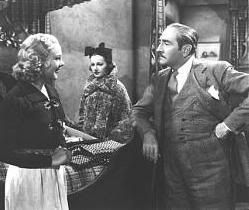
Sonja Henie, seen here with Adolphe Menjou in her first feature film One in a Million, is the Norwegian figure skater who won gold medals at the Olympics in 1928, 1932, and 1936. At the time, the Olympics were strictly for amateurs, so she decided to make some money skating by coming over to Hollywood, where she was signed to a contract by Twentieth Century-Fox. She made a string of movies that were reasonable entertainment but nothing that would be considered truly great; if you wish to judge for yourself you can watch her in Sun Valley Serenade, March 14 at 6:00 AM ET on the Fox Movie Channel.

But this isn't really a thread about Henie; instead it's a look at Hollywood's derivative and copycat nature that existed even back in the 1930s. The executives at MGM saw what Fox was doing with Sonja Henie, and wanted to make money of their own by making skating movies. So what did they do? They put on the Ice Follies of 1939, which TCM is airing Tuesday, March 11, at 7:45 AM. MGM contract player Joan Crawford (stop laughing; if you think the idea of Crawford on ice skates is bad, wait until you see what's coming next!) is on skates in what must be the most original plot since 42nd Street: she's married to a fellow skater, played by James Stewart (See? -- I told you there was more!). Into their lives walks another skater (Lew Ayres), whose presence causes their marriage to become strained as Stewart and Ayres become romantic rivals. It's all ended with a Technicolor scene involving the three stars, and every ice follies player not under contract to another studio the MGM bosses could find.

You might remember Lew Ayres for his Oscar-nominated role in Johnny Belinda. And perhaps it would have been more interesting if TCM had put the cast of Johnny Belinda on ice instead. I can only imagine Jane Wyman gesticulating wildly out on the ice, and poor old Agnes Moorhead struggling to maintain her balance.

Ice Follies of 1939 is not available on DVD, and probably won't be until the owners of the MGM library decide to put out a completist retrospective of the MGM careers of either Crawford or Stewart.

Sunday, March 9, 2008

Shakespeare in heat

TCM is airing a night of movies based on the tragedies of William Shakespeare on March 10. I'd like to point out one a classic movie based on one of Shakespeare's comedies instead: Warner Bros.' 1935 version of A Midsummer Night's Dream. The play is a bit of a slog by modern standards due to the language and the complexity of the relationships amongst the various characters, but the richness of the Bard's work, combined with the assets of the studio system, make this one of the more interesting (in a good sense) Shakespeare adaptations out there.

Two pairs of lovers (Ian Hunter and Verree Teasdale as Theseus and Hippolyta; and Olivia de Haviland and Ross Alexander as Hermia and Demetrius) are betrothed to be married, and spend the night in the forest of Arden on their way to Theseus and Hippolyta's wedding.

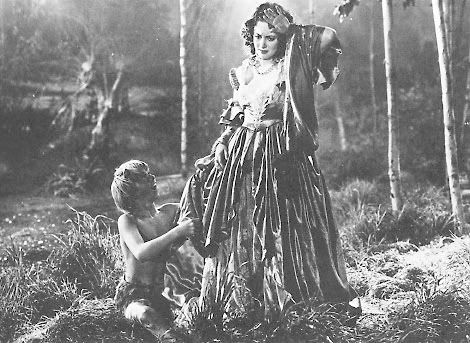
Into all this walks a troupe of actors led by Nick Bottom, played by James Cagney in a very atypical role for him; and the mischievous spirit Puck, played by a fourteen-year-old Mickey Rooney in the one time MGM lent him out to another studio. When they saw what a good job Rooney did as Puck, the MGM brass decided to keep him for themselves. Puck decides to create mayhem for all involved by casting various spells that will make the characters fall in and out of love with all the wrong people, instead of with their respective betrothed; this includes Warners' musical stalwart Dick Powell, who is miscast here but tries gamely. The highlight of all this mayhem is that Bottom is given the head of a horse, a feat Cagney pulls off surprisingly well, considering he was used to playing gangster roles. Rooney is also wonderful; even if you don't normally like his antics, they're exactly what the role of Puck calls for, and Rooney's normal obnoxiousness is used to great effect. He, after Cagney, is the highlight of the movie, and that's saying something considering Olivia de Havilland and a slew of great character actors appear

Eventually, we get to the wedding, and this is where the studio system half of the fun begins. Amongst Nick Bottom's troupe, who are there to perform at the royal wedding, are several character actors we wouldn't normally think of as being Shakespearean actors: Frank McHugh and Joe E. Brown, who gets to perform one skit in drag. Despite not being Shakespearean actors, these character actors do a remarkable job, probably because what they're doing isn't all that Shakespearean, but instead relatively light comedy. Joe E. Brown's antics and facial expressions work particularly well here. Veteran 1930s character acter Grant Mitchell plays Hermia's father, while Victor Jory plays Oberon, the king of the fairies; watch also for veteran British butler Arthur Treacher in a bit part as well.

In addition to the interesting cast, there's lush cinematograpy made to look like an actual dream sequence that's as beautiful as anything made in the 1930s, and rivalling the work of Gregg Toland in the 1940s.

A Midsummer Night's Dream was the first movie Olivia de Havilland made. (However, it was not the first one released; that would be Alibi Ike, starring the aforementioned Joe E. Brown.) It is available on DVD as well.

Saturday, March 8, 2008

Daylight Savings Time

The second Sunday in March marks the beginning of Daylight Savings Time in the US, when we all "spring forward" by moving our clocks one hour forward (well, not the people in Arizona and Hawaii). In honor of this day, I'd like to recommend The Clock (MGM, 1945).

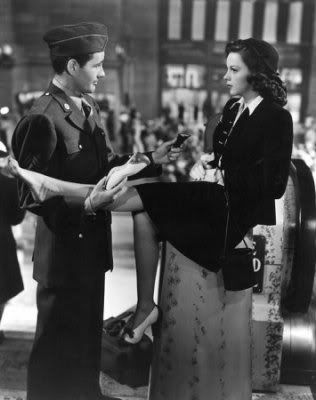
Robert Walker stars as Cpl. Joe Allan, a serviceman who has two days' leave in New York City. While in Penn Station, Allan helps the young Alice Mayberry (Judy Garland) when she breaks the heel of her shoe. She agrees to show him the sights, and they quickly fall in love, despite the fact that she's already got a date for that night. Well, she breaks the date, meets Joe under the clock at the Astor (hence the title of the movie), and proceeds to begin a whirlwind, if unorthodox, romance that lasts for the rest of his leave.

The romance is unorthodox because of whom they meet along the way: they get stuck in Central Park after the buses have stopped for the night, and kindly milkman Al Henry (played by veteran character actor James Gleason) agrees to take them home, although they'll have to go with him on his rounds first. Things get tough, however, when Henry gets socked by a drunk at one of the deliveries (played by Keenan Wynn), and Joe and Alice have to finish the milkman's rounds for him. Afterwards, they take him home, where we meet, Mrs. Henry, who is played by James Gleason's real-life wife of over 40 years, Lucile.

I won't give away how the romance ends, but The Clock is a wonderful movie. It's Garland's first as an adult, and she doesn't do any singing or dancing, either. To be honest, I'm not generally that much of a fan of Garland's work, since I don't care too much for the Freed Unit musicals, and in her later work, she became almost a caricature of herself. But in The Clock, Garland shows that she was actually quite a capable actress, despite having been badly misused by MGM for all those years. Walker is fine as the soldier, and James Gleason is a delight as the milkman; like so many of the character actors in the days of the studio system, Gleason's presence brightens every movie he's in, and oftentimes studio movies are just as fun to watch for the charactor actors in the cast as they are for the stars.

The other highlight is the set design: the scenes in Penn Station were not filmed in New York, as the station was just too busy, and filming would have been a logistical impossibility. Instead, a recreation was created on the MGM back lot, with stunning accuracy.

Happily, The Clock is available on DVD.

Friday, March 7, 2008

Aldo Ray, redux

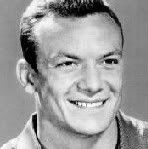
I briefly mentioned Aldo Ray when TCM aired Pat and Mike several weeks back. Aldo Ray returns to get a starring role, in Nightfall, airing March 8 at 8:30 AM ET on TCM. In this movie, Ray stars as a man with a bit of a past: while he was hunting with a friend (played by Frank Albertson), a pair of bank robbers showed up with $350,000, but due to a snafu, Albertson gets killed, and Ray runs off with the money bag, dropping it in the snow by Ray with the robbers hot on his heels. Now, he's in Los Angeles, and the robbers want to know where their money is. The $350,000, of course, would be
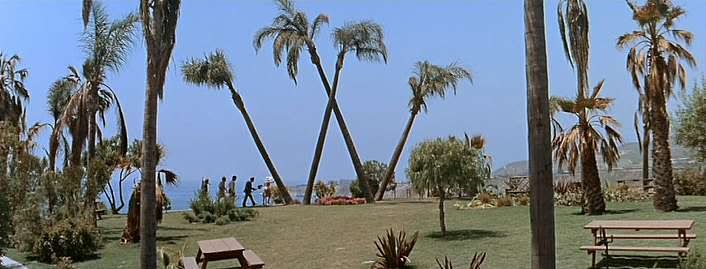
Under the Big W
buried under the big "W". Er, not that big W; instead, the money bag is somewhere in the snow in Wyoming, not far from where Ray and Albertson were hunting. But the only thing is, thanks to all that snow, the roads are impassable, so Ray is playing a waiting game, waiting for the snow to melt while simultaneously trying to avoid the bank robbers. Oh, and there's a detective on his trail, too....

While escaping from the robbers, Ray hides in the apartment of Anne Bancroft, here playing a lovely young model. What this unfortunately means for her is that she's in danger too, eventually being forced to join Ray on the run.

Nightfall is, at 79 minutes, a fairly short movie, and one less action than you might think: although Ray is on the run, the scenes with Bancroft are surpringly quiet; especially one scene where she's on the job modeling clothes and discovers that the robbers have spotted her, forcing her to make an escape in a designer gown. Eventually, we do get some excitment once everybody gets to Wyoming at the beginning of spring, but even here the action is understated. And yet, that works for this movie. Directed by Jacques Tourneur, who might be best knwon for the horror classics he made for Val Lewton such as Cat People, Nightfall is a little gem that deserves more exposure than the cast of relatively less prestigious stars (not counting Bancroft) would imply.

Sadly, Nightfall is not available on DVD.

Thursday, March 6, 2008

Guy Kibbee birthday

Guy Kibbee, 1882-1956

TCM spent the better part of this morning and afternoon celebrating the birthday of Guy Kibbee by showing a mini-marathon of his lesser-known movies. Kibbee was a character actor who played all sorts of older male roles, from a convict in the Errol Flynn movie Captain Blood, to a dirty old man producer in the classic muscial 42nd Street, to a pool player turned society judge in Lady For a Day, to a frontier doctor in Of Human Hearts with James Stewart. But I'd like to recommend two of his movies that are available on DVD:

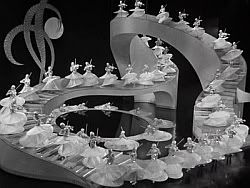
Gold Diggers of 1933. In this movie, Kibbee plays a man with money whom a group of down and out Broadway performers hope will finance their musical. Kibbee himself does a more than adequate job, and the plot isn't that bad, but this movie is more about the musical numbers of Busby Berkeley. Berkeley's style first came to prominence with the aforementioned 42nd Street, but the numbers in Gold Diggers of 1933 are much more elaborate and interesting: in the opening "Dance of the Dollars", a group of chorus girls sing "We're in the Money" with giant gold dollars serving as a sort of codpiece. If that's not enough, the "Dance of the Dollars" also has Ginger Rogers singing a verse -- in pig latin! (This alone would be worth the price of admission.) Then there's the two numbers at the end; the first involves an elaborate choreographing of neon violins, as well as enormous staircases that curve in manifold ways; this is followed by the "Song of the Forgotten Man", which is tacked on to provide a social message at the beginning of the New Deal.

Earthworm Tractors. In this silly B-comedy, the star is Joe E. Brown, who was best known for his broad facial expressions that he used to good effect in a series of B comedies for Warner Bros. in the 1930s; Brown also played the millionaire who fell in love with Jack Lemmon in Some Like it Hot. Brown plays a man who claims he can sell anything, and winds up working as a salesman for the Earthworm Tractor Co., trying to sell tractors to the rural folk of Mississippi. Guy Kibbee is one of them; although the plot is well-suited to kids, it's a lot of fun to watch Kibbee and Brown try to handle out-of-control farm equipment. It's typical of the double-bills of the era: a movie about 70 minutes with lesser stars that has the obvious look of lower production values than the "prestige" movies -- but one which is still quite entertaining.

Wednesday, March 5, 2008

The dated 60s

I stayed up to watch The President's Analyst on TCM last night. Unfortunately, instead of getting a movie that's a biting satire on the Cold War and the counterculture, I felt I was getting something that's aged very badly.

As for the plot: James Coburn plays psychiatrist Sidney Schaefer, who is called upon to be somebody for the Preisdent to talk to, since the President has such a high-stress job. Hence, the title, The President's Analyst. Unfortunately, the various security bureaucracies surrounding the President decide Dr. Schaefer is too much of a security risk: what happens if the Soviets get a hold of him? So, they decide to get rid of him -- except that he escapes first, and ends up running for his life, chased after by spies from multiple countries.

The plot, on the face of it, doesn't sound so bad. And yet, I found something quite off in the execution. Not only was I getting something from the hippie era (which in and of itself doesn't necessarily make for a bad movie), I felt as though it was stuck in the hippie era, and wasn't translating well to 2008. And yet, other, earlier movies don't feel similarly dated, even those that deal with politics. Why is that?

I'm not quite certain, but my first guess would be that The President's Analyst is in color. There's something about the less-vibrant color from after the mid-1950s that doesn't fit in all that well today, while black and white seems timeless. One, Two, Three deals with the Cold War, and yet, it's still quite the farce today. Likewise with Ninotchka, which also involves Soviet agents, in an even earlier era.

And yet, there are other color movies that still play well in 2008. I've recommended Yours, Mine, and Ours, which clearly shows the styles of the 1960s, and yet retains an air of being an evergreen. As I mentioned about Yours, Mine, and Ours, it deals with topics that are always relevant -- love and dealing with new relatives -- and does it with dignity and class.

However, there are movies involving characters much closer to hippies that still fit in in 2008; much of the humor of Cactus Flower revolves around the idea that there's a generation gap going on between the two couples. But there's always been a generation gap.

So, perhaps it's just that The President's Analyst is trying too hard to be hip. There are quite a few movies from the 1960s that give off the vibe that this is what happens when the stuffy studio executives try to develop a plot that will appeal to the hip youngsters of today. Instead, what you get is the older people's caricature of youth, with the same profound unfunniness.

Or, perhaps it's just me. I wasn't around for that era, and to be honest, I've long been sick and tired of the idea that every event today has to be filtered through a prism of events that happened between the assassination of John F. Kennedy and the resignation of Richard Nixon. And perhaps that clouds my view of the movies and other culture of that era. What say ye, fans of The President's Analyst?

(The movie is also available on DVD, in case you haven't seen it and would like to judge for yourself.)

Tuesday, March 4, 2008

Six degrees of Kevin Bacon

It's odd the way various movies come to mind. Yesterday, I heard a report on the death of Canadian jazz/blues guitarist Jeff Healy. He wasn't that commercially successful here in the States; you might remember him for his one hit "Angel Eyes". When I mentioned his passing on another forum I frequent, somebody who knows my love of classic movies said he was surprised I didn't mention Healy's brief appearance performing behind Patrick Swayze in Road House. (Well, it is an easy enough movie to forget.) This reminded me not of Swayze's famous turn in Dirty Dancing, but of his as-forgettable-as-Road-House movie Sommersby. And Sommersby reminded me of the original, The Return of Martin Guerre (Original French title: Le Retour de Martin Guerre).

The Return of Martin Guerre stars Gérard Depardieu in the title role, that of a 16th century Frenchman returning home from several years of military service. Everybody welcomes him, of course, despite the fact that those years of service have changed him quite a bit. Then, however, another ex-serviceman comes along, claiming that this man is in fact not Martin Guerre. Is Depardieu really Martin Guerre, or isn't he? And if he isn't, what are the locals to make of all the good works he did while he was putatively Martin Guerre? And what of Martin Guerre's wife, who loved this man? If she loved this man thinking he was Martin Guerre, can she still love him for who he's been since entering her life, despite his not being Martin Guerre?

Being a foreign film, The Return of Martin Guerre has a rather different feel from Hollywood movies, so you should expect something with a rather deliberate and thoughtful pace. I first saw this movie many years ago when I was in college, on the local PBS channel, and remembered being very impressed by it. Fortunately, it is available on DVD, although, being a foreign import, carries a high price according to Amazon. It is, however, available on Netflix.

Monday, March 3, 2008

Tastes great, less filling

Every Tuesday night in March, TCM is looking at psychiatry in the movies. One of this week's selections is Now, Voyager, at 1:45 AM ET on March 5. (That's 10:45 PM March 4 on the west coast; don't get me started on TCM's days beginning not at midnight, but at 6:00 AM.) This movie is generally considered a classic, so you probably know the story already: Bette Davis plays an old maid who suffers a nervous breakdown at the hands of a domineering mother; she's saved by psychiatrist Claude Rains who sends her on a cruise to South America where she meets and falls in love with divorcé Paul Henried.

I'd like to dwell on that nervous breakdown for a minute. "God, talk to me!" wails Davis, after being prodeed by Bonita Granville. "You people like making fun of me, don't you?" Well, yes. We like making fun of your over-the-top scenery chewing. It's always good for a laugh. Indeed, I find one of the best things about watching Bette Davis' movies is waiting for those scenes when she goes off and starts overacting. A few of my favorites:

In 1934's Of Human Bondage, there is the famous scene of Davis telling off poor Leslie Howard. "And when I kissed you, I used to wipe my mouth," she tells him, and then, making an exaggerated gesture of wiping her mouth on her sleeve, repeats, "wipe -- my -- mouth!" It's supposed to be one of the key dramatic moments of the movie, but I can't help but laugh at it. "I want the truth," says Howard. "You can't handle the truth!" replies Davis. (Er, no; that's a different movie, but the sentiment is the same.)

Davis spends much of What Ever Happened to Baby Jane? over the top as she torments poor Joan Crawford, although in fairness to her, most of the time, the script calls for it. Bette would repeat this in Hush, Hush, Sweet Charlotte, but again here, it's due in large part to the typecasting she had gotten as Baby Jane.

My favorite Davis rant, however, is probably in In This Our Lives. Bette Davis has just run down a pedestrian, and blamed it on a young black man, although it looks like her attempt to frame him is doomed to failure. Davis looks to her rich uncle (played by the lovable Charles Coburn) for consolation, but he's just discovered he's terminally ill and only has months to live. When he tells Davis he's going to die, compassionate Bette responds, "You've lived your life! What about mine? Mine's only just begun!"

What's your favorite Bette Davis rant?

Sunday, March 2, 2008

Thank heaven for little harlots

... for little harlots grow up to be the women of Pre-Code movies. Tuesday, March 4 sees the release of the Forbidden Hollywood Collection, Vol. 2, including five Pre-Code movies. In honor of this, TCM is showing all five movies starting at 8:00 PM ET on Monday.

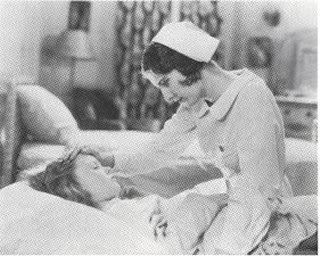
I've seen four of the five, but since two of those four won Oscars (The Divorcée at 8:00 PM and A Free Soul at 3:45 AM Tuesday), I'd like to mention the other two. First up is Night Nurse, at 10:45 PM Monday. Barbara Stanwyck stars as nurse Lora Hart. There's not much money in working at the hospital, so she takes a job working as a nurse for two sick rich children. After examining the children, she determines that the problem is that they're deliberately being neglected! And this is being done so that they'll die, and the adults left behind can have the trust-fund money for themselves! This must have been fairly shocking stuff for 1931, as it's an idea that would be shocking even now, three-quarters of a century later. And who's responsible for this? Why, it's the chauffeur, played by a young Clark Gable before he became a star (this movie and especially A Free Soul, also from 1931, are the movies that made Gable a star). When Nurse Hart tries to inform the kids' mother of what's going on, she finds that the mother is a dissolute woman, leading a life of drinking at parties downstairs, too drunk to care about the warnings of what will happen to her children. (Or is she in on the plot?) The cast also includes Joan Blondell as Stanwyck's fellow nurse, and early 1930s Warner's stalwart Ben Lyon as a small-time bootlegger to whom Stanwyck and Blondell minister under the table, and who eventually comes back to save the day for Stanwyck. In addition to the adult subject material, watch for a pre-Code scene of Stanwyck and Blondell changing their clothes in the hospital changing room, showing off their 1930s undergarments.

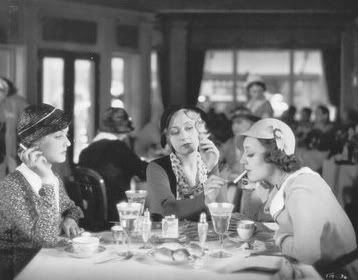
Night Nurse will be followed at midnight on Tuesday (that's 9:00 PM Monday out on the Pacific coast) by Three on a Match. Early 1930's Warner's leading lady Ann Dvorak stars at Vivian Revere, one of three women who were friends in school a decade earlier. Each of them has gone her own way, but by chance, they meet at a restaurant one day and bring each other up to date on what's happened in the intervening years. Mary Keaton (played by the aforementioned Joan Blondell) led a bit of a wild life, spending time in reform school and becoming a nightclub singer; Ruth Westcott (played by Bette Davis in an early supporting role before she became a star with Of Human Bondage) is an eminently practical secretary; and Revere has married a wealthy man. At the restaurant, they all use the same match to light their cigarettes -- and you know the superstition about lighting "three on a match".... The bad luck this brings is that Vivian has gotten bored with the life of an idle wealthy woman. She's fallen in love with a gangster (Lyle Talbot) and is willing to leave her husband and child for him! And if that's not shocking enough, she also becomes... a dope fiend! He's gotten into some debts, so, to pay them off, he kidnaps her child for the ransom money. In addition to all this adult content, watch for one scene of Bette Davis changing her clothes and wearing just a petticoat. Also, watch for the gangsters: one of them is Humphrey Bogart, in a bit part even before The Petrified Forest pushed him onto the B-list.

Saturday, March 1, 2008

The Day of the Jackal

TCM's prime-time offering for February 29 was Fred Zinnemann's 1973 thriller The Day of the Jackal. To be honest, I had never seen this movie before, and enjoyed finally being able to watch it. Despite it being about a historical event to which we know the outcome, Zinnemann's direction makes this an excellent and gripping film.

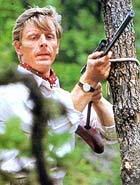
The basic synopsis is that in 1963 France, a group of army officers unhappy with Charles de Gaulle's handling of the situation in Algeria hire an contract killer to assassinate de Gaulle. The assassin, played by Edward Fox is an efficient, ruthless killer. The first half of the movie takes place predominantly outside France, as we see the assassin's detailed preparations -- obtaining multiple false identities, disguises, and a high-powered sniper's rifle he'll be able to smuggle into France.

Meanwhile, French intelligence figures out that something is up, but they have no idea exactly what: the man they seek has to them no known name, face, or fingerprints. It could be any of fifty million people. There's only one man in France who has the investigative ability to find the killer the authorities seek: Inspector Lebel, played by Michel Lonsdale (looking rather like Oskar Homolka). Lebel's dogged pursuit, combined with a massive dragnet and some pure dumb luck, gets him to within a few hours of the assassin on numerous occasions, but our antihero always manages to stay one step ahead of the authorities, as he has informants of his own.

We know what will happen at the end of the movie: the attempt on de Gaulle's life will fail; in real life de Gaulle resigned the French presidency after the student riots of 1968, and died quietly in 1970. And there's not a whole lot of action. With the exception of one scene at the beginning and the assassin's practice session with his sniper's rifle, we don't get explosions. Nor do we get a French Connection-style car chase. Still, there's always dual tensions. How is the assassin going to get out of the latest tight situation he's in, and how is Lebel going to find him and foil the assassination plot? And by playing these tensions off of one another, Zinnemann is able to create an atmosphere of suspense that keeps us glued to our seats right up until the final bullet is fired.

The Day of the Jackal is available on DVD, in case you missed TCM's recent showing. Although it runs just over two hours, twenty minutes, at no point does it feel like a long movie.