Showing posts with label Adolphe Menjou. Show all posts

Thursday, August 13, 2026

Sweet Rosie O'Grady

Last year at Thanksgiving, Dave Karger sat down with comedy legend Carol Burnett to present some of her favorite movies, paired with the parodies that Burnett and her friends did on her weekly variety show in the late 1960s and early 1970s. One parody was The Doily Sisters, which if you know your old movies parodies The Dolly Sisters, a movie I wrote about back in 2017. Unfortunately, TCM couldn't work out the rights to that movie for some reason, so they obtained a different Betty Grable musical for Dave and Carol to talk about: Sweet Rosie O'Grady.

Grable plays Madeleine Marlowe, an American who's the hit of the London stage in the 1880s. She's about to head back to America to appear in her next musical. She's also had men pursuing her, especially Charles, the Duke of Trippingham (Reginald Gardiner). For various reasons, they're not getting married in England, and they're also not traveling back to America together. Madeleine will be going to America with her dresser Edna (Virginia Grey), while the Duke is going to be following in about a month. They'll get married and live happily ever after....

Yeah, right, since all of this is happening in the opening reel. Over in America, there's a scandal sheet called the Police Gazette, edited by Tom Moran (Adolphe Menjou). His best writer, Sam McGee (Robert Young), has heard rumors of Marlowe's past here in New York before she went off to London and became big star Madeleine Marlowe. It seems that Marlowe is a stage name for a "Rosie O'Grady" who worked in the sort of theater that wasn't considered so respectable to the London audiences that flocked to Marlowe shows, making Marlowe the sort of woman a duke might not want to marry. Worse, when Marlowe gets off the boat in New York, she's tricked into getting in a carriage with McGee, who uses this ruse as a way of getting an even more scandalous interview.

Rosie, as I'll call her for the rest of the post, is unhappy. But she's also not stupid. So she decides she's going to turn the tables on McGee by starting a publicity campaign to get everybody to believe that she and McGee are actually carrying on a romance together, which is something that McGee doesn't really want. And even though the intention is that this be a fake romance, the Duke gets all the news when he gets to America, so he's not quite so happy himself and decides that he'll get together with McGee to try to turn the tables back on Rosie again.

Complications ensue, but considering who's got the top two billing spots, you can figure out where things are going to go. (Hint: Rosie does not end up with Moran.) Then again, you also might have been able to figure it out if you've seen other classic movies. Sweet Rosie O'Grady is a remake of a Loretta Young movie called Love Is News. There's also a third version of the story, That Wonderful Urge, which I have apparently not done a post on yet.

The obvious difference with Sweet Rosie O'Grady is that, as a vehicle for Betty Grable, it's got extra musical numbers, most of which are presented as numbers for her stage actress character to perform in her various stage shows. The plot works well enough again, and Grable does fine with her musical numbers even if those aren't quite so necessary to the plot. Sweet Rosie O'Grady is also in Technicolor, and the print Fox ran was quite good. Somewhat surprising for a Grable movie is that the running time isn't padded out by the presence of those musical numbers. IMDb lists the running time as shorter than Love Is News, which wasn't a long movie to begin with.

Saturday, October 11, 2025

We're not quite in the money

Another of those classic movies that TCM shows often enough because it's part of the old Turner library, but that I'd never actually seen before, is Gold Diggers of 1935. So, the last time it showed up on TCM I made the point of recording it so that I could do a post on it eventually.

The movie opens up with a ridiculous number of staff members making final preparations for what seems to be the grand opening of a new hotel, except that it's not new but only open for the summer which is why you wonder how it can support such a large staff. Among the staff are desk clerk Dick Curtis (Dick Powell), who is taking on this summer job in his years between college, as he's really hoping to complete his studies to become a doctor and marry his girlfriend Arline (Dorothy Dare).

Coming to the resort are the ultra-wealthy who have decamped from New York or Boston, one supposes, since this is mentioned as being New Hampshire. One such family is the Prentiss family, led by a matriarch widow (Alice Brady) with two adult children: Humbolt (Frank McHugh) and Ann (Gloria Stuart). Humbolt is a playboy who has already been through four wives and cost Mom a ton of money to get out of the marriages as a result. Ann is set to be married to T. Mosley Thorpe (Hugh Herbert), which is in many ways more of a marriage of convenience since Thorpe is even more fabulously wealthy than the Prentiss family. Ann certainly doesn't seem thrilled with the idea of this marriage.

And then we see why. Thorpe will also be spending the summer at this resort, working on his book, a monograph on snuff boxes. He has the hotel send up a secretary to take dictation, getting sent young Betty (Glenda Farrell) who falls for him and also sees dollar signs. You can already guess how part of the romantic conflict is going to be solved. The other half comes when Mrs. Prentiss hires Dick as a chaperone for Ann. Those two fall in love, which seems a bit mean to Arline but things are going to turn out OK for her in the end too.

Mrs. Prentiss is asked to put on a charity show, something the family has apparently been asked to do every year, and it's at this point that we learn that she's no longer as fabulously wealthy as she used to be, thanks to the Depression cutting the dividends her late husband's business interests yield. Stage producer Nicoleff (Adolphe Menjou) shows up; he's heavily in debt and gets the idea of taking Prentiss for as much as he can while putting on that show. The show is, of course, the big excuse for all the musical numbers the movie has around the wafer-thin plot, with the highlight musical number being "The Lullaby of Broadway".

The plot of Gold Diggers of 1935 is even sillier than some of the previous musicals Dick Powell had made, although again one doesn't watch a Busby Berkeley musical for the scintillating plots. Hugh Herbert is playing such a drip that it's only logical the only thing anybody really sees in him is his money. Dick Powell is appealing, although he doesn't have much to do. It's no wonder he wanted to do a movie like Murder, My Sweet so that he could be considered a more "serious" actor.

Having finally seen Gold Diggers of 1935, I understand why it's not as well known as its predecessor Gold Diggers of 1933. It's watchable, and the "Lullabye of Broadway" number is worth the price of admission, but it's not an all-time great either.

Friday, July 26, 2024

The Housekeeper's Daughter

This week's Noir Alley selection is a foreign film I've blogged about before: the 1960 South Korean movie The Housemaid, airing at midnight between July 27/28 (on the east coast; as always, that's still Saturday, July 27 in more westerly time zones) and again Sunday, July 28 (in all time zones) at 10:00 AM. With that in mind, I figured it's time to do a post about a movie that's been sitting on my DVR for several months, that's only related by title: The Housekeeper's Daughter.

Joan Bennett plays the daughter, although as the movie opens up there's no housekeeper involved. Bennett plays Hilda, who is watching one of those 1930s poker games in hotel rooms that, to anybody who had seen enough movies from the beginning of the decades, was obviously rigged. However, there's still one mark who must not have seen enough such movies, and keeps losing hand after hand. Hilda finally drops a hint that perhaps the mark can't win, which is trouble for her, as her boyfriend Floyd (Marc Lawrence) is one of the crooks fleecing the mark.

Hilda realizes she needs to get away, so she heads for her mother's house. Or, at least, her mother's living quarters, since mom Olga (Peggy Wood) is the housekeeper to the Randall family, an archeology professor and wife with an adult son Robert (John Hubbard) who wants to be a reporter instead of following in his father's footsteps. The parents are going away for a working vacation, so there's enough space for Hilda to stay at least until her troubles boil over. Meanwhile, Robert, partly wanting to earn his own living and partly from having seen Hilda, decides to stay.

Back to Hilda's boyfriend Floyd. He's looking for a new girl to replace Hilda, and has settled on a showgirl. A Runyonesque bum, Benny (George E. Stone), who helped Floyd procure this showgirl, is distressed at how Floyd is treating her, so serves Floyd a cup of poisoned coffee. Except that Floyd doesn't drink the coffee, giving it instaed to the showgirl, who promptly dies and gets dumped into the river by Floyd.

That story obviously makes the newspaper, and when Robert reads it, he wants to help solve the case. So he simply calls up one of the newspaper editors, Wilson (Donald Meek), and says he wants to help ace crime reporter Deakon Maxwell (Adolphe Menjou). Amazingly, the editor hooks the two up. Deakon is also a hard drinker (another of those 1930s stereotypes), and unsurprisingly Robert is unable to keep up with Deakon's drinking. Robert gets blackout drunk one night but interviews Benny, calling up Wilson and relating Benny's confession, waking up the next morning to have no recollection of having done so but getting a byline in the paper. This is what brings everybody's storylines together, not that Floyd knew Hilda was living under the same roof as Robert.

The Housekeeper's Daughter was produced by Hal Roach at a time when he was trying to get into bigger pictures than the "screenliners" and shorts his studio had been making, even though this one only clocks in at about 79 minutes. It is a bit more than a B movie thanks to the presence of Bennett and Menjou, but it's certainly not anything major. Despite the relatively low production values, it does entertain, at least for people who like old movies already.

Nobody will ever put The Housekeeper's Daughter on a list of greatest pictures of all time, but it's still definitely worth one watch.

Thursday, May 23, 2024

Forbidden

Another movie that I noticed was on Tubi but I think is leaving at the end of the month is a Barbara Stanwyck pre-Code that a search of the blog says I haven't blogged about before: Forbidden. And, having watched it, I don't think I'd actually seen it before. So now I do a post on it in order that you can see it for yourself before it leaves Tubi.

Stanwyck plays Lulu Smith, which is certainly an odd name for a Stanwyck character. Even odder is that as the movie starts, she's a small-town librarian of the sort that Donna Reed in It's a Wonderful Life would have been if Jimmy Stewart had never been born. Lulu, needless to say, doesn't much care for this kind of life. So she decides to cash in all the money she's saved up, get a makeover, and take a luxury cruise to Havana, this of course being decades before Communism.

However, you can't take the prim and proper out of the librarian, so on the cruise, Lulu keeps dining alone. One day, however, she goes to her cabin after dinner, and finds that somebody else is in there! And that somebody is... a man! A drunk man, no less, up-and-coming lawyer Bob Grover (Adolphe Menjou), who has thoughts about a career in politics. Lulu is surprisingly forgiving about this drunk crashing her cabin, so much so that she decides to have dinner with him. And then, when they get to Havana, she spends the entire vacation with him!

Back home, we see that Grover is a district attorney, put into office with help from the local scandal sheet newspaper. Editor Al Holland (Ralph Bellamy) is none too pleased with this, and decides he's going to work at derailing Grover's career. The only thing is, he doesn't really have any way to do this, at least not honestly. That's only because he doesn't know about Grover and Lulu.

Grover meets Lulu for Halloween, and each of them has a surprise for the other. Lulu got knocked up on that vacation to Havana, and she's about to tell Bob so that he can marry her and the two can live happily ever after and make lots more babies. Well, we're not far enough into the film for that to happen, so instead Bob has to break the terrible news to Lulu that he's got a wife Helen (Dorothy Peterson), except that she was badly injured in a car crash and is now an "invalid" (judging by the way she's able to walk, I'm guessing the only part of her body that got injured was her uterus). Because of the injuries, Bob can't divorce Helen.

Fast forward to the maternity hospital, where Lulu checks in as Jane Doe and has the baby, Robert. She finally comes up with a way to tell Bob about the baby, which is a plan to have the Grovers adopt the baby Roberta, and for Lulu to be the baby's governess. It's a wacky idea, and Helen puts the kibosh on it when she finds out that Lulu doesn't have any references -- frankly, that's not unreasonble on Helen's part, and she's not written as the villainess of this piece.

The villain is Al. Lulu, in need of a job, gets one as the lonelyhearts columnist at Al's newspaper, and then many years later winds up marrying him. Lulu has been scrapbooking Roberta's childhood, since Grover is prominent enough that Roberta gets in the society section of the papers. Grover's political career is coming along nicely, too, as he's in the running for governor. But Al finds out the truth about who Roberta's mom is, and he's got no compunction about using that information to bring Grover down.

Forbidden is one of those early 1930s melodramas that's got some interesting ideas. In fact, possibly too many of them for the movie's own good, since the movie on multiple occasians turns on a dime. It's fun, and thanks to the direction of Frank Capra, there are some nice visuals. The story isn't the best, however. On the bright side, all three of the leads do more than the best they can with the material such that its weakness doesn't seem like such a big deal.

Sure, there are better and more lurid pre-Codes out there. But Forbidden isn't bad, and it's absolutely worth a watch.

Thursday, January 11, 2024

To Please a Lady

Another of the movies that I've had sitting on my DVR for a couple of months is To Please a Lady. Recently, I finally got around to watching it in order to be able to do a review on it here.

After the opening credits, the camera focuses on a poster advertising "Regina Forbes, America's Leading Woman Columnist". Forbes is played by Barbara Stanwyck, and she's in the office with her editor, Gregg (Adolphe Menjou). They're watching a TV promo about Mike Brannan (Clark Gable), a racecar driver who drives all sorts of cars to make a living. The promo points out that he's become successful, but he's also now the villain because he'll do anything to win, not that they had the word kayfabe in those days. In any case, Gregg thinks Brannon would be a perfect person for Regina to do her next column on.

Regina and Gregg go out to Newark to the midget car track where Brannan is racing this week. Brannan is good and knows it, and as a result treats Regina with all the respect he deserves, which is not much but also about as much as he'd give to any writer not already in the racing world. It's an attitude that turns Regina off to Brannan. She and Gregg stay in the stands to watch the race, which is rather an eventful one. Brannon and another driver are in a fight for the lead, having lapped other cars that are much slower. In an attempt to lap another car, there's enough of an accident that Brannan's rival crashes off the track, eventually dying from his injuries. Regina is ruthless in her column, and Brannan finds that he's unable to race anywhere.

Some time later, Gregg reads a newspaper article mentioning how Brannan has been blackballed from racing, and is now a trick driver at the sort of traveling carnival that, a generation earlier, would have featured stunt pilots who would have been lionized in early talkies. Regina feigns disinterest, but you get the feeling she was so turned on by Brannan's bad boy act back in Newark that she just has to go to the carnival when it shows up in the New York area. Not only that, but she goes over to see Brannan after the show even though he seems to be pursuing one of the women working in the carnival.

Regina is clearly falling for Brannan, although he certainly doesn't return the favor at first. And he's got good reason to be pissed at her. But he thinks he's finally earned enough money to try to get back into racing, and this time big time racing as in the Indianapolis 500, which was the Great American Race back in thos days. But you know that eventually Brannan is going to thaw and start having feelings of his own for Regina.

It takes some time as Brannan goes back up the ranks, and Regina is also forced to re-examine herself when another person she wrote a nasty column about decides to commit suicide rather than face a prison sentence resulting from one of Regina's poison-pen columns. Brannan and Regina may finally be able to accept each other for who they are, but the relationship is going to have to survive Brannan's attempt to win the Indy 500.

I've mentioned in the past how I think MGM was quite good at doing literary adaptions and costume dramas. However, there were certain genres they weren't as good at, and To Please a Lady falls squarely into that latter half. It doesn't help that the movie was made in 1950. Gable and Stanwyck were both much too old for their roles, Gable in particular. Plus, tastes were changing after World War II and To Please a Lady feels a lot like the sort of auto racing movie that would have been done in the pre-war years. The script also doesn't do any of the stars any favors.

To Please a Lady may be of interest to fans of either Clark Gable or Barbara Stanwyck, but it's not a terribly good film.

Friday, January 27, 2023

Friends and Lovers

Er, not quite

Another of the movies that had been sitting on my DVR for quite some time was the short early talkie Friends and Lovers. With it being an RKO movie and with the two male leads, I'm surprised that it doesn't seem to have wound up in any Warner Archive collection.

One of the male leads is Adolphe Menjou, who plays Capt. Roberts, who we are led to believe is an officer in the British Army. Now, Menjou was a very good and often elegant actor, but one thing he most definitely was not is British. He's in London on leave or something, where he's been carrying on an affair with the equally un-British Alva Sangrito (Lili Damita, later wife to Errol Flynn). Alva is married to Victor (Erich von Stroheim), who "finds out" about the affair one night. Except that as we learn it's really a scam on the part of Victor and Alva. She has affairs, and then, when she gets caught, gets the other man to cut a big check so as to avoid any scandal. Nice work if you can get it.

So Capt. Roberts goes back to India, which at the time the movie was made was still a British colony, together with his manservant McNellis (Hugh Herbert, who is even less British than Menjou). One of the officers serving under Capt. Roberts is an actual Brit, Lt. Nichols (Laurence Olivier, who I don't think I knew had made a Hollywood movie this early in his career). Nichols talks about the woman he loves, and Roberts realizes the woman in question is Alva! Roberts knows now that Alva is bad news, but Nichols is thinking with his other head, and Roberts' comments about this sort of woman threatens to derail the two officers' friendship.

Meanwhile, back in England, Alva and Victor get into a heated argument, which has the looks of turning into a case of domestic violence, although I don't believe that term was used in the 1930s. Just when Alva really seems to be in danger, one of the servants shoots Victor dead! This being a pre-Code, we don't hear anything about the servant going to prison or Alva getting in any legal trouble. Alva sends a letter off to India, which one guesses explains what happened, but Roberts and Nichols decide to burn the letter without reading it, in order to save their friendship.

Some time later, Roberts and Nichols are both on leave again in England, where they're invited to a party at one of those country houses that populated movies of the 1930s set on either side of the Atlantic. Who should show up as one of the guests but widowed Alva? And, needless to say, it tests the friendship between Roberts and Nichols again.

Friends and Lovers is one of those movies where the whole is less than the sum of its parts. There are some scenes and performances (von Stroheim especially) that are a lot of fun, and the idea is certainly interesting enough, but the way the script resolves it just doesn't feel realistic. Maybe values being different in the 1930s and in England, it might have been something more likely to happen, but I'm not so sure. Other people speak very poorly of Damita's acting, although I didn't have as much of an issue as some did.

All in all, Friends and Lovers is one of those movies that probably should have made its way to one of those old four-film TCM box sets, but never did. It's not the sort of movie I'd pay standalone prices for, however.

Thursday, December 2, 2021

Journal of a Crime

I mentioned both yesterday and Tuesday that there were two movies early Friday that I wanted to blog about. I did a post on The Silver Cord yesterday, so now I want to do the post on the other movie, Journal of a Crime, which is on TCM at 9:45 AM tomorrow.

Ruth Chatterton plays Françoise Moliet, upper-class Parisian wife of theater playwright/director Paul (Adolphe Menjou). In the opening scene, Françoise is standing outside the stage door one night waiting for everybody to come out, staying far enough away that she won't be seen by the people who do exit the theater. Eventually, Paul comes out, along with the play's lead actress, Odette (Claire Dodd). The conversation makes clear that Paul and Odette are having an affair. Further, Odette wants Paul to leave his wife, and he hasn't yet been able to bring himself to tell Françoise about the affair.

In the Moliets' bedroom, we see a night-stand between the two beds and that there is a gun in the drawer, because everybody in movies seemed to have a gun back in those days. Paul has decided he's going to tell Françoise about Odette in the morning. But when he wakes up, he finds that she's already gone. And the gun isn't in the drawer either. It's pretty darn obvious what Françoise is going to do.

Meanwhile, not far from the theater, career criminal Costelli is robbing a bank, something that results in his shooting one of the tellers dead. He escapes, going into the theater. We then see Odette getting shot during a rehearsal. The police come, all of the entrances are sealed, and the police quickly find Costelli, so it's no big stretch for them to conclude that Costelli killed Odette while trying to escape.

We know better, however, and soon enough Paul does as well because he finds his and Françoise's gun discarded in a bucket of water, as if nobody was ever going to find it. (I guess Françoise didn't have much time to think, and she might have guessed nobody would look there so she could get the gun later.) Paul knows what his wife did, but he doesn't tell the police, letting her suffer instead. Theoretically, Costelli is being wrongly convicted for a murder he didn't commit, but then there's a murder he did commit so being in jail for two murders is no worse than rightly being in jail for one murder. They can't un-guillotine him after the first murder so that they can guillotine him a second time for the second murder.

Journal of a Crime comes right at the end of the pre-Code era, having been released about three months before Joe Breen really began cracking down on Code enforcement. This is why Françoise can kinda-sorta get away with a murder even though she really doesn't. But the final resolution is a rather bizarre one and a bit of a cop-out at that. Still, the first 60 minutes or so of the movie are quite interesting with a psychological premise Hollywood didn't give us much in those days.

The last I checked, I couldn't find Journal of a Crime on DVD, so you're going to have to catch the TCM airing. It's definitely worth watching.

Wednesday, August 25, 2021

All About Eva

Katharine Hepburn was the Star in TCM's Summer Under the Stars this past Saturday. One of the movies not on the schedule was Morning Glory, the movie that won Hepburn her first Oscar. I had seen it many years ago but never did a blog post on it. Since it was on the schedule not too long ago, I recorded it then, and recently watched it to finally get around to doing that blog post.

The thing I didn't remember from my first time watching the movie is how little there really is going on. Hepburn plays Ada Love, a naïve young woman from Vermont who's come down to New York at the height of the Depression thinking she's going to make it big on the Broadway stage, because she did community theater back in Vermont, don't you know. She shows up unannounced at the office of prominent producer Louis Easton (Adolphe Menjou), but can't get in because like a lot of offices in 1930s movies, there's one of those swinging gates that keep the visitors on one side and the doors leading to the actual private offices on the other side.

Easton is talking to his favorite playwright, Joseph Sheridan (Douglas Fairbanks Jr.) about what to do as their next collaboration together. Meanwhile, waiting outside is an older actor Easton has cast a lot, Hedges (C. Aubrey Smith), who takes a liking to Eva and even offers her acting lessons. Needless to say, Eva is not able to impress Easton, but then a lot of aspiring actresses would have shown up over the years the way Eva did.

Some time later, Eva is in one of those 1930s diners where the hard-luck characters of Hollywood movies go to eat cheaply, or at least just get a cup of coffee if they can't even afford to eat. Who should show up at that diner but Hedges? Hedges has pity on Eva and offers to take her home, but decides to take her to a party that Easton is holding. Perhaps at least she can get some hors d'œuvres in her stomach. Of course, Eva is stupid enough not to eat, but to drink a bunch of champagne instead, get rip-roaringly drunk, and do an impromptu Shakespeare recital before passing out.

Easton, seeing Eva passed out in his lap just wants to pay her off to get rid of her and at least survive for however long it's going to take to find a part in a play somewhere. Eva somehow has the silly idea that perhaps she's actually got a part, and just walks out of the apartment, probably expecting a call or something that isn't going to come, forcing Eva to do vaudeville, the horror.

Sheridan is apparently able to find her, because he gets her as an understudy for the new play that he and Easton are doing, one that has Rita Vernon (Mary Duncan) in the leading role. But Rita is a diva, and decides on opening night that she's going to hold Easton hostage by demanding a much better contract than whatever she signed. Sheridan holds the trump card in Eva, however, and somehow she's actually able to pull the role off, at which point the movie abruptly ends.

Hepburn gives a good performance, although at times she's showing the same self-absorbed blankety blank that she is in a bunch of her other movies, notably Bringing Up Baby and The Philadelphia Story. Perhaps Hedges should have shaken some sense into Eva like at the end of Old Acquaintance instead of offering to take on Eva as a student; it probably would have helped Eva in the long run. Unsurprisingly, all of the men are just fine in their supporting roles although it's Hepburn's picture all the way. The one irritating thing, however, is the ending, as it really feels like the writers didn't know what to do after making Eva a star. The didn't have a boyfriend to reunite her with, or a big musical production as in 42nd Street. It just ends.

If you want to see Katharine Hepburn before she became "box office poison" in the late 1930s, Morning Glory isn't a bad place to start.

Sunday, August 1, 2021

The Ambassador's Daughter

If you've ever watched Three's Company, one thing you can't help but admit is that the plots of mistaken identity and misunderstandings are thoroughly unoriginal. For some reason, I found myself thinking of Three's Company as I was watching The Ambassador's Daughter.

Olivia de Havilland plays the daughter here, and frankly she's much too old for the part, but that's another story. She's Joan Fisk, daughter of post-war US Ambassador to France William Fisk (Edward Arnold). They're visited by a US Senator, Jonathan Cartwright (Adolphe Menjou) and his wife (Myrna Loy), doing the sort of visit that Jean Arthur was making to Berlin in Billy Wilder's A Foreign Affair. Specifically, Sen. Cartwright is concerned about the plethora of American GIs who are taking their furloughs to go to Paris and cause difficulty for all the French folks there. So he thinks the military should make Paris off-limits to American servicemen, and is trying to get General Harvey (Minor Watson) to do just that.

The ambassador isn't so sure, and his daughter decides that she'll offer to do some undercover research to discover just what American serivcemen are like, by pretending to be French and dting a visiting serviceman for the duration of his furlough. And wouldn't you know, she's quickly going to get the chance to do just that. A charity fashion show is going to be given to raise money for the American Red Cross' work in France, with various socialites playing the part of the models. Crashing their way into the audience for the show are two GIs, Sgt. Danny Sullivan (John Forsythe) and his best friend Cpl. Al O'Connor (Tommy Noonan).

Danny sees Joan, who is one of the models, and falls for her, while she puts on her best French accent and does nothing to disabuse Danny of the belief that she's a model for Christian Dior. So she willingly goes around Paris with him, although we of course know the real reason she's doing it. Gen. Harvey, meanwhile, brings Al back to the US Embassy, where he promptly has too much to drink and spills the secrets of things American servicemen do to try to win the hearts of European women.

Unsurprisingly, Sgt. Sullivan unwittingly does some of the same things, but out of pure innocence, having no idea that he's falling into a trap that Cpl. O'Connor has unintentionally set. When Joan learns of what Al has told the Senator and the Ambassador, she's ticked off because she wanted to help the servicemen keep their right to visit Paris, and look what they've done to her. But she also does something which leads to a misunderstanding. Danny decides to go to the Christian Dior house to look Joan up, and she, not actually being a model, shows up with the Senator to try to get him to buy a dress that he saw at the Red Cross fashion show for Mrs. Cartwright. Danny sees this, and thinks that Joan is two timing him with a sugar daddy.

Eventually, it all gets worked out for the best, although there's also the added complication of Joan having a fiancé in the form of a now-stateless prince (Francis Lederer). But boy does it take a long time to get there and do so unoriginally.

Olivia de Havilland had recently married a Frenchman and started living in Paris at the time the movie was made, which I'm sure is a large part of the reason why the movie got made at all. She was there, and it was a way for everybody else to get a working vacation in the City of Light. The establishing shots of Paris are lovely, but that's probably the best thing that can be said about the movie. The plot strains credulity and feels like a mish-mash of romantic misunderstanding movies that had been done at least since the start of the screwball era (although The Ambassador's Daughter is not a screwball comedy by any means).

Completists of any of the main cast members may want to see The Ambassador's Daughter, but for everybody else, I'd recommend a whole bunch of their other movies over this one.

Sunday, April 4, 2021

A Farewell to Arms (1932)

I'm not the biggest fan of Ernest Hemingway, and perhaps that colors my view of the 1932 adaptation of his novel A Farewell to Arms. It's going to be on TCM tomorrow afternoon at 6:15 PM, so you have a chance to watch and judge for yourself.

Gary Cooper plays Lt. Frederic Henry, an American who decided he was going to go off and have some adventure by taking part in World War I on the Italian front as an ambulance driver. He's stationed with Rinaldi (Adolphe Menjou), a surgeon who has fallen a bit for one of the British nurses, Catherine Barkley (Helen Hayes), but not anywhere near the opint of it being serious.

Frederic meets Catherine, and sure enough the two fall in love, even though both of them know how forbidden this is. Catherine's best friend Ferguson (Mary Phillips) isn't so sure about the romance. Eventually, Catherine is assigned to a hospital in Milan, well behind the lines, so that she won't be able to see Frederic any more.

Frederic and his crew go on a mission that takes them close to the front lines, where they're going to have to hunker down in a basement while the Austrians are dropping bombs. One of those boms hits close enough to the house Frederic is in, resulting in substantial leg injuries. He gets sent to the hospital in... Milan. Gee, who could have guessed?

So of course Frederic and Catherine meet again, and they get secretly married by a priest, something which as I mentioned before is highly against regulations. Now being married, they can actually have sex, which serves here to facilitate the plot point of Catherine getting pregnant, because you didn't think Frederic was going to get pregnant, did you? Frederic is malingering and a nurse, finding all the alcohol he's been imbibing, sends Frederic back to the front. Catherine goes off to Switzerland to have the baby.

Catherine writes to Frederic, but Rinaldi, in a total dick move, intercepts the letters and, instead of censoring them, has them returned to sender without Frederic ever knowing Catherine has been writing him! Frederic, meanwhile, has been writing to the hospital in Milan, but of course Catherine is no longer there, and didn't leave a forwarding address. Eventually Frederic decides he's going to resort to desertion to find Catherine, with tragic results.

Apparently there's more going on in Hemingway's novel A Farewell to Arms than there is in this movie, which might explain why the 1957 film version runs almost two and a half hours. This one is a shade under 90 minutes, but even that feels long since the movie is overly talky. Cooper and Hayes do about as well as you can expect with the material, but the script certainly doesn't help them. Hayes, in particular, is not well served by the finale.

Still, A Farewell to Arms is the sort of movie you'll probably want to check out for yourself.

Saturday, October 5, 2019

No Snickers, please


During September's TCM salute to the 100th anniversary of United Artists, one of the movies shown that I hadn't blogged about before was the 1921 version of The Three Musketeers. A recently-restored print is available on DVD, so I recorded it and sat down to watch.

The time is France in the 1620, and there's palace intrigue going on. Louis XIII (played by a young but recognizable Adolphe Menjou) is the King, although the real power behind the throne is Cardinal Richelieu (Nigel De Brulier). Louis' wife Anne (Mary MacLaren) is in love with England's Duck of Buckingham (Thomas Holding), but apparently the King doesn't yet know about it. Richelieu does, though, and one can guess is planning to reveal it at a time that would be advantageous to him.

The Cardinal seems to have decided that that time is coming up soon, as the Queen's seamstress Beatrice has a boyfriend in D'Artagnan (Douglas Fairbanks Sr.) whom she calls to Paris for help. There's a big dance coming up, and Louis wants Anne to wear a particular piece of jewelry. But Anne gave it to Buckingham as a token of remembrance since they really shouldn't be having a relationship. He's taken it back to England, and Anne needs it back.

D'Artagnan has wanted to join the King's Musketeers, a defense force that's been clashing with the Cardina's defense force. When D'Artagnan gets to Paris, he calls on the musketeers, which is where he meets three of their number, Athos, Porthos, and Aramis, whom you'll remember from the book. (Aramis is played by a young and unrecognizable Eugene Pallette. I knew he was thin in a previous life before he became the portly character actor with the memorable voice; I didn't know just how unrecognizable he was.) Eventually, D'Artagnan and the musketeers set off for England to get the jewel, while Richelieu tries to stop them.

This version of The Three Musketeers is moderately interesting, but it also has problems that have nothing to do with the fact that it's a 1921 movie that was limited to the filmmaking capabilities of that era. There are plot holes galore, with the big one for me being that news somehow travels much faster than the musketeers. Somehow, Richelieu is able to keep getting news to people further ahead of the musketeers, despite that it would take time to get news from the musketeers' location back to Paris, and then have Richelieu decide something and get that news out. I suppose carrier pigeons might have been faster than men on horseback, but I'm not convinced.

Also, for as much as Douglas Fairbanks Sr.'s reputation is predicated on being a swashbuckler, and how much this story in any of its adaptations should be built on swashbuckling, the sequences we get here are surprisingly tame. Last, but not least, the pacing is slow. Fairbanks, now being at a studio of his own, was able to make this as an epic and it runs right about two hours when maybe 90 minutes would have been better to keep things from dragging.

Overall, this version of The Three Musketeers is an interesting little curio, but if it comes to Fairbanks I'd recommend The Mark of Zorro first.

Monday, March 4, 2019

The Fuzzy Pink Nightgown

Some months back, I recorded The Fuzzy Pink Nightgown off of TCM when they ran it as part of a night of Jane Russell movies. I finally got around to watching it over the weekend.

Jane Russell plays Laurel Stevens, a Hollywood star who for some bizarre reason is given a blond wig that looks unflattering on her. Anyhow Laurel's latest film, The Kidnapped Bride, is premiering, and studio bosses Arthur and Barney (Adolphe Menjou surprisingly far down the credits and Robert Harris, respectively) are going to be sending a studio limo to pick her up.

Later that evening the doorbell rings, and chauffeur Dandy (Keenan Wynn) is there to pick up Laurel. The only thing is, when she gets in the car with Dandy and Mike (Ralph Meeker), they don't take her to the premiere. Instead, this is a kidnapping. Mike was wrongly convicted and just released for a crime he didn't commit, and this is apparently his form of revenge.

There's a small problem, however: everybody outide the studio and the actual kidnappers thinks that the disappearance of Laurel isn't a kidnapping per se, but a studio publicity stunt, because what better way to promote a movie called The Kidnapped Bride than to "kidnap" the star! Laurel would like to escape, although she understands that if this kidnapping is portrayed as a publicity stunt, it's bad for her career. On the other hand, she doesn't want Mike to throw his life away, especially after he starts giving off vibes that he's really just a guy who's made a really stupid mistake by kidnapping Laurel.

The Fuzzy Pink Nightgown is very slight stuff, reminiscent of later movies like Too Many Crooks, but with a less well-plotted script and done very much on the cheap. Everybody tries, but the material becomes increasingly grating as it winds toward its madcap ending.

The Fuzzy Pink Nightgown doesn't seem to be available on DVD. But it is currently on Amazon's streaming service, and I'm running out of room on my DVR. That, and the fact that streaming seems increasingly the way things are going, makes me wonder whether a movie like this is ever going to get a DVD release. So if you want to see it, streaming or waiting for the rare TCM showing are probably the only ways to go.

Saturday, June 2, 2018

Letter of Introduction

It's often said that honesty is the best policy. A movie in which following that policy would have save a lot of characters a lot of grief is Letter of Introduction.

Kay (Andrea Leeds) is a struggling actress who lives in the same apartment building as platonic friend struggling ventriloquist Edgar Bergen (yes, playing himself). They arrive home on New Year's Eve to find that their apartment building has caught fire. Edgar goes in to save Charlie; Kay wants to get a letter of introduction that supposedly means a lot to her. However, she's thwarted by the fire and helped by dancer Barry (George Murphy) who lives just across the street. The two fall in love with each other.

As for that letter of introduction, it's to prominent actor John Mannering (Adolphe Menjou) who left the stage for screen stardom and in the years since has gone through a series of wives, about to be married to the latest, Lydia (Ann Sheridan). Kay makes her way to John's apartment and is eventually able to give him that letter, which states that before John became a star he had fathered Kay by his first wife, since deceased. John and Kay divorced before John knew Kay was pregnant, so this is the first he's heard of having a daughter, while Kay only learned who her father really was when her mom died the previous year.

At this point, father and daughter ought to try a bit of honesty. Lydia unsurprisingly things Kay may be John's next girlfriend; after all, John has gone through a series of wives. If John could have just told Lydia how he's only just found out he's got a daughter by his first wife, it would be a shock to everybody but they'd all muddle through. He doesn't however, and that causes a couple of scenes of problems before Lydia up and dumps her fiancé.

As for Kay, she's got that boyfriend in Barry, and when Kay starts spending time with John, he understandably gets the impression that John is trying to horn in and make Kay his girlfriend. Barry, as you can expect, is none too happy about this. If Kay had told Barry that John is actually her father, he would have had a much easier time than even Lydia dealing with it. But Kay doesn't say anything either.

John is able to get Kay her big break on the stage, but at the cost that he's going to have to take the male lead, something he feels he's no longer equipped to do. He's planning to reveal the truth about Kay at the curtain call on opening night, but what if something intervenes?

Letter of Introduction is generally good, although I found the plot to be formulaic and the character motivations questionable. As I've been saying throughout this post, if everybody could just be honest, they wouldn't have had the problems they do and there would be a lot less heartache. The story is by no means bad; it's just that I wanted to shake these people and scream "You idiots!"

The supporting cast all does well. Edgar Bergen, of course, gets a lot of opportunity to do his routines with Charlie McCarthy, and these are one of the highlights of the movie. Eve Arden plays Cora, who also lives across the street from Kay and took Kay in after the fire. She winds up being the voice of common sense and best friend to Kay, getting some good one-liners along the way too.

Unfortunately, the print I saw was terrible and I think it had a few scenes cut out. Not that that was enough to make the straightforward storyline unintelligible. Letter of Introduction is available on DVD, although I have no idea about the quality of the print.

Sunday, August 28, 2016

Café Metropole

A couple of weekends ago, I had the opportunity to watch Café Metropole after having DVRed it off of FXM Retro. It's going to be on FXM Retro again tomorrow at 8:40 AM, so you've got the chance to catch it, too.

(NB: FXM doesn't show its movies properly. A lot of things are forced into a 16:9 format, including pre-Cinemascope films that were in a roughly 4:3 aspect ratio. To watch an old movie like this properly, you'll have to look through your TV's aspect ratio settings.)

Adolphe Menjou plays Victor, the manager of the titular Café Metropole, a swanky restaurant in Paris. He meets a drunk Alexander (Tyrone Power) as a customer at his restaurant, and then later at the casino. Victor is going to the casino because he's desperate to make money. The thing is, he's been embezzling from the restaurant, and needs to put the money back into the business before the auditors come in a few weeks. So he goes off to the casino and plays baccarat, eventually winning the FFR 960,000 he'd embezzled from the business.

But there's a catch. The last round of baccarat was played against Alexander, who goes on to inform Victor that the check he's written is going to bounce: Alexander has barely a sou to his name. Victor can send Alexander to jail, but then Victor wouldn't have any way to get the money back, which would mean jail for him too once the restaurant's books are audited and the mising FFR 960,000 are spotted. So Victor has an idea. The wealthy American businessman Joseph Ridgeway (Charles Winninger) will be coming to Paris with his sister Margaret (Helen Westley), and more importantly daughter Laura (Loretta Young). Alexander should pose as one of the many Russian émigré noblemen living in Paris, and woo Laura until he and Victor and wangle a large financial settlement from the Ridgeways.

Alexander isn't too thrilled about becoming Alexis, but then he doesn't have much choice. He takes up the offer, and things don't quite go as expected when Laura runs into him before the two have been officially introduced. So, when the two are introduced to each other, Laura may be suspecting that something isn't quite right, and simply because she's in love with whatever is behind Alexis.

Café Metropole goes on like this, until the eventual denouement. The movie is, to be honest, a little trifle, running a little over 80 minutes, even though it's got two of Fox's bigger stars. It's the sort of movie that's a bit forgettable after you watch, if only because it resembles so many other movies. (I happen to prefer Power and Young in Love Is News.) That doesn't mean it's not good. In fact, it succeeds very well in entertaining while it's running. Power didn't get to do enough comedy once he started swashbuckling, but he shows that he would have been quite adept at this sort of romantic comedy. Young is good at it too, and Menjou, unsurprisingly, is endlessly charming as the scheming restaurant owner. The movie also benefits from some good casting in the supporting roles, even beyond Winninger and Westley.

Café Metropole did get a DVD release at one point, but I think it's out of print.

Tuesday, June 2, 2015

You Were Never Lovelier

A few months back, TCM ran You Were Never Lovelier, which I hadn't seen before. I was going to do a post on it afterward, but as far as I could tell it's out of print on DVD. At any rate, it's running again on TCM, overnight tonight at 3:15 AM (or very early tomorrow morning, depending upon your point of view). If you haven't seen it before, it's an entertaining one to catch.

Fred Astaire stars as Robert Davis. He's an American, stuck in Buenos Aires trying to get the money to get back to America. He's got an idea for the way to get that money. He'll work in the nightclub at the swanky hotel owned by one Señor Eduardo Acuña (Adolphe Menjou). Acuña, for his part, seems to be a very difficult man to get to, in more ways than one.

He's not just unapproachable in his office because of all the business stuff he's got going on; he's difficult in his family life, too. That's because there's always been a tradition in the Acuña family that daughters in a generation will be married off in the order in which they were born. It's currently the turn of daughter Maria (Rita Hayworth), but she steadfastly refuses to believe in the institution of marriage. This is especially troubling for Maria's two younger sisters, who have men they'd like to marry. So Dad gets an idea. He'll write up a bunch of phony love letters and send them with flowers to Maria, with them being from a secret admirer. Once Maria falls in love with the mystery man, Dad can find somebody to fill the role. Sure, it's daft, but this is a Hollywood movie and a Fred Astaire vehicle, after all.

Since it's a Fred Astaire vehicle, you know that he's going to get mixed up in Dad's crazy scheme. One day, something happens that the original delivery man isn't able to deliver the flowers, and Mr. Davis gets asked to deliver them to the Acuña house. He does, but Maria sees him, and jumps to the conclusion that he must be the secret admirer. Oh dear, this might just be an even bigger problem for Dad. He doesn't particularly like Davis; that feeling is mutual; and besides, Davis is supposed to go back to America. But Maria is in love.

Of course, it's not going to be that straightforward. It's a reasonable guess if you think that Robert and Maria are going to wind up together in the final reel, but it's also reasonable to believe that there are going to be a whole lot of complications between Robert and Maria along the way. It's Fred Astaire, and he did this formula so many times with Ginger Rogers already.

The upshot is that You Were Never Lovelier is a movie that you watch not so much for the plot, but for Fred Astaire, the music, and the dancing. We all know Fred Astaire was a darn good dancer, but he also had very good things to say about Rita Hayworth. I'm not an expert in dance, so it's not as though I'd be good at telling whether Hayworth is better with Astaire than Ginger Rogers or any of Astaire's other partners. But there certainly doesn't seem to be anything wrong with Hayworth and Astaire's dance numbers. As for the music, much of it is provided on screen by Xavier Cugat and his orchestra. If you've ever watched I Love Lucy reruns, you might recall that Ricky Ricardo would mention Cugat's name as if Cugat were Ricardo's big rival. Cugat appeared in quite a few movies in the 1940s, and this is one of your chances to see him.

Overall, You Were Never Lovelier is one of those light movies where the plot is a bit forgettable after you've watched it. I have to admit that in doing this post, I'm having a bit of trouble remembering exactly what the problems are that cause Robert and Maria to split up and get back together three or four times over the course of the movie. But it's the sort of light movie that Astaire was so good at doing, with the result that it more than succeeds in entertaining the viewers for the course of the movie.

Monday, February 18, 2013

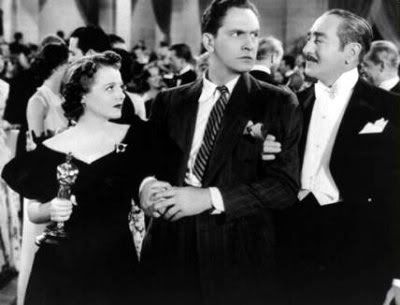
Adolphe Menjou, 1890-1963


Adolphe Menjou talks to Janet Gaynor and Fredric March in A Star is Born (1937)

I would have thought I'd done a birthday post on Adolphe Menjou before, but apparently not. Menjou had a long career, starting in silents in the teens and continuing to act up until 1960 and his final film, Disney's Pollyanna. If I had to pick just one movie to represent Menjou's body of work, I'm not certain which one I'd pick, just because he turned in so many good performances. He plays the newspaper editor in the 1931 non-comic The Front Page, a deeply cynical movie which is probably overshadowed by the comic 1940 remake His Girl Friday. Another good guy role is in 1952's The Sniper, in which Menjou plays a San Francisco police detective trying to determine who's the serial killer murering people with a sniper's rifle.

Menjou's moustache, I think, makes him always look elegant, as in the 1937 version of A Star is Born, or even 100 Men and a Girl, where as an unemployed musician he probably shouldn't look quite so elegant. Only in Hollywood can poverty look so good.

Left-aligned photo As for bad-guy roles, Menjou plays the Czechoslovak Communist functionary hovering over Fredric March's shoulder in Man on a Tightrope. He's also quite good as a French World War I general who court-martials a trio of soldiers for not carrying out a suicidal mission in Paths of Glory. The photo at left, in fact, is a scene from Paths of Glory with Menjou alongside Kirk Douglas, who has the thankless job of trying to defend the three soldiers in the court-martial. For a somewhat bad guy earlier in his career, albeit one who fits the elegant persona that imbues a lot of Menjou's performances, you could try The Easiest Way.

Tuesday, November 6, 2012

November 2012 Star of the Month: Constance Bennett

If you don't want to watch a bunch of Election Day coverage (and really, who would want to watch that stuff?), you're in luck. TCM is spending Tuesday nights in November looking at the films of Constance Bennett. Bennett actually started her career in the silent era, although TCM's salute is, I believe, all talkies. The first night of salute includes her early talkies, which means a bunch of fun pre-Code movies, such as The Easiest Way, which you can catch at 11:00 PM.

Bennett plays Laura, a young woman from a lower class family who's a working girl, working as a shop girl in one of those big New York department stores. Being unmarried, she still lives with her family, which includes her parents (Clara Blandick and J. Farrell MacDonald) and her sister Peg (Anita Page). Dad's an alcoholic and depends on the daughters' income to survive, while Peg has a boyfriend in Nick (Clark Gable before he became a star), who works for a laundry and has big dreams of opening his own chain of laundries. Mom and Dad like that idea, but Laura wants love.

Laura's about to have a change of luck, however, when she's discovered by some guys who work for a modeling agency. They give her their business card, and when she models clothes for the big boss Brockton (Adolphe Menjou), she finds that she's good at modeling, and can make good money doing it as well, which could really help out the family. The problem for Laura, though, is that some of the family -- notably Mom and Nick, who by now is Laura's brother-in-law -- think modeling is unrespectable. Well, it's not just that; Laura has also more or less become Brockton's mistress.

Brockton takes Laura on a business trip west, and while leaving Laura with friends in Colorado, Laura meets journalist Jack (Robert Montgomery), and falls in love with him. Indeed, she's even willing to give up the good money she's been making modeling and being Brockton's woman in order to marry Jack. The only thing is, Jack gets called away to an assignment covering a revolution in the Argentine, and Brockton dumps her, leaving her in debt. What's a woman to do? Well, when she eventually stops hearing from Jack, she resigns herself to a life as a kept woman, and returns to Brockton. But you know Jack is going to return for the final reel....

The Easiest Way is an interesting little pre-Code movie, with a surprising number of stars. Bennett is good as a model and nice to look at. Montgomery seems at first a bit miscast as a reporter only because we're probably all well acquainted with all the elegant gentlemanly roles he played. But Montgomery does a good enough job with his role. Menjou, with that moustache, looks like he's perfectly cast to play the creep, and he's quite good here too. Gable doesn't have much to do, but you can already see the qualities that were soon to make him a star.

The Easiest Way should be enjoyable for those who like pre-Codes, and has gotten a release as part of the Warner Archive.

Friday, July 22, 2011

The Tall Target

A month or so ago, TCM showed The Tall Target, which I hadn't seen before, although it happens to have been released to the Warner Archive collection. It's showing up again tomorrow morning at 9:30 AM, and is worth a viewing

Dick Powell, long since past his days as a star of light musicals, plays John Kennedy, a detective with the New York police in early 1861. This is the time just before Abraham Lincoln was to be inaugurated President (remember, back then, inauguration day wasn't until March), and for obvious reasons, there were a lot of Southerners who would have been more than happy to see Lincoln never become President. Kennedy believes he has good intelligence that there's a specific plot afoot to assassinate the President-elect when he changes trains in Baltimore, but unfortunately, he can't get the right people to believe him. The wrong people, on the other hand, certaingly believe it, because they're part of the apparent plot: Kennedy is supposed to have a ticket for the train from New York to Washington, but when he gets to the station, he finds there are people who don't want him on the train. Eventually, he's taken in by his old friend Col. Jeffers (Adolphe Menjou), who has an extra berth in his compartment. The only problem is, Jeffers turns out not to be much of a friend, as he's in on the plot, and even tries to shoot Kennedy. Jeffersthen uses his power to get Kennedy turned over to the police, and from there The Tall Target becomes a movie along the lines of Alfred Hitchcock's Saboteur, where the hero has not only to foil the bad guys, but stay one step ahead of the police in doing so.

Fortunately, he's able to pick up an ally in the form of Rachel, a slave played by a young Ruby Dee. Her owner's brother (Marshall Thompson) is a southerner claiming he's going to South Carolina, but Rachel knows he's actually planning to get off in Baltimore. There are other people, too, how may or may not have something to do with the assassination plot, which suddenly has to be called off when it's revealed that Lincoln has cancelled his previously scheduled stop in Baltimore. Or is the plot over? There wouldn't be much of a movie if that's how the conflict was resolved, so we know that there is still one more trick up the sleeve of the scriptwriters.

I don't think that The Tall Target is near the level of Saboteur; nor is it as good as the train-based thriller The Narrow Margin But it's entertaining and well-made in its own right. Adolphe Menjou is always worth watching, and Dick Powell is rather an underrated actor. Also, the movie does a fairly good job of maintaining the suspense up until the final denouement.

Saturday, January 8, 2011

My kind of town

You probably remember the recent Oscar-winning movie Chicago. Younger people probably think of it as being based on a musical, but in fact, it's a movie adaptation of a musical that is itself an adaptation, of a Broadway play of the mid-1920s. That play got two more-or-less non-musical adaptations. The first was as a little-seen silent (also named Chicago) in 1927. The second was given the name of its main character: Roxie Hart, and is airing tomorrow morning at 9:00 AM ET on the Fox Movie Channel.

Roxie is played by Ginger Rogers and is a struggling actress in 1920s Chicago. She wants to make a name for herself, so when her husband shoots an intruder, she's insistent that she'll take the rap. Of course, once she tries to plead guilty, she actually has to go on trial and get off, so that she can resume her career as an actress. After all, the trial is only so she can become famous, not so she can actually go to jail! It's up to lawyer Adolphe Menjou to get her off. Needless to say, there are some folks out there in the press who have an idea what's going on, led by George Montgomery, who also tells the story in flashback. But, since you know the story of Chicago, you probably know the basic story of Roxie Hart already.

To be honest, this isn't my favorite Ginger Rogers movie. She's just too wacky and irritating here. She's great when she can be elegant with Fred Astaire. She proved she could act in Kitty Foyle, where she gives a good performance and won an Oscar, even if there are a bunch of other reasons why I don't particularly care for that movie. (That, however, is a topic for a different post.) And Rogers had already long since shown she could do comedy. After all, there are comic elements in 42nd Street and Gold Diggers of 1933, but she had actually starred in out-and-out comedies like Rafter Romance already. Still, there's something about the Roxie Hart character here that's just all wrong and not so sympathetic. And it's a bit of a shame, since the story is a good one, and there are lots of great character actors showing up.

Still, if you're a fan of Ginger Rogers, or if you enjoyed the movie Chicago and want to see one of the non-musical versions of it, you'll probably like Roxie Hart. It's gotten a DVD release, too.

Thursday, November 18, 2010

Ava Gardner, Night 3

Tonight is the third Thursday of Ava Gardner's turn as TCM's Star of the Month. I'm looking forward to The Naked Maja, which I haven't seen before, kicking the night off at 8:00 PM ET. Coming up quite a bit later, early tomorrow morning at 5:00 AM, is The Hucksters

"Hucksters", of course, is a word that comes from advertising, and this is a movie about the dark side of the world of advertising. Clark Gable plays an up-an-comer at an ad agency who recently returned from years of service in World War II. He's got a boss in Adolphe Menjou who is trying to manage the contract of tyrannical soap magnate Sydney Greenstreet. Greenstreet's controlling ways, combined with the maxim that the customer is always right, means that whenever Greenstreet says, "Jump", Menjou asks how high. And Menjou wants Gable to jump right alongside him so that he can move up in the advertising world.

Jumping means several things. First is getting war widow Deborah Kerr to sign on as a paid celebrity spokesman for Greenstreet's company. Hollywood's plots being as predictable as they are, you can guess that Gable is going to fall in love with Kerr. Things get a little more complicated when Gable meets nightclub singer Gardner and falls in love with her, too. And then there's Greenstreet's next flighty idea. He's taken a liking to comedian Keenan Wynn, and wants to get Wynn a radio show out on Los Angeles. Gable has to get the job done, or else Greenstreet will take his business to another company. The only problem is, Wynn's material is oh-so-unfunny.

It all sets up a series of moral conflicts for Gable, but because this film was made under the Production Code and made at glitzy MGM instead of socially conscious Warner Bros., the best we can hope for is that Gable comes to his moral senses in the way Jack Lemmon does in The Apartment. In reality, he and Menjou are more like the Claude Rains character in Mr. Smith Goes to Washington. Still, The Hucksters is worth watching for Sydney Greenstreet's performance. Despite being billed third, he's the star who shines most.

The Hucksters has not received a DVD release, not even to the Warner Archive collection. So you'll have to watch TCM's showing.