Showing posts with label Anne Bancroft. Show all posts

Tuesday, June 3, 2025

Mel Brooks does Ernst Lubitsch

José Ferrer was honored in Summer Under the Stars last year, and I think it was for his day that TCM ran the 1980s remake of To Be or Not to Be. I made a point of watching it before it expired from my DVR and writing up a post to put up later since I'm running well ahead in my blogging.

Now, I think most of you know the plot, since this is a remake of the 1942 classic that starred Jack Benny and, in her final role, Carole Lombard. The movie opens up in August 1939, which is just before the Nazis invaded Poland and set off what is the European theater of World War II. Frederick Bronski (Mel Brooks) runs a theater troupe in Warsaw together with his much more famous wife Anna (Anne Bancroft) and behind the curtain they engage in comic bickering. Frederick has come up with an extremely anti-Nazi revue but, with the political situation, the censors force him to close that show, leading him to do a revival of Hamlet.

Andrei Sobinski (Tim Matheson) is a flyboy in the Polish air force, and also a big fan of the theater, going to all of Anna's performances. One night, ahen Frederick is doing Hamlet's soliloquy, Andrei goes to the dressing rooms to meet Anna, with Frederick getting jealous over who's sending Anna flowers. Not long after, the Nazis invade, and the airmen are forced to flee Poland for the safety of the UK where they can reform a Polish squadron much like the Czechs did if you recall the movie Dark Blue World.

José Ferrer plays Prof. Siletski, a putative member of the anti-Nazi intelligentsia giving speeches and the like. But in fact he's actually a Nazi sympathizer and spy. So when he tells the airmen he's going on an underground trip to Poland, they all stupidly reveal the addresses of their families, which would basically give up the entire Polish resistance if Siletski could give those names to his Nazi handlers in Poland. The only way any of this is figured out is because Sobinski wants Siletski to give Anna Bronski the message "To be or not to be", which will of course make sense to her. But Siletski seems to have no clue who Anna Bronski is, as though everybody in the Polish elites would know every stage actor out there, something that's long been a weird conceit of the movies.

Sobinski is parachuted into Warsaw to try to get to Bronski first in the hopes that the underground can stop Siletski. This leads to Frederick finding out about Anna and Andrei, and Frederick and Anna (and the rest of the Bronski theater troup) having to work with the underground to stop Siletski and the rest of the Nazis.

Now, as I mentioned before, this is a remake of a very classic comedy, so it's a bit hard to watch it without immediately thinking of the musical. And, to be honest, there are I think some ways in which it doesn't quite reach the level of the original. One is the presence of Mel Brooks. Brooks was a great satirist and does a marvelous job for the most part with his parodies. But this version of To Be or Not to Be is not a parody of the original or of any genre of film. As such, the blunt style doesn't always work, as with an extra scene at the beginning where Anna and Frederick are bickering in Polish. Some of the studio sets also look a bit too artificial, much in the same way I commented on when reviewing New York, New York and Pennies from Heaven.

On the other hand, by the 1980s Mel Brooks could be daring in a way that Lubitsch couldn't. Anna's dresser is very obviously gay, even before he reveals the pink triangle that Nazis made homosexuals were. A film released in 1942 could never have mentioned the Nazi persecution of homosexuals.

So this remake of To Be or Not to Be is interesting, if not always great.

Monday, March 10, 2025

84, Charing Cross Road

Back in 1987, one of the movies that I hear about getting a release, but never got the chance to watch because I wasn't really in a place to go to the local mall sixtyplex by myself was 84 Charing Cross Road. Over the years, I'd heard other people say some really good things about it, and it was one of those films I'd wanted to see. So when TCM ran it last August when Anne Bancroft was honored in Summer Under the Stars, I finally got the chance to record it and watch it.

I had known that the movie was based on an epistolary novel, but what I didn't realize is that it's actually based on a true story. Helene Hanff (played by Bancroft) is a woman who, as the movie opens, is getting on a plane to London. A big part of her visit is to get to the titular 84, Charing Cross Road (no comma in the title of the movie but apparently there is in the title of the book), which was the home of used book store Marks & Co. She gets there to find that the store is closed and workmen are renovating it into something else. But as with the opening of Twelve O'Clock High, this is a chance for all those old memories to come back....

Flash back to 1949. Helene Hanff is a research writer/script editor working in New York and living in the sort of apartment filled with books. She needs more books for her work, and is having a dickens of a time finding them in New York. In the Saturday Review of Literature, she sees an ad for Marks & Co., and decides to write to them to see if they have the books she needs. That letter is answered by Frank Doel (Anthony Hopkins), who fills the order and starts both a tab for Hanff and a long running correspondence between the two.

Helene responds, in some ways coming across as the character Bancroft played in Garbo Talks: the quintessential New York stereotype of a person who won't back down and do things her own way. The two also talk about their personal lives. Hanff is single, while Frank has a wife Nora (Judi Dench) and two daughters. Eventually, one of Frank's co-workers writes to Helene as well, and everybody in the store is interested in Helene, with the interest being mutual as the movie in part becomes a sort of retrospective of life for a certain class of British person over the course of 20 years.

Frank and the rest of the people in the store hope that perhaps Helene can make it to London some day, although this is the early 1950s when transatlantic travel is very expensive. Helene does make plans to get over to the UK, but financial issues keep coming up to prevent it. She has a friend who does stage acting and gets a part in a touring company that will be going to London. But when she goes to Marks & Co., she doesn't recognize Frank. The correspondence goes on, until.... Well, we know that Helene does make it to London but only after the store went out of business.

84 Charing Cross Road is the sort of movie that you'd think would have a tough time working, from the idea of adapting letters into a good movie to the fact that the two main characters never meet. And yet the movie is something very charming, thanks in part to Bancroft's very American performance and Hopkins' very British performance. Perhaps for people who are more used to current-day movies from the 2020s, 84 Charing Cross Road may seem a bit old-fashioned and tough to get into. But for anyone who likes classic film, I think they'll very much enjoy it.

Wednesday, August 14, 2024

Torch Song Trilogy

Today in Summer Under the Stars is the day for the movies of Anne Bancroft. One of her movies is on my DVR from when TCM ran it back in June as part of a two-night salute to "Pride" Month: Torch Song Trilogy. It concludes Bancroft's day, early tomorrow (August 15 in all time zones in the contiguous US) at 4:00 AM.

The movie is based on a set of three one-act plays by Harvey Fierstein that were eventually combined into a Brodway play in the early 1980s and the edited down to movie length for the film, and since the plays all have (mostly) the same set of characters, the material fits as one coherent whole. Fierstein plays Arnold Beckoff, who in a prologue is a New York boy caught by his mother (Anne Bancroft) trying on women's make-up and clothes. Nowadays, the Ts who have tried to take over the LGBT community would try to tell you that young Arnold was really showing he's "transgendered", but thankfully in those days they didn't have puberty blockers and people pushing chopping off genitals, so Arnold and all the other boys like him were able to grow up to be the gay men they always were.

Fast-forward to the first of the acts, set in 1971. Arnold, now an adult, is a female impersonator using the stage name "Virginia Hamm" and working with a bunch of other impersonators at a gay nightclub. But Arnold doesn't really have any love in his life, at least until he meets Ed (Brian Kerwin) at a bar. The two start a relationship, but Arnold is consistently more needy than Ed and pushing the relationship faster and farther then Ed is thinking of going. Arnold then goes over to Ed's apartment for Ed's birthday, to find out that Ed is having dinner with... old girlfriend Laurel (Karen Young). Ed says he's bisexual, although Arnold notes that most bisexuals are really gay and just not ready to admit it.

Act two starts at Christmas, 1973. Arnold is still performing at the same club, and one night a bunch of young men including Alan Simon (Matthew Broderick) show up. The group seems to be slumming by acting like it's daring to go to a gay club to see the show, but one of Alan's companions starts being really nasty to Arnold in a way that results in fisticuffs and Alan ending up unconscious. Arnold takes Alan back to his apartment to recover. A few days later, Alan shows up again outside the stage door, mostly to reveal that he's gay too, and the sort of young man who all the older gay men found gorgeous. But now, as a fully legal adult of 21, Alan wants something more out of life. The two start a relationship that goes on for several years, until out of nowhere, Ed and Laurel call, wanting to meet Arnold. Arnold decides he wants a real family, and applies to foster a troubled gay teen, David. This necessitates moving to a new neighborhood, but they pick one with a lot of gay-bashing....

Finally, in 1980, Arnold is alone with David, since Alan was killed in one of those gay-bashing attacks. Arnold hasn't had the courage to tell Mom that he's taken on a son, or even about his relatinoships with Alan and Ed, because Mom is so full of regret that one of her kids turned out to be gay that she just can't handle it. Arnold, for his part, can't handle Mom, either. She decides to return from Florida and learns about what's going on in Arnold's life, which opens up all those old wounds again.

For the most part, Torch Song Trilogy is an excellent movie, although sometimes I feel like the script has Arnold not realizing that he's partly causing his own problems through his emotional neediness (in a way, I should point out, that is not because Arnold is gay; there are straight people who are just as clingy). But then, the main theme of the movie is how tough it would have been for gay men to find love in a time and place where there was a lot less acceptance of gays than there is now. One other problem for me is that I don't know that Fierstien can really sing like a woman. I found myself thinking of Carol Channing, who looked and sounded like she was 60 even when she was 30; Fierstein here sounds like the male equivalent with a voice that sounds like it should be coming out of the mouth of a character like Vic Tayback's short-order cook in Alice Doesn't Live Here Anymore.

But these are minor quibbles that don't really distract from what is generally a fine movie. If you haven't seen Torch Song Trilogy before, take this opportunity to watch it.

Monday, October 9, 2023

New York Confidential

Another of the movies that I had somewhat surprisingly never heard of before I noticed that it was available on Tubi was the 1950s crime film New York Confidential. Since it sounded interesting and had a pretty good cast, I decided I'd watch it to be able to do a review on it here.

The movie starts off with a narration (Marvin Miller is the narrator) about a killing that was dirty enough that it was going to point to the New York syndicate, which is the head for the syndicate in the country as a whole. That's not a good thing, and the syndicate is going to have to do something to make certain it doesn't happen again. Charlie Lupo (Broderick Crawford) is the head of the syndicate, and to deal with his problems, he and the rest of the syndicate brings in hired hitman Nick Magellan (Richard Conte) from Chicago.

Charlie knew Nick's father, and wants Nick to work for him, not so much for the syndicate in general. Nick has to this point been working for a subhead of the syndicate, Achilles (Onslow Stevens). Nick doesn't want to switch allegiances, at least not until being told that Achilles is actually OK with it. Nick becomes Lupo's bodyguard, ultimately living for a time in the Lupo house.

Lupo has a devoted mother, as well as a college-aged daughter Kathy (Anne Bancroft). Kathy knows what her father does, and doesn't like it, largely because everybody else knows too, and Kathy wants to be seen as decent and respectable. She's at the point where she's willing to try to run away, even though Charlie would go to the ends of the earth to bring her back. Kathy also starts falling for Nick, apparently not getting that he's a hitman.

Further complicating matters is that we've got another of those "good government" types who wants to go after the syndicate. For the most part, the authorities keep being able to get the small-time folks, while the heads go off unscathed. But this group of crusaders apparently has some witnesses in higher places, and that's going to require the syndicate to do something about it. The bad news for them is that the hitmen -- not Nick -- that they hire to do it botch the job such that they're obviously going to be noticed. It's up to Nick to deal with that. As the violence spirals out of control, it threatens to engulf everybody....

New York Confidential isn't a bad little movie, at least not by the standards of non-prestige movies of the 1950s. Broderick Crawford has the sort of role he could play in his sleep, but he does it well. Ditto Richard Conte. Anne Bancroft is on her way up, but does an OK job. Bigger and better things were to come for her. The ending is a surprising one in a way, in that it somewhat satisfies the Production Code, but in other ways you'd think the Code Office would have had issues with it.

New York Confidential isn't the greatest movie, either, but it's one that's definitely worth a watch for anybody who likes movies of that era.

Tuesday, October 18, 2022

Sorry, but there's no sexy sidewalks here

A few weeks back, Eddie Muller's selection for Noir Alley was a movie I had never heard of before, The Naked Street. I wanted something a bit shorter than what I had been watching, so recently I sat down to watch it.

Farley Granger plays Nicky Bradna, a small-time gangster who, at the start of the movie, is on death row in Sing Sing for having killed a man. He clearly did it and if you believe in capital punishment, probably deserves it, which brings up the interesting question of how the Production Code is going to handle the rest of the movie. But that's not important right now. What is important is Rosalie Regalzyk (Anne Bancroft), the kid sister of a much higher-up gangster, Phil Regal (Anthony Quinn).

Phil loves his sister, and wants what's best in life for her, and will stop at nothing to get that, which is going to mean breaking the law if necessary, something he has no compunction about doing. And Phil is greatly distressed when he learns that Rosalie had been the girlfriend of Nicky. Partly because he'd like Rosalie to escape the sort of life he has, and more importantly because she really hasn't. Indeed, she's gotten pregnant by Nicky, and the thought of Rosalie giving birth to a bastard child horrifies Phil.

So Phil does what any good big brother would do, which is to engage in some good old witness intimidation so that the witnesses who saw Nicky commit the murder will say no, they really didn't, and get Nicky sprung from prison in time for him to marry Rosalie and make a respectable woman out of Rosalie. Phil also gets a decent job for Nicky, but that's not out of the goodness of his heart. Instead, he wants to be able to keep close tabs on Nicky and make certain that Nicky stays on the straight and narrow and does right by Rosalie.

Nicky is thrilled to be out of prison and not have death hanging over him, so he accepts this bargain, and even seems to be a fairly good husband. At least, until disaster strikes in the form of the unborn child strangling itself to death on the umbilical cord. A devastated Nicky starts seeing other women, as well as taking up gambling and other stuff. It's only a matter of time before Phil discovers what's going on and vows revenge on Nicky.

The Naked Street is a movie with a plot that strains credulity, and for once that's not because of any script gymnastics the screenwriters have to do to deal with the Production Code. Instead, the idea of all of this happening in the real world seems a bit far-fetched. However, the movie is saved by good performances, to the point that you don't think that much about the unrealisticness of the plot. Also in the cast is a young Peter Graves, as a reporter who's been trying to bring down Regal and who provides the narration.

The Naked Street certainly isn't one of the all-time classics of the noir cycle, and it's also not the best movie of any of the main stars. But it's one that entertains successfully enough to be worth a watch.

Anot

Friday, September 25, 2020

Young Winston

I got a five-movie box set of Columbia "war" movies some time ago, from which I watched two movies so far, although surprisingly a search of the blog claims I haven't blogged about either. One of those movies is Young Winston, which I also recorded off of TCM, so recently I watched that airing to do a blog post here.

Simon Ward plays Winston Churchill, at least as a young adult. The movie starts off in about 1897, when Winston is 22. He's a reporter who had been in the military, covering a British military operation on the Northwest Frontier, which would be roughly the modern border between Pakistan and Afghanistan. The British army isn't exactly happy to have him there, especially when it turns out he's ambitious and using the experience to try to advance what is soon to become a nascent political career.

But after this opening, we go back to when Winston is about 7, about to be sent to boarding school by his parents, Lord Randolph (Robert Shaw), a member of parliament for the Conservatives under Lord Salisbury (Laurence Naismith), and Randolph's American-born wife Jenny (Anne Bancroft). Winston always has a difficult relationship with Dad because of a bunch of reasons, including Dad's advancing syphilis, which eventually kills him in his 40s.

Winston is a middling student at best, taking multiple tries to pass the exams to enter the military academy, and only being admitted as a member of the cavalry, which is apparently less prestigious. This eventually gets Winston sent to Sudan, where he meets with General Kitchener (John Mills), who had heard of Winston and absolutely didn't want Winston serving under him.

Winston's ambition has him try to get elected to Parliament after his father dies, but it doesn't work the first time, although of course we know from history that he would eventually win election and then become Prime Minister during World War II. At any rate, Winston, having failed for now in politics, goes to South Africa to cover the Boer War, again ostensibly as a journalist but still really helping the military. This gets him captured and sentenced to a POW camp.

But Winston escapes, and becomes a worlwide cause célèbre as he evades capture (and likely execution) by the Boers despite not speaking Afrikaans. We know from history that he escapes and returns to England, which he parlays into his second run for Parliament, this time successful, despite seeming a bit too chummy with Liberal lader David Lloyd George (Anthony Hopkins).

Sir Richard Attenborough directs Young Winston as a series of set pieces, any of which would have made a decent portion of a miniseries of Winston Churchill's life. Winston most likely embellished his life story, on which the movie is based, but apparently even the unvarnished truth would have made for acceptable episodes. But each scene is an opportunity for a quality actor to get a cameo; among the ones I haven't mentioned yet are Edward Woodward and Jack Hawkins (who has almost no dialogue since his cancer had already cost him his voice).

Unfortunately, as one long movie, the stories strung together don't quite work; the material definitely would have worked better as a multipart TV miniseries. I think a lot of that is down to Attenborough's languorous direction, along with an extremely irritating technique of giving each of the the Churchills an extended solo scene where they're being interviewed by a never-seen off-screen voice. These don't work at all, and bring the movie to a screeching halt. To do it once is bad; to do it three times is unforgivable.

While I didn't exactly hate Young Winston, I definitely think the material could have been made a whole lot better. Still, watch and judge for yourself.

Tuesday, April 30, 2019

Agnes of God

Another movie that I watched over the weekend to free up space on my DVR is Agnes of God.

The movie starts off rather shockingly, with the screaming of a young woman giving birth, followed by the baby being killed. That's bad enough, but this is all happening at a convent not far outside of Montreal, Quebec, and the young woman in question is a nun. Even if you're not Catholic, you probably know that nuns aren't supposed to be having sex, and in a cloistered place like this, where are the men coming from? The nun who gave birth, Agnes (Meg Tilly), is going to have to stand trial, but first it needs to be determined how she got pregnant and if she's even fit to stand trial.

To determine the latter question, the authorities send in psychologist Martha Livingston (Jane Fonda), a woman who has her own psychological baggage regarding the Catholic Church. she goes to the convent where she is met by the Mother Superior, Mother Miriam (Anne Bancroft). Miriam unsurprisingly has her own problems with outsiders, thinking they're out to destroy the reputation of the Church, never mind what you think about whether the Church is causing its own problems. But she's also defending Agnes who, as Dr. Livingston talks to her, it becomes clear is a woman who has serious problems above and beyond however she got pregnant. She seems to know nothing of the outside world, and talks elliptically about what happened to her.

Dr. Livingston takes it upon herself to investigate not only the question of whether Sr. Agnes is sane, but also what actually happened to her. Mother Miriam continues to be wary of her, and we get the feeling that the latter knows a lot more than she's letting on. But what actually did happen to Agnes?

Agnes of God is an interesting movie, and one that is certainly thought-provoking. I can imagine that both anti-clerical people and religious Catholics might have some probems with the movie at first, however. (I was born Catholic, but outside of weddings and funerals haven't been to a Mass in probably 20 years.) Fonda's character is drawn so one-dimensionally that I found myself wondering whether the script was trying to make a negative point about the Church, or about people with hangups about the Church. But Bancroft's character certainly isn't a saint either, and probably any institution in a situation like this would probably do some unethical things to try to save its repuatation.

Bancroft and Tilly are excellent; Fonda adequate although again I think that's more down to the script. The cinematography is also glorious, with director Norman Jewison having used rural Canaidan locations as well as Montreal for shooting. Georges Delerue's evocative score is also a nice touch.

Amazon lists Agnes of God as being on DVD, but it doesn't seem to be available at the TCM Shop. Amazon does also have it on streaming, as far as I could tell.

Tuesday, November 20, 2018

Fatso

A movie that's been back on FXM Retro for a little while now is Fatso. It's going to be on again tomorrow morning at 6:00 AM.

The movie opens with a montage of a couple of cousins, Sal and Dominic, in a large Italian-American family in New York. As the two cousins grow up together, we see that they both have a great affection for food; way to confirm that stereotype about the Italian mother constantly feeding her children. At any rate, the love affair continues up until Sal is 39, when he rather abruptly dies of a heart attack, devastating Sal's extended family. Not that it stops adult Dominic (Dom DeLuise) from his epicurean desires during the wake.

This being a close-knit Italian family, Dominic and his kid brother Frankie (Ron Carey) live upstairs from their sister Antoinette (Anne Bancroft) and her family. Indeed, Antoinette and Dominic run a greeting-card store together, so they spend a lot of time together. And Antoinette having been close to Sal as well and seeing what happened to him, she starts worrying about her brother. Is Dominic going to die an early death too from obesity? She urges him to see a diet doctor, but understandably, Dominic doesn't want to.

Eventually he does, and he's frankly horrified at all the diet advice he's given, which contradicts every instinct related to food that he's had growing up. Two things make Dominic reach a breaking point. One is that he eats a piece of his nephew's birthday cake -- before he gets home with it. But more important is something that happens at work.

Just down the street, an antiques-themed gift shop opens, run by Lydia (Candice Azzara). Dominic sees her, and it's love at first sight. That might just give him the impetus to start eating better and lose weight. So he joins a group called the Chubby Checkers since apparently the filmmakers couldn't use the names of any of the 12-step groups. But it's still a huge struggle for Dominic to try to lose that weight, as all he can think about is food....

Fatso is a movie with an interesting premise, even if the ideas and execution seem a bit conventional. DeLuise is entertaining as the basically decent man who just has a problem with food. The old adage from The Narrow Margin that nobody likes a fat man except his grocer and his tailor isn't quite true. But the movie also has some problems, thanks to Anne Bancroft surprisingly enough. She wrote and directed in addition to starring, and it's there that the problems show up. Her character as written is to obnoxiously shrill. It's easy to understand that she loves her brother and doesn't want to see him die young the way their cousin did, but still you want to reach out and smack her to shut her up at times. And some of the scenes (not involving her character) come across as a little to zany and again loud.

Still, Fatso is an entertaining look at a New York of its era. Diet advice has advanced a bit since then, thankfully. And the 70s and 80s New York is always interesting to see. The movie is out of print on DVD, so you're going to have to catch the FXM showing if you want to see it.

Wednesday, January 27, 2016

Garbo says a word or two

One of the movies stuck on my DVR that I finally got around to watching is Garbo Talks. It's available on DVD, so I can feel comfortable doing a full-length blog post on it.

Ron Silver plays Gilbert Rolfe, an accountant with one of the big firms in New York City liing with his wife Lisa (Carrie Fisher). Gilbert also has a mother Estelle (Anne Bancroft) who is quite the character. She loves the movies of Greta Garbo, and she has principles to the point that she's willing to get arrested for them. Indeed, at the start of the movie, Estelle has just gotten arrested again, in a dispute over the price of some produce. It's up to Gilbert to bail her out of jail. What a mother!

Things, however, are about to change. Estelle has been suffering from headaches recently, and they've been getting more severe. When she goes to the doctor, she gets the terrible news: she's got a brain tumor, and it's inoperable. There are some treatments, but they're probably going to be futile, so in all likelihood she's only got six months or so to live. She can't live in her apartment any longer, so it's off to the hospital while the doctors treat her as best they can, and while Estelle waits to die. While having a conversation with Gilbert at the hospital, she comes up with a daffy wish: she'd like the opportunity to meet Greta Garbo before she dies.

It was well enough known that it didn't take the sort of people who nowadays read movie blogs to be aware that there's a big problem with this wish. Garbo was famously private. Not quite reclusive, since she could be seen in shops in the vicinity of her Manhattan apartment; but private in that she wasn't about to let anybody get close to her and didn't do any public appearances. How's a regular schlub like Gilbert Rolfe going to find Greta Garbo, much less convince her to see his mother?

With this begins our son's quirky quest to fulfill his mother's dying wish, regardless of the consequences. There's a substantial monetary commitment in trying to find her, which puts a strain both on his work and on his marriage. But along the way, Gilbert meets a number of interesting characters played by a series of actors not quite of the prestige of an Anne Bancroft. Howard Da Silva (in his final film) plays a photographer who used to stalk people to get photos of them; Hermione Gingold (also in her final film) plays a woman who made silent films with Garbo, although she was well down the cast list; Harvey Fierstien plays a gay man Gilbert meets on Fire Island; and Dorothy Loudon has a hilarious scene as a cat lady/agent.

All in all, Garbo Talks is a pretty good journey, although I have to admit that I found the Estelle character to be terribly irritating. It's easy to understand why Lisa would find her difficult and why Gilbert's sudden chasing of Greta Garbo would put a huge strain on her marriage. Not that Lisa is a saint, of course. But the problems Lisa poses Gilbert seem more for comic effect, while Estelle is the sort of person you'd think seriously about not bailing out the next time she got herself arrested. It is, however, a testament to Anne Bancroft's acting that she makes Estelle a compelling character to watch.

Especially if it shows up on TV anywhere, give Garbo Talks a chance.

Tuesday, December 8, 2015

The Prisoner of Second Avenue

One of the films that I DVRed some time back and only recently got around to watching is The Prisoner of Second Avenue.

Jack Lemmon stars as Mel Edison. He's an ad exec in New York City in the era just before, as I like to put it, President Ford told the city to drop dead. It's tough living in the city, as it's suffering from a terrible heat wave, while the city seems almost to be falling apart. There have been rolling blackouts, and Mel just can't seem to catch a bus. And, it seems, the Edisons' apartment is falling apart too. There are cracks in the walls, they've had water problems, and the like.

Meanwhile, this being the mid-1970s, the economy isn't in such hot shape. Specifically, the advertising industry is having difficulties, which manifest themselves first in one of Mel's colleagues being sacked, and then Mel having to pay for his own lunch. But even worse is to come, when Mel is summarily sacked after 22 years. He can't bring himself to tell his wife Edna (Anne Bancroft), but how is a man his age going to get another good job

If having the infrastructure crumble around you and losing your job aren't bad enough indignities, there is worse to come. Mel and Edna go out to visit his brother Harry (Gene Saks), who lives in suburban Connecticut and has done quite well for himself financially, in the lighting fixture business. Who doesn't like good-looking lamps? But Harry's success has always been a sore spot for Mel, who isn't exactly looking forward to the visit.

Much worse is to come, though. Edna goes out to do the grocery shopping, and when she comes home, she finds that the place has been robbed -- not just robbed, but ransacked. Oh, and the elevator is out too, so she had to climb 14 floors to get back to the apartment.

It's all enough to drive a man mad, and that's what happens to Mel, as he suffers a nervous breakdown. How is he going to recover?

That's pretty much all there is to The Prisoner of Second Avenue. It was originally a two-act play by Neil Simon, but it was opened up for the movie. That having been said, I have to say I have a lot of problems with this one. I don't have any animus toward Neil Simon; I like The Odd Couple, Plaza Suite, and especially The Sunshine Boys. But as I watched I couldn't help but find the two main characters to be extremely tiresome. They're almost constantly screaming, and the situations aren't nearly as funny as I think Simon intended them to be. Not that it was supposed to be a straight-up comedy, but I don't think it was supposed to be a straight drama either. After all, a lot of the scenes are introduced by news bulletins that are clearly meant to be there for comic relief. Still, I don't want to laugh at these characters as much as I want to grab them by the throat and shake them. That having been said, a lot of the reviews on IMDb are highly positive, so give the movie a try and you may like it a whole lot more than I did.

The Prisoner of Second Avenue did get a DVD release, but I think it's out of print on DVD since it's not available at the TCM Shop. Amazon does offer the DVD, and I think streaming options too if you have the ability to do that.

Monday, May 19, 2014

Brooksfilms

Robert Osborne has been sitting down with several Hollywood veterans over the past month or so: we've had Shirley Jones presenting a night of her movies, as well as Robert Wagner and Mitzi Gaynor. Next up is director/producer Mel Brooks, who will be on TCM for the next two nights to discuss six of the movies produced by Brooksfilms, the production company he created.

Brooksfilms was created in part to make The Elephant Man, which Brooks was producing, but was not involved with directing or acting. Since Brooks was primarily known for comedy, and especially the parodies he did, he didn't want his name that prominently displayed for a serious drama such as The Elephant Man, or everybody might think it was a comedy. The next two nights will show a relatively broad range of the movies Brooksfilims produced, which includes a comedy in which he stars.

Tonight kicks off at 8:00 PM with Fatso, directed by his wife Anne Bancroft. Dom Deluise plays a fat man who loves food. But when a cousin of his and sister Anne Bancroft dies, she begins to fear her brother is going to eat himself into an early grave, too. But it's only the possibility of love that gets Deluise to think about finally trying to drop those pounds.

At 10:00 PM is 84 Charing Cross Road in which Anne Bancroft and Anthony Hopkins become pen-friends across the Atlantic Ocean.

Then at midnight is the body-snatching horror film The Doctor and the Devils.

Prime time tomorrow kicks off at 8:00 PM with the aforementioned The Elephant Man, based on the story of the disfigured Victorian-era man Joseph Merrick (named changed to John for the movie), who wound up as a freak show exhibit.

Second on Tuesday is My Favorite Year at 10:15 PM, in which Peter O'Toole plays an actor known for his drinking and escapades, who has to be kept sober for a TV appearance.

Finally at midnight between Tuesday and Wednesday is the Mel Brooks version of To Be or Not to Be, which I don't like nearly as much as the Carole Lombard/Jack Benny version.

Monday, January 13, 2014

Treasure of the Golden Condor

What's left of the Fox Movie Channel is still plugging along, even airing movies that are new to me. One such movie is Treasure of the Golden Condor, which is on again tomorrow morning at 7:45 AM.

Cornel Wilde plays Jean-Paul, who at the beginning of the movie is actually a young boy living with his maternal grandfather in 18th century France. His paternal grandfather was the Marquis de St. Malo, and his father married his mother on a ship's voyage to the colonies in the Caribbean, where both of them eventually died of tropical diseases, leaving the boy an orphan living with the other grandfather on the ancestral lands. Those or now controlled by Jean-Paul's uncle (George Macready), who is a usurper, and knows it. He's got a plan to get Jean-Paul out of the way though, which involves playing on the illiteracy of young Jean-Paul and his grandfather to present them with a document supposedly legitimizing the familial relatoinship, but in actuality making Jean-Paul a bonded servant.

Fast forward to Jean-Paul's adulthood. Jean-Paul is still working in the St. Malo stables, where he from time to time is met by his cousin the Comtesse (Anne Bancroft). The two fall in love, but there's no way for them to have a real relationship as long as he's a servant. He needs some way to claim his rightful inheritance, which means money to find the proof of the marriage.

Wouldn't you know it, a plan, however cockamamie and unrealistic it may be, shows up, in the form of MacDougal (Findlay Currie). He's a Scot who had lived in the highlands of Guatemala among the descendants of the Mayans, and he's got what is supposedly a treasure map in the old Mayan language, showing the location of wealth beyond anybody's dreams! He can't read it of course, but the one person who can just happens to be the priest in the local parish on the St. Malo lands. Yeah right. Jean-Paul finds out about it, and decides to run away (which is technically highly illegal) with MacDougal to go to Guatemala and get some of that treasure for himself so that he can reclaim the inheritance.

So, we get about a third of the movie set in Guatemala (and partially filmed there, at least the establishing shots) in which MacDougal and Jean-Paul try to get that treasure. Along the way, MacDougal meets his daughter Clara (Constance Smith), who is decidedly against her father's quixotic quest, because she's seen the destruction it's wrought upon her family. Still, what with the whole plot line of Jean-Paul needing the treasure to go back to France, you kind of have to expect that they're going to be successful in getting the treasure so that the rightful climax of the movie can be back in France. You can expect that the good people are going to come out well, the bad guys are going to get their comeuppances, but I won't go into much detail as to exactly how that happens once Jean-Paul gets back to France, so that I won't give away the key plot details. One thing worth adding, though, is that Jean-Paul gets help from financier Dondel, played by Leo G. Carroll.

Although there are some plot twists, Treasure of the Golden Condor is a fairly formulaic movie, with an ending you might be able to see coming from a mile away, as well as some other plot points that are quite telegraphed. But then, you're watching an adventure movie, not something serious. You should know going into it that the point is to be entertained and not edified. In that regard, Treasure of the Golden Condor certainly succeeds. Cornel Wilde is well-suited to this sort of movie; the color cinematography is lovely, both of the Guatemala scenes and the interiors; and the acting from the supporting characters is generally reasonably good. Currie is a treat to watch, even if what happens to his character is a bit unbelievable.

As far as I can tell, Treasure of the Golden Condor doesn't seem to be on DVD.

Tuesday, September 17, 2013

Anne Bancroft, 1931-2005


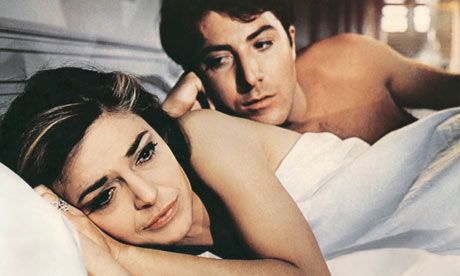
Anne Bancroft and Dustin Hoffman in The Graduate

Today marks the 82nd anniversary of the birth of actress Anne Bancroft. Bancroft started off in TV before making her first film, Don't Bother to Knock. Bancroft continued to work at Fox, making movies such as The Raid, and some others that I've seen but have never gotten around to blogging, and I don't think they'll ever air on the Fox Movie Channel again. Gorilla at Large, which has Bancroft, Lee Marvin, and a gorilla terrorizing an amusement park, is fun if not great. Ricardo Montalbán does a fairly good job opposite Bancroft in 1955's A Life in the Balance, which, it turns out, I did blog about. (It's still not on DVD, though.) Anyhow, getting back to Bancroft's films from the 1950s I've blogged about before, Nightfall is enjoyable because it's actually pretty good, while there's also The Girl in Black Stockings, which is enjoyable precisely because it's not very good.

Bancroft made more serious (in the sense of prestige movies where she had leading roles) work in the 1960s, starting with The Miracle Worker, which won her the Academy Award, through The Graduate, which famously had her trying to seduce Dustin Hoffman, who in real life was only about six years her junior. The magic of Hollywood casting. I'm happy to say that one of the movies in that time frame that I recommended several years ago, The Slender Thread, has since been released to DVD.

Bancroft eventually married Mel Brooks, appearing in a couple of his films, such as Blazing Saddles, Silent Movie, and the remake of To Be or Not to Be. She also tried her hand at directing with Fatso in 1980, an interesting if flawed film about a fat man (Dom DeLuise) who loves food but has to lose weight when a cousin dies way too young and he meets somebody he loves. In between all of those was the Oscar-losing ballet film The Turning Point.

Thursday, February 24, 2011

It kills bugs, too!

Coming up at 7:00 AM ET tomorrow morning on the Fox Movie Channel is the interesting historical movie The Raid. What's interesting about it is that it's based on a real event.

The movie starts in September 1864 at a POW camp for Confederate soldiers located in northern New York. Confederate Major Benton (Van Heflin) leads his fellow POWs in a breakout which is successful and which enables them to get to neutral Canada where they can meet up with some of their Confederate sympathizers who have a plan hatched. That plan is to cross the border and raid the nearest moderately-sized town, St. Albans, VT. There, they'll rob all the banks to get the money necessary to buy arms for the Confederates still fighting in the South.

To that end, Benton goes to St. Albans with the view of finding a suitable farm where the Confederates can congregate in preparation for the raid. Posing as a Canadian, he puts up at the hotel run by the widow Mrs. Bishop (Anne Bancroft), who has good reason to hate Confederates, and no reason to suspect that her new boarder is one himself. Likewise her son (Tommy Rettig), who begins to look up to the new father figure in his life.

Benton eventually gets a place outside of town and begins to bring in some of the Confederates who will take part in the raid, but it's not so simple. Some of the soldiers, notably Lt. Keating (Lee Marvin), are rather more vocal in their defense of the Confederacy. That just won't do, since this is an operation where subtlety is called for, lest the townsfolk figure out what's going on. Eventually, the day of the raid comes....

The Raid is good enough, but not particularly great. The parts of the story embellished for Hollywood's purposes are fairly pedestrian and predictable, but don't do anything to take away from the real-life story that's quite interesting in its own right. The cast is competent, although you get the feeling at times that they've all been doing these character types for years, particularly Marvin and his mean bastard routine. Still, there are much worse ways to spend an hour and a half. Unfortunately, The Raid isn't available on DVD.

Thursday, September 16, 2010

The Girl in Black Stockings

If you want to see a fun, even if not that good, low-budget mystery, you could do worse than to watch The Girl in Black Stockings, which TCM is showing tomorrow afternoon at 12:15 PM ET.

Lex Barker's outfit in our movie might be even skimpierLex Barker, who is probably best known for having played Tarzan in the early 1950s, plays David, a prosecuting attorney from Los Angeles who is on vacation at a resort in Utah that has a pool, thus allowing him to strip down to his 1950s style swim trunks and show us that yes, he had the body to play Tarzan. He's not there too long when, suddenly, one of the guests gets murdered. Everybody at the resort is a suspect, and because David's a prosecutor from the big city, he's just the right person to help the local Utah police investigate. Complicating matters is the fact that not only could anybody there be a suspect; one of the guests, Beth (played by Anne Bancroft) is a woman with whom David had a past. (Yeah right they just happen to meet in some middle-of-nowhere Utah town. Funny how Hollywood works.)

Going swimming in high heels?This being a Hollywood murder mystery, it comes as no surprise that this is a wacky cast of suspects. Ron Randell plays Edmund, the owner of the resort, a man who is now a quadraplegic and has a hangup about women. (However, with everybody being a suspect, you start to wonder whether being bound in a wheelchair is just a ruse and he's the murderer.) He's being taken care of by his sister (Marie Windsor). But, since Edmund has that problem with women, you know there's a busty one here, and that woman is Mamie Van Doren, who has just as much in the way of assets as Lex Barker and is given ample opportunity to display them. Along the way, there's a character who gets killed by walking backwards into a buzzsaw, although you can see it coming a mile away when the characters visit a sawmill; and our hero actually does solve the mystery.

Not that the mystery or its solution is particuarly satisfying; The Girl in Black Stockings is fairly mindless entertainment that will keep you entertained for the 75 or so minutes that it runs. Instead, watch for a cast of names you'll probably recognize trying to act their way through material that's much too overripe. That, and some nice location shooting. Unfortunately, The Girl in Black Stockings doesn't seem to be available on DVD, so you'll have to catch the TCM showings.

Friday, July 23, 2010

0 for 11

The Fox Movie Channel is showing The Turning Point this evening at 6:00 PM ET. The movie is famous for being nominated for 11 Academy Awards, and winning a big fat zero of them (a feat later duplicated by The Color Purple; back in 1948 Johnny Belinda also lost 11 nominations, but the 12th nomination, Jane Wyman for Best Actress, won). Looking at the movie a third of a century on, it's understandable why The Turning Point came up short come awards time.

Shirley MacLaine plays Deedee Rogers, a woman raising a family in Oklahoma. She used to be a ballet dancer 20 years earlier, but she got knocked up, whcih is a problem for a dancer's career. So she married the dancer who was the father of her child (Tom Skerritt), moved to Oklahoma, and now runs a dance school while raising three kids. The American Ballet Theater, with which she danced all those years ago, is in town for a performance, so the family goes to see the show and then invite members of the dance troupe over for a party afterwards. It's here that Deedee meets her old rival, Emma (Anne Bancroft), who got the part Deedee was looking for back when she got pregnant. Emma went on to bigger and better things, and that's led to some resentment on Deedee's part.

The tables, however, are about to turn. Emma is getting to that age where her body will no longer do the graceful things it once did, demoting her to lesser roles; it's a fate that befalls every dancer, but one that none of them wishes to face. Deedee, on the other hand, has an extremely talented daughter Emilia (Leslie Browne), and Emilia is good enough to get an audition with the dance company in New York. So, Deedee goes with Emilia to New York, and lives somewhat vicariously through her, hoping for her success.

If you've seen movies like 42nd Street, you'll know that success is a product of hard work: lots and lots of hard work, to be more accurate. You've got the choreographer, the producer, the dance coaches, and a whole bunch of competing dancers each trying to get their own vision of dance to come across. Probably the highlight of all this for the viewers is Mikhail Baryshnikov as a Russian member of the company, who is also after Emilia's affections. In real life, he had defected only a few years earlier and wsa probably about as good a dancer as he ever would be -- after all, age would catch up to him too.

Having said that, the story falls a bit flat ultimately. The backstage world is a tried and true plot line, but the disadvantage it has is that it can also seem old and trite, which happens to a good extent here. Other than the two female leads (MacLaine and Bancroft), the rest of the dancers are dancers first, actors second. For those who are fans of ballet, it's sure nice to see them dance, but they're not as good at acting as the ballroom dancer/actors of the 1930s. Further, The Turning Point gets bogged down about two thirds of the way in by an extended dance sequence. Again, it's nice to have all this ballet preserved on the screen for posterity, but the opening night sequence goes on much too long, and feels like an afterthought that doesn't add to the plot even more than Gene Kelly's dance with Cyd Charisse in Singin' in the Rain. If you like ballet, I think you'll really like the movie, although you'll probably have seen it already. If you're not a fan of ballet, give it a shot, but there's no shame in not liking it.

The Turning Point was released on DVD, but is apparently out of print, so you'll have to catch the Fox Movie Channel showings.

Monday, July 13, 2009

Lee Marvin is being mean again

Our next selection is the little-seen movie A Life in the Balance, airing at 7:30 AM ET tomorrow on the Fox Movie Channel. Given its cast, you'd think it would be more remembered than it is, but such are the vagaries of time.

Ricardo Montalban plays a widower in Mexico City struggling to raise his young son. He only works intermittently, and as a result, money is always a problem, and the neighbors want to take custody of the son because they can take better care of him. However, Montalban knows a woman who owes him a bit of money, and he goes to her apartment to collect it. Unfortunately for him, the woman winds up dead, the victim of a serial killer -- and Montalban was the last person seen with the woman, so he's the natural suspect for the police. In fact, at the time of the murder, Montalban was at a pawn shop buying a guitar for his son, where he met the lovely Anne Bancroft. He was on his way to a local night spot, where he was going to meet his son again, and takes Bancroft there with him, so at least he's got an eventual alibi.

The son, on his way to meet his father, happens to see the real murderer, Lee Marvin. Unfortunately, Marvin sees the kid, and kidnaps him. Worse, Marvin is perhaps even more psychotic here than he was in The Big Heat. Eventually, the police decide to use Montalban as bait to find the real killer....

The movie isn't bad, although truth be told, it's not great, either. Everybody is competent, and yet it feels like something is missing. A big plus, however, is the location shooting; the movie was made in Mexico City, and the locations are more than suitably ramshackle. But perhaps the lack of anything special is why the movie isn't so well-remembered, and why it's never been released to DVD. Still, it deserves a viewing.

Wednesday, August 6, 2008

The postman rings

TCM's Summer Under the Stars continues today with 24 hours of movies dedicated to Anne Bancroft. I've mentioned Nightfall before, and that's already aired, but it's not out on DVD. TCM don't have the rights to too many films from 20th Century-Fox, so one of the Bancroft movies they couldn't air is Don't Bother to Knock.

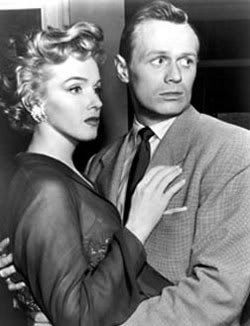
Bancroft isn't really the star; that honor falls to Marilyn Monroe. She plays a baby sitter for a New York hotel who, as we'll eventually see, has a dark past. The male lead is Richard Widmark, who plays an airline pilot who stays in this particular hotel whenever he's in New York. He's got some problems in his life, in that he's carrying on a relationship with Bancroft, who plays the hotel lounge act, but the relationship is quickly going south. So, Widmark looks out his hotel window, sees the lovely Monroe in the room on the other side of the courtyard, and calls her room. He probably shouldn't have.

Poor Richard Widmark soon discovers that Monroe has a screw loose. She only came to the big city to get away from the small town where she grew up: she had married a pilot who fought in World War II, and was killed in action; this caused her to suffer a nervous breakdown and slit her wrists. Her parents put her in an asylum, but after she was released, she went to New York because her uncle lives there; he (played by Elisha Cook) got Monroe the baby-sitting job. However, she's still mentally fragile, and loses it, eventually taking the kid she's supposed to be watching hostage.

Don't Bother to Knock is very atypical work for Marilyn Monroe. She's pretty good at it, although not quite great. It was still early in her career when she made this movie, and if she had decided to try her hand at more serious dramas, she probably could have improved a good deal as a dramatic actress; I think she's even better in Niagara. Part of the problem, though, is that this isn't an easy role to play, and it's quite easy to veer into the maudlin or the parodic when trying to play mentally unstable characters. Widmark is fine, although the script doesn't call for anybody other than Monroe to do too much. Bancroft's role is small enough that there's nothing to be critical about.

The "spot the character actor" game is as fun as always. Jim Backus plays the father of the girl being baby-sat, while the aforementioned Elisha Cook is not only Monroe's uncle, but an elevator operator at the hotel. (An interesting bit of trivia is that he had also played an elevator operator 11 years earlier in Love Crazy.)

Don't Bother to Knock is available on DVD, and is well worth a viewing. Even if it's not a truly great movie, it's interesting to see three talented actors early in their careers.

Monday, June 2, 2008

TCM's Sydney Pollack tribute

I've been remiss in posting the details of TCM's tribute to the late Oscar-winning director Sydney Pollack. That tribute is airing tonight, and features four of Pollack's movies:
The Slender Thread at 8:00 PM ET;
Three Days of the Condor at 10:00 PM;
Tootsie at midnight; and
Jeremiah Johnson at 2:00 AM.

I commented on Tootsie when Pollack died, so today I'll recommend The Slender Thread instead. Sidney Poitier stars as a psychology student who, as part of his coursework, is manning a crisis hotline. One day, he gets a call from Anne Bancroft, who tells him that not only is she suicidal, she's actually taken the pills necessary to kill herself. It's now a race against time: Poitier has to keep her on the line in order that the phone company can trace the call, but there's another good reason for keeping her on the line, namely, that keeping her talking makes it slightly less likely that the sleeping pill overdose will knock her out and hasten her death. I can imagine this would be a difficult enough situation for an experienced psychologist, and for a student like Poitier's character, it must be extremely nerve-wracking. Of course, Hollywood has a relative amateur put into the situation, as it's a natural part of the formula for creating more tension and suspense. Indeed, the formula had been used before by Hollywood, in movies such as Fourteen Hours, where Paul Douglas plays the part of the inexperienced man trying to prevent a suicide to Richard Basehart's man threatening to jump off a building ledge.

Despite the fact that it may seem formulaic, The Slender Thread delivers an effective dose of tension and suspense. Pollack got excellent performances from the two leading stars, and the rest of the cast is filled with names that should be familiar from watching TV: Telly Savalas plays the professional psychologist who set up the hotline; Ed Asner is a police detective; Steven Hill, who spent many years on one of the "Law and Order" shows, plays Bancroft's husband; and Dabney Coleman has a small role, too. For those living in Seattle, watch for the vintage location shots.

Unfortunately, The Slender Thread does not seem to be available on DVD, so you'll have to catch it tonight.

Friday, March 7, 2008

Aldo Ray, redux

I briefly mentioned Aldo Ray when TCM aired Pat and Mike several weeks back. Aldo Ray returns to get a starring role, in Nightfall, airing March 8 at 8:30 AM ET on TCM. In this movie, Ray stars as a man with a bit of a past: while he was hunting with a friend (played by Frank Albertson), a pair of bank robbers showed up with $350,000, but due to a snafu, Albertson gets killed, and Ray runs off with the money bag, dropping it in the snow by Ray with the robbers hot on his heels. Now, he's in Los Angeles, and the robbers want to know where their money is. The $350,000, of course, would be
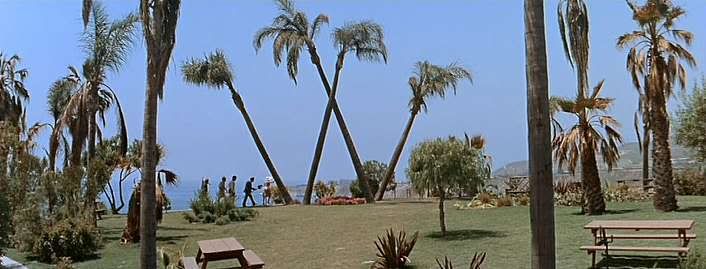
Under the Big W
buried under the big "W". Er, not that big W; instead, the money bag is somewhere in the snow in Wyoming, not far from where Ray and Albertson were hunting. But the only thing is, thanks to all that snow, the roads are impassable, so Ray is playing a waiting game, waiting for the snow to melt while simultaneously trying to avoid the bank robbers. Oh, and there's a detective on his trail, too....

While escaping from the robbers, Ray hides in the apartment of Anne Bancroft, here playing a lovely young model. What this unfortunately means for her is that she's in danger too, eventually being forced to join Ray on the run.

Nightfall is, at 79 minutes, a fairly short movie, and one less action than you might think: although Ray is on the run, the scenes with Bancroft are surpringly quiet; especially one scene where she's on the job modeling clothes and discovers that the robbers have spotted her, forcing her to make an escape in a designer gown. Eventually, we do get some excitment once everybody gets to Wyoming at the beginning of spring, but even here the action is understated. And yet, that works for this movie. Directed by Jacques Tourneur, who might be best knwon for the horror classics he made for Val Lewton such as Cat People, Nightfall is a little gem that deserves more exposure than the cast of relatively less prestigious stars (not counting Bancroft) would imply.

Sadly, Nightfall is not available on DVD.