Left-aligned photo 
Technically, Roland Garros is played on terre battue, or crushed brick, which is what gives it that distinctive red color. But everybody in the English-speaking world calls it clay, so we'll stick with that. The most natural place to look for clay in the movies would be pottery, and perhaps the best-known instance of pottery in the movies is the scene in Ghost where the ghost of Patrick Swayze helps Demi Moore on a potter's wheel. It's a scene so famous that it's been parodied a host of times, probably most notably in Naked Gun 2-1/2, with Leslie Nielsen helping out Priscilla Presley on the potter's wheel, followed by a bunch of stock film scenes depicting various Freudian sexual images that are even more blatant than the kiss in Alfred Hitchcock's Spellbound.
The other use of clay in the movies would be claymation, a form of stop-motion animation. A good recent example of this would be the Wallace and Gromit movies.
Sunday, June 7, 2009
One of my other passions


Essentials, Jr. Returns
TCM's summer series Essentials Jr., looking at movies the whole family can enjoy, returns for the summer this Sunday evening at 8:00 PM ET. They've got some interesting selections that push the envelope for how I'd want to introduce the topic classic movies to kids, but the first movie is more than appropriate: Jimmy Cagney's Oscar-winning performance as George M. Cohan in the musical Yankee Doodle Dandy.
Saturday, June 6, 2009
Diabolique
About three months ago, I made brief mention of the French movie Les Diaboliques, and its climactic scene set in a bathtub. IFC is once again airing Les Diaboliques in its Sunday morning foreign-film slot, at 8:00 AM ET tomorrow.
Friday, June 5, 2009
Another reason to mention The Children's Hour
Yesterday, I made brief mention of Audrey Hepburn's elegant teacher role in The Children's Hour. The movie gets another mention, and not just because it will be airing as part of TCM's salute to director William Wyler. That airing will be at midnight ET between June 6 and June 7 (or late Saturday evening in other time zones). However, The Children's Hour was based on a Lillian Hellman play of the same name; and that play had already been made into a movie once before, with the title These Three. That movie was also directed by Wyler, and is airing tomorrow morning at 7:45 AM ET.
The play and the later movie both dealt with a child's allegation that her two teachers were having a lesbian relationship. As These Three was made in the mid-1930s, however, there was no way that they were going to get a topic such as lesbianism past the Production Code office. Instead, the topic of gossip is that one of the teachers was involved in an adulterous relationship. Interestingly enough, this isn't necessarily a bad thing for the movie. Back in the 1930s, homosexuality would have been an even more shocking topic than it was in the early 1960s, and using such strong shock value takes away from the theme that malicious gossip can be highly damaging. (By the same token, Alfred Hitchcock's Rope works better with the idea that the two male leads are having a homosexual relationship being understated.)
These Three has not been released to DVD, so you're going to have to watch the TCM showing.
Thursday, June 4, 2009
Trevor Howard
TCM's look at directors is spotlighting Carol Reed on June 5, and you can see the British actor Trevor Howard in two of Reed's movies tomorrow: the romantic drama The Key, at 6:00 AM ET, in which Howard plays one of two World War II convoy captains vying for the affections of Sophia Loren; and The Third Man, at 6:00 PM ET, in which Howard plays a British Army officer. Another Howard movie I'd like to recommend, even though it's not airing soon, is Father Goose.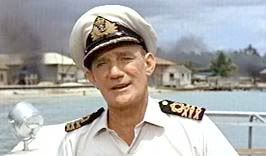
Grant begins to look out for Japanese planes and ships, but soon gets more than he bargained for. Not in the form of the Japanese -- they're saved for the climax of the movie -- but the lovely Leslie Caron, who's been stranded herself by a Japanese attack. Worse, she's a teacher, and has seven of her young female students in tow! She's also very proper, and proceeds to hide all of Grant's liquor, in order that he'll actually do the job he was sent to the island to do.
Of course, this is where the plot gets predictable: you know that Grant and Caron are going to fall in love, that the Japanese are going to come back, and that the two adults and all the children are going to have to try to make a daring escape. Still, it's not a bad little comedy. This was made in 1964, near the end of Grant's career. By this time, he had become stereotyped as a distinguished older gentleman, and wanted to do a movie that would have him be a bit less of a gentleman. Leslie Caron is a bit too elegant to be a teacher, but that wouldn't be a first for a Hollywood movie; Audrey Hepburn was impossibly elegant in The Children's Hour. The children can be obnoxious at times, but really are necessary to the plot. All in all, it's a pleasant enough movie that's well worth watching and avoids the bad language that plagues movies of today. It's also available on DVD.
David Carradine, 1936-2009
David Carradine has been found dead in his hotel room in Bangkok, Thailand, according to published news reports. He was 72. He was probably more famous on TV than on movies, having starred in the early 1970s TV series Kung Fu and doing a lot of guest roles in episodes of various TV series. Amongst his movie roles, he might be best remembered for playing Woody Guthrie in the 1976 movie Bound For Glory.
His other claim to fame would be being part of an acting family that includes, among others, half-brother Keith, who appeared in movies like Robert Altman's Nashville, and father John, a veteran character actor whose lengthy list of credites includes The Grapes of Wrath and, amongst movies I've commented upon, Of Human Hearts.
Wednesday, June 3, 2009
The Magnificent Dope

Tuesday, June 2, 2009
It Happened Tonight
One of the great comedies of all time, It Happened One Night, is airing at 8:00 PM ET tonight on TCM as part of TCM's salute to director Frank Capra. The story is well-known; Claudette Colbert plays an heiress who wants to marry somebody of whom her father (Walter Connolly) doesn't approve. So, she jumps off their yacht anchored off Palm Beach, and tries to make her way back to New York City. Meanwhile, Clark Gable is a journalist in despearate need of a story, and here's one that's about to fall right in his lap! So, while she's trying to make her way back to New York on a bus, he "protects" her to try to get his exclusive scoop. Along the way, you know he's going to fall in love with her, despite the fact that she's one of the most spoiled and naïve things you'll ever see.
What makes It Happened One Night so good? That's a bit of a paradox. In many ways, the movie is fresh and timeless, despite having been made 75 years ago and being filled with 1930s references (motels being referred to as auto-camps; the autogyro, the Depression, and others). Even today, though, we still have elopements, and the gossip of the idle rich (or nowadays, Hollywood celebrities and American Idol contestants) filling newspapers and entire TV channels. The movie strains credulity -- you'd think Colbert could just call her fiancé collect and have him pick her up in, say, Jacksonville when she gets stranded there. And yet, the movie doesn't seem at all like the escapist stuff we have today.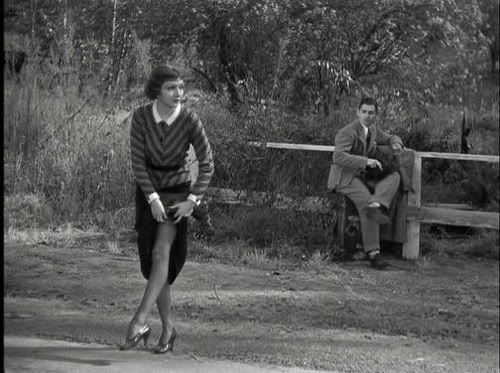
It helps that the cast is wonderful. It's not just Gable and Colbert who are great together; Walter Connolly is good as the poor put-upon father (a role he would later reprise in Libeled Lady), while character actor Roscoe Karns plays an obnoxiously unctuous bus passenger who harasses Colbert until Gable comes to her defense. The premise is so good that Columbia Pictures remade it twice; once in the 1940s as Eve Knew Her Apples starring Ann Miller, and again a decade later as You Can't Run Away From It with June Allyson and Jack Lemmon. The original is the best, though.
Monday, June 1, 2009
What is marriage?
Last month I mentioned two of Fox's anthology movies. A third one is coming up tomorrow at 9:00 AM ET: We're Not Married!.
The movie starts with Fred Allen and Ginger Rogers stopping at a justice of the peace on Christmas Eve. The need to get married for the sake of their careers as the "husband and wife" hosts of a radio show, and they're fortunate to find a justice of the peace who can marry them. He has a bit of difficulty, though in that it's his first day on the job, but he has no qualms about marrying the young couple in love.
Fast forward two and a half years. The "happily married couple" are constantly bickering, but have to stay married if they want to keep their lucrative radio show going. Events reach a head with an interesting dilemma for them: it turns out that the justice of the peace who had married them wasn't officially a JP at the time he performed their marriage; although he got the letter informing him of his commission, that commission wasn't vaild until the new year. Worse, in between Christmas and New Year's, the not-yet-JP performed four other marriages as well, all of which are technically invalid. Oh well; just send each of the couples a letter informing them of the clerical error, and we'll even refund you your money.
Naturally, though, the news is problematic for each of the four other couples, just as it is for Allen and Rogers. First up are David Wayne and Marilyn Monroe. She's busy winning the Mrs. Mississippi beauty pageant, leaving him to be a househusband. Worse, her manager (James Gleason) wants to take her around the country to market her. Next up is Paul Douglas and Eve Arden as a couple in a bit of a rut, followed by Louis Calhern and Zsa Zsa Gabor, who are on the verge of divorce, with Gabor planning to take Calhern for all he's worth. Finally, Eddie Bracken plays a Navy man about to leave for sea whose wife (Mitzi Gaynor) is pregnant, and he's worried that the kid is going to be a bastard kid if their marriage isn't valid.
As with all episodic movies, if you don't like one story, wait a few minutes, and another one will come up. In this case, though, the stories are all pretty good. The first one, with Allen and Rogers, is probably the weakest, but even that one isn't too bad. Monroe is fun to watch as always, as are Paul Douglas and James Gleason, two character actors who never quite got as much leading male attention they both deserved. (Douglas did get a few starring roles at Fox, but mostly in B movies.) Eddie Bracken might be the best of them all, as his story is tailor made for the type of lovably insecure comedy he did in several of his other movies, most notably The Miracle of Morgan's Creek.
We're Not Married is available on DVD, too.
More Andy Devine
I've commented in the past that I enjoy the work of Andy Devine. If you want to catch him in one of his smaller roles, TCM are showing the 1939 version of Stagecoach tonight at 10:00 PM ET.


