Showing posts with label Ginger Rogers. Show all posts

Tuesday, June 24, 2025

Another ensemble hotel picture

Some months back I did a post on the movie Hotel Berlin, which is based on a story by Vicki Baum but is not the remake of Grand Hotel. As I mentioned at the time, the remake is Week-End at the Waldorf, and with that having been on my DVR, I eventually watched it in order to be able to do a review of it here.

It's mildly unfair to refer to Week-End at the Waldorf as a remake of Grand Hotel, since it's not so much a remake as a reworking, with the story lines all getting substantial reworkings. The setting is moved from Weimar Berlin to New York's Waldorf-Astoria in the latter days of World War II as well. Walter Pidgeon is the nominal male lead here, and his character doesn't really exist in Grand Hotel. Pidgeon plays Chip Collyer, a war correspondent who's returned stateside for some rest and wants exactly that. His editor, however, wants Chip to get the goods on shady businessman Edley (Edward Arnold), who is trying to secure the oil rights from the Bey of Stock Arab Country (George Zucco), possibly by trying to involve non-shady businessman Jessup (Samuel S. Hinds) who has an apartment at the Waldorf. Except that Jessup doesn't use the apartment on a full-time basis, so he's decided to let a war hero and his newlywed wife use it since with the war on hotels are fully booked up with people moving in and out of the city.

Another connection to World War II is wounded soldier Capt. James Hollis (Van Johnson) who wants to go back to his old home town and start a business there. He's also written a song which, though a mix-up, winds up in the hands of Xavier Cugat. James meets the hotel stenographer Bunny (Lana Turner, since Joan Crawford was now much too old for the role and besides had already decamped to Warner Bros.) and the two fall in love, although Bunny wants financial security and thinks she sees that in Edley who keeps calling her up to his suite on actual work matters. He's also got the financial security -- or so she thinks -- to get her to do his bidding.

One of the main story lines from Grand Hotel is that of the world-weary actress, played in the original by Greta Garbo which is why the role is so big. Here, that actress is played by Ginger Rogers, a woman named Irene Malvern who is in town for the opening of her new film before heading back to Hollywood. Chip shows up in her suite thanks to a botched attempt to get the story on Edley. Instead, Irene thinks Chip might be the jewel-thief who is rumored to be in the hotel and rumored to want Irene's jewels. Chip uses this as an excuse to get involved romantically with Irene, as she has to use him to help out somebody else as well as explain how he wound up in her room.

There's more to the cast of characters, notably a young Keenan Wynn as the reporter Chip's editor sends in Chip's place to get the story on Edley when Chip claims to need that rest, along with story lines coming together and drifting apart until the final reel when the good guys get the requisite happy ending and the bad guys get their comeuppance.

Week-End at the Waldorf runs 15-20 minutes longer than Grand Hotel, and frankly, it shows in the final product. It consistenly feels long, in the sense that nobody was able to find the spark that made Grand Hotel one of the classic all-star movies of the early 1930s. Walter Pidgeon is, I think, not quite right as that war correspondent, while Ginger Rogers doesn't really give off the sense of wanting to be left alone.

Having finally watched Week-End at the Waldorf, I think it's with good reason that it's not as well-remembered as Grand Hotel.

Tuesday, May 13, 2025

Romance, not melodrama

Ginger Rogers started her screen pairing with Fred Astaire back in 1933 with a supporting performance in Flying Down to Rio. But sometimes it feels like RKO didn't know what to do with Rogers when they had to put her in a movie without Astaire. A good example of this is the 1935 film Romance in Manhattan.

We don't see Rogers first; that honor goes to her co-star, Francis Lederer. Lederer plays Karel Novak, a Czech who at the start of the movie is at Ellis Island on his way into the country. He's followed all the rules for becoming an immigrant, or at least he thinks he has. Apparently at some point after he booked passage to America, the law changed from requiring an immigrant to have $50 with him to having $200. Since Karel only has about $60, he's not legal so it's straight back on the boat for him. Come back when you've got $200.

So Karel does what anybody would do in that situation, which is to squeeze through a porthole and literally jump ship, swimming back to a harbor where he's more or less fished out of the water because he's about to drown. In another shame for Karel, he loses his wallet which has his money and ID, so now he's in Manhattan without any money, not even the $60 or so he had had.

While roaming Manhattan, he passes a stage door where, just outside, a young chorus girl is having lunch. The show has apparently put on sandwiches, donuts, and the like, so this young lady gives Karel some food figuring he's one of the army of the unemployed since there's still a depression on. This young woman is of course the Ginger Rogers character, named Sylvia Dennis. Even better for Karel is that Sylvia says she's got a brother who might be able to help Karel get a job.

If this were a Warner Bros. movie or a woman not played by Ginger Rogers, you might think that Karel is going to be sucked into a life of crime, but her offer is more or less legitimate, or at least well-intentioned. Said brother is actually her kid brother Frank (Jimmy Butler), who makes extra money as a paperboy, the two living together since their parents are dead; Frank might be able to get Karel a job selling newspapers. However, Frank is continally skipping school to earn that extra money, and now the social worker types want to put Frank in an orphanage.

Karel is willing to do any work, and does, although things keep conspiring to make life more difficult for him. Along the way, Karel and Sylvia fall in love, which means that the rest of the story is basically the journey to the requisite happy ending.

I don't know exactly what immigration law was like back in the 1930s, but there's no doubt about the fact that Karel has violated federal laws. Not that the movie is trying to make any of the sort of commentary that a movie in 2025 would be making about immigration, of course. But that's one of what felt to me like a plot hole. Never mind Karel being incredibly naive, or the owner of the building where Sylvia lives never noticing that she put Karel up on the roof to sleep since you couldn't have an unmarried couple shacking up together. The movie also feels like it didn't know how to write a gritty character for Rogers.

Then again, I don't think that Romance in Manhattan would have been conceived of by the studio as anything other than a programmer at most. Looking back 90 years at it, I'd say that it's interesting as a time capsule, but nothing particularly noteworthy otherwise.

Friday, June 9, 2023

Once Upon a Honeymoon

When the US entered World War II in December 1941, Hollywood joined the war effort, and there were a lot of films from 1942 that give the feeling of either being rushed into production or as though events of the day overtook the events of the film. One such movie that made a bit more sense to me as I was thinking about people in Hollywood wanting to do their part for the war effort is Once Upon a Honeymoon.

The story opens in Vienna in early 1938. As always, if you know your history this was the time when Austria "decided" (not that they had much choice) to merge with Nazi Germany in what is known as the Anschluß. The movie begins just before Austria voted itself out of existence, and surprisingly there are ex-pats who seem oblivious to what's going on. Namely, that's Kathie O'Hara (Ginger Rogers), a showgirl from Philadelphia who wound up in Vienna and fell in love with a German Baron, von Luber (Walter Slezak) and is planning to marry him in spite of the political situation.

Someone more clued in to the political situation is American correspondent Patrick O'Toole (Cary Grant), and his nominal job is to get an interview with O'Hara because of the wedding. Kathie is famously not giving any interviews, so O'Toole has to get up to all sorts of ruses. The baron, however, is wise to all of this. Meanwhile, the political merger is completed, and the baron is called off to business in Prague, capital of the then still independent Czechoslovakia. Kathie obviously goes with him, while O'Toole follows.

History tells us that the Czech part of Czechoslovakia was the next to fall, with the Sudetenland being annexed outright in the fall of 1938 and the rest of Bohemia and Moravia becoming a protectorate in early 1939 with Slovakia being a nominally independent puppet state. After all these events, von Luber goes off to... Poland! Baroness von Luber and O'Toole follow, with O'Toole finally having figured out that wherever the Baron goes, another country is bound to fall, and that the Baron is obviously a no-good Nazi. But can O'Toole get Kathie to become a good American and turn on the Baron?

Obviously, since the movie was released in 1942, you know that Kathie is going to wise up and do her part for her country, although with the number of countries that fall to the Nazis, she's also going to have to do quite a bit of moving around Europe with her husband. O'Toole, meanwhile, is trying to figure out how to expose the true nature of the shadowy Baron. Along the way, O'Toole and O'Hara get mistaken for Jews and sent to the Warsaw ghetto, and then get directly get clued in to American intelligence when they're in Paris.

I read quite a few negative reviews of Once Upon a Honeymoon, and it's easy enough to see why somebody would draw that conclusion about the movie. Much in the same way that the characters have to wing it in moving around Europe, so it feels tht the screenwriters were writing as events dictated, even though everything that happened in the movie would have been a good two years before the movie actually started filming (IMDb says filming started in June 1942, which is a good six months after Pearl Harbor).

It's also definitely not the best film any of the principals involved with the movie made, although I'd also say it's decidedly not the worst. It's just a bit of a mess because it feels like the morale boost is the thing here, above and beyond any story line, which is a bit of a shame, because there are movies out there which do a much better job of giving a great story first and then the morale boost (To Be or Not to Be comes to mind).

Monday, August 29, 2022

Lucky Partners

Jack Carson is the star getting 24 hours of his movies played tomorrow, August 30. I think that for all the movie on the TCM schedule tomorrow, I've either blogged about it or haven't seen it yet. However, within the last week or so I watched a Carson movie that seems to have gotten a Warner Archive release but is not part of the Carson lineup tomorrow: Lucky Partners.

Carson, unsurprisingly, plays a supporting role here. Since the movie was made at RKO, the real star here is Ginger Rogers, playing Jean Newton. Jean lives in Greenwich Village with her aunt Lucy (Spring Byington), working at Lucy's bookstore. But she's engaged to Freddie (that's Jack Carson if you couldn't tell), an insurance salesman. That relatively calm life is about to be upended, however. In the film's opening scene, Jean comes across a random stranger, David Grant (Ronald Colman), who wishes her good luck.

Jean decides to buy an Irish Sweepstakes ticket, on the proviso that David spring for half the cost and they split the proceeds should they win. David agrees, but with a proviso of his own, which is that the two go on a trip together should the ticket pay off, as David has some sort of social experiment he wants to undertake and apparently needs a woman for it.

Freddie isn't terribly pleased, and tries to sell the ticket out from under Jean and David when he learns it has a greater potential to pay off (no, I don't understand the workings of the Sweepstakes either), and decides he's going to sell Jean's half of the ticket for a cool $6,000, which was a fairly substantial sum at the time. David in theory still has his half of the ticket, but Jean, apparently thinking that the $6,000 is for the whole ticket, decides to offer half of that to David.

David then decides to do a scaled-down version of the experiment, buying a car in Jean's name and then taking her up to Niagara Falls, where they'll register as brother and sister in separate rooms. Jean agrees, with Freddie eventually following the two of them up to Niagara Falls. As you can probably guess since Colman is billed ahead of Carson, David falls in love with Jean, and the feeling winds up being mutual. But David has a past, and is transporting a painting that may not legally belong to him, winding up in a trial in one of those small-town courtrooms....

Lucky Partners is a movie that I wanted to like more than I did, since the cast is appealing and everybody is professional. But the script does none of them any favors, and the courtroom scene is a particular mess. Most trials don't have sparks, so Hollywood has to create them, with the result being usually less funny than they think. Jean's motives also make little sense, at least in the beginning of the movie.

Still, with a cast like this, Lucky Partners is the sort of movie you'll probably want to watch for yourself and come to your own opinions.

Monday, May 9, 2022

Smoke Gets In Your Eyes

Another movie sitting on my DVR was the 1935 Fred Astaire/Ginger Rogers musical Roberta, so I recently watched it to do a post on here. Interestingly enough, even though the pairing of Rogers and Astaire had become successful already, and they had starred together in The Gay Divorcee, they're not the stars here.

That honor goes to Irene Dunne, and to a lesser extent Randolph Scott, even though he gets biling below the other three. But the movie starts off with Fred, here playing a man named Huck Haines, leader of a band called the Wabash Indianans. They've made their way to Le Havre, the port that serves Paris, because they've been booked by the owners of one of the nightclubs. However, that owner (character actor Luis Alberni) that he was going to be getting Indians (as in feather and all the other stereotypes), not Indianians, so he cancels the contract on the spot.

Huck's friend John Kent (Randolph Scott) was going to go to Paris anyway to see his aunt Minnie, who goes by the pseudonym Robert (Helen Westley) because she runs a fashion house in Paris that apparently would be more successful under the Robert name than under the Minnie brand. Working for Roberta is Stephanie (Irene Dunne), who also does the designs and likely has an option to buy the business should Roberta retire. Unsurprisingly in a movie like this, John falls in love with Stephanie, even though he has an old flame Sophie (Claire Dodd) who is going to be coming over to Paris to join the fun.

I haven't mentioned Ginger Rogers yet. At one of the nightclubs John and Roberta are trying to get Huck and his band a gig at, one of the singers is the Russian émigrée Countess Schwarenka (Rogers). Except, Huck knows that's an act because he knows the alleged countess, real name Lizzie, from back in the States. The two wind up having a relationship a lot like the one that James Cagney and Joan Blondell had in their movies over at Warner Bros., and not one complicated by misunderstandings.

Those misunderstandings are for John and Stephanie. Sadly for all involved, Roberta suddenly drops dead; without a will, the fashion house goes to the nearest relative, which happens to be John. This even though he knows nothing about fashion design or this sort of business. Sophie, having heard about the inheritance, shows up, and it's up to Huck to make certain that John ends up with the right woman.

Among the interesting things here is that Fred and Ginger (and decidedly more so Ginger) are not the stars of the show, although they certainly get some dance numbers. And Randolph Scott gets the girl rather than playing the second banana in all those other romantic comedies.

And then there's the music. Roberta was based on a stage show with songs by Jerome Kern, including a tune that's gone on to become a standard, "Smoke Gets in Your Eyes". The bad news is that the script has Irene Dunne's character sing it, and her Jeanette MacDonald-like voice is, I think, entirely wrong for the song. That may, of course, be because like a lot of younger people, I would have heard the Platters' 1950s version on one of the oldies stations my parents would have listened to before seeing the movie. Other songs in the movie have also become standards, such as "Lovely to Look At".

Roberta, being stuck squarely in the 1930s, may not be for everybody, and certainly younger viewers are most likely not to appreciate something seemingly old-fashioned. But for anybody who likes the 1930s style of musical, Roberta should be right up your alley, and definitely worth a watch.

Saturday, September 26, 2020

In which person?

Another of the movies that I DVRed and happens to be available on DVD courtesy of the Warner Archive is In Person. So I recently sat down to watch it to do a review on it here.

George Brent plays Emory Muir, a man interested in things like bird photography. One day in a hotel elevator he runs into a mysterious woman wearing a veil. He follows her until she nearly gets run over by a taxi, resulting into fleeing to another hotel, but not before Emory gets to see the woman without her veil. It turns out she's an incredibly homely woman named Clara Colfax, with horn-rimmed glasses, buck teeth, and a bad hairdo among other things.

In the next scene, when she's escaped into that other hotel, we see a man referring to her as Carol Corliss, with her telling the man not to call her that. We then see Carol, who is of course also Clara, but minus the wig and other make-up job, and she's pretty darn good looking, which isn't a surprise considering that she's played by Ginger Rogers.

Emory has followed her up to the hotel suite, where he meets the other man, Dr. Sylvester (Samuel Hinds), along with one Judge Parks (Grant Mitchell), who is Carol's uncle. Carol apparently suffered from some sort of nervous reaction to one of her crowds of adoring fans, to the point that she's become afraid of going out in public, which explains the veil and disguise.

Dr. Sylvester has an idea. Not telling Emory the real identity of his patient, he suggests that Carol would do well by getting away from it all at a place up in the mountains, which Emory just so happens to have. Emory is just going to have to pretend to be some sort of therapist. But since he was intrigued by the woman in the veil, and he was planning on going up there anyway, he agrees.

Alone up in the cabin, Carol decides she can take off the disguise. Emory sees a newspaper clipping of Carol and realizes who she is, but for whatever reason, pretends not to know who she is and doesn't believe she's a Hollywood actress no matter what she does to try to prove it. Perhaps taking him to one of her movies in town will do the trick, when she can show by her adoring fans' reaction that they recognize her as Carol. It could cause other problems, however.

Meanwhile, Carol's acting partner Jay Holmes (Alan Mowbray) is in love with her, as well as wanting her to get back to work on her next movie. So he shows up at the cabin and causes a scene, although Emory is able to defuse it by claiming to be one of Carol's doctors. The local sheriff has seen Jay, however, and thinks that he's the man the sheriff's obnoxious young daughter is referring to when the daughter sees Carol's sorrow. We know who should end up together in the last reel, but it's going to take some time getting there.

In Person is a bit of a mess, in large part because it doesn't seem to know exactly what it wants to be. It shoehorns multiple plot lines together, not too successfully. It also varies between genres, with some it seeming to be a light drama, and others trying, but not doing particularly well, to be a comedy. Ginger also gets a couple of song and dance numbers. The one in the first movie-within-a-movie is particularly bad, as though the songwriters had been given the task of coming up with a bad song for an actress character to be saddled with in a movie.

Ginger Rogers tries her best with the material she's given, but ultimately I think that even she can't save it. In Person is the sort of movie that should have wound up on one of those four-movie box sets that TCM used to put out with Warner Home Video, rather than (or in addition to) a standalone disc. At that price point, it might be worth a watch, but at the Warner Archive price point, I'd go for a bunch of other Rogers movies first.

Saturday, August 29, 2020

The part of Nora Charles is now being played by Ginger Rogers


I was looking for movies on my DVR that are available on DVD, and one of them is Star of Midnight, which is unsurpisingly available on DVD courtesy of the Warner Archive.

A brief introductory scene has Tim Winthrop (Leslie Fenton) talking with his girlfriend Alice Markham, with the agreement that they'll meet mid-evening. Cut to a shot of a clock showing a time much later when they were supposed to meet; a phone call to where Alice is supposed to be reveals that she's skipped town to head to New York.

Clay Dalzell (William Powell) is a lawyer in New York who has a young woman chasing him in the form of Donna Mantin (Ginger Rogers). Tim has reason to belive that Alice came to New York, and wants Clay to help find Alice. They do find her, playing the lead actress in a weird show called Midnight, where she's wearing a mask and performing under the name Mary Smith. When Tim calls her Alice, she leaves the stage and disappears, much to everybody's consternation. On leaving the theatre, Clay meets Jerry, an old flame who has been married several times and is now married to Roger (Ralph Morgan).

Meanwhile, Tommy Tennant is a newspaper gossip columnist who has been writing about Clay and Donna in ways that are quite unflattering to Clay. But he also has information on why Alice bolted from the show she was performing in, and he comes over to Clay's apartment to discuss it. However, before he can reveal what he knows, a mysterious hand holding a gun appears, firing the gun and shooting Tennant dead and grazing Clay before throwing the gun down near the two men.

Stupidly, Clay picks up the gun to chase the gunman, leaving his fingerprints all over it such that when the police come, Clay is going to be an obvious suspect. Clay realizes that he's going to have to do an investigation of his own to try to find both Alice and whoever it is that killed Tennant. (We of course already know that Clay is innocent.) Inspector Doremus (J. Farrell MacDonald) is on the case, and one suspect we haven't mentioned yet is shady lawyer Kinland (Paul Kelly).

William Powell investigates a murder, and he and his love interest drink a lot, so Star of Midnight brings up obvious resemblances to The Thin Man. This one was made at RKO as opposed to The Thin Man at MGM. so the whole production looks a little less polished than what we get over at MGM. The story itself is also a little more convoluted and doesn't work the way The Thin Man did, although to be fair the story is only part of the reason you watch a movie like this.

The other main reason is the chemistry between the two leads, and both of them shine here. Ginger Rogers holds her own as much as Myrna Loy did in the Thin Man movies. The movie is pretty much about the two of them even more than other "couples investigate a murder" movies are, as the rest of the characters are surprisingly unmemorable.

Star of Midnight is certainly worth a watch, although this is another of those movies that would be better served being on a four-film box set of the sort that Warner Home Video used to put out in conjunction with TCM.

Wednesday, January 15, 2020

The Barkleys of Broadway


Back in December, TCM ran a night of movies starring Oscar Levant (or at least co-starring since he wasn't usually the male lead). Among the movies I had not blogged about here before was The Barkleys of Broadway.

Levant plays Ezra Millar, a pianist (there's a stretch) and good friends to the Barkleys, Josh (Fred Astaire) and Dinah (Ginger Rogers). The Barkleys are a successful Broadway couple, doing light musical comedy together. Their latest show has just opened up, and it's a big success, with the couple getting a large amount of applause when the curtain comes down. When they do their curtain call, they flatter each other to the point that you wonder whether or not something is going on in the background.

Unsurprisingly, we soon learn that there is in fact something between the two. In one of the post-premiere parties, Dinah meets director Jacques Barredout (Jacques François), who is going to be doing a play based on the early life of renowned French actress. Barredout admires Dinah, and thinks that she'd be perfect for the lead role. But this is a drama, and Dinah has never done real drama before. Still, Barredout praises Dinah's interpretation in the one point of her current show with Josh where Josh had criticized it, so Dinah decides she's going to try drama.

Josh doesn't like this, thinking Dinah isn't a good fit for drama, and not wanting to lose her from his show. They eventually get in an argument about it, and Dinah decides she's going to leave Josh entirely to do the show, which frankly makes no sense, as they could easily have remained married.

Josh still loves Dinah, and he decides he's going to try to win Dinah back through an elaborate scheme that's going to have him imitate Barredout and giving her advice on how to handle certain scenes in the play. It's a scheme that you'd think would get caught out straight away, but somehow it doesn't. Ezra, for his part, also tries to bring the couple back together at a benefit, but it's too much emotionally for Dinah.

Of course, this being a Fred Astaire/Ginger Rogers movie (their final one together a decade after The Story of Vernon and Irene Castle), you know that after all the misunderstandings they're going to wind up together in the final reel, and that does indeed happen with Josh realizing Dinah has the chops for Dinah and Dinah realizing Josh actually had well-intentioned advice for her and is happy doing light comedy.

Even though Astaire and Rogers hadn't done a movie together for ten years, The Barkleys of Broadway follows the tried and true formula of their other comedies, although this one isn't nearly as madcap as the 30s movies. In addition to the dance numbers, with Levant in the cast we get a couple of longer piano scenes as well, notably Khachaturian's "Sabre Dances" and Tchaikovsky's Piano Concerto No. 1. Frankly, I found that these slowed the movie down a bit.

Still, I think anybody who likes the Rogers/Astaire movies from the 30s will enjoy The Barkleys of Broadway. It's available on DVD courtesy of the Warner Archive collection.

Saturday, May 26, 2018

Having Wonderful Time

Last night's DVR viewing was the vintage romantic comedy Having Wonderful Time. (Note that this is the correct title; not Having a Wonderful Time.) As an RKO release that ended up in the library of films Ted Turner bought, it's no surprise that this one is also available on DVD from the Warner Archive collection.

Ginger Rogers plays "Teddy" Shaw, a girl working in the typing pool in Manhattan but living wither her family in the Bronx. She's finally gotten two weeks of paid vacation that she's able to use, so she's going to be going up to Kamp Kare-Free, a resort in the Catskills, something that seems interesting because the Catskills even before World War II were part of the Borscht Belt and nobody here is Jewish. Teddy's coworkers hope she finds a good man up there, although she wants an educated man. (They give her a book of Schopenhauer essays.) Teddy's family think she should go back to the boyfriend Emil (Jack Carson in a very early role) who's been pursuing her and has his own business.

The vacation doesn't start off well for Teddy. She's picked up at the train station by Chick (Douglas Fairbanks Jr.), a "waiter" at the resort. They're only waiters during meal times; at other times they're expected to perform other duties catering to the guests such as picking them up at the train station or be dance partners. Chick is a lawyer who hasn't been able to get a good job as an attorney, so we can guess that he's right for Teddy. However, he dumps her luggage by accident, so we can see they're going to have a lot of bumps along the way before we assume they wind up together in the final reel.

At the resort, Teddy's "semi-private" bungalow is shared with some other women: there's Fay (Peggy Conklin); Miriam (Lucille Ball) who has met Buzzy (Lee Bowman) at the camp and started a relationship; Henrietta (Eve Arden). Everybody tries to set Teddy up with a man, but of course she's not certain what she wants while Chick continues to pursue her.

Having Wonderful Time would have been a good movie, but putting Rogers and Fairbanks in the leads makes it more of a programmer. As such, it's not bad by any means, but it's certainly formulaic and arrives at its climax rather abruptly. The movie is helped out by a rich cast of supporting actors. In addition to all those mentioned, there's Donald Meek as the manager of the resort, and Red Skelton as another "waiter" who proms a couple of comic relief skits. He's not quite at the level of acquired taste that he would become in later movies.

Having Wonderful Time is one of those movies that frankly would benefit from being part of one of those TCM four-film box sets. It would be easy enough for TCM to do one with Ginger Rogers movies that don't also have Fred Astaire.

Tuesday, November 4, 2014

Another chance at heaven

Back in May 2012, when Joel McCrea was TCM Star of the Month, I made a brief mention of the movie Chance at Heaven. It's airing again tomorrow afternoon at 12:45 PM on TCM as part of a birthday salute to McCrea. I still stand by what I wrote in that one paragraph, except for the bit about it not being on DVD: TCM's schedule now lists it as being available from the TCM Shop as part of the Warner Archive collection, and currently on sale. Still, I'd recommend watching the movie on TCM before buying the DVD.

Joel McCrea plays Blackie, who runs one of those old-style service stations that didn't just sell you gasoline, but could also fix your car back in the days when eveything wasn't computerized and you had to take your car to the dealer to get it looked at. Blackie is engaged to the girl next door, Marje (Ginger Rogers), and the two of them are sure to get married and live happily after. Well, of course you know that's not going to be true, because if it were, we wouldn't have a movie.

The service station is in the vicinity of Silver Beach, one of those little seaside towns where the rich people decamp to for the summer. This summer, that means Glory (Marian Nixon) and her family. Glory takes the car out and has problems with it, resulting in her winding up at Blackie's service station. She's immediately smitten with Blackie, becuase he's Joel McCrea. What woman wouldn't be smitten with young, handsome McCrea? The bigger problem is that Blackie feels the same way toward Glory. Although, again, to be fair, young Marian Nixon isn't bad looking, and with her big-city ways you can see why somebody like Blackie would be thrown for a loop before coming to his senses. The ohly thing is, he doesn't come to his senses. Even though Glory's parents don't like the idea of her having a relationship with a guy like Blackie, the two are in love. Marje knows she's licked, so she gives up Blackie and gives him her blessing to get married to Marje.

This is where the story gets weird. Glory doesn't know how to be a good housewife to Blackie, which shouldn't be surprising since she would have had a bunch of servants catering to her every need. What is bizarre is that Marje stays in the picture, helping teach Glory how to take care of Blackie. And she doesn't seem to be doing it with any intention of trying to take Blackie back! Eventually, Glory gets pregnant, because that's what married couples do. This life-changing event makes her decide that perhaps being married to a guy like Blackie isn't how she really wants to spend the rest of her life. So Glory up and goes home to mother!

The material in Chance at Heaven is really screwed up, especially towards the end. Everybody tries hard, but can't really save the movie. That having been said, the extent to which I found myself thinking what the hell these characters were doing makes Chance at Heaven worth a viewing. That, and the presence of Ginger Rogers and Joel McCrea.

Wednesday, December 4, 2013

TCM Star of the Month December 2013: Fred Astaire


Wednesday nights in December see a new Star of the Month on TCM: Fred Astaire. He made enough movies that the Astaire films contine into Thursday mornings; good news for those of you who like musicals. Astaire is probably best remembered for all those musicals made with Ginger Rogers. There are ten of them in fact; nine in the 1930s and The Barkleys of Broadway ten years later. Five of those movies kick off the salute to Astaire in tonight's prime time lineup. (The other five won't be airing until Christmas night.) Their first screen appearance together, in Flying Down to Rio, is on at 8:00 PM this evening.

As for my favorite of their movies, I think I'd have to pick The Story of Vernon and Irene Castle, which you can see overnight, or early tomorrow morning depending on your perspective, at 4:00 AM. What I like about it is that, being a biopic, it actually has a mature plot, where films like The Gay Divorcee (10:00 PM tonight) have fairly dopey plots that are little more than hooks for dance numbers. Granted, the dance numbers in Flying Down to Rio are spectacular, and it's got some nice pre-Code dialog, but it's still a standard-issue love story.

Tuesday, November 5, 2013

Primrose Path

While TCM is celebrating the centenary of Vivien Leigh today, it's also the birth anniversary of Joel McCrea, who was born on this day in 1905. TCM will be spending tomorrow morning and afternoon honoring McCrea, with movies including Primrose Path, tomorrow at 12:30 PM.

The star of the movie isn't McCrea, but Ginger Rogers, who plays Ellie May Adams. Ellie is the eldest daughter in a family that by the 80s would have been called dysfunctional. Dad Homer (Miles Mander) is at heart a good person, but he's an alcoholic who can't keep a job and depends on his wife to support him. That wife, Mamie (Marjorie Rambeau) has been making a living as a prostitute, something that's been going on in the family for over a generation, since Grandma (Queenie Vassar), who lives with them, was a prostitute herself -- and you get the feeling that she encoraged her daughter to become one.

Ellie wants a better life for herself, so one day when she's at the seashore digging for clama and meets a man, she takes her chance. That man, Ed Wallace (the aforementioned McCrea), works at a short-order diner on the beach. She falls in love with him, and seeing a way out of her family in the bad neighborhood, charmingly horns in on Ed's life in such a way that he eventually agrees to elope with her. Of course, Ellie hasn't told Ed about her family.

This is a problem for multiple reasons. First, as in a movie like The Mating Season, the spouse who has been kept in the dark is understandably rather displeased about not having been told the truth in the first place. You get the impression that if only Ellie had told Ed the truth, he might have loved her anyway, but lying to him is a big problem. Primrose Path, however, is not a comedy; not by a long shot. If you had any thoughts about it being a comedy, those will be disabused once Ellie introduces Ed to her family. It's here that Ed leaves Ellie. But her family hasn't reacted well, either. Mom and Grandma seem to think that they're going to lose their meal ticket for retirement if Ellie goes off with Ed and marries him. Just as Grandma had encouraged Mom to become a prostitute, now they're encouraging Ellie to follow in their footsteps.

It's here, though, that Primrose Path starts to develop some problems. The melodrama that gets piled on top of melodrama strains credulity, and the way the problems are resolved between Ellie and Ed don't seem realistic either, but forced to provide an ending that won't have the audience screaming at the movie screen. The writers probably also had to do quite a lot of contortions with the script to satisfy the Production Code: even though it's clear that prostitution runs in the family, that's never explicitly stated. That having been said, the cast members playing the folks in Ellie's family, as well as Rogers herself, are all excellent. The dysfunction in the Adams family is somewhat reminiscent of the family structure in A Patch of Blue, except that Ellie's supporting herself is more realistic. Both movies have an excellent portrayal of family dysfunction. McCrea is more than adequate, but he's not the center of attention here. Although the plot does have some problems, the movie as a whole more than overcomes those problems.

For whatever reason, Primrose Path doesn't receive quite the attention that many of Ginger Rogers' other films -- even the ones without Fred Astaire -- do. That's a shame, because it's really quite good, especially in those supporting performances. Primrose Path has at least received a DVD release from the Warner Archive Collection, so you can catch it any time you want.

Monday, September 23, 2013

I thought I had blogged about Twist of Fate before

The TCM schedule for Tuesday (September 24) brings a bunch of movies starring Ginger Rogers after she made all those great musicals with Fred Astaire. The day kicks off at 6:45 AM with Twist of Fate. For some reason, I thought I had blogged about it before, but apparently not. And it doesn't seem to be on DVD, either. I hope that some of you who haven't seen it before will be able to catch this post before the movie airs tomorrow morning.

Ginger Rogers plays "Johnnie" Victor, an actress who is now living on the French Riviera, and the mistress of wealthy businessman Louis Galt (Stanley Baker). The plan is that Louis is going to divorce his wife, so that he can marry Johnnie. Or, at least, that's what Louis has been telling Johnnie, although it's a pack of lies. Indeed, Louis' business is more than just the legitimate shipping business; he's the head of a criminal ring that's counterfeiting gold coins! Johnnie, of course, doesn't know any of this.

At the casino, Johnnie meets Emil (Herbert Lom). Johnnie has a passing relationship with Emil, based on the fact that Emil's wife had done some acting with Johnnie, but the wife is now in a sanatarium, or at least that's what Emil is telling Johnnie. Emil needs some money to pay for his wife's expenses, or possibly for something else, as we're going to find out later.

Things get more complicated when Johnnie meets the fourth major character in our film, ceramic artist Pierre (Jacques Bergerac). She meets him in when she's facing a bit of a crisis: Johnnie eventually learns that perhaps Louis is not only going to be unable to get that divorce, but has never really intended to get that divorce at all. Johnnie goes off driving like, say, Lana Turner's character in The Bad and the Beautiful did after finding Kirk Douglas with Elaine Stewart, and gets in an accident on one of those twisty hillside roads on the French Riviera coast like the one where Grace Kelly lost her life. Pierre's house is the nearest one, and Johnnie meets him while looking for help. She winds up falling for him, so now she's got three men in her life.

Having three men in her life is bad enough, but what she doesn't know is that Emil is an underling in Louis' counterfeiting ring, and part of the reason Emil borrowed money from Johnnie is to pay off Louis. Oh, and that's not all. Emil needs more money, so he steals one of Johnnie's necklaces, having the brilliant idea that Louis can fence it and that will help to pay the debt. There's a catch that Emil didn't know about: Louis had given the necklace to Johnnie. Emil, in fact, doesn't know that Louis is her boyfriend, and now Louis thinks Johnnie is cheating on him with Emil, when in fact she's cheating on him with Pierre.

Twist of Fate isn't a bad movie, although it's not particularly great either. Ginger Rogers made it for one of the British studios at a time in her career when she was getting to the point where women of her age couldn't get good roles like this in Hollywood. The British studios didn't quite have the budget that Hollywood did, and would bank on a big Hollywood star like Rogers to try to pump up interest for the film in the US. Still, the British knew how to make movies competently on a lower budget, and as I've suggested a lot in the past, having a good story is at least as important as having a big budget. If there's any problem with the story, it's that you have to expect it's going to have an ending that will satisfy the Hollywood Production Code. Still, Twist of Fate does a good job getting to that ending and on balance this post should be taken as a positive review of a nice little movie..

As I said at the beginning, Twist of Fate has, as far as I know, not received a DVD release, at least not in the States, and Amazon doesn't seem to list any imports either. That's a shame, because it's really a pretty good flick.

Monday, July 22, 2013

The Story of Vernon and Irene Castle

The last of the interviewees in this week's lineup of Carson on TCM is Fred Astaire, in an interview from 1973. TCM will then be spending the rest of the evening with films that Astaire made in the 1930s with Ginger Rogers, the two being such a famous screen team. The night ends with what was their last movie for ten years, The Story of Vernon and Irene Castle, at 5:00 AM Tuesday.

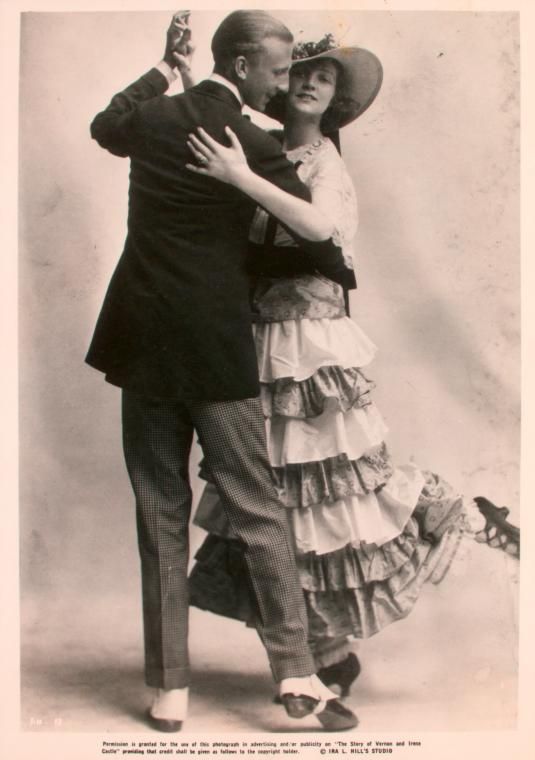
The movie is a biopic about the Castles, with Astaire playing Vernon and Rogers playing Irene. (The real-life Castles, not Astaire and Rogers, are pictured at left.) Vernon was a British-born comic who by 1910 was working as a second-rate vaudeville comic doing the tourig thing. His travels take him not to the big cities, but to smaller places like New Rochelle, NY, which is where he meets Irene, the daughter of a middle-class doctor. Things click between them, and eventually Vernon winds up back at Irene and her familiy's house, which is where she shows off her talent, which is a raw, untrained dance number. Vernon sees that Irene's got talent, and since the two love each other, they wind up getting married and trying to make it in the clubs as a couple doing their dance routine.

This eventually takes them to Paris, where they believe they've got a gig lined up at one of the famous nightclubs, although they're wrong; the manager wanted to see Vernon's comedy number. However, English agent Maggie Sutton (Edna Mae Oliver) is able to get them a chance at another of the nightclubs. This chance proves successful, as their dance, the Castle Walk, takes Paris by storm, with the Castles in demand everywhere, and women wanting to look just like Irene. (In real life, Irene Castle was a famous brunette and had her hair famously short; in the movie, Ginger Rogers keeps her blonde hair and keeps it long, which is one of the big departures from real life.) The two continue their fame and career together until 1914, which, if you know your history, you'll know is when World War I began.

I mentioned at the beginning that Vernon was British-born, so once World War I came he decided to support the British war effort, doing so by becoming a distinguished pilot. If William Wellman had directed a movie like this, he could have told you that World War I air action was dangerous, but amazingly Vernon Castle survived all of the dogfights, even winning a Croix de Guerre along the way. He was sent back to North America to become a flight instructor for the Americans, who had recently entered the war. Ironically, being out of the theater of action ended up being less safe, as Vernon was killed in a training accident. (I don't think I'm giving too much away, since this is a biopic.)

I'm generally not a big fan of musicals. The Story of Vernon and Irene Castle is different, though, because it's not so much a musical as it is a biopic about people who danced. As such, the dance numbers fit well into a realistic plot; one of the problems with other Astaire/Rogers movies is that the plots seem contrived at best, serving as a hook upon which to hang the dance numbers. Astaire and Rogers are both quite good; Oliver is enjoyable; and Lew Fields, who in real life was the star of the vaudeville review that led to Vernon's meeting Irene. Walter Brennan plays the Castles' servant, which is another departure from real life, as the Castles has a black servant. Irene Castle was a technical advisor for the film, and apparently didn't like some of the difference Hollywood made, such as the casting of Brennan or Rogers' keeping her natural hair. But for those of us today who don't know every little detail about the Castles, this isn't such a big deal. The main facts all seem to be more or less correct, and the ending scene is inentive.

TCM lists The Story of Vernon and Irene Castle as being part of an Astaire/Rogers DVD box set. I'm not certain if it's available individually.

Friday, April 26, 2013

Kitty Foyle

Tonight is the last night of Cher presenting the Friday Night Spotlight with Robert Osborne, presenting the defining Hollywood era of women on film. Three of Cher's four selections for tonight are on DVD, with the one not currently available being Kitty Foyle, at 10:00 PM.

The movie opens with Kitty Foyle (played by Ginger Rogers) living in New York where she's a bigwing in a fashion house, who has Mark, a doctor with a conscience (James Craig) for a boyfriend. She spends part of her evening on rounds with him, at the end of which he asks for her hand in marriage. Mark drops Kitty off at her place presumably to pack for their honeymoon -- Dr. Mark even has an all-night justice of the peace lined up to perform the ceremony. While Kitty is getting married, there's a knock on the door, and in walks Wyn Strafford (Dennis Morgan). This is a problem for poor Kitty, because she was in love with him at one time. And now he's back, to ask her to run away with him. What's a woman to do...?

At this point, we get a flashback, surprise surprise. Flash back a decade or so to Philadelphia, where Kitty is a working-girl who lives with her father (Ernest Cossart), who is that perfect Irish stereotype of the lovable drunk who's always a few dollars short, but dammit if you can't help but love the charming rascal anyway. Kitty understandably wants better, to be financially stable, so she dreams about being one of the beautiful people she reads about in the high society pages. Pop, warns her against this because the rich are just evil snots who won't respect her and she should just stay in her class. (The screenplay was written by Dalton Trumbo, so you have to understand there's going to be some unsubtle politicizing here.) And then into her life walks Wyn. He's one of those wealhty people from the "Main Line", Philadelphia's equivalent of the 400. Wyn loves Kitty, and she loves him, but this is a big bit of rebelliousness from Wyn, but he doesn't have the courage to go all the way and tell his parents to respect her no matter what.

This, combined with Pop's death, causes Kitty to leave Philadelphia and go to New York to get away from it all and clear her head. It's here, working as a shop assistant, that she meets Dr. Mark, who isn't perfect himself, but is at least of the "right" social class. But Wyn eventually returns and he and Kitty get married just long enough for Wyn to knock up Kitty, while Wyn's family, all of whom are Trumbo tropes, try to turn Kitty into the "proper" woman that she isn't. So the marriage is annulled and Kitty returns to New York, which is where she finds out she's pregnant (so she obviously couldn't have been married too long), and that Wyn's relatives have arranged a marriage of convenience for him, even though he really still loves her. But Kitty starts taking up with Mark again, eventually leading to the fateful night that starts the movie....

Kitty Foyle is a movie that I have a lot of problems with, mostly because the characters all leave me cold. The choice of which suitor to go with is supposed to be a crisis for Kitty, but I found myself not particularly caring which one she married at the end. Compare this to a conflict like The Easiest Way, where there are clear pros and cons for each of the two suitors. It doesn't help having a screenwriter who makes the point so bluntly obvious for us as well. That, and the fact that Kitty Foyle is definitely in the "women's picture" genre. Still, Ginger Rogers give a good performance, and there are lots of women out there who would love "women's pictures".

I'm really surprised that Kitty Foyle has fallen out of print. Amazon suggests that the movie got a DVD release back in 2006. With Ginger Rogers as the star, giving an Oscar-winning performance, and with the rights now controlled by Warner Home Video, you'd think the movie would have gotten a release to the Warner Archive, or one of those four-film box sets that TCM hawks between movies. But apparently not.

Friday, April 27, 2012

Where's Katharine?

See!  There really was a DVD release!TCM is airing Stage Door tonight at 8:00 PM ET as part of a night of movies set in boarding houses. In this case, that's the Footlights Club, a New York City boarding house for aspiring stage actresses, with the movie having a wonderful cast, even if you don't like Hepburn that much. There's Ginger Rogers as the other female lead; she plays the "veteran" if you will of the boarding house. Hepburn plays the naïve new girl, fresh off the bus from somewhere in the Midwest or New England.

Lucille Ball plays one of the roomers, and a very young Ann Miller gets to dance a scene with Ginger Rogers. If you've been watching TCM, you'll probably have seen the "Word of Mouth" piece Miller did on wanting to do a dance number with Ginger. Oh, and I can also mention Gail Patrick and Eve Arden in supporting roles. As for the men, the one big male role is Adolphe Menjou as the theatrical producer; Menjou playing well as an elegant-looking man who has the same slimy intentions as Guy Kibbee would have had in 42nd Street.

The film is more of an ensemble movie with a slice-of-life theme than one with a real plot, but that doesn't mean it's not an entertaining film. That having been said, what I'm really wondering about is the DVD availability. TCM's website says it's not available for purchase from the TCM shop. IMDb links to Amazon, and says that there has been a DVD release. Well, two actually. One was back in 2005, so that would unsurprisingly be out of print. The second, however is a TCM Greatest Classic Legends Film Collection box set of four Hepburn films. It very much surprises me that TCM could put a film like this on a box set, and then apparently stop printing the box set. Not only that, but if they've remastered the movie for a DVD release, you'd think they could also make the movie available as a single film in the Warner Archive set. More pricey, but at least still available.

Then again, there's something fishy on the Amazon page. The big bold heading at the top of the page says 2006. To be honest, I don't remember when TCM first started making these four-film box sets that they've been advertising. But 2006 I think was some time before they started the Warner Archive, which might explain why a film like Stage Door might not have gotten a release to the Archive. On the other hand, if you scroll down, you'll see that they list a release date for the collection of March 13, 2012. This has to be an error, since one of the two reviews is dated two months earlier.

I'm not a huge fan of Katharine Hepburn, but the all-star case of Stage Door makes it a great candidate for another DVD release.

Wednesday, April 25, 2012

Storm Warning

During TCM's Star of the Month salute to Doris Day a few weeks back, one of the dramas they showed was Storm Warning. With Ronald Reagan being the male lead, the movie has received a DVD release as part of a Reagan box set. It's certainly worth a look.

Day isn't the star; that honor goes to Ginger Rogers. Rogers plays Marsha, a fashion model of the sort who worked with traveling salesmen, back in the days when representatives from clothing companies went to various department stories trying to sell the companies' clothes. She and her salesman companion (who is only seen briefly in the openoing scene) are travelling through the South by bus, with the bus scheduled to stop in a town where Marsha's sister Lucy (Doris Day) lives. Marsha hasn't seen Lucy in quite a long time, in fact, the two haven't met since Lucy got married to Hank (Steve Cochran). So Marsha wants to stop for a day and meet Lucy.

What Marsha finds is at first mysterious and then shocking. She's looking for a taxi at the bus station, but the taxi driver lies about being a taxi driver and refuses to take her, at which point the bus station closes early, and Marsha is forced to walk to the bowling alley/entertainment center where Lucy works. When Marsha gets to the town square, she finds a bunch of guys in white robes and hoods -- obviously the Klan -- killing a journalist who was writing an unflattering exposé of the Klan. Thankfully, the Klansmen didn't see Marsha: she saw two of their faces when they stupidly took off their hoods; she'd probably be in danger if they knew they had been witnessed by an outsider.

Indeed, it's only the outsiders the Klan have to fear. Ronald Reagan, who was mentioned at the beginning of the post, plays Burt Rainey, the prosecuting attorney. He doesn't like the Klan and what they've done to his town and state, but for the most part he's powerless to stop them. The Klan are either actively supported by people in town, or have intimidated the non-supporters into remaining silent. Marsha tells Lucy she saw the murder, which means that she's going to have to see Rainey, who is leading the inquest, and tell him what she knows. This becomes problematic when she finally meets Lucy's husband Hank. Hank, in fact, is one of the two Klansmen she saw without his hood! What's a sister-in-law to do?

Storm Warning is a pretty good, if slightly preachy movie. When watching a movie like this, it's easy enough to say smugly that we would stand up to the bad guys if we were in Marsha's place. But, as can be seen in a film based on real life like The Phenix City Story, we know the reality is that most people will just do the minimum they have to, if that. Rogers plays that dilemma fairly convincingly. Reagan really doesn't have that much to do here. He's supposed to be the good guy, and his real-life affability makes him a natural to play a role that calls for uprightness without much emotion. Doris Day is almost a spare tire here; she's almost forgettable next to Rogers. Cochran is the bad guy, and maybe he overplays it a bit, but he looks brutish but stupid here, and plays it enjoyably well. The cast rises above the social commentary, although they're also helped out a bit by an ending that's a bit astonishing.

Storm Warning isn't perfect by any means, but it's not a bad little film.

Saturday, October 1, 2011

Vivacious Lady

TCM is showing the movie Vivacious Lady this evening at 10:00 PM, and I don't believe that I have ever blogged about it before. Despite the fact that it has two fairly substantial stars in James Stewart and Ginger Rogers, it's one that's relatively little-seen. To be fair, Stewart wasn't quite yet the big star he was to become; Vivacious Lady was released in 1938 and it was movies like Mr. Smith Goes to Washington a year later that made him a much bigger star. But Rogers was already quite big.

But enough of that, and on to the plot. Stewart plays Peter Morgan, Jr., a professor at a college in some unnamed middle American city where his father (Charles Coburn) is the president. The good professor starts off the film in the big city on a trip with his cousin Keith (James Ellison), who is rather the playboy, and obviously not the family member of which the rest of the family would be proud. In fact, we first meet Keith in a nightclub, where he's enjoying the singer (Ginger Rogers) despite the fact that staying at the club is going to make him miss his train home. It's Peter Jr.'s job to fetch Keith and bring him home, but Peter himself gets waylaid... by that singer. That singer, of course, is Ginger Rogers, playing a character named Francey. When Peter sees Francey, it's love at first sight, and the two get a quickie marriage before taking the train home.

This, unsurprisingly, causes serious problems. First, Dad is bound not to approve of the marriage. Could you imagine a college professor getting married to a nightclub singer? (Sure, in a Hollywood movie.) The trustees are certain not to like the idea either. So at first Peter Jr. keeps the marriage a secret, putting Francey up in a women-only apartment house while he works up the courage to tell Dad the truth. Dad isn't the only person who needs to learn the uncomfortable truth: Peter Jr. was engaged to Helen (Frances Mercer) before going off to pick up his cousin. Mom (Beulah Bondi) would be more accepting, but unfortunately she, like her son, has been too cowed by Dad to stand up to him.

Now, Vivacious Lady is a comedy, so all of this is handled very lightly. And it's quite an enjoyable little comedy, too. It doesn't seem to be trying to anything too big; we just have a bunch of professional actors going about their jobs and doing a darn good job of it.

Saturday, July 30, 2011

William Powell, Detective

I hadn't heard of the movie Star of Midnight until I saw it on tomorrow morning's TCM schedule: 6:30 AM, to be precise. Powell plays -- surprise surprise -- a detective, and one who drinks and trades quips with a woman (Ginger Rogers). Sounds a lot like The Thin Man, which was released a year earlier and at another studio. But then, studios have never been original.

Not that The Thin Man marked Powell's debut as a screen detective. He had played Philo Vance in films like The Kennel Murder Case in the early 1930s. There are also other detective roles for Powell, such as The Ex-Mrs. Bradford, where his ex-wife (a mystery writer played by Jean Arthur) ropes him into playing detective with her.

Tuesday, May 3, 2011

[dolefully shakes head at Ginger Rogers]

Like Joan Crawford and Bette Davis, Ginger Rogers didn't always get the best movies to star in as she aged. A good example of this is the movie Teenage Rebel, which is airing tomorrow afternoon at 2:00 PM ET on the Fox Movie Channel

Fortunately, Rogers isn't in the title role of the "teenage rebel", as she was 45 and much too old for something like that. The rebel is Rogers' daughter, played by Betty Lou Keim (more on her later). Rogers plays Mrs. Fallon, living with her second husband (Michael Rennie) and her young son Larry, who is as mischievous as all boys in the 5-7 year old range. The Fallons receive a telegram that Mrs. Fallon's daughter Dorothy from a previous marriage will be coming for the three weeks of visitation that Mrs. Fallon was supposed to have. You see, Mrs. Fallon divorced and lost custody of her daughter because she was in the wrong, having fallen in love with Rennie and having an affair while still married to another man. And Dorothy's father was vindictive in the divorce, taking the daughter to Europe so that the visitation order couldn't be enforced. It turns out, though, that Dad has a reason for bringing his daughter back to the States. He's got a woman he wants to marry, and up to now, Dorothy has been successful in breaking up all of Dad's attempts at remarrying. So packing Dorothy up and sending her across the country to spend time with Mom gives Dad a chance to finalize his remarriage.

As you might have guessed from the comment about Dorothy breaking up her father's relationships, Dorothy has grown up to be a real teenage prize. She has no desire to be out in California with her mother, and is a snotty, stuck-up little bitch to everybody. (Pardon the language, but at the start she really is a piece of work.) It gets to the point where Mr. Fallon pays the neighbor's two kids (Warren Berlinger and Diane Jergens) to make nice to Dorothy. But Dorothy sees through them. At least, she sees through them at first. This is where the film starts to develop big problems. We should probably expect that she's going to warm up a bit over the course of the movie, but she does so almost on a dime. And then she turns back again, and again, going through a series of melodramatic mood swings. That, and a bunch of the tropes of teenage movies of the 1950s. There's even a scene that looks to be stolen from Ninotchka along the way. Teenage Rebel tries to take a serious look at the problems old farts thought teenagers of the mid-1950s were facing, but probably gets them wildly wrong. (I wasn't a teenager in the 1950s, but my teenage years were nothing like any Hollywood teen movie.) Still, the movie is good for some unintended laughs along the way.

As for the cast, Rogers does as well as she can. Rennie's wooden, and you have to wonder what Rogers ever saw in him. Their neighbor is played by Mildred Natwick, and it's nice to see character actors like that show up. Poor Louise Beavers gets to play the Fallons' maid, and is used as stereotypically as she'd been for the previous 20 years. And then there are the teens. Keim, Berlinger, and Jergens are billed as something like "Three Stars of the future", as though the suits at Fox were really trying to push them. Berlinger has a relatively lengthy career playing supporting roles in movies and TV, while Jergens retired relatively young. Keim stopped acting even younger, when she decided to get married -- to Berlinger. They were married in 1960 and married for almost 50 years until Keim's death in early 2010.

Still, you have to feel a bit bad for Rogers. She tries, and it's not her fault that Teenage Rebel isn't very good. It hasn't been released to DVD, either, so you're going to have to catch it on the Fox Movie Channel.