Showing posts with label Cary Grant. Show all posts

Monday, September 28, 2026

Devil and the Deep

Not too long ago I picked up a box set of early Cary Grant movies, made when he was at Paramount. Technically I think it's two box sets, one of comedies and one of dramas, repackaged. In any case, the set had several movies I haven't yet seen, and some I'm glad to have on DVD now, like Hot Saturday. I decided to watch one of Grant's earliest films off the colleciton, The Devil and the Deep.

This is so early in Grant's career that although he gets fourth billing, he's written out after 10 or 15 minutes. Grant plays Lt. Jaeckel, who serves on a submarine under Cmdr. Charles Sturm (Charles Laughton in his first Hollywood film getting an "introducing" credit) based out of a port somewhere in North Africa. As the movie opens, Jaeckel has a note from Sturm's wife Diana (Tallulah Bankhead); apparently they danced together at some function. But the note is dropped on the floor and Cmdr. Sturm picks it up, leading Sturm to suspect that perhaps Jaeckel is seeing his wife on the sly. Now that would be a no-no under military regulations, but worse is that Cmdr. Sturm is insanely jealous as Diana well knows.

Cmdr. Sturm uses his rank to get Jaeckel reassigned to a different sub, which is why Cary Grant is written out of the movie so early. (To be fair, Paramount wouldn't have known at the time that Grant was going to go on to become a big star.) More important in terms of the movie is that at home that night, Cmdr. Sturm pretty much threatens his wife, showing why she considers him insanely jealous. Diana runs out of the house for her own safety, although she doesn't realize that she's running into danger as there's some sort of street festival going on and a crowd of lusty Arab men is not the safest place for a western woman to be. Fortunately for her, there's a western guy there, Sempter (Gary Cooper). He pulls Diana aside into one of the shops in the bazaar and, to satisfy the merchant, buys Diana some cheap perfume, which is obviously going to be a bit of foreshadowing.

This is the first time the two have met, and they wind up going out into the desert to spend an evening together. This is naturally something that would make Cmdr. Sturm even more jealous if he were to find out about the relationship. As you might guess, Cmdr. Sturm is indeed going to find out, and the perfume is going to be part of why. The reason is that Sumpter is in fact Lt. Sumpter, and he's in town because he's the replacement for Lt. Jaeckel. In Sumpter's defense, he doesn't know when he first meets Diana that she is in fact Mrs. Sturm; that only comes the next day when Sumpter goes to give his transfer papers to Cmdr. Sturm. The transfer papers bear some traces of that perfume that Sumpter bought for Diana the night before.

The sub is set to head out on a training exercise that night, and Diana goes to the sub to warn Sumpter of just how insane her husband is. She's hoping to get on the sub, warn Sumpter, and get off before the sub sets out. But when Cmdr. Sturm gets to the port, he hears from the sentry on duty that his wife is on board. So as a sign of how insanely jealous he is, he orders the sub to set out early, before his wife can get off the sub. But that's only the half of it. Cmdr. Sturm is planning to engineer a murder-suicide in which he'll sink the sub, leading to the deaths of himself, his wife, and Sumpter. Now there's also an entire crew of innocents on board the sub.

Devil and the Deep is a really interesting little movie thanks in part to it having been released in the pre-Code era. There aren't as many strong pre-Code touches as in some other movies, but it was also a time when movies still were all over the place in terms of plotting. The idea of Cmdr. Sturm being crazy enough to sink his own sub is really out there, and Laughton's oversized acting works here. Bankhead's scenery-chewing also works, while Cooper has a poorly-written character, which is one of the issues the movie has. While Devil and the Deep is certainly interesting, it's also uneven. The positives do outweigh the negatives, but there are certainly reasons why the movie isn't all that well known despite the big cast.

Friday, June 19, 2026

The Amazing Quest of Ernest Bliss

One of those movies that fell into the public domain such that I firstl learned about it by seeing it show up as a DVD for purchase on sites specialising in public domain stuff is The Amazing Quest of Ernest Bliss. (It was released in the US under the title The Amazing Adventure.) Some time back I found that it had made its way to one of the FAST platforms, so I decided I'd finally give it a try.

Cary Grant plays Ernest Bliss, one of those men who seems to have inherited a bunch of money and who is able to live off that wealth as a result, not that he'd have known World War II would be coming along to destroy the wealth and way of life of people like him. In any case Bliss, despite having a wonderful apartment, finds that he's just not satisfied with life, something that's understandable considering he doesn't have any sense of purpose. After talking to his friend Lord Honiton, Bliss goes to see doctor to the wealthy Sir James Alroyd, who coes up with the wacky diagnosis that Ernest is suffering from affluence, which sounds like something a scammer would say to get wealthy people to part with their money.

Ernest, for his part, doesn't like Alroyd's suggestion, so tells him that he could make it on his own without that wealth. To that end, he makes a wager with Sir James, to the tune of £50,000. Bliss says he can survive for a year being staked to a measly £5, not using any of his wealth in any way that might benefit him personally. If he fails the bet, Alroyd's clinic will get the £50,000.

Ernest has no difficulty getting an attic room to let, but getting a good job that will allow him to pay the rent and survive is rather more difficult. Eventually, he gets work as a door-to-door salesman selling kitchen stoves, but the work is based on commission and Bliss doesn't seem able to make any sales. That is, until he comes up with a brilliant idea for a promotion, but one that's going to cost £500. He can use his own money for it, but that would cause him to lose the bet. Except that since the wager called for him not to use the money for his own benefit, he figures if he quits the job immediately after the promotion works, it can't be seen as using the money for his own benefit. Also working for the company, as the boss' secretary, is Frances Clayton (Mary Brian). She and Ernest become friends, and she too leaves the company because her boss is trying to pressure her into marrying him.

Bliss gets a job as a chauffeur for the 1930s British equivalent of a limousine service, and finds that one of the assignments he gets is actually to his own old apartment that he's left his valet in charge of. His valet rather stupidly decided to wager a bunch of money on dog racing, such that he's been blackmailed into letting the people who lent him the money live in Bliss' apartment. They've been thinking of forging Bliss' signature to get money out of his bank accounts, so when they see a chauffer who looks like Bliss they see a great chance for their scheme to work.

Bliss is able to foil this, but we're still not at the one year mark, and the requisite happy ending that a movie like this is bound to have. How we get there, you're going to have to watch for yourself.

The Amazing Quest of Ernest Bliss was originally released in Britain in 1936 with a running time of about 80 minutes. But when it was released in the US, it was edited down to about 62 minutes. It's that edit that TubiTV has, along with all of the public domain sites. (Supposedly the BFI has a 77-minute version.) The result of getting and edit but by almost a quarter is that it really does feel like something is missing from the movie.

In any case, Cary Grant does a professional job on a movie that would be more or less a programmer. It's not great by any stretch of the imagination, but it's also certainly not bad, and would have fit the bill of entertaining audiences of the day while keeping Cary Grant in the spotlight with another film.

Tuesday, October 1, 2024

The Grass is Greener

Back at the beginning of January when I posted about Robert Mitchum being TCM's Star of the Month for January, I mentioned that one of his movies I hadn't heard of before was The Grass Is Greener. Recently, I finally got around to watching it before it expired from the DVR, and now I can do a post on it.

The opening credits, designed by Maurice Binder, oddly show a bunch of infants, with four names getting roughly equal credit and only one name being listed among co-stars. After the credits, we get a song from Noël Coward about British stately houses and how the aristocrats who lived there can now no longer necessarily afford to do so. Cut to one such manor, where Victor (Cary Grant) and Hilary (Deborah Kerr), the Earl and Countess of Rhyall respectively, live, together with their two children. The couple live in a couple of rooms in one wing of the house that are marked "Private", which is because the rest of the house with all its artwork and other museum-quality furniture is subject to guided tours to help pay for the upkeep of the house. They even have to get rid of the governess, giving those duites to the butler, Sellers (Moray Watson, the one non-star in the credits).

During one of those tours, a man walks into what is essentially Victor and Hilary's living room, claiming that he did not see any "Private" sign because it fell off the door. That man, Charles Delacro (Robert Mitchum) is an American oilman who is in the UK on an extended holiday. Hilary is obviously none too pleased at first about seeing this strange man walk right into her living quarters, but the two strike up a conversation and Charles reveals himself to be extremely charming, as they head out onto the grounds. Eventually, however, Victor comes back into the living room from his office, discovering the two, and figuring out (correctly) that there's some sort of budding romance taking place.

Charles heads back to London where he's staying, and Hilary finds a reason to go to London, namely to get her hair done. But the only appointment is first thing in the morning, before the train would get her there, so she's going to have to stay overnight. She calls her and Victor's frend Hattie (Jean Simmons), a recent divorcée living off the alimony, to ask to stay there. What Hilary apparently doesn't know is that Hattie and Victor were romantically involved. Hilary spends several days in London consistently meeting up with Charles, while Hattie goes to see Victor, with the latter two planning a way to get back at poor Hilary.

That "revenge" is to try to get Charles to agree to a duel, and to use that duel to get Hilary to make up her mind about what to really do. Along the way, however, there's a lot of verbal jousting over who knows what about whom. The duel does eventually take place, albeit with somewhat surprising results.

It's mentioned in the opening credits that The Grass Is Greener is based on a stage play, and despite the attempts by the playwrights (who also wrote the screenplay for the movie adaptation) to open up the play, it's always very obviously based upon a stage play. Now, all five of the players give very good performances, and the movie isn't bad by any means. However, I must admit that it's once again the sort of material that probably would have worked better on the stage with a live audience than in this screen version. Watching it by myself, and with the stars not having any audience energy to play off of, it just feels like something is missing.

Of course, it's also not as if The Grass Is Greener is going to be widely revived on the stage for people to be able to see, so this movie version is going to have to suffice. It's a thoroughly professional outing from everyone involved.

Saturday, June 8, 2024

Touched by a Mink

Many years back, well before I started the blog, I saw the Cary Grant/Doris Day romantic comedy That Touch of Mink. I never got to blog about it, so when Cary Grant was TCM's Star of the Month and they got the rights to show it, I recorded it in order that I could finally watch it again to do a blog post on it.

Under the opening credits, we get to meet both Grant and Day's characters. Grant is Philip Shayne, an executive who rides through Manhattan in a chauffeured limousine. Day plays Cathy Timberlake, an unemployed computer operator in the days when computers meant punch-card programming and a device that took up a whole room. As she's on her way to the unemployment office, Philip's limousine accidentally drives through a puddle, splasing it all over Cathy and ruining her outfit. He wants to make it up to her, so sends his executive assistant Roger (Gig Young) out to try to find her.

Cathy, meanwhile, is facing trouble at the unemployment office, as the man in charge of her case, Beasley (John Astin) keeps putting the moves on her, which is thoroughly unprofessional and should have gotten him fired even in those days, let alone today. She lives with her best friend Connie (Audrey Meadows), who works at the Automat across the street from Shayne's office. So it's only natural that Shayne is going to see Cathy on the street and get Roger to talk to her.

Both of them would like to show Philip what-for, so Roger brings Cathy up to the office. However, Cathy is so totally taken by Philip that it's love at first sight for her. And it's similarly love at first sight for Philip. And since he's fabulously wealthy, he's able to take Cathy all over the place and do things that no mere mortal could do, like get Cathy into the dugout at a Yankees baseball game, which is an excuse for cameos for a couple of the Yankees' stars of the day.

But it's fairly quickly that Cathy realizes the relationship is getting serious, which means the possibility of sex -- and sex outside of marriage is a somewhat controversial thing for the early 1960s. Cathy is beginning to think she'd rather be married. At the same time, Cathy and Philip's friends are having misunderstandings of their own, with Connie still wondering whether Philip is taking advantage of her, while Roger seeing an analyst who completely gets the situation wrong.

Cathy finally comes to the conclusion that she's going to have to force the issue. She goes back to Beasley, and gets him to take her out in such a way that Philip will absolutely find out and do whatever it takes to win her back, leading to a climax that is madcap and more reminiscent of the old screwball comedies, with an ending that satisfies the Production Code.

That Touch of Mink is a physically pretty movie to watch, with lovely color showing off early 1960s design as it actually was (more or less), and not the idealized view people today have of the Kennedy era. As for the story, it feels really dated, and I hate to say that both Cary Grant and Doris Day are much too old for their roles. They do the best they can, and they're both still appealing as actors, but at times I can't help but want to reach through the screen and smack the writers.

But the appeal of Grant and Day makes That Touch of Mink a passable enough movie with flaws that some people are going to find easier to overlook than I did.

Friday, December 1, 2023

TCM Star of the Month December 2023: Cary Grant

Cary Grant and Loretta young ice skating in The Bishop's Wife (Dec. 22, 8:00 PM)

Once again, we're in a new month, which means that it's time for a new Star of the Month. This time, it's Cary Grant, and his movies will be airing every Friday night in prime time. Now, Grant has been Star of the Month multiple times before, in part because the old Turner Library has a bunch of his films because they're apparently easier for TCM to get the rights to show. The last time was nine years ago, and I had a bunch of photos of him. Unfortunately, most of them are from the days when I was still using Photobucket to host the images, so I still had to find them on one or another hard drive.

Suspicion (Dec. 16, 2:00 AM)

There's a double feature of Grant's work with Alfred Hitcochcok on the third night of the salute, those two movies being Suspicion overnight at 2:00 AM on December 16, so still December 15 on the west coast. That's followed at 4:00 AM by North By Northwest. Grant of course made four movies with Alfred Hitchcock, but the other two don't seem to be in the schedule. To Catch a Thief was made at Paramount, and apparently they still hold the rights to it (unlike the other movies Hitchcock made at Paramount, to which Universal now holds the rights). Rather more surprising is the omission of Notorious, which was made at RKO and otherwise shows up regularly enough on TCM. I think there's one TBD slot on the schedule during the Grant salute, so who knows what will show up there.

The Bachelor and the Bobby Soxer (Dec. 1, 6:15 PM)

The salute actually kicks off a bit early, with a couple of Fridays having Grant movies in the afternoon; this I think is because Saturday more or less has the matinee block beginning at 8:00 AM. In any case, today's movies are Arsenic and Old Lace at 2:30 PM, Sylvia Scarlett at 4:30 PM, and The Bachelor and the Bobby Soxer at 6:15 PM.

This being December, it's also Christmas, which is part of why I opened the post with a still from The Bishop's Wife. TCM is doing another week-long marathon of Christmas movies in the run-up to Christmas, but this doesn't mean the salute to Cary Grant gets pre-empted. In fact, Grant was in enough movies with Christmas scenes that they're all lumped together on December 22. As for The Bishop's Wife, it's getting another airing outside of the Christmas marathon, at 6:00 PM on December 3.

Friday, June 9, 2023

Once Upon a Honeymoon

When the US entered World War II in December 1941, Hollywood joined the war effort, and there were a lot of films from 1942 that give the feeling of either being rushed into production or as though events of the day overtook the events of the film. One such movie that made a bit more sense to me as I was thinking about people in Hollywood wanting to do their part for the war effort is Once Upon a Honeymoon.

The story opens in Vienna in early 1938. As always, if you know your history this was the time when Austria "decided" (not that they had much choice) to merge with Nazi Germany in what is known as the Anschluß. The movie begins just before Austria voted itself out of existence, and surprisingly there are ex-pats who seem oblivious to what's going on. Namely, that's Kathie O'Hara (Ginger Rogers), a showgirl from Philadelphia who wound up in Vienna and fell in love with a German Baron, von Luber (Walter Slezak) and is planning to marry him in spite of the political situation.

Someone more clued in to the political situation is American correspondent Patrick O'Toole (Cary Grant), and his nominal job is to get an interview with O'Hara because of the wedding. Kathie is famously not giving any interviews, so O'Toole has to get up to all sorts of ruses. The baron, however, is wise to all of this. Meanwhile, the political merger is completed, and the baron is called off to business in Prague, capital of the then still independent Czechoslovakia. Kathie obviously goes with him, while O'Toole follows.

History tells us that the Czech part of Czechoslovakia was the next to fall, with the Sudetenland being annexed outright in the fall of 1938 and the rest of Bohemia and Moravia becoming a protectorate in early 1939 with Slovakia being a nominally independent puppet state. After all these events, von Luber goes off to... Poland! Baroness von Luber and O'Toole follow, with O'Toole finally having figured out that wherever the Baron goes, another country is bound to fall, and that the Baron is obviously a no-good Nazi. But can O'Toole get Kathie to become a good American and turn on the Baron?

Obviously, since the movie was released in 1942, you know that Kathie is going to wise up and do her part for her country, although with the number of countries that fall to the Nazis, she's also going to have to do quite a bit of moving around Europe with her husband. O'Toole, meanwhile, is trying to figure out how to expose the true nature of the shadowy Baron. Along the way, O'Toole and O'Hara get mistaken for Jews and sent to the Warsaw ghetto, and then get directly get clued in to American intelligence when they're in Paris.

I read quite a few negative reviews of Once Upon a Honeymoon, and it's easy enough to see why somebody would draw that conclusion about the movie. Much in the same way that the characters have to wing it in moving around Europe, so it feels tht the screenwriters were writing as events dictated, even though everything that happened in the movie would have been a good two years before the movie actually started filming (IMDb says filming started in June 1942, which is a good six months after Pearl Harbor).

It's also definitely not the best film any of the principals involved with the movie made, although I'd also say it's decidedly not the worst. It's just a bit of a mess because it feels like the morale boost is the thing here, above and beyond any story line, which is a bit of a shame, because there are movies out there which do a much better job of giving a great story first and then the morale boost (To Be or Not to Be comes to mind).

Tuesday, November 30, 2021

My Favorite Wife

A search of the blog suggests that I haven't done a full-length review on My Favorite Wife before. I see that it's coming up on the TCM schedule, at 4:30 AM tomorrow (although since TCM's broadcast day generally begins at 6:00 AM, they'd say it's on tonight at 4:30 AM). Since I've got a copy of it on DVD as part of a TCM Cary Grant box set, I decided to put that DVD into the player and watch the movie to do a review on it here.

Grant plays Nick Arden, a lawyer who at the beginning of the movie is appearing before Judge Bryson (Granville Bates). It seems as though Nick's first wife Ellen was shipwrecked seven years ago and has been presumed missing ever since. Seven years is (or at least was back in those days) the amount of time somebody had to be missing before you could declare them legally dead, so Nick is now going through the motions of having Ellen declared dead. It's something that should be straightforward enough, but somehow, it's turned into fodder for comic relief here.

The reason why Nick is filing the paperwork to have Ellen declared dead is that, while searching for Ellen, he met another woman, Bianca Bates (Gail Patrick). She'd be a good mother to the two Arden children, so Nick wants to marry her, something he can't do if his first wife is still legally alive. Eventually, the judge figures out what's going on and performs the marriage ceremony, leaving the couple to go off on their honeymoon at a resort in the mountains where Nick and Ellen went on their honeymoon back in the day.

After Nick and Bianca leave for their honeymoon, a woman shows up at the Arden house looking for Nick. She's a stranger to the two children, although she seems to have some idea who they are. It's only when she goes inside the house that we learn that this woman is one Ellen Wagstaff (Irene Dunne), who married Nick all those years ago. She went on a scientific expedition in the Pacific when the ship sank and she wound up on a deserted island for seven years. Now, you'd think that news would have gotten out about her rescue from the ship that picked her up, and that would have been some weeks before she shows up at her old home. But no, nobody seems to know anything about her having been rescued.

When her mom tells her about Nick's new wife and where they went on honeymoon, Ellen immediately heads up there herself, surprising Nick. Nick, for some reason, can't bring himself to tell Bianca the truth about who this woman is, even though again, you'd think Bianca might have seen photos of Ellen. Ellen, for her part, isn't telling Bianca who she is, because reasons that make no sense to the plot.

Meanwhile, Nick learns from Ellen that she wasn't alone on the island, but that one other passenger survived on the same raft and washed ashore on the island, one Stephen Burkett (Randolph Scott). He, having spent seven years alone with Ellen, has fallen in love with her, and would like to marry her. Now, the fact that she's legally dead ought to mean that her marriage to Nick has been dissolved, leaving Stephen free to marry Ellen. Somehow, however, Nick is declared a bigamist.

There's an interesting dilemma at the heart of My Favorite Wife, one that naturally presents a bunch of opportunities for comedy. But as I was watching, I couldn't help but think of all the plot holes. Also, I found myself thinking of what I've often called the "comedy of lies", where a character has to tell a little white lie for some reason and is thereafter unable to bring himself to tell the truth, resorting to ever bigger lies. My Favorite Wife has that in spades, and I just wanted somebody to smack some sense into Cary Grant's character and have him tell his second wife the truth. For me, the movie grew increasingly less funny and more grating.

Other people, however, have rated My Favorite Wife much more highly, so it's definitely another movie you should watch and judge for yourself.

Tuesday, May 11, 2021

Merrily We Go to Hell

During last autumn's Women Make Film series on TCM, they unsurprisingly included Dorothy Arzner, one of the few women directing movies in the golden age of the Hollywood studio system. The film TCM selected, Merrily We Go to Hell, was recently released on DVD courtesy of Criterion, so I sat down to watch it and do a review.

Sylvia Sydney plays Joan Prentice, daughter of a canned-foods magnate (George Irving) who, at the start of the movie, is a guest at a penthouse party in Chicago. Also at the party is newspaperman Jerry Corbett (Fredric March) who, like a lot of newspapermen in the movies, is cynical and a heavy drinker. Jerry hits Joan with an elastic band, which leads the two of them to talk, and Joan to invite Jerry to her house the next day for a party.

Jerry shows up, eventually, being late in no small part because of that drinking. But still, for some reason, Joan falls in love with Jerry, while Dad tries to disabuse Joan of any notions of romance. He also tries to disabuse Jerry, to the point that when he's proposed to Joan her dad offers Jerry a large sum to break off the engagement. But Jerry says he's going to marry Joan and live on his money, not her father's. Of course, he can barely bother to show up to the engagement party, having passed out drunk on the way when his friend and drinking buddy Buck (Skeets Gallagher) tries to bring him. And at the wedding, Jerry has lost the wedding ring. Talk about an auspicious marriage.

Jerry decides that he's going to right the Great American Play, although it's not clear if he'd ever tried to write any stage work before getting married. He's a journalist, you see, so he should be able to write anything. Unsurprisingly, success doesn't come at first, until just as he's about to give up and a telegram comes from New York saying the play can be produced if Jerry comes to New York to make changes.

Those changes are because the lead actress, Claire Hempstead (Adrianne Allen), demands them, and it seems she's had a past with Jerry. Jerry, for his part, has gotten on the wagon to try to get this play produced. But having Claire around is enough to drive any man to drink, especially considering she seems determined to drive a wedge between Jerry and Joan. Joan decides she too might think about stepping out. Only after she finally leaves Jerry to return home to Dad do we learn that she's gotten pregnant, too.

Merrily We Go to Hell is interesting if predictable, helped out by being a pre-Code movie and two good performances from Sidney and March. Cary Grant shows up ninth-billed in a small performance, but that voice is still instantly recognizable.

There are other pre-Codes that I'd recommend first, but Merrily We Go to Hell is definitely worth a watch.

Wednesday, February 10, 2021

Indiscreet (1958)

A couple of months back, TCM featured Scott Eyman, who had recently written a book on Cary Grant. One of the movies they featured that night was Indiscreet, which I hadn't blogged about before, so I DVRed it and finally got around to watching it to do a blog post on here.

Cary Grant is one of the stars, but the other one appears first. That's Ingrid Bergman, playing Anna Kalman. She's an actress based out of London who, needing a change in life, went down to Spain for the winter, but quickly got bored of it and returned to London. So when her sister Margaret (Phyllis Calvert) and Margaret's husband Alfred Munson (Cecil Parker) show up to borrow the apartment to change for a function in central London, they're surprised to find that the apartment is not unoccupied.

Anna was planning to spend a nice quiet night in her apartment, but the Munsons are going to some NATO banquet on international currency, and they've got the keynote speaker, Philip Adams (Cary Grant) with them. He's an American who is apparently an expert on currency stability, and Alfred and his bosses are trying to get Philip a job in Europe working for them. Philip, being played by Cary Grant, is obviously good looking, at least in the way that a 40-something woman (Bergman was in her early 40s when she made Indiscreet and Grant was 54) would like, so when Philip makes the excuse that they could use Anna to make the numbers even, she decides to go, not that she needs much convincing.

As you can guess, Philip and Anna eventually start a relationship. But there's a catch. Philip informs Anna that he has a wife in his home town of San Francisco, and that she's never going to grant him a divorce, so Philip will never be able to marry Anna. So Anna knows what she's getting herself into with her eyes wide open, and still goes for it. Philip eventually gets a position working in Paris, and gets an apartment one floor below Anna's so that when he returns every weekend, he can be right in the same building as Anna.

There's one other catch. It turns out that Philip isn't really married. In fact, he's never been married, and has no intention of getting married. The false claim of a wife is what Philip thinks is the honorable way of telling women that he has no interest in a truly serious relationship with them right from the start, rather than leading them on into thinking he might marry them only to drop them later. And in the case of Philip and Anna, it has gotten pretty serious, to the point that Anna plans to follow him to New York when work is going to send him on a temporary transfer there. By this time, Alfred and Margaret have learned the truth about Philip, and Margaret is mean enough to tell Anna.

To be honest, Indiscreet isn't really about the story that goes on, but about the acting performances of the two leads. Those are unsurprisingly quite good, and make the movie work even if the actual story feels like material that's been done before. It's an intelligent take on two older people looking for (and finding love) and the pitfalls they face. If there's one flaw, it's that the ending felt a bit rushed to me, but that's a minor flaw. Other than that, Indiscreet is eminently watchable.

Monday, January 18, 2021

Thirty Day Princess

Getting through the backlog of movies on my DVR, I recently sat down to watch Thirty Day Princess, which TCM ran back in August as part of Sylvia Sidney's day in Summer Under the Stars.

Sidney doesn't quite show up at first. Instead, the action starts at the spa baths in the capital city of the Central European kingdom of Taronia. American banker Richard Gresham (Edward Arnold) is on vacation there, and just happens to be in a bath next to the regining monarch, Anatol XII (Henry Stephenson). Anatol strikes up a conversation with Gresham, as His Highness has admiration for a country like America where even the peasants have electricity and running hot water. Taronians are a good people, but the country is underdeveloped.

Ah, but Gresham is a banker! He could figure out a way to fund a bond issue that would help Taronia be able to develop. But there's one catch. Americans don't know anything about Taronia, and would need a public relations campaign to be persuaded to purchase the bonds. Anatol can't do a state visit to America, because there's always the possibility that somebody will start a coup and Anatol won't be able to get back to Taronia.

But Anatol has a daughter, Crown Princess Catterina (Sylvia Sidney), who would be perfect for going to America for that PR tour. The Americans would love a charming princess who has just enough difficulty with English to be lovable. She's up for it, especially since it will get her away from obnoxious fiancé Nicholaus, to whom she's only engaged for political reasons.

So Catterina and some of the King's advisers take the ship to America and, on arrival, Catterina gives a speech. But she collapses at the end of the speech and is taken to the hotel feeling slightly ill. It turns out that she has the mumps, requiring her to quarantine for 30 days, and threatening to put the kibosh on the grand tour.

The bond issue failing would please Porter Madison III (Cary Grant) to no end. He's a newspaper publisher, and his paper prints the sort of populist stuff that generates dislike of bankers like Gresham, who Madison would argue is responsible for that little economic depression that's going on.

Gresham comes up with a backup plan. There are 8 million people in New York; surely, one of them has to look enough like Catterina that they can substitute her with a little training and pass her off as the Princess until the bond issue can be subscribed. It's the sort of daft plot you only see in the movies, of course, but don't think too hard.

Nancy Lane is a struggling actress who can't even pay the rent. She goes to an Automat, where she's accosted by two guys who she thinks are the police wanting her for trying to get a turkey leg without paying for it. Instead, they're actually representatives of Gresham, hired to find a lookalike for Catterina. Nancy, unsurprisingly, looks exactly like Catterina, because Nancy is also played by Sylvia Sidney. (There's one scene of Nancy and Catterina together toward the end.) Nancy could use the money, and who wouldn't like to try out being royalty for a month, so she takes the job.

You can probably guess what happens next, which is that Nancy-as-princess meets Madison, and the two fall in love, while Madison's associates at the paper thinks there might be something fishy and try to prove it. Nicholaus eventually shows up in America to try to prove that the woman Gresham has been trotting out in public isn't actually Catterina. But this being a light comedy, you can suspect that the plot isn't really going to work and people are going to live happily ever after.

Thirty Day Princess is a nice little programmer. Sidney was a fairly big star for Paramount at the time, while Cary Grant was still on the rise, not yet getting the roles that would really make him a big star. They make an appealing enough couple. The plot is nothing earth-shattering, but it's got the sort of predictability that would probably have made Depression-era audiences happy. It all works pleasantly enough, entertaining for the roughly 75 minutes that it runs.

You could do far worse than to watch a movie like Thirty Day Princess. It got a DVD release courtesy of Universal's MOD scheme, and TCM also shows it as being available on a couple of Cary Grant box sets.

Saturday, December 7, 2019

Room for One More


TCM ran a bunch of family-friendly movies over the Thanksgiving holiday, so I took that opportunity to watch Room for One More.

Cary Grant plays George Rose, a civil engineer for the small city in which he lives, married to Anna (Grant's real-life wife at the time Betsy Drake), with three children and too many pets -- Anna takes strays in, much to George's constant irritation.

He's about to get more irritated. Not only does a dog show up, but another human does, too. Anna and the other members of the local PTA have made a visit of one of the orphanages for older children who can't be adopted, and after the visit, administrator Miss Kenyon (Lurene Tuttle) knows of a case that would be just right for the Roses to take in as a foster child on a trial basis. Anna pretty much accepts without even discussing it with George, which should be a serious red flag in any marriage, but somehow this marriage survives.

Jane (Iris Mann) is about 16, so older than the Roses' own children, and has a lot of problems. Her father died and Mom didn't want her, so she has serious abandonment issues and doesn't expect the Roses to want to keep putting her up after the two-week trial period. Somehow, though, the Roses -- Anna especially -- are just such magically good parents that they're able to keep Anna, who grows to like living with the Roses.

But if one foster child isn't bad enough, Anna inflicts a second, much more difficult case on George. Jimmy John (Clifford Tatum Jr.) is a boy of about 10 with polio, who wears leg braces and has become extremely withdrawn as a result of all the times he spent in hospital. It's to the point that he doesn't talk at all, and can't read either. Anna is determined to help him, but he's going to be a much more difficult case. And then both Jimmy John and Jane have serious problems over the Christmas holidays....

Room for One More is a movie looking at a topic that didn't get much mention in the movies, that of foster parenthood. There's always been adoption of infants, as in the recently mentioned My Blue Heaven or Cary Grant's earlier Penny Serenade, but the emotional difficulties of older children in need of a stable home weren't discussed very often. In that way, Room for One More is a really nice addition to the family movie genre.

But I also had some pretty big problems with this one, notably in the relationship between Anna and George, as well as the fact that everybody's problems seemed to be solved way too neatly. I can't help but feel Jane would have had problems for a lot longer than two weeks, for example, while in the real world nobody would have let Jimmy John try to get his Scouting merit badge in the dead of winter.

Still, Room for One More is definitely worth a watch, and available at Amazon on a Warner Archive DVD as well as from the Prime streaming video.

Saturday, September 21, 2019

People Should Shut Up


Tomorrow morning at 6:00 AM, FXM is running People Will Talk.

The movie starts off with Dr. Elwell (Hume Cronyn), a professor at a university teaching medicine, talking to an older lady sent to him by a private investigator. Elwell seems to be trying to get some sort of dirt on one of his colleagues, Dr. Pretorius (Cary Grant), and this woman used to know Pretorius when he was practicing medicine in a small town in the southern part of the state ages ago.

As for Dr. Pretorius, he's lecturing to what is supposed to be Elwell's class, when one of the students, Deborah Higgins (Jeanne Crain), faints. After some discussion, Pretorius takes Higgins to his private hospital, where tests are run to determine that Higgins is pregnant (and that word is actually used in the movie)! Higgins is unmarried and the father of the child is not in the picture and probably a one-night stand, so she tries to kill herself.

Pretorius decides that the best thing to do for Higgins is to marry her, which seems like a rather severe violation of ethics since she's one of the students at the same university where he teaches. But this isn't why Elwell is going after Pretorius. Instead, Elwell seems worried that Pretorius is bringing disrepute on the medical profession through supposedly unorthodox practices. More worrying to Elwell is the presence of Pretorius' mysterious factotum, Mr. Shunderson (Finlay Currie), who has a past that's finally explained at a professional ethics hearing.

People Will Talk is a movie that has a lot going on, and frankly I thought that it didn't handle the clash of styles particularly well. There's no good reason given for Elwell's zeal in going after Pretorius; Shunderson's back story is unrealistic; and the Higgins plot line isn't really resolved. In addition to all of these subplot, there's a fourth involving Pretorius being the conductor of the "student" orchestra whch inexplicably also has a professor on it in the form of Barker (Walter Slezak), who seems there more for comic relief. Cary Grant is either miscast or misdirected, too.

Still, some of you will probably like People Will Talk, so check it out. It doesn't seem to be in print on DVD, so you're going to have to catch the FXM showings.

Sunday, August 4, 2019

Gunga Din

Last month TCM did a retrospective of the movies of 1939 since this year is the 80th anniversary of what is often considered Hollywood's greatest year. I hadn't blogged about Gunga Din before, so since that was part of the spotlight, I decided to DVR it and watch it.

Based on a character created by Rudyard Kipling, the movie is set in India under the British Raj late in the Victorian era. Parts of the subcontinent, especially those in the northwest near what is now the Afghanistan-Pakistan border, are still a fraction region, and there is all sorts of anti-British activity going on.

Cutter (Cary Grant), Ballantine (Douglas Fairbanks Jr.), and MacChesney (Victor McLaglen) are three friends who are serving together in this part of India and also getting in a few scrapes. Apparently, Cutter tried to buy what is purported to be a map leading to a large stash of gold which would leave Cutter set for life, and that's gotten the three in a spot of trouble. But up to this point they've always been able to fight their way out of it in cartoonish fashion.

Currently, a group known as the Thuggees (from which we get the word "thug") is rebelling, specifically downing telegraph lines but also attacking towns where the telegraph offices were. The three friends are given the task of dealing with it. It might just be their last mission together, since Ballantine is planning to get married to Emmy (Joan Fontaine) and leave the service.

Meanwhile, the three soldiers have a friend in their water carrier, the titular Gunga Din (Sam Jaffe). He also has his ear to the ground so knows a bit about what's going on, and also has a strong desire to be more British, specifically to be a British soldier. He helps Cutter escape from the brig after Cutter is put their to prevent going looking for that gold.

What they find is a temple which they ultimately realize has gold-plated (if not solid gold) sculptures, so Cutter would be engaging in a form of looting even worse than just leaving the Elgin Marbles to rot in the elements. But this being a 1939 movie, nobody thought of those things. Instead, this is also the temple where the Thuggees are planning their big rebellion. After Cutter is waylaid by the Thuggees, Ballantine and MacChesney follow to find him. The four eventually realize that when the British army as a whole comes, they'll be walking right into a trap. They have to figure out a way to escape and warn the British.

Gunga Din is a rousing action picture well suited to younger boys who want their action dished out with obvious heroes and villains; anybody looking for cultural subtlety isn't going to find it here. If you know that going in -- and you should probably expect it considering that the movie is from 1939 -- it works. I'll admit that I personally prefer the Errol Flynn swashbucklers for their action to Gunga Din, but this one isn't too bad.

Gunga Din is available on DVD.

Wednesday, July 11, 2018

The Hawk and/or the Eagle

Some time back I DVRed a double feature of World War I airplane movies off of TCM. I already blogged about Hell's Angels; the other movie was The Eagle and the Hawk.

Jerry (Fredric March) and Henry (Cary Grant) are a pair of trainees in the British air corps, or whatever it was called before the RAF. On one of their training flights together, Henry crash-lands their plane, much to Jerry's consternation. The result is that when the rota is prepared for the next round of reconnaissance flights, Jerry is one of the pilots, but Henry's name is nowhere to be found. Henry blames Jerry for this. Anyhow, Jerry flies his first mission, and it's successful, except that as part of the dogfighting with a German airplane, Jerry's observer (the man with his eyes to the ground doing the actual reconnaissance work) gets hit and during a loop-de-loop, falls out of the plane to his death. Jerry is none too pleased about it.

Jerry keeps flying missions, and he keeps having the terrible luck of losing observers, to the point that he loses five in two months. Attrition among the air corps is so high that pretty much any available hand is brought it, and that eventually means that Henry is back with the reconnaissance team. And he gets paired with Jerry, something which makes neither of them happy.

To be honest, I found The Eagle and the Hawk to be less of an action movie and a bit closer to a character study of two men who are turned cynical by the violence of war. Fredric March, unsurprisingly, is excellent in his role, as he had had more than enough opportunities over the course of his career to play men with hardened hearts. Grant, on the other hand, is usually remembered for much lighter fare, so it's easy to forget that he had a couple of hard-boiled men like his Henry. This is one of the movies that shows just how good of an actor Cary Grant was.

Adding to the cast is Jack Oakie as another pilot whose role in the movie is to provide the lighter moments. Carole Lombard gets fourth billing although she only has a few scenes when Jerry has leave in London. Even thouse scenes are well-handled, as Jerry has to face a kid who wants to see one of those pilots that people back home are putting on a pedestal. Jerry knows he's no hero.

The Eagle and the Hawk is available at the TCM shop both as a standalone, and in a couple of box sets.

Monday, October 31, 2016

The Pride and the Passion

I've read that producer Stanley Kramer was fond of making message pictures. If that's the case, then the message of The Pride and the Passion must have been, "I'm arrogant enough to think I can put Cary Grant and Frank Sinatra in a costume drama and make it work."

The setting is Spain in 1810. Napoleon was running much of the Continent, and he had put one of his family on the Spanish throne, also occupying the place with a whole bunch of French troops. One company is dragging a cannon around, and it's more trouble than it's worth, so they ditch the thing down a ravine. The British find out, and sent naval man Anthony (Cary Grant) with a British company to retrive the cannon and bring it to the coast at Santander.

He retrives the cannon, but when he gets it to the flat land above the ravine, he's met by Miguel (Frank Sinatra). Miguel leads a bunch of rebels from Ávila, which is well inland. And dammit, Miguel wants to use that cannon to take Ávila back from the French. Miguel has more force with him than Anthony, so you can guess which way the cannon is going to go.

The Pride and the Passion is filled with one trope after another of the sort that you'd see in the wagon train-style western, or a bunch of military movies. One is that there has to be a love interest to be both a source of conflict between the two male leads, and to moderate between them. That part, Juana, is played by Sophia Loren.

Other tropes involve getting that cannon over, around, or through a whole bunch of obstacles. There are mountains, a river, a treeless plain, a bridge for a detachment to blow up, and a whole bunch of French patrols they have to avoid. Commanding those forces from Ávila is General Jouvet, played by Theodore Bikel who is about as well cast as Grant and Sinatra.

And then there are the silly ones, like the "village" that has a cathedral and thousands of people dressed in what look like Ku Klux Klan outfits, complete with pointy hoods, doing some sort of religious ritual. Oh, and there's the priest who doesn't want to hide the cannon in his cathedral; you wonder why.

It all goes on like this for a runtime of 132 hours. Well, it only feels like 132 hours; the running time is actually 132 minutes, which is still entirely too long. Poor Cary Grand and Frank Sinatra are terribly miscast, leading this viewer to laugh at a whole lot of this movie, which was clearly not the intent. And then there's the music. At times it's overpowering, with the musical cues being blatantly obvious.

Even the lovely Technicolor cinematography of Spain and of Sophia Loren can't save this one. But it's the sort of thing you might want to judge for yourself. The movie is available on DVD and Blu-ray from the TCM Shop. Amazon, meanwhile, seems to be running a special deal that's only available to those who have Amazon Prime. Not that I have any plans to buy this one.

Monday, February 29, 2016

The Jim Fisk story, more or less

Over the weekend, I got the chance to watch The Toast of New York off my DVR. It's available on DVD from the Warner Archive, so I'm comfortable doing a full-length post on it.

Edward Arnold stars as Jim Fisk, who at the start of the movie is seen in the old South just before the Civil War began. He's there with his business partners Nick Boyd (Cary Grant) and Luke (Jack Oakie) selling soap in a scam. Just as the scam is about to be discovered news arrives of the firing on Fort Sumter, and the three northerners have to beat a hasty retreat north. Jim, however, gets an idea: with the Civil War, the North is going to blockade the south making it difficult to get cotton out of the South. Jim can smuggle to cotton out, and make a financial killing doing so.

Fisk and Boyd do more or less make a killing, but after the war is over they return to Luke in Boston, only to find out that he was stupid enough to invest all of their profit in Confederate war bonds. So, the partners are more or less broke, unless they can use those bonds to scam somebody, which of course Jim is fairly easily able to do, getting involved with the shipping company of Daniel Drew (Donald Meek, wearing one of the worst fake beards you'll ever see in the movies). Fisk uses his new partnership with Drew to go up against the magnate of the time, Cornelius Vanderbilt.

Meanwhile, Fisk and Co. go to the theater to see the latest sensation from Paris, Fleurique. Fisk wants to meet her back stage, but due to an error, he really winds up meeting Fleurique's maid, Josie (Frances Farmer) who is a maid only because it's what's getting her into the theaters. She really has dreams of becoming an actress. Jim falls in love with her, but she's really in love with Nick, who has ambivalent feelings for her. Fisk is rising in the business world at the same time he's carrying on the romance with Josie, and Nick is worried that Jim is letting his love for Josie blind him to the financial perils he's going to face.

Eventually Jim develops a serious case of hubris, deciding that he can corner the gold market. Nick thinks this is a step too far, since the US Treasury is bound to release gold into the market, thereby driving down the price of gold and bankrupting Jim. And while the attempt to corner the market is going on, it's going to create a market panic anyway. As the movie presents things, Fisk's attempt to corner the market is what finally ticks off his shareholders irrevocably.

Too bad it didn't quite happen that way. In real life, James Fisk did indeed love a Josie Mansfield. But he could never marry her because he already had a wife. They weren't living together, but were enough of friends that they'd spend the summers together at their old summer place. And Josie was also seeing another of Fisk's associates, the one that the Nick Boyd character is more or less based on. Well, that's a bit off too, since the movie completely omits Diamond Jim Brady from the plot. It's this other business associate who finally puts an end to all of Fisk's dealings because of the relationship with Josie. Fisk, in fact, came out of the gold panic relatively unscathed.

But while The Toast of New York gets some key points of history wrong, it's still a pretty entertaining movie. Edward Arnold brings a lot of energy to the role of Jim Fisk, something that's necessary for a man who wanted to be bigger than life. Grant is pretty good in what is clearly a supporting role, something he was soon to graduate from. Jack Oakie provides the comic relief very comically, and Frances Farmer does OK as the love interest. RKO also went to great expense by RKO standards to make this movie look good, and succeed there too.

I'd recommend both watching this movie, and reading up on the real Jim Fisk.

Thursday, April 16, 2015

Apparently I haven't blogged about Holiday before

Tonight's TCM lineup is a bunch of heiress comedies, starting at 8:00 PM with Holiday. A search of the blog claims I haven't mentioned this one before, so today would be a good time to do a post on the movie.

Cary Grant plays Johnny Case, a young man of modest birth who isn't quite certain what he wants out of life, but he knows that whatever it is, it's going to be the strenuous life. But it looks like there's going to be happiness in that life. He's recently met a nice young lady named Julia Seton (Doris Nolan) and is going to marry her. He just needs a little advice from his mentor/quasi-foster parents the Potters: Prof. Nick (Edward Everett Horton) and his wife Susan (Jean Dixon) tell him to see Julia's fmily and tell them that he needs to take a sabbatical and that if Julia really loves him, they can get married after the sabbatical.

What Johnny finds shocks him. Julia Seton is a Seton, one of the Setons, as though everybody should know who the Setons are. After all, their father is only Edward (Henry Kolker), one of the wealthiest bankers in all of New York. He's run the family fairly conservatively much like the sort of family that Arthur's parents want him to marry into in that Dudley Moore movie. Julia has taken her father's guidance to heart and, while she's not a bad person, she's just a bit boring. At the house, Johnny meet's Julia's sister Linda (Katharine Hepburn), and finds that Linda is completely different from everybody else in the family. We know that she's going to be the apparent right one for Johnny, not just because we need a plot conflict, but because Katharine Hepburn is billed first and Doris Nolan only third. Rounding out the family is Julia and Linda's brother Ned (Lew Ayres). He too is living the life his father thinks the Setons should live, but you can tell it chafes at in in a way he can't really understand, because he's a dissolute drinker.

You can probably guess more or less what happens in the movie, although there are two possible endings: the You Can't Take It With You ending where the family is changed by the newcomer (the Jean Arthur character being the newcomer, not her family being changed), or the Arthur ending in which the man marries for love and the jilted "proper" family basically gets written out of the story if there were a movie about the couple's life post-marriage. Holiday does what it does pretty well, except that it's got Katharine Hepburn in the cast. I've always had difficulty warming to Hepburn, feeling that in a lot of her movies she's basically playing a spoiled, self-centered bitch of the sort that you want to smack the way Cary Grant does at the beginning of The Philadelphia Story. I've never really been able to get the impression that Hepburn's characters would be compatible with anybody in the long term.

Holiday is based on a stage play that had already been turned into a movie once, back in 1930. That version stars Mary Astor as Julia and Ann Harding as Linda and is a movie I'd be interested to see. Only the 1938 version seems to be on DVD, however, as part of a Cary Grant box set.

Sunday, April 12, 2015

Charade

I neglected to do a post on the 1963 film Charade the last time it aired. It's coming up again this afternoon at 4:00 PM on TCM, so now's your chance to get it.

Audrey Hepburn plays Regina Lampert, a French woman married to an American who's in the business of business, or something. She doesn't really know what her husband does, except that it provides her with a living that keeps her in all that Givenchy and going to fashionable places in the alps to spend her holidays with her friend Sylvie and Sylvie's son Jean-Louis. That's where Regina meets Peter Joshua (Cary Grant). He's walking along the breakfast terrace of one of those places, when Jean-Louis comes up and... shoots him with a water pistol! Peter and Regina strike up a converstaion, playing it a bit coy and Regina thinking nothing of it.

She'll have more time to think when she gets back to Paris. She returns to find that her apartment has been emptied, and her husband murdered, thrown off a moving train! It's some small consolation that Peter has somehow made it to Paris too, and is there to comfort the grieving widow. But if Regina thinks the shock is big, she ain't seen nothing yet. When she goes to the funeral, three strange men show up to pay their respects: Tex (James Coburn), Herman (George Kennedy), and Leopold (Ned Glass); all three of them show up briefly, do something strange, and then leave. And not long after the funeral, Regina gets a letter stating that she is to appear at the American embassy and meet officer Hamilton Bartholomew.

He's got an even bigger shock. Those three men were three of her late husband's four accomplices in the theft of $250,000 in gold that the five of them stole during World War II. One of the other men was believed already dead, and none of the remaining four had been able to get their hands on the hidden gold, apparetnly until now, with Mr. Lampert presumably having done so which would explain why the other three were trying to track down Lampert and get to him. They wanted their share. Regina, for her part, is completely innocent, having no idea that her husband was involved in anything like this and no idea where the quarter million could possibly be. A search of her husband's traveling back yields no clues.

And what does Peter Joshua have to do with this? He's passing himself off as a man who could be Regina's friend, and the one person she can trust in Paris while these other three guys are coming after her for the money, thinking that she's holding out on them. But as the movie goes on it's clear that Peter is keeping secrets from Regina, even as the two of them and the three obvious crooks wind up at the same run-down hotel in their search for the money and their attempts to keep their eyes on each other. Who among the various characters are the real criminals, and where is the money?

Charade is a movie with an excellent story, and one that's told exceedingly well. But, it's a movie that's got one small problem, and that's in the casting. Specifically, the casting of Cary Grant and Audrey Hepburn. Both of them are fine actors, Grant doing well playing the suave older gentleman and Hepburn being an elegant damsel in distress. But it's Grant and Hepburn. Both of them had reputations, and already 20 years earlier when Grant made Suspicion it was clear that producers hated the idea of him being an unalloyed villain and how audiences would respond to that. In the intervening 20 years, especially the decade or so leading up to Charade, Grant had become a man playing characters you knew where going to be the good guy regardless of what the story was trying to tell you. You can't help but expect that to happen in Charade too, and that's the one thing that works to the movie's ddetriment. Other than that, though, the movie is a winner in every way. It's lovely to look at, and there's a good mix of dramatic thriller elements and comic relief to break up the dark proceedings.

Charade is listed as being available from the TCM shop, but courtesy of the Criterion Collection, which means more pricey.

Tuesday, February 10, 2015

The Bachelor and the Bobby-Soxer


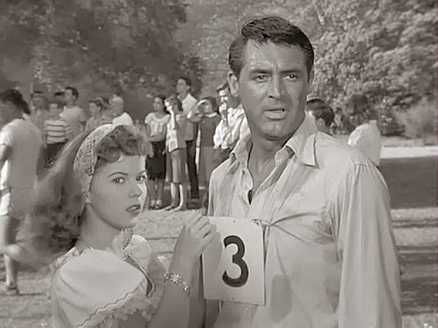
Shirley Temple and Cary Grant in a scene from The Bachelor and the Bobby-Soxer (1947)

Apparently I haven't done a full-length post on The Bachelor and the Bobby-Soxer before. It's coming up on TCM overnight tonight (or early tomorrow morning) at 2:45 AM, so now is a good time to do that post.

The titular bachelor is Richard Nugent, a playboy artist played by Cary Grant. He's consistently winding up in court prosecuted by assistant district attorney Tommy Chamberlain (Rudy Vallee) for the sorts of crimes that would be TMZ fodder nowadays: nothing for which he should end up with a substantial jail sentence, but annoying for everybody all around. He's brought up before Judge Margaret Turner (Myrna Loy). She's got problems of her own. She's got a much younger sister Susan (Shirley Temple) at home that she's taking care of because the parents are presumably dead. (With a kid sister 22 years younger, you can understand why the parents would be dead by now.) Susan mat Mr. Nugent when he came to her school do give a lecture on art, and she unsurprisingly developed a crush on this man who is so much more worldly and better looking than the gawky, pucescent classmates she sees around her every day. Still, Margaret understands that there's no way thi crush could successfully become a real relationship, especially consideirng that Nugent wouldn't want these young girls pursuing him.

So it gives the good judge an idea: sentence Nugent to be Susan's escort for a while! It'll disabuse Susan of any notions she has about Nugent once she has to spend a lot of time with him, and it will teach him a few things about responsibility. Why any defense lawyer would permit this is beyond me, but perhaps Nugent thought all the other alternatives were worse. Besides, he's got a plan of his own. He escorts Susan, but starts acting as though he enjoys doing this, and tries to do what he can to make the "responsible" adults regret their decision to come up with this "punishment". Now, he does it all in a classy way, of course, and nothing at all illegal, which I'd think would drive the judge and the people around her up a wall. Especially when you consider that Nugent's actions don't seem to be doing anything to make Susan fall out of love with him.

Along the way, one other thing happens that you can probably guess from a movie like this: Judge Margaret finds herself beginning to fall in love with Nugent. It doesn't help that the ADA has had his eye on the judge. Can anybody say conflict of interest? Of coure, The Bachelor and the Bobby-Soxer is light comedy, and never meant to be anything with any sort of message, so we can overlook how the film has no grounding in any sort of reality.

The ultimate result is a movie that's frothy, but a hell of a lot of fun. We all knew that Cary Grant was one of the great comic actors, as he'd been doing roles like this for a decade or so. Myrna Loy also does extremely well as the more grounded character, but still adept at comedy nonetheless. The Thin Man, after all, was a full 13 years before The Bachelor and the Bobby-Soxer. The surprise is Shirley Temple, who shows little of the qualities that made her endearing in all those movies she did at Fox, but here would be terribly inappropriate. Her character isn't an adult, but is not childish by any stretch of the imagination. And Temple does well playing off of Grant in their scenes together.

And then there's the screenplay. It was written by Sidney Sheldon, who won an Oscar for it. My first memory of Sheldon was in the late 1970s or early 80s with the ads for the novel Rage of Angels, which sounded so grown-up and trashy. (I've never read the book.) And then when I watched TV reruns I saw I Dream of Jeannie and noticed that it was created by... Sidney Sheldon. And then many years later I saw this. An interesting career, to say the least.

The TCM Shop lists The Bachelor and the Bobby-Soxer as being available on one of those four film box sets, focusing on Cary Grant.

Monday, December 29, 2014

The last night of Cary Grant

Tonight is the last Monday in December, so it's the last night for Star of the Month Cary Grant on TCM. There's one movie that's really worth recommending, except that I haven't seen it in ages and don't remember it quite as well as I remember some other movies that I haven't seen in ages. Don't ask me why some movies resgister better than others; they just do. So I'll just give a one-paragraph synopsis of that movie, Houseboat, which is on at 10:15 PM, and brief mentions of a couple of others.

Cary Grant plays a widower in Houseboat, but a differnet kind of widower: one who hadn't seen his kids in years since he was estranged from his wife. So he's got custody of the kids and tries to be the best father he can, saving money by living on a houseboat on the Potomac River. However, the kids need a mother, and a motherly presence comes in the form of Sophia Loren, who passes herself off as hired help even though she's running away from her conductor father. You can probably guess that the Grant and Loren characters fall in love, and everybody learns something about being a family along the way. I remember being reasonably and inoffensively entertained by the movie, but nothing to make it stand out against the other family comedies of the 50s or 60s (such as the much more memorable Yours, Mine, and Ours). Houseboat is apparently available on DVD from Amazon, but not at the TCM Shop.

The same goes for Father Goose, which kicks off the night at 8:00 PM and which I blogged aboug back in June 2009. Cary Grant plays a drunk vagabond who winds up as a plane-spotter in World War II, and then winds up having to take care of a stranded schoolteacher (Leslie Caron) and her kids. This one is also apparently not available at the TCM Shop, but is worth a watch.

I was going to do a one-paragraph post about Dream Wife, the way I did about Houseboat, only pointing out that it's pretty dire. However, it turned out that I already did a fuller-length post back in the summer of 2011. As always with a movie I strongly dislike, you may still want to watch it to judge for yourself. I'm sure somebody out there likes this movie.