Everybody loves The Wizard of Oz, and TCM are showing it overnight tonight at 12:15 AM ET (that's late this evening in the Central Time Zone and points west). You know Judy Garland; Billie Burke as Glinda the Good Witch; and Margaret Hamilton shrieking, "I'm melting! Melting!!!". However, 12:15 AM Monday is the slot for TCM's Silent Sunday Nights, and the version of The Wizard of Oz they're showing is a silent version released in 1925.
It's got little to do with the movie that's now considered a classic. Dorothy Dwan plays Dorothy, who in this movie is purportedly the heir to the throne in Oz. The evil Prime Minister doesn't want her to sit on the throne, and he'll stop at nothing to prevent her from taking her rightful place. Sure, Dorothy gets helped by a tin man, a scarecrow, and a lion. Parts of the movie are set in Kansas, and there's even a tornado. But don't expect anything like Judy Garland or MGM's dazzling Technicolor spectacle in this one.
In fact, the movie largely gets poor reviews. Part of it is deserved; the movie has its problems. The story is problematic, and the movie can't quite decide what it wants to be. But I can't help but think there are a lot of people who remember the 1939 version fondly -- as it deserves to be remembered -- and rate the silent version on how well it compares to the classic. At any rate, this version is certainly of interest to anybody who's a fan of The Wizard of Oz, just as the later The Wiz would be. That, however, isn't all. This movie has Oliver Hardy (without Stan Laurel) in the Tin Man role (and some others), a fact which by itself makes the movie worth seeing once just as a curiosity.
Sunday, November 30, 2008
Nowhere over the rainbow


Saturday, November 29, 2008
Twentieth Century Columbia
Tomorrow morning's movie to watch out for is Twentieth Century, airing at 10:00 AM ET on TCM. The title has nothing to do with the movie studio of that name, but the train.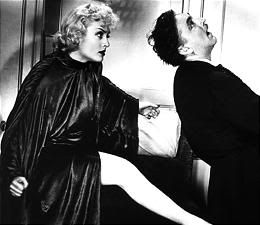
Howard Hawks directed this nifty little comedy, and it has his fingerprints all over it. As in better-known movies like Bringing Up Baby or His Girl Friday, Hawks uses rapid-fire dialog, with the characters almost talking over each other. There is also the requisite cast of oddball supporting characters, which in this case means Barrymore's two assistants, played by Walter Connolly and Roscoe Karns. Both of them were Columbia Pictures regulars, having appeared the same year as Twentieth Century (1934) in It Happened One Night (Connolly as Claudette Colbert's father; Karns as annoying bus passenger Mr. Shapely). Watch also for an oddball who insists on putting put stickers with a religious them on every surface he can find.
Twentieth Century is also the movie that really made Lombard a star, showing the world how adept she was at comedy. Indeed, John Barrymore was exceedingly impressed with her work and let her know just how highly he thought of her performance in this movie. I'm not the biggest fan of John Barrymore, personally preferring Lionel, but John is fine here. If anything, the overbearing producer is the right sort of type for him to be playing -- by this stage of his career he was quite the alcoholic, and was well on his way to becoming a parody of himself.
Twentieth Century is available on DVD, should you miss tomorrow's showing on TCM.
Friday, November 28, 2008
The morning after
This being the morning after the big holiday, I found myself thinking of that dreadful song, "The Morning After", which believe it or not, is an Oscar-winner, from the 1972 blockbuster The Poseidon Adventure.
The movie's been remade, so you certainly know the story. A luxury cruise ship goes on a voyage, and on New Year's Eve gets hit by a giant tsunami (yeah, right: the voyage is in the Mediterranean, where they wouldn't get tsunamis). This capsizes the ship, and begins to fill it with water, forcing the survivors to make their way where they think is up, to eventual safety. Nowadays, this is all standard-issue stuff, but in 1972, when the movie was released, it hadn't really been done before.
The cast is an all-star one, and pretty good at that. Gene Hackman plays the ship's chaplain, reduced to working on ships because no real ministry would have him anymore; Ernest Borgnine plays a cop married to Stella Stevens; Shelley Winters and Jack Albertson are the older couple on their second honeymoon; Red Buttons the aging bachelor who's never been able to find true happiness in life; and Roddy McDowell the ship's purser. (Leslie Nielsen has a brief role at the ship's captain, although he doesn't survive the tsunami.) For good measure, throw in the proverbial bratty kid and his older sister. Once the tsunami hits, all of them end up together, working as a group to try to ensure their survival.
What makes this more interesting, however, is that not everybody survives. There's no particular rhyme or reason as to which of the characters are going to live, and I wouldn't spoil the movie by saying anything about it. However, the movie gives us ample opportunity to form opinions about which of the characters we'd like to see survive. As for the performances? Well, the script isn't the greatest, but the main idea of the story is much that don't need the greatest screenplay. Shelley Winters probably gets the best part, and in one key scene she gets to show off her swimming skills, despite the fact that she put on a good 20 or 30 pounds to play the role. Winters earned a Best Supporting Actress Oscar nomination for it. Red Buttons is also quite good in his poignant role. Hackman is mildly irritating, and Borgnine and Stevens strain credulity.
Finally, there are the special effects. They're 1970s vintage, which means they're clearly not as advanced as they'd be today -- except that they're also not CGI. Apparently, however, the giant ship set must have cost quite a bit of money: there wasn't enough left in the budget to get a wide shot of the doomed ship for the final scene. You see the survivors on the outer hull of the Poseidon, and that's it. There's no pulling away. Still, The Poseidon Adventure is available on DVD and a great way to spend two fun hours.
Thursday, November 27, 2008
A brief Thanksgiving message
This being a holiday, I don't have the time to do a full blog posting, so I'll just be putting up a brief item that I've written beforehand.
Thanksgiving is historically based on the day we give thanks for the bountiful harvest, so that got me to thinking about some of the farm harvests in classic movies. I've already posted on Our Daily Bread, a very interesting movie that's on DVD.
Another really interesting movie is Aleksandr Dovzhenko's 1930 silent Earth, about a Ukrainian collective farm that gets its first tractor. Unfortunately for Dovzhenko, his work was being used in furtherance of a policy that resulted in the deaths of millions through famine. This movie is also available on DVD,
I would like to have recommended Our Vines Have Tender Grapes, as well, in which Edward G. Robinson plays a Norwegian immigrant farmer, but it's not on DVD.
Wednesday, November 26, 2008
Driving Home
Thanksgiving is one of those holidays when everybody goes home to see the familiy if they can. I wanted to recommend Sunday Dinner For a Soldier as a good movie to watch on Thanksgiving, but sadly, it's not available on DVD or even VHS, which is a great shame.
There are a lot of movies about journeys of discovery -- and I've recently recommended the great Harry and Tonto as such a movie. It's a universal theme, and foreign movies like Ingemar Bergman's Wild Strawberries or the Japanese classic Tokyo Story fit the genre as well.
Travelling home, however, is a bit less common. A very interesting, and understated, little movie on the subject is The Trip to Bountiful. Geraldine Page stars as an elderly woman who is now living in a small apartment in Houston, Texas, with her son and his wife. It's a fairly pitiful existence, and the one thing she'd still like to do in her final days is to visit an old friend who lives in the tiny town of Bountiful, where she grew up. Her daughter-in-law rules the roost, however, and has absolutely no desire to let the poor old woman travel back to Bountiful. However, Page is a crafty old woman, and one day when her daughter-in-law is off at the drug store gossiping with friends, she gets up and runs away, to go to the bus station and take the bus back to Bountiful.
Of course, the trip isn't so easy. Everybody except for her one friend has abandoned the town of Bountiful, to the extent that the railroad and buses don't go there anymore. And, she has to stay one step ahead of her son and daughter-in-law, who have discovered she's missing, and start searching for her. Page, in addition to being crafty, is also charming and determined, and she plans to let nothing stop her from getting to Bountiful....
The whole movie revolves around Geraldine Page, who is wonderful in this movie. She won the Best Actress Oscar, deservedly so. The rest of the cast are mere supporting props, even though they all do a good job with their parts. John Heard plays her son, and Carlin Glynn the daughter-in-law. However, the one to watch for is Rebecca De Mornay, early in her career. She plays the wife of an Army man who's been shipped abroad, and she's on the way back to live with her family while her husband serves overseas. De Mornay gets the seat next to Page on the bus, and shares her story with Page, forming a fast friendship.
The Trip to Bountiful is available on DVD.
Tuesday, November 25, 2008
The comedy western
I've mentioned before that I'm not a huge fan of westerns. Movies that are good in other ways, and happen to be set in the old West, however, are a different story. I've already recommended the psychological drama No Name on the Bullet, and tomorrow morning at 8:00 AM ET, TCM is airing a comedic western: Support Your Local Sheriff!.
Although Garner is technically the star, the movie is really more of an ensember cast. In addition to Garner and Morgan, there's Joan Hackett as Morgan's odd daughter, who falls in love with Garner; Walter Brennan as the patriarch of the gang, and Bruce Dern as one of his sons; and veteran character actor Jack Elam as Garner's deputy. All of the actors look as though they're having a blast making the movie, and it's an infectious enthusiasm that makes the movie all the more enjoyable for the viewer.
For whatever reason, Support Your Local Sheriff! isn't all that well-known today. It might have something to do with the fact that it was released in 1969, and doesn't really have any social commentary. Also, the 1969 release date is towards the end of the biggest era of popularity of the whole western genre. Third, many of the cast members were more veteran, meaning that, like Yours, Mine, and Ours, the movie comes off as being directed more toward a stodgier generation. Paradoxically, though, as with Yours, Mine, and Ours, this has the effect of making the movie feel less dated than other contemporary movies, such as Cactus Flower (which, despite being a very good movie, very much feels like a product of the 60s in a way that the others don't). It's available on DVD, too, which is a nice bonus.
Monday, November 24, 2008
The producers kindly ask that you not spoil the ending
This week sees the last night of Charles Laughton's time as TCM's Star of the Month. Laughton made many great movies, and one of those near the top of the list would have to be Witness for the Prosecution, airing at 10:15 PM ET tonight.
Laughton plays a prominent London barrister who's had a heart attack, and is about to go off to Bermuda for a well-deserved retirement. However, fate intervenes in the form of Tyrone Power, who's been charged with murdering a rich old lady. There are a lot of discrpeancies in the case, and in many ways it doesn't look so good for Power, but Laughton agrees to take the case.
What follows is a stand-out legal drama, even if it does contain some of the clichés of Hollywood movie-making. Laughton's man who's fighting against time goes back to at least the Warner Baxter producer of 42nd Street a quarter-century earlier. The vacillation between whether we should think Power is guilty or innocent is also a staple of lawyer movies, as is the dark humor.
The cast includes Elsa Lanchester as Laughton's nurse, and Marlene Dietrich as Power's wife, and the movie was directed by the great Billy Wilder, based on a play by the equally talented Agatha Christie. If seeing all those famous names in the cast and crew makes you think this is going to be a good movie, well, you'd be right.
You'll note that I haven't gone into that much of a description of the plot. That's because when the movie was made, it was well-known that the ending was going to be something to watch out for. Indeed, in the trailers for the movie, the producers deliberately asked people not to reveal the ending to their friends, as that would spoil the movie for them. And so I too won't spoil that ending, if you haven't seen it before.
Sunday, November 23, 2008
Orphans of the Storm
Tonight's offering on TCM's Silent Sunday Nights is DW Griffith's 1921 film Orphans of the Storm airing just after midnight (technically very early Monday on the east coast; Sunday evening in the rest of the US).
The plot is a simple one. Lillian and Dorothy Gish play a pair of sisters living in rural France as it was (well, not really) just before the French Revolution. One sister is blind, so the other takes her to Paris for an operation that will supposedly cure her of her blindness. There wouldn't be a movie if that's all there were to the story, so we get a melodramatic plot twist: an aristocrat falls in love with the sighted sister, taking her into his world, and leaving the blind one to suffer at the hands of a cruel man who forces her to beg for a living. Worse, the French Revolution is about to intervene, and our aristocratic hero is about to fall on the wrong side of the revolution....
DW Griffith directed, and it must have been becoming clear to everybody that the world of movie-making was passing him by. Sure, Griffith had made masterpieces like Birth of a Nation and Intolerance, but other directors were now making pictures with more advanced techniques and better stories. Indeed, this was the last movie the Gishes made with Griffith. Still, Orphans of the Storm has some pretty nifty sequences. One involves the aristocratic class partying with gay abandon, oblivious to all the social upheaval going on outside their manors. The setting for this is more than suitably decadent, and Griffith shows very nicely the chasm between the French classes. Later, after the Revolution has begun, there's a scene involving peasant prisoners being freed by force, and tormenting their previous captors. Their literally riotous celebrating is also excellently photographed.
The other thing that's quite interesting about this movie is the historical goings-on surrounding it. The French revolutionaries were inspired by the American Founding Fathers, but clearly went much further (probably because the French governmental system was much more centralized under the King than the English system, from which the Americans broke away, had been). Griffith's intertitles on the Revolution itself comment on this, and make an interesting mention of the radicals of his day, socialists and communists influenced by what had been going on in Russia.
The version of Orphans of the Storm TCM is showing is supposed to be a restored version. They're listing the running time at just over 150 minutes, which I believe is several minutes longer than the version they've previously shown.
Saturday, November 22, 2008
A three-hour tour
TCM showed the three-hour Hawaii today, and not being able to think of anything better to write about, I hit on the idea of combining Hawaii with three hours, coming up with "Gilligan's Island". The three-hour tour sung about in the theme of course turned into something quite a bit longer, but I started thinking of small boats in the movies.
Large boats and ships are obviously common, with naval battals, voyages of exploration, and the obvious tragedies like Titanic or The Poseidon Adventure. Using a smaller boat, on the other hand, is something quite a bit different. Montgomery Clift famously rented himself one when he intended to kill poor Shelley Winters in A Place In the Sun, while we recently saw a bunch of people ride boats through the tunnel of love in Strangers on a Train. And who could forget the tiny, cramped boat in Alfred Hitchcock's Lifeboat?
One of the more picturesque boat trips would have to be that taken by Paul Scofield in A Man For All Seasons, when he's returning from Hampton Court after having seen Henry VIII. The trip is an overnight one, and Scofield's Thomas More wakes up to a beautifully misty England, well captured in vibrant color. Interestingly, the King later comes to see More, and gets to come on a much bigger boat.
Friday, November 21, 2008
Ingrid Bergman does comedy!
Ingrid Bergman had made some comedy movies in her native Sweden in the 1930s before coming to the US, but after coming across the Atlantic, she didn't make many. One notable exception is Cactus Flower.
Walter Matthau stars as Julian Winston, a New York dentist who is also a confirmed bachelor. He serially gets into relationships with young women, such as his current relationship with Toni (Goldie Hawn), and then breaks them off by saying he can't get married to them, because he's already married to a woman who won't give him a divorce. Unfortunately for the caddish doctor, Toni responds to this rejection by closing all the windows to her apartment and turning on the gas stove, intending to commit suicide. Her next-door neighbor Igor (Rick Lenz) discovers her, saves her life, and hears her tragic story. Eventually, they hit on an idea: if she can see Dr. Julian's wife, she'll be able to convince her to grant him a divorce, or else disabuse herself of the idea that she'd want to marry Dr. Julian.
Cactus Flower is a lot of fun. It was released in 1969, and is clearly a product of the 1960s, but it's a fun trip back in time, with the horrid fashions and design. This sort of schemer is a role that Matthau was perfect for, having already won an Oscar for playing the type in The Fortune Cookie. In Cactus Flower, however, the Oscar went to Goldie Hawn, who does do a fine job as the young woman. That having been said, the one who really shines is actually Bergman. She shows deft comedic timing, and gets some of the more fun lines, notably one about Idaho champagne delivered in a 60's-chic nightspot. Her character starts off as an almost uptight, spinsterish woman, but really begins to loosen up and discover how much joy there can be in life as she meets and falls in love with Igor, who seems bohemian, but really has a conscience under that exterior. Lenz, to be honest, is competent, although he seemed to have been cast to provide eye candy, getting several scenes where he's just come out of the shower and is only wearing a towel.
Somewhat surprisingly, reviewers of the time weren't so kind to Cactus Flower. Although it's dated, it's a little gem, and not just for Ingrid Bergman's good turn at comedy. Thankfully, it's been released to DVD, too.


