Saturday, April 30, 2011

Buck Rogers

Last Saturday at 11:00 AM, TCM started showing the 1939 Universal serial Buck Rogers. Now, I'm much too young to have gone to the movie theater on Saturdays and watched for the latest episode in some movie serial, so to be honest, this is a bit of a new experience for me. I'm looking forward to the remaining ten parts, however.

Last week, Buck (Buster Crabbe) and his little buddy Buddy (Jackie Moran) were in a zeppelin crash and put into suspended animation, where they remained for 500 years before being rescued. Unfortunately, Earth in that time has been taken over by racketeers(!), with only a small contingent of "good guys" hiding out in the Hidden City. Their only hope for salvation is to go to Saturn and get help from the surprisingly human-looking people of Saturn. Buck escapes the racketeer's air controls and gets to Saturn, only to find out that the the Saturnians are going to side with the racketeers, who claim Buck and friends are "revolutionaries". But smart Buck takes one of the racketeers' ships and flies it back to Earth. The folks in the Hidden City think this is a trap, and not realizing it's Buck on board, try to destroy it....

Of course, to find out how Buck escapes certain doom, you're going to have to tune in for Chapters 3 and 4, which are showing this week. It's goofy, trippy stuff, though. Saturn looked amazingly like those places where Hollywood filmed the bad B westerns of the 1930s, in the days before they could go out to Monument Valley. I can forgive the filmmakers for knowing nothing about Saturn's atmosphere, but surely it should have been obvious that Saturn, being a bigger planet, would have stronger gravity; and being farther away from the Sun, would have dimmer light. Those are fairly basic flaws. But then, I presume the target audience wouldn't have noticed or cared about such mistakes anyhow.

Friday, April 29, 2011

Going postal

When Ted Turner acquired what became the "Turner library" of movies it only included movies from Warner Bros. up until the late 1940s, as the later movies had been packaged differently for TV showings. Even though the rights to all the movies are now owned by one or another branch of the megacorporation that also owns TCM, the movie channel has historically not been showing all that many of the Warner Bros. movies from after 1950. Thankfully, that's been changing over the past year or more, with some interesting (and some not so good) later movies from the studio winding up on TCM. Another such movie got one airing last month and another this month: Dear Heart, which airs this afternoon at 4:00 PM ET.

Glenn Ford plays Harry, a salesman who's checking in at a New York hotel for what will probably be the last time: he's about to marry a widow with a son who will be moving to New York with him and getting an apartment. Harry is met at the airport by a too-nice young man who seems a bit too eager to help Harry. It turns out that young man (Michael Anderson) is Patrick, the son of the woman Harry will be marrying. Harry thought the kid was younger, but that's because his fiancée has been showing Harry a very old photo; Patrick isn't 12 but a college student. Not only that, but he's really pleased about the upcoming wedding because he'll once again have the father he so desperately wants.

That's the first sign things might not be going so well for Harry, but there's more trouble to come. Also checking in to the hotel is Evie (Geraldine Page), a postmistress from out in the sticks. She's in town for a postmasters' convention, and she's got just as many problems as Patrick. Evie's a spinster, and it's fairly clear why, as she's a bit nutty and as needy as Patrick. She likes to have herself paged, and lets the bellboys page her for a good 20 minutes or more, just because she thinks it will make everybody else think this Evie woman is important. She meets Harry and you know she's going to fall for him just because she needs any man.

Cynics would think that the obvious solution would be for Evie to pair up with Patrick, let him develop a Norman Bates type complex, and Harry and his fiancée Phyllis (Angela Lansbury, who only shows up for the last 20 minutes or so) can go and live happily ever after. But pretty quickly, you know that the movie is going to head in the direction that long-time bachelor Harry is likelier to end up with the long-time spinster Evie. Will that actually happen? If so, how will the conflict resolve itself? After all, Hary would have to break off an engagement to be with Evie. Dear Heart is one of those movies that's for grown-ups, but in a good way. There's not a whole lot of material that parents might find objectionable; instead, it's the sort of material that's handled with the sort of intelligent sensibility and slower pacing that would make children find the material boring boring boring. Glenn Ford is fine here as the sturdy lead actor, while everybody else around him is screwed up to greater or lesser degrees. Page's Evie is really irritating at first, but if you can get over that the movie is really a pretty good one.

Dear Heart is one of those "little" movies that's been all-too forgotten, which is a shame. It hasn't been released to DVD either, so it's TCM or nothing if you want to see it.

Thursday, April 28, 2011

Why not post Raquel Welch photos

Sorry, this one ain't airing

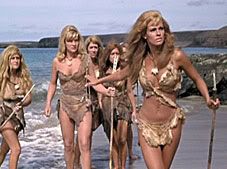
I've briefly mentioned One Million Years BC before, the Raquel Welch movie about prehistoric times that is a remake of a 1940 mvoie starring the equally nice to look at Carole Landis. TCM has the Raquel Welch version listed on their schedule for 6:00 AM ET tomorrow, which is mildly surprising as I can't remember it having aired before. I'm not quite certain exactly what the programming theme is; TCM has put it next to Them!, at 8:00 AM. Both have special effects, but while One Million Years BC has Ray Harryhausen credited for the effects, Them! doesn't seem to have anybody listed for the effects.

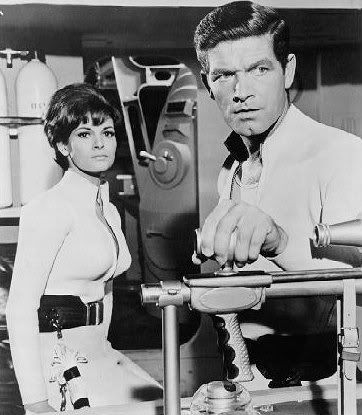
Still, both movies are well worth watching for the entertainment value, if not for any other high level of cinematic achievement. Now if only TCM could get the rights to show Fantastic Voyage....

Wednesday, April 27, 2011

250 years before Baby Face

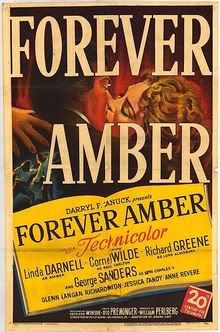
No, Hollywood wasn't making movies 250 years before they released Baby Face. I don't think anybody was. Our next selection is a movie that was set a quarter millennium or more before Baby Face, but has similar themes. That movie, Forever Amber, is coming up tomorrow morning at 9:30 AM on the Fox Movie Channel.

Amber here isn't the color or the mineral, but a young woman named Amber, played by Linda Darnell. Amber is first seen as a foundling in 1640s England, not long before the English Civil War and the Oliver Cromwell era. Fast forward to 1660, by which time Cromwell has died and the monarchy has been restored. Amber's adoptive parents are Puritans, while Amber has entirely different sensibilities. She realizes she and her parents are incompatible, and much the way Barbara Stanwyck makes her way to New York after her father dies in Baby Face, Amber connives a way to escape her parents and get to London. This is only the start of a journey which sees her go through a variety of roles: actress, Moll Flanders-style thief, and trophy wife to the rich and noble; always, she's using her sex appeal to try to climb her way up the social ladder. One of those men, privateer Bruce Carlton (Cornell Wilde) becomes the love of her life and even knocks her up, but it's a love that can never be permanent. Eventually, Amber becomes a widow and one of King Charles II's (George Sanders) mistresses, while Carlton has gone off to America to make his fortune. Once he does, he comes back to London for his son....

Forever Amber shares a bit in common with the aforementioned Baby Face in that both movies are about women who want more out of life and use sex and lots of lots of men to get where they think they want to be in life, only to find out it's not quite all they thought it would be. There's one huge difference permeating the entire movie Forever Amber, though: the fact that it was made after the introduction of the Production Code. Baby Face could be much more open about its sexuality, and the novel on which the movie Forever Amber is based is apparently quite steamy. (I haven't read it, so I wouldn't know.) But it's fairly obvious that Hollywood couldn't get away with such stuff in the mid-1940s, and the Catholic Legion of Decency was there as well to ensure they wouldn't. The result is something rather watered down, but still interesting.

That interestingness is provided largely by Sanders, who was good in almost every role he played. Linda Darnell does reasonably well, but doesn't have the steely determination in her performance that Stanwyck seemed to have so many times; not only in Baby Face. As for Cornel Wilde, you have to wonder whether this was a role originally conceived with Tyrone Power in mind. He was consistently getting cast in historical movies like this, looked the leading part, had the charisma that Wilde doesn't, and probably would have been able to play the role well. Wilde, however, is the weakest of the main players. The one other key difference between Baby Face and Forever Amber is that the latter is in Technicolor, which is a plus for the movie, as a lot of historical movies are served well by color in a way that modern-day set movies like Baby Face aren't.

Forever Amber doesn't seem to be out on DVD, which is mildly surprising, and a bit of a shame.

Tuesday, April 26, 2011

The Lost Weekend

I've briefly mentioned The Lost Weekend a couple of times in the past, but never done a full blog post on the movie. It's airing again tonight at 8:00 PM on TCM as part of their salute to Star of the Month Ray Milland.

Milland plays writer Don Birnam. At the start of the movie, his brother Wick (Phillip Terry) is about to take him for a trip to the country. But we see that Don is thinking about a bottle that he's got tied to the windowsill outside their apartment, and we know that he's not going to go. And, we know why: Don is a raging alcoholic. Philip has been trying to cover for Don for years, including letting Don live with him, but at the same time he knows that he can't really keep Don from drinking if Don doesn't want to, so Philip eventually goes off to the country alone, while Don stays behind, as does his on again, off again girlfriend Helen (Jane Wyman).

Don quickly goes downward in a spiral of drinking, drinking, and more drinking, always looking for the next drink. As I wrote back in March 2008, my drinking is limited to a glass of wine at dinner, so I don't know quite how accurate Don's journey is. But it's certainly harrowing and not (yet) clichéd. (I can't help but wonder if this is the movie that started a lot of the alcoholic clichés.) Don gets into it with his bartender Nat (Howard Da Silva), tries to find a bottle that he hid in the ceiling light fixture, and winds up in Bellevue Hospital where he's warned about the insects and pink elephants; this last is a particularly jarring sequence.

Regardless of how accurate it is, The Lost Weekend is pretty darn good stuff. The movie does bog down with a few flashback scenes involving Don and Helen at the start of their relationship, but during all of the drunk scenes, it's more than suitably uncomfortable. The question of whether we should let the Don Birnams of the world drink themselves to death if that's what they're intent on doing is one that is still relevant today, not only regarding alcohol, but other drugs as well. Terry takes one side of that question, while Wyman takes the other. Milland's performance doesn't do much to make the answer any easier, and that's a good thing. The ending of the movie is a bit too hopeful, but that's something you have to expect from addict movies. The one exception might be Less Than Zero, and that's a movie that's got a lot of problems, to put it mildly.

Monday, April 25, 2011

In a black and white movie, the sky is always gray

Tomorrow at noon, the Fox Movie Channel is showing the enjoyable western Yellow Sky.

Gregory Peck stars as Stretch, the leader of a gang of bank robbers out in the old west. Their latest robbery doesn't go quite right, and the gang winds up with the sheriff and a posse chasing after them, guns blazing. The only way to escape is across 70 miles of salt flats, and needless to say, the rest of the gang thinks that's not such a good idea: surely nobody can make it across such a barren expanse. Now, Yellow Sky could be an interesting movie if all it were about were people trying to make it across those salt flats and inevitably failing (the Production Code wouldn't let bank robbers succeed, of course, if it meant they escaped the law). Watching the movie, in fact, the salt flats sequences only take up a portion of the movie, but are harrowing enough if you look at what happens to the poor horses, never mind what happens to the one robber who had decided to fill has canteen with whiskey instead of water. However, the movie is about something different, and our robbers eventually do make it through the salt flats, winding up at a watering hole just outside the ghost town of Yellow Sky.

Only, it's not quite a ghost town. It turns out that there's an elderly man (James Barton) and his granddaughter Constance (Anne Baxter), nicknamed "Mike", living there. Stretch realizes that they're there for a reason, as do the rest of the gang. Here, we really start getting into conflict. There's the natural conflict between the gang and the two prospectors. But there's also a growing conflict among the robbers. Second-in-command Dude (Richard Widmark) wasn't thrilled with the idea of going across the salt flats, and now he's even less pleased with Stretch's plans for dealing with the old man and his granddaughter. Dude figures they're hiding gold someplace, and wants the gold now. Stretch, on the other hand, is more concerned with safety, and realizes the old man has to be on good terms with the local Indian tribe, which is probably not so likely to care for the robbers. Further, there's the beginnings of a romantic conflict, as several members of the gang find "Mike" quite attractive.

There's nothing particularly groundbreaking here, as we know the movie is going to wind up with the obligatory shootout, with the bad guys getting their due, and the good guys.... Well, the writers had to satisfy the constraints of the Production Code, so the ending is a bit contrived, which doesn't really work to the movie's benefit. That having been said, this is more one to watch for the acting. Peck is quite good in the morally ambiguous role, while Widmark is just as good a gangster in a western as he was in the more modern gangster movies like Kiss of Death. Baxter is both suitably good to look at, and effective as a would-be tough woman who doesn't have the experience that her grandfather does. Watch for Harry Morgan later of M*A*S*H as the gangster "Half Pint"; he's credited here as "Henry Morgan" as he often was in movies of the 1940s. Direction is handled well by William Wellman. All in all, Yellow Sky isn't quite great, but it's more than good enough.

Yellow Sky has also been released to DVD, so you don't necessarily have to wait for the FMC showings.

Sunday, April 24, 2011

IMDb's "synergy" with Amazon

A lot of times, when I look to see whether a movie is available on DVD, I just use the little yellow buttons in the top corner of a movie's IMDb page. An exception would be a movie that's more likely to get a release from the Warner Archive and not be available from Amazon. However, I was surprised to see this morning that Godspell was not in print on DVD.

Why, then, did I say in my post this morning that Godspell is available? Probably because it is. The link on IMDb's page is this long ling full of numbers, which eventually resolves to this more readable link. If you look carefully at the link, you'll see that it's searching for the movie's full title, and points out that we've been redirected from IMDb. However, the DVD that's available is one that's been printed under the film's more common title, which is just plain Godspell. So, when you do an Amazon search of movies with the word Godspell, the first link up is to the DVD of Godspell. That, of course, shouldn't be a surprise. What's slightly more surprising, though, is the other DVDs that show up in this particular search: Jesus Christ Superstar is at least somewhat understandable, but Hair? Rent??

Oh well, at least Godspell can be bought on DVD.

Gospel Road with different music

If you can set the life of Jesus to country-gospel music, you can set it to almost any genre of music. Rock opera shows up tonight on TCM at 8:00 PM with the movie version of Jesus Christ Superstar, which is followed by show tunes with Godspell at 10:00 PM.

The framing story is an interesting one. In New York City of the early 1970s (just before Gerald Ford was telling the city to drop dead), a bunch of people are having problems with their personal lives. One by one, each of them sees a bearded man, who through sheer force of personality gets them to go off with him! It's obviously an allegory to Jesus! Er, no it isn't. It's actually John the Baptist, as we see when he takes all of them to a fountain to have them baptized. This, of course, is where Jesus shows up, wanting to be baptized; at this point Jesus becomes the leader of the new group of believers....

In this telling of the story, it's an excuse for "Jesus" and his "apostles" to go around New York retelling the story of Jesus' life, and singing Broadway show tunes set mostly outside in front of suitably impressive backdrops of various locations in New York: Lincoln Center, the Brooklyn Bridge, Grant's Tomb, and even one number shot in part on the World Trade Center which was still under construction at the time.

As with Gospel Road, it's a bit difficult to give a rating to a movie like this: it's much less about the story then it is about the music. That having been said, Godspell, I think, winds up quite a bit better than Gospel Road. It's not because I prefer show tunes to Cash's style of music; in fact I'm not that big a fan of Broadway. However, the "apostles" here have an enthusiasm that fits perfectly with the music, and the framing story is much better, effectively making its point about how God is (or should be, depending on your religious beliefs) relevant in modern day life. It's a statement that's particularly well-made at the very end, after the crucifixion of Jesus. (Oh, I didn't give away the story, did I?)

Godspell is not only available on DVD; you can get any of a large number of versions of the soundtrack on CD.

Saturday, April 23, 2011

Still he survived

There's a story in the Bible about the King trying to kill all of the Jews' first-born sons so that their infant savior-to-be will never grow up to be their savior. Paul Newman's career could have been nipped in the bud by the disaster that is his first film, The Silver Chalice, which is airing at 6:30 AM tomorrow on TCM.

Newman plays Basil, a Greek silversmith in the first century AD/CE who gets sold into slavery. Along come the Christians, who have just seen the loss of their Messiah. They want a replica in silver of the Holy Grail, the cup from which Jesus was believed to have taken his last drink. So far so good. Along the way, however, Basil finds himself having to deal with two women. The lovely Deborah (Pier Angeli), a Christian and daughter of Joseph of Arimathea, who is clearly supposed to be right for him; and the horrid pagan harlot Helena (Virginia Mayo, who gets top billing).

That's not all Basil and the Christians have to deal with. There are people out there who clearly don't like the idea of Jesus being a messiah, and so they come up with the brilliant plan of having a messiah of their own, one who is still living! They're just making up a messiah, of course, so they need somebody who can pull off the con, and that would be magician Simon (Jack Palance). You know the Christians are going to win, of course, but they way it happens is a bit interesting: Simon actually begins to believe the garbage he's spewing!

There's rather a bit more in this turgid movie. The basic story shouldn't be that bad, but there's a fair amount of miscasting (notably Mayo, and her Helena character as a younger girl, played by Natalie Wood), and mis-direction. We know that Newman would later go on to be quite a good actor; why is he so off here? On the bright side, at least we have Jack Palance to steal the show. If younger viewers remember him today, it's the elderly Palance who had an Oscar-winning role in City Slickers. At the beginning of his career, though, he played villains and heavies, in movies such as Second Chance. Whether it was his idea or the director's, I'm not sure, but Palance goes over the top here and at least makes things somewhat interesting.

Apparently people at the studio must have known that Newman had more potential than he was able to show in this mess. Either that, or he was already at work on his next film. At any rate, The Silver Chalice is one of the worse Biblical movies of the 1950s, which has gained a bit of cult stauts for having screwed up so badly despite its cast. For that alone, it probably deserves one viewing.

Friday, April 22, 2011

Stella Dallas

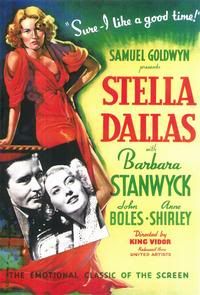
Stella!!!If you've been watching TCM lately, you've probably seen the nice little piece on Barbara Stanwyck narrated by Jennifer Jason Leigh. I think last week it was being run because Ball of Fire was last week's TCM Essential; this week it's being run for the 1937 movie Stella Dallas, which is finally airing tonight at 10:00 PM, in which Stanwyck plays the title role.

We see young Stella at the start of the movie before she's Mrs. Dallas, as the younger daughter in a family in one of those old New England mill towns, who dreams of moving up in the world. She gets her chance when she brings her brother's lunch to the mill and meets one of the supervisors, Stephen Dallas (John Boles), who had a bit of a past in which an inheritance was lost. They're incompatible, of course, but it's love at first sight, so they fall madly in love and get married. Stephen is more reserved, as he feels befits his station in life, while Stella wants to live, and thinks she has the chance when she meets horse trainer Ed Munn (Alan Hale) at the country club. Stephen knows Ed is all wrong for Stella, and eventually it leads to their divorce.

But not before Stephen and Stella have a daughter Laurel together (who grows up to be a young woman played by Anne Shirley). The two separate, but Stella keeps custody of Laurel. Laurel spends time with Stepehen and his rich set, which comes to include a widow (Barbara O'Neil) with three sons. Dad thinks daughter Laurel would be better off living with him and the widow, especially because Laurel seems to like all of the eldest son's friends. However, Laurel is also devoted to her mother, and doesn't want to devastate Mom by leaving her for Dad. Mom goes to visit Laurel and the smart set, realizes she can never fit it, and makes the decision to give up custody of Laurel, although Laurel doesn't understand why....

Jennifer Jason Leigh's piece says something to the effect that this is melodramatic, soapy material, and that in the wrong hands (ie. not Stanwyck's) it could fail by going over the top in its maudlin nature. Leigh implies, of course, that Stanwyck keeps it from doing so. I'm not quite sure I agree with Leigh, but that might be because I'm a man. Stella Dallas is certainly a "women's picture", although I don't think it's quite as much so as some of the movies of Bette Davis (Dark Victory comes to mind) or Joan Crawford (tonight's TCM lineup stars off with Crawford's tedious Daisy Kenyon at 8:00 PM). It's certainly worth watching, even if like me you begin to find some of the scenes unintentionally comic.