Showing posts with label Bob Cummings. Show all posts

Monday, July 20, 2026

For some values of luck

TCM's schedule for most of the morning and afternoon tomorrow, July 21, is films with have the word "lucky" or a variation thereof in the title. One that's been sitting on my DVR is Lucky Me; not having seen it before, I once again wanted to watch a movie in order to be able to do a full-length post on it. The movie comes up at 2:15 PM tomorrow, so now is your chance to watch it, too.

Doris Day stars as Candy Williams, opening with a well-choreographed musical number singing a song about superstition, before winding up backstage at a theater in Miami. She's part of a troupe called the Parisian Pretties managed by Hap Schneider (Phil Silvers), who also appears in the troupe. They put on a sort of vaudeville revival show with song and dance acts but no overarching plot. It's a nostalgic sort of show that time has passed by. Audiences have passed it by, too, causing the show to be canceled and leaving Hap and Candy stranded in Miami together with two other members of the troup, Duke (Eddie Foy, Jr.) and Flo (Nancy Walker).

Hap, playing fast and loose with the truth, comes up with a scheme to get a free dinner at the hotel across the street involving a cop friend of theirs "arresting" them just before the check comes; however, the scheme fails when the cop in question gets rotated out on his shift so is no longer there to arrest them. Since this was a fancy hotel, they're going to have to pay their way out of the bill by doing various forms of work for the hotel. This is how we get to the male lead. One of the guests in the hotel is Dick Carson (Robert Cummings). He's a Tin Pan Alley songwriter who's had a fair deal of success writing for other people. But he wants to strike out on his own and write a complete show of his own. To that end, he also needs a backer, and thinks he might have one in Texas oilman Otis Thayer (Bill Goodwin). Otis has a daughter Lorraie (Martha Hyer) who is kinda-sort Dick's girlfriend, with the obvious implied threat that if she's not his girlfriend, he's not getting her daddy's money.

One evening at a gas station, Candy runs into Dick but doesn't know him. For various reasons, especially involving the fact that he doesn't want more people trying to audition themselves for him since he already had to deal with Flo doing just that, Dick passes himself off as a mechanic at the station named Eddie. From here, it's not too difficult to guess what happens the rest of the way. First, Dick and Candy fall in love although Dick has to keep up the ruse. Then, Candy learns the truth from a meeting between Dick and Hap, who does recognize Dick. This causes Candy to believe Dick is just trying to take advantage of her. Worse is that when they patch things up and Candy sings for Dick, Lorraine finds out. Lorraine decides that if she can't have Dick, she won't let her father back the show.

This leads to a finale at a birthday party for Otis where Dick was planning to play some of the songs for Otis. Dick decides to abandon the show, and Candy and her friends come up with an idea to put everything right. This involves crashing the party and coming up with a ruse to get Lorraine away from the party just long enough for Candy to sing some of the songs Dick was writing. Unfortunately, they can't keep Lorraine away long enough, although as you'll have figured out the film is bound to have a happy ending. You'll also know who ends up together in the last reel.

Lucky Me is, like the show the Parisian Pretties put on, a hoary old chestnut of a story. The story idea might not have been a bad one in the early 1930s, although it's decidedly dated here. It also doesn't help that Doris Day gets a subpar set of songs to sing. Day tries, and the film's weaknesses are definitely not her fault. But there's a reason Lucky Me got lukewarm reviews when it was released. Doris Day fans will probably still enjoy it, but anybody else watching it will see fairly quickly why it got those tepid reviews.

Saturday, March 14, 2026

It Started With Eve

A few months back, I mentioned having recorded a double-feature of Deanna Durbin movies that aired on TCM. One of the movies, It Started With Eve, is one that I had watched many years back but never actually done a review on. So I watched it again in order to be able to do this review on it.

We don't meet Deanna Durbin for several minutes. Instead, we see Jonathan "Johnny" Reynolds, Jr. (Robert Cummings). He's the son of wealthy businessman Jonathan Sr. (Charles Laughton). Except that Dad is on his deathbed, and Junior is returning home to see Dad for what is probably the final time, with some newspaper types keeping a vigil outside the family mansion and wondering whether Johnny is going to make it back in time before Dad dies. Tragically, this means that Dad isn't going to make it to his son's wedding: Johnny has only recently gotten engaged while on the sort of vacation to a place where all the rich people go. With that in mind, Dad tells his son that his dying wish is to meet his son's fiancée, Gloria Pennington.

Johnny dropped the Penningtons off at the hotel, not realizing that Dad would want to meet them; to be fair one can think that bringing the fiancée's family to an occasion like this might be too much for the old man. But it means he has to go back to the hotel room and pick them up, and who knows whether they'll make it back in time before Dad dies? Worse, when Johnny gets to the hotel, he finds that Gloria (Margaret Tallichet) and her mom have gone out late in the evening to get a custom fitting for clothes for the funeral, which again seems like a bit of a plot hole considering that stores would likely not be open at this hour of the evening.

On his way out the lobby, Johnny runs into hat-check girl Anne Terry (Deanna Durbin), who is hoping to get back to her family in Ohio. Johnny, being desperate, offers this woman he's never met before a proposition. Would she be willing to play the part of his fiancée for an hour or two until Dad dies? Johnny will pay her good money, and since Dad will never see her again, is there really any harm in this little white lie? Anne could use the money, and it won't keep her from catching her train, so she decides to accept.

Except that this is a Hollywood movie and we're only ten or fifteen minutes in, so you know fully well that this isn't all that's going to happen and that there are going to be serious complications. Dad does not in fact die. Not only that, but it looks like he's going to start getting better and eventually even make a reasonable recovery. Johnny has to go back to Anne's apartment and bring her back to the house, which she's not particularly excited about at first. And then there's the real Gloria and her mother, who are understandably displeased about not being able to meet their future in-law until Johnny can come up with some sort of explanation as to what's going on. Even worse is that Dad really likes Anne. Finally, as you might guess, as the movie goes on it's going to become more and more apparent that Johnny and Anne are the ones who are right for each other, even if they don't yet realize it.

It Started With Eve is one of those movies that has a premise where you know exactly where it's going to go and that it's going to get to a happy ending, but the fun is seeing how it gets there. And with a cast like Deanna Durbin, Robert Cummings, and Charles Laughton, it's a fairly fun ride getting to the obvious destination. Charles Laughton did not get to play comedy as often in his career as he probably should have been given the chance to do. He's clearly enjoying himself here in the sort of mischievous older father role you could easily see Charles Coburn do, and his enthusiasm really makes the film a lot of fun. Durbin and Cummings are more than adequate. There's a bit of odd miscasting with Guy Kibbee as an Episcopal (I think) bishop; Kibbee just doesn't look the part although it's not as if he does anything wrong with his smallish role.

Sunday, October 31, 2021

How to be very, very unfunny

Another of the movies that recently started showing up in the FXM rotation is How to Be Very, Very, Popular. It's going to be on again tomorrow at 8:10 AM, so I recently sat down to watch it and do a report on it here.

Stormy Tornado (Betty Grable) and Curly Flagg (Sheree North) are burlesque dancers at a club in San Francisco. One night, at the show, another of the dancers in another act is shot dead by a bald guy. Stormy and Curly, having witnessed the murder and knowing that they will be held against their will as material witnesses, decide that the best thing to do is skip town.

Unfortunately, they don't have very much money, so they're forced to get off in the town of "College City" not too far away, and home to Bristol College. Also unfortunate for them is that they've already been spotted, and the police back in San Francisco, as well as the killer, are going to be making their way to College City fairly soon.

The two women are not just broke, but cold and hungry. And unbeknownst to them, they've wound up right outside one of the men's fraternity dorms. So when they go in to try to get food, they wind up in a place that's not supposed to have any women in it other than house mother Miss Sylvester (Alice Pearce).

And a wacky group of students it is. There's Fillmore Wedgewood (Bob Cummings), a forty-something who has learned that he can keep living off of his grandfather's trust fund as long as he's still studying. Also there's Eddie Jones (Tommy Noonan), who attended a lecture on hypnosis and is trying to hypnotize his friend Toby Marshall (Orson Bean), a former student at the college who was expelled for his poor grades. However, Toby's father B.J. (Fred Clark) is one of the college's wealthiest donors, having spend the past few years attending to business in the Middle East, and doesn't know his son has been expelled, instead expecting to see Toby graduate tomorrow.

One thing that's obvious is that Eddie's hypnosis isn't going to work on Toby, but it will work on somebody else; that somebody just happens to be Curly. Stormy has also gotten in touch with Curly's father (Rhys Williams), who is planning to come get his daughter. He, like Toby's father, is bald, which as you'll already have figured out is going to play into the plot since the murderer is bald.

It all goes on like this for 90 minutes, always being tediously unfunny and cringeworthy. I don't know what audiences in the 1950s saw in Tommy Noonan, since he's been the obnoxious half of his comedy team with Peter Marshal in everything I've seen him in. Even though Cummings is supposed to be playing an overage student, he looks way too old even for that. Ditto Betty Grable, who is in her final movie. Apparently, the role Sheree North took was originally conceived for Marilyn Monroe, which is why North looks and sounds the way she does.

The only positive thing about the showing is that FXM left the movie in the original Cinemascope aspect ratio. But simply having widescreen is never going to be enough to overcome a myriad of flaws.

Wednesday, October 20, 2021

College Swing

I didn't intend to watch a slew of movies with fairly thin plots back-to-back; it's pure dumb luck that the movies I picked recently happen to have not a whole lot going on. For the latest example, I dove into my Bob Hope box set and settled on College Swing.

We don't see Hope for a while, as the movie starts with a prologue. It's 1738, and a school is having its graduation, presided over by Edward Everett Horton, who is decidedly non-colonial. All of the students get their diplomas except for Grace Alden (Gracie Allen). She's so ditzy that she's been in school for nine years and still can't graduate. Her father and the Horton character get into a debate with it suggested that she couldn't graduate in 200 years. So a contract is drawn up that the school will keep Alden's money in escrow until such time as a female descendant of the Aldens graduates, at which time she can claim the inheritance. Otherwise, in 1938, the money will revert to the college.

Fast forward to 1938, when the movie was made. There's another Gracie Alden, and she's still trying to graduate from the school. This is where Bob Hope shows up. He plays Bud Brady, some sort of smooth operator type who comes up with the brilliant idea of "tutoring" Gracie to pass the examination and then claiming a nice up-front free from that as well as a handsome annual salary from the college, which would be Gracie's inheritance. This "tutoring" really means finding out in advance what the questions are and feeding the answers to Gracie.

Hubert Dash (Edward Everett Horton), a descendant of that man from 1738, returns from South America to administer a special exam just for Gracie, with questions read by George Jonas (George Burns). Although there winds up being a flaw in Bud's scheme, Gracie somehow passes the test through a comedy of errors, and winds up taking control of the college, which means instituting all sorts of new policies including new faculty, which is where the phony "Professor Therese" (Martha Raye), professor of love, comes in, to play the romantic interest for Bob Hope.

There's another love story, typical for the genre, involving two of the students, including one who's related to a bigwig in the administration, played by John Payne and Florence George. But the main story, such as it is, still has some time to play out, so it's quickly suspected that Gracie must have cheated on the test. This means that Bud is going to have to come up with another scheme to help her cheat and pass another test, this one on live radio.

With not much plot here, the reason to watch is for the various musical numbers and sketch comedy that have all been stitched together to come up with something that's actually not terribly incoherent. But having said that, College Swing is also definitely not the sort of movie that's going to be for everybody. I can imagine quite a few modern viewers being put off by the 1930s music, with the comic interludes not being particularly funny for other people. Unsurprisingly, Allen is the best thing here, followed closely by Hope and Raye.

College Swing is another of those movies I'm glad to have picked up as part of a box set, but one that I wouldn't pay a standalone price for.

Tuesday, February 16, 2021

You still gotta stay happy

Back when Olivia de Havilland died, TCM replaced a day in Summer Under the Stars with a day of her movies, which gave me the chance to DVR a couple that I hadn't seen before. One of those, Princess O'Rourke, is on again tomorrow at 12:15 PM, so I sat down to watch it and do a post on it here.

Olivia, as you can guess, does play the princess, but her name isn't O'Rourke. She's Princess Maria, who at the start of the movie is the princess of some unnamed central European country that's been overrun by the Nazis, the movie having been released in 1943. The royal family has been forced to flee, with Dad in exile in London and Princess Maria, together with a secretary and an uncle, Holman (Charles Coburn), holed up at a hotel in New York (I'm guessing they don't control the embassy in Washington).

Maria is bored in New York, and has a count she doesn't care for pursuing her because the royal family needs a suitable marriage. Holman decides that the best thing to do would be to send Maria out west, since the royal family has some friends in California who have a ranch. It would be a nice change of pace for Maria, as well as a way to get her out of the spotlight for her own safety should the need arise.

The only problem is that she's going to have to fly out to California, something that she's rather afraid of doing. Holman and the secretary come up with the brillian idea of giving her a sleeping pill before the flight, so that she'll sleep through the flight (a redeye with train-like sleepers) and wake up in California refreshed.

But it doesn't work out like that. Maria can't sleep, so first she asks the stewardess for a sleeping pill. She still can't sleep, so now it's the turn of co-pilot Dave Campbell (Jack Carson) to give her a pill. When that still doesn't seem to work, she asks the pilot, Eddie O'Rourke (aha! there's the O'Rourke, played by Robert Cummings), for a pill, and he gives her two.

The pills eventually do the trick, and perhaps Holman should have told her in the first place that it wasn't going to be instantaneous. But taking five of them really knocks Maria out, to the point that when the plane hits fog and has to turn back to New York, she doesn't realize the plane has landed, and can't wake up. And when she finally does, it's left her with a cloudy brain such that she can't remember where she's staying.

So O'Rourke puts her up at his place for the night, since Dave has a wife in Jean (Jane Wyman) and Eddie has the room, although Eddie asks Jean over to change Maria into something more appropriate for sleeping.

You can probably guess more or less what happens next. Maria likes this way of being incognito, so after she leaves Eddie's place, she escapes the hotel to go see him again. He wants to see her, anyway, not realizing she's a princess, and so begins a beautiful love relationship.

Well, that's how it begins, but it's going to take some twists and turns before it gets to the end. The big one, of course, is what's going to happen when Eddie finds out that Maria is in fact a princess. Perhaps thankfully for him, he comes from a long line of sons, leading Holman to believe that he's likely to produce a son for the royal family, which after all is the chief duty of a Prince Consort. But is Eddie going to want the sort of life that a Prince Consort has to live? And is Maria going to want that sort of life for Eddie?

For unsurprising reasons, Princess O'Rourke made me think of You Gotta Stay Happy, which I blogged about not too long ago. Both are about a pilot falling in love with a rich woman, and they have the sisters Olivia de Havilland and Joan Fontaine. But of course there are a lot of differences, with the big one here being that Princess O'Rourke has the heavy hand of World War II hanging over it. Well, maybe not heavy in that it doesn't do anything to harm the movie; just that it gives the movie a completely different tone. It mostly works for Princess O'Rourke, and while it's certainly not the greatest movie in the careers of any of the main stars, there's nothing notably wrong with it.

If you want a change of pace from Olivia de Havilland, you could do a lot worse than to watch Princess O'Rourke.

Monday, October 26, 2020

Crime does not pay, but not MGM-style

I've mentioned the MGM Crime Does Not Pay shorts on a couple of occasions. Recently, I watched an odd little movie that shares the message of those shorts, but does it in an entirely different way: You and Me.

The movie starts off with a song about how you need money to get whatever you want, before we wind up in Morris' department store. Helen (Sylvia Sidney) is one of the shop clerks, and she's just found a woman trying to shoplift a satin blouse. The woman begs Helen not to be turned over to the authorities. When another clerk, Joe (George Raft), shows up to ask Helen if there's a problem, she lets the shoplifter off the hook by claiming there's a flaw in the blouse and the department store shouldn't be putting out gods like this.

Joe actually loves Helen, but there's a problem. He's an ex-convict, finishing up his parole. Mr. Morris (Harry Carey), who owns the store, believes in giving ex-cons jobs as a way of rehabilitating them, but the parolees are still under all sorts of restrictions, such as having to report to their parole officer constantly and not being allowed to get married. So Joe hasn't been willing to reveal his love to Helen up until now. Even then, he's decided that he doesn't want to saddle Helen with an ex-con for a wife, he's going to go west to California instead.

Helen is having nothing of it. She loves Joe too, and she decides that she's going to push the issue herself, asking Joe to marry her! Naturally, he accepts, and the two have a quickie wedding before starting off a life of marital bliss in her rooming house run by a very nice older couple who don't know anything about Joe's past.

They, and Joe himself, don't know much about Helen's past. It turns out that she too is a parolee, but her parole isn't up yet. So she's still under the prohibition on marriage, and she'd get in huge trouble if her parole officer or pretty much anybody but her landlords found out about the marriage. So she makes up a lie to Joe about Morris not wanting his employees to get married to each other.

Joe is obviously going to find out about Helen's lie at some point. Meanwhile, he and some of the other parolees working at Morris' (played by, among others, Roscoe Karns, Warren Hymer, and a young Robert Cummings) are getting approached by the big guy, Mickey (Barton MacLane) to do a job stealing from Morris' department store. Joe wasn't certain at first, but once he's learned his wife has been lying to him, he decides to go ahead with the job.

And here is where the story gets really weird. (Naturally, spoilers abound.) Helen decides once she hears about it from Gimpy (Hymer's character) that she's going to inform Morris. Normally, we'd get the police rounding up the bad guys as the Production Code would have retired. In You and Me, however, Morris has his detectives interrupt Joe and the gang in flagrante delicto, and then have Helen give the guys a lecture on the actual financial figures on crime not paying! It's a really bizarre resolution, but since the gang decides not to go ahead with the crime, it must have satisfied the enforcers of the Production Code.

You and Me, despite being a strange film, works and is quite interesting for all its weirdness. The casting is interesting, what with Sidney being an out-and-out con; ditto Karns and even more so Cummings. Nobody stands out as being particularly good or particularly bad, but together and under the direction of Fritz Lang they make a movie that absolutely needs to be seen at least once.

You and Me was released by Paramount; as with almost all of Paramount's talkies from before 1950, the rights were acquired by Universal. Many of these movies have the modern day Universal logo at the beginning, but You and Me had the 1930s vintage logo of a plane flying around the globe! The movie has received a DVD release from Universal's mod scheme, although it might be nicer had it been part of a box set.

Thursday, October 22, 2020

Something happened some time or another

Another of the movies that's been in the FXM rotation lately and that I haven't blogged about before is Everything Happens at Night. It's going to be on again tomorrow morning at 4:40 AM, so I recently watched it to post about here.

Robert Cummings plays Ken Morgan, Paris correspondent for a New York paper. He's about to escape a club where his boss is, but his boss has urgent news for him. Remember the story about the peace advocate Dr. Norden and how he was assassinated by the Nazis last year? Well, somebody's been sending unsigned letters that sound suspiciously like the same exact style Norden would use, meaning Norden might still be alive and moving from one location to another to stay one step ahead of the Nazis. The lastest information implies that this person, if it is Norden, is in a small village in Switzerland. Morgan is to go there and find out whether that really is Norden.

Now, you'd think this would really be putting Norden at risk if it is him, but as in a movie like Five Star Final, you've got editors and reporters who don't care about the damage they do to their subjects. So Morgan heads off to San Palo and gets the last available hotel room, this being a a small town during ski season. And just after Morgan arrives, who should show up but Geoffrey Thompson (Ray Milland), claiming to be a British botanist but obviously a journalist also on the trail of Norden to get the story.

Eventually they meet Louise (Sonja Henie), a lovely young woman who is playing nursemaid to a guy in town to get the mountain air for his health. Both journalists presume that this is Norden, but Louise isn't about to tell. Still, the obvious thing to do is to gain her confidence, although both journalists fall in love with her along the way, complicating matters. But since Morgan is the one who gets the ice skating fantasy sequence, it's a good guess that he's the one who's going to wind up with Louise in the last reel.

You can probably guess that Louise is in fact taking care of Norden, but the movie takes a really dark turn after that. Morgan files the story and Thompson tricks the telegraphist to send it to Thompson's editor in London; when the story breaks the Nazis now know precisely where Norden is. The chagrined journalists try to spirit Norden out of France, but the Nazis show up for a little covert action. How they lost track of him and didn't already have a bunch of spies in town, I'll never know.

Generally, you know what to expect when you see that Sonja Henie is the star of a movie. Surprisingly, however, Everything Happens at Night is much darker than the other of her movies I've seen. Henie wasn't much of a serious actress, but she's nice to look at and passable as a romantic lead. But she only gets the one ice skating number here, and not a finale. All along the way, Everything Happens at Night feels like a movie that can't decide what exactly what it wants to be, and never really gets the two sides together in a satisfying way.

Yet, because of this failure, Everything Happens at Night might still be more interesting than the Henie movies that are a higher overall quality or have the better ice skating numbers. The movie did get a DVD release courtesy of Fox's MOD scheme, in case you're unable to catch it on FXM.

Wednesday, April 3, 2019

For Heaven's Sake

A movie that recently got taken out of the Fox vaults for running on FXM is For Heaven's Sake. It's going to be on again tomorrow morning at 6:00 AM, although apparently not for some time after that.

Clifton Webb plays Charles, an angel who has a problem he has to deal with down on earth. Apparently one of the junior angels, "Item" (Gigi Perreau), has gotten it into her head that she wants to be born. And, she's found the perfect couple to be born to, the Boltons. Jeff (Robert Cummings) is a successful theater director, while his wife Lydia (Joan Bennett) is the female lead in all of their plays. They live in a deluxe duplex in Manhattan with enough servants that Item thinks they'd make great parents to her.

There's just one problem. Jeff is definitely married to his work, and Lydia is dedicated to the stage even if she's more than ready to take a vacation. Starting a family seems not in the cards, and if they can't resolve whether to do another play, who knows if the marriage will survive. Not that Item cares; she's insistent upon their being her parents, and she's not going to leave. Charles and his partner Arthur (Edmund Gwenn) are sent to fetch Item.

Eventually Charles comes up with an idea. Item knows that if the Boltons can just have one more successful play, that will satisfy them enough and bring back the spark to their lives such that they'll start a family and Item can be born. Charles is going to "materialize" in human form and use his powers to persuade Jeff and Lydia to do the new play and start a family. Not that it's going to be easy.

Charles shows up at the racetrack as a rancher channeling Gary Cooper, and has a "chance" meeting with Jeff and Lydia that convinces them to offer a new play written by their friend Daphne (Joan Blondell) for "Slim Charles" to back. Not that he has the money having just come down from heaven. But Charles goes down to the Bolton's farm for a weekend to discuss the play. Daphne is very clearly attracted to Charles, which presents all sorts of problems. Among them is her ex-boyfriend Tony who doesn't want anybody else to have Daphne. Charles wins a bet with another rancher that results in the other guy backing the play and getting the profits, and Charles winning a $10,000 consolation. Tony reports Charles to the IRS, threatening to scupper everything.

For Heaven's Sake is a pleasant enough diversion, although in terms of angel movies there are a lot of better movies, starting with The Bishop's Wife and Here Comes Mr. Jordan. Still, you could do worse than to waste 85 minutes with For Heaven's Sake. You know it's going to have a happy ending, but how it gets there is the fun part. Clifton Webb's attempt at playing a Texan, or some sort of rancher, has to be seen to be believed. Edmund Gwenn is good, as always, and I really liked the plot twist of bringing in the IRS. Perreau comes across as a bit too cloyingly precocious, but that's in part because the character is written that way.

For Heaven's Sake is available on DVD at Amazon courtesy of Fox's MOD scheme, but for some reason doesn't show up at the TCM Shop, which is why I was thinking it might be out of print. To be honest, I'm not so sure I'd spend MOD prices on it, but I've also seen a lot worse.

Saturday, January 19, 2019

The Last Train from Madrid

Another recent movie watch was The Last Train from Madrid.

It's Madrid sometime during the early days of the Spanish Civil War. Madrid is almost under siege (the city was occupied by the Republicans, although which side is which is not mentioned), with there only being time for one more train to get out of town before the city is sealed off. Capt. Alvarez (Anthony Quinn) is going to be responsible for getting passes for people to board the train, under the command of Col. Vigo (Lionel Atwill). Meanwhile, the military authorities, desperate for men to fight the other side, are going to let non-political prisoners fight.

This is a bit of good news for Alvarez, as one of the prisoners, de Soto (Gilbert Roland) had served with him in Spanish Morocco back in the day. So when the prisoners are being transported, Alvarez is going to get de Soto sprung and a pass on the train for him. Meanwhile, de Soto has an old girlfriend in Carmelita (Dorothy Lamour) whose house he stays at and who is also trying to escape Madrid.

Then there's the American journalist Bill Dexter (Lew Ayres) who doesn't know it, but he's going to be forced onto that trian because somebody higher up doesn't like his writing. On his way back to Madrid, he runs into Maria (Olympe Bradna), whom he drives back to Madrid but who has a past she's hiding. Two other couples get involved: young soldier Juan Ramos (Robert Cummings) who deserts because he knows he's about to be sent to his death, who meets Lola (Helen Mack); and the Baroness Helene (Karen Morley), who is involved with Michael (Lee Bowman).

The titular train doesn't show up until nearly three quarters of the way through, but that ought to leave more time for the various characters' stories to be developed. The big problem for me is that the stories didn't seem so well fleshed out. That's partly because of the short running time. IMDb claims 85 minutes; Wikipedia says 78 and that was the length of the print TCM ran. With as many stories as there are, that's not really enough time for most of them to have full story arcs. It's not that The Last Train from Madrid is bad; it just needed to be treated as a 100-minute project instead of an 80-minute programmer. Quinn, in fact, is quite good this early in his career.

The Last Train From Madrid is one of those Paramount movies that Universal got the rights to back in the 1950s, which resulted in the TCM print having an odd color "Universal pay TV" screne before the Paramount titles. It also means that the movie's DVD release cam courtesy of Universal's MOD scheme. That DVD is available at Amazon, but for some reason notat the TCM Shop, even though other Universal MOD movies like the recently mentioned Lady on a Train are.

Monday, October 20, 2014

Apparently I haven't blogged about Kings Row before

A search of the blog claims that I've never done a full-length post on Kings Row before. It's airing tonight at 10:00 PM on TCM as part of a night of "Bob's Picks", so now would be a good time to do that full-length post on the movie.

The movie is set late in the 19th century and at the beginning of the 20th in the fictional small town of Kings Row, which really could substitute for any small town anywhere in the country, bet it Peyton Place, NH, or the small Mississippi town in Intruder in the Dust. The story is told more or less in three parts, with the first part introducing us to the various protagonists as children. There's Parris, who lives in a big house with his grandmother; Drake, who's going to receive a stipend from a trust fund when he grows up; Cassie, the doctor's daughter; and Randy, the daughter of a railroad worker who lives on the "wrong" side of the tracks. Not that it matters to the kids, who have always been less conscious of class than the adults. Randy likes Drake, while Parris and Cassie have a crush on each other. The latter relationship is much to the chagrin of Cassie's father, Dr. Tower (Claude Rains). Rumor has it that Cassie's mother is not right in the head, and that's had an effect on Cassie. Or, at least, the doctor thinks it has, so he eventually pulls Cassie out of school and the others only see her through upstairs windows.

Fast forward to when everybody is a young adult. Drake (now played by Ronald Reagan) is now living off that trust fund, with a fashionable carriage and chasing after the fashinable women. Randy (Ann Sheridan) still lives with her father in a ramshackle place on the other side of tracks. Cassie (Betty Field) still lives as a recluse with her father, while Parris has decided to study medicine to become a doctor, and is doing so with Dr. Tower. This gives Parris the chance to try to see Cassie, although Dr. Tower strictly forbids it. This, even though Cassie wants to see Parris. But is she going crazy, just like everybody rumored about her mother? Eventually, two tragedies happen. One befalls Drake when the bank manager at the bank where Drake's trust fund is administers runs off having embezzled all the money, leaving Drake penniless. The other befalls Parris and Cassie when there's a murder-suicide at the Tower residence involving the doctor and Cassie.

Parris gets an opportunity to study psychoanalysis in Vienna, presumably under a youngish Dr. Freud. Drake goes off to work at the rail yards with Randy's father, which allows Drake to discover that Randy was really the girl for him all along. They fall in love and have plans for the future, but those plans change when there's an accident at the railyard and Drake's legs get pinned. Dr. Gordon (Charles Coburn) is called in and he decides to operate -- by amputating both of Drake's legs! (This leads to the classic line, "Where's the rest of me?" when Drake discovers he's an amputee.) Randy writes to Parris in Vienna for help, since the amputation has left Drake bitter and feeling no hope for the future. Parris returns and finds that Drake's isn't the first amputation in town, and that perhaps Drake's amputation wasn't medically necessary. So what's going on here?

Kings Row is the sort of movie that makes you wonder what Douglas Sirk would have done with the material if he had been around in Hollywood and getting prestige movies to direct in the early 1940s. By the end of the movie, the material really does get to be that over the top, although not in a bad way. Cummings and Reagan both have roles that test the limits of their acting abilities. Both strive valiantly, but ultimately come up a bit short in spots. It's not quite a big deal with Cummings since his character goes away for much of the final third of the movie, while Reagan's difficulties in playing characters with a really dark part is particularly noticeable after the amputation when he's supposed to have no hope. Reagan was always more suited to play the equanimity he shows when he first takes the railroad job, the "I'm not going to let this get me down" attitude that allows his affable nature to shine through. When something finally dows get him down, in this case the amputation, Reagan looks like he's going through the motions.

Still, Kings Row is a very entertaining movie in part because of the material, and in part because it's Ronald Reagan trying to pull off this material. The TCM Shop is offering the movie on DVD as part of one of their four-film box sets, this one of Ronald Reagan movies. I don't know if it's available on a standalone DVD.

Tuesday, February 26, 2013

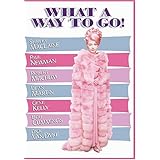
What a Way to Go!

What a Way to Go! is airing tomorrow morning at 8:00 AM over on the Fox Movie Channel.

Shirley MacLaine stars as Louisa, a woman who at the start of the movie wants to donate all of her wealth to the US Government. The IRS thinks she's crazy, and send her to a psychiatrist, Dr. Stephenson (Bob Cummings) to have her head examined. (In real life, the government actually has an address for those who want to make donations to the Treasury. I don't think they would have turned her down. But then we wouldn't have much of a movie.) It turns out that she's a widow worth a good $200 million, left to her by a series of husbands who died. So, obviously, we're about to have a flashback to how Louisa became wife to all these men and how they left her that fortune....

Louisa spent her childhood in one of those typical for the movies Midwestern towns, with a mother (Margaret Dumont) who claimed to follow the Christian precepts about the love of money being the root of all evil and all that stuff. In fact, she was a hypocrite, berating her husband for not being financially successful and recommending that Louisa get married to the man pursuing her. That man is Leonard Crawley (Dean Martin), who owns the local department store and making a fortune because none of the other stores in town can compete. Louisa doesn't like him, and instead falls for Edgar Hopper (Dick Van Dyke), who owns a not very successful store but is happy with the simple life. That is, until he marries Louisa. For a while they live happily together, like in one of those old silent movies, but when he gets humiliated by Crawley one time too many, Edgar gets the idea that he needs to provide better for Louisa, and proceeds to start working. He works and works and works, which makes Hopper's a successful business to the point of driving Crawley's out of business, but it takes all of his time away from him so that he's only at his job and never with Louisa. In fact, all of this work will be the death of him, as he drops dead on the job, leaving Louisa with a couple million dollars.

Louisa puts the money in a bank, living off a small allowance which she uses to take a trip to Paris. There, she meets Larry Flint (Paul Newman), who doesn't do porn but is instead a starving artist who, like Edgar initially was, is happy with his station in life. Louisa, seeing this as a change from Edgar, makes Larry Husband #2. You can probably guess what happens next. A series of coincidences leads to Flint's art being shown at a fine gallery and made the toast of Paris, which means that Larry gets rich too, just like Edgar. However, it also means that he has to spend more and more time with his art and not with Louisa, which, as with Edgar, eventually leads to his untimely death, but also leaves Louisa with more millions.

At the airport on the way back to the States, Lousia meets the man who is about to become Husband #3, Rod Anderson (Robert Mitchum). Rod is already rich, which is obviously a turnoff to Louisa. But you know that they're going to get married anyway. In fact, once Rod and Louisa marry, Rod becomes less interested in his business and more in lavishing Louisa with whatever she wants. Of course all this backfires, and Rod eventually dies young too. Ditto Husband #4, Pinky (Gene Kelly) a failed nightclub actor who's only got a job because his act is a failure -- that is, until Louisa unwittingly does something to make it a success. Pinky then goes on to become a big success until he too dies, which takes Louisa to the present day, back to Dr. Stephenson's couch.

What a Way to Go! is advertised as a black comedy, and while there are certainly a lot of comic elements, both black comedy as well as parody, the movie is just as much a fantasy in that the lives with the four husbands are thoroughly unrealistic and presented that way. Louisa describes each of the four marriages as being idyllic, like a certain genre of movie. I mentioned the silent movie for Edgar; there's also a French movie for Larry, one of those lavish 1950s Technicolor dramas with Rod; and a musical (choreographed by Gene Kelly, of course) with Pinky. The movie-within-a-movie for her marriage with Rod is particularly fun, as Louisa is shown in dress after dress after dress, which are increasingly over the top in their frilliness and garish colors.

Does the movie work? For the most part yes, as long as you know what you're in for. There are times when the comedy is just a little too wacky. But if you know that there's parody coming in spades along with the homages to filmmaking of the past, the movie does a good job with those things. MacLaine and Van Dyke both do a good job acting in the silent movie style; Newman and Mitchum do well as a foil for all the comic stuff going on around him, while Kelly is more or less playing himself. There's nothing deep about the movie, but it's entertaining enough.

What a Way to Go! has receieved a DVD release, but I'm not sure if it's still in print.

Tuesday, April 12, 2011

Nowadays it would be a text message

TCM's Star of the Month for April is Ray Milland; he's getting a bunch of movies every Tuesday night this month. Tonight's salute to Milland brings a number of his suspense films. Surprisingly, I don't think I've ever recommended Dial M For Murder before; that's airing at 10:00 PM ET.

Milland plays former tennis pro Tony, who's married to the lovely Margot (Grace Kelly) and living in London. However, he suspects that she's having an affair with an old friend from America, mystery writer Mark (Robert Cummings). Tony is right that Margot is still in love with Mark, so Tony comes up with an elaborate plan to get Margot bumped off, which involves blackmailing one of his old friends from school, who will take Tony's key to get into the apartment and then strangle Margot. However, the plot goes wrong: instead of Margot winding up dead, she's able to grab a pair of scissors off the desk and stab her assailant in the back, killing him and leaving him on the floor of their apartment, which presents a bit of a problem for Tony.

However, quick-thinking Tony gets an idea: he'll pin the killing on Margot, suggesting that she did it because she was trying to kill a blackmailer. Having there be a motive other than pure self-defense means that Margot can be found guilty and sentenced to be executed, which for Tony is just as good as if the original assailant had killed Margot. And the plan would work too, if it weren't for those meddling kids -- or, at least, that meddling American mystery writer.

Dial M For Murder may not be Alfred Hitchcock's masterpiece, but it's one of the many very good movies that he made. It's never less than entertaining, and despite some gymnastics necessary to guide the movie through its limited setting (most of the film is set within Tony and Margot's apartment), it inventively solves most if not all of the plot holes and reaches its natural "crime does not pay" ending in a satisfying manner. The acting is nothing memorable here, but then, it's all in service of the story, which is the more important thing for a movie like this. And the story delivers.

Two other interesting bits about the movie: as I mentioned back in November 2009, the scene in which Milland tries to phone his wife from the club has an obvious prop. Second, the movie was originally supposed to be in 3-D, back in the 1950s incarnation of that overrated technology. The one scene where this is most obvious is when Grace Kelly is reaching for the scissors on the desk; it's shot in such a way that Kelly's hand appears to be coming out of the screen toward the audience.

Monday, May 3, 2010

Moon Over Miami

TCM is showing several bright color musicals from the 40s tonight. Among them, they got the rights to broadcast one from Fox: Moon Over Miami, at 9:45 PM ET.

Betty Grable and Carole Landis play a pair of sisters working at a drive-in diner in Texas when they learn of the passing of a wealthy relative, who has left them $55,000, a fairly substantial sum for the early 1940s. Unfortunately, they quickly discover that's the amount he left them before tax. Estate tax, probate fees, and the lawyers' cut take the vast majority of that money, leaving the two sisters and their aunt with just over $4,000. It's not really enough to live on, so Grable gets an idea: the three of them should go to Miami, where she'll pretend to be wealthy, all the while playing golddigger to look for a wealthy man. So, off the three women head, Grable playing the rich one, Landis her secretary, and Aunt Charlotte Greenwood her maid.

Once in Miami, they quickly get a bottle of champagne from wealthy Bob Cummings, who invites Grable over to his bungalow for what looks like the remnants of a wild party. Cummings proceeds to pursue Grable, but isn't alone in this, as fellow wealthy businessman Don Ameche is also in town looking for a woman, and has his eyes on Grable. The result is a fairly standard story, with the two men each trying to outdo the other, secondary romances for Landis and Greenwood, everybody trying to cover up their lies, the requisite amount of music, and the obligatory happy ending.

Moon Over Miami is nothing groundbreaking. What it does have is Betty Grable in spades; she was quite popular back in the 1940s and Fox made musical after musical with her in an attempt to cash in on that popularity. The music may not be up to the standard of a Johnny Mercer, but is passable enough. Perhaps best, though, is the location shooting. There's quite a lot of outdoor scenes, and many of these were filmed at various places in Florida. That opportunity to see at least a bit of Florida as it was in 1941 is by itself worth watching the movie at least once. (There is a Traveltalks short made around the same time on Florida, but TCM doesn't have that listed on the schedule, despite having a 90-minute movie start at 8:00 PM, and a good 10 minutes after Moon Over Miami before the next movie.

Moon Over Miami has been released to DVD, both on its own and as part of a box set of Betty Grable movies.

Monday, July 14, 2008

Bastille Day

July 14 is Bastille Day, the French national holiday, marking the start of the French Revolution in 1789. TCM has been celebrating the day with an entire morning and afternoon of movies set against the backdrop of the French Revolution: two versions of Charles Dickens' A Tale of Two Cities, and the Norma Shearer biopic Marie Antoinette feature prominently. A very interesting "little" picture, however, that wouldn't get as much attention, is The Black Book.

The Black Book deals specifically with the end of the Reign of Terror, the period in 1793 and 1794 when Maximilian Robespierre (played here by Richard Basehart) was running the Revolution with a ruthless iron fist. The "black book" refers to Robespierre's "enemies list", which Robespierre intended to use to trump up charges against his political enemies and consolidate his political power as dictator. Whether or not the real Robespierre had the names in a book form is a matter for debate, although he almost certainly did have an enemies list. But it's convenient for the sake of a Hollywood movie that there actually be a physical black book.

The actual plot of the movie is told almost as an adventure story/thriller, with the enemies of Robespierre desperate to get their hands on the black book, and Robespierre having claimed the book has been stolen by his enemies and that he needs it back. Given the task of finding the black book is the chief prosecutor of Strasbourg, a certain M. Duval. However, he gets killed at the beginning of the story by our hero, played by Bob Cummings, who then assumes the identity of Duval.

The story is quite a fun one, with lots of twists and turns, and narrow escapes. Since the essential plot elements all deal with crossing and double-crossing ones enemies, and pretending to be somebody other than who you really are, it can get a bit difficult to figure out what's going on. However, since it's got a lot of thriller elements to it, the complexity (or should it be duplicity) actually adds to the experience.

What really detracts from the story, hoewver, is the copy of the print. The movie was made by tiny Eagle-Lion films, originally under the title Reign of Terror, and later re-released with the title we see on TCM's presentation and the DVD. Obviously, the movie must have fallen into the public domain at some point, as the print is a very bad TV print, very murky and with relatively poor sound quality. This is a huge shame, since the story is quite good and told very well. In addition to the fine leads of Cummings and Basehart, there's Arlene Dahl playing the female lead, Norman Lloyd (the bad guy in Alfred Hitchcock's Saboteur) as one of Robespierre's enemies, Charles McGraw (the male lead in The Narrow Margin) in a smaller role as a sergeant, and veteran character actress Beulah Bondi as an elderly farmer who shelters Cummings and Dahl.

If you can stand a movie with a terrible print quality, I can strongly recommend The Black Book.

Saturday, May 24, 2008

Please Release Me, No. 3

This being Memorial Day weekend, it's the perfect time to fire up the grill, or, if you're in a warmer clime, get away to the beach for a weekend. In the years leading up to World War II, however, when suburban living for the middle classes had not yet become the standard, resorts were closer to home: New Yorkers might go to Altantic City, the "Borscht Belt" resorts in the southern part of the Catskills, or maybe even the Poconos in Pennsylvania. It you weren't so well off, you might just spend a day at Coney Island. One classic pre-War movie with a Coney Island scene is The Devil and Miss Jones. Sadly, it's not available on DVD -- and it's a smart little comedy that really should be. It's just as fun now as it was when it was released in 1941. Jean Arthur gets the "starring" billing as Miss Jones, but she's really not the star of the movie. That would be male lead Charles Coburn. Coburn plays J.P. Merrick, the "richest man" in New York. He's so rich, he's got holdings he doesn't even know about, such as a department store whose workers are protesting their working conditions by burning him in effigy. Merrick hires detectives to figure out who's behind the workers' rebellion, but when they can't give him a satisfactory answer, he decides to take matters into his own hands by going undercover and taking a job in the department store under the name Tom Higgins. You can imagine the humor inherent in a crotchety old man with no sales experience working as a shoe salesman -- indeed, in one scene, Merrick hires his butler to bring a young girl in and buy her five pairs of shoes to show that he can sell even to the most difficult customers. But there's a lot more, as we get two romantic stories. Arthur's Miss Jones feels sorry for "Mr. Higgins", little realizing that her relationship with union organizer Joe O'Brien (Bob Cummings) could get her in serious trouble. Also feeling concern for "Higgins" is an older lady employee, Elizabeth Ellis (played by Spring Byington). And naturally, she falls in love with him, despite hating rich people: of course, she only sees Coburn as Higgins, not as Merrick, and so doesn't know the truth about him. The movie having been released in 1941, everything is handled with a light touch; no big social messages here. In fact, modern audiences might find the ending a bit of a deus ex machina. But the performances are all wonderful. Charles Coburn is quite skilled at comedy, and earned an Oscar nomination for his part -- although it was only in the Supporting Actor category; a bit of a surprise, since Coburn's role is much too big to be considered a supporting role. (Coburn would later win an Oscar for another comedy, The More the Merrier, also starring Jean Arthur; The More the Merrier is available on DVD for those who wish to see Coburn's comedic talents.) In addition him and the aforementioned Arthur, Cummings, and Byington, there's veteran character actor S.Z. Sakall playing Coburn's butler; William Demarest in a brief role as one of the detectives, and the usually-likeable Edmund Gwenn playing against type as Hooper, the nasty boss of the shoe department. Not only is the acting excellent, the script is a gem; it's refreshing to see such intelligent comedy. There is a bit of wealthy-bashing, especially at the very beginning of the movie, but it's mostly in the vein of the wealthy not knowing how to act poor, and not any deep social commentary. It's a shame that this isn't out on DVD.