Showing posts with label Olivia de Havilland. Show all posts

Saturday, March 25, 2023

Stanley Kramer makes a medical drama

Whether producing or directing, Stanley Kramer was known for making "message pictures" dealing with important social issues. Sometimes, his style was blunt enough that the message came across as more important than the picture. One good example of this is Guess Who's Coming to Dinner. This was something I kept thinking about as I was watching his debut directorial effort (although he had already produced several movies), Not As a Stranger.

Lucas Marsh (Robert Mitchum) is a medical student at Big City Medical School, studing under Dr. Aarons (Broderick Crawford) and lightening the mood with his best friend, Alfred Boone (Frank Sinatra, and yes, everybody is pushing 40 and much too old for the parts they're playing). Watch also for a young Lee Marvin as another medical student, although he's not part of the second half of the movie. Marsh is highly driven and pretty darn intelligent, but this causes him to clash with the established doctors. To be fair, part of this is that they may not be up to date on the latest medical techniques.

Also causing problems for Marsh is his father (Lon Chaney in a small role). Marsh's mom died some time back and left him a fair amount of money which should help pay for medical school. But Dad is an alcoholic, and drank away the money, leaving Lucas with no money to pay his upcoming tuition. Thankfully for him, however, he does meet somebody who has a little bit of money saved up. That's nurse Kirstina (Olivia de Havilland), who has been saving up money, and who for some reason is part of the Swedish immigrant community along with Oley (Harry Morgan), forcing her to essay a ridiculous Swedish accent for no discernible plot reason. Lucas marries Kristina for her money.

Eventually everybody graduates from medical school and does their internship before going into practice. Alfred decided to go the route that Robert Donat did for a while in The Citadel, of becoming a wealthy doctor in private practice, although he's going to remain Lucas and Kristina's friend and show up when necessary to advance the plot. Lucas, on the other hand, decides to go to a small town that looks partly like a studio backlot and partly like a smaller city than a small town. There are some farmers around, and Lucas will certainly be serving them, but there's also a surprisingly well-equipped hospital and some ritzy areas.

The ritzy areas and farm life come together one evening when Marsh goes out to attend to a farmer who got kicked by his horse. The farmer's wife says that Miss Lang (Gloria Grahame) wants to see him, even though it's 1:00 AM. Now when you see the name Gloria Grahame in the credits, you can guess that the character is a bit of a vamp, or a femme fatale. Well, more than a little bit. Lang lives in a big house with a sort of hobby horse-raising concern attached to it, and she leads a lonely life drinking more than she should. You can guess that Lucas is going to find himself falling in love with her, and that this is going to cause a problem with his marriage to Kristina.

I mentioned at the beginning that Stanley Kramer made a bunch of message pictures, and boy does he try to insert as many of the medical drama tropes as he can to get The Message across. At times this makes the movie become unintentionally funny. There are montages of the doctors treating patients which look like they could have come from a medical issue of the week TV drama. Worse, or more hilarious depending on your point of view, is Kramer's use of horses when Marsh finally falls and becomes unfaithful with Lang. There's also the blatant foreshadowing. Kristina talks so much about having a family that you know that she's going to get pregnant, and it's obvious way before we see the scene of Dr. Boone telling her that it's already happened.

The casting is also interesting. Robert Mitchum is clearly miscast, much like epileptic research scientist Ronald Reagan in Night Unto Night. And as I mentioned, why Kramer made de Havilland and Harry Morgan take on Swedish accents was beyond me. On the other hand, Broderick Crawford shows he could play more than tough guys. Charles Bickford plays the elderly small-town doctor who takes Marsh into his practice, and he does well too.

Overall, Not As a Stranger is a movie that's more interesting for how it lets The Message dominate the movie than it is for being any sort of truly great movie. But it's still worth a watch.

Saturday, November 5, 2022

The Male Animal

After all off the kerfuffle over the schedule for the end of Daylight Savings Time dies down, you can sit down to watch The Male Animal, at 8:00 AM Sunday, Nov. 5.

The inventively-named Midwestern University is one of those big state schools out in the US midwest where college football is just as important as academics, and the movie starts off on the day before the big game, oddly enough against a real school, the University of Michigan. Tommy Turner (Henry Fonda) is an assistant professor of English at the university who is up for a full professorship, which would please him since he'd like to be able to support his wife Ellen (Olivia de Havilland) better. But there are going to be a couple of problems along the way.

Both are ultimately based on the fact that Turner seems to be more interested in academics than anything else. Definitely he's cares less about football. Joe Ferguson (Jack Carson) was the big star of the team a decade ago, and he's back in town to watch the big game, living in Pittsburg with a marrige that doesn't seem to be going so well. Back in the day, Joe had at least a bit of interest in Ellen, and he was actually able to dance with her, something Tommy doesn't seem to care so much about. Tommy worries that Joe would be more appropriate for Ellen than he is, and that the two are going to wind up together.

And then there's Tommy's lack of interest in office politics. One of the students, Michael Barnes (Herbert Anderson), has written an article for one of the student magazines about what a bunch of fuddy-duddies the trustees, led by Mr. Keller (Eugene Pallette) are. And Michael specifically singles out Turner for tweaking the trustees, as Turner's freshman composition class is going to be reading a letter written by anarchist Bartolomeo Vanzetti (of the Sacco and Vanzetti trial) as an example of good composition by someone who wasn't a professional writer, or even writing in his native language. In theory this shouldn't be a big deal, but free speech and academic independence have always been a big issue on college campuses. Heck, they still are today, just with a different set of views that will get you in hot water. The trustees decidedly want "American" values, in an era when that clearly didn't include socialists and anarchists.

Rounding out the movie is the existence of a second love triangle among the present-day students. Michael is interested in fellow student Patricia Stanley (Joan Leslie), but she seems more interested in the jocks, enjoying the temporary presence of Joe but really desiring present-day football hero Wally (Don De Fore).

As I was watching the movie, I couldn't help but think the presentation looked a lot like a play that hadn't been opened up enough for the screen which doesn't have the limitations that the stage does. Sure enough, The Male Animal had been a Broadway play by James Thurber and former movie actor Elliott Nugent, who took the Henry Fonda role in the play and actually directs the movie. But the much bigger problem is that the characters all seem like unrealistic caricatures, given unbelievable dialog. They're also generally not terribly likable. So it made the movie quite a slog for me.

That's a bit of a shame since the stars all do a professional job with the material they're given; it's just that for me it's decidedly sub-par material. As always, however, you may want to watch and judge for yourself.

Wednesday, January 19, 2022

The Great Garrick

Another movie I watched recently was the period comedy The Great Garrick, which as far as I can tell received a DVD release courtesy of the Warner Archive.

Brian Aherne plays David Garrick, a real actor on the British stage in the middle of the 18th century, and apparently one of the most famous actors of his day. At the start of the movie he's just finishing up playing a season of Hamlet at London's Drury Lane Theater, which again we're to presume is one of the most prominent theaters in London, and hence all of Great Britain (and even the world). But Garrick tells the audience that it's his last performance in London for a while because he's received an invitation to perform with Paris' equally famed Comédie Française.

Garrick's London audience is enraged, taking it as a personal affront that he possibly thinks French actors are more worth acting with than the English. Garrick decides that the way to get out of this is to say that no, the French aren't really good actors, and that he's going to be going to Paris in order to give them a lesson on what good acting is. Somehow, this immediately changes the opinion of an audience that had no good reason to be ticked off anyway.

Somehow, news of Garrick's comments make it to Paris in those slow transportation days well before Garrick even sets out for France. You'd think they might have heard the whole story, but no. So Picard (Melville Cooper) and Beaumarchais (Lionel Atwill), heads of the Comédie Française, decide that they're going to teach Garrick a lesson rather than just rescinding the invitation. They know Garrick's itinerary once he crosses the English Channel, so they know exactly which road house he and his valet Tubby (Edward Everett Horton) are going to stay at. So they plan to get there first and play the staff and patrons of the place, putting Garrick in a compromising situation.

Now, it probably ought to be obvious to anybody that there's something amiss, as these French actors are playing the most wacky, over-the-top characters. And indeed, Garrick does figure it out pretty quickly. He decides that he's going to get back at them by showing them what true acting is.

But there's a complication. Among the people at the inn is Germaine (Olivia de Havilland), claiming to be a countess whose father has gotten her betrothed to a man she doesn't want to marry in Paris. So she's running away and can't go back to Paris. And she seems afraid of these wacky actors; perhaps Garrick can protect her. Now, Garrick obviously sees Germaine as another member of the troupe and the perfect person to try to get him into that compromising position. But it turns out that Germaine isn't part of the troupe, and actually sincerely loves Garrick. She doesn't know anything about his trying to turn the tables on those other French people, so when that jig is up, she thinks Garrick was exploiting her. By this time, Garrick has realized he's falling in love with Germaine.

The Great Garrick was based on a stage play, and I'm guessing the characters were all written to play to the back of the audience, as they're extremely broad and farcical. And to be fair, the whole act that the French are putting on at the inn is supposed to be bad. But that does make the movie a bit of a slog at times. The actors all do the best they can with the material, with de Havilland coming off best and Edward Everett Horton playing yet another of his comic relief characters.

The Great Garrick is the sort of movie that would benefit from being on a box set instead of at the price point of a standalone Warner Archive disc.

Wednesday, November 24, 2021

They Died With Their Boots On

I mentioned at the beginning of the month when I posted about Star of the Month Sydney Greeenstreet that one of his movies I hadn't blogged about before, They Died With Their Boots On, would be running at 6:00 AM on Nov. 25. That's tomorrow morning, and since I have the movie on DVD as part of an Errol Flynn box set, I made a point of watching it to have it fresh in my mind for a post on the movie.

Errol Flynn plays George Armstrong Custer, who at the start of the movie is entering West Point as a plebe in the summer of 1857. Custer, as presented here, doesn't seem to care much for rules, naïvely thinking that he'll be able to bring his hunting dogs with him and get the biggest suite in the barracks, egged on by upperclassman cadet Ned Sharp (Arthur Kennedy). This is just the first of many, many incidents in which Custer will pick up demerits, he being constantly wary of authority.

One of those incidents results in his having to march guard, basically marching back and forth and having to keep his mouth shut. Elizabeth Bacon (Olivia de Havilland) is a young woman from the same town as George, Monroe, MI. But she comes from the well-to-do part of town while George was a blacksmith's son, so there's a class difference that her father may not approve of. Of course, it's going to take a while for George and Elizabeth to meet each other again.

1861 comes, and this of course means the start of the Civil War. All of the cadets from the South leave West Point, while those in Custer's class are still a year away from graduating (at the time, West Point was a five-year school). The Union was badly in need of junior officers, so they took the West Point cadets and graduated them a year early. Custer fights in his own iconoclastic way, eventually rising to the rank of brevet general, although that's not a full general but only a temporary rank. So when the Civil War ended, he was returned to his regular rank of Captain and sent back to Michigan with the thanks of a kind nation.

Having married Elizabeth, who father died soon after the war, Custer is in need of a good job, even though the military is all he really knows. Ned Sharp shows up looking to trade on Custer's name to have it behind a development company looking to develop the Dakota Territory. Custer rightly doesn't trust Sharp one bit, and refuses, instead looking to get put back into regular service.

Custer does, in fact, get promoted to Lieutenant Colonel and sent as a cavalry commander west... to Fort Lincoln, which is in the Dakota Territory and where Ned Sharp just happens to be. Custer finds all sorts of chicanery going on, including with the Indian agent for the region, which causes him to try to take his case to Washington. Ned and the agent are trying to get the treaty with the Sioux and other tribes abrogated so they can bring more white settlers onto the land, from which they hope to make a hefty profit. Custer's patrols eventually take him to the Little Big Horn in eastern Montana, and his unorthodox command style finally does him in.

Pretty much anybody who has a good knolwedge of history and who has seen They Died With Their Boots On will tell you that the movie is more or less a whitewashing of history, along with a hefty dollop of Hollywood tropes deemed necessary to entertain the viewers. I can certainly say that the tropes are laid on in grand style, from the romance between Flynn and de Havilland to Hattie McDaniel as the Bacons' servant, to the whole military gallantry.

From what I've read, the real life Custer was indeed a discipline problem and unorthodox. There might actually be room for an interesting movie about the question of unorthodox command when the battle is actually raging and the communication lines break down. It's generally presented in World War II movies that Nazi generals were fairly rigid, with American initiative and ingenuity winning the day. But when is it right to take that initiative, and when not?

Also, in later years there were a lot more westerns about how the Bureau of Indian Affairs was cheating the Indians blind, something we wouldn't get in pre World War II days. The real-life story of Custer seems interesting in that the corruption apparently ran all the way up to the Secretary of War (nowadays Secretary of Defense) and President Grant's brother; Custer was a witness in the impeachment proceedings of the Secretary of War and arrested when he wanted to return back to his post out west instead of staying around to testify when he thought his written testimony was enough. There's material for a Tennessee Johnson type movie there, but nobody in Hollywood ever thought to make it.

What we do get, however, is more than worth watching as examples of what Flynn and de Havilland could do, and on the whole an example of what the studio system could put out. Just don't expect real history from They Died With Their Boots On.

You'll note that I haven't brought up Star of the Month Sydney Greenstreet once. That's because he's got a smaller role as General Winfield Scott, fighting the war from central command in Washington. He has a few scenes during the portion of the movie covering the Civil War, but once the war ends, he's pretty much out of the picture.

Sunday, August 1, 2021

The Ambassador's Daughter

If you've ever watched Three's Company, one thing you can't help but admit is that the plots of mistaken identity and misunderstandings are thoroughly unoriginal. For some reason, I found myself thinking of Three's Company as I was watching The Ambassador's Daughter.

Olivia de Havilland plays the daughter here, and frankly she's much too old for the part, but that's another story. She's Joan Fisk, daughter of post-war US Ambassador to France William Fisk (Edward Arnold). They're visited by a US Senator, Jonathan Cartwright (Adolphe Menjou) and his wife (Myrna Loy), doing the sort of visit that Jean Arthur was making to Berlin in Billy Wilder's A Foreign Affair. Specifically, Sen. Cartwright is concerned about the plethora of American GIs who are taking their furloughs to go to Paris and cause difficulty for all the French folks there. So he thinks the military should make Paris off-limits to American servicemen, and is trying to get General Harvey (Minor Watson) to do just that.

The ambassador isn't so sure, and his daughter decides that she'll offer to do some undercover research to discover just what American serivcemen are like, by pretending to be French and dting a visiting serviceman for the duration of his furlough. And wouldn't you know, she's quickly going to get the chance to do just that. A charity fashion show is going to be given to raise money for the American Red Cross' work in France, with various socialites playing the part of the models. Crashing their way into the audience for the show are two GIs, Sgt. Danny Sullivan (John Forsythe) and his best friend Cpl. Al O'Connor (Tommy Noonan).

Danny sees Joan, who is one of the models, and falls for her, while she puts on her best French accent and does nothing to disabuse Danny of the belief that she's a model for Christian Dior. So she willingly goes around Paris with him, although we of course know the real reason she's doing it. Gen. Harvey, meanwhile, brings Al back to the US Embassy, where he promptly has too much to drink and spills the secrets of things American servicemen do to try to win the hearts of European women.

Unsurprisingly, Sgt. Sullivan unwittingly does some of the same things, but out of pure innocence, having no idea that he's falling into a trap that Cpl. O'Connor has unintentionally set. When Joan learns of what Al has told the Senator and the Ambassador, she's ticked off because she wanted to help the servicemen keep their right to visit Paris, and look what they've done to her. But she also does something which leads to a misunderstanding. Danny decides to go to the Christian Dior house to look Joan up, and she, not actually being a model, shows up with the Senator to try to get him to buy a dress that he saw at the Red Cross fashion show for Mrs. Cartwright. Danny sees this, and thinks that Joan is two timing him with a sugar daddy.

Eventually, it all gets worked out for the best, although there's also the added complication of Joan having a fiancé in the form of a now-stateless prince (Francis Lederer). But boy does it take a long time to get there and do so unoriginally.

Olivia de Havilland had recently married a Frenchman and started living in Paris at the time the movie was made, which I'm sure is a large part of the reason why the movie got made at all. She was there, and it was a way for everybody else to get a working vacation in the City of Light. The establishing shots of Paris are lovely, but that's probably the best thing that can be said about the movie. The plot strains credulity and feels like a mish-mash of romantic misunderstanding movies that had been done at least since the start of the screwball era (although The Ambassador's Daughter is not a screwball comedy by any means).

Completists of any of the main cast members may want to see The Ambassador's Daughter, but for everybody else, I'd recommend a whole bunch of their other movies over this one.

Monday, April 26, 2021

Devotion (1946)

I had two movies on my DVR titled Devotion, with different stories. The early talkie version doesn't seem to be on DVD, but the 1946-released movie titled Devotion is, so I watched that recently to do a review on here.

The Brontës are a family living in Yorkshire near the moors in the 1830s, where their father (Montagu Love) is a reverend in the Anglican chuch. There are four surviving children, daughters Charlotte (Olivia de Havilland), Emily (Ida Lupino), and Anne (Nancy Coleman), along with son Branwell (Arthur Kennedy). (In real life there were two older daughters but they, like all of the siblings, died young.)

As you probably know, all three of the surviving daughters liked to write, while Branwell liked to paint, as well as drink. Charlotte and Anne are set to go off to become governesses, while Emily stays to look after Branwell. He gets drunk one night at the local inn just as a new curate, Rev. Arthur Nicholls (Paul Henried) shows up to work alongside the overworked Rev. Brontë in the parish. Rev. Nicholls brings Branwell home, but Emily thinks Nicholls is one of Branwell's drunkard friends.

Emily has on again-off again feelings toward Arthur, until Charlotte shows up back home. The three sisters finally think about publishing some of their poetry, although they do it under male pseudonyms since apparently the thought of women writers, at least from outside the gentry, was somewhat scandalous. Not as scandalous as Branwell's behavior, mind you, but scandalous nonetheless.

Emily and Charlotte go off to Brussels to teach in a school there, where they meet married headmaster Constantin Heger (Victor Francen). Charlotte is portrayed as having a crush on Heger while Emily has more muted feelings for him, although this is probably just Hollywood hogwash from what I've read. Branwell has another bout of illness that forces the sisters to return home, just in time for him to die.

As you know from real life, Emily became famous for writing Wuthering Heights and Charlotte for Jane Eyre. Charlotte goes to London after Jane Eyre has been published under the pseudonym Currer Bell. There she meets William Thackeray (Sydney Greenstreet), author of successful books like Vanity Fair. He learns the secret of the Bells which is that they're actually women, and thinks that Emily's writing is more powerful than Charlotte's, not that he dislikes Charlotte. And then Emily gets sick too....

As with most Hollywood biopics, from what I read, there's a lot in Devotion that's exaggeration at best and made up out of whole cloth at worst. As a movie, however, Devotion is an interesting jumping-off point if you want to learn more about the Brontës. Arthur Kennedy looks like he's channeling MGM contract player Van Heflin here, although since the movie was made at Warner Bros. they probably couldn't get Heflin. In fact, although the movie was released in 1946, it was actually made early in 1943 and shelved for a couple of years, possibly because of de Havilland's lawsuit against Warner Bros. (Indeed, Montagu Love died in 1943, long before the movie was released.)

De Havilland and Lupino both do reasonably well, although some people might find the material a little beneath them what with Hollywood's changing biographies around for dramatic effect. It all winds up feeling like material that should have been handled by MGM since they still had the gloss necessary to put this kind of movie over. Devotion isn't bad by any means, but it feels like it could have been so much more.

Wednesday, April 14, 2021

Don't call it "Slander"

In TCM's 31 Days of Oscar, we're about to get up to the letter L, which includes the movie Libel, on tomorrow morning at 6:00.

Paul Massie plays Jeffrey Buckenham, a Canadian pilot on a layover in London. While in a pub, he sees a TV program about the gret old manor houses of Britain. This episode focuses on Sir Mark Loddon (Dirk Bogarde) and his wife, Lady Margaret (Olivia de Havilland). That's something which really intrigues Jeffrey, for reasons that will become clear in a short while.

The Loddons have periodic guided tours of the estate in order to defray the costs of living there, and Jeffrey comes to one of those tours, more as a way of seeing Mark in the Loddons' private residence after the tour. It turns out that both Mark and Jeffrey served in World War II, and wound up in the same POW camp. Mark's bad experiences in the camp resulted in his only having sketchy memories of a lot of things that happened when he was younger before the War, which would explain why he doesn't recognize Jeffrey despite the fact that they escaped together.

When Jeffrey sees Mark's hand and sees that Mark has lost the first joint on one of his fingers, his suspicions are confirmed: this isn't Mark Loddon, but an impostor, Frank Welney. Frank was the third member of the escape, and an actor who had lost a joint on that finger. In Jeffrey's view, Frank's actions during the escape were less than honorable and resulted in Mark's death. So Mark writes an open letter to one of the Sunday tabloids.

Mark doesn't like that the letter was printed, and especially doesn't like the resulting publicity. In theory, they could just ignore it as the writings of a crank, but then what effect would it have on Mark and Margaret's son? So Mark makes the difficult decision to sue for libel, since the libel laws in the UK are rather more generous toward the putative victim than in the US. But the problem with taking the case to court is that a whole bunch of uncomfortable stuff is going to come out into the public, and with Mark having all sorts of memory holes thanks to that POW experience, who knows what's really going to come out.

Sir Wilfred (Robert Morley) is Sir Mark's barrister, while Hubert Foxley (Wilfrid Hyde-White) is Jeffrey's. At the trial, we get the views of both Jeffrey and Mark about what heppend both while they were in captivity, and that pivotal escape attempt, told in flashback. It's clear that Jeffrey thought even while they were all in captivity that Welney was a chancer who was trying to learn as much as possible about Mark's past life in order to kill Mark when the opportunity presented itself and take over Mark's identity. That opportunity would, in Jeffrey's view, present itself during the escape attempt.

Libel is a well-acted movie, albeit one with what seemed to me a glaring plot hole. Surely the British military would have had either fingerprint records of everyobdy under arms, or dental records, or both, in order to aid with identification of the killed in action if dog tags or other ID went missing. It should have been a fairly simple thing to check against those records. (A quick search suggests the US Army started fingerprinting soldiers all the way back in 1905; I couldn't find similar information for the UK.) I had other problems with the script, too, which is a shame since the actors all did a fine job.

Libel was produced by MGM's British arm, so it's no surprise that the movie has received a DVD release from the Warner Archive.

Tuesday, February 16, 2021

You still gotta stay happy

Back when Olivia de Havilland died, TCM replaced a day in Summer Under the Stars with a day of her movies, which gave me the chance to DVR a couple that I hadn't seen before. One of those, Princess O'Rourke, is on again tomorrow at 12:15 PM, so I sat down to watch it and do a post on it here.

Olivia, as you can guess, does play the princess, but her name isn't O'Rourke. She's Princess Maria, who at the start of the movie is the princess of some unnamed central European country that's been overrun by the Nazis, the movie having been released in 1943. The royal family has been forced to flee, with Dad in exile in London and Princess Maria, together with a secretary and an uncle, Holman (Charles Coburn), holed up at a hotel in New York (I'm guessing they don't control the embassy in Washington).

Maria is bored in New York, and has a count she doesn't care for pursuing her because the royal family needs a suitable marriage. Holman decides that the best thing to do would be to send Maria out west, since the royal family has some friends in California who have a ranch. It would be a nice change of pace for Maria, as well as a way to get her out of the spotlight for her own safety should the need arise.

The only problem is that she's going to have to fly out to California, something that she's rather afraid of doing. Holman and the secretary come up with the brillian idea of giving her a sleeping pill before the flight, so that she'll sleep through the flight (a redeye with train-like sleepers) and wake up in California refreshed.

But it doesn't work out like that. Maria can't sleep, so first she asks the stewardess for a sleeping pill. She still can't sleep, so now it's the turn of co-pilot Dave Campbell (Jack Carson) to give her a pill. When that still doesn't seem to work, she asks the pilot, Eddie O'Rourke (aha! there's the O'Rourke, played by Robert Cummings), for a pill, and he gives her two.

The pills eventually do the trick, and perhaps Holman should have told her in the first place that it wasn't going to be instantaneous. But taking five of them really knocks Maria out, to the point that when the plane hits fog and has to turn back to New York, she doesn't realize the plane has landed, and can't wake up. And when she finally does, it's left her with a cloudy brain such that she can't remember where she's staying.

So O'Rourke puts her up at his place for the night, since Dave has a wife in Jean (Jane Wyman) and Eddie has the room, although Eddie asks Jean over to change Maria into something more appropriate for sleeping.

You can probably guess more or less what happens next. Maria likes this way of being incognito, so after she leaves Eddie's place, she escapes the hotel to go see him again. He wants to see her, anyway, not realizing she's a princess, and so begins a beautiful love relationship.

Well, that's how it begins, but it's going to take some twists and turns before it gets to the end. The big one, of course, is what's going to happen when Eddie finds out that Maria is in fact a princess. Perhaps thankfully for him, he comes from a long line of sons, leading Holman to believe that he's likely to produce a son for the royal family, which after all is the chief duty of a Prince Consort. But is Eddie going to want the sort of life that a Prince Consort has to live? And is Maria going to want that sort of life for Eddie?

For unsurprising reasons, Princess O'Rourke made me think of You Gotta Stay Happy, which I blogged about not too long ago. Both are about a pilot falling in love with a rich woman, and they have the sisters Olivia de Havilland and Joan Fontaine. But of course there are a lot of differences, with the big one here being that Princess O'Rourke has the heavy hand of World War II hanging over it. Well, maybe not heavy in that it doesn't do anything to harm the movie; just that it gives the movie a completely different tone. It mostly works for Princess O'Rourke, and while it's certainly not the greatest movie in the careers of any of the main stars, there's nothing notably wrong with it.

If you want a change of pace from Olivia de Havilland, you could do a lot worse than to watch Princess O'Rourke.

Sunday, November 8, 2020

Hard to Get

Olivia de Havilland died at the end of July, and TCM replaced an entire day of their original Summer Under the Stars with a day of de Havilland's movies, which gave me the chance to record a couple of movies that I hadn't seen before, and certainly hadn't blogged about. One of them is Hard to Get.

De Havilland plays Maggie Richards, elder daughter in a wealthy New York family of the sort that would go off to Newport for the summer. Except that for whatever reason, she decides she's not going to go this year, staying behind with her father (Charles Winninger) while Mom (Isabel Jeans) and her sister Connie (Bonita Granville) head off the Newport only to show up again in the final reel.

Maggie goes off for a drive, stopping to get gas at a service station somewhere in the suburbs which is run by Bill Davis (Dick Powell). Bill is an architect who is running the station because he has plans that the company should be setting up a bunch of Interstate-style service areas with attached motels (although there were no Interstate highways back in those days, of course), somewhat like the desert station we see in Heat Lightning. Anyhow, Maggie doesn't have any money on her, simply expecting to be able to put any purchases on a tab or to be able to come back and pay the next day. Yeah, right, says Bill, who makes her do chores around the station to pay off the debt.

Maggie is irritated by this, so she comes up with a plan for revenge after Dad tells her that Bill was right to do what she did. She finds out about Bill's plans for the service stations, which works to her benefit as Dad is an oilman who knows the people who could put the plan into motion. So she gives Bill Dad's nickname as a password to get in to see him, knowing fully well that Dad only gives that nickname out to his closest friends and is going to be pissed to see this stranger calling him by that nickname. Dad wants to know who gave Bill the name, but Bill isn't going to tell.

Instead, Bill winds up going back and forth between Mr. Richards and Atwater (Thurston Hall), a banker who isn't about to give Bill the time of day either despite Bill's increasingly outlandish schemes to try to get in to see both Atwater and Mr. Richards. Bill gets one of the Richards' maids (Penny Singleton) involved, and as you can probably guess, also starts to fall in love with Maggie along the way. She has fallen in love with him first, but it's going to take until the last reel for the two to wind up together even though we know it's coming.

Hard to Get is predictable but still competently made, which should be no surprise considering the caliber of stars in the lead roles. Watching it, though, I can see why de Havilland is one of those people who tried to break her contract to get better roles. After thinking about her time at Warner Bros., most of her good roles were with Errol Flynn, while her other good roles were at other studios (eg. Gone With the Wind or Hold Back the Dawn). Powell, it feels like, is taking a step down into a programmer with a routine plot and a lot fewer musical numbers for him to sing. However, he did get one classic in "You Must Have Been a Beautiful Baby".

Hard to Get is perfectly passable entertainment, and a movie that's more than worth watching the next time it shows up on TCM. It got a DVD release courtesy of the Warner Archive Collection, although it's another of those movies that would be nice to see in a box set.

Saturday, August 22, 2020

TCM's Olivia de Havilland tribute


Actress Olivia de Havilland died at the end of last month at the age of 104. Since her passing occurred so close to the start of Summer Under the Stars, I wondered whether TCM would just wait until September to do a likely 24-hour salute to her. However, TCM decided to bump what was originally going to be Bette Davis' day tomorrow, August 23, and do a day of Olivia de Havilland instead. The movies they're showing are:


The Male Animal, with Henry Fonda and Ronald Coleman, kicks things off at 6:00 AM.

At 8:00 AM, there's Princess O'Rourke.


Light in the Piazza with Rossanno Brazzi, George Hamilton, and Yvette Mimieux, comes on at 10:00 AM.

In This Our Life follows at noon.
Captain Blood, which teamed de Havilland with Errol Flynn for the first time, shows up at 1:45 AM.


There's more of de Havilland and Flynn in Dodge City at 4:00 PM, and


The Adventures of Robin Hood at 6:00 PM.


Prime time kicks off at 8:00 PM with Gone With the Wind.


De Havilland won her second Oscar for The Heiress, airing at midnight.
Her first Oscar was for To Each His Own, which follows at 2:15 AM.
The final film in the tribute is Hard to Get, at 4:30 AM.

Saturday, November 30, 2019

It's Love I'm After


One of the movies that TCM ran during Bette Davis' turn as Star of the Month that I had not seen before is It's Love I'm After. Since it's available on DVD courtesy of the Warner Archive, I sat down to watch it and do a review here.

Bette Davis is nominally the female lead here, but the story is really about the male lead, Leslie Howard. He plays Basil Underwood, a Shakespearean actor who has had a long love-hate relationship, both personally and professionally, with Joyce Arden (that's Bette Davis). She plays the female leads in Basil's stage productions, and shares a hotel suite with him as they travel on the road. She's a bit tired of this in that she wants him finally to propose marriage to her.

But before that can happen, another woman shows up. That's young Marcia West (Olivia de Havilland), a star-struck young woman who for whatever reason thinks the world of Basil and shows up at his dressing room one night after a performance and carries on a conversation with him while Basil and Joyce are zinging insults at each other through the wall that separates their dressing rooms. Never mind that Marcia is already engaged to be married. Unsurprisingly, Joyce catches a glimpse of Marcia as she's leaving the theater, although she can't be certain Marcia was in Basil's dressing room.

The one person (well, other than Basil and Marcia themselves) who is certain of it is Marcia's fiancé Henry (Patric Knowles). He loves Marcia and doesn't want to lose her to Marcia's fantasy view of Basil, so he goes to Basil's hotel suite to see him after Marcia goes home. By this time, Basil has finally proposed to Joyce, but Henry has a big favor to ask: could Basil show up at Marcia's mansion and show himself to be such a jerk that Marcia's image of him will change? Joyce is certain to be unhappy about it, but Basil knew Henry's father and is certain this is only going to take a couple of hours, so he reluctantly accepts.

Of course, things don't go as planned. No matter what Basil tries, it only seems to solidify Marcia's image of him. And she's also got a batty screwball comedy family, notably bratty eavesdropping kid sister Gracie (Bonita Granville). Further complicating matters is that Joyce shows up at the house, alternatively claiming to be married to Basil already, and being totally willing to give him up to Marcia.

How is everybody going to extricate themselves from the sticky situation? Well, you can probably guess that the movie is set up so that Basil and Joyce are together at the end, as are Henry and Marcia. So the fun is supposed to be in how the two get there. In that regard, however, It's Love I'm After seems slightly off, even moreso than the Warner Bros. screwball comedy I previously recommended, Four's a Crowd. I think that a lot of it comes down to the Marcia character, who is written as a bit of a jerk. (Well, OK, I found her more than a bit of a jerk.) Add to that that none of the four were normally screwball actors, and the problems mount.

Still, everybody tries, and the leads all being professionals, it not any of their faults that the movie has the problems it does. One standout is Eric Blore as Digges, Basil's valet, playing the sort of role he could play in his sleep.

Even though It's Love I'm After was definitely not one of my favorites, you might want to give it a try since it's definitely the sort of movie some people are going to like more than I did.

Monday, November 25, 2019

That time Warner Bros. remade Libeled Lady


Some weeks back TCM ran a day of movies starring Errol Flynn and Olivia de Havilland. One that I hadn't reviewed before was Four's a Crowd, so I watched it to do a post here.

The opening reminded me a bit of Libeled Lady, with the four main characters all walking down the street together. As for the real action, we don't see Flynn or de Havilland first. That honor goes to Rosalind Russell, playing reporter Jean Christy. She's got a great story, but it's not going to be printed, because her publisher, Patterson Buckley (Patric Knowles), is planning on shutting down the newspaper. Jean knows just the editor the paper needs to keep it going, but that's a former editor: Jean's on-again, off-again boyfriend Bob Lansford (Errol Flynn).

Bob, no longer at the paper, made the switch to public relations, handling the affairs of rich people and making them look better in the eyes of a public that didn't necessarily like them during the Depression. He's currently trying to get the biggest target of them all, John P. Dillingwell (Walter Connolly), but Dillingwell has the good sense not to get involved with PR firms.

Bob sees a chance to get a contract with Dillingwell once Jean informs him of what's going on at the paper. He'll have the paper publish a series of nasty stories about Dillingwell, which Bob can then use to get that contract, after which Bob will use the paper to make Dillingwell look good. Of course, that's if he can even get to see Dillingwell in the first place.

When he gets to the Dillingwell place, he mees John's granddaughter Lorri (Olivia de Havilland), and is immediately taken with her. There's only one minor problem: Lorri is currently in a relationship with Buckley! And God only knows what's going to happen if Lorri were to figure out that the PR campaign is solely for the purpose of enriching Bob.

I mentioned in the title of this post, and early on about the opening credits, that the movie kept reminding me of MGM's Libeled Lady from a few years earlier. Unfortunately, Four's a Crowd comes off like the poor cousin of Libeled Lady in any comparison. I can think of a couple of possible reasons for this.

First is that I think Rosalind Russell is really the only one of the four leads who was a natural for the screwball comedy. Everybody else tries, but seems better suited to other genres. Second is the fact that this was made at Warner Bros. Certainly there has to be at least one good screwball comedy to come out of Warner Bros. (maybe The Bride Came C.O.D.?), but Warner Bros. really seemed more adept at social dramas and action, while a glittering comedy like this was more in MGM's wheelhouse.

Still, everybody tries their hardest, and it's not as though Four's a Crowd is a bad movie by any stretch of the imagination. It's just that you get the feeling it could have been so much better. Four's a Crowd is available on DVD courtesy of the Warner Archive, so you can watch and judge for yourself any time you want.

Wednesday, February 20, 2019

Airport '77

Some time back I bought the box set of the four Airport movies. Having done reviews of Airport and Airport '75, it's now time for the third movie in the series, Airport '77.

James Stewart plays Philip Stevens, an extremely wealthy businessman who is taking some of the fine art that he owns and has stored up north, and opening a museum down in Palm Beach, FL. Not only that, but he's inviting a galaxy of VIPs to the opening of the museum and flying both them and the artwork in on his lavishly appointed private 747. Christopher Lee plays businessman Martin Wallace, married to nasty Karen (Lee Grant); Olivia de Havilland and Joseph Cotten are a pair of elegant passengers who last met in London in 1936; Capt. Don Gallagher (Jack Lemmon) is the pilot; and Eve (Brenda Vaccare) is his girlfriend.

Anyhow, with all those rich folks and artwork on the plane, you know it's going to attract people who want to steal the stuff. This time, there's an inside plot involving to co-pilot Chambers (Robert Foxworth). They install some anesthetic gas that they'll be able to run through the ventilation system (they, of course, will be wearing gas masks), knocking the passengers out, and enabling Chambers and his men to fly the plane to a small abandoned airfield in the Bahamas where the paintings will be unloaded.

Or, at least, that's the plan, and it's one that doesn't quite go the way the bad guys had it figured out. After knocking the passengers out, they have to fly low in order to evade radar detection, and when they get into a fog bank, they find an oil platform sticking up out of the ocean at a height where they could run into it. Ultimately, they clip a wing, and are unable to correct out of this, resulting in the plane crashing into the ocean and sinking to the bottom.

Thankfully for the passengers, the bottom isn't so deep that the water pressure would crush the fuselage. That's the one piece of good news they have when they wake up. Well, the other one is that the hijackers are either dead or severely injured so they don't have to worry about that. However, they do have to worry about the panicking passengers; the ticking time bomb of being underwater; and the fact that they're off course so rescue crews don't know where to look. To save the plane, Capt. Gallagher and scuba diver Wallace are going to have to get a dinghy with a rescue beacon to the surface.

Airport '77 is a worthy entry in the disaster genre. It's entertaining, if not particularly great. Still, seeing all the grand old stars together with some then-new ones is always fun. Stewart is underused and given a boring role, almost as if he came in for one or two days to film all of his scenes. Lemmon is surprisingly interesting in a sort of role he never really essayed before. De Havilland and Cotten are nice throwbacks, and Lee Grant is a hoot.

As for the plot, sure it's full of holes and unrealistic, but a movie like this you watch for the stars and the disaster, and in that regard both of them come through. I can certainly recommend Airport '77.

Saturday, June 30, 2018

Anthony Adverse

One of those movies I had known about for a long time only because it's in those lists of Oscar winners is Anthony Adverse. I finally DVRed it the last time it showed up on TCM. It's going to be on again tomorrow at 11:30 AM, which was the impetus for me finally to get around to watching it.

Fredric March gets top billing, although he doesn't show up for quite some time. Instead, we get a long introductory sequence introducing us to Anthony and his backstory. In France circa 1770, Don Luis (Claude Rains) is the Spanish ligate to France, having just gotten married to Maria (Anita Louise). However, he's also busted his foot and has to go to the spa for a spa cure. Maria is perfectly happy for that, since this is an arranged marriage and she doesn't like her creep of a husband. She's been having a torrid love affair with Denis (Louis Hayward), one that results in her getting knocked up. Eventually, Don Luis finds out and kills Denis in a duel. Maria dies in childbirth, and Don Luis leaves the baby at a girls' convent school, and Maria's maid Faith (Gale Sondergaard) with Maria's father John Bonnyfeather (Edmund Gwenn), a British merchant in Livorno (called by the old-fashioned English name Leghorn), Italy.

Long backstory, isn't it. And it's still not over. Ten years pass and the nuns have to do something with the kid, since you can't well have a boy at a girls' school. So they look for a foster parent among the British merchants to whom they can apprentice the boy, whom they named Anthony since the boy was dropped off at the convent on the feast day of St. Anthony. Bonnyfeather immediately recognizes the resemblance between the young boy and his dead daughter, although how the kid grows up to look like Fredric March is a mystery to me. Faith, on the other hand, is pissed. She knows the kid is a danger. She was slated to receive the bulk of the Bonnyfeather estate if John died without a biological descendant, but now there's this damn kid. And don't you know that John wants to make Anthony his chief heir.

Anthony grows up and falls in love with the chef's daughter Angela (Olivia de Havilland, turning 102 tomorrow unless she drops dead in the next 24 hours), who wants to be an opera singer. But Napoleon invades, and that threatens everybody's business, especially Bonnyfeather who's got debtors all over the place. Bonnyfeather sends Anthony to go to Havana to deal with one of the debts. But before heading off, Anthony marries Angela and the two go off to their separate jobs.

Years pass, and Anthony goes first to Havana, and then to Africa to be a slave trader to pay off Bonnyfeather's debts. And when he finally does that he heads for home in Livorno, where he finds out that John died and that Faith hid the news from him because of that whole inheritance thing. So it's off to Paris to straighten out the inheritance, with Faith and her now husband Don Luis in hot pursuit to stop Anthony. To make matters even more complicated, Angela has made her way to Paris where she's known as Mlle. Georges, a successful singer and mistress of Napoleon. She's also born Anthony a son, who was obviously conceived in the quickie Anthony and Angela had in the 20 minutes between when they were married and when the two had to go off to Havana and the opera tour respectively.

Anthony Adverse is one of those wannabe epics that's not particularly epic, instead being more of a story that goes on and on and on and never really goes anywhere. To me it felt more like a series of scenes than a connected whole. The acting is also uneven. March is surprisingly bland here, while Rains overacts, chewing the scenery every chance he gets. De Havilland is second-billed, but doesn't have much to do. Gale Sondergaard won the first Best Supporting Actress for hissing her way through the role and basically looking nasty all the time.

Anthony Adverse is available on DVD from the Warner Archive. But it's a movie I'd suggest watching on TCM first before deciding whether you want to spend the money on the DVD.

Monday, July 3, 2017

Too old to care about my reputation

On Saturday morning when I was listening to the top of the hour news on the classical music station, one of the reports began, "Hollywood legend...." My immediate thought was "Now who died?" It turned out that the rest of the story was about Olivia de Havilland, who was turning 101, is is suing FX. The suit has to do with the FX miniseries Feud, which is about Bette Davis and Joan Crawford and the making of What Ever Happened to Baby Jane.

Apparently (I haven't watched the show), Olivia de Havilland is depicted in it, and she or her lawyers don't like the portrayal. (I can't imagine Olivia, living in Paris, watching the show.) They think it damages her reputation and is inaccurate. I understand there's the principle of it all, but I can't help but think that once you get to be 101, you shouldn't have to worry too much about your reputation -- the luxury of being too old to give a damn.

And then there's the question of how pristine de Havilland's reputation is. After all, as part of the Bette/Joan feud, Olivia and Bette celebrated with Coca-Cola after Joan Crawford left the production of Hush, Hush... Sweet Charlotte. Joan probably deserved it, but I'd think people worried about their reputation would want to be seen as classier and above that. And I can only wonder what Joan Fontaine would say if she were still alive.

Somehow I can't imagine Olivia testifying at trial, and certainly not going to Hollywood to do so.

Wednesday, March 1, 2017

Dodge City

A couple days ago I mentioned having watched the DVD of Dodge City which I got as part of an Errol Flynn box set. I didn't do a full-length post on it then, instead waiting for a day where less was going on to do the full-length post. Now is as good a time as any to do it.

The movie opens with a prologue set just after the Civil War. Wade Hatton (Errol Flynn), an Irish immigrant who fought for the North, is now working for a railroad along with friend Rusty (Alan Hale) keeping the buffalo away while the railroadmen build. The railroad is finished, to Wade and Rusty are going to go back to cattle driving, except that they frist have to stop the evil Jeff Surrett (Bruce Cabot) from poaching buffalo.

Fast forward several years. Wade and Rusty are driving cattle north from Texas, but included in the drive are some pioneers heading to Dodge City, notably Abbie Irving (Olivia de Havilland) and her obnoxious brother Lee (a very young William Lundigan). He's obnoxious enough that he causes a stampede that kills him, and Abbie hates Wade as a result. Oh, you know that the two are going to meet again, and that Abbie is going to fall in love with Wade, because this is a movie starring Errol Flynn and Olivia de Havilland. How could things be any different.

Of course, there are going to be issues along the way. First is the growing town of Dodge City. Jeff Surrett has become a cattle broker, buying from the drivers. Or more accurately, he's obtaining the cattle by hook or by crook, even willing to have his henchman Yancey (Victor Jory) shoot people who won't sell to him. A lot of the town' more respectable citizens, including Abbie's uncle (Henry Travers), don't like this, but what are they going to do? Surrett has become the boss of the town by driving out one sheriff after another.

So the town fathers have the brilliant idea of asking Wade to become sheriff. After all, this is Errol Flynn. Surely he can maintain law and order. (Well, when he's not carousing and possibly engaging in statutory rape, but that's another subject.) Of course Wade eventually takes the job, and starts out on making the town peaceful, which is of course going to mean coming into conflict with Surrett for the climax.

There's really nothing groundbreaking in this one, but it still has so much to recommend it. First and foremost is the lead performance by Errol Flynn, who really was a better actor than he's generally given credit for, and was a natural for all these action movies (even if I don't think they used that term back then). Olivia de Havilland actually has less to do here, but any shortcomings in her performance are strictly the result of the script. Warner Bros. used a bunch of character actors to good effect, from the ones already mentioned to Frank McHugh as a newspaper publisher (even if that sounds like ridiculous miscasting), or young Bobs Watson as a kid whose father gets killed by Surrett's men.

The story, as I mentioned, is nothing groundbreaking, but it's still more than entertaining enough, offering enough action for anybody who could want it. Even better is the film's Technicolor photography. A few of the western town shots look like the print could use a bit of a restoration, but a lot of the print is lovely to look at, especially in the climax, which is set on a burning train.

Dodge City is a winner in every way, and well worth a watch.

Friday, July 15, 2016

Olivia de Havilland out of print

In looking through tonight's schedule on the TCM site, I'm somewhat surprised by what seems to have fallen out of print, based on what doesn't seem to be available from the Shop TCM site.

Tonight starts off with an Oscar-nominated performance from Olivia in The Snake Pit; at 8:00 PM. (I can't believe it's been six years since I blogged about it.) That one got a DVD release back in 2004 from Fox Studio Classics, so it's unsurprising that it's fallen out of print. I don't know if De Havilland did enough at Fox for them to put out a box set.

Coming up at 12:15 AM is de Havilland's first Oscar-winning performance, in To Each His Own. The DVDs on offer at Amazon seem not to be North American DVDs.

Perhaps most surprisingly is that A Midsummer Night's Dream, airing tomorrow morning at 9:30 AM, doesn't seem to be available from the TCM Shop. Amazon do have a 2007 DVD on offer; I'm not certain if it's in print, but it didn't seem to bring up the warning I saw for The Snake Pit that there is only a limited number of copies available. Considering that this one was put out by Warner Bros., I'm surprised they never made it part of one of those four-movie TCM-branded box sets of Olivia de Havilland movies.

Friday, July 8, 2016

In This Our Life

I mentioned last week that I apparently haven't done a full-length post on In This Our Life before. It's coming on tonight at 8:00 PM as part of the salute to Star of the Month Olivia de Haviland, and it's worth a watch.

Bette Davis stars as Stanley Timblerlake, sister of Roy (that's de Havilland); both are nieces of Uncle William (Charles Coburn). Stanley is engaged to Craig (George Brent), while Roy is already married to Peter (Dennis Morgan). But Stanley decides she'd rather have Peter, so she schemes to get him, and then runs off to the big city with him! Once Peter's divorce from Roy is finalized, he and Stanley get married, but Stanley continues to be a controlling blankety-blank. In fact, she's so controlling that poor Peter decides the only way out of this marriage is to kil himself! Meow.

So Stanley comes back to her old home town. By now, Roy is doing well for herself by having fallen in love with Craig; after all they were both screwed over by Stanley. Craig is a prosperous lawyer, helping out young black clerk Parry (Ernest Anderson), who has dreams of going on to law school to become an attorney. (Pretty daring stuff for a 1940s film, to be honest.) Not that Stanley is any more racist than the rest of American society; she's just a selfish controlling you-know-what. So one night Stanley has a little too much to drink, and gets into an accident. What's the easiest thing to do? Why, blame it on the young black kid!

All along the way Stanley has been enabled by her uncle William, as the family was wealthy and Stanley was more like her mother (William's sister). But this time when she tries to get help from William, there's a plot twist, that allows Bette Davis to have one of her better screen rants.

Supposedly Bette Davis didn't think much of In This Our Life, but I think that's quite unfair. Sure, it's a melodrama, but it's a really fun melodrama, and one that gives Davis a chance to strut her stuff in spades. It's only natural that she takes the chance and runs with it. Everybody else does well, although George Brent and especially Dennis Morgan don't have much to do. This one is Davis' picture all the way.

In This Our Life doesn't seem to be in print on DVD.

Friday, July 1, 2016

Olivia De Havilland turns 100


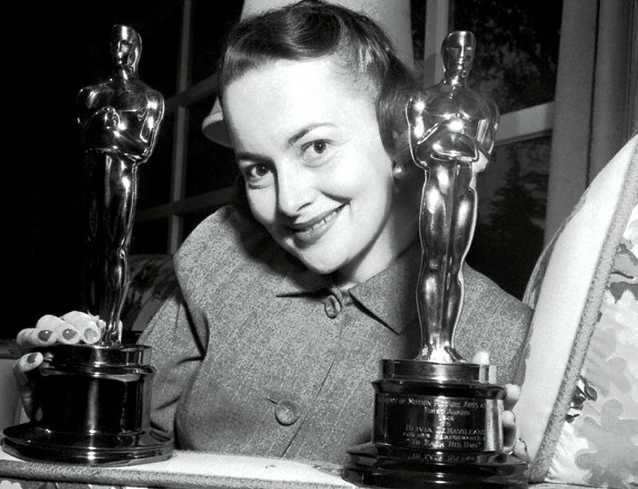
Olivia De Havilland not long after winning her second Oscar

Today is the 100th birthday of one of Hollywood's legends, two-time Oscar winning actress Olivia De Havilland, whose career goes all the way back to 1935 when she appeared opposite Joe E. Brown in Alibi Ike (airing tomorrow morning at 11:30 AM). Well, that was the first movie released; she actually made A Midsummer Night's Dream (9:30 AM July 16) before that but it wasn't released until later. Unsurprisingly, TCM has decided to make De Havilland its Star of the Month for July, running her movies every Friday (going well into Saturday) in prime time with the large number of movies they have.


De Havilland's first Oscar was for To Each His Own (12:15 AM July 16; or late July 15 in more westerly time zones) in 1946; it's a movie that I think is overrated because, as I stated when I blogged about it back in 2010, I don't think it's very original.


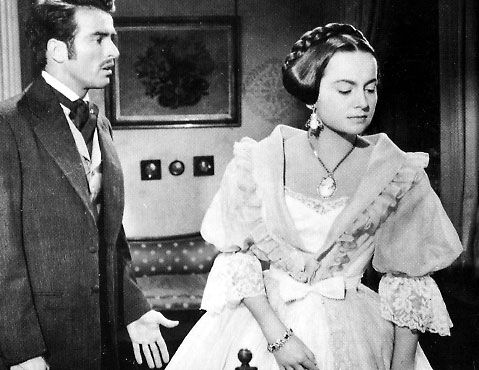
That second Oscar came three years later for The Heiress (July 15 at 10:00 PM). This is one of those movies that would, I think have fit right into last month's "Stage to Screen" spotlight, since it came from a 1947 stage play. (That play, to be honest, was taken from Henry James' 1880 novel Washington Square.) De Havilland and Montgomery Clift are both quite good in this one.


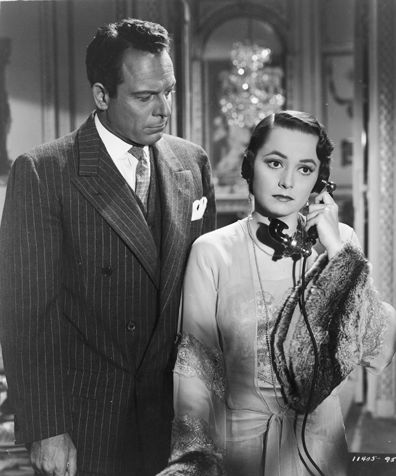
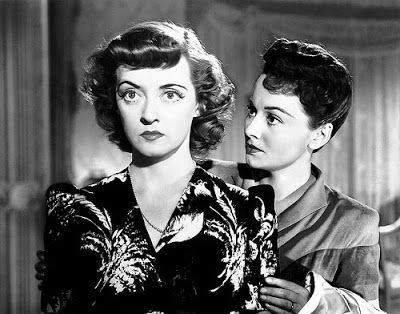
I noticed when I was preparing to do today's post that I only seem to have one photo of De Havilland accompanying all the previous posts I've done on her films, so I had to go and quickly look for some others. Here, for example, is Olivia De Havilland working with Bette Davis in 1942's In This Our Life (8:00 PM July 8); I don't think Hush, Hush, Sweet Charlotte is on the month's schedule. Apparently, I haven't done a full-length post on In This Our Life before. (They also appeared before this in The Private Lives of Elizabeth and Essex, which is on overnight at 3:15 AM.)


The only image I already had was of De Havilland with one of her most frequent male co-stars, Errol Flynn, in Captain Blood (tomorrow morning at 5:15 AM); a bunch of their movies together are airing this month.

Sunday, August 2, 2015

The Proud Rebel

A few months back, I got the chance to see The Proud Rebel for the first time when TCM showed it. TCM is running it again at 10:00 PM tonight as part of 24 hours of Olivia de Havilland films, so now would be a good time to do a full-length blog post on the film.

The movie opens up with John Chandler (Alan Ladd) approaching a town somewhere in southern Illinois together with his son David (real-life son David Ladd) and the best sheepdog in the world. It turns out that the elder Chandler is a southerner who fought for the Confederacy in the recently-concluded Civil War. But he's going north looking for doctors. Apparently his young son saw his mother die when the Union Army burned down the farm, and ever since then David has been either unwilling or unable to speak. Since it's probably some sort of mental block instead of a physical block, there's a chance that David might be able to speak again, and John is going to do anything he can to see that his son does speak again. This particular town has a doctor, Enos Davis (Cecil Kellaway), who might be able to help in that regard.

He's not able to help directly, but he does have an acquaintance at the Mayo Clinic up in Minnesota who might be able to help. Of course, there's the issue of getting the money to make a trip all the way up to Minnesota. And to complicate matters, John and David get waylaid in town. The Burleighs -- father Harry (Dean Jagger) and sons Jeb (Harry Dean Stanton) and Tom (Tom Pittman) ride into town, and their entrance spooks a flock of sheep. However, the Chandlers' dog is able to herd them back into some sense of normalcy. The Burleighs want that dog, although it's absolutely not for sale. Things get heated, and Harry's sons wind up getting in a fight with John, and lying about what really happened at the resulting trial. The only other witness is David, and he's not talking.

So John has to either go to jail or pay a fine with money that he doesn't have. Ah, but who does have it? The widow farmer Linnett Moore (Olivia de Havilland; after all, it is her day on TCM). She can use a man around the farm, especially since the Burleighs are trying to drive her off her land. Unsurprisingly, despite the fact that both John and Linnett intend for their relationship to be all business, you know that some sort of emotional bond is going to develop between the two, as well as between Linett and David, since he's now got a sort of foster mother. Not that it will help him to talk.

I mentioned earlier the problem of getting David up to Minnesota, and John can't just save up for it because the doctor at the Mayo Clinic who could help is going to be leaving in a month's time. It seems increasingly certain that the only way John can get the money is to sell the dog, but that will just devastate poor little David. John eventually does sell the dog without telling David, and the Burleighs find out which gives them a chance to get back at John....

The Proud Rebel a movie that I found squarely in the camp of your typical Hollywood studio era output, this time in the same sort of area that Friendly Persuasion falls into: it looks like it could be a western, but it's not really set out west now, is it? The ranchers, the conflict between the two farms, and a lot of other western tropes are there. But I really think of The Proud Rebel as more of a straight drama that just happens to be set in the post-Civil War era. The cast does well, including young David, who has a difficult part since he's not allowed to speak during the film. The cinematography is nice, and the film has a satisfying ending. I think it's also good for adults and kids alike.

The Proud Rebel is also available on DVD.