Showing posts with label James Gleason. Show all posts

Sunday, September 20, 2026

Somebody at least had a navy

During World War II, the US military worked with Hollywood to put out a bunch of rah-rah stuff focusing on various sections of the military to promote themselves as well as build morale. A lesser known section that got such a movie was the dirigibles, in the movie This Man's Navy.

Wallace Beery plays dirigible pilot Ned Trumpet, who's such a serial fabulist that you wonder how he wasn't pensioned off when he hit his 20 years since it's not as if anybody would want such a story-teller in a position of command, I don't think. Maybe Pearl Harbor hit before the 20 years and they still needed him. In any case, one of the things he makes up is the wife and kid he supposedly has, somthing you'd think that records would easily disprove. Part of the responsibilities of the dirigible unit is to patrol for submarines, since the U-boats didn't really have the sort of missiles that could take out things in the air.

Anyhow, another part of Trumpet's duties, serving with his friend Jimmy Shannon (James Gleason), is to teach the new recruits both in blimps and balloons. When talking with a recruit in the basket of a balloon and discussing hand-to-hand combat, Trumpet gets knocked out of the balloon. Fortunately he's got a parachute on him, and he lands on a ranch owned by Maude Weaver (Selena Royle) and her son Jess (Tom Drake). Jess isn't serving in the war because he had an accident with one of the horses that left him with bad legs using crutches. But Trumpet sees an opportunity. Jess could become the sort of foster son he never had, which would satisfy all the people in the Navy who think he's been lying about having a son. Meanwhile, this would enable Jess to get surgery courtesy of the military and possibly be able to serve if he doesn't need the crutches any more.

So now we get a sequence of the recruits going through training, which is part of the propaganda that movies like this were designed to be at least from the point of view of the military. At the end of the training, Jess decides that he's going to take up training at Pensacola, which is an air station for regular planes, not blimps. Poor Trumpet is disappointed, especially because he's got his own problems. However, he is given the chance to redeem himself when the Navy sends him over to British India to work with the British to send blimps from India to western China from where the Chinese are fighting against Japan.

And then things get terribly unrealistic. Weaver is on a mission, when his plane crashes. Trumpet gets the idea that because of the dark and the fog, he can actually get a blimp through to pick up the stranded pilots before the Japanese get to them. This even though planes can fly much faster than blimps. But considering the sort of movie this is, we know that Trumpet is going to be able to save the day even though the Japanese are going to be shooting at him all the way back to India and frankly should be able to destroy the blimp the way it's a sitting duck.

I'm sure air buffs will enjoy seeing the blimps in action, although the story is a fairly weak one. Wallace Beery's character is rather a blowhard and if there weren't a war on it would be hard to be sympathetic to him. Tom Drake is also not the most charismatic actor out there. But once again audiences of the day probably enjoyed the morale boost that came with the depiction of the military.

Thursday, July 16, 2026

Better than stepping on somebody else's toes

I've mentioned in a couple of other movies that I've blogged about here that both James Gleason and Donald O'Connor were selected to be part of TCM's Summer Under the Stars in August 2025. As it turns out, they also did a movie together, although the structure of the movie makes their common appearance rather brief: On Your Toes.

Gleason plays Phil Dolan Sr. the patriarch of a family still trying to make it in vaudeville even though it's a dying business. Queenie Smith plays Mom, while O'Connor plays a young Phil Dolan Jr. Dad wants him to keep going with vaudeville, while Mom insists he get an education. Another of the acts in the same troupe as the Dolans has a young ballet dancer of Russian descent, Vera Barnova, although her act leaves the troupe.

In any case, 15 years pass and Phil Jr. (played as an adult by Eddie Albert) has gotten something of an education, trying to make it as a songwriter and, if possible, a "serious" composer. In a hotel lobby he runs into grifting Ivan Boultonoff (Leonid Kinskey), a composer for a Russian emigre ballet company managed by equally grifting Sergei Alexandrovitch (Alan Hale). Ivan offers to give Phil music composition lessons, although it's as much a way for him to hear Phil's ideas, and liking them, get them to Sergei. That, and get the main credit for the music since the orchestrations are going to be his. Phil's recompense, as it were, is going to be dancing a minor role in the current show.

And wouldn't you know it, but the prima ballerina of the company is none other than... Vera Barnova, also all grown up (and played by Vera Zorina). The two meet again and rekindle a friendship, although it's expected that Vera is going to have a more serious relationship with one of the male dancers. But having a friend in the prima ballerina is a valuable thing to have. With that in mind, when things go south with a male lead, Phil's vaudeville dance experience comes in handy as he knows all the dance moves for what's going to be an experimental jazz ballet.

What Vera and Phil don't know is that, for various reasons, a group of Russian agents have been brought in to assassinate the original Russian lead dancer as part of the climax to the jazz ballet. Vera and Phil do eventually learn of this plot, but it's mid-performance, forcing them to try to keep dancing long enough for the authorities to stop the murder from going forward and catching the responsible guilty parties.

On Your Toes is based on a Rodgers and Hart musical that, to be honest, I hadn't heard of before seeing the movie. Having read the reviews of the movie, it seems that enough was changed from the original stage musical -- or at least enough of the traditional songs removed -- that fans of the stage musical aren't fans of this movie adaptation. At the same time, the ballet numbers we get in the movie are apparently faithful renditions from the original stage musical, and are considered highlights. For me, not having seen the stage musical, I don't have that issue. I do have other issues with it, however, such as the grifting nature of Ivan and Sergei that it makes them both more unsympathetic than humorous.

So, On Your Toes may not be for everybody, but some people are really going to like it.

Saturday, June 27, 2026

A million tanks

James Gleason was an always reliable character actor, and it was nice to see him get a day in the 2025 Summer Under the Stars on TCM. One of his movies that I hadn't seen before was the Hal Roach Streamliner Tanks a Million, so I recorded it in order to be able to do the post on it here.

A search of the blog says I haven't mentioned the Streamliners before. These were a series of movies Hal Roach produced that were longer than the shorts he had mostly been producing, but still shorter than even a lot of the B movies, clocking in mostly at a shade under an hour (this one is 50 minutes). Granted, this was still the era before TV so in later years material like this would probably have been storyboarded for episodic TV. The "star", if you will, here is William Tracy, playing Dorian "Dodo" Doubleday. As the movie opens, he's on a radio show where he's showing off his photographic memory. Dodo works at a train station information booth, but that work is coming to an end as he's just been drafted into the army. (The movie was released in September 1941, so no mention of any possible upcoming war.)

Sgt. Ames (Joe Sawyer) is the drill instructor assigned to the new recruits, but Pvt. Doubleday already knows the entire army manual and not only that, but seems to know how to actually do the stuff the manual asks of new recruits. And he's frankly obnoxious about showing off all this knowledge. Needless to say, it ticks Sgt. Ames off, but when Ames goes to his superior officers, they get the brilliant idea to promote Doubleday to sergeant, albeit with a bit of a devious catch. Doubleday is assigned to a unit that has the most inept recruits, who also have a bit of a mischievous streak in that they figure out ways to do stuff very close to sergeant's orders. If Sgt. Doubleday fails to mention every article of clothing they're supposed to wear, they'll only wear the ones he mentioned. The trick's on them, however, when they have to march barefoot.

Col. Barkley (James Gleason) is coming to the base, where he's supposed to deliver a speech that's going out on a national radio hookup. Not that he likes giving radio speeches. Sgt. Doubleday gets assigned to be Barkley's orderly. But when he gets some sort of powder on Barkley's uniform, he puts the jacket on himself to be able to clean the powder off. Unfortunately, this leads to his being mistaken for Barkley, leading to all sorts of complications. But since this is a comedy, and a short one at that, you know things are going to work out well, and quickly.

Tanks a Million is a film that's rather more episode than something that has a fully-fledged plot, although that's probably to be expected coming from Hal Roach since he'd been doing a lot more with shorts. The material is adequate for what it is, which is a throaway B movie. Nobody will consider Tanks a Million any great shakes, but back in 1941 I'd bet it entertained while it came and went, to be promptly forgotten as it was replaced by the next movie.

Thursday, April 16, 2026

Better than only being inhuman

There was a movie I saw many years ago that involved a particular plot point and, if memory served, starred Jane Wyatt. Not too long ago, the movie We're Only Human showed up on TCM, and the plot synopsis and presence of Jane Wyatt made it sound familiar. Sure enough, I had seen it an age ago and never blogged about it. So now that I've watched it again and it's fresh in my mind, I can give you a post on it.

Jane Wyatt plays lady reporter Sally Rogers, who would not go on to work on the Alan Brady Show, but that's another story. Rogers shows up outside a joint where policeman Pete McCaffrey (Preston Foster) is casing the joint across the street. A hearse shows up and carries up a wicker body bag, but McCaffrey knows this is a ruse, so when they come back out, he confronts them, finding out that Lefty Berger is in the not-a-coffin. Burger is a wanted gangster, so McCaffrey thinks he's done a great job. Sally is naïve, so she thinks Pete has done a great job, too, writing a glowing story about what she saw and even falling in love with Pete.

However, Pete's boss is ticked off, because the rest of the gang is going to be spooked, and the police department was doing a bigger investigation that was hopefully going to bring down the whole gang. Worse, Pete is the sort of police detective who insists on doing things his own way, because he just knows the rules as they currently stand aren't always right and need to be broken. Worse for him, however, is when he is given the assignment to take Lefty up to prison on the train, Lefty escapes! That, and Lefty starts taunting McCaffrey about his inability to bring Lefty back to justice.

Things get even worse for McCaffrey when his regular detective partner and housemate, Det. Walsh (James Gleason), radios for backup outside a bank. A subplot involves the fact that McCaffrey lives with Walsh and his wife (Jane Darwell), and Mrs. Walsh keeps trying to see that McCaffrey gets a suitable wife. Anyhow, when McCaffrey winds up at the bank, he and Walsh go in to try to catch the gangsters who go in, only for Walsh to be fatally shot. It's getting harder and harder to find Lefty.

Meanwhile, there's a lawyer inside Lefty's organization, Martin (Arthur Hohl), who is terribly displeased with the fact that Lefty has been escaped, the reasoning being that Lefty has to know somebody tipped off the police to the fact he was going to be in that coffin escorted out by the fake funeral workers. Martin not illogically expects that Berger will conclude it was he who fed information to the cops, and will want revenge. Sure enough, Martin gets shot in a drive-by shooting. But then, and this is the plot point I remember because of how unbelievably stupid it was, Sally is with McCaffrey at the shooting and, in getting the story, prints the address of a couple of eyewitnesses along with their picture.

So, of course, the eyewitnesses get harassed by Berger's men, and McCaffrey seems to be back to square one with Berger arrogantly taunting him. But, since this is a Code-era movie, you know that Berger is going to be caught, and that the cop and reporter are going to live happily ever after, more or less.

The big problem with We're Only Human is that the plot has the main characters be inordinately stupid, climaxing in that scene where Sally interviews the eyewitnesses. Indeed, none of this bears much resemblance to reality. To be fair, however, the movie was only intended to be a B movie, and another of those films where probably nobody expected viewers 90 years later to be watching and giving their critique. So sit back and watch just to see where all the faults are. And thankfully, it'll all be over fairly quickly.

Wednesday, January 21, 2026

Better than a Ben Mankiewicz podcast

TCM's schedule for tomorrow, January 22, is all six of the Hildegarde Withers mysteries followed by all four of the Margaret Rutherford Miss Marple movies, before prime time brings us another night of the films of Jean Arthur. I've actually got one film each from the two mystery series sitting on my DVR. But since I don't really feel like doing two mysteries in a row, today's post is going to be on The Plot Thickens, tomorrow at 11:00 AM.

We don't actually meet Hildegarde Withers for a good ten minutes or more. Instead, we get a starting scene in a park, with a woman calling up wealthy John Carter to say she want to meet him there. Carter, meanwhile, has a guest at home and some servants who would prefer the night off. There's the butler, Joe the chauffeur (a young Paul Fix two dozen years before The Rifleman), and Marie the maid who seems to be in romantic entanglements with both Joe and the butler. Everybody's out of the house when a mysterious figure comes out of the bushes in the park and shoots Carter dead during his assignation. But the body is only found the next day, with the investigation also finding a young couple, Bob (Owen Davis, Jr.) and Alice (Louise Latimer) having been at the park so they could be suspects.

It's up to police detective Piper (James Gleason) to solve this. Well, not quite of course. He's the boyfriend of teacher Hildegarde Withers, here played by ZaSu Pitts. Piper calls her up, and as usual she's excited to take part in another murder investigation, although not so excited to deal with incompetence beyond being able to sling acerbic quips at anybody she sees as not up to the task. This of course includes Piper, who is just as good at slinging those barbs back at Hildegarde. The Withers movies are as much about the interaction between Piper and Withers as they are about the mysteries.

In any case, during the investigation at Carter's house, Hildegarde finds a precious gem and learns that it had been stolen some years back in France. The New York police learn from their French counterparts that the man who had stolen it was recently freed from prison, so the assumption is that it might be the same man involved. This also shifts the action to an art museum, specificlly to the exhibit of the "Cellini Cup", an allegedly valuable Renaissance-era piece of fine silver work which also has a pearl hanging from it in one strategic spot. The two things are clearly related, but how is something that we're only going to learn in the final reel when the guilty parties are caught.

As I said, the Hildegarde Withers movies are as much about the relationship between her and Piper as they are about the actual plots. ZaSu Pitts does a good job here, although she doesn't come across quite as well as Edna May Oliver when it comes to striving for a classier attitude. Oliver could seemingly pull that off in her sleep, while Pitts feels a bit more like the Staten Islander types who would be the wives of New York cops. She's still funny, mind you, and the repartee and "mystery", such as the mystery is, do work, making The Plot Thickens an enjoyable entry in the series.

Wednesday, December 24, 2025

I know -- let's put on a minstrel show!

Continuing to go through the movies that I recorded when Mickey Rooney was TCM's Star of the Month in December 2024, this time it's another of the musicals he did with Judy Garland, Babes on Broadway. This is, of course, not to be confused with Babes in Arms which is another musical that Rooney and Garland did together although they play different characters.

This time around, Mickey Rooney is playing a young man named Tommy Williams, who is apparently all grown up since he doesn't have any parents around. That, and he's part of a trio calling themsleves the "Three Balls of Fire" together with Ray (Ray McDonald) and Hammy (future director Richard Quine when he was still in front of the camera). They have dreams of fame, but of course those dreams don't seem to be going anywhere in part because it's tough to make it in New York, and more generally tough to get noticed period. On their last night performing as the entertainment at an Italian restaurant, they get a big tip from a Miss Jones (Fay Bainter). It turns out that Jones is actually the executive assistant Thurston Reed (James Gleason), and she is able to get the Three Balls of Fire an audition with Reed.

Of course, Tommy is a bit stupid in that he tries to use this to get all his other friends auditions too, which is not what Reed would want. And the friends is a new one, Penny Morris (Judy Garland). She is the daughter of a music teacher, and works at a settlement house with underprivileged children. The settlement house is looking to do the fresh air thing; that is, get city kids out of the city for a couple of weeks and up to a camp in the Catskills or out in New Jersey or some such). Tommy and Penny both get the brilliant idea to set up a charity fundraiser of having the young people perform, except that Tommy intends to use it to raise the money to rent a real theater instead of helping the poor city kids.

That threatens to put the kibosh on what is also going to be a budding relationship between him and Penny, as you might guess since these musicals are nothing if not formulaic. But a wrinkle gets put in those plans thanks to World War II on the other side of the Atlantic. (The movie was released a few weeks after Pearl Harbor, although surely most of the filming must have been before December 7, making it interesting that this plot line is in the movie.) As a result of the war, British children were being evacuated to Canada and the US (as in On the Sunny Side which shows up from time to time on FXM), and they need help more than the settlement house kids. Also, Tommy has more sympathy for them and probably wants to bed Penny too, so he decides to be honest.

This gives Jones the idea of letting the kids use one of Reed's old, disused theaters if they can refurbish it (where are they going to get the money for that) to put on the show. The refurbishment offers the opportunity for probably the best sequence in the movie, as Penny and Tommy imagine the performers who played here in previous generations and do their impressions of what such performances might have been like. However, there are legal issues with the show going forward, combined with the fact that Reed doesn't exactly know his old theater is being reused. But, since it's a Mickey Rooney/Judy Garland musical, we know that it's going to have a happy ending.

That happy ending is where the minstrel show comes in, and is the thing that pretty much everybody else brings up in discussing Babes on Broadway, because this is a long blackface sequence, much longer than there were in some other movies. And modern-day people have to point out how terrible it is that this stuff was popular back in the day. (Some might say still is, except that it's now womanface and men who don't look like convincing women calling themselves "trans" so they can get off on getting into what are supposed to be private spaces for women.)

In any case, Garland and Rooney give their typical rousing performances, and it's easy to see how the movie taken as a whole would have lifted the spirits of audiences on the homefront who had a lot going on in their lives by the time the movie was released. So Babes on Broadway is actually worth a watch.

Wednesday, November 5, 2025

The Will Rogers Story

Another movie that I have to admit I didn't realize it existed until the last time TCM ran it is The Will Rogers Story. So, when it ran on TCM, I decided to record it so that I could do a post on it here after I watched it.

The opening credits point out that this is a movie based on a story by Will Rogers' widow Betty (although she had died some years before the movie was actually made), starring Will Rogers Jr. as his father, so expect a bit of hagiography going into the film. And indeed, before we get into the actual action of the film, there's an introduction about how much stuff is named after Rogers even though he's not the sort of person you would normally expect things to be named after. So why is that the case...?

Flash back to a few years before Oklahoma became a state, so the very beginning of the 20th century. Will Rogers was the son of wealthy part-Cherokee Clem Rogers (Carl Benton Reed), but a man who didn't seem to have any good idea of what he should make of his life, to the point that he's been drifting around Texas as a sort of cowboy before he returns home to Oogalah, OK. At the train station, he meets Betty (Jane Wyman), a relative of the station master who is working at the station having recently come from Arkansas. As you can guess, they eventually get married, but in a traditional Hollywood trope, they don't hit it off at first.

Eventually they do hit it off, but by that time Will has to leave Oklahoma to make a success of himself, sending a series of postcards from all over the world as he does ranch hand work in various parts of the world before getting a job with a wild west show where he can do his horseback and lasso tricks. He returns to Oklahoma to marry Betty, except that their honeymoon, such as it is, involves him going on tour with a show for several years.

Eventually, Will winds up in the Ziegfeld Follies, and part of what he does is to provide comic relief during the intermission when the girls are changing outfits and whatnot. Will goes out on stage and provides homespun wisdom that can be interpreted in any number of ways. This really makes him famous, and gets him a career in movies as well as being introduced to pilot Wiley Post (Noah Beery Jr.), that latter being important because Rogers and Post were flying up to Alaska when they were involved in the plane crash that killed the both of them.

One thing that's interesting about The Story of Will Rogers is what doesn't get included, which is Rogers' career as an actor in talking pictures. I'd bet that was almost entirely down to the fact that those movies were made at Fox and The Story of Will Rogers was made at Warner Bros. Instead, the latter portion of the movie deals with Rogers as a foreign correspondent, followed by charity work during the Depression. There's also his realization that aviation is going to have much bigger military use, something that the higher-ups don't want to deal with after World War I.

As for the movie itself, it's entertaining enough, if most likely not overly accurate. (Clem is shown at the 1932 Democratic National Convention even though he'd been dead for 20 years by this point.) Will Jr. does a good job portraying his father, although you get the impression that's about the only role he could play considering that he didn't have much of a movie career. Jane Wyman isn't really asked to do much here but does it adequately. The movie also looks good enough with its Technicolor photography.

Saturday, July 12, 2025

Rock-a-Bye Baby

I mentioned a couple of times how Jerry Lewis got a day in TCM's Summer Under the Stars last August, and how I recorded a ton of movies, because even though I have a box set of some of Lewis' films, a lot of what TCM selected was not on that box set. Unfortunately, I didn't get around to watching all of them before they expired, but one that I did watch is Rock-a-Bye Baby.

Marilyn Maxwell plays Carla Naples, one of those small-town girls like Esther Blodgett who couldn't stand the small town and went to Hollywood to try to make it big. She's done so, but with a squeaky-clean image. Unbeknownst to the studio, she went and blew up that image by getting married to a bullfighter in Mexico and getting pregnant on her wedding night before the bullfighter was killed in the ring the next day. So there's a kid on the way and no husband or marriage license, Carla having ripped that up.

Carla's agent Harold Hermann (Reginald Garidner) suggests that she go off somewhere to have the kid like Bette Davis in The Great Lie and then have someone she can trust take care of the kid until they can figure out what to do that will be all nice and legal and not ruin Carla's image. Unfortunately, Carla's Italian immigrant father has never forgiven her for wanting to do the Hollywood thing, so he's right out.

But Carla does have a one-time boyfriend in her midwestern hometown from back when both were very young, that being Clayton Poole (Jerry Lewis), who is now working as a TV repairman, although this being Jerry Lewis, the word "repair" is doing a lot of work. Clayton loved Carla even more than she liked him, and he's always wanted to be a father although he's never found the right woman. In fact, the right woman is right under his nose in the form of Carla's kid sister Sandra (Connie Stevens). Carla discovers that she's actually pregnant with triplets, and drops the kids off on Clayton's front step.

Clayton tries to raise the kids as a single father with some help from Sandra. A lot of complications ensue because Clayton isn't quite up to raising triplet infants. Not because he's a bad person or negligent, but he does have to work and somebody has to look after the kids. That's going to lead to a climactic courtroom scene since there are understandably people who think there's something better for the kids than this low-earning single father who is not the biological father. Being a Jerry Lewis comedy, however, there's going to be a requisite happy ending.

Rock-a-Bye Baby is a loose remake of The Miracle of Morgan's Creek, reworked for the abilities of Jerry Lewis. Lewis wasn't directing himself yet, here being directed again by Frank Tashlin who was adept at directing boundary-pushing, mildly subversive comedies (his previous film was Will Success Spoil Rock Hunter?), and had directed Lewis a couple of times before. So he's able to tone down Lewis, although some of the physical comedy, as in the initial TV repair scene involving Lewis adjusting a rooftop antenna, does veer into over-the-top territory.

Rock-a-Bye Baby is competently made if not great, more the sort of thing that would serve as comfort food to fans of Lewis.

Friday, March 14, 2025

Murder on the Blackboard

TCM is going through the Hildegarde Withers mysteries as part of the Saturday matinee programming block. There were six of them and Edna May Oliver played Withers in three of them. I know I hadn't recommended Murder on the Blackboard before, as I had never actually sat down to watch it despite the fact that the Withers mysteries show up on TCM often enough and I enjoy the acting of Edna May Oliver. So the last time it aired I recorded it, and now it's getting the Saturday matinee airing, tomorrow (March 15) at 10:15 AM.

As you can guess from the title, the movie is set at a school. Before we get into the mystery aspect of the film, however, we're introduced to the school's janitor, Otto, who seems to live in the basement of the school, probably because he's an alcoholic. We also meet the school's secretary, Miss Davis (Gertrude Michael), who for some reason brings a gun to school. Principal MacFarland (Tully Marshall) tries to put the moves on Miss Davis before seeing the gun; Miss Davis tells him that it belongs to one of the teachers, Louise Halloran, who is also sharing an apartment with Miss Davis. Louise is scared of something.

Miss Davis is in a relationship with one of the teachers, Addison Stevens (Bruce Cabot), who had a failed relationshp with Louise previously. MacFarland has also been trying to put the moves on Louise. And, Lousie and Otto the janitor get into a dispute over her owing him money and having given him a check that bounced. So it doesn't take much to figure out who is going to get bumped off, as well as the fact that we've got a handful of suspects who all had the motive and opportunity to kill the eventual murder victim.

It's only here that we finally meet Hildegarde Withers. She's at school late because she keeping one of the students for being a gossip. That turns out to be fortuitous in a way, in that she's able to find the body of Louise Halloran, who has obviously been murdered. Since she's already solved one murder case in The Penguin Pool Murder, she sends the student to call police detective Oscar Piper (James Gleason), since the two of them worked together on that previous murder case.

The method of killing is kind of nonsensical, and the reveal is particularly silly, but the point of watching the Hildegarde Withers movies isn't so much for the mystery as it is for the comic banter between Withers and Piper, who could each dish it out and who both have their strengths and weaknesses in trying to solve mysteries. Edna May Oliver is in pretty good form here, as is Gleason, and together they much more than the story make the movie something worth watching. These were only B movies, too, so it's not like you're going to be investing too much time in them.

Monday, September 27, 2021

Blondie of the Follies

Another of the movies that I've had sitting on my DVR for quite a few months is Blondie of the Follies. Recently, I finally got around to watching it in order to clear up some space on my DVR.

Marion Davies plays Blondie McClune, who lives in a tenement apartment together with her parents (James Gleason and Sarah Padden) and siblings. Money is always tight since there's a depression on, and not even enough money to buy Blondie that new dress she wants. Also living in the building is Blondie's best friend Lottie Callahan (Billie Dove).

The two want to get into a big Broadway show, which Lottie eventually does, taking on the stage name Lurline and getting noticed by one of those rich guys who picked up chorines in movies of the early 1930s, one Larry Belmont (Robert Montgomery). Lottie meets Blondie and invites her over now that Lottie is living in a swanky apartment on Park Avenue.

This is where Larry meets Blondie, and immediately takes a liking to her. Blondie could consider any boyfriend of Lottie's a platonic friend, but she would never dream of trying to take Lottie's boyfriend away from her. Lottie, understandably, doesn't see things that way, and it's going to drive a huge wedge into the friendship, even after Blondie too gets a job in the Follies, which pisses her dad off since he doesn't think that's appropriate for a good woman.

Another rich guy, Murcheson (Douglass Dumbrille) is having a party on his yacht, and since Larry and Lottie are guests, Lottie brings Blondie along, which bugs Larry enough to drive a wedge between him and Lottie. Larry is freer to pursue Blondie, but she's still loyal enough to Lottie that she wouldn't dream of trying to take Larry away from Lottie.

Still to come are Blondie's tragic reunion with her father, as well as Lottie getting so mad at Blondie that she tries to ruin Blondie's big number, also with tragic results. But it's that latter tragedy that might just bring BLondie and Larry together. After all, Davies and Montgomery get top billing, a sure sign that they should be together.

The box guide referred to this as a comedy, although it really isn't. The one big comic scene comes when Jimmy Durante finally shows up, basically playing a variation of himself. He shows up at a party Blondie is throwing, and together the two do a spoof of Grand Hotel, with Durante taking the part of John Barrymore (to be fair, Durante does have a rather notable profile himself) and Davies doing Greta Garbo. It's fun comic relief that works.

The rest of the movie doesn't work quite as well, but it's not exactly a bad movie. It's more one of those dated early 1930s movies that would be a bit difficult for people not fans of older movies to get into. Although Davies and Montgomery both do an adequate enough job, they were both better in other things. Still, for anybody whose opinion of Davies is based on Orson Welles' reference to her in Citizen Kane, even Blondie of the Follies should dispel that notion.

Wednesday, January 1, 2020

Mayors Go Wild


While making the 1935 movie Call of the Wild, Clark Gable had an affair with his co-star, Loretta Young, that resulted in her getting knocked up, going off in private for several months to have the child, and "adopting" the child. Fifteen years later, the two stars would be reunited for the movie Key to the City.

Young plays Clarissa Standish, the mayor of Wenonah, ME, one of those medium-sized towns that populated Hollywood movies and which there seem to be too many of compared to the US population as a whole. She's in San Francicso with a whole bunch of other mayors from similarly made-up medium-sized towns for a convention. (The US Conference of Mayors claims to represent 1400 mayors of cities with populations of at least 30,000; I don't know how many cities of that size there were back in 1950 when Key to the City was released.). Mayor Standish is there presumably to look into the latest in fire trucks of something. But a lot of the mayors seem to be there more to schmooze and party.

One of the mayors in the latter category is Steve Fisk (that's Clark Gable if you couldn't tell), mayor of Puget City, CA. He was a longshoreman and worked his way up to mayor. Having gotten into politics this way, he's not as secure in his position as somebody like Clarissa who is the niece of a federal judge (Lewis Stone). As for Steve, he's there with his fire chief(? -- why would the fire chief be there?) Duggan (Frank Morgan in his final movie; this one was released after he died).

Steve and Clarissa meet and it's love at first sight, although there are going to be complications along the way. A bunch of the mayors go to a nightclub where the star attraction is the dancer Sheila (Marilyn Maxwell). Steve unintentionally starts a riot that results in a bunch of people getting hauled into the police department, where Sgt. Hogan (James Gleason) tries to keep the mayors' predicament from becoming public.

Of course, things do go public for both Fisk and Standish. It's a bigger problem for Fisk, since he's got strong political opposition back in Puget City, where Taggart (Raymond Burr) is trying to get some sort of housing development nixed in the short term so that he can get his contractors the contract to build it, or something like that. By this time, Clarissa has agreed to marry Steve, so she follows him to Puget City where he tries to salvage his political career.

Key to the City is one of those many post-World War II movies made at MGM which seem to have gone wrong somehow. I don't know if it's just that they didn't change with the times quickly enough or whether they were more concerned with the Freed Unit musicals, but increasingly when I watch MGM's A movies from this period they all seem to have something not quite right about them. In this case, Key to the City really feels like a movie that would/should have been made before the war. A decade later, however, and everything feels perfunctory and sterile. The movie also feels like it's got some sort of bad plot hole that made what's supposed to be a farce ending tediously unfunny for me.

Still, Key to the City is filled with competent performances by aging character actors who try their best in the supporting roles, only to be brought down by a subpar script. It's available on DVD courtesy of the Warner Archive collection, so you can judge for yourself.

Saturday, June 6, 2015

Crash Dive

Earlier this afternoon, FXM Retro ran Crash Dive, a movie that I have to admit was new to me. It's running again tomorrow morning at 11:50 AM if you want to see it.

The movie starts off with an Allied civilian boat of some sort having been torpedoed by the Nazis. Coming to their rescue is a PT boat, captained by Lt. Ward Stewart (Tyrone Power, who was billed in the cast as part of the Marine Corps Reserves). He drops some depth charges, annihilates those damn Nazis, and becomes a hero for it. For his troubles, he gets sent to New London, CT, where there is a submarine base. Apparently, the US submarines are short of officers, and the Navy needs Lt. Stewart on a submarine, even though he's good on the PT and likes it. At any rate, Lt. Stewart gets transferred to the Corsair, captained by Lt. Cmdr. Dewey Connors (Dana Andrews in an early role).

Lt. Cmdr. Connors, for his part, has had a lot on his mind. He's been waiting for the requisite senior officer to join him, and is mildly miffed that Lt. Stewart needs to go to Washington for the weekend to take care of some business before setting out to sea in the submarine. Meanwhile, Connors also has a girl, Jean Hewlett (Anne Baxter), who teaches at the local girls' school. He sees her off at the train station, as she's taking some honors students to Washington.

Unsurprisingly, Hewlett winds up in the same car as Lt. Stewart, who has accidentally occupied her berth. He immediately falls in love with her, not realizing that not only does she have a boyfriend, but that boyfriend is his fellow officer. So he decides that the best way to get the girl is to act like a complete jerk, because there are some women who like such jerks, and because with Power being billed ahead of Andrews in the cast, there's a reasonable expectation that it's his character who is supposed to be with Baxter's, not Andrews' character. Lt. Stewart keeps pursuing Jean, until she finally gives into him. Well, she really gives in to his nice grandmother (Dame May Whitty).

Meanwhile, the submarine goes out and confronts a Nazi mine boat somewhere in the North Atlantic, and they realize that the boat is far enough out that they have to have a base somewhere. Not that there's anywhere in the North Atlantic for them to have a base. The most logical explanation would be if it's hidden in Greenland, except that the comments they make about the climate would imply that the base is someplace further south, if only there were islands far enough south in the Atlantic for them to have a base.

The sub gets back to New London, Lt. Stewart finds that Jean is engaged to be married to Connors, and then Connors finds that Jean and Stewart are in love with each other. All of this at the same time they're about to head back out into the Atlantic to find that Nazi base and destroy it....

There's a fair bit in Crash Dive that's predictable and formulaic, but then this one was made during World War II, when audiences probably wanted something that was more morale-raising than anything else, which means uncomplicated and familiar. Crash Dive, I think, probably would have succeeded for audiences of the day; as for today's audiences I'm not so certain. I thought Power was even more of a jerk than he was in A Yank in the RAF. The climactic raid on the Nazi base is OK, but the print has colors that are muddled, even more than would normally be the case for a nighttime raid. It was to the point that it was sometimes tough to tell what was going on. And then after the raid succeeds -- as I said, this was a morale builder -- there's a tacked on bit about the importance of every type of ship to the war effort.

As I say when there's a movie I don't particularly care for, however, watch and judge for yourself. The movie did get a DVD release, but I don't know if it's still in print.

Wednesday, April 29, 2015

Apparently I haven't blogged about "Tycoon" before

TCM's Star of the Month salute to Anthony Quinn has been running his starting roles early in prime time, and then at the end of the night and early the next morning going to movies in which he played supporting or tiny roles. One of those smaller roles is in Tycoon, airing early tomorrow morning at 4:00 AM on TCM.

John Wayne stars as Johnny Monroe. He's a construction engineer, working for Mr. Alexander (Cedric Hardwicke). Alexander is building a railroad in the Andes mountains of exotic South America. Johnny and Alexander have a constant clash of ideas, so when Alexander needs to see somebody about the progress on the construction, he usually talks to Johnny's partner Pop (James Gleason). It doesn't help that Johnny is one of those people who works hard and plays hard. Anyhow, John and Pop have come down from the mountains to the city where Alexander is living in part to unwind for the weekend, and in part to talk to Alexander. Alexander wants to build a tunnel, which in theory is shorter in the long run, but there's the question of expense if you really want to do the tunnel safely.

Meanwhile, John has gotten himself good and drunk and is ogling the ladies. He sees one particularly lovely lady going into church for Mass, and decides that he's going to get this woman because that what John Wayne always does in his movies. The woman turns him down at first probably because he's hung over, so he follows her home and finds out that... this woman is Maura Alexander, the daughter of his boss! It goes without saying that Dad is none too happy with the idea that his daughter is thinking about seeing this engineer. Doesn't she know he's going to love the railroad more than he'll love her? Oh, and there's the social class difference and John's hard living. After a brief romance that sees them get caught in the middle of nowhere one night, the two get married!

What the hell were they thinking? Maura tries to make the best of it, moving in with Johnny up at the camp where they're building the tunnel. By now, it's turned out that Johnny and Pop were right about the idea that you can't build a tunnel if you're going to cheap out on safety. There are multiple cave-ins at the tunnel site, and Johnny's obsession with getting the tunnel finished strains his and Maura's relationship to the breaking point. Well, she was wanred that he'd love the construction work more than he'd love her.

Eventually, it becomes clear that they won't be able to get the tunnel built on time or on budget, so Johnny insists that the better solution would be to build a bridge instead. In theory a bridge is cheaper, but there's the question of whether it can stand up to the rainy season and the increased flow of the river. Still, Johnny is insistent on getting the railroad done so that he can win back Maura....

There's a lot going on in Tycoon, and while the movie is fairly interesting, it generally doesn't quite add up to the sum of its parts. John Wayne is about as good as he normally is, taking the lessons he learned from making all those westerns and the few military films he had done to this point and applying them to the job of playing a construction engineer. Laraine Day is lovely even if her role isn't all that demanding. James Gleason plays the moral conscience for the main character yet again, and is always worth watching for his supporting roles. As for Star of the Month Anthony Quinn, he plays Alexander's nephew who is also a construction engineer. Rounding out the cast is Judith Anderson as Maura's former governess who is sticking around as a sort of foster mother.

Tycoon is available on DVD, but you might want to watch the movie on TV first before deciding whether to spring for the DVD.

Monday, October 29, 2012

The Last Hurrah

The Last Hurrah is another of those movies I've been meaning to blog about for some time, but never got around to doing. It's airing tomorrow afternoon at 12:15 PM as part of the last day of Spencer Tracy's turn as Star of the Month on TCM.

Tracy stars as Frank Skeffington, the long-time mayor of an unnamed city, although you can presume it's one of those New England cities that had a large Irish Catholic population and the political machine to go along with it. Skeffington has headed the machine and served as mayor with an iron fist, but we're beginning to get to the era (the movie was released in 1958) when political machines are beginning to weaken. Back then, candidates had to do a lot of pressing of the flesh and speaking at community meetings and stuff, but with the advent of television, savvy politicians realized that they could get their political message out with less effort and without filtering by that other old institution, the partisan newspaper. Skeffington realizes times are changing, and has announced that even if he wins, this is going to be his last term as mayor.

Skeffington in theory should be a shoo-in. He's been good to the little people who support the machine and vote for him, returning the favor with a lot of patronage. Who could possibly be against him? Well, it turns out that with every political machine, there's a lot of corruption. In this case, Skeffington and the machine have more or less been playing favorites with selecting local businesses, and understandably there are money interests who don't like him. Here, the money interests are represented by banker Norman Cass (played by Basil Rathbone). John Carradine edits the local newspaper, which has a decidedly pro-business bent, and even the Cardinal (Donald Crisp) has turned against Skeffington. Still, they, like Skeffington, do all of their dealings in smoky back rooms of the local club.

In many ways, The Last Hurrah is the product of a bygone era. Not only are the political machines and the personalized campaigning here a part of the past (well, maybe with the exception of very small towns where pretty much everybody knows everybody), so is the style of filmmaking. The Last Hurrah is a slow-developing movie, with no effects, little real action, and seemingly nothing big happening. The movie seems to spend an inordinate amount of time at one funeral, for example. I can't imagine a movie about political campaigning being made like this any longer. Finally, a lot of the actors were people nearing the end of their various careers. In addition to the people I mentioned, there are holdover character actors from the 1930s playing the Mayor's closest confidants: Pat O'Brien, James Gleason, and Edward Brophy. That doesn't mean The Last Hurrah isn't a good movie. If you like movies that are grown-up and methodical, this is a very good movie, filled with excellent performances.

TCM's schedule page says The Last Hurrah is available on DVD, but they obviously have a problem with their database, as their listing for the Spencer Tracy movie links to a DVD for a 2009 movie also titled The Last Hurrah. Amazon lists an all-region import DVD available for purchase, but it also seems to be out of print.

Saturday, August 8, 2009

Worse than The Howards of Virginia?

Cary Grant is the star for TCM's Summer Under the Stars all day and night on Sunday, August 9, and the day kicks off with what might be his worst movie: Once Upon a Time, at 6:00 AM ET.

The plot involves Grant as a slightly shady promoter who needs a new act to help him get out of a $100,000 debt. Lucky for him, he meets a young orphan boy who's got just the act for him: a caterpillar that dances to the tune "Yes Sir, That's My Baby". Grant doesn't see a poor orphan; he sees dollar signs, and damn the little kid. Along the way, Grant meets the kid's adult sister, who's been raising him; in one of the older Hollywood plot "twists", Grant falls in love with her, and she with him -- until she learns his darker nature.

Once Upon a Time is a train wreck on so many levels. It's got an unappealing Cary Grant -- not the evil Grant from most of Suspicion, mind you, but something much worse, a nondescript unappealingness. The movie is also filled with stale plot devices: the orphan; the adult sibling raising the kid; the love story with the orphan bring the two people together; and Grant's right-hand man (played here by James Gleason). It's also got a lousy ending which should be obvious: the first time I saw the movie, I found myself thinking, "Don't they know [what happens in the ending, which I won't give away]?"

So why am I recommending Once Upon a Time? Well, it's got Cary Grant, and James Gleason. Not only that, but a lot of times, train wrecks can be fascinating to watch.

Monday, June 1, 2009

What is marriage?

Last month I mentioned two of Fox's anthology movies. A third one is coming up tomorrow at 9:00 AM ET: We're Not Married!.

The movie starts with Fred Allen and Ginger Rogers stopping at a justice of the peace on Christmas Eve. The need to get married for the sake of their careers as the "husband and wife" hosts of a radio show, and they're fortunate to find a justice of the peace who can marry them. He has a bit of difficulty, though in that it's his first day on the job, but he has no qualms about marrying the young couple in love.

Fast forward two and a half years. The "happily married couple" are constantly bickering, but have to stay married if they want to keep their lucrative radio show going. Events reach a head with an interesting dilemma for them: it turns out that the justice of the peace who had married them wasn't officially a JP at the time he performed their marriage; although he got the letter informing him of his commission, that commission wasn't vaild until the new year. Worse, in between Christmas and New Year's, the not-yet-JP performed four other marriages as well, all of which are technically invalid. Oh well; just send each of the couples a letter informing them of the clerical error, and we'll even refund you your money.

Naturally, though, the news is problematic for each of the four other couples, just as it is for Allen and Rogers. First up are David Wayne and Marilyn Monroe. She's busy winning the Mrs. Mississippi beauty pageant, leaving him to be a househusband. Worse, her manager (James Gleason) wants to take her around the country to market her. Next up is Paul Douglas and Eve Arden as a couple in a bit of a rut, followed by Louis Calhern and Zsa Zsa Gabor, who are on the verge of divorce, with Gabor planning to take Calhern for all he's worth. Finally, Eddie Bracken plays a Navy man about to leave for sea whose wife (Mitzi Gaynor) is pregnant, and he's worried that the kid is going to be a bastard kid if their marriage isn't valid.

As with all episodic movies, if you don't like one story, wait a few minutes, and another one will come up. In this case, though, the stories are all pretty good. The first one, with Allen and Rogers, is probably the weakest, but even that one isn't too bad. Monroe is fun to watch as always, as are Paul Douglas and James Gleason, two character actors who never quite got as much leading male attention they both deserved. (Douglas did get a few starring roles at Fox, but mostly in B movies.) Eddie Bracken might be the best of them all, as his story is tailor made for the type of lovably insecure comedy he did in several of his other movies, most notably The Miracle of Morgan's Creek.

We're Not Married is available on DVD, too.

Thursday, May 21, 2009

God isn't perfect

Or at least, maybe his messengers aren't. That's the lesson that we learn at the beginning of the movie Here Comes Mr. Jordan, airing at 4:30 PM ET today on TCM.

Robert Montgomery stars as boxer Joe Pendleton, training for a prize fight. These were the days when boxing was romanticized, so instead of having tattooed thugs like Mike Tyson, you get a saxophone-playing, airplane-flying, high-class man like Montgomery. Unfortunately, though, his plane crashes on the way to New York City, and he "dies". Only thing is, he when he gets up to heaven, it's determined that he wasn't supposed to die, but, due to the incompetence of angel Edward Everett Horton, we have Joe Pendleton waiting for his trip to the pearly gates. Enter Horton's boss, Mr. Jordan, played by the inimitable Claude Raines. He eventually comes to a deal with Joe to send Joe back down to earth, putting him in another man's body.

Unfortunately, that man is a wealthy man who's got a wife who wants to murder him and run off with her lover! Along the way, Joe, who everybody else sees as that wealthy man, who was also a bit of a crook, meets the daughter of one of the people his body's previous owner defrauded (played by Evelyn Keyes, who is seen with Montgomery in the photo above). Needless to say, he's going to fall in love with her, something made more complicated by the fact that he's going to have to change bodies again.... Along the way, Joe, a boxer all along, still wants to compete in that title fight, and starts training in his new body, which of course throws everybody for a loop.

The cast is superb. In addition to all the people I've mentioned, watch for Joe's trainer, played by veteran character actor James Gleason. Gleason had supporting roles in scads of movies, from a brief appearance in The Broadway Melody through to playing the town drunk living in a dilapidated houseboat in Night of the Hunter. However, Here Comes Mr. Jordan marks Gleason's only Oscar nomination. Here Comes Mr. Jordan was, of course, remade in the 1970s under the title Heaven Can Wait (not to be confused with the 1940s movie with the same title), and again at the beginning of this century as Down to Earth. The original, as is often the case, is the best. Thankfully, it's on DVD, too, so you can watch it any time you wish.

Tuesday, June 3, 2008

Beware Greeks bearing gifts

Perhaps James Stewart should have heeded the above advice in The Jackpot, airing June 4 at 10:30 AM on the Fox Movie Channel. Stewart plays a middle manager in a department store in a small Midwestern town. One day after work, he gets a phone call out of the blue -- a radio network asks if he listens to their quiz show "Name the Mystery Husband", and is told that if he can solve the riddle of the mystery husband on that night's program, he has the chance to win the $24,000 jackpot. Excited by the possibility of winning the jackpot, Stewart and his wife (Barbara Hale) enlist help, in the form of the local newspaperman (played by James Gleason), who uses his connections in New York City to try to figure out who the mystery husband is. (The fact that this is cheating is completely overlooked by the movie's writers.)

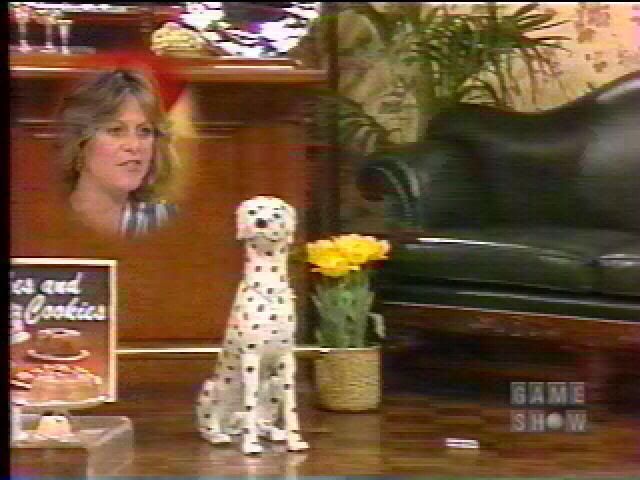
Stewart does win the jackpot, but unfortunately for him, the jackpot turns out to be $24,000 of mostly useless merchandise. It's not as bad as the ceramic dalmatians (courtesy of Ranger Ian) that contestants had to buy back when "Wheel of Fortune" had shopping after each round, but it's still pretty bad. There's a female portrait artist (Patricia Medina), of whom Hale becomes jealous; Stewart becomes jealous of a home-makeover interior designer (played by Alan Mowbray) who hates everything in the house, including some of the new merchandise he won. Worse, though, is the fact that Stewart will have to pay taxes on his winnings. The only way he can do this is to try to sell some of the merchandise he doesn't want, which also causes problems: unbelievably, Stewart is dumb enough to try to sell some of the prizs on the side at the department store where he works. And then there's a "buyer" in Chicago recommended by Gleason who turns out to be a fence....

The Jackpot is a pleasant comedy, but it's not much more than that. Watch out for Stewart and Hale's two kids, though: they're played by a young Natalie Wood, and Tommy Rettig (later of "Lassie"). It's not available on DVD, which is a bit of a surprise for a movie starring James Stewart.

Wednesday, May 28, 2008

Frank Sinatra vs. Cliff Richard

If you've been reading this blog for any length of time, you'd realize that I grew up in the 70s and 80s, and enjoy making references to some really lousy music. Those of you who remember the train-wreck-of-a-movie Xanadu may remember that, stuck in amongst the symphonic rock of the Electric Light Orchestra, was a duet between star Olivia Newton-John and the quintessentially British singer Cliff Richard: "Suddenly". Someday I might blog about Xanadu, but I make the bad music pun because overnight tonight, ie. at 3:00 AM ET on May 28, TCM are airing the Frank Sinatra movie Suddenly.

Sinatra comes late to the movie; we first see 50s B-movie stalwart Sterling Hayden as Todd Shaw, the sheriff in Suddenly, California. He's approached by the Secret Service: the President is taking a fishing trip, and his train is going to make an unexpected stop in Suddenly so that he can disembark and get into a car that will take him to his final destination. It's up to Sheriff Shaw to get everybody away from the President and the train station, without letting anybody in on the fact that the President is coming to town.

Of course, the bad guys already know the President is coming to town. They're led by John Baron (played by Frank Sinatra), and they're casing the town for the best place to shoot at the president. That, of course, is obvious: it's a house on a hill owned by "Pop" Benson (there's wonderful character actor James Gleason in yet another role), who just happened to be a Secret Service agent before being shot in the line of duty. He lives there with his widowed daughter-in-law (played by Nancy Gates), who just happens to be in love with the sheriff. Naturally, Baron and his gang force their way in, taking the Bensons hostage, and eventually taking the sheriff hostage as well when he shows up -- he too realizes that the Benson house is the obvious place for any bad guy snipers to shoot at the president.

Suddenly is a pretty good "B" thriller (despite having a star like Sinatra, it's got all the trappings of a "B" movie), and it's available on DVD. Apparently, Sinatra had it pulled from any sort of distribution after John F. Kennedy was assassinated, and it must have fallen into the public domain, allowing those with prints of it to sell copies themselves. (The only print I've ever seen is pretty lousy; let's hope TCM have access to something better.) The one upside to this is that you should be able to find a DVD of a good movie for a very small price.

edited to correct the time Suddenly is airing

Monday, May 26, 2008

Manhattan Transfer

A remarkable movie that I had never even heard of, until it aired about a month ago on the Fox Movie Channel, is being repeated, as is Fox's wont, at 6:00 AM ET on May 27: Tales of Manhattan. Directed in 1942 by French exile Julien Duvivier, Tales of Manhattan is an anthology movie, telling several stories framed by a formal topcoat, and the several people into whose hands it falls, both figuratively and literally.

As is the case with anthologies, the stories are uneven, with some only good, and others outstanding. The happy side of this, however, is that if you don't like the current story, wait ten minutes, and you'll get another story. A brief synopsis of the seven stories:

1. Charles Boyer is having an affair with Rita Hayworth behind the back of her husband Thomas Mitchell;
2. Henry Fonda helps his friend Cesar Romero by claiming a love letter to Romero is actually for him; Ginger Rogers falls for the ruse and falls for Fonda;
3. Charles Laughton gets the chance to conduct the concerto he wrote;
4. Edward G. Robinson, a disbarred lawyer living at James Gleason's mission, goes to his 25th reunion, where he's discovered by George Sanders;
5. W.C. Fields plays a teetotaler pushing the benefits of coconut milk -- not knowing that Margaret Dumont's husband has spiked it;
6. J. Carroll Naish plays a casino robber;
7. Paul Robeson and Ethel Waters are sharecroppers who share the $41,000 Naish robs with their preacher, Eddie "Rochester" Anderson.

As you can see, Tales of Manhattan has an all-star cast (and I haven't mentioned a few character actors who show up in the framing stories). Perhaps the best of the stories are two in the middle. Charles Laughton's composer is a struggling one; at the opening of his story he's working as a pianist in a jive joint, playing popular music instead of the serious music he'd like to compose. Indeed, every time the boss turns his back, Laughton tries to play the songs with a more classical-styled arrangement. Watching this, along with the extremely expressive faces that Laughton makes in the bar and later, as his big chance seems to go sour, is a joy.

Edward G. Robinson's story is also excellent; he's a disbarred lawyer who needs the topcoat to be able to go to his reunion, and when he gets there, you can see it's clear that he doesn't want to disappoint his classmates by their finding out the truth about him -- despite the machinations of Sanders, who is wonderfully slimy, eight years before Sanders played the similar schemer Addison DeWitt in All About Eve.

The Naish segment might be the weakest of the bunch, in part because it's too short to have much of a story line, and in part due to the lack of star power. Other reviewers suggest that the Henry Fonda/Ginger Rogers love story is a bit weak, too. It's a straight up comedy, something which Fonda didn't do much of during his career. Usually, when he was in a comedy, he tended to play the foil and let others around him be funny, as in Yours, Mine, and Ours. (Yes, I know he was in Preston Sturges' The Lady Eve, but that's an exception.) Fonda isn't that bad, but the humor is often forced, and it's a "comedy of lies" (in that a little white lie leads to bigger and bigger cover-ups that are supposed to be the basis of the humor) that generally rubs me the wrong way.

Some may find the final segment uncomfortable, since it does come close to verging on racial stereotyping, much more so than when Anderson and Waters were together in Cabin in the Sky.

One final note: if you look carefully, you'll see that W.C. Fields isn't in the credits. That's because his sequence had been cut from the movie at one point, only to be added back in in the restored version.