Showing posts with label Judy Garland. Show all posts

Wednesday, December 24, 2025

I know -- let's put on a minstrel show!

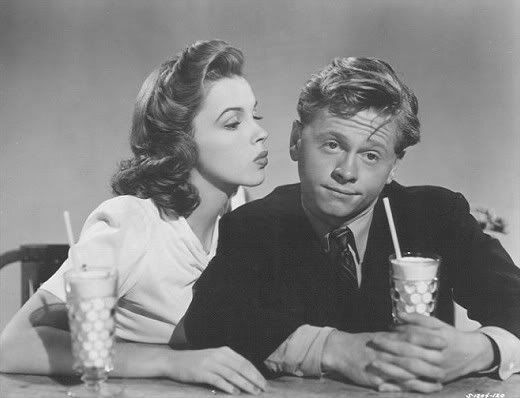
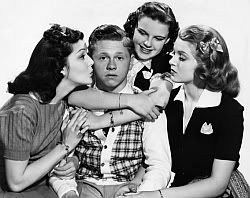
Continuing to go through the movies that I recorded when Mickey Rooney was TCM's Star of the Month in December 2024, this time it's another of the musicals he did with Judy Garland, Babes on Broadway. This is, of course, not to be confused with Babes in Arms which is another musical that Rooney and Garland did together although they play different characters.

This time around, Mickey Rooney is playing a young man named Tommy Williams, who is apparently all grown up since he doesn't have any parents around. That, and he's part of a trio calling themsleves the "Three Balls of Fire" together with Ray (Ray McDonald) and Hammy (future director Richard Quine when he was still in front of the camera). They have dreams of fame, but of course those dreams don't seem to be going anywhere in part because it's tough to make it in New York, and more generally tough to get noticed period. On their last night performing as the entertainment at an Italian restaurant, they get a big tip from a Miss Jones (Fay Bainter). It turns out that Jones is actually the executive assistant Thurston Reed (James Gleason), and she is able to get the Three Balls of Fire an audition with Reed.

Of course, Tommy is a bit stupid in that he tries to use this to get all his other friends auditions too, which is not what Reed would want. And the friends is a new one, Penny Morris (Judy Garland). She is the daughter of a music teacher, and works at a settlement house with underprivileged children. The settlement house is looking to do the fresh air thing; that is, get city kids out of the city for a couple of weeks and up to a camp in the Catskills or out in New Jersey or some such). Tommy and Penny both get the brilliant idea to set up a charity fundraiser of having the young people perform, except that Tommy intends to use it to raise the money to rent a real theater instead of helping the poor city kids.

That threatens to put the kibosh on what is also going to be a budding relationship between him and Penny, as you might guess since these musicals are nothing if not formulaic. But a wrinkle gets put in those plans thanks to World War II on the other side of the Atlantic. (The movie was released a few weeks after Pearl Harbor, although surely most of the filming must have been before December 7, making it interesting that this plot line is in the movie.) As a result of the war, British children were being evacuated to Canada and the US (as in On the Sunny Side which shows up from time to time on FXM), and they need help more than the settlement house kids. Also, Tommy has more sympathy for them and probably wants to bed Penny too, so he decides to be honest.

This gives Jones the idea of letting the kids use one of Reed's old, disused theaters if they can refurbish it (where are they going to get the money for that) to put on the show. The refurbishment offers the opportunity for probably the best sequence in the movie, as Penny and Tommy imagine the performers who played here in previous generations and do their impressions of what such performances might have been like. However, there are legal issues with the show going forward, combined with the fact that Reed doesn't exactly know his old theater is being reused. But, since it's a Mickey Rooney/Judy Garland musical, we know that it's going to have a happy ending.

That happy ending is where the minstrel show comes in, and is the thing that pretty much everybody else brings up in discussing Babes on Broadway, because this is a long blackface sequence, much longer than there were in some other movies. And modern-day people have to point out how terrible it is that this stuff was popular back in the day. (Some might say still is, except that it's now womanface and men who don't look like convincing women calling themselves "trans" so they can get off on getting into what are supposed to be private spaces for women.)

In any case, Garland and Rooney give their typical rousing performances, and it's easy to see how the movie taken as a whole would have lifted the spirits of audiences on the homefront who had a lot going on in their lives by the time the movie was released. So Babes on Broadway is actually worth a watch.

Wednesday, August 6, 2025

A Star Is Born (1954)

A Star Is Born is one of those classic Hollywood tales that's been don a bunch of times: four under that title, and some would argue that the 1932 film What Price Hollywood? is pretty much the same story. I haven't seen the most recent remake with Lady Gaga, although I think I've done posts on the 1930s and 1970s A Star is Born as well as What Price Hollywood? I saw that the 1954 version starring Judy Garland is on tonight at 8:00 PM, so I watched it off my DVR to do a sort of review on it.

Now, I call it a sort of review because this is the sort of film where I'd guess most people already know the story. Esther Blodgett (Judy Garland) is struggling in her career until she's seen by Hollywood star Norman Maine (James Mason) who is painting the town red for the umpteenth time. Maine gets Esther a screen test, and she eventually changes her name to Vicki Lester, becomes a star, and marries Norman. But as Vicki's career rises, Norman drinks more, until the tragic ending.

So, in discussing this version, I think it's a bit better to talk about some of the things that distinguish it from previous versions. The first one is that as the movie opens, Esther is already a singer in a big band, with a maybe-boyfriend in Danny McGuire (Tommy Noonan). Esther having to suffer in the Dakotas during the Depression but with a grandmother with a heart of gold who helps Esther get to Hollywood isn't here at all. (Indeed, the May Robson character is totally written out.) I think that having Esther already have at least a halfway successful career isn't such a good choice. I couldn't help but think of her traveling singer in comparison to the one her real-life daughter Liza Minnelli goes on to play in New York, New York, where it doesn't seem to be that bad a career.

Judy Garland being a singer, there are a lot of musical numbers for her to perform, as that's a talent she definitely had as opposed to Janet Gaynor. Fans of Judy Garland's singing will obviously love the plethora of musical numbers. I have to admit that I'm not the biggest fan of Garland's singing. The songs help push the movie out to a shade under three hours, which includes a few minutes here and there of production stills with the dialogue track. This last conceit, however, is not like the "restored" version of Greed which added on a good 100 minutes of production stills.

On the plus side is the casting of Charles Bickford in the role of studio boss Oliver Niles, a character played by Adolphe Menjou and done reasonably well. Bickford doesn't have quite the elegance that Menjou always did, although I think that for the dark story line that's something that works even better. Bickford has a sort of bitter elder statesman dignity that I don't think Menjou did. Jack Carson gets a beefed-up role as the publicity agent and is good, although there's that one scene where he's gratuitously nasty to Norman Maine. A reading of the 1937 synopsis points out that the scene is in that movie too, although I didn't remember it, probably because the publicity agent there was played by Lionel Stander who is much lower down the status list than Jack Carson was.

Personally, I prefer the 1937 A Star is Born, but I'm sure many people will greatly enjoy tonight's showing of the 1954 version.

Monday, June 9, 2025

The Harvey Girls

I generally try to avoid doing posts on multiple films with the same star in close succession. Every now and then, however, the films on my DVR that are showing up on TCM happen to include a pair with the same star. That happens again this week; a few days back I posted on The Pirate, and now The Harvey Girls is showing up on TCM tomorrow, June 10, at 3:15 PM as part of a birthday salute to Judy Garland.

Opening title cards inform us of what the Harvey Girls were, which is a good thing because while a few people still living in 1946 when the movie was released might have remembered Harvey Girls, audiences today wouldn't. Fred Harvey was a freight agent for one of the railroads back in the 1870s who had the idea of setting up a series of restaurants at those stations along the line where the trains stopped long enough for passengers to eat. The restaurants became known as Harvey Houses, and employed unmarried women who were required to fit a squeaky-clean image in exchange for good-for-the-era pay.

As the movie opens, Judy Garland is not one of the Harvey Girls, but instead a young woman named Susan Bradley who is traveling west to the town of Sandrock to meet the man she's going to marry, having corresponded with him by letter. Also on the train is a new set of Harvey Girls managed by Sonora Cassidy (Marjorie Main). Susan gets off at the same town where the new Harvey House is being built, and finds that the putative man of her dreams is no such thing, but a drinker and old coot named Hartsey (Chill Wills). She doesn't want to marry him now, and thankfully Hartsey is OK with that, telling Susan that the love letters were written as a sort of joke by Ned Trent (John Hodiak).

Ned Trent runs the local den of iniquity, a saloon with dancing girls called the Alhambra, and Susan is so pissed with him that she vows to become a Harvey Girl herself and help drive the Alhambra out of business by bringing Harvey House civilization to Sandrock. Ned and his friend Judge Purvis (Preston Foster) plot to put the Harvey House out of business, but of course Ned eventually finds himself falling in love with Susan. Complicating matters is the fact that the head of the Alhambra dancing girls, Em (Angela Lansbury), is in love with Ned.

It all leads to the predictable conclusion, but with a bunch of musical numbers along the way because audiences expected that from a Judy Garland movie. Indeed, when we first see Garland on board the train she's singing a song. The musical numbers are certainly well-done and lively, although as many of you may know I'm not the biggest fan of Judy Garland musicals. It's easy to see, though, why Garland fans and audiences of the day would enjoy The Harvey Girls.

Thursday, June 5, 2025

The Pirate

Next up on the list of movies that I have on my DVR that's coming up again soon on TCM is The Pirate, which TCM will be running tomorrow (June 6) at 8:00 AM.

The movie opens up with some title cards telling us about the legendary pirate Macoco, who preyed upon shipping in the Caribbean in the second half of the 18th century. Having read those tales is Manuela (Judy Garland), who lives on one of the Spanish islands in the caribbean with her aunt Inez (Gladys Cooper), who has raised her since her parents died. As Manuela is technically an orphan, aunt Inez wanted to marry her off, which she's about to do with Don Pedro Vargas (Walter Slezak), who has been shipped in by the Spanish authorities to be mayor of the provincial town where Manuela and Inez live.

Manuela, having been fascinated by the tales of Macoco, wants to see the Caribbean before she gets married, so she goes off to the port town serving the island, ostensibly because her trousseau should also be arriving and she can have alterations to her wedding dress made there if need be. Also arriving in port is an acting troupe led by Serafin (Gene Kelly), sporting a ridiculous moustache and wig, and in one of the dance numbers an extremely short tunic.

Part of the shtick of Serafin's show is mesmerism, at the time a sort of parlor trick since people didn't really understand hypnosis. Serafin hypnotizes Manuela, who does a musical number about loving Macoco. Since Serafin was struck by Manuela's beauty and that was the whole reason he put her under hypnosis in the first place, Serafin decides to pose as Macoco to try to win over Manuela, never mind that she's betrothed to Don Pedro.

And then Serafin has a run-in with Don Pedro. It turns out that this isn't the first time the two met, as Don Pedro is the real Macoco, and had at some point in the past taken Serafin and his acting troupe hostage off the coast of Africa. But nobody else knows the real Macoco. The Spanish want Macoco, and Don Pedro sees an opportunity to kill two birds with one stone. Except that this would violate the Prodcution Code, and besides, Gene Kelly is a much more romantic leading man than Walter Slezak, so you can guess who winds up with whom in the final reel.

The story in The Pirate isn't terribly original, but that's beside the point. The Pirate is a vehicle for its stars: Gene Kelly gets to do a lot of dancing, while Judy Garland gets to sing. They both get to show off their ample talents in that regard, and the song and dance numbers are all exceedingly well executed technically. The only thing for me, however, is that because the story is so week, all the musical numbers left me a bit cold, as if the movie just has no heart.

However, if you like either Judy Garland or Gene Kelly, chances are you'll be able to overlook the story weaknesses and really enjoy The Pirate.

Sunday, May 25, 2025

Thousands Cheer

Red Skelton was TCM's Star of the Month back in April. One of his movies that I had on my DVR surprisingly enough was not shown as part of the tribute. But since the movie would be kinda-sorta appropriate for Memorial Day weekend (not that TCM is programming it), and because the movie is going to expire from my DVR relatively soon, I figure that now is a good time to blog about it. That movie is Thousands Cheer.

The opening credits of the movie announce that it's introducing José Iturbi, a Brazilian pianist/conductor who would appear in several muscially inclined movies over the next several years, and he's in the opening, leading a philharmonic concert where one of the performers is singer Kathryn Jones (Kathryn Grayson). After her musical number, she informs the audience that she's going to be taking a sabbatical from performing: her father Bill (John Boles) is a US Army colonel, and with the movie being made in 1943, it's smack-dab in the middle of World War II. Col. Jones is about to be assigned to another base, and Kathryn is going to follow him in order to provide morale for the troops stationed there about to go off to war.

One of those troops is Pvt. Eddy Marsh (Gene Kelly), who is on the same train to the base as Col. Boles. He implies to Kathryn that he loves her, not realizing that she too is going to be staying at the base, which is going to make things awkward when the two of them meet again. They do meet again on the base, and Eddy informs Kathryn that he doesn't really like the army. He was drafted, but he came from a family of circus aerialists, with the result that he feels much more comfortable up in the air than on the ground and as a result would really prefer to be transferred to the Air Corps.

Kathryn falls in love with Eddy along the way, although Eddy has a problem with the officer corps which means that by definition he also has a problem with the daughter of an officer. Additionally, Kathryn's mother Hyllary (Mary Astor) doesn't want her daughter marrying a soldier. Hyllary did so and suffered heartbreak thanks to her husband's transfers and basically being married to the military. Besides, Eddy's attitude is so bad that one wonders whether he's going to be court-martialed out of the military.

All of that occurs in the amount of running time that a movie might have if Thousands Cheer were a B movie. But it isn't, being one of MGM's big, morale-boosting films for the war effort. As such, Kathryn has to invite all her friends to help put on that big show for the soldiers about to go off to war. Mickey Rooney (playing himself) is the MC of that show, and he's brought his MGM friends (again playing themselves) to perform skits and musical numbers at the camp for the soldiers. This show-within-a-show takes the final third of the movie, with a coda at the end to resolve the main story. Quite a few of MGM's stars perform, including Skelton.

Thousands Cheer is an odd little -- or should I say big, since it runs a bit over two hours -- movie, since it's really two movies in one. Gene Kelly was fairly early in his career, but already shows his ability. However, he wasn't given a particularly interesting story in which to show that ability. It's not Kelly's fault, of course; the movie has to hit the propaganda notes of a serviceman redeeming himself by doing the right thing for his country, and it has to do that fairly briefly since we've got 45 minutes of MGM cameos to show, thank you very much.

Some of the cameos are better than others, with Frank Morgan being irritating while some of the singers do reasonably well. The aerialists might be the highlight of the camp show. That, and Mickey Rooney doing his impressions of some of his fellow MGM contract players. Not that they're notably good, but they're certainly fun. Interestingly, there's a conceit where one of the soldiers in the crowd, played by Ben Blue, goes googly-eyed over all the female singers. Except when Lena Horne shows up, but then again Horne's segment has obvious points where censors in the South could have cut so those sensitive southern moviegoers wouldn't have to see a black woman singing.

For me, Thousands Cheer comes across 80-plus years on as more of a time capsule than anything else, but it's one you may want to check out.

Monday, September 9, 2024

Till the Clouds Roll By

I had some more movies that were about to expire from YouTube TV's cloud DVR, so I had to make a point of watching them to do a review now. The latest is the musical "biopic" Till the Clouds Roll By.

The movie opens with one of those old-style forewords informing us that the action begins on December 27, 1927, the opening night of the musical Show Boat. The music was written by Jerome Kern (played here by Robert Walker), a composer who had already had a string of Brodway hits in the 1920s, although getting to the top wasn't easy. On his way back home after the show, he asks the cab driver to detour and look for a particular brownstone. Since the movie opens up at the height of Kern's career, we know that we're about to get an exceedingly original plot device... the flashback to the beginning of the subject's career.

This time, we go back around 20 years (the real-life Kern got his start fairly young, around age 20 in 1905). Young Jerome is a budding composer, but he doesn't know so much yet about lyrics or good arrangements. To that end, he's been sent to the brownstone that older Jerome asks the driver to stop by. There (in 1905) lives an arranger, James Hessler (Van Heflin). Now, this leads to why I put the word "biopic" in sneer quotes above. James Hessler is the other main character of the movie along with Kern, but Hessler is a completely made-up person! Hessler is an arranger who would like to be a symphonic composer. He's also a widower with a young daughter Sally (grown-up Sally is played by Lucile Bremer). In any case, Hessler becomes Kern's mentor.

Kern writes good music, and would like to write for Broadway, but when they try to get a foot in the door, they learn that it's still the fad on Broadway to import revue-type shows from the UK and that the music of London is more popular to the Broadway crownd than the new American sounds bubbling up. So it's off to London.

Kern eventually meets British producer Charles Frohman (a real-life person, and his death along with Kern's tangential relationship to that being more or less accurately portrayed), and is able to sell one of his songs to Frohmann's London Gaieties. This also leads to Kern getting hired to write more songs for a show that's going to open in New York. Also while in the UK, Kern met Eva (Dorothy Patrick), the woman who would become Mrs. Kern.

Kern goes back to America with the Hesslers and Frohman, and I'd guess it was the US being out of the Great War for a couple of years while the European powers were fighting it that really boosted the careers of composers like Kern. Sally, now grown up, has always considered Jerome like an uncle, and wants to follow Jerome into musical theater. To that end, Jerome even writes a song for a musical that would give Sally her first solo even though she's not going to be the star of the show. The producer, however, thinks the song would be a better fit for the show's star, Marilyn Miller (another real-life person, played by Judy Garland). Sally has a hissy fit and... runs away!? Dad, by now ill with heart problems, wants Jerome to find Sally, but Dad dies before father and daughter can be reunited.

Jerome, like a lot of other composers and lyricists, went off to Hollywood once sound comes to movies, and wrote more memorable songs for movies in addition to adapting some of the old musicals for Hollywood. The last 10 minutes or so is a montage of various MGM stars doing numbers of a bunch of different songs, giving MGM a chance to put those stars into a big-budget musical if they hadn't already been used in a production number earlier in the movie.

If you like the Great American Songbook, you'll love Till the Clouds Roll By. The songs are unsurprisingly quite good. There's a reason why things like Show Boat or the song "Smoke Gets in Your Eyes" from Roberta endure. The production numbers MGM did, at least up until the finale which is a bit more bland, are also very well done. The dramatic story, however, is something best not discussed. To be fair to MGM, however, the real life Jerome Kern story was mostly something not cinematic or dramatic enough for a biopic. But that's part of why Till the Clouds Roll By is a bit of a mixed bag.

If you like the Freed Unit, then Till the Clouds Roll By is definitely for you.

Wednesday, May 22, 2024

Words and Music

Yet another movie that's been sitting on my DVR just waiting for another TCM airing so that I could watch it and do a post on it is the musical "biopic" Words and Music. That next showing on TCM is tomorrow, May 23, at 5:45 PM, so with that in mind I sat down to watch it in order to be able to do a post on it in time for you to watch the next showing.

After an opening credits sequence set over a chorus singing one of the songs of the writing team of Richard Rodgers and Lorenz "Larry" Hart, we're introduced to Rodgers. Well, not Rodgers himself, but Rodgers as a character, played by Tom Drake. The fact that a decidedly second-tier star like Drake is playing Rodgers is a good hint that this is much more a story about Lorenz Hart.

Back in 1919, Lorenz Hart was a struggling songwriter who came up with all sorts of lyrics that the smart set might have thought were witty, but didn't have any music to go with them. His friend Herb Fields (Marshall Thompson), realizing that Larry needed a composer to put those words to music, decided to introduce Larry to one of his friends, that of course being Richard Rodgers. Rodgers is mildly confused considering that Larry doesn't really seem to be listening to his music, but some time later Larry tells him he does like one of his melodies and they should put the two together.

However, actually trying to sell any of their songs is much more difficult. Eventually Richard gets to the point that he thinks seriously about giving up trying to become a composer, telling his father that he's going to quit music to go into selling children's apparel. But Larry ropes him back in asking him to give it one last chance, and wouldn't you know it, but the Garrick Gaieties comes along introducing a bunch of new faces to Broadway, with Rodgers and Hart being asked to be among those new faces, even if not on the onstage side.

One person who might make a nice new face is struggling actress Peggy Lorgan (Betty Garrett). Larry does try to get her a starring role in the gaieties, but he's not a producer or casting agent, with the result being that another actress, Joyce Harmon (Ann Sothern) gets the part. Still, the two develop a nice friendship together. It goes far enough that Larry decides he's going to ask Peggy to marry him, but she turns him down. This is where the "biopic" really starts getting sanitized, as if it weren't already being sanitized to this point.

In real life, Lorenz Hart was gay at a time when one couldn't really be gay in public life. Apparently, he did have an actress with whom he was good enough friends that he'd ask her to marry him in what would have been an obvious sham relationship in the Tab Hunter/Natalie Wood vein, but that actress turned him down. Again in real life, being gay and not being able to be so publicly led Larry to engage in heavy drinking and other self destructive behavior that led to his death just before the age of 50, as well as to Richard Rodgers' decision to team up with Oscar Hammerstein when Broadway came calling with what would be the musical Oklahoma. Hart did live long enough to see that become a success, dying not long after.

So while Words and Music really plays fast and loose with the facts, in some ways that's not the reason one would watch a movie like this. In a film about a composer, it's always going to be just as much if not more about the music as about the music. And as we all know, Rodgers and Hart wrote quite a few of the great pre-war songs from the Great American Songbook. Not only is there the music, but MGM took a whole bunch of its musical stars under contract and had them do cameos singing various of the Rodgers and Hart songs. These include Judy Garland, Gene Kelly, Lena Horne, Perry Como, and others.

Words and Music may be utter nonsense as far as the historical facts go. But if you like vintage Broadway music, you'll get that in spades. That, combined with MGM's superb Freed Unit production values. Maybe someday somebody will put the real story of Lorenz Hart on film. But I don't think it would be as vivacious a movie as Words and Music.

Sunday, April 14, 2024

I guess tax day is Christmas for *some* people....

Another well-known movie that I'd never actually done a post on before is Meet Me in St. Louis. So, when TCM ran it during 31 Days of Oscar, I decided to record it so that I could rectify the omission of it from my reviews. With this being the 100th anniversary of MGM and TCM doing a retrospective of the studio every Monday, it's not a surprise that Meet Me in St. Louis is one of the films selected. That airing is coming up tomorrow, April 15, at 11:45 AM.

For good reason, Meet Me in St. Louis is thought of as a Christmas movie, that being the debut of the song that's now a Christmas standard, "Have Yourself a Merry Little Christmas". But two-thirds or more of the film is really not about Christmas. In fact, the movie is set in the run-up to the 1904 World's Fair held in St. Louis, and looks at the life of one family living in St. Louis, the Smiths.

Esther (Judy Garland) is the second oldest of four daughters of Anna (Mary Astor) and upper-middle-class lawyer Lon Sr. (Leon Ames); Lon Jr. is a fairly minor character in the story. As the film opens it's the summer of 1903. The family is thinking somewhat of the exposition coming to their growing city in the final year, but Esther and her elder sister Rose (Lucille Bremer) are both thinking about love. Rose has a beau currently in New York, Warren Sheffield, who is supposed to call long distance that night, which is a big deal for 1903. Rose and Esther are hoping Rose can get Warren to propose marriage to her during that call. Rose, for her part, loves the next-door neighbor, John Truett (Tom Drake), but he doesn't quite seem to notice it yet.

Fast-foward to the autumn, specifically Halloween. The two much younger daughters, Agnes (Joan Carroll) and Tootie (Margaret O'Brien), go out and engage in the sort of tricking that I suppose was done in the days before trick-or-treating. Tootie comes back claiming to have been beaten up by John, which threatens to put a crimp in the budding relationship between him and Esther. But putting a much bigger dent in those plans is one evening when Dad comes home and announces that the firm has given him a "promotion" that requires he transfer to New York. Everyone is going to have to start anew, which is a massive problem for the two eldest daughters. Not only that, but they'll miss the World's Fair!

We move again to winter, which means Christmas. There's a big formal ball coming up for Esther and Rose, but mishaps occur that may make the ball a disaster for the both of them. Also, with Christmas coming up, it means that the family's time in St. Louis is about to end, since the family is supposed to move to New York in the New Year. (I'd have thought they'd be closing up the house by Christmas, not leaving everything to literally the last week. Having moved my father a year ago from the house where he'd lived for almost 50 years, I know how arduous that is.) But, since we're getting to near the end of the TCM's allotted time slot for the movie, we know that a happy ending is about to come. The movie concludes with the spring of 1904, which is really a coda of the family at the exposition, lasting far shorter than the previous three seasons.

It's once again easy to see why audiences of 1944 when the movie was released loved it, flocking to it and making it a huge box-office hit. Released during World War II, it's a nostalgic look back much like some of the Fox musicals I've mentioned favorably here. The Technicolor is lovely, and the songs work for those who like musicals. I'm not the biggest fan of musicals in general or of Judy Garland's vocal stylings in particular; I'd much rather re-watch her in The Clock where she's excellent.

But just because Garland isn't to my personal taste doesn't mean the movie isn't good. A year or two earlier the Academy cut the number of Best Picture nominations from ten to five; if they hadn't I'm certain Meet Me in St. Louis would have been nominated. For anybody who's a fan of musicals, Meet Me in St. Louis should be highly appealing.

Sunday, March 31, 2024

Easter Parade

With it being Easter today, TCM has a traditional lineup of movies with religious themes. But one other movie that they seem to pull out every Easter is an appropriate one not just because of the title, but because the opening and closing scenes are set on (secular) Easter: Easter Parade.

The movie opens on Easter Saturday, 1911, although the movie doesn't quite mention dates until much later in the movie. Fred Astaire, playing dancer Don Hewes, is singing a song and doing some gift shopping. Eventually, he goes into a toy store to by a stuffed rabbit, but that's really just an excuse for a fairly spectacular dance number involving him and the little boy from whom Hewes is going to get that bunny.

The gifts are for Don's kinda-sorta girlfriend, Nadine Hale (Ann Miller). But Nadine isn't just a possible romantic partner; she's also Don's dance partner in the dance pair Nadine and Hewes who do revue shows and the like. I say "is", but it's about to become "was". Don has signed the two of them up for another road show, but Nadine has decided she wants to try to make it on Broadway. With that in mind, she's signed a contract to appear in what is going to become the latest edition of the Zigfeld Follies.

Don can't convince her not to leave him, so he goes to a bar to try to drown his sorrows. Except that this is an odd little dive bar in that it also has a floor show, complete with numerous chorus girls. One of those chorus girls is Hannah Brown (Judy Garland), and Hewes is so taken with her that he decides to tell her she should come see him the following morning since he wants her to be his new dance partner. She thinks the guy is crazy, and even rips up his business card, until she finds out that he's the famous Don Hewes.

After rehearsal the next morning, Hannah runs into Don's best friend, Jonathan Harrow (Peter Lawford). Jonathan is also taken with Hannah, and proposes to take her out to dinner, but you know Jonathan is going to be the third wheel in any relationship in the movie. Indeed, he later winds up pursuing Nadine for reasons that don't really make much sense and don't do all that much to advance the plot.

Don and Hannah go out on the road and are able to work steadily if not spectacularly, at least not for several months. Eventually, Don signs a contract for the two of them to star in a musical revue of their own, which after rehearsals and road previews, is set to open on Broadway on Easter Saturday 1912. The premiere is in fact a success, but when the two go to the Ziegfeld Follies to celebrate, Nadine asks Don to do one of their old numbers with her, leading Hannah to think he only used her to get back at Nadine. This was in fact Don's original intention, but along the way he truly fell in love with her.

Easter Parade is a movie that has a very slight story -- indeed, it's the sort of on-again, off-again series of misunderstandings that I could easily have seen Fred Astaire doing with Ginger Rogers at RKO a decade earlier. Here, the story is set against a series of songs written by Irving Berlin that are used as the basis for dance numbers. The story isn't much, as I said, and frankly it's by far the weakest part of the story. Indeed, in that regard I'd rate the movie a notch below one of Berlin's earlier musicals, Alexander's Ragtime Band.

But what Easter Parade has going for it is a couple of things. One is those dance numbers. Fred Astaire was much better in terms of dancing that any of the cast of Alexander's Ragtime Band. It also has Technicolor, which makes a movie like this that much better. Indeed, I don't think the movie would be memorable at all if it had been made in black and white. That's how much weaker the story is than even the old Fred-and-Ginger films.

So, although I had some problems with Easter Parade, it's definitely a movie that's worth watching. And I think that if you're the sort of person who likes the dance numbers, you'll really love Easter Parade.

Tuesday, May 23, 2023

The sort of programmer MGM was good at

I've suggested before that I think Warner Bros. made the best B movies and programmers. Having said that, other studios could make good programmers too, especially when it fit the sort of movie the studio was good at making. If MGM needed something glossy and upscale for one of its programmers like a romantic comedy, they didn't do so bad. There were also the "family" type movies to keep up the spirits of people during the depression, such as all those Andy Hardy movies. Another movie that fits more into that second group is Listen, Darling.

The family here is a sort of broken family, which is largely because Dad has died, leaving behind Mom, Mrs. Wingate (Mary Astor) to try to raise two children. Billy (Scotty Beckett) is the nortmal sort of Hollywood brat you get a lot of from younger children in the movies, but the elder child is already becoming an adult. Pinkie (Judy Garland) is about 15, finishing middle school, and already a talented singer. She ought to go to music school, but then, Mom's a widow now, and can't afford that.

Meanwhile, there's a well-meaning banker, Mr. Drubbs (Gene Lockhart), who likes Mrs. Wingate as something more than just a friend. He also doesn't dislike the children, and is willing to provide for them by marrying their mother. Mom doesn't exactly dislike Drubbs, but recognizes that it would be more of a marriage of convenience to give the kids what they need. It's a sacrifice, but one that Mom would be willing to make for her children.

The other problem is that Pinkie is getting to the age where she's mature enough to understand all of this. She wants her mom to be happy, and recognizes that Drubbs isn't right for Mom. But how to get Mom to recognize this? Well, Pinkie has a platonic friend in the form of Buzz Mitchell (Freddie Bartholomew) who is picking up some extra money by working at his uncle's service station. Buzz finds some law books in the Wingate family trailer, and gets the idea to shanghai Mrs. Wingate into the trailer and then taking the whole family on a trip, where hopefully they'll find a more suitable man for Mrs. Wingate. It's a ridiculous idea, least of all because one wonders how they'll get the money to keep gas in the car and keep the trailer powered.

But of course, this being a light MGM comedy, you know that the plan is going to have success, and if you know the formula of the movie, it'll have too much success. Also traveling around by trailer is the bachelor photographer Richard Thurlow (Walter Pidgeon). He and Mrs. Wingate keep meeting and eventually become friends, with the possibility that it could become love. But one of the places they camp is just down the road from the mansion of insurance executive J.J. Slattery (Alan Hale), and he and his butler take care of the children when they get lost and have an encounter with a skunk. Slattery could be a good father for the kids, too, but he knows better since he's further down the credits from Walter Pidgeon's character.

Judy Garland was on her way to stardom, although the hadn't quite attained it yet, as this was a year or so before The Wizard of Oz and the big musicals with Mickey Rooney like Babes in Arms. As such, she only merits the programmer treatment and not a prestige movie, especially not with this plot. And you'd think that a plot like this could become too syrupy, yet somehow it works surprisingly well. Especially Walter Pidgeon surprises at doing what is fairly light comedy. Contrast this with something like Scandal at Scourie a dozen years later where he's weighted down by a moralizing plot and the presence of Greer Garson.

If you were looking to watch an old-style movie night with a B movie or programmer before the big show, Listen, Darling would be a great movie to start off with.

Tuesday, November 24, 2020

Strike Up the Band

TCM ran a centenary salute for Mickey Rooney back in September which gave me the chance to record a couple of movies I hadn't blogged about here before. One of them is Strike Up the Band.

Mickey Rooney plays Jimmy Connors, not the ill-mannered tennis player but a high school senior who plays the drums in the school band. However, Jimmy has ideas about playing in a jazz band, that being the hot new style of the day. He gets a bunch of his classmates together, and they start practicing after school, although there's some consternation amongst the parents who think this might just be taking time away from their kids' studies.

Among the folks involved in the band are Mary Holden (Judy Garland), who is the singer for the band, and Willie (Larry Nunn), whom we only mention because he's going to come up later in the movie in a key if mawkish plot point. They put on a dance to raise money for the school, which proves to be successful, and gives Jimmy bigger ideas.

Jimmy's big ideas are going to be furthered when he's brought into contact with rich girl Barbara Morgan (June Preisser, basically reprising the same sort of character she played in Babes in Arms). Jimmy falls for Barbara which could be a problem with Mary, and also offers to be the band for a big party Barbara's parents are putting on, something that could make more money for the band.

The band has also put on another show after learning about a big contest Paul Whiteman (playing himself) is putting on for high school-aged bands. The only thing is, Whiteman is based out of Chicago, and Jimmy and his friends are out east (I think Long Island but I'm not certain the movie specifically gives the location of the fictional high school), and are going to need $200 to get the money for train fare to Chicago for the contest.

They're in luck, however. The Morgans aren't going to hire Jimmy and his band because they already have one for the party -- Paul Whiteman and his band! Jimmy and his friends show up at the party and, during one of the Whiteman band's breaks, do something unimaginable: they pick up the Whiteman band's instruments and start playing! Now, I'd think that if a professional musician found a bunch of well-meaning amateurs taking their instruments like this, the pros would be absolutely pissed. But instead, Whiteman is impressed, and after Whiteman hears Jimmy's sob story about not having the last $50 he needs to get the band to Chicago for the radio contest, Whiteman personally fronts Jimmy that money.

Ah, but there's another catch. Remember Willie? The second show the band put on was not just a concert, but a musical comedy show. Part of that show had Willie in a harness that gave him a serious arm injury. Willie needs an operation stat, but the orthopedic surgeon who has the most qualification to perform it is out in Chicago, and the plane there is going to take the $200 that the band needs to get to Chicago for the contest.

Of course, you know that the conflict is going to be resolved and Jimmy and Marry are going to wind up together in the last scene, which is actually a big concert of all of the bands in the contest, whom you'd think might have a bit of trouble being in sync seeing as they haven't practiced together before. But this is an MGM musical, so minor plot points like that can be ignored.

To be honest, I didn't mind the new tunes to be particularly memorable, but of course I'm also not the biggest fan of musicals. Anybody who is a fan of musicals, or of Judy Garland, is going to really like Strike Up the Band. Garland and Rooney bring a lot of energy to the movie, and even if the plot is hokey and predictable, their enthusiasm overcomes it. This was made for audiences who knew what they wanted and not something daring, and there's nothing wrong with that.

The last I checked, Strike Up the Band has been released on both DVD and Blu-ray courtesy of the Warner Archive collection.

Friday, April 15, 2016

Judy Garland shorts

Judy Garland is, of course, this month's Star of the Month on TCM. They've been showing her movies every Friday night this moth, and this week sees, in addition to her starring roles, a couple of shorts she made before she became a star.

First up, before prime time, is Fiesta de Santa Barbara, at approximately 7:39 PM. I blogged about this briefly back in 2013; it's a bunch of MGM stars celebrating, fiesta-style. Garland (who would have been 12 or 13 at the time) and her sisters sing a song; Andy Devine, Robert Taylor, and other stars show up. The color on the TCM print I've seen is gorgeous. Oh, and if you've seen the TCM Extras intro? The guy singing next to the horse is from this one.

Bubbles comes on around 9:48 PM, a bit after For Me and My Gal, the movie that kicks prime time off at 8:00 PM. I mentioned this one back on Judy Garland's birthday in 2014, as it's a really odd short. Children are performing, which isn't a particularly big deal. Except here they're presented as the children of the moon or something, so the way the short is presented is a bit bizarre, to say the least.

As you can see from the above link, a very young Judy Garland also appeared in a short called Starlet Revue. That one can be seen overnight at 3:16 AM, or just following The Clock (1:45 AM). The Clock, which I blogged about all the way back in March 2008, is an excellent movie, and well worth watching along with the short.

Friday, April 1, 2016

TCM Star of the Month April 2016: Judy Garland


Judy Garland and Mickey Rooney in, I think, Babes on Broadway (April 9, 3:00 AM)

We're into a new month already, as I briefly mentioned yesterday. This means, in addition to some movies back on FXM Retro, that we get a new Star of the Month on TCM. This time, it's MGM star Judy Garland, and her movies will be airing on each of the five Fridays this month.

Garland having worked at MGM for close to 15 years, TCM should have had no problem getting most of the movies they would have wanted to show. Or, at least, the movies she made before leaving MGM in about 1950. One later movie that doesn't seem to be on the TCM schedule this month is Garland's final film, I Could Go on Singing. Even The Wizard of Oz, which used to show up fairly rarely on the channel, can be seen next Friday at 8:00 PM.

Tonight starts off with a decided supporting role, in Pigskin Parade at 8:00 PM, one of those college football movies that seem to have been so popular in the 1930s. But just a year or two after making that one Judy was already a pretty big juvenile star, as can be seen by her high billing in the following film, Listen, Darling at 9:45 PM.

Monday, June 9, 2014

Judy Garland's birthday tomorrow


June 10 marks the 92d birth anniversary of actress Judy Garland, and unsurprisingly, TCM will be spending the morning and afternoon with her movies. The two shorts that are on the schedule also have her in them, and the shorts are to me the more interesting part of the schedule anyway.

The second of the two shorts is Bubbles, but I mention it first because I've mentioned it here in the blog previously. It comes on almost immediatley following Babes in Arms (11:45 AM, 96 min). Basically, it's a talent show except that it's the moonbeam children doing it, produced by the man in the moon. Or something like that, as it's all quite a bit odd. But watch for an 8-year-old Garland with her sisters, as part of the Gumm Sisters.

The Gumm Sisters show up in the even earlier Starlet Revue, which is on at about 9:33 AM, or just after Everybody Sing (8:00 AM, 91 min). I don't recall whether or not I've actually seen this one before, but it too is a revue of a bunch of children performing various songs and dances, with the Gumm Sisters doing one of the pieces. Judy would have been about seven here.

Fragments of Bubbles seem to be on Youtube, but I couldn't find anything for Starlet Revue.

Wednesday, February 27, 2013

Early Color Shorts

TCM has a couple of shorts on today's lineup that ar OK, but more interesting for the fact that they're among the earliest live-action shorts in the three-strip Technicolor process.

The first of them is La Cucaracha at about 7:35 PM, just after That Hamilton Woman. You probably recognize the title as that of a Mexican-sounding children's song, and in fact the song features prominently in the short. The plot, which is a bit wanting, involves a female singer and her male dancer partner in a Mexican club who are visited by a producer from the big time who is looking to sign the dancer, and only the dancer, to a bigger gig. The singer obviously is afraid of losing her partner, so she tries to sabotage things. You can probably guess what happens next. The print I remember seeing on TCM some years back wasn't quite as good as prints of some other early three-strip shorts. The short has been included as an extra on an out-of-print DVD of the Wheeler and Woolsey movie Dixiana. It also appears to be on Youtube.

The second short is La Fiesta de Santa Barbara, at 5:35 AM after The Private Life of Henry VIII. This one has even less of a plot; it's a bunch of Hollywood players -- some stars and some not-yet-stars -- celebrating a fiesta in Santa Barbara with a bunch of novelty performance. Andy Devine is part of a bullfighting bit with, I believe, Buster Keaton; Warner Baxter, Robert Taylor, and Gary Cooper show up in the audience. Ida Lupino wasn't a star yet, but she shows up as a cowgirl. Really. The short is probably best known for Judy Garland and her sisters singing "La Cucaracha". Multiple people have posted this one to Youtube. There's a version split into two parts, and one that seems to be in its entirety, although a caveat is that I didn't watch the Youtube videos at any of the links.

Thursday, August 25, 2011

Judy Garland, actress

TCM's honoree today for Summer Under the Stars is Burt Lancaster. But in the movie I'm blogging about today, the person to watch isn't Lancaster, but his co-star Judy Garland. That movie is A Child Is Waiting, airing at 6:00 PM on TCM.

Garland plays Jean, a woman looking for meaning in her life, who has decided that the way to achieve it is to work with retarded children. The movie was released in 1963, so the language isn't quite what we'd use today. Also, 1963 was still in the era when such children were put in institutions instead of "mainstreaming", or slowing things down for people of normal intelligence and vastly increasing the amount spent on education with little overall benefit. But I digress. Anyhow, Jean has no real experience working with the mentally retarded, but she has energy. Dr. Clark (Burt Lancaster) knows that you need more, and this sets the stage for a series of clashes between the two as Clark, who is in charge of running the institution, tries to do things by the book, and Jean tries to do things by feel and usually against the wishes and better judgement of the equally well-meaning Dr. Clark.

Part of A Child Is Waiting plays out like a series of vignettes, much like a number of other institutionally-set movies, such as To Sir, With Love or Captain Newman, MD. But there's also one plot line working its way throughout the movie in the form of one particular student. We see that student, Reuben, getting dumped off at the institution at the beginning of the movie, after having been lied to about where he's being taken, and obviously quite displeased about being lied to. Jean takes a shining to Reuben, and Dr. Clark naturally thinks she's getting too close. If you get too close, you're going to get burned. Clark warns Jean, but she just won't listen. Anyhow, Reubin is the child who is waiting in the title, as all the other kids see their parents visit each week during the visiting hours, while poor Reuben is left alone. Jean tries to write to Reuben's parents to explain the situation and get them to visit, but as in Our Very Own a few weeks back, the visit doesn't go so well.

A Child Is Waiting is, as I mentioned, somewhat conventional, at least when it comes to the convention of movies that are vignettes instead of having one overarching plot. But that's not to say it isn't a good movie. I'm not a particularly big fan of Garland, and especially not her singing. She helps run the music therapy and plans the Thanksgiving recital, so she does get a chance to sing. But once again, Garland shows that, given a chance not to sing, she can actually act. Burt Lancaster is professional as always, and the rest of the cast is good, notably the children. A Child Is Waiting doesn't seem to be available on DVD, however.

Friday, June 10, 2011

I could go on repeating posts, too

Today happens to be the birth anniversary of Judy Garland. TCM is unsurprisingly spending the entire morning and afternoon honoring her, concluding with her final film, I Could Go On Singing, at 6:15 PM. Now, I new I had blogged about that movie before, and as luck would have it, my searching the blog for posts on Dirk Bogarde (since he's starring overnight in Victim) brought it up. The post was made on Judy Garland's birthday last year. Amd, coincidentally enough, when TCM scheduled I Could Go On Singing last year, they scheduled it for 6:15 PM as well. How convenient.

So, I got to wondering how many of the movies from last year's tribute to Garland were repeated for this year's. The Clock and The Pirate were shown back-to-back both years, although this year they came a bit earlier in the day. Summer Stock showed up mid-afternoon both days, and Girl Crazy showed up in the morning. No Meet Me In St. Louis (not that I care for the movie, of course); no Babes on Broadway with Mickey Rooney; no Harvey Girls.

Now, I can understand that for people who have a relatively limited filmography, or people for whom TCM would have difficulty getting the rights to broadcast some of the movies, that the same movies would get repeated. You'd think TCM could show two completely different lineups for Judy Garland, though.

Thursday, December 16, 2010

Sex finds Andy Hardy

TCM is showing all of Mickey Rooney's Andy Hardy movies as part of their Star of the Month salute to him. The only thing is, they're showing them in reverse chronological order. One with a particularly interesting cast member is Love Finds Andy Hardy, which is airing overnight at 2:30 AM ET.

Love Finds Andy Hardy isn't so much a love triangle as it is a love icosahedron, or some other complex Euclidian solid. Andy's traditional love interest Polly (Ann Rutherford) is going away for Christmas, leaving Andy girlless for the big town Christmas party. Except that somebody has an escort for him. That escort is his old pal Beezy, who is going away for Christmas himself, but has a girlfriend, Cynthia (a young Lana Turner). Beezy doesn't want anybody going after Cynthia, so he offers to pay Andy to play the part of an escort for the holiday season. Andy takes him up on the offer, as it will give him the appearance of a girl, as well as some much-needed money.

Things begin to get complicated, though. Cynthia begins to fall for him, and there's always the threat that either Beazy or Polly will come back early, discovering this blossoming new love. Worse for Andy is his obnoxious new neighbor Betsy (Judy Garland), visiting her grandmother for the holidays. She's got a crush on Andy, but he thinks she's much too young for him. However, she's got a mother who's loaded and apparently doesn't care about her daughter's profligate spending. (Always like a woman to spend.) Andy could certainly use that money, and being the inveterate schemer that he is.... You know Andy's scheme will eventually backfire, until his father the judge (Lewis Stone, as always) has a heart-to-heart talk with Andy which helps Andy solve the whole problem.

Love Finds Andy Hardy is typical of the Andy Hardy movies, but with the plus of having Lana Turner. If you like the Andy Hardy movies, you've probably already seen this one; if not, it's pleasant enough to watch once. It'a also available on DVD.

Saturday, November 27, 2010

A Star is Bored

TCM's Essential for this week is the Judy Garland version of A Star is Born, at 8:00 PM. I've mentioned before that I'm not a big fan of Judy Garland's musicals, and this one is no exception. Not only that, but this is the reconstructed version of the movie. When originally released in 1954, theater owners thought it ran too long, and so the studio cut a good half hour of the movie out. (It's still too long, but that's another story.) In recent years, A Star is Born has gotten the same "restoration" treatment that Greed did: finding production stills, and sticking them into the movie where appropriate to show the plot points that got cut out. At least here, that only accounts for a half hour or so, and not close to two hours as in Greed.

Still, I'm sure some of you are Judy Garland fans. You'll probably love this. Actually, you'll probably love it again, since the Judy Garland fans would have seen it before.

Monday, June 23, 2008

The quicker picker-upper

Last night's selection for TCM's Essentials Jr. was the 1935 version of Mutiny on the Bounty. Why anybody would want to mutiny over paper towels is beyond me, but then, the HMS Bounty existed long before the paper towels. The paper towels of the same name, however, do have a connection to classic film.

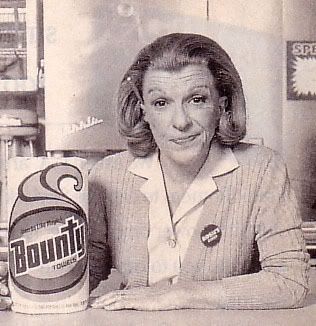
In the 1970s and 1980s, Bounty ran an advertising campaign centered on the fictional waitress Rosie, played by Nancy Walker. Today, Walker is best known for her TV appearances, not only as the aforementioned Rosie, but also as Ida Morgenstern on the sitcom Rhoda. Walker had started her career in the movies, though, and one of her first movie roles was in the 1943 MGM musical comedy Girl Crazy.

Walker plays second fiddle to Mickey Rooney and Judy Garland, but does a find job. Rooney and Garland were extremely popular at the time, and Girl Crazy fills the prescription for what audiences wanted to see when they went to see a musical starring those two: a light boy-meets-girl story in which it takes the girl a while to warm to the boy, but they eventually live happily ever after; throw in a bunch of song standards and more elaborate production numbers for good measure. Specifically, Rooney plays a New York playboy who's living a bit too high of a life for his father's liking (including getting mixed up with a young June Allyson). So, his father sends him off to a mining college out west. It's an all-male school, but the dean (Guy Kibbee) has a granddaughter (Judy Garland). However, enrollment is declining, probably because nobody really wants to go to an all-male school in the middle of nowhere. Along the way to falling in love, our two heroes devise a scheme to save the college from losing its charter.

Where does Nancy Walker fit in to all of this? She plays Judy Garland's cousin. Her character realizes that, even at the tender age of 21, she's nowhere near as glamorous as the Garland character, and compensates for this be being a wise-cracking sidekick. It's not a big role, but Walker shines in it, being a joy to watch in every scene. Rooney and Garland are fine, as is Kibbee. Finally, the musical numbers, by George Gershwin, are up to his usual standard, including such songs still remembered today as "I Got Rhythm" and "Embraceable You".

Rooney and Garland, being a popular screen couple whose names are still famous today, were natural candidates for a DVD box set, and so it is to be expected that Girl Crazy is available for your home viewing enjoyment. Even if you don't care that much for musicals, it's still a pleasant enough movie.