Showing posts with label Richard Burton. Show all posts

Thursday, June 6, 2024

Cornelius Ryan

Today is June 6, which is of course the anniversary of the D-Day invasion in Normandy, and this year it's an exact number of decades. So TCM is running a day full of films about the invasion. One that was sitting on my DVR was The Longest Day, airing at 11:00 PM. So with that in mind I watched it to do a post in conjunction with tonight's showing.

The Longest Day is based upon the book by military historian Cornelius Ryan, a man who wrote sprawling epics trying to cover World War II battles from a multitude of angles, his other famous book turned into a movie being A Bridge Too Far (that one is also on my DVR because it has former Star of the Month Dirk Bogarde in the cast). But Ryan's books tried to present things in as factual a way as possible; they're not historical or military fiction.

As a result, the film version of The Longest Day is also mostly a docudrama on an extremely grand scale. A very large cast (named only at the end) portrays the invasion from the point of view of the Americans, British, French, and the Germans. In fact, it starts off a few days or weeks before the invasion. The Nazis knew full well that the Allies were going to be invading on the western front, although the key question was where. The most obvious place to invade would be across the Pas-de-Calais/Strait of Dover as that's the closest point on the Continent to England. With that in mind, the Allies knew that this was also going to be the most heavily fortified area, which is why they thought about invading somewhere farther west despite the English Channel being wider there.

The preparations for the invasion were meticulous and complicated. Soldiers were getting antsy having to sit around in the UK and wait. But at the same time, there was the question of whether to invade in bad weather; rough seas seems like a major no-no for an amphibious invasion and the Nazis knew this. Indeed the Nazis as portrayed here all seemed surprised that the Allies hadn't invaded in May.

Additionally, the invasion is personalized somewhat by having some of the smaller parts of the invasion focused on, such as the need to take and hold a particular bridge or how paratroopers were dropped in on the night between June 5 and 6 before the beach landings at dawn. And then when the landing does come, the Americans under Brig. Gen. Cota (Robert Mitchum) get bogged down on Omaha; it's vital that they break through for the invasion as a whole to succeed.

As we know from history, the invasion did succeed. But does the movie succeed? For the most part, I'd say yes. The screenplay does a good job of explaining everything that's going on without being too dry or didactic. Not having opening credits apart from one title card showing the title of the picture is also a big plus; there are so many big-name actors here that looking for them all from the credits would be a bit distracting. Coming off best is probably John Wayne, who I think has the biggest role as a commander of paratroopers. The wordless look of horror on his face when he sees those paratroopers who died because they were off course and parachuted right into town says more than any dialogue (and John Wayne's delivery isn't the most helpful in that regard) does.

Others who have smaller roles are Henry Fonda and Edmond O'Brien as American generals; Richard Burton as an RAF man; Curd Jürgens as a German chief of staff; and many many more. A lot of the Americans only get one or two scenes, while there are fewer Germans so all those actors get more screen time.

Where The Longest Day doesn't always work, however, is in the pacing. The subject is sprawling, and there's not really enough done either with the subplots or anything to narrow it down. The result is that of a relentless slowness. I understand that the invasion itself took a long time, but cinematically it feels like a whole lot of the same thing happening and not ending, especially once we hit June 6.

Overall, however, The Longest Day is a very well-made movie and one that, if you haven't seen before, you really should.

Friday, February 25, 2022

Cleopatra (1963)

The Elizabeth Taylor/Richard Burton version of Cleopatra has been in the FXM rotation recently. I thought it had an airing today and tomorrow, and was planning to do a post on it today for tomorrow's airing, but it turns out this week's airings were yesterday and today. Oops. At any rate, having watched it, it's still worth blogging about.

This version of Cleopatra is really two movies in one. Based on various biographies, one contemporary and several ancient, the movie opens up a couple of years before the death of Julius Caesar (Rex Harrison). Rome has been in one of its periods of Civil Wars, with Julius Caesar, then a general, having defeated Pompey. Pompey fled to Egypt, which was nominally independent but really a vassal state of Rome. So Julius Caesar goes to Alexandria to try to find Pompey.

Meanwhile, Egypt has its own problems. Ptolemy XIII is the emperor, but he's got a sister in Cleopatra (obviously Elizabeth Taylor) whom he's been trying to banish. The Egyptians, understandably, also don't really like being a vassal state. Still, they kind of have to give Julius Caesar some fine accommodations at the royal palace. However, it's a palace full of secret passages and hiding spaces, which gives the supporters of Cleopatra the ability to smuggle her into the palace in order to meet Julius Caesar and hopefully get him to take her side in the Egyptian power struggle.

Cleopatra being so beautiful, Julius starts thinking with his lower head than the one on top of his neck, and not only takes her side, but also marries her with the intention of increasing his power back in Rome. After the wedding, he even brings her to Rome in a lavish spectacle as well has having another son by her, which is a bit of an issue since he's already got an adopted son in Octavian (played as an adult in the second half of the movie by Roddy McDowall). The Senate, in what is supposed to be a republic, is increasingly disturbed by Caesar's power-hungry desires, so of course they kill him on the Ides of March. Everybody else lived happily ever after.

While the death of Julius Caesar might be a good place to end a story, this is Cleopatra, and she's got another half of her life to live. So instead of end titles, we get entr'acte music before the second half of the movie. Caesar having been killed, there's now a power vacuum in Rome, with a new triumvirate of Octavian, Marc Antony (Richard Burton), and a third general who is less important to the story. They make three provinces out of the lands under Roman control, with each of them nominally getting one-third of the not-yet empire.

Cleopatra, meanwhile, has returned to Alexandria, since Julius Caesar made Octavian his legal heir, and she's got a country to manage anyway, even if it is a vassal state. Antony is still fighting for war, but needs more resources, and is forced to ask Cleopatra for them. Antony, meeting Cleopatra, also starts thinking with his wrong head. But he at least has the good sense to realize that Roman politics is complicated and dangerous, and that he has to marry a Roman woman for political reasons.

He still loves Cleopatra, however, and when things seem to calm down, he finally divorces his Roman wife and marries Cleopatra, which really enrages Octavian, who sets out for Egypt for what ought to be the decisive showdown, except that everybody is able to escape Egypt by water leading to the real decisive showdown at the naval Battle of Actium off the northwestern coast of Greece. If you know your history, you know how it turned out.

Cleopatra as a movie has a whole bunch of problems, many of them caused by producer Walter Wanger's desire to make this movie the grandest spectacle ever put on screen. That, combined with Elizabeth Taylor's illness that nearly killed her and then Taylor's love affair with Richard Burton, caused all sorts of controversy and budget-busting delays. The spectacle is easy to see on film, and it's not terribly surprising that the film got Oscar nods for production design and costume design.

In terms of story, well, that's where the spectacle creates more problems. The film plods along, coming in at 251 minutes inclduing the overture/entr'acte/exit music. There are two clearly defined halves, which apparently was deliberate on the part of director Joseph L. Mankiewicz, who would have preferred to see two distinct movies, one of each half. Indeed, that would probably work better artistically. As it is, we get something that's frustratingly slow, with perhaps one bright spot in highlighting the complexity of the political problems Cleopatra faces.

Still, this version of Cleopatra should be seen at least once, in part for the spectacle and in part to see just why the movie nearly bankrputed Fox.

Wednesday, November 4, 2020

Bitter Victory

Earlier this year, I bought this 5-film "war" movie box set. (Young Winston, which I blogged about not so long ago, is only partly a war movie, while I wouldn't call The Prisoner a war film at all.) I had recorded Bitter Victory before picking up this set, and finally got around to watching it.

The scene is North Africa during World War II, when the Germans still control a fair portion of North Africa, notably Benghazi. The British command in Cairo wants to get some important information from the Germans, necessitating a commando operation. Who to lead it? They have two choices. Capt. Leith (Richard Burton) knows the area and speaks Arabic, having studied the archaeology of North Africa. But he's only a captain. Maj. Brand (Curd Jürgens) has rank on Leith, but is a by the books officer who doesn't exactly inspire confidence in the men under him. So the general makes the Solomonic decision to have both men go with the rest of the commandos, with Brand nominally in command.

Brand and Leith then go to dinner, where Brand introduces Leith to Mrs. Brand (Ruth Roman). Of course, they need no introduction, as Mrs. Brand had a relationship with Leith before marrying Brand, one that Leith broke off. But for whatever reason, Maj. Brand is pissed about it, probably because his wife still holds a candle for Leith. So there's going to be a lot more tension between Leith and Brand.

The men parachute in behind the lines and reach their assigned target. Unsurprisingly, the place is well-guarded enough that the commandos aren't going to be able to get those documents unmolested. And wouldn't you know it, one of the German guards spots the interlopers and attacks. Brand finds himself unable to kill the enemy, being too much of a coward to kill at close range, leaving Leith to do the deed. No wonder nobody has any respect for Brand.

The commandos head out into the desert toward where they're supposed to rendezvous with the people who are going to provide them with the camels they need to get the rest of the way out of the desert. However, along the way they spot a German patrol and get into a firefight with them, killing several but also leaving a British solder and a German officer seriously wounded. Brand, being in command, comes up with the brilliant idea of leaving Leith behind with the two wounded men since they can't just leave a British soldier to die alone. It also has the added benefit in Brand's mind that it will probably kill Leith too, and Leith won't be able to report back to Cairo how much of a coward Brand was.

It doesn't quite work out that way, as Leith decides the least bad thing to do is to put both wounded men out of their misery. The two wounded do ultimately die out there in the desert, leaving Leith free to leave the scene and catch up with Brand. Boy can you bet there's going to be a lot of tension once Leith shows up again, and even more when they discover the people provisioning the camels have been found out and killed, leaving just one camel for the men.

You'll have to watch the rest of Bright Victory to see how the conflict between Leith and Brand is resolved. It's an interesting movie in that it's more of a thoughtful movie than a war movie of action. Casting a German in Jürgens as an Allied officer (he's passed off as South African, presumably an Afrikaner) seems odd, but works because he gives a good performance. I'm not the biggest fan of Richard Burton, but he doesn't do anything to make the movie worse. Roman only gets a couple of scenes, while the commandos include a very young Christopher Lee whom I didn't recognize at first.

Much of the filming was done on location in Libya; this was a dozen years before Qaddafi came to power. The rest was done in France. Although the print TCM ran has a Columbia logo at the beginning, the movie was made by a comapny called Transcontinental Films based in France with Columbia getting distribution rights in the English-speaking world. Apparently there were cuts made for the original release (there are a couple of scenes I can understand censors being unhappy with), but the print TCM ran and the one on the box set are both around 102 minutes which, as I understand it, was the original pre-cut running time.

People who want a war movie with less action will probably enjoy Bitter Victory, but be aware that it's also a bit of an acquired taste.

Tuesday, September 8, 2020

For those who like Tennessee Williams

Another of my recent watches off the DVR was The Night of the Iguana.

Richard Burton plays Rev. Lawrence Shannon, who at the start of the movie is an Episcopalian minister in some middle-class parish of the sort that David Niven had in The Bishop's Wife where everybody seems to attend services. Shannon, however, has some sort of breakdown when he's about to deliver one of his sermons, which results in going on a rant and getting dismissed from this particular congregation.

Cut to Mexico, at some point in the future. Shannon has apparently been down here for quite some time, never having been able to get a minister's post with another congregation. He's leading a tour of little old (well, middle-aged) ladies from Texas, a tour that includes one student, Charlotte (Sue Lyon). She's constantly leading him on, and he seems to be OK with it.

The woman who organized the tour, Miss Fellowes (Grayson Hall), understandably thinks Shannon is the one responsible for the way the relationship between him and Charlotte is going, and to be fair, in some ways he is. But she's also a prudish little biddy who's going to be complaining about the smallest thing. What she's doing on a tour like this, I'll never know.

Then again, I don't really know what everybody's doing in a movie like this. The tour is scheduled to go to Puerto Vallarta, which was apparently a backwater at the time. Shannon commandeers the bus and takes it from the hotel in downtown Puerto Vallarta to a ramshackle resort run by a woman with whom Shannon had a previous relationship, Maxine Faulk (Ava Gardner). He then steals the bus' distributor so that the tour can't leave.

Fellowes and Charlotte and Shannon and Faulk go through a lot of overheated Tennessee Williams dialogue, but if that's not enough for you, they're joined by sketch artist Hannah Jelkes (Deborah Kerr) and her elderly grandfather poet who should have been in a rest home decades earlier, Nonno. Hannah obnoxiously touts her and her grandfather's talents, while tending to Shannon, since she's the one who realizes how broken he is.

The tour group is able to get the distributor back and escape, while Shannon and the other two women do things for another half hour, as if the movie hasn't gone on long enough, until it reaches a conclusion of some sort.

As you can probably tell, I didn't particularly care for The Night of the Iguana. It's partly down to the dialogue from Tennessee Williams, which possibly works better on a stage, although I haven't seen the play either. It's not helped by direction from John Huston, who turned this into another of his indulgent movies. I couldn't help but think of Under the Volcano, which had an excellent performance from Albert Finney, but a Hustonesque ending that nearly sinks the film. The performances here are adequate but not quite as good as Finney's, and Huston thankfully has to hew at least somewhat to Williams' script.

Still, The Night of the Iguana definitely isn't going to be for everybody. If you're a fan of John Huston or Tennessee Williams, you'll probably like it; otherwise, I'd suggest starting with something like The African Queen for Huston and Suddenly Last Summer for Williams.

Tuesday, July 28, 2020

Who's afraid of making a good movie?


Earlier this morning, against Stakeout, TCM ran Who's Afraid of Virginia Woolf?. I had recorded it when it ran during 31 Days of Oscar, and watched it over the weekend not realizing it was on today. At any rate you can get it on DVD and Blu-ray, so you get a post on it anyway.

Richard Burton plays George, an assistant professor of history at one of those small New England colleges that dot the movie landscape. He's married to Martha (Elizabeth Burton), who happens to be the daughter of the college president, as we later learn. George hasn't advanced beyond assistant professor, and Martha doesn't let him forget that, or that he likely got the job because of her father.

Neither of them lets the other forget a lot of things, since they're constantly bickering. First on their way home from some university function, then in their kitchen, and even once some guests pop in.

Nick (George Segal) is a young biology professor at the school, married to Honey (Sandy Dennis), who is pregnant, a topic that winds up being a sore point between George and Martha. But then again, there are a lot of sore points between the two.

I said before that George and Martha keep up the bickering even when the guests show up, and boy do they do that. It gets worse and worse, to the point where if I had been in Nick's shoes, I would have gotten up and left. Not only do Nick and Honey not do that; they get in the car with George and Martha to go to a roadhouse for more drinks, and don't ask to be driven home after leaving the roadhouse.

Along the way, George goes on and on with Nick and Honey about his and Martha's son, whom we never see for reasons that will become clear by the end of the movie. In reality, George is doing all this talking because he wants to manipulate Nick and Honey to get back at Martha. Martha, for her part, is doing the same.

Who's Afraid of Virginia Woolf? goes on like this for an interminable 130 minutes. The movie received a plethora of Oscar nominations, and won for Taylor and Dennis; everybody says that the movie is a triumph of acting. Frankly, though, I hated all the characters, to the point that I really disliked the movie. George and Martha are nasty, volleying juvenile, masturbatory drivel back and forth and thinking they're oh-so-intelligent. Instead, the sound more like overgrown adolescents. If you remember the things you wrote as an adolescent and thought they were profound, only to go back and reread them and by embarrassed by what you wrote, well, that's what this movie is.

Now, I don't necessarily have a problem with movies that don't particularly go anywhere; I loved The Whales of August and really liked Larisa Shepitko's Wings. I can also appreciate movies with difficult people and topics, such as The Dresser. But Who's Afraid of Virginia Woolf? is just obnoxious. I find it difficult to believe there are people who wouldn't want to shake some sense into these people like Bette Davis did to Miriam Hopkins at the end of Old Acquaintance.

So Who's Afraid of Virginia Woolf? is definitely a movie you'll want to watch and judge for yourself.

Sunday, April 14, 2019

Where Eagles Dare

I need to free up more room on my DVR, so I made the point of watching a longer movie, Where Eagles Dare.

The movie starts off with a plane being shot down in the winter of 1943/4, and then getting very quickly to the real action. That plane was carrying Carnaby (Robert Beatty), an American general on the way to a conference with the Soviets on the "second front", which of course nowadays means D-Day. The plane was shot in the high Alps, and the general is being held at a mountaintop fortress accessible only by cable car that has been commandeered for use by the SS. So British intelligence gives Maj. Smith the task of leading the team to find Carnaby and bring him back. Smith's team includes several Brits, and one American, Schaffer (Clint Eastwood).

Now, my first thought would have been why they didn't fly over the Atlantic to north Africa and from there to wherever the meeting would be held, but that's not Schaffer's first inkling that something isn't quite right. For Schaffer, that comes just after they all parachute in to the mountains, and the radioman is found dead of a broken neck, with a bruise that implies it didn't happen during the fall. Apparently, as with 13 Rue Madeleine, they've got a traitor in their midst, but who is it?

We begin to suspect something is up with Maj. Smith fairly quickly when he says that he forgot to get the codebook off the radio operator, but it's really a ruse to go meet Mary (Mary Ure), who was segregated from the rest of the team during the parachuting so that apparently Smith is the only one who knows she's part of the group.

The group makes it to the town at the base of the mountain where the castle is, at which point another of them gets murdered. The Nazis, for their part, realize they've got some British officers in their midst, and Maj. Smith gives them up, on the grounds that they'll be safer getting out of the Gasthaus where they're stuck with the Nazis looking for them. It works, at least for Smith and Schaffer, and eventually they're able to make their way up to the castle.

It turns out that this is only in part a rescue operation. Oh, there is an American being held hostage; it's just an actor who looks amazingly like the American general. They have to free him not to keep the Nazis from finding out about the second front, but to keep the Nazis from discovering the guy is an impostor who knows nothing about it. But more than a rescue operation, it was an intelligence operation to determine who are traitors in British intelligence.

Yet with all that, they actually still have to get out of the castle and back to territory held by the Allies, and it's here that we get the real climax with the action and explosions. The movie takes a darn long time in getting there, but when it does it's more than entertaining enough.

Having said that, there are some problems with the movie, starting off with the length, at about 155 minutes. Boy is it slow at times. There's also the trope of there being lots and lots of Nazis, but about the worst damage they do is to shoot Smith in the hand. Every time the plucky Allies fire their guns, they take down multiple Nazis. Yeah right. Much of the rest of the escape strains credulity too. Still, as I said, Where Eagles Dare is certainly entertaining. If you want to sit back with a bowl of popcorn and just watch something fun, you could do far worse.

Sunday, January 27, 2019

Villain

I wasn't expecting to do two British crime movies in close proximity after mentioning The League of Gentlemen the other day, but I wasn't thinking about that when I sat down to watch Villian.

Richard Burton plays Vic Dakin, a particularly brutal gangster. A croupier at a casino he gets protection money from has been getting ideas above his station, so Dakin and his men wait in the guy's apartment where Dakin slashes his throat to within an inch of his life and leaves the guy dangling off the balcony. Nice. Dakin goes home, where he's excessively devoted to his mother, like James Cagney in White Heat, except that Mom here (Cathleen Nesbitt) probably has no idea of what her son is doing.

Dakin's partner in crime is Wolfe (Ian McShane), a chancer who makes his living by providing all sorts of illicit services, whatever will pay the bills. That can be drugs to a nightclub, or young women for upper-class parties where the people are expecting sexual favors from the young ladies in return. Among the "respectable" people is MP Gerald Draycott (Donald Sinden), to whom Wolfe even offers his girlfriend Venetia (Fiona Lewis) at a party. Wolfe even provides services to Dakin, being a partner in more than just crime.

Anyhow, Dakin leaves Venetia at the country estate party because he's going to meet with Dakin and some other gangsters about a possible crime. A guy who's gotten into debt over a girl at a nightclub has offered information that would make a factory payroll robbery easier, earning a cool £60,000 or more. Dakin talks with Fletcher (T.P. McKenna) about it, since this is the sort of thing that's more Fletcher's area of expertise instead of Dakin's. However, the planning also brings in Fletcher's ulcerous brother-in-law Lowis (Joss Ackland), who really isn't physically up to this sort of crime any more.

Needless to say, the payroll heist doesn't quite go as expected, with Lowis ending up in bad shape and in need of hospital care, but with him also being the one who knows where the money is and unable to make the meetup with Dakin. The police, led by Inspector Matthews (Nigel Davenport) have collared Lowis, and use this to try to get at Dakin, especially after Dakin tries to blackmail Draycott into giving the police an ironclad alibi, because everybody back in 1971 would believe an MP, you see.

Villain is another of those movies that feels like it's plowing the same ground that's been done in a whole bunch of gangster movies, except that this one was done not too long after the disintegration of the Production Code. So there's a lot more violence than in earlier movies, as well as other adult situations, like Dakin's sexual relationship with Wolfe. It's finally revealed in an unintentionally hilarious scene when Venetia walks into Wolfe's apartment and realizes he's with somebody else. A few minutes later, out comes Dakin. Not what Venetia was expecting.

Even though there's relatively little new in terms of plotting, the movie is quite good thanks to the more permissively realistic 1970s atmosphere, and a daring performance from Richard Burton. The only real flaw I could find was at the very end, with Dakin getting to give some last lines I found somewhat unrealistic. But that's a minor quibble with an otherwise excellent movie.

Villain is available on DVD from the Warner Archive collection.

Friday, May 25, 2018

Elizabeth Taylor calls the sandtune

Another recent movie viewing off my DVR was The Sandpiper, which TCM ran when Elizabeth Taylor was Star of the Month in March. It's available on the four-movie box set of Elizabeth Taylor/Richard Burton movies, since both are in it.

Taylor plays Laura Reynolds, an artist living in a beach house (or at least, for what passes for a beach) in California's Big Sur. She lives with her son Danny (played by James Mason's son Morgan) and no father in sight. Laura home-schools Danny, so although he's bright, he's got some problems with society. It's caused a few run-ins with the law, and this time the judge has decided he's had enough. Danny is going to be put in a boarding school, an Episcopal school run by Rev. Dr. Hewitt (Richard Burton).

Laura is unhappy with this, but the alternative is the boy going into reform school, so she reluctantly decides to send Danny there. She's afraid that Danny is going to develop "conventional" values which won't serve him well as an adult and that he won't be able to reason for himself. Danny isn't happy either at first, but when he recites Chaucer -- in Middle English, no less -- to Hewitt's assistant Claire (Eva Marie Saint), she sees the potential in him.

Oh, Claire is Mrs. Hewitt, too; remember that Dr. Hewitt is Episcopalian and they have no qualms about married ministers. This is going to be a problem for reasons you can probably figure. Dr. Hewitt has to deal with Laura both for the practical purposes of getting legal paperwork done, but also to try convince her that his school really is best for the kid. But while doing so, it opens up a whole new world to him, as he gets to see the real Laura and her bohemian artist friends Cos (Charles Bronson) and Larry (James Edwards). And slowly Dr. Hewitt begins to fall in love with Laura.

That is a huge problem for a man who is supposed to be a moral pillar, never mind what it's going to do to his wife should she find out about the relationship. Meanwhile, Laura's theories are beginning to make Dr. Hewitt question whether he should be raigins money for a new chapel for the school....

The Sandpiper is clearly a star vehicle for Taylor and Burton, who were a hot pair after their romance started a few years earlier (I think on the set of Cleopatra). It's too bad that the story is pedestrian, and director Vincente Minnelli couldn't be bothered to rein in Taylor. She takes every opportunity she can to chew the scenery and make the whole movie faintly ridiculous. If you like watching Taylor chew the scenery, you'll love this one. If not, unfortunately The Sandpiper isn't even bad in a fun way like X, Y, and Zee.

The Sandpiper also won an for its original song "The Shadow of a Smile", heard in instrumental throughout the movie and then with lyrics in a horrible MOR arrangment over the closing credits. It's a terrible song, and only makes the movie more aggravating.

Then again, I always say that you should probably judge for yourself. The TCM four-film box sets are always moderately priced, so if you don't like The Sandpiper, you might still like one of the other movies.

Friday, November 24, 2017

Anne of the Thousand Days

I recently watched Anne of the Thousand Days off my DVR, since it's available on DVD (in a two-disc set along with the 1971 version of Mary, Queen of Scots).

The story is one that's well-known, since this is a historical drama. The Anne of the title is of course Anne Boleyn. Anne (played by Geneviève Bujold) was educated in France and returned to England where she was noticed by the King, Henry VIII (Richard Burton). The Boleyns were already known to Henry, since he'd been banging Anne's elder sister Mary thanks to their father basically pimping the kids out to the King for financial gain. (At least, that's the way it's presented in the movie.) Of course, at the time, Henry was married to Catherine of Aragon (Irene Papas).

The marrige between Henry and Catherine had problems, however. Henry desperately needed a male heir to the throne, and all Catherine had been able to do is bear Henry one living child (she had two stillborn births, a couple of miscarriages, and one son who lived seven weeks), Mary ("Bloody Mary", not Mary, Queen of Scots). Henry feared he'd never have a male heir by Catherine. He wanted Anne, but trying to marry her would present all sorts of problems: Catholic law wouldn't permit it, and Henry had been declared "Defender of the Faith". Further, the Spanish Emperor was Catherine's nephew and he sacked Rome, so there was no way that Henry VIII would get the Pope to annul the marriage to Catherine.

Henry tried to get an ecclesiastical court led by top advisor Cardinal Wolsey (Anthony Quayle) to annul the marriage, but when that didn't work Henry sacked Wolsey (who was terminally ill) and found a Cardinal who would be more pliant to Henry's claim that Catherine's first marriage (to Henry's brother) was in fact valid so her marriage to Henry wasn't. This ultimately freed Henry to marry Anne, and split the English Church from the Catholic Church.

Anne got pregnant... but she bore Henry another daughter, named Elizabeth. And then she got pregnant again... but gave birth to a stillborn child. Henry began plotting with his new top advisor, Thomas Cromwell (John Colicos) on how to get rid of Anne so that he could marry his new squeeze Jane Seymour who obviously would deliver him a son. (She did, although as King Edward VI he didn't outlive Henry by too long.) Eventually Henry accused Anne of adultery, which meant treason, a crime punishable by death.

Anne of the Thousand Days is one of those post-studio system costume dramas that's lovely to look at. No longer tied to the backlots, the studios were able to film in British locations that lend an air of verisimilitude. Burton and especially Bujold are good in their roles; Thomas Cromwell is excellently portrayed as a manipulative schemer, while Wolsey is well-played as someone trying to please two masters while enriching himself on this world. The movie has a longish running time at 145 minutes, but it didn't feel that long as I was watching it.

Obviously, a lot of the material in this movie is related to material in A Man For All Seasons. Personally, I think I preferred A Man For All Seasons which to me looks even more beautiful. But Annd of the Thousand Days is more than worth a watch.

Monday, March 6, 2017

TCM Star of the Month March 2017: Richard Burton

Now that we're back into the first full week of a new month, it's time for another Star of the Month on TCM. This month it's Welsh-born actor and two-time husband of Elizabeth Taylor, Richard Burton. Normally, TCM has its Star of the Month on one night a week every week for a month. This time around, however, they're doing something different in that Richard Burton's movies will be on every night in prime time this week. If you've seen any TCM in the past few weeks, you'll have seen the promos for March Malice, this month's TCM Spotlight which will be on every night from March 20-25.

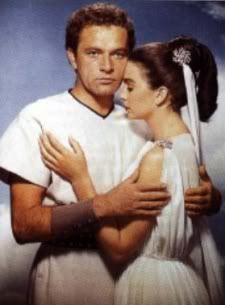
I think the only picture of Burton I've posted here on the blog is one with Jean Simmons that's a publicity still from The Robe, which will be on at 3:15 AM overnight tonight or early tomorrow morning depending on your point of view. Burton's Hollywood career started off at Fox, so we get what I think are a couple of TCM premieres this evening. Those would be Prince of Players at 9:45 PM, and Sea Wife at 1:30 AM. I know Sea Wife has aired on FXM Retro in a widescreen print, but I don't think Prince of Players did. So I'm not certain what print will be getting for Prince of Players.

My Cousin Rachel, kicking things off at 8:00 PM, definitely isn't a TCM premiere, since it showed up on TCM last July, I think, when Olivia de Havilland was Star of the Month on her centenary. I wasn't a particular fan of the movie on having watched it; I found it a tedious period melodrama with all of the characters having questionable motivations. But watch and judge for yourself.

As for Elizabeth Taylor, it looks as though the movies she and Richard Burton made together will be coming up on Wednesday and Thursday night.

Friday, April 5, 2013

Sr. Joan Collins

I think I've stated once or twice before that Joan Collins gets unfairly maligned, largely because of all that time she spent as part of the cast of Dynasty in the 1980s. To be honest, there are better actresses out there, but Collins was not incapable when she was young. A good example of this is Sea Wife, which is airing at 6:00 AM tomorrow on the Fox Movie Channel. (It will be getting another airing on April 22.)

The movie starts off in London at some point after the end of World War II. Richard Burton plays a man who's taking out classified ads in all the London newspapers, looking for somebody he calls "Sea Wife", and signing the ads "Biscuit". Who's "Sea Wife", and why won't she answer? Obviously, we're going to find that out in a flashback....

Flash back to the beginning of 1942. Japan is attacking Singapore, which was a British colony at the time. Because of the Japanese siege, everybody who can is trying to get out of Singapore, and the boats are severely overcrowded. Burton is able to get on one of the boats, where he's got a place sleeping on the top deck cheek-by-jowl with a bunch of others waiting for him. Joan Collins also gets on, but gets a slightly better place to sleep. She's a nun, and is ministering to the sick children who got on the boats and whose parents couldn't; or, at least, that's more or less what's implied. It's not a comfortable journey though, even for her, as the cabins are overcrowded as well. In addition to being uncomfortable, it's downright dangerous, what with all thost Japanese subs patrolling the Indian Ocean trying to bomb ships. And, sure enough, this ship gets torpedoed.

In the panic, four people get off the boat into one of the lifeboats: Burton, Collins; a man nicknamed "Bulldog" (Basil Syndey), and a member fo the ship's crew (Cy Grant) who is given the nickname "Number Four". The panic is so severe that Collins loses her nun's habit and winds up in the lifeboat with an outfit on that I suppose could pass for some old-fashioned sleepwear. So Burton, who is given the nickname "Biscuit", falls in love with Collins, giving her the name "Sea Wife", while she doesn't return the favor. There's a major plot hole here, which is the question of why on God's earth she didn't just tell him she's a nun? As opposed to, say, Heaven Knows, Mr. Allison, in which Robert Mitchum's character sees Deborah Kerr's nun in full nun's vestments praying in church when he first meets her on that deserted island.

And if anything, the script is the problem with Sea Wife. In addition to keeping a secret about the real identity of Collins' character from Burton's, the plot has some other problems. Number Four is black, and so you know they just have to make Bulldog racist to provide sufficient tension. And then the lifeboat makes it to an island that is presumed to be one of the Andaman or Nicobar Islands. Either there would have been British patrolling the area at the time, as that would have been close to the front line in the war, or the Japanese would have found the survivors since they occupied the islands in March 1942. Collins does OK given the trite material she has to work with, while Burton seems to be working for a paycheck.

Sea Wife did get a DVD release, although I'm not certain if it's still in print.

Saturday, December 5, 2009

Richard Burton does Shakespeare

Richard Burton did quite a bit of Shakespeare when he was on stage, but not so much in film. So, it's an interesting historical document in more ways than one to be able to see Prince of Players, which the Fox Movie Channel is airing tomorrow at 8:00 AM ET.

Richard Burton stars in this movie as Edwin Booth, a name that should sound familiar to Americans at least. Edwin was the son of Junius Brutus (played here by Raymond Massey), and the brother of John Wilkes (played by John Derek). The father and both brothers were Shakespearean actors of the mid-19th century, although of course John Wilkes went on to something much more (in)famous.

Prince of Players opens near the end of Junius' life. This being the days before the movies, actors had to do extensive touring, and this combined with Junius' alcoholism cut Junius' life short, and forced Edwin to spend a lot of time looking after his father when in fact he'd rather be acting himself. Instead, it was John Wilkes who was being groomed by the family to be the actor. But, with Junius' sudden death while on tour, Edwin was forced into action and seized the opportunity, becoming the great Shakespearean actor of his generation. John Wilkes was rather less successful, jealous of his brother's success, and, as a southerner, began developing other interests....

Or so goes the story in Prince of Players. This being a Hollywood biopic, I don't know exactly how much of the movie is accurate, particularly the melodramatic final scene. Still, it's not exactly a bad movie. In addition, it's made more interesting by the fact that, as a movie about a Shakespearean actor, it's got several scenes that involve people performing the Bard's plays. We get to see Raymond Massey do Shakespeare at the beginning, and Burton several times over the course of the film, but no John Derek. (Whether this is a good or a bad thing is a question left to the reader.) Most entertaining might be a re-enactment of the Romeo and Juliet balcony scene, set here at a New Orleans brothel! However, the more worthwhile thing is watching Burton with a couple of people who had started on stage: Ian Keith (who did a lot of movies) plays the ghost of Hamlet's father, and Eva La Gallienne (who did very little film) plays Hamlet's mother.

Prince of Players hasn't been released to DVD, and what makes this doubly sad is that the last time the Fox Movie Channel showed it, they showed a panned-and-scanned version of it. This is particularly ironic considering that the opening frames that introduce the movie as a Cinemascope production, standard to all of Fox's stuff of that era, were left in.

Tuesday, November 10, 2009

An in-between all-star movie

In the early days of the talking picture, Hollywood tried to bring people into the theaters by puting all of their stars into the same movie, in the case of films such as Dinner at Eight. It's a formula that became much more common in the 1970s, with the advent of the disaster movie, in films such as The Cassandra Crossing or The Poseidon Adventure. In between? Well, we got movies like The VIPs, which TCM is showing tonight at 10:15 PM ET.

The scene is the VIP lounge at London's Heathrow airport, back in the swingin' 60s, when air travel was much more glamorous than it is today. Several well-heeled passengers are on their way across the Atlantic for various reasons. But, the famous London fog rolls in, socking in the airport and making any flights out absolutely impossible. This, needless to say, causes problems for all of the people stuck at Heathrow.

First among these is Elizabeth Taylor. She's playing a woman married to Richard Burton, but is about to leave him in order to live in the Caribbean with suave Louis Jourdan. She's left Burton a "Dear John" letter that she expects him to find only after her plane is in the air, well over the Atlantic. But the fog scuttles those plans, and when Burton finds the breakup letter, he naturally drives back to Heathrow to try to convince his wife to change her plans. His presence, however, happens to be a godsend for another man, Rod Taylor. Taylor is playing an Australian businessman who has to get to an important board meeting in New York or else face the possibility of losing his business. He needs to be able to borrow some money to pay off some debts, and despite not being able to make it to New York, perhaps Burton's money can help him. Meanwhile, Taylor is also beginning to discover that his executive assistant (Maggie Smith) has a crush on him.

Two other stories involve Margaret Rutherford as a formerly wealthy old lady who has one of those great English manors that is really a white elephant because of all the upkeep, and Orson Welles as a movie director who would like to flee England and its confiscatory tax regime, but discovers that Rutherford's manor house might just be the perfect setting for his new film.

As far as movies with ensemble casts go, The VIPs is probably a better movie than Grand Hotel, in that the stories are more interesting, and rarely seen overplayed. And with these all-star movies, if you don't like one of the stories, they'll always switch back to another of them soon. (This is one of the advantages that the later disaster movies of the 1970s don't really have. The characters have backstories, but there's really only one main plot.) That having been said, The VIPs isn't quite as good as Dinner at Eight; nor does it have the slightly irreverent sense of fun that The Poseidon Adventure does. Not many movies do, though, so this is only a minor criticism. The VIPs is a nice look at a slice of the uppercrust as it was in the early 1960s, and entertaining, to boot.

Monday, August 31, 2009

Not Bond. Not James Bond.

One of the more cynical spy movies of the 1960s, The Spy Who Came In From the Cold, is airing at 8:00 PM ET tonight on TCM as part of the final day of their Summer Under the Stars look at the films of British actress Claire Bloom.

Richard Burton stars as Alec Leamas, a British spy working in West Berlin. He's part of an operation that goes wrong, and as a result, he gets sent into retirement, trying to live a life as a library assistant. It's not much of a life for him, and he's quickly recruited for one more mission, a complicated one that appears to have him become a double agent for the East Germans, while in fact he's really working for the British, trying to figure out what's happened to one of their agents in East Germany and see if they can rescue him.

Or, maybe it's all part of a much bigger plot to use Leamas, who by now isn't of much value to the British spymasters, as a pawn for.... Well, who only knows what for? Those nasty spymasters don't care about the little people like Leamas. (Not that the little people in the spy business like Leamas care for anybody but themselves.) As for Bloom, she plays Nan, a co-worker at the library who falls in love with Alec. She's a committed socialist or, more accurately, a dupe who fell for the idiotic communist propaganda being peddled by the Eastern bloc in the first half of the Cold War era. Because of both her love for Alec and her communist leanings, she's the perfect person to become part of this whole plot.

Truth be told, The Spy Who Came In From the Cold isn't my favorite movie, in part because Richard Burton has never been one of my favorite actors. The distinct impression I've gotten on watching this movie is that the makers were trying hard to send an earnest message about the futility of the whole spy business, and this message gets in the way of the story it's trying to tell. There are worse spy movies, but there are better ones, too.

Saturday, January 31, 2009

Jean Simmons turns 80

It was on this day in 1929 that actress Jean Simmons was born. You can watch her just after midnight on TCM as the female lead in Elmer Gantry, opposite Burt Lancaster. However, I'd like to comment on a different movie, The Robe.

Richard Burton stars as the Roman tribune Marcellus, who is sent to Judea around the year AD30. If you know your history and a bit about religion, you know this is right about the time when Pontius Pilate had Jesus crucified. Well, poor Marcellus has the privilege (if you can call it that) of seeing the crucifixion, and winning Jesus' robe when the soldiers gamble for Jesus' vestments after the crucifixion. The robe has quite an effect on Marcellus, with strange things suddenly happening to him as though he were a character in one of those bad 1950s horror movies. It quite frankly horrifies Marcellus, who decides he'll do anything he can to destroy Jesus' robe, which he has since given away.

Cut back to Rome. Jean Simmons plays Diana, a woman who knew (and loved) Marcellus when she was young, but grew up to become a ward of Emperor Tiberius when her parents died. The Empress thinks Diana would make a good wife for the heir to the throne, Caligula, who got Marcellus sent to Judea in the first place. Diana tries to intercede on Marcellus' behalf, but this only makes things more difficult since jealous Caligula wants Diana. Eventually, you know that Christian virtue is going to win out, with Burton realizing that the touch of Jesus' robe is actually a good thing, and Diana realizing it too, and ending up with Marcellus.

How this happens, though, takes far too long. This is the sort of Biblical-based epic that Cecil B. DeMille might have made, except that it was actually Henry Koster and the people at Fox in charge of it all. Still, we get the requisite dose of Christianity, with an ending that's pious beyond belief, and ludicrous to the point of inducing howls of laughter. Did they think anybody would believe this? And at nearly two hours and fifteen minutes, they could have easily cut a good half hour out. Perhaps one of the reasons they didn't is that this is one of the very first movies Fox released in the new Cinemascope widescreen format, and they must have thought that people would want to see stunning panoramas in widescreen -- two hours' plus worth of panoramas. It couldn't have been for the story. Still, Jean Simmons is lovely to look at here.

If you want to watch The Robe now, instead of waiting for Easter, which is probably a more suitable occasion, you are in luck. The Robe is available on DVD.