Showing posts with label Robert Stack. Show all posts

Wednesday, December 3, 2025

For some values of "nice"

Some months back, TCM ran a Sunday night double feature of films starring Deanna Durbin. The first was It Started with Eve, but when I sat down to watch it I had the distinct feeling I'd seen it before. So instead I watched the other, Nice Girl?, to do the obligatory post on here. Now, as it turns out, I have seen It Started With Eve, but have never done a post on it; I wouldn't be surprised if the last time it was on TCM was before I started blogging since Deanna Durbin was at Universal and TCM doesn't get the rights to their films all that often. So I'll watch it again and eventually do a post on it.

Durbin plays Jane Dara, middle daughter in a family that is somehow middle class enough to have a maid Cora (Helen Broderick), as well as a father Oliver (Robert Benchley) who is doing experiments on the diets of rabbits that Jane helps with. Indeed, Dad is hoping to get a fellowship with a prestigious institute in New York to be able to help fund his studies. Jane has a boyfriend in Don Webb (a young Robert Stack), who has an interest in cars and could probably make a reasonable living as an auto mechanic, although I get the impression that even in those days this wasn't necessarily the profession a middle class man would want his daughter to marry.

A running subplot is Cora's relationship, or her being pursued by, the mailman Hector (Walter Brennan), who also leads the town's band that meets in the small-town park band shell for holidays like July 4, this being one of those Connecticut small towns that populated Hollywood movies like this in the years leading up to World War II. Hector brings Oliver a special delivery letter informing him that the foundation is sending a man from New York to look over the experiments with a view to the foundation funding these experiments. Jane goes to the train station to pick that man up: Richard Calvert (Franchot Tone). Richard has done research on various pygmy populations and the extent to which diet has made them short, and this has caused him to travel all over the world (and as we'll see later, have an impossibly big New York apartment for someone of his employment). That travel makes him sophisticated in the eyes of the three daughters, all of whom put on airs in the hopes that he'll take an interest in them, even if they're all too young for him.

Eventually it's time for Calvert to go back to New York, and Jane offers to drive him to the train station, in Don's convertible since Don's working on her car. However, she sabotages the convertible so that it won't get to the station on time, meaning she has to drive him to New York. They get stuck in the rain, and in a series of coincidences, Jane winds up wearing a pair of pajamas belonging to Richard's sister while her own clothes are drying. Then when Calvert makes it clear there's no romantic interest between them, Jane drives home in the middle of the night, arriving home at a scandalous time and making the whole town gossip about her.

Now, this is a Deanna Durbin movie, so we know that everything is going to come out right in the end. But to see exactly how that's going to happen, you'll have to watch for youreself. Nice Girl? is the sort of movie that I can see why it would appeal to fans of Deanna Durbin, especially back in 1941 when it was released. However, I can also see why Deanna Durbin was growing tired of these ingenue roles and wanted something more talent-stretching. This being Deanna Durbin, there are also several opportunities for her to sing, which again fans of hers will enjoy. The misunderstandings plot doesn't always work, and to me it felt wrapped up a bit too quickly. But for the most part Nice Girl? is simply inoffensive fun.

Tuesday, November 11, 2025

Fighter Squadron

As I mentioned last week, Rock Hudson is TCM's Star of the Month for November, and his movies are airing every Tuesday in prime time. This includes today, which happens to be Veterans' Day in the US, a time when TCM normally airs a bunch of military-themed movies in honor of the day. As it turns out, TCM has enough military movies with Hudson in the cast to use for tonight's prime time lineup, although the last one is Hudson's debut where he only has an uncredited bit part with just a few lines: Fighter Squadron, which is on at 5:15 AM tomorrow (Nov. 12), or the end of the prime-time lineup.

It's 1943, and war is raging in Europe. Since the western side of the Allies haven't been able to start their land invasion quite yet, at least not across the English Channel, much of the action is air raids over targets in Germany, which comes with a fairly heavy price. The planes are supposed to provide support flying in formation, and stay at a high altitude to avoide the German surface-to-air missiles. One pilot, Maj. Hardin (Edmond O'Brien), thinks these orders are the wrong ones, and that the pilots need more flexible measures for dealing with the Germans. Indeed, he had flown over China wiht the Flying Tigers, so he's already been exposed to that greater flexibility. The problem, however, is that he engages in that flexibility in direct violation of those orders.

This goes up the chain of command, from Maj. Hardin's commanding officer Col. Brickley (John Rodney), to the generals, Maj. Gen McCready (Henry Hull), and above him Brig. Gen. Gilbert (Sheppard Strudwick). McCready has some sympathy, but others point out that the flexibility also comes with a short-term cost of more planes and pilots being damaged or lost. Brickley needs to think about keeping the men under his command safe to fly the next mission. Meanwhile, the other men in Hardin's squadron, notably best friend Capt. Hamilton (Robert Stack), like Hardin.

So the higher-ups decide to teach Hardin a lesson. Col. Brickley gets a promotion, and suggests that Hardin be promoted to take his place. Now that he'll be more or less grounded and have to have these other men now under his command, perhaps he'll understand why Brickley was the way he was with Hardin. Hardin tries to be nice to his men as the bombing raids continue, but there's one catch. He still believes in the idea that the men under his command shouldn't be married, because then pilots will think about their wives and not do some of the risk-your-life things necessary to carry out the mission. Hamilton just happens to be engaged, so he heads back to America when he gets leave and gets married, although he does return to the unit much to Hardin's consternation. More raids follow up to the unit's provision of air cover for the D-Day invasion.

Fighter Squadron is nothing if not formulaic, and decidedly a product of Hollywood. There's even a daft subplot about a pilot who has a series of girlfriends, and is able to get off base to see them through the ruse of obtaining a bunch of black cats. The other pilots don't like seeing black cats and ask him to take the cats away, which gives him a chance to go off base. It's supposed to be funny, but to me it was just irritating. Fighter Squadron is well-enough made, however, and I can see why audiences back in the day might have been entertained. Better and more inventive war movies, however, have come out in the intervening years.

Tuesday, September 9, 2025

Tourneur Classic Movies revisited

Director Jacques Tourneur was born in November, but for whatever reason TCM honors him from time to time with a daytime lineup of some of his movies. Such is the case today, September 9, and one of his films that I haven't recommended before is the western Great Day in the Morning, which concludes the afternoon lineup at 6:15 PM.

Robert Stack stars as Owen Pentecost, and as the movie opens it's the beginning of 1861. Now, this means the start of the Civil War, although that hasn't happened yet. Owen is making his way west to Colorado, still a territory at the time, and along they way is saved from Indians by Steven Kirby (Alex Nicol). Steven is also helping a northerner make her way west, in the form of Ann Alaine (Virginia Mayo). Owen, however, is from North Carolina, which is going to secede in the not too distant future, but since the war hasn't begun yet Ann is able to stand up for Owen and break up any fighting between northern and southern men.

In a surprisingly small (and snowless, since it's still late March) Devner, they stop at a hotel which, like a lot in town, is owned by Jumbo Means (Raymond Burr) and staffed by barkeep Boston Grant (Ruth Roman). Owen and Jumbo begin to play poker against each other, although Jumbo is an inveterate cheat. Owen spots the cheating and challenges Jumbo to a fair game, eventually bankrupting Jumbo, although the question of how much Boston is helping is an open one: both Boston and Ann have a thing for Owen.

Among the things Owen wins from Jumbo are a bunch of mining claims, as it's thought there's gold in them thar hills. Owen goes out to visit the mining area, and finds a bunch of southerners trying to eke out a living with the hopes of finding gold. They're hoping that in the upcoming war, they'll be able to help the Confederate cause. Owen isn't unwilling, but is there to make money first and foremost. His fellow southerners aren't happy, but Owen has the power.

Pre-war tensions continue to mount and, as you might guess, things break down along the lines of which state people came from back east. Owen would stil rather be more of a mercenary, but with everybody around him being violent, he's forced to defend himself, killing a miner trying to cheat him and winding up taking care of the dead man's orphaned son. And then news reaches Colorado that the Confederates have attacked Fort Sumter, kicking off the Civil War and forcing Owen finally to take sides. The rest of the personal stories of these characters play out against this backdrop.

Great Day in the Morning is another of those well-enough made mid-tier westerns that Hollywood was still cranking out in the 1950s, with them being a bit more grown-up in themes to contrast with what was moving to television. The actors all do a professional job with the material which is competent if not spectactular. The print that TCM ran was also a very good one with nice color and wide-screen photography. If you want to be entertained, you could certainly do far worse than to watch Great Day in the Morning.

Friday, January 5, 2024

1941

When I was a kid, I remember hearing about the movie 1941 and how it was supposedly an epic box office bomb. I had never seen it, so when it showed up in the PlutoTV rotation, I made a point of looking out for it to be able to watch it and make my own judgment as to how good the movie is or isn't.

As anyone who's watched enough World War II movies will know, Japan attacked the US naval base at Pearl Harbor on December 7, 1941 (hence the title), sending the US into World War II. Nobody in the US knew what Japan was going to do next, and since in theory Japan could have continued heading east, which would have sent them to the US Pacific coast, there was the potential for a lot of worry in the US west. That fear of what might happened is portrayed when, six days after Pearl Harbor, a woman goes for a swim in the Pacific, only for a submarine to surface right under her!

That sub is indeed a Japanese sub, captained by Cmdr. Mitamura (Toshiro Mifune), who has a German liaison officer on board with him, Capt. von Kleinschmidt (Christopher Lee). Mitamura had not taken part in the raid on Pearl Harbor, and wanted to do his part for the Japanese war effort, which to him meant destroying something noteworthy in the US mainland. Fortunately, they've surfaced near Los Angeles, which is pretty noteworthy.

In the US, the country is quickly getting on a war footing. There are a lot of men in uniform, and nightclubs have been converted into USO clubs as part of the patriotic fervor. Those who can't serve for physical reasons or who have not been able to enlist are quickly becoming second-class citizens, as we see in the form of restaurant dishwasher Wally, who has a girlfriend Betty Douglas. She's joined the USO, and can no longer dance with Wally since men who aren't enlisted aren't allowed at the USO club. Not only that, but servicemen dining in the restaurant where Wally works, like Sgt. Tree (Dan Aykroyd) and his crew, treat the unenlisted like dirt.

As for Betty, she's lived in a seaside house out Santa Monica way with her parents (Ned Beatty and Lorraine Gary), and this would be a perfect place for the Americans to set up a lookout point to check for the possibility of Japanese subs or aircraft; indeed, Sgt. Tree wants the Douglases to set up an anti-aircraft battery on their property as part of the war effort.

Regarding aircraft, the Americans are also scrambling military planes to do patrol duty, with Capt. Wild Bill Kelso (John Belushi) being one of the pilots and getting a little too enthusiastic in doing his duty. As for the general in charge of security for the whole of the west coast, "Vinegar Joe" Stillwell (the one real person in the story, played by Robert Stack), he's busy at a screening of Dumbo and has no idea of the increasing mayhem happening around him in Los Angeles.

It's a bit of a sprawling synopsis, and indeed 1941 is a sprawling movie with a large cast and a lot happening that all more or less comes together by the finale. As another sign of how sprawling it is, director Steven Spielberg filmed it with an original cut that lasted nearly two and a half hours, although this was edited down to just under two hours for the theatrical release as well as the print that Pluto ran.

1941 as I said, is generally considered a famous bomb, although in real life it did make a modest profit. The reputation is more down to critical reception and the fact that it wasn't as successful as Spielberg's previous blockbusters, and it's not hard to see why the critics didn't rate it so highly. A lot of the humor is way too manic, with scenes going on way too long (the fight at the USO club) and plot threads feel like they're ignored if not abandoned. Several IMDb reviews I read compared 1941 to It's a Mad, Mad, Mad, Mad World, but that movie had a coherent goal for all of the characters to be heading toward in the form of the money buried under the big W. 1941 doesn't have such a goal to resolve the plot, so even though a lot of main characters wind up together at the end, getting there feels a lot more disjointed.

But, as always, you may want to watch for yourself and form your own opinions.

Thursday, June 5, 2014

A salute to mawkish tripe

If you like the sort of sentimental, romanitcized view of small-town America that's su sugary it'll eat out the insides of mere mortals, FXM/FMC has just the movie for you: Good Morning, Miss Dove, tomorrow morning at 6:00 AM.

Jennifer Jones plays the titular Miss Dove, a teacher in Liberty Hill, a small New England town that looks as picturesque as Peyton Place but which doesn't have the scandal going on underneath the surface; or, if it does, everybody's decided to repress it. Miss Dove is an irritating scold who expects all of her students to act just so, and when I say "all of her students", I could just as easily say the whole town, since this is one of those towns where nobody new seems to move in and everybody who lives there seems to have had Miss Dove for a teacher. That may be about to change, though, as Miss Dove's life is in mortal peril! This is not a joke. Miss Dove has kept one student after school because he wasn't acting just so, and while looking after him, Miss Dove feels a sharp pain. Would you oh-so-kindly fetch your father the doctor (Robert Stack), Miss Dove tells the young lad.

With Miss Dove's health in a possibly parlous state, what's a woman who's spent her entire life in this little town as a teacher to do, other than to look back on her life? So, we get a series of flashbacks, which is a groundbreaking technique since no moviemaker had ever thought to do something so radical before. In the first flashback, we learn why Miss Dove became a teacher in the first place. Miss Dove came from one of the town's well-to-do families, as her father was a banker. Dad was apparently well enough off that she could run off with an archaeologist to get married and escape Liberty Hill. The only problem is, Dad drops dead, at which point it's been discovered that he's been embezzling from the bank! Now, any sane person would just sell off the house and assets, which probably ought to cover the $11,000 that Dad embezzled. But not Miss Dove. She's got some bizarre sens of duty, which tells her to dump her fiancé and try to repay the debt by becoming a teacher and teaching the children of Liberty Hill.

Once Miss Dove goes off to hospital, where she's going to get an operation that will supposedly save her life (or at least prolong it; she probably had cancer which would have had a terrible prognosis at the time although I don't think the script ever mentions precisely what's wrong with her). The nurse at the hospital was of course one of her students, so Miss Dove thinks back to the influence she had on the nurse. The nurse's boyfriend Bill (Chuck Connors), the town cop, was also one of her students. Indeed, Miss Dove's influence on the town's children was so great that former students come from far away just to see her. Yeah, we get the point already.

Good Morning, Miss Dove way overdoes it with the sentimentality. Even though everybody is doing the best they can, they're working with a script that drags all of them down. In watching Good Morning, Miss Dove, I found myslef thinking of Goodbye, Mr. Chips, and why that's such a great movie while Good Morning, Miss Dove founders on the rocks of sentiment. I think one of the big reasons is that Goodbye, Mr. Chips focuses almost solely on Mr. Chips; the students are almost an afterthought. Indeed, the passage of time is shown by using montages of the same children to note historical events and technological advances. Where Mr. Chips leaves it to the viewers to imagine the impact he's had on the lives of his students, Miss Dove takes us by the shoulders and shakes us, screaming "God dammit you're going to realize the impact this teacher had!" Well, Miss Dove herself wouldn't do that, as it would be ever so improper.

I'm not certain if Good Morning, Miss Dove is on DVD, so you're going to have to catch the rare FXM/FMC showing.

Saturday, March 15, 2014

Robert, not Mary, Stack


Robert Stack in a production still from The Mortal Storm (1940)

I think I've mentioned once or twice before that I've got a blog-stalker; that is, somebody who seems to read the blog only for the purpose of posting the odd comment about how awful the blog is or to promote some link to her site. This stalker comes from one of my other interests, that being the libertarian blog of the reason magazine, where a bunch of us like-minded people blow off steam in the comments. It gets quite bawdy at times and much of the comment sections would never have made it past Joseph Breen enforcing the Production Code. ACtually, he probably would have had a fit of apoplexy at seeing how vulgar it can get. But all this is beside the point, other than to point out that the troll who followed me here used the surname Stack as a pseudonym.

So what better than to deal with another comment from her than to post a bunch of gratuitous Robert Stack photos?


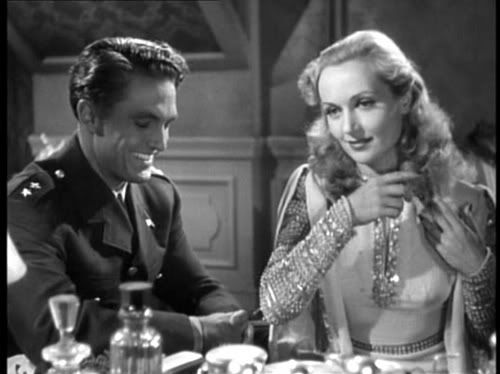
Robert Stack, this time fighting the Nazis, in a still with Carole Lombard from To Be or Not to Be (1942)


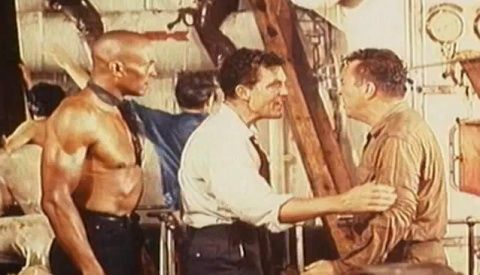
Moving ahead 20 years, we've got Robert Stack trying to help people in a doomed luxury liner, including half-naked crewman Woody Strode, in The Last Voyage


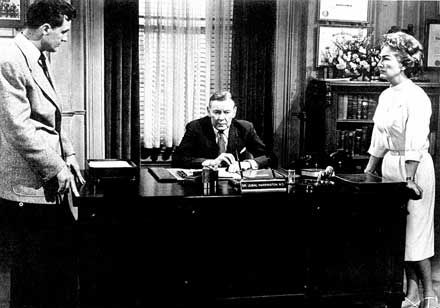
Robert Stack (on the far left) fought late-career Joan Crawford for the approval of mental hospital administrator Herbert Marshall in The Caretakers


Finally, Robert Stack got the chance to revive his career when he was cast in Airplane!; here he is with Lloyd Bridges.

Saturday, May 5, 2012

Oooh, another hilariously overwrought film from Douglas Sirk!

TCM is showing the delightfully melodramatic Written on the Wind at midnight tonight. From the very start, you know that this is going to be a fun movie: Robert Stack rapidly and drunkenly drives his sports car to one of those lovely southern mansions, and runs in. Shots ring out, and we see Lauren Bacall shot and Stack staggering out of the house. And all of this is only over the opening credits....

Flash back, thanks to the help of the cinematic device of the pages of a page-a-day calendar flipping in reverse, about a year. Robert Stack plays Kyle Hadley, the scion of a Texas oilman (Robert Keith) who is expected to take over the firm in the future, but right now would rather just be a playboy, chasing every woman he meets. Looking after Kyle is the much more sensible Mitch (Rock Hudson), who has been Kyle's "best friend since childhood". (Personally, I wonder where there were supposed to be some homosexual overtones here. The film is rife with sexual overtones, as you'll soon see.) Mitch came from the wrong side of the tracks, but it seems as if the elder Hadley likes him more, something which causes more resentment by Kyle. (It probably leads to more of Kyle's sexual problems, too: he's got serious daddy issues.) Mitch's other job is to look after Kyle's sister Marylee (Dorothy Malone, who won an Oscar for this role). In continuation of the sexual tension, Marylee has just as high a sex drive as Kyle, and she's trying to woo every man in town, something which drives both male Hadleys nuts. Indeed, Kyle is constantly looking for a gun to deal with people who would go after Marylee, even if in fact it's she who is going after the guys. Did I mention there's a lot of sexual overtones here?

All that plot isn't enough. I mentoined that we see Lauren Bacall getting shot in the opening credits, and she eventually shows up as Lucy Moore, an advertising artist. Kyle being the playboy that he is, immediately falls or her and tries to bed her. Mitch likes her too and wouldn't mind being in love with her, except that Kyle comes first. Lucy is a bit wary of Kyle, but eventually decides to elope with him. Kyle tries to get her pregnant but finds out from the doctor that he's got a "problem" (we'd guess a low sperm count, although the Production Code wouldn't let the filmmakers be explicit) that makes it significantly less likely, but not impossible, that Kyle will ever knock up Lucy. Meanwhile, he's beginning to get jealous of Mitch. Fast forward a few months and, miracle of miracles, Lucy gets pregnant by Kyle. At least, Lucy swears up and down to Mitch that Kyle is the father. Lucy realizes that Kyle won't believe this, which I suppose is understandable, and that Kyle will accuse Mitch of infidelity. After all, Mitch does spend entirely too much time with the rest of the Hadleys.

Oh good lord is this whole film sexually charged. But it's this whole attitude of "Let's beat the viewer over the head with more nonsensical sexual innuendo!" that makes Written on the Wind so much fun. It's gotten a DVD release, although as part of the Criterion Collection, so it's a bit pricey.

Tuesday, February 14, 2012

The Last Voyage

A full decade before the all-star disaster epics of the 1970s, MGM produced the entertaining The Last Voyage. It's airing tomorrow morning at 7:00 AM on TCM.

The movie starts off in the boiler room of an old luxury liner that's outlived its usefulnes and is going to be retired soon. Sooner than everybody expects, in fact, but we'll get to that in a bit. Down in the boiler room, the crew is having trouble with a fire that's broken out in the engine room. The captain (George Sanders) doesn't want to bother the passenges, for obvious reasons: why panic them until you absolutely need to get them off the ship? Besides, he thinks the fire can be put out. Still, some of the passengers have noticed that there seems to be something up. There's a bigger problem, though, which is that the fire has melted some of the valves, such that too much fuel is flowing into the engines, and the pressure is rising. If they're not careful, there's going to be an explosion!

Well, this is a Hollywood movie, so you know that despite their best efforts, that explosion is going to happen, and it's going to have catastrophic consequences. It cripples the ship, but more importantly, it rips a giant hole through several decks, affecting some of the cabins. Specifically, that's the cabin of the Henderson family. Dad (Robert Stack) was in a different part of the ship from Mom (Dorothy Malone) and their daughter, who were in the cabin. The result is that Dad winds up on the right side of the gaping hole, that being the side from which escaping the ship is going to be relatively easy. The kid is on the wrong side of the hole, but with a little help should be able to make her way to safety. Mom, however, is trapped under a steel beam! Hooray for cheap plot devices that introduce suspense!

What's a father to do? He goes to the crew for help, but unsurprisingly, they have bigger problems. They have to worry about the entire ship and all the passengers, and not just poor little Robert Stack. And among the officers there's still some debate as to whether the ship can be saved. The second officer (Edmond O'Brien) wants to abandon the ship and start getting the passengers off and to safety now; the aging captain still seems to think the ship can be saved. Neither of them has much time for the the problems of a single passenger. Thankfully, there are other crew members working to get all the passengers off. Stack finds one of the stokers, Woody Strode, and he's willing to help Stack.

The Last Voyage is fairly predictable stuff, especially if you've seen the more epic movies of the 1970s. And to be honest, it's only moderately good. Robert Stack shouts his way through his role (although in his defense, what else is a man who's got a wife trapped under a girder to do?); Dorothy Malone is trapped under the aforementioned beam; the kid is annoying; George Sanders isn't given much more to do than Malone; and Woody Strode only seems to be there for the purpose of running around half-naked and tittilating the ladies in the same way that a Mamie Van Doren or Jane Russell would tittilate the men. Still, dammit, The Last Voyage is entertaining. Which means that, despite all its flaws, it's a good movie that does precisely what it set out to do. And there's one big positive, too, which is that the filmmakers got an actual old ship about to be decommissioned on which to film, so that many of the sets are authentic. That ship is the Île de France, which is famous for being the first ship to come to the rescue of the Andrea Doria when it had its collision back in the mid-1950s.