Showing posts with label Shelley Winters. Show all posts

Tuesday, November 25, 2025

Insert into slot A

Another of the movied that I recorded off of TCM some time back because the premise sounded interesting and that was wholly unknown to me when TCM aired it was the movie Flap. Having seen it, I can see why it was wholly unknown to me.

Anthony Quinn plays Flapping Eagle, an aging member of the Navajo tribe living on the reservation and drinking too much, making a meager living by transporting goods to and from the reservation. As the movie opens, he's hauling tchotckes through Tucson on his way to the edge of the reservation where one of those kitsch places is going to sell them as "authentic" Indian dolls. Except that Flapping Eagle misjudges a turn resulting in some of the boxes falling off the truck. When he and his friends Lobo (Claude Akins) and the much younger Eleven (Tony Bill) get out to pick up the stuff, it causes a traffic backup that results in police Lt. Rafferty (Victor French) engaging in a bit of police brutality on them.

Back at the reservation, Flapping Eagle talks to tribal lawyer Wounded Bear (Victor Jory) to find out if there's anything that can be done. To which, the answer is, not much. And it's not as if Wounded Bear is much of a lawyer anyway. He's more of a historian in that he's got the old copies of all the tribal treaties between the Navajo and the Americans, most of which isn't going to to Flapping Eagle any good in traffic court.

Life on the reservation is tough, and is only about to get tougher when the US government plans to extend the Interstate Highway System over land that happens to belong to the Navajo. This necessitates the exhumation and reburial of several bodies, as well as the placement of a whole bunch of heavy equipment on tribal land that's going to be cut in two.

But, at this point, knowledge of the old treaties is something that might finally be useful. Apparently, there was a clause in one of the old treaties that if the Americans abandoned anything on tribal land, it would become property of the tribe. Now, the construction equipment can't really be considered abandond, but Flapping Eagle gets the idea that the Navajo could cause something else to just happen to be abandoned on the reservation, as there's a disused railroad spur leading onto the reservation. Flapping Eagle gets the railroad switch in working order, and gets cars of a cargo train to be shunted onto the reservation, but not the engine or the caboose, since that would result in humans being held technically captive on the reservation.

When Flapping Eagle claims ownership of the "abandoned" railroad cars, this causes a national sensation, as news organizations from all over the country want to see what's going on with this human interest story. Of course, the government wants the original owners to get their stuff back, and that leads to a conflict with ultimately tragic results.

I can once again see why people would want to make the story that forms the basis of Flap. Unfortunately, the movie goes wrong in its execution. Flap and the other Indians are basically stereotypes, and not particularly appealing characters. I'm not certain whether Flap was supposed to be a dark comedy or a serious drama, but it consistently feels off in tone with the result that it's neither funny nor serious enough in its drama. Shelley Winters appears as a love interest for Flap, but she way overplays it and is more irritating than anything else.

Wednesday, March 5, 2025

MGM makes a boxing movie

The next movie that I had on my DVR that's coming up soon on TCM is Tennessee Champ. That next airing is tomorrow, March 6, at 2:45 PM, so as always I watched it in order to be able to do a post on it here.

The nominal lead here, at least in terms of the actor getting the highest billing), is not the "Tennessee Champ" character, but a man named Willy Wurble (Keenan Wynn). As the movie opens up, he's in Vidalia, TN, playing fairly high-stakes poker. But just as he's about to win a big hand, violence breaks out, and Willy is forced to beat a hasty retreat in a rowboat across the river. He comes across another person affected by the violence, a man swimming in the river trying to get away named Daniel Norson (Dewey Martin). Daniel got in a fight with a man names Sixty Jubel and knocked the guy out, with Sixty hitting his head and dying in the fall, as Daniel tells Willy in the boat after Willy saves Daniel.

Willy's real job is as a boxing promoter, of a washed-up boxer named Happy (Earl Holliman). Happy is supposed to have a fight soon, but there's an issue with Happy's opponent. Willy gets an idea when Daniel runs into Willy and Happy in town the next day, which is to stage a fight between Happy and Daniel, even though Daniel knows nothing about Marquess of Queensbury-style boxing by the rules. Not even that Daniel knows much about fighting in general, to be honest. He's the son of a preacher man, and filled with the spirit of the God that pervades revival Christianity, which raises the question of how Daniel even got into that fight with Sixty in the first place.

But with the prospect of money coming in, Willy calls up his wife Sarah (Shelley Winters) and gets her to go on the road with him. This especially after Daniel knocks out Happy despite the staging supposed to be Happy letting the inexperienced Daniel hang around for several rounds before beating him. Sarah, meanwhile, realizes that Willy is back to his old ways of being dishonest with his boxers by not giving them a fair percentage of the take. Daniel, having won, gets christened the "Tennessee Champ", and vows to win enough money to be able to build a church of his own, since his real aim in life is to bring the spirit of the Lord that he feels to everybody else.

Not everyone is happy with this. Certainly not Willy, who sees his opportunity at a big payday about to go by the wayside. And not some of the other managers, who expect the fights to be more or less fixed. Daniel finds out that the fight game is fixed, and leaves, since he can't be dishonest. But there's still the question of getting the money to build a church. That, and Daniel's perceived need to atone for what happened to Sixty....

I mentioned MGM in the title of my post because Tennessee Champ is another of those movies where MGM could bring a lot of gloss to a subject, even when bringing that sort of gloss is exactly what this sort of movie doesn't need. Indeed, the whole religion angle turns the material into something that feels rather hokey. Plus, once again there's the question hanging over the story of how everything is going to be resolved in a way that satisfies the Production Code while also having a happy ending.

I do have to say, however, that Tennessee Champ isn't as bad as some of my comments above might lead you to believe. It's more something that could have been a lot better than it turns out being.

Wednesday, November 8, 2023

Buona Sera, Mrs. Campbell

Gina Lollobrigida died at the beginning of 2023, and a few months later TCM had a tribute to her with a night of her movies. With Veterans' Day coming up, I decided I'd finally get around to watching Buona Sera, Mrs. Campbell and doing a post on it here.

As the opening credits play out over scenes of Mrs. Carla Campbell (Gina Lollobrigida) riding through the Italian countrysides in one of those snazzy convertible sports cars that seemed to be a thing in the 1960s. That, and a horrendously dated song sung by one of those sub-par singers I'd never heard of. Eventually, Carla drives into her home town of San Forino where she sees a banner reading in English, "Welcome Back". The joke is that she thinks the sign is for her, until a second banner under it is unfurled, welcoming the 293rd squadron of the US Air Force.

The squadron was stationed in San Forino when the Americans occupied Italy presumably just after the end of World War II, although the dates don't really work out. It's a big anniversary of their time in the country, and instead of having a reunion every year like other groups did, they decided to have one big bash and use the money to aid the locals in San Fornio with a chapel. Indeed, the movie cuts to a shot of a plane landing in Rome and introducing us to three of the Americans returning for the reunion:

Phil Silvers plays Cpl. Newman, who has a wife Shirley (Shelley Winters) and three children of the bratty, precocious type that is a standard if very annoying character type in movies like this. Lt. Justin Young (Peter Lawford) seems to have hit a difficult patch in his marriage to Lauren (Marian Moses), and then there's Sgt. Walter Braddock (Telly Savalas), who jokes that he begged his wife Fritzie (Lee Grant) not to come along. The fact that each of them has a family is a problem, as we really learn fairly quickly in the movie.

Carla has a daughter Gia (Janet Margolin), who was conceived while the Americans were occupying San Farino. And Carla slept around a lot, specifically with the three members of the squadron I mentioned above. The only thing is, she has no idea which one was the father, and she slept with them just before the squadron left, so by the time she found out she was pregnant, they had moved on and were unavailable to marry her, which is why they wound up with families in the States.

But Carla made lemonade out of lemons, telling each of the three men that she was pregnant, implying of course that they were the father, since none of the men knows the others slept with Carla. All three offered to provide child support, although you have to wonder how none of the wives knew their husbands were sending checks to Italy for 20 years or so. So all of the men also have to keep their wives from finding out the truth while trying to make amends with Carla.

Unfortunately, I have to say that I found Buona Sera, Mrs. Campbell to be fairly dated and not nearly as funny as the premise might lead you to believe. Instead, pretty much everybody winds up a bit shrill and when the material tries hard to be funny, it's just too wacky instead of funny in a good way. Come September, which I reviewed earlier out of the films in the Lollobrigida tribute, is a much better romantic comedy and you should probably watch that one given the chance instead of Buona Sera, Mrs. Campbell.

Monday, February 6, 2023

Let No Man Write My Epitaph

Another of the stars honored in last year's Summer Under the Stars was Shelley Winters. One of her movies that I hadn't seen before is Let No Man Write My Epitaph, and since the movie sounded interesting, I decided to record it.

The movie was released in 1960, although there's an introductory scene set in the Chicago of 1950. Nick Romano Jr. is a nice young boy who has a lot of Damon Runyonesque friends that he meets on the street, in what is clearly a poor part of Chicago. There's the "Judge", Bruce Sullivan (Burl Ives), who sells stuff from a pop-up stall and lives in a flophouse; amputee newsstand operator Wart; former prizefighter "Goodbye" George (Bernie Hamilton); and would-be nightclub singer Flora (Ella Fitzgerald). They're all friends of Nick's mom, Nellie (that's Shelley Winters, as if you couldn't tell), who works at one of the bars.

It's Christmas, and Nellie goes and gets herself fired from the bar, so her friends try to cheer her up by bringing an impromptu party to her tenement apartment. The Judge in particular is worried about young Nick, however. He knows Nellie's past, and that Nick's father went to the electric chair for killing a cop, something that Nellie hasn't told young Nick yet. She probably subscribes to the same theory as the folks in Close to My Heart that knowing about a kid's bad ancestry dooms the kid, so she's going to do everything she can to make certain he never finds out.

Not that there's very much she can do. Fast-forward 10 years, and Nick (James Darren) is a high school senior. Mom has scrimped and saved so that Nick can have piano lessons, and Nick has become a pretty good pianist. Perhaps good enough to go to music school. Mom dreams of him becoming a concert pianist, although music teacher would probably be a more likely outcome, not that that's a bad outcome. Still, all the people at the high school seem to know about Nick's dad, and they bully him constantly and pick fights with him for it just because, even though Nick has no real desire to fight. It doesn't help that they also tease him over how Nellie earns her living, which isn't exactly reputable.

One of those late-evening fights sees Nick set upon by multiple gang members, and Goodbye George coming to Nick's defense. This gets everybody hauled off to night court, with the Judge showing up for good measure too hoping to defend him. (Whether the Judge really ever was a lawyer who got disbarred for alcoholism or something else is never fully answered.) Also showing up is Louis Ramponi (Ricardo Montalban), who decides to pay Nick's fine to keep him out of jail. This is really because he's interested in Nellie, having known the elder Nick. Nick's business card has the address of a florist's shop, but that's a front for rather less legal business.

Young Nick notices an alarming change in Mom after she starts seeing Louis, although he thinks she's just becoming an alcoholic, as bad as that may be. Everybody else begins to see it too, but things are going to get a whole lot worse when Nick finds out what's really going on.

Let No Man Write My Epitaph feels like it's the sort of movie that's trying to be a message picture while softening that hard edge through the use of the Runyonesque characters. However as I was watching it felt to me as if the screenwriter had little idea either how to write a message picture, or how to write Runyonesque characters. The characters feel mostly like caricatures, and the message gets way too heavy-handed at times. The one saving grace is that at a lot of other times, the movie feels more like an unintentional comedy. Burl Ives chews the scenery, and Shelley Winters is, well, Shelley Winters. James Darren doesn't quite have the emotional heft necessary to pull this one off.

Unfortunately, the print of Let No Man Write My Epitaph that TCM ran is another one that was panned-and-scanned down from 1.85:1 to 4:3.

Monday, September 12, 2022

Behave Yourself

One of the movies that ran during TCM's Summer Under the Stars that I hadn't seen before and sounded interesting was Behave Yourself. So with that in mind, I recorded it, and recently sat down to watch it and do a review on it here.

The movie starts off with a bunch of gangsters using a trained dog named Archie to deliver messages, much in the way that some people might have tried to use carrier pigeons in a different era. However, one of the gangsters has to make a phone call at a pay phone, and the dog gets away. Meanwhile, accountant Bill Denny (Farley Granger) is celebrating his wedding anniversary. Well, he's supposed to be celebrating it. But he forgot, and there's not a whole lot to celebrate anyway. He and his wife Kate (Shelley Winters) are still living with Kate's mother, and boy does she make Bill feel like he's not enough of a man to be able to support Kate properly.

Bill, having suddenly been reminded of the anniversary, goes out to buy a gift for Kate, which is where Archie shows up in Bill's life. Unfortunately for Bill, Archie makes a mess out of Bill's attempt to buy something nice for Kate, instead following Bill all the way home and making Kate believe that it's the dog that's Bill's anniversary present for Kate.

At least, unlike Room for One More, the other spouse is OK with getting a surprise pet as a present. Bill, however, isn't pleased, because he makes the obvious assumption that a dog as well-trained as this has to belong to somebody, and that somebody is going to want their dog back. And how is Bill going to explain to his wife that no, this isn't really your anniversary gift and I forgot to get you anything? (If Bill is lucky, there might be some reward money for the return of Archie, and might make a good gift for Kate.)

Bill, having pored through the classified ads, finds one that looks like it's Archie's owners looking for him. It was placed by one Albert Jonas (Elisha Cook Jr.). Bill, unsurprisingly, doesn't know that Albert is one of the gangsters. Worse for him, he doesn't know that just after getting in touch with Albert to arrange for the return of Archie, another man, Gillie (Hans Conried), enters Albert's apartment and stabs him to death, or that Gillie is going to try to frame Bill for the murder.

Police detective O'Ryan (William Demarest) enters the case to investigate, while everybody and his brother in the underworld is now looking for Archie, which means that there's danger all around for Bill, who knows at least some of what's going on, and Kate, who doesn't. Now, of course, the Production Code was still around at the time Behave Yourself was made, so you know that things are most likely going to end up well for Bill and Kate, and that the bad guys are all going to face justice in one way or another.

The existence of the Production Code is a bit of a problem for Behave Yourself, but a lot of movies in that era faced the same strictures and handled them just fine. The bigger issue with Behave Yourself is that the story is just too convoluted for its own good. Supposedly the script was written in four days, and it really shows. It's a shame because the premise of using a dog to commit crime is certainly fairly original, even if getting an innocent couple mixed up in all of it isn't. Farley Granger isn't quite adept enough to pull off such a madcap story, and he and Shelley Winters aren't the best of screen couples.

Still, the movie has such an interesting premise that Behave Yourself is the sort of movie you'll want to see at least once, just to judge it for yourself.

Monday, April 11, 2022

What's the Matter With Helen?

If Tod Slaughter, one of the stars of yesterday's selection Sexton Blake and the Hooded Terror, got to go over the top and make the movies he was in fun as a result, another person who did the same later in her career was Shelley Winters. One of those performances can be found in What's the Matter With Helen?

The movie starts off with newsreels from early in the days of the Franklin Roosevelt administration. After stories about Franklin and Eleanor, we get a fictitious one about the notorious trial of two young men in Braddock, IA, who committed a particularly grisly murder. The two men were found guilty, and their mothers walk out of the courthouse and into a car waiting to whisk them away to the collective jeers of the people assembled outside.

The action then shifts to "real life", or at least real by the movie's universe, and out of the newsreel. The mothers are Adelle Bruckner (Debbie Reynolds), and Helen Hill (Shelley Winters), who seems a little more high strung. Adelle ran a school of dance for children in Braddock, with Helen a business partner providing accompaniment on the piano among other things. But they won't be able to keep a business running in a small town as the mothers of two notorious criminals. Worse, Helen reveals in the car that somebody stabbed her in the palm of her hand. Worse, she starts getting threatening phone calls from some guy who breathes like the obscene phone callers of 1970s jokes.

So Adelle gets the idea that she's going to change her name to Adelle Stuart and decamp to Hollywood, teaching there the children of stage parents who think their daughters might actually have some artistic talent. Helen, who generally puts more faith in the Lord, listening to radio evangelist Sister Alma (Agnes Moorehead) and not doing worldly things like going to the movies, has nothing else to do so she takes the name Helen Martin and goes out to Hollywood with Adelle.

Despite the fact that there's supposed to be a depression on, Adelle's school does moderately well. Well enough for Helen to keep rabbits in the yard out back, as well as for people to take an interest in the school. One is Hamilton Starr (Micheal Mac Lammoir), who just walks in to the house one day because Adelle keeps leaving the front door unlocked. This should be unnerving to anyone, but is especially so for Helen. You see, in addition to the phone call back in Iowa, she has this feeling someone is out there watching her. Worse, she starts having hallucinations in which she sees the dead body of the woman her and Adelle's sons killed. But Hamilton, it turns out, is a bit of a chancer who claims he can teach the dancing daughters elocution, something they'll need if they want to act.

And then a rich Texan also comes into the picture. That mank is Linc Palmer (Dennis Weaver), and he begins to fall in love with Adelle, which drives a bit more of a wedge between her and Helen, whose behavior is growing increasingly paranoid. Is one of these men out to get Helen and Adelle? Do they know about the women's past? Well, you'll have to watch the rest of the movie to find out.

By the time What's the Matter With Helen? was released, it had been almost a decade since What Ever Happened to Baby Jane? took two grand old stars of Hollywood and put them together in grand Gothic style. So in some ways you would think the genre had mostly been played out. And in some ways, that's true, because there's not much new going on here. However, the success of a movie like What's the Matter With Helen? depends as much on the performances of the stars. Winters does reasonably well, although not as well as some of the other actresses in the genre, or as well as she'd do the following year in The Poseiden Adventure. Reynolds also seems a bit too flat for the role.

Still, What's the Matter With Helen? is pretty darn entertaining in spite of its flaws, and is definitely worth watching.

Sunday, November 21, 2021

Blume in Heat

George Segal died earlier this year, and TCM honored him with a day in Summer Under the Stars. One of his movies that I hadn't seen before is Blume in Love, so I recorded that. Recently I got around to watching it so that I could do a post on it here.

Segal plays Stephen Blume, a divorce lawyer in the Los Angeles area who thinks Venice is one of the most romantic cities out there, as he keeps going back, at least in his imagination. (I'm not certain whether the sequences in Venice are real; if they are, the movie has serious continuity problems.) Blume has a wife in Nina (Susan Anspach) -- or had, since he's been caught philandering and she's obtained a divorce.

Nina is a social worker, and as part of that work she meets Elmo Cole (Kris Kristofferson). He's a musician who has been unable to get a job for years, moving from state to state and living out of his truck, although somehow he has the money to get pot, among other things. In any case, Nina finds Elmo so darn charming that she invites him to live with her!

Blume is distressed by all of this, and one of the ways he handles it is by gettin a new girlfriend in Arlene (Marsha Mason). The other way is by trying to get Nina back into his life, in part by ingratiating himself to Elmo. After all, Elmo is such a nice guy that Blume can't help but like him too.

The movie goes on like this for almost two hours, without much of a plot as the characters go about their musings, sit through analysis, and the like. Then, without a half hour left, there's a plot twist that I frankly found horrifying but in the time the movie was made is apparently supposed to be something acceptable.

It didn't help for me that the box guide had this one listed as a comedy. There's certainly a place for comedies about a divorced spouse trying to win back the other half of the marriage, going back to at least The Awful Truth. But while Blume in Love is mostly fairly light drama as far as drama goes, it's definitely not comedy first, if it's even comedy at all. I didn't laugh much.

Perhaps Blume in Love is one of those "you had to be there" movies, with people who lived through the 70s and this sort of lifestyle appreciating the look at it. All I know is that I sure as hell didn't appreciate any of it.

Sunday, March 28, 2021

Let's talk about sex during the Production Code!

Shelley Winters was TCM's Star of the Month a few months back. One of her movies that I hadn't seen before is The Chapman Report, so I recorded that and recently sat down to watch it.

Dr. George Chapman (Andrew Duggan) and his assistant Paul Radford (Efrem Zimbalist Jr.) are flying from the east coast out to Los Angeles in order to continue their scientific research, which is on the subject of human sexuality. Specifically, they want to do research into the sex lives of women, somthing which would have been a fairly controversial subject back in the early 1960s (and, you'd think -- rightly, in my view -- difficult to discuss with the Production Code still in effect).

Cut to a series of suburban women, all of whom plan to go to a lecture Chapman is giving about his research. This lecture is also a forum to call for volunteers, who are being handled in a very discreet way, or at least that's the intention. They'll all get ID numbers that aren't tied to their names in any way (indeed, they're not supposed to sign the cards they fill out); they'll do the interviews behind screens so that the researchers interviewing them won't be able to see them, and the like. The four women who form the main part of the movie are:

Kathleen Barclay (Jane Fonda). She was married to a test pilot who unfortunately died in an accident, leaving her a widow for the past three years. She's moved back in with Dad, and the two are busy editing her late husband's memoir, trying to turn it into a book in some way that might possibly sell. She's frigid because she was a virgin when she got married, and then when she didn't perform well for her husband, he treated her less than admirably.

Sarah Garnell (Shelley Winters). She's in a conventional marriage to Frank (Harold Stone) with two children, but one that's hit a rut with her being bored by the relative lack of sex. So she's started getting romantically involved with Fred (Ray Danton), a director who works at the community theater that middle-aged housewives like Sarah were wont to take part in.

Naomi Shields (Claire Bloom). She's a divorcée, who suffers from an extremely high libido. As such, she started having sex at a relatively young age, and having it with a succession of guys. She got married (we never see her ex-husband), and had a series of affairs. Indeed, one of the first times we see her, she meets the bottled-water man (a young Chad Everett) delivering to her house; not long after that, a musician brings her some mail that was mistakenly delivered to him; this starts a disastrous relationship.

Teresa Harnish (Glynis Johns). She's happily married to Geoffrey (John Dehner), working with him to put out an audiobook of recorded poetry or somesuch. She starts recording her interview, which seems like a huge no-no, and gets the distinct impression that, while she's happily married as far as she knows, the interviewers are going to find it boring. So when a group of football players led by Ed Kraski (Ty Hardin) accidentally cross her path at the beach, she decides to start pursuing Ed, although things don't wind up the way she imagines.

While Naomi's story winds up in melodramatic disaster, as though she could have been one of the characters in a movie like The Best of Everything; Teresa's goes more humorously wrong. And frankly, this dichotomy is part of the problem with the movie. If everything had been handled as more of a light drama or a comedy in the sense that the later Sex and the Single Girl was, the movie might not be such a mess. However, director George Cukor and the writers wanted this to be a serious drama.

As I mentioned, back in the early 1960s you still couldn't really talk that openly about sex. So trying to talk about the serious issues that the Bloom and Fonda characters have is very difficult if not impossible. Well, maybe only impossible to make something good out of the material. In Fonda's case, it doesn't help that there's a serious violation of scientific research ethics that drives the plot. What works better is Winters' storyline, and even more so the more comic Johns storyline. She comes off as the best of the bunch.

I suppose, not having even been born back when The Chapman Report was made, that it should be viewed as a product of its time. It's just a product that's doomed by the constraints of the time.

Monday, January 11, 2021

My Man and I

I've commented in the past that I think the MGM programmers of the early 1950s are often just as interesting as the prestige movies (usually Freed Unit musicals) the studio was releasing. One with potential that turns out to be a misfire is My Man and I.

Ricardo Montalbán plays Chu Chu Ramirez, a Mexican-born man who has worked itinerant labor in California's agricultural sector together with his Mexican friends, rooming with them now somewhere in the northern half of the state. Chu Chu has become an American citizen and believes so much in the American dream that he wrote a letter to the White House on becoming a citizen and got a very nice form reply, something he insists on telling everybody around him. He's also bought a used set of encyclopedias to try to educate himself and advance his lot in life.

Chu Chu's latest job is working for Ansel Ames (Wendell Corey), using Ames' tractor to clear fields for a month and make the princely sum of $90 plus room and board. Ansel has a wife (Claire Trevor) and doesn't treat her particularly well; Mrs. Ames seems to want to be anywhere but on this god-forsaken farm in the middle of nowhere, especially when the dogs attack her beloved cat. One look at shirtless Chu Chu working the tractor, and you know she's in love with him.

Chu Chu plans to save the money he makes, but one night he goes into town. At a bar there, he meets Nancy (Shelley Winters), an alcoholic who prefers those awful sweet wines. She's got a bar bill she can't pay, and just as Mrs. Ames immediately fell for Chu Chu, so he immediately falls for Nancy, the big difference being that Chu Chu doesn't get to see Nancy' sweaty and topless. Still, he's going to do everything he can to keep seeing her, even after it's clear that her alcoholism is killing her.

Back to the Ameses, Ansel gives Chu Chu a check and, when Chu Chu goes to cash it, he's told that the check is bouncing, which displeases Chu Chu. He goes to see Ansel, who gives him a line about how the check is good and Chu Chu will get his money, while we viewers know that Ansel really hates Mexicans, considers them inferior, and fully plans on stiffing Chu Chu. After Chu Chu signs the check over to one of his friends and the friend tries to cash the rubber check, Chu Chu takes Ansel to small claims court and wins.

At this point, Ansel gets really pissed, to the point that he threatens to shoot Chu Chu. After Chu Chu leaves the property, Ansel and his wife get in an argument with him smacking her around, before the gun accidentally goes off and shoots Ansel in the shoulder. At this point, the movie takes a ridiculous turn, as Ansel somehow is able to convince his wife that they should both lie and say that Chu Chu shot him. Why a wife who's just been beaten and clearly doesn't like her husband should go along with this, I don't know. But they get Chu Chu arrested and put on trial, and even though the legal system is clearly stacked against him, he still has not just faith in the system, but an unrealistically Pollyannaish faith. Of course, this being MGM and with the Production Code still in effect, we know the movie is going to have a happy ending, but still....

The plot turn for the final act is one of the reasons I have a problem with the movie. The other big problem is that the characters are little more than cardboard cut-outs of character types rather than realistically drawn and complex characters. Chu Chu is way too happy all the time; Ansel is too mean and too much of a con artist; Mrs. Ames has no good motivation to stay with her husband; and the Mexicans are given cartoonish accents even if some of them were played by actual Mexicans. (Jack Elam was definitely not Mexican.)

If you want to see how a movie of an interesting time could go wrong, then My Man and I is a good example to watch. But if you want to watch a real quality movie, I could suggest other movies from any of the man actors.

Monday, November 23, 2020

Enter Laughing

A few months ago, after the death of Carl Reiner, TCM ran a programming tribute to him of some of the movies he directed, including Enter Laughing. It's airing again tomorrow morning at 6:15 AM as part of the salute to Star of the Month Shelley Winters, so I recently sat down to watch it and review it here.

Although Shelley gets second billing, she's not really the star here, having a smaller role. She's Emma Kolowitz, matriarch of a New York Jewish family in 1938 with husband Morris (David Opatoshu) and son David (Reni Santoni, who is the real star of the proceedings). David is a recent high school graduate, and a huge fan of Hollywood movies, especially actor Ronald Colman. He has a girlfriend Wanda (Janet Margolin), but also eyes other women. And he's got a job working in the machine repair shop run by Mr. Foreman (Jack Gilford), although he always seems to be preoccupied with things other than work, much to his boss' consternation.

One of the things David is interested in is becoming an actor, although he's never really done any acting before and doesn't have all that much ability for it. Mom wouldn't hear of it anyway; she wants David to go to pharmacy school and learn a nice, respectable profession that will also pay the bills. But David has learned about a community theater that currently has auditions for the latest play they're running, so David signs up.

This is actually a pretty threadbare operation, even more so than the traveling theater we saw in Exit Smiling. Actor Harrison Marlowe (José Ferrer) is the owner, with his daughter Angela (Elaine May) being the lead actress, and Pike (Richard Deacon) serving as stage manager. Mr. Marlowe and Pike see quite clearly that David can't act, but that doesn't dissuade Angela. David's the right height, and reasonably nice looking, so she begs Daddy to cast David in a small part. Dad eventually relents.

And then David learns just how threadbare an operation this is. David gets a "scholarship", but that only means he's supposed to chip in $5 toward the running of the place instead of the regular $10. And the role he has requires him to wear a tuxedo, which he's supposed to provide for himself. Not that David has one, and the cheapest one he can find, not being able to afford anything better, is extremely ill-fitting.

Meanwhile, Angela seems to be in love with David, which presents him some problems in his relationship with Wanda. Worse, however, is that Mom finds out how David is spending his extra time and money, and she's pissed. Acting is just not respectable, and she went to so much trouble to get the money to send David to pharmacy school. So she starts putting the stereotypical Jewish mother guilt trip on David.

Eventually, after many twists and turns, we get to the opening night of the play, and David's big scene, which almost doesn't come off considering the quality of David's acting. But this being a comedy, everything ends up relatively happily for most of the characters.

Enter Laughing is for the most part a pretty funny movie, although there were a few times when I felt it was crossing over from funny to manic and needed to be toned down. Carl Reiner let Shelley Winters go way over the top toward the end, for example. On the other hand, Richard Deacon is quite good in his supporting role. Michael J. Pollard also shows up as David's friend, who seems to serve the role of comic relief, since I don't know why else he's there.

Enter Laughing doesn't seem to be available on DVD, so you're going to have to catch the TCM showing.

Monday, November 9, 2020

Lolita

Shelley Winters' turn as TCM's Star of the Month continues tonight at 8:00 PM with Lolita.

Lolita is one of those movies that starts off at the end. Humbert Humbert (James Mason) shows up at the house of Clare Quilty (Peter Sellers). Quilty is a dissolute man, at least from the looks of his house, with a table tennis table in the main room covered with all sorts of junk, and a generally slovenly look to the whole place. But Humbert is really there to shoot Quilty!

Flash back four years. Humbert Humbert is a British professor of French literature who has gotten a job at one of those small liberal arts colleges that dot Hollywood movies, this one being somewhere in Ohio. But Humbert decides he's going to spend the summer before he has to go out to Ohio working on a book, so he shows up in the town of Ramsdale, NH, looking for a place to rent a room for the summer. The one he gets is in a house owned by Charlotte Haze (Shelley Winters).

Haze is a widow with a teenaged daughter, Dolores (Sue Lyon), who has the nickname Lolita. Lolita is beginning to learn about boys, and don't you think she doesn't know the power that she has over them, what with her good looks and their hormones. She even pursues Humbert, who finds himself falling prey to her charms. But Charlotte is also in need of a man, not that she's going to be as direct about it as her daughter.

One night at a dance ostensibly for the teens, Charlotte and Humbert meet Clare Quilty, a screenwriter also in Ramsdale for the summer. Humbert keeps finding that he wants to be alone with Lolita, but this is obviously not morally acceptable, so he comes up with the next best solution, which is to start up a relationshp with Charlotte as a ruse to be able to be near Lolita. Charlotte, being in need of a man and not realizing what Humbert is up to, agrees to marry Humbert.

But then she reads Humbert's diary and learns the truth, which causes her to go nuts and run out in the rain, where she gets run down by a car and killed. Lolita is off at summer camp at the time, so she doesn't know what happened. And Humbert is too stupid to tell her the truth for several days after picking Lolita up from the summer camp!

On the way back from summer camp, they run into Quilty at a hotel, Humbert not recognizing him from that dance back in Ramsdale. But Quilty certainly recognizes Humbert and Lolita, and starts plotting a way into Lolita's life, as we see when he shows up at the Humbert house in disguise claiming to be a high school psychiatrist! He's also written a play just to get Lolita cast in it and near him. Humbert tries to get away, while Quilty keeps following.

I had two big problems with Lolita. One was with the characters. None of the four main characters was particularly likeable. Humbert lies for no good reason; Lolita is nastily manipulative; Charlotte is a shrill clingy harpy; and Peter Sellers is in post-Strangelove obnoxious mode even though this one was made a year before Dr. Strangelove. The other big problem is with the director, Stanley Kubrick, who decided that the best way to handle the material is to have it drag on for over two and a half hours. It's way too slow, I think.

Interestingly, the one thing I didn't have much of a problem with is the whole idea of a much older guy with a stepdaughter who may or may not be of legal age. That idea is handled reasonably well, in part because the Production Code hadn't been completely dismantled yet (even though the movie was made in England, Kubrick was obviously going to have to conform to the Code to get the movie shown in America). So everything is handled in a somewhat more circumspect manner than it would have been half a dozen years later.

There's also a 1990s version of Lolita, which I haven't seen, so be careful if you're looking for a DVD.

Wednesday, July 15, 2020

Maybe you should have quit after one of the first 999 times


Several months back, TCM had a spotlight on remakes, with one of the nights devoted to movies with multiple remakes. It's here that I got the chance to record I Died a Thousand Times, the third version of High Sierra.

This one hews closer to High Sierra than the other remake, Colorado Territory. Jack Palance, still in his villainous days, plays Roy Earle, whom we see at the beginning of the film racing down a middle-of-nowhere road and keeping the Goodhues from getting in an accident. They meet up at a service station, where we learn that the grandparents (Ralph Moody and Olive Carey) are taking granddaughter Velma (Lori Nelson) to see her mom who has remarried. Velma has a club foot and needs surgery, but the Goodhues can't afford it.

As for Roy, he's recently been let out of jail in Illinois, and is heading to Los Angeles to loo up Big Mac (Lon Chaney), who has a big job planned for Roy. That involves robbing a hotel vault and stealing jewels and cash worth somewhere in the mid-six-figure range, a nice sum for the mid-1950s. While the plan is being finalized, Roy is going to stay at a cabin up in the Sierras.

Also staying there are Roy's incompetent partners-to-be in the crime, Babe (Lee Marvin) and Red (Earl Holliman). And one of them brought "his" girl Marie (Shelley Winters) up to the mountains. Roy doesn't want her there, but she has nowhere else to go; worse, she doesn't want to be with Babe and Red, but with Roy, because she can tell he's going to treat her halfway decently. Rounding things out is a dog that you just know is going to be trouble because he has so much loyalty to Roy from the first time the dog sees Roy.

Roy has to head back to Los Angeles a couple of times, giving him a chance to see the Goodhues again, and offering to "lend" them the money for Velma's operation. Roy loves her, although he should realize he has no chance at getting not only because of the Production Code but because Velma had a boyfriend back east.

The heist itself goes off OK, but the escape doesn't. Babe and Red are stupid, and take a wrong turn that results in their driving off a steep embankment and burning to a crisp. When Roy goes to see Big Mac for advice, it turns out that Mac has died, and Mac's second-in-command doesn't like Roy. People are going to recognize Roy, too....

I said at the beginning that this is a remake of High Sierra, and it felt like a really close remake (although I'll admit it's been years since I've seen High Sierra). Still, updating the movie with color and widescreen helps, and Jack Palance is good as the nominal bad buy. If I Died a Thousand Times were an original story, and not a remake of a recognized classic like High Sierra, it would have a much higher reputation. It's really a pretty good movie.

I Died a Thousand Times did get a Warner Archive release, but it's one of those that the TCM Shop claims is on backorder while Amazon has the DVD and the movie on streaming.

Tuesday, June 4, 2019

Untamed Frontier

For those of you who have the StarzEncore pagkage of movies, you have a chance to catch Untamed Frontier tomorrow morning at 6:19 AM.

Joseph Cotten plays Kirk Denbow, one member of a family who owns a whole bunch of land in the Arizona territory. However, there's also a bunch of land owned by the federal government, and under the Homestead Act they intend to parcel that land out to settlers. The problem is, the land is surrounded on all American sides by the Denbows' land. They use their own land and the Federal land to graze their cattle, and they're not about to give any settlers right-of-way across the Denbow land to settle since it would ultimately mean the loss of free grazing land that the Denbows are using.

Kirk is the most pragmatic member of the family. He's got a cousin in Glenn (Scott Brady) who is much more of a hothead. Indeed, he's currently in town raising a ruckus as well as seeing his girlfriend Jane (Shelley Winters), who, while she loves him, also has sympathy for the settlers. Eventually, Glenn gets in a gunfight with somebody who, it turns out, is not armed, so the legal system is going to come after him, and by association the Denbows.

Matt Denbow (Minor Watson), patriarch of the family, comes up with the idea to spirit Jane away to Texas since she's the one witness who could convict Glenn. She's too honest to do that. So Matt and Glenn come up with another idea, which is to have Glenn marry Jane! That way she'll be his wife and can't be forced to testify against Glenn. (Couldn't she choose to testify?) Since she does like Glenn, she marries him and starts living at the ranch.

She soon realizes the mistake she made. Glenn has another girlfriend in Lottie (Suzan Ball), and Jane starts becoming friends with Kirk. Meanwhile, the settlers are massing for an invasion of the strip of land they'd have to cross to get to the federal land....

Universal made a whole bunch of programmer westerns in the 1950s, of which this is one. They're short (Untamed Frontier clocks in at 78 minutes) and capably produced if nothing spectacular. Untamed Frontier fits in perfectly in that mold. Everybody does an adequate job, but the story feels as though it could be interchangeable with the cast of whatever other western was being produced at the time. You'll likely be entertained, but it won't linger in your memory like the great westerns.

Untamed Frontier does not seem ever to have gotten a DVD release in the US, so you're going to have to catch the rare cable showing.

Tuesday, March 6, 2018

Megacetacean vs. Octopoid

And for fun over the weekend, I watched Tentacles, which is available on Blu-ray in a double feature with Reptilicus. (I recorded Tentacles off of TCM Underground, so I don't have Reptilicus to do a review on.)

The movie starts off innocently enough, with pleasant beach scenes somewhere in southern California. A young woman there with her toddler goes to get something out of her car, and gets stopped by one of her friends so the two have a talk. In some clear foreshadowing, we get camera angles some of which would block the mother's view of her baby. So eventually the baby and baby seat are just gone. The mother looks frantically, and finds the seat in the ocean! Her baby is obviously dead!

Ned Turner (John Huston, who thankfully is nowhere near as pompous when he acts as his can get when he directs) is a journalist married to Tillie (Shelley Winters) and they have a young son. Ned hears about the baby's death, and the odd circumstances, and he wonders what's going on. It turns out that it's not the first death, and when Ned sneaks his way into an autopsy, he finds that one of the deceased has basically been sucked clean, leaving just a skeleton.

Apparently some company has been constructing an undersea tunnel, and Ned suspects that company's tunneling of being somehow responsible, so Ned begins to pester the head of the company, Mr. Whitehead (Henry Fonda), and Whitehead's flunky Corey (Cesare Danova). They and the oceanography institute, under a team led by Will Gleason (Bo Hopkins) investigate.

More people get killed, including some of the people doing the investigating, and eventually they all come to the same conclusion we've already been kinda, sorta shown: there's a giant octopus, much larger than anything heretofore known by man, that has been lured out of its lair by the sonic waves or some such from the undersea tunnelling. Frankly, this seems faintly ridiculous to me. Most of the other creature movies used radiation in no small part because it's known to cause genetic mutations. Night of the Lepus had the good sense to use a drug experiment gone wrong.

Anyhow, it's up to the oceanographers to stop the giant octopus before it goes on more rampages and kills more people. One minor problem is that it can come up out of the sea and destroy boats. And then there's the minor issue of the junior regatta, in which Ned and Tillie's kid will be competing. Gleason finally hopes his killer whales will be able to help deal with the octopus.

Tentacles is silly fun, even if it's not particularly good. Fonda phones in his performance the same way he would in The Swarm, never mind that he's not given too much to do. Shelley Winters shamelessly overacts. Bo Hopkins talking to his whales is a hoot. The whole thing is clearly derivative of Jaws, except that this one has ridiculous plot problems. Remember that baby that got killed? Much too far away from the shore for the octopus to get him.

Winters is involved with the best humor in the film. In one scene Ned chides Tillie about eating too much candy, and Tille, referring to her ample size, says, "This isn't candy; this is passion!" Later, as she's entering her son and his friend in the regatta, she says she wishes she could take part, at which point the friend says, "Then we'd need a tornado to move the boat!"

If you're looking for something entertaining to watch with friends and a bowl of popcorn, you could do worse than Tentacles.

Tuesday, January 23, 2018

When the Alpha, Beta, and Gamma Forces fail

So I watched The Delta Force off my DVR since it's available on DVD and Blu-ray in multiple editions, and Amazon has it in the streaming thing, too.

The movie starts off with a sequence that isn't quite necessary to the movie, but establishes the Delta Force. In 1980, after the Iranians took US embassy workers in Teheran hostage, a plan was hatched to rescue them by sending in helicopters. The plan failed, and eight people died. In the movie, this plan is credited to the Delta Force, with commander Col. Alexander (Lee Marvin) and his second in command Scott McCoy (Chuck Norris).

Fast forward six years. For those who don't remember, the 1980s were a time with a lot of terrorism, especially in Europe. One of the more memorable incidents was that of TWA Flight 847. Hijackers (played in the movie by Robert Forster and others) got on the plane in Athens and hijacked the plane, forcing it to land in Beirut. The plane then went from Beirut to Algiers, and then back to Beirut.

In the movie, the hijackers, being from an Arab terrorist group, want to kill all the Israelis, but there are supposedly no Israelis on board. So instead, they want all the Jewish men. There were a couple of men with Jewish-sounding surnames (Martin Balsam and Joey Bishop, with their wives played by Shelley Winters and Lainie Kazan respectively), a couple of young Navy guys, and a Catholic priest (George Kennedy) who all got taken to the front of the plane, presumably to be treated differently from everybody else.

Anyhow, it's time to call in the Delta Force. As far as they know, there are two hijackers on the plane, which is now heading for Algiers. What they don't know is that at the fuel stop in Beirut, the two hijackers smuggled in about another ten accomplices, making the Delta Force's task much more difficult. The mission in Algiers gets aborted as the plane heads back to Lebanon. However, the hijackers had magnanimously let the women and children off the plane.

Back in Beirut, they deal with the remaining hostages, while Delta Force scrambles to figure out a way to rescue them. This is going to be a bigger problem, as the US was able to get the cooperation of the Algerian government. Lebanon, however, was in the middle of a civil war at the time, and there was no way they'd be able to get in normally.

The Delta Force is very much a movie of two distinct halves. The first half deals with the hijacking up until about the second landing in Beirut, and the second half deals with the Delta Force's rescue operation. The two halves couldn't feel more different. The first half is a generally tense, dramatic, and suspenseful affair, with shades of movies like The Incident when you wonder why nobody fights back. But once the Delta Force lands in Lebanon, it becomes a 1980s action movie, with increasingly ludicrous premises (the motorcycle Chuck Norris' character rides, for example).

Having said that, the action half still entertains and winds up being a lot of fun as long as you know you're getting something that's not prestige movie material. Don't pay too much attention to the acting here since there's not much. Well, fat-era Shelley Winters gets to overact some more which is always enjoyable. And George Kennedy is a more believable priest than OJ Simpson was in The Cassandra Crossing. Acting honors probably go to the actor playing the Greek Orthodox priest in Beirut, a man named Shaike Ophir I'd never heard of. (I don't recognize most of his movies either.) This was a Cannon movie, at a time when the studio was owned by Menahem Golan, so much of the filming was done in Israel and the movie got one of the bigger budgets in the studio's history. It shows, I think.

The Delta Force is ultimately very much a product of the 80s, but also a fun way to spend two hours if you're looking for a popcorn movie.

Thursday, January 19, 2017

Thursday Movie Picks #132: Featuring Actors/Actresses Who Passed Away in 2016


This being Thursday, it's time for another Thursday Movie Picks, run by the Wandering Through the Shelves blog. This week's theme is actors and actresses who died in 2016, and of course as a lover of old movies, I'm picking some slightly older movies.

First up is Strait-Jacket, from 1964. This one is in honor of George Kennedy, although he only has a small role. The star here is Joan Crawford, playing a woman who axe-murdered her husband decades ago and spent a long time in a mental institution as a result. She's out now and living with her adult daughter (Diane Baker), but odd things start happening that bring Crawford's sanity back into question, especially when somebody gets axed to death. Kennedy's small part includes a memorable scene of him having to axe a chicken to death:


This was made by William Castle, known for his gimmicks; I guess the gimmick here is starring Joan Crawford.

Next we get the 1962 two-reeler Happy Anniversary. This was made by and stars Pierre Étaix, a French clown who made several movies in the 1960s, all known for their inventive visual humor. This short has Étaix playing a husband who is trying to buy a gift for his wife on her anniversary, only to have anything that can go wrong actually go wrong: there's traffic, he has trouble fitting a gift in his tiny car, and so on. Meanwhile, the wife is back at their apartment having made a nice dinner for her husband; they being French, she's also opened a nice bottle of wine. And she waits... and waits... and waits....

Finally, I'll mention another movie where the actor had a small role: Running on Empty. Judd Hirsch and Christine Lahti play a couple of 60s radicals who accidentally killed an innocent janitor when they bombed a napalm factory; they've been on the run ever since with their two children. The elder of the two children, played by River Phoenix, is a piano prodigy, and good enough to go to Juilliard. Except of course that there's a problem, which is that if he were to go off it might reveal his parents' identities, and will also probably mean he's never see his parents again. I'm mentioning this film in honor of actor Steven Hill, perhaps best known from the TV series Law and Order. He plays Christine Lahti's father, and has one memorable scene when he meets his daughter at a restaurant for the first time in ages as she asks him to consider taking custody of her son so he can go to Juilliard.

I thought about using Debbie Reynolds so that I could mention What's the Matter With Helen, which has her and Shelley Winters playing two mothers who have to leave Iowa after their sons commit a notorious Leopold and Loeb-style murder. The mothers' friendship eventually goes downhill....

Monday, November 14, 2016

Mary Poppins bares her breasts!

I mentioned the other day after Robert Vaughn died that he was in S.O.B., which I have on my DVR. So I made a point of watching it over the weekend. It's available from the TCM Shop, so I'm comfortable doing a full-length post about it.

The movie starts off rather creepily, with Sally Miles (Julie Andrews) doing a rendition of "Polly Wolly Doodle" on a movie set; obviously, this is a scene in a movie-within-the-movie, as intertitles helpfully tells us after the opening credits. Producer/director Felix Farmer (Robert Mulligan) has just directed his wife Sally in "Night Wind", and the movie has been not just his first flop, but a spectacular flop. Meanwhile, Sally is preparing to divorce Felix. The result is that Felix goes nuts and decides to try to kill himself.

The suicide attempt fails when the gardener, trying to shut off the ignition in Felix' car, accidentally shifts it into gear, sending the car through the garage and ultimately into the ocean. This brings a whole lot of attention in the form of gossip columnist Polly Reed (Loretta Swit), as well as getting Felix' bosses at the studio to try to find him.

Studio head Blackman (the aforementioned Vaughn) wants to take control of the picture, while Felix' lawyer Culley (William Holden, in his final film role) just wants Felix to live. Things get complicated at Felix' beach house, until they wind up holding a party there with a whole bunch of people who got invited heaven only knows how. Felix is still trying to kill himself, but when an attempt to shoot himself goes awry, he gets a sudden insight: the way to rescue "Night Wind" is to turn it into a softcore porn movie!

Remember that scene at the beginning of the movie of Julie Andrews doing "Polly Wolly Doodle"? Apparently it was a dream sequence from "Night Wind", and now it's going to be an erotic dream sequence detailing the sexual horrors Sally's character had to face. Or something like that. The result is that Sally is going to have to bare her breasts as part of the scene. Except that she's a pure and virtuous as Julie Andrews' image supposedly was. (Not that she's impure; it's just that she was, after all, willing to do whatever it took to make a movie work.) Sally isn't sure she wants to do it, but she owns half the movie since she's in a community propery state, and dammit she's going to protect that property.

This is the basic plot of the movie, but it really just serves as a hook on which to put Blake Edwards' satire of all things Hollywood. The plot actually goes all over the place, with only about a third of the movie going from the time Felix gets his idea to the resolution in which Sally actually does go topless. (And yes, we see it. The way it's handled makes Sally look rather less erotic than any of the other characters in the dream sequence.) And after the resolution of that plot strand, there's still another third of the movie to go.

The result is something that reminded me of the Norman Lear/Bud Yorkin movies, Divorce American Style and The Night They Raided Minsky's. All three movies have some good ideas, and some of those ideas are very well executed. But I found S.O.B, like the earlier movies, to be less than the sum of its parts. Among the things that work are a running joke about a man who's suffered a fatal heart attack while jogging on the beach with his dog just outside the Farmer beach house, and nobody noticing the poor dead man. Loretta Swit does well in her part, as does Shelley Winters as Sally's agent. Andrews is perfectly acceptable, although you have to wonder how she/Sally wound up with all these nutcases. I'd say the same for William Holden, except that he'd already done Network and probably drank prodigiously with enough people in Hollywood for him to fit in to Blake Edwards' satire.

As for what doesn't work, there's Sally's servant who wants to be an agent, and the Chinese cook; the attempt to satirize the way Hollywood treated Asian servants just falls flat and is grating. There's also the doctor who comes to treat Felix after the original suicide attempt (Robert Preston); he's obnoxious. And much of what happens in the final third of the movie just makes no sense, as though Edwards ran out of a coherent plot, but still had punchlines for how to satirize Hollywood.

Overall, I think people who like movies in the "Hollywood on Hollywood" genre will like this one, while people looking for an introduction to any of the actors in the movie, or even the "Hollywood on Hollywood" genre, would be better served with other movies.

Saturday, October 8, 2016

Bloody Mama

So I got to watch Bloody Mama a few weeks back having recorded it when it showed up on TCM as part of the salute to American International Pictures. It's available from the TCM Shop, so I'm OK with doing a full-length post on the movie.

The movie starts off telling us that any reference to Ma Barker is wholly intentional; that's followed by the four Barker brothers: Herman (Don Stroud), Lloyd (Robert De Niro), Arthur (Clint Kimbrough), and Fred (Robert Walden) chasing after a young woman. Apparently they do something less than gentlemanly to the young woman, because her father shows up with vengeance on his mind. Their mother, "Ma" Barker (Shelley Winters) is tired of life in the middle of nowhere in the Ozarks and would like something better anyway, so she takes the four sons and goes off with them.

But what to do? It's the early days of the depression, and honest work is hard to come by, so they turn to a life of crime! Herman takes up with the prostitute Mona (Diane Varsi), while Fred winds up in prison which is where he meets Kevin (Bruce Dern), who's up for a little prison rape. Fred and Kevin break out of prison, reunite with the rest of the family, and the seven of them (the four boys, Ma, Kevin, and Mona) all start running around the south.

But it's not a particularly happy family. Ma is a bit of a tough taskmaster, and wants to run things her way. When they kidnap a wealthy man (Pat Hingle) for the ransom it will surely bring, Ma thinks that actually letting him go will cause problems, so she instructs her sons to kill the man! More disturbing is that she has an incestuous streak in her, wanting to sleep with her grown sons. It warps all of them in their own way, most notably with Lloyd turning to whatever drugs he can find.

Eventually, of course, Ma Barker was killed by the feds. The movie shows that, although it takes considerable liberties with the rest of the gang. In real life, Herman was already dead before the events of the movie. Only Fred would die in the shootout that also killed Ma; the other two sons and the genesis for the Kevin character all survived. And there's some debate over whether Ma was actually involved in the crime to any extent greater than being an accomplice and protecting her sons.

Still, Bloody Mama is interesting to watch. It's a flawed movie in many ways, thanks in no small part to Winters going way over the top, and the movie veering wildly in how Ma's personality should be portrayed. But all of that makes it entertaining in a low-budget fascinating way. I'm not certain how much money I'd drop on the DVD, but watching it if it shows up on TCM is certainly worth the hour and a half.

Sunday, September 18, 2016

Wild in the Streets

So over the weekend I've had the opportunity to watch Wild in the Streets off the DVR, having recorded it when it was part of the TCM salute to American International Pictures back in May. It's available from the TCM Shop, which I'm assuming means it's in print on both DVD and Blu-Ray; with that in mind I'm comfortable doing a full-length post on the movie. The movie is certainly an odd one.

Max Flatow (Christopher Jones) is the son of overbearing mother Daphney (Shelley Winters) and henpecked Max Sr. (Bert Freed). As we see in a series of brief vignettes at the beginning of the movie, it leaves Max wanting to rebel, which he does by learning chemistry and then forming a rock band. The rock band becomes successful, and Max Jr., having changed his name to Max Frost, is living the wealthy life in Beverly Hills with the rest of his band. Watch for Diane Varsi as Max's girlfriend, and a young Richard Pryor as the band's drummer.

This is the late 60s, so there's the whole counter-culture thing. Max's accountant is a boy wonder Billy (Kevin Coughlin) who graduated law school aged 15, so when they hear politicians talking about lowering the voting age from 21 to 18 (the 26th Amendment still hadn't been ratified by this point), Max points out that the majority of the population is under 25 and thus the voting age should be lowered even below 18.

US Rep. Johnny Fergus (Hal Holbrook) is running for Senate, in part on a campaign of lowering the voting age. He more or less teams up with Max to get the youth vote on his side, ultimately winning the election. But that's not the end of it for Max and company. The election campaign resulted in getting tens of thousands of young people out on the streets, and that bloc, of which Max is the de facto leader, can be used for further political reform. Max ultimately comes up with the idea of amending the Constitution to lower the age of eligibility to become President, and then coming up with such wacky ideas as putting all old people in camps and drugging them on LSD to keep them docile! Needless to say, things hit a snag.

As I said that the beginning, Wild in the Streets is one strange movie. The plot, of course, strains credulity, but I don't think that's really a problem for the movie. I can't help but think the movie wasn't taking itself any more seriously than the beach movies American International was releasing in the first half of the decade. Times had changed and with the disintegration of the Production Code, more daring things could be tried. There are a bunch of "generation gap" movies from that era where I think the filmmakers and big stars were seriously trying to appeal to the youth and failing spectacularly. Here, I think several of the older stars -- especially Shelley Winters -- are in on the joke, giving over the top performances that fit with the bizarre nature of the movie. Using Paul Frees as the narrator and having a bunch of cameos also adds to the surreality

That doesn't mean Wild in the Streets is a particularly good movie in the typical sense. The acting is poor, especially from the younger actors, and the musical scenes are tedious. The acid trips are, well, interesting if a bit wacky. And it all has a bit of a cheap vibe to it. The result is a movie that's a bit hard to rate. It's not in the "so bad it's good" category; it's not in the "so bad it's terrible" category; and it's certainly not terribly good. It's an overall strange experience.

Watch Wild in the Streets for yourself. I think you'll have an interesting experience.

Wednesday, January 21, 2015

Have I not blogged about A Place in the Sun before?

Tonight on TCM is a night of "Bob's Picks". Robert Osborne's first selection is A Place in the Sun at 8:00 PM. Apparently I've never done a full-length post on this one before, and the TCM schedule claims it's not available from the TCM Shop, so now might be a good time to recommend the movie


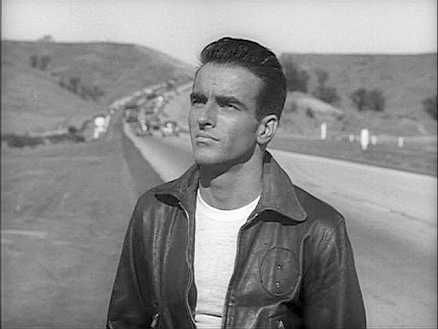
As the opening credits come up, we see Montgomery Clift hitchhiking along a highway trying to get to town. It turns out that the young man's name is George Eastman, and the place that he's going to is a business called... Eastman Industries. No, George doesn't own the place. Instead, it's his uncle Charles who owns the place, and George is looking for a job at the bottom of the ladder. Apparently, George's father and the rest of the Eastmans didn't get along all that well: Mom is working at the mission in one of the big cities in the midwest while the rest of the familiy is wealthy. It's not just that George's parents (Dad presumably died as we don't see him) are doing charity work; they really seem to belive the whole probably non-mainstream branch of Christianity stuff. But uncle Charles and his son Earl give George a job on the assembly line boxing shirts and blouses.

Most of the workers here are women, and Earl lets George know about the company policy in no uncertain terms: no romantic liaisons between the male and female employees. Not that they thought about sexual harassment back in those days; it was just easier not to have to deal with workplace romances. You can argue that it's good advice, but the policy is given so obviously that you just know George is going to fall in love with one of the workers there, which soon enough happens as he's walking home from work with Alice Tripp (Shelley Winters). In theory, a workplace romance might not be such a bad thing if one of them can get a job someplace else or if they can get married and the woman can become the housewife as would have been the expected thing back in 1951 when the movie was released. But of course the movie isn't going to work out that way.

George, being the nephew of the factory owner, eventually goes to meet his uncle Charles at the Eastman estate. While waiting for Charles in the billiard room, in walks young debutante Angela Vickers (Elizabeth Taylor). She's taken by George's raw manliness gained from having worked blue-collar jobs instead of a life of leisure that all the other young men she's ever known would have had. George falls for Angela because, well, she's played by Elizabeth Taylor, who really was a stunning looker up until about Butterfield 8. Of course, there's a problem in that George already has that relatinoship with Alice Tripp, and probably another problem in that George isn't really the right social class for Angela and her family. That latter problem could probably be solved, or at least ameliorated, if George can get his uncle to give him a promotion.

But the former problem is about to get much bigger. Alice informs George that she's going to have a baby! George is trying to have a relationship with Angela now, but having knocked up one's ex really throws a monkey wrench in the works. And Alice is making no bones about it. Do something now, or I'm telling everybody about our relationship. What's a young man to do? George decides to take Alice up to the lake for Labor Day, where he's going to rent a canoe, and let nature take its course, or perhaps push nature along. The story strongly implies that George is planning to murder Alice, but the way the scene is played deftly makes it ambiguous as to whether he murdered her, or whether she really fell out accidentally and then George committed negligent homicide by doing nothing to try to save Alice. Either way, though, George is going to have to pay, thanks to the Production Code.

Even though we know where the movie is going to wind up thanks to the strictures of the Production Code, it's still an excellent movie even after is starts the path along that preordained denouement. The story before that is top-notch and the last third is not bad at all. Elizabeth Taylor is OK, although her character is for most of the movie given fairly little to do other than look good and make it obvious why George would fall for Angela. And when you look as good as Elizabeth Taylor did back then, that's not hard. But then Taylor gets her finale and shows that was was going to blossom into much more than just a juvenile actress. Montgomery Clift is very good, playing the difficult role of the man who's gotten himself caught between two women and between two worlds, and has made a complete mess of his life. I've never considered myself the biggest fan of Clift's work, and yet every time I see one of his movies I find that there's an extremely high-quality movie to be had, and it's not as if he's detracting from that one bit. The reveltion, though, is Shelley Winters, who is very, very good, up until she announces that she's pregnant, at which point she's fabulous. It's just too bad that her character has to die off two-thirds of the way through the movie. Winters and Clift were both nominated for Oscars, although they both lost (to Humphrey Bogart in The African Queen and Vivien Leigh in A Streetcar Named Desire respectively). The movie won several awards, however, for George Stevens' direction, the screenplay, and the lovely black-and-white cinematography, among others.

If you haven't seen A Place in the Sun before, I strongly recommend it.