Showing posts with label George Kennedy. Show all posts

Saturday, December 16, 2023

The "Human" Factor

George Kennedy is interesting in pretty much everything I've seen him in, and he had a pretty long career. Recently, while looking through what's available on Tubi, I came across a movie of his that I'd never heard of: The "Human" Factor. The plot also sounded interesting, so I sat down to watch it in order that I'd be able to do a review on it.

Unfortunately, the print that Tubi has is in 4:3 and looks like it was done on videotape and could be a TV movie, although every bit of information I found suggests it's in fact a theatrical movie. It starts off showing John Kinsdale (that's George Kennedy) looking like a typical American family man, which in many ways he is, except that he's an expat, working for NATO in their Southern Europe headquarters in Italy as a computer expert, together with British electronics expert Mike McAllister (John Mills). One night, Kinsdale returns home to what is supposed to be his son's birthday party, only to find out that a bunch of police cars are surrounding the front entrance, willing to keep even him out since they don't realize yet he's the patriarch of the family. He finds that his family has been killed execution-style, in a way completely new to the Italian authorities by police inspector Lupo (Raf Vallone).

Lupo gives Kinsdale a bit of information that perhaps he shouldn't, as it's evidence in the ongoing investigation into the murders. Even though Kinsdale has an ironclad alibi and wants the killers caught, giving out such information probably isn't a good idea. In Kinsdale's case, however, it kindles in him an idea to start his own investigation to try to avenge the murders of his wife and kids. So he steals some credentials Lupo has courtesy of the US Embassy. Being a computer expert and working for NATO, he uses his knowledge of accessing government databases to get into them and figure out who the murderer might be.

A second murder committed in the same way against another American family takes place, and Kinsdale is able to meet with a bigwig in the US embassy, George Edmonds (Barry Sullivan). Edmonds, not having been told by Kinsdale that this is the husband of the first family that got killed, reveals what is more or less classified information, that some sort of terrorist cell has contacted American authorities with blackmail demands, that they'll kill another American family every few days unless certain demands are met. This gives Kinsdale an even more urgent desire to figure out who carried out the killings and stop future killings from happening.

But Kinsdale isn't an expert in this sort of investigation, and whatever vigilante actions he's taking may only screw up the investigation being carried out by the Italian police in cooperation with the legitimate American authorities. It all leads to a climax at one of the US bases in the area....

As I said, The "Human" Factor looks, and in many times feels, like a TV movie of the week. Not that it's bad; there are quite a few TV movies from that era that were pretty darn good. The computer technology depicted here is primitive, but in some ways it only serves to add to the charm of the movie. George Kennedy does well as the man with a burning desire for revenge, while Mills, along with Rita Tushingham as the third member of their crew, provide level-headed moral support. The views of the Naples area as it was in 1975 are also worth catching.

The "Human" Factor isn't the world's greatest movie by any stretch of the imagination. But if you haven't seen it before, and just want to be entertained, it will certainly do.

Monday, July 10, 2023

The Good Guys and the Bad Guys

I'd been writing up posts in advance and scheduling them as soon as I copy them over to Blogger, but then I noticed that one of the movies I've got in my queue is one that just so happens to be coming up on TCM again soon, so if anything looks like it's not quite accurate in terms of dates or if two posts come up in rapid succession, that would be the reason why. Anyhow, the movie that I notice was on the TCM schedule again is The Good Guys and the Bad Guys, which has its next TCM showing on July 11 at 12:30 PM.

Robert Mitchum plays the good guy, a man named Flagg who is marshal in the small town of Progress NM around the time of New Mexico statehood. The area is changing rapidly, and quite a few people even have automobiles. Flagg is beginning to get up there in years much like Joel McCrea and Randolph Scott's characters in Ride the High Country, but he knows that there are still some bad guys out there who haven't aged out and might still commit the sort of crime that was done when Flagg was a younger man.

One such man is McKay (George Kennedy), who was the leader of a big gang 20 years ago but who seems to have been laying low, even though he's still wanted. There's a rumor that McKay and his gang are heading for Progress, as the town is about to get a new bank which means a large transfer of cash by train; either the train or the new bank would be prime targets for the old-style western gangs. Flagg tries to tell Mayor Wilker (Martin Balsam) about the danger, but Wilker seems more concerned with his political future and doesn't seem to believe there's any danger from the old-time gangs. Besides, isn't McKay dead? Nobody's heard from him in 20 years.

Of course, McKay isn't dead, and Flagg is able to find him and bring him into town for the reward money. McKay is no longer really the leader of the gang, as it's a wholly new gang led by Waco (David Carradine) who has new ideas, ideas that are fankly too violent for McKay's changing tastes as he too is growing too old for the crime game. Waco's plan is to rob the train when it stops at the station in town, before the money can be transferred to the bank, but without having to board a moving train as folks in the old days might have done. McKay decides to help Flagg defeat Waco's gang.

This means that Flagg and McKay are going to have to board the moving train themselves, and either get it to stop before getting to town (not very likely), or get it to go through town without stopping, which is doable but also difficult. It doesn't help that Flagg is no longer marshal and so the train crew doesn't believe him that he and McKay are the good guys here.

The Good Guys and the Bad Guys is one of those movies from just after the end of the old Production Code regime where westerns tried to blend seriousness with some lighter comedy. It doesn't always work here, but I would also say that it's not a failure by any means. Instead, The Good Guys and the Bad Guys winds up being one of those movies that entertains for the 90 or so minutes that it's on the screen, but by the end it's not anything groundbreaking or terribly memorable. So it's definitely worth a watch if you want something unknown enough that it's more likely new to you, and if you just want to sit back, relax, and enjoy the ride.

Tuesday, September 21, 2021

Cahill US Marshal

Some time back a late-career John Wayne movie I hadn't blogged about before showed up on TCM: Cahill, US Marshal. So I recorded it, and recently watched it to do a blog post on here.

Wayne, as you can probably guess, plays J.D. Cahill, the titular United States Marshal chasing after criminals somewhere out west. He's a widower with two children, and because of his time chasing all those bad guys, he hasn't been a very good father to his sons, being absent all the time. So when he comes home from his latest long jaunt away from the kids, he finds that elder son Danny (Gary Grimes), almost a legal adult, is in the town jail on a drunk and disorderly. Also in the jail are Fraser (George Kennedy), and his two henchmen Stuther (Morgan Paull) and Brownie (Dan Vadis).

It turns out, however, that this is a ruse. Fraser and his men robbed the local bank, with some help from Danny and JD's other son Billy Joe (Clay O'Brien), killing the local sheriff in the process; since they can claim they were in jail at the time, the might be able to convince people that they didn't commit the bank robbery. Of course, the fact that the sheriff died might be an issue.

In any case, JD sets off to find the bank robbers in order to bring them to justice, taking Danny along with him as a sort of impromptu deputy. What they find is MacDonald (Royal Dano) and his men, who had robbed somebody passing through. They're not the bank robbers, but since they've got money on them it's enough to get a jury to convict them and sentence them to hang.

I mentioned that kid brother Billy Joe, all of about 12, was in on the robbery in an attempt to get attention from his father, and that's where the problems start to mount. His job was to hide the money until things blew over and Fraser could divide the money. Well, things have moved quickly, and Fraser and his men would like their share, the sooner the better. They'd be willing to kill him, except that he's the only one who knows. However, Billy Joe secretly takes Danny to get the money, found out by Cahill and mixed-race tracker Lightfoot (Neville Brand). So Dad knows who committed the robbery, even if he isn't letting on.

Cahill, US Marshal isn't Wayne's best western by a long shot, but fans of the Duke will get what they're looking for. It's amiable enough and feels like it's treading ground that Wayne had been doing for years. So if you want something comfortable and not too demanding, Cahill, US Marshal will fit that hole fairly well. For people new to any of the stars, however, there are other things I'd pick first to recommend.

Tuesday, September 29, 2020

The Phoenix's Flight

In another installment of the "movies that have shown up in the FXM rotation recently and are on again", there's the 1965 version of The Flight of the Phoenix. Its next showing is at 12:35 PM tomorrow, followed by another one at 3:30 AM Thursday.

Frank Towns (James Stewart) is a pilot flying an old airplane in parlous shape togethr with his co-pilot Lew Moran (Richard Attenborough) for Aramco, the oil company operating in various parts of the Middle East. In this case, they're flying from a rig somewhere in the Sahara up to Benghazi, this being a few years before Qaddafi led the coup that changed Libya's history. Considering what they say about the plane itself, the fact that the radio is out, and this is in a sequence before the opening credits, you know something bad is about to happen.

Sure enough, something does when a sandstorm hits. The sand clogs up the carburetor, making the propellers stop and forcing the plane into a crash landing. Worse, cargo falls from where it's been secured, killing two passengers instantly and fatally injuring a third.

The plane has landed off course, in the middle of the Sahara, with no radio, and with nobody knowing for several hours that something's happened to the plane. The only good thing is that among the cargo, there was a supply of pressed dates, so at least the passengers and crew don't have to worry about running out of food. They do, however, have to worry about running out of water, which is much more serious.

Towns is technically boss as his first duty is to the plane and keeping his passengers safe. However, one of the passengers is a former British army officer, Captain Harris (Peter Finch). He just knows he's going to be able to find the oasis that's "only" 30 miles or so away, through a featureless landscape with everybody having no idea where they are. The alternative, of course, is staying where they are and hoping somebody finds them before the water runs out, which doesn't seem appealing either.

Over Towns' objection, Harris eventually sets out with Carlos, leaving behind his underling Sgt. Watson (Ronald Fraser) who picked up a slight injury making him unable to take a trek through the desert. The rest of the men settle in for a long wait that's probably going to result in their deaths unless they're extremely lucky....

Or if somebody can come up with an absolutely ridiculous idea. Another of the passengers is Heinrich Dorfmann (Hardy Krüger). He's a German aircraft designer, and he's done the calculations to conclude that there is a way out of this mess: they can take the parts of the plane that survived the crash, move a wing here, a propeller there, and soon enough, they'll have a plane that at least can fly to that oasis where they can be rescued. It is, of course, nuts, and since World War II is fresh in people's memories, there's some question of whether or not they should trust Dorfmann. But the alternative is to have no hope, so perhaps doing something is the least bad thing.

As you can guess, there's a lot of difficulty along the way, as the other passengers aren't necessarily as fit for labor as Dorfmann's calculations would have them being. There are further complications involving whether or not Towns can let Dorfmann have authority, or whether a group of Bedouins that pass a couple of dunes over might actually be bandits who would just as soon kill all the non-Arabs.

Flight of the Phoenix isn't a bad little movie if you can get past the idea that the plot is so ludicrous that nothing like this could happen in real life. They'd all be long dead. Although there's nominally the action of trying to build the plane, much like the bridge in Bridge on the River Kwai, the story is just as much about the psychology of the interaction among the various stranded people in a time of disaster. There are also shades of Alfred Hitchcock's Lifeboat what with a German who may not be fully trustworthy amid that disaster.

I thought that FXM's airing might be panned and scanned since it fills up the 16:9 screen, but IMDb claims that the movie was originally filmed in a 1.85:1 aspect ratio and not Cinemascope, so at most there's a little bit off the sides. The movie itself got a DVD release, although that seems to be out of print. There was also a remake in 2004, and that one also got a DVD release that seems to be out of print too. Both versions seem to be available on Amazon Prime streaming video.

Friday, November 29, 2019

Civil War fantasy


Some time back I picked up a DVD of Shenandoah. With my previous DVR having died, forcing me to watch some of my DVDs, I finally put this one in the player and watched.

James Stewart plays Charlie, the patriarch of the Anderson family in western Virginia's Shenandoah Valley in 1864. Now, if you know your history you should know that this is over three years into the US Civil War, and in the Confederacy. By this time the war was already effectively lost for the South. But dammit, it looks as if the war hasn't touched the Anderson place at all. None of his six sons has gone off to fight the war, and they somehow grow or make everything they need, as all the oil lamps stay lit. Indeed, Charlie is pissed that Confederate procurement agents want his horses. (To be fair, I'd be pissed too about it. But you'd think at least one of the sons would have gone off to fight.)

In addition to having six sons, he's got a daughter Jennie (Rosemary Forsyth) and daughter-in-law Ann (Katharine Ross in her movie debut), the latter of whom is married to son James (Patrick Wayne) and pregnant. Somehow, all of these people are able to live a fairly idyllic life with the only real tragedy seeming to be that the matriarch died in childbirth with youngest son Boy (Philip Alford).

But we wouldn't have much of a movie if this idyllic life just kept going on. A couple of things happen. One is that Jennie gets married to Confederate officer Sam (Doug McClure) who has to go almost straight from the wedding back to the front. And then one day while Boy is out hunting, he runs into a Union ambush. Since he had stupidly put on a Confederate cap that he had found, he gets taken prisoner by the Union.

Charlie finds out, and he decides that he's just going to get up from the farm and form a search party to find Boy come hell or high water! And he and most of the remaining children are just able to go off and do the searching, barely being troubled by any of the soldiers from either army going around the area. They find a Union officer (George Kennedy) who doesn't have Boy and suggests a rail transport; there they find Sam but not Boy. Meanwhile, things aren't particularly safe back at the farm....

Shenandoah goes on like this for the entirety of its 105-minute running time. Most of that time I found maddening, since the plot not only strains credulity, it breaks it, stomps on its carcass, and demands that we respect it for having done so. OK, I'm being a bit hyperbolic. But not much. Stewart gives a good performance, and frankly there's nothing wrong with the acting from the supporting players either. It's just that plot.

Well, one other technical problem I had was that Shenandoah uses some battle footage from Raintree County. In and of itself that's no big deal, but Raintree County was in a 2:35:1 aspect ratio, while by the time of Shenandoah the 1.85:1 ratio was much more standard, so all that Raintree County footage looks grainy and out of place.

Still, many of you will probably like Shenandoah much more than I did, so get a copy and judge for yourself.

Sunday, April 28, 2019

The Concorde: Airport '79

I recently mentioned the death of Swedish actress Bibi Andersson, and that she had appeared in The Concorde: Airport '79, which I have on Blu-ray as part of the box set of all four Airport movies. So with that in mind, I sat down to watch it and do a full-length review here.

The basic plot involves one of the Concorde supersonic passenger airplanes, which has been bought by an American airline and is going to go on its first flight for that airline from Washington DC to Paris, and from there to Moscow as a goodwill gesture ahead of the upcoming Summer Olympics in Moscow. (This was obviously made before the US and many other western countries boycotted the games.) Among the passengers on that flight are going to be a team of Soviet gymnasts, coached by Mercedes McCambridge and Avery Schreiber, with American reporter Robert Palmer (John Davidson, not singing "Addicted to Love" here) following along because he's trying to bed one of the gymnasts, I assume in the name of detente and world peace or something.

Another passenger is Maggie Whalen (Susan Blakely), another television reporter having an affair with the head of the Harrison defense contracting company, run by Dr. Harrison (Robert Wagner). Somebody passes documents to her, documents that show that the Harrison company has been illegally arming various militias in a bunch of third-world countries that at the time would have been the sites of proxy wars that were going on because of the Cold War. She's apparently planning to release those documents once she gets to Moscow. We've already seen that people are willing to kill to get those documents back, so when we learn that the Harrison company is going to be doing some testing of drone planes for air-to-air combat, Harrison gets the brilliant idea of using that drone to try to take down the Concorde!

The French Concorde pilot Metrand (Alain Delon), a notorious womanizer who is carrying on with one of the stewardesses Isabelle (Sylvia Kristel), along with the co-pilot Patroni (George Kennedy, who apparently learned how to fly the damn Concorde after every other unrelated job he had in the previous three Airport movies), evade the missile over the Atlantic and, with some minor damage, get the plane to Paris. Amazingly, you'd think that after the suffering the passengers went through on the first leg of the journey, they'd make alternative arrangements to get to Moscow, but no, they stupidly get back on the plane! Harrison tries to take it down again.

Now, this being a disaster movie, we know there should be a bunch of stars each getting a cameo story line. Among them are Eddie Albert as Sands, the head of the airline; Cicely Tyson as Elaine, who is going to Paris to fetch an organ for transplantation into her son; Martha Raye as an incontinent woman who keeps needing to use the bathroom; Jimmie Walker as a pot-smoking jazz musician who plays his saxophone during the first leg of the flight and then, after it gets destroyed, pickes up a fresh sax for the second leg (!!); and Charo as a woman trying to smuggle her dog onto the flight -- she should have called it her service dog. As for Andersson, she plays a high-class "escort" that Metrand procures for Patroni during their layover in Paris.

The Concorde was the last of the Airport movies, and it's easy to see why. It's terrible in oh so many ways. But it's one of those movies that's delightfully awful; you'll be splitting your sides laughing at the thought of it all. There are too many to list, although I've already mentioned everybody getting back on for the second leg as well as Jimmie Walker's second sax. There's the terrible special effects looking like a very primitive Chroma-key, and Patroni firing flares out the cockpit window (!) to try to deflect the heat-seeking missiles from the drone. I think my favorite moment involved Avery Schreiber's character bringing his young daughter into the cockpit to talk to the pilot. Dad is translating in some sort of sign language for the daughter, while I was hoping Patroni would ask the girl if she likes gladiator movies.

I'm glad I picked up this box set, because all four of the movies are worth watching, even if only the original is really good. The other three reach varying levels of disaster in the figurative sense, and are all the more fun for it.

Wednesday, February 20, 2019

Airport '77

Some time back I bought the box set of the four Airport movies. Having done reviews of Airport and Airport '75, it's now time for the third movie in the series, Airport '77.

James Stewart plays Philip Stevens, an extremely wealthy businessman who is taking some of the fine art that he owns and has stored up north, and opening a museum down in Palm Beach, FL. Not only that, but he's inviting a galaxy of VIPs to the opening of the museum and flying both them and the artwork in on his lavishly appointed private 747. Christopher Lee plays businessman Martin Wallace, married to nasty Karen (Lee Grant); Olivia de Havilland and Joseph Cotten are a pair of elegant passengers who last met in London in 1936; Capt. Don Gallagher (Jack Lemmon) is the pilot; and Eve (Brenda Vaccare) is his girlfriend.

Anyhow, with all those rich folks and artwork on the plane, you know it's going to attract people who want to steal the stuff. This time, there's an inside plot involving to co-pilot Chambers (Robert Foxworth). They install some anesthetic gas that they'll be able to run through the ventilation system (they, of course, will be wearing gas masks), knocking the passengers out, and enabling Chambers and his men to fly the plane to a small abandoned airfield in the Bahamas where the paintings will be unloaded.

Or, at least, that's the plan, and it's one that doesn't quite go the way the bad guys had it figured out. After knocking the passengers out, they have to fly low in order to evade radar detection, and when they get into a fog bank, they find an oil platform sticking up out of the ocean at a height where they could run into it. Ultimately, they clip a wing, and are unable to correct out of this, resulting in the plane crashing into the ocean and sinking to the bottom.

Thankfully for the passengers, the bottom isn't so deep that the water pressure would crush the fuselage. That's the one piece of good news they have when they wake up. Well, the other one is that the hijackers are either dead or severely injured so they don't have to worry about that. However, they do have to worry about the panicking passengers; the ticking time bomb of being underwater; and the fact that they're off course so rescue crews don't know where to look. To save the plane, Capt. Gallagher and scuba diver Wallace are going to have to get a dinghy with a rescue beacon to the surface.

Airport '77 is a worthy entry in the disaster genre. It's entertaining, if not particularly great. Still, seeing all the grand old stars together with some then-new ones is always fun. Stewart is underused and given a boring role, almost as if he came in for one or two days to film all of his scenes. Lemmon is surprisingly interesting in a sort of role he never really essayed before. De Havilland and Cotten are nice throwbacks, and Lee Grant is a hoot.

As for the plot, sure it's full of holes and unrealistic, but a movie like this you watch for the stars and the disaster, and in that regard both of them come through. I can certainly recommend Airport '77.

Friday, January 11, 2019

Brass Target

On December 21, 1945, General George Patton died as a result of injuries sustained in a car crash. The 1970s were a period when conspiracy theory books and movies were a big thing, so it is perhaps not surprising that somebody would revisit Patton's death and suggest that it was not a car accident, but an assassination. After all, Patton did have quite a few political opponents. Anyhow, that novel was adapted into the movie Brass Target.

George Kennedy plays General Patton, who at the beginning of the movie is dealing with a pretty substantial problem. A train of Reichsbank gold that was being transported for safekeeping to Frankfurt was waylaid in a tunnel, and the $250 million in gold (quite a sum for 1945) stolen. Worse, the US Army soldiers guarding the train were all killed. So you can see why Patton would want to find out who did it. Plus, the Soviets aren't happy with him.

The first suspect is Maj. Joe De Lucca (John Cassavetes). De Lucca was a former member of US military intelligence, and he came up with the plan for stealing Nazi gold from the Nazis that was used by somebody else to steal the Nazi gold from the Americans. Since military justice doesn't work quite like the innocent until proven guilty of the American system, especially in an occupation zone, De Lucca decides that he'd better investigate the case himself and figure out who did it in order to prove that he didn't.

We learn fairly early that it's an inside job, as a group of OSS men led by Col. Rogers (Robert Vaughn) is behind the heist. Worse, when Maj. De Lucca meets his old girlfriend Mara (Sophia Loren). She discovers that another former boyfriend, Shelley Webber (Max von Sydow), now of a refugee resettlement organization in Switzerland, is really a professional assassin and is being hired by Rogers to kill Patton! Now she and De Lucca have to stop that.

Of course, we know from history that they don't prevent Patton's death, although whether or not he was assassinated is a different question. But Webber leaves a lot of carnage in his wake before the end of the movie.

Brass Target is an interesting idea, but one that doesn't quite succeed in the execution. It's slow, and has a difficult plot to follow. Kennedy has the difficult task of playing Patton when George C. Scott's bravura portrayal of the general was still fresh in the moviegoing public's memory. Kennedy does the best he can, and thankfully it's not the biggest role in the movie. Everybody else tries, but it hamstrung by the poor script.

Brass Target is available on DVD from the Warner Archive, if you want to watch and judge for yourself.

Sunday, October 21, 2018

At least it was better than Mister Buddwing

Looking through my DVDs to see what genre of movie I hadn't blogged about lately, I decided that I'd sit down and watch Mirage.

Gregory Peck plays David Stillwell, who at the start of the movie is working on the 27th floor of one of those corporate behemoth buildings in New York. The power has gone out, leaving everybody in the dark and David to walk down 27 flights of stairs to get out of the building. Just behind him is a mysterious woman Shela (Diane Baker); the two have a conversation along the way. They eventually go past the ground floor and through the sub-basements before Shela gets far enough ahead of David that she can just disappear.

When David gets out of the building, he hears an ambulance; it seems as if somebody fell, jumped, or was pushed out of a window in the building where David worked. And it was a 27th floor window. Eventually David goes back to his building to find Shela, and he's shocked to discover that there's no sub-basement! When he gets to his apartment, he finds that there's a man with a gun waiting for him in the hallway. Everybody is wanting him to go see "The Major", whoever that is. David tries to call his boss Josephson (Kevin McCarthy), but uses a number that's out of service. More and more things happen to David that lead him to believe that he's suffering from amnesia. The fact that he's got people chasing him trying to kill him doesn't help.

David tries to go to the police, but they're no help. More alarmingly, he goes to a psychiatrist who is extremely rude to him and doesn't want to help either. Is the pyschiatrist in on the conspiracy? Finally, David turns to a private detective, Ted Cassell (Walter Matthau), who reluctantly takes the case. When they go back to David's building, his old office isn't there, and in the basement that's not a sub-basement, the guy who was there before, Willard (George Kennedy), is there again threatening the two with a gun!

David goes around town trying to piece his past back together. The dead guy, Charles Calvin (Walter Abel) was apparently leading some sort of peace group, and David begins to realize that perhaps he knew Charles. But how? And what are all of David's flashbacks to a conversation on a grassy field about? Worse, David still has to deal with Willard chasing and trying to kill him....

The big problem I had with Mirage was the fact that nothing seemed to fit. Obviously, the movie was structured as it was to try to put the viewers in the predicament of a man who suddenly doesn't know who he was, which is the same conceit as Mister Buddwing a year later. I really disliked that one, and Mirage is only slightly less of a problem for me. I also had big issues with the whole conspiracy theory thing. You can't keep this much a secret, especially not in a big city. Granted, some of the things can probably be explained away by saying they were figures of David's amnesiac imagination. But things like the psychiatrist can't. The impression I got is that he was violating medical ethics treating David the way he did, and for no good reason. The ending also made me feel as though David's amnesia may have been resolved, but the viewers' issues weren't.

Still, this is another of those movies you should probably judge for yourself, and since it was on a cheap box set, it's not as if I wasted too much money on it.

Friday, July 20, 2018

No, this isn't the 74th sequel

Part of my last batch of DVD and Blu-ray purchases at Amazon was a four-disc set of the Airport movies. I'd already seen the first of the Airport movies, so last night I popped in the disc of the second, Airport '75 (which actually premiered in theaters in October 1974).

The movie starts off with a lengthy list of stars in the opening credits, some near the top of their career, some who were old enough to retire if they had wanted to, and a few names who became famous later. As for the actual action of the movie, flight attendant Nancy (Karen Black) meeting her boyfriend, pilot instructor Alan (Charlton Heston), at Dulles International Airport just outside Washington DC. Nancy apparently has some Big Issue she wants to discuss with Alan, but he has to get the next plane out to LAX in Los Angeles while Nancy is on the red-eye several hours later.

This being a disaster movie, we then get to see the famous names you should already be watching out for if you paid close attention to the opening credits. In no particular order, there's Mrs. Patroni (Susan Clark), wife of George Kennedy's character from the first Airport movie, a role Kennedy reprises here. There's older nun Martha Scott traveling with more modern nun Helen Reddy(!); little old lady Myrna Loy getting harassed at the airport bar by Jerry Stiller, Norman Fell, and Conrad Janis; Sid Caesar is a bit-part actor who hits on Loy during the flight; and Linda Blair as a kidney transplant patient traveling with her mother (Nancy Olson). Oh, and there's Gloria Swanson playing herself. As for the crew, Efrem Zimbalist Jr. is the pilot, Roy Thinnes the co-pilot, and a young Erik Estrada(!) the navigator.

Now for the disaster. There's thunderstorms and fog all up and west coast meaning that our jet is going to have to land in Salt Lake City while the weather clears. Meanwhile, traveling in a small plane from Albuquerque to his home in Boise is Dana Andrews, who's actually a veteran of air disaster movies, having made Zero Hour! and The Crowded Sky many years earlier. He's desperate to get home because he's got a huge business deal to conclude in Boise the next day, one that's going to fall through if he doesn't get home. He's never going to get home. He suffers a hilariously overacted heart attack, causing him to lose control of his plane and crash into the cockpit of the 747. That crash sucks out Thinnes and Estrada, and leaves Zimbalist with cuts that because of the bleeding, temporarily blind him. Poor Karen Black is going to have to land the plane with help from her boyfriend telling her over the radio what to do. And when that doesn't work, they're going to have to rappel a pilot through that hole into the cockpit to land the plane himself!

To be honest, I find Airport '75 to be a difficult film to give any sort of a grade to. The plot strains credulity to the point that I found myself laughing at the idiocy of it. Most of the characters' story lines don't get any fleshing out because there are just way too many of them. And the characters are pretty much archetypes from all the all-star disaster movies that had preceded it.

Yet I found Airport '75 immensely entertaining. A lot of the characters get terrible dialog, but it's hilariously funny, and not even in a "so bad it's good" way. I suppose Dana Andrews' heart attack isn't dialogue, but that's one good example. The elder nun's distaste of Gloria Swanson, along with Swanson's constant name-dropping about old Hollywood, are another. And then there's Helen Reddy's having to sing an awful song about how you are your own best friend to Linda Blair. Myrna Loy by comparison doesn't acquit herself any worse than her character in From the Terrace, with the exception that this one likes to drink boilermakers, only she doesn't call it that.

Airport '75 may not be as good as the original Airport, but it's a hell of a lot better than things like The Swarm or Beyond the Poseidon Adventure.

Monday, April 30, 2018

The Eiger Sanction

Over the weekend, I got around to watching The Eiger Sanction off my DVR. It's available on DVD and Blu-Ray in multiple editions and, for those of you with the Cinemax premium cable package, it's going to be on several times this week.

The movie starts off in lovely Zürich, Switzerland, with an older guy walking up to his apartment and opening up a piece of bubble gum that contains some microfilm. In the background, we can see a pair of shady figures, which can mean only one thing: spies are afoot, and somebody's about to get killed by somebody else. Sure enough, the two shadowy guys whose faces we never see (for reasons that will become obvious in a bit) kill the one guy whose face we did see.

Cut to a college somewhere out west. Professor of art Jonathan Hemlock (Clint Eastwood) is finishing up the last lecture of the semester. In his office, he's approached by somebody who clearly has nothing to do with the university. Hemlock, as it turns out, had a past in the spy services himself. Specifically, he was an assassin, but he insists he's retired now. Still, Dragon (Thayer David), the head of this spy service, wants Hemlock to perform one more assassination, or "sanction" as they say in their jargon. Find the guys who killed that agent in Zürich. And you're going to do it, Hemlock, because I've got all sorts of dirt on you, says Dragon.

The guy was also one of Hemlock's best friends when they fought as mercenaries in Indochina some time in the past, so Hemlock goes to Switzerland and finds one of the guys who killed their spy and kills that guy in return. End of story. Oh, you bet that it's not going to end that quickly. Nobody could find the other guy. But that's good enough for Hemlock, who did the job he was asked to do.

And then, bizarrely, the agency gets a piece of intelligence that the other guy who killed this agent is going to be taking part in an international expedition to climb the north face of the Eiger in Switzerland, and this is where Hemlock really comes in. Hemlock, in addition to being an assassin and an art connoisseur, also used to be an accomplished mountaineer. They don't kow which of the other guys on the expedition killed the agent, but it's going to be Hemlock's job to find out and make the other guy's death seem like a mountaineering accident. Hemlock, with his mountaineering past, is the only agent who can do the job, because climbing the north face of the Eiger is notoriously difficult.

So Hemlock goes off to train with his old friend Bowman (George Kennedy), faces another mercenary Mellough (Jack Cassidy) who once betrayed him and the previously murdered agent, and then finally gets ready for the big climb in Switzerland. It really seems as though any of the other three climbers could be the man Hemlock is looking for....

To be honest, the main plot of The Eiger Sanction is a bit absurd. The idea that they'd get a bead on only one assassin but not the other is mildly odd, but then the idea that they just know he's going to be on that expedition, but still don't know which one it is, really defies logic. Having said that, however, the movie as a whole is fairly entertaining. I felt that the training scenes at Bowman's tourist resort in Monument Valley went on too long, but other than that everything pretty much worked.

There's enough suspense in the Alps, and the scenery is gorgeous. There are lots of picturesque mountains in Switzerland, Utah, and at Hemlock's university. Plus Zürich isn't a bad backdrop, although this is a decidedly lower-rent part of the city. Suspend your disbelief, and strap yourself in for two hours of entertainment.

Saturday, July 1, 2017

The Sons of Katie Elder

I had another movie planned to blog about today, but things came up and so I had to watch The Sons of Katie Elder off a three-film DVD set of John Wayne movies. (It turns out there's a nine-film set available both at Amazon and the TCM Shop that has the three on the set I bought and six others.)

The movie starts off with a train heading towards a town, with opening credits and music that's unmistakeably Elmer Bernstein accompanying. That train stops in the town of Clearwater, Texas, where three men are waiting for a fourth. A man does get off the train, but it's not the one they were expecting, and the one they were expecting isn't on the train at all. It turns out that the three men are the Elder brothers: Tom (Dean Martin), Matt (Earl Holliman), and young Bud (Michael Anderson Jr.); they were expecting eldest brother John (John Wayne) to show up for their mother's funeral. John does show up, although he watches the funeral from afar.

The man who did get off the train, Curley (George Kennedy), goes to a ranch owned by Hastings (James Gregory), who is planning big things for the town. But the ranch used to be owned by the Elders' parents. Dad -- well, we'll learn a bit more as the movie goes on about how the ranch passed from his hands -- suffice it to say that he got shot to death, but the murder is unsolved. Mom had to move off the ranch after Dad died, and she died poor and one would guess of a broken heart.

The four sons begin to investigate, and find out that things aren't quite right, but that nobody will tell them the full truth of what's going on. Having said that, we can guess that Hastings is no good right from his first scene, as he's clearly expecing John Elder to mean trouble. The whole point of bringing Curley in is to deal with John before John can deal with Hastings.

The Sons of Katie Elder is one of those movies that I'd call good, solid entertainment, but it's also not the sort of thing I'd think of as standing out at anything. The movie has a fairly leisurely pace, running a bit over two hours and having a resolution that comes rather abruptly. The plot is one that you'd call "formulaic" if you wanted to denigrate the movie, but is really more of a standard-issue Western theme of revenge. (One of the top IMDb reviews used the word "traditional", which has rather more positive connotations than "formulaic".) There's a fair amount of action in the second half, and reasonably good performances. I just found it hard to find anything special in the film.

Still, the various box sets are relatively low priced. And considering that you're getting The Man Who Shot Liberty Valence and The Shootist at least, it's easy to think of The Sons of Katie Elder as a bonus. Besides, there are other people who will like it even more than I do.

Thursday, January 19, 2017

Thursday Movie Picks #132: Featuring Actors/Actresses Who Passed Away in 2016


This being Thursday, it's time for another Thursday Movie Picks, run by the Wandering Through the Shelves blog. This week's theme is actors and actresses who died in 2016, and of course as a lover of old movies, I'm picking some slightly older movies.

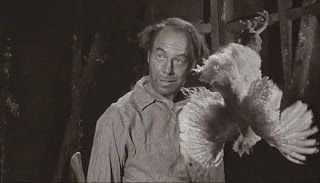
First up is Strait-Jacket, from 1964. This one is in honor of George Kennedy, although he only has a small role. The star here is Joan Crawford, playing a woman who axe-murdered her husband decades ago and spent a long time in a mental institution as a result. She's out now and living with her adult daughter (Diane Baker), but odd things start happening that bring Crawford's sanity back into question, especially when somebody gets axed to death. Kennedy's small part includes a memorable scene of him having to axe a chicken to death:


This was made by William Castle, known for his gimmicks; I guess the gimmick here is starring Joan Crawford.

Next we get the 1962 two-reeler Happy Anniversary. This was made by and stars Pierre Étaix, a French clown who made several movies in the 1960s, all known for their inventive visual humor. This short has Étaix playing a husband who is trying to buy a gift for his wife on her anniversary, only to have anything that can go wrong actually go wrong: there's traffic, he has trouble fitting a gift in his tiny car, and so on. Meanwhile, the wife is back at their apartment having made a nice dinner for her husband; they being French, she's also opened a nice bottle of wine. And she waits... and waits... and waits....

Finally, I'll mention another movie where the actor had a small role: Running on Empty. Judd Hirsch and Christine Lahti play a couple of 60s radicals who accidentally killed an innocent janitor when they bombed a napalm factory; they've been on the run ever since with their two children. The elder of the two children, played by River Phoenix, is a piano prodigy, and good enough to go to Juilliard. Except of course that there's a problem, which is that if he were to go off it might reveal his parents' identities, and will also probably mean he's never see his parents again. I'm mentioning this film in honor of actor Steven Hill, perhaps best known from the TV series Law and Order. He plays Christine Lahti's father, and has one memorable scene when he meets his daughter at a restaurant for the first time in ages as she asks him to consider taking custody of her son so he can go to Juilliard.

I thought about using Debbie Reynolds so that I could mention What's the Matter With Helen, which has her and Shelley Winters playing two mothers who have to leave Iowa after their sons commit a notorious Leopold and Loeb-style murder. The mothers' friendship eventually goes downhill....

Tuesday, March 1, 2016

George Kennedy, 1925-2016


George Kennedy, who won a Best Supporting Actor for Cool Hand Luke

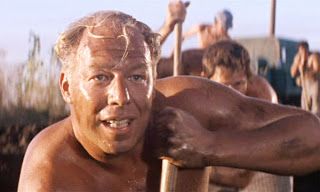
George Kennedy, whose long career included a lot of tough guy roles early on as well as comedy later in his career, has died at the age of 91. Kennedy won a Best Supporting Actor for his role opposite Paul Newman in Cool Hand Luke, pictred above. Kennedy has a wonderful "Word of Mouth" piece that shows up on TCM from time to time in which he mentions the making of one particular scene where he and the other prisoners have the hots for a young woman, helpfully informing us that the prisoners and the young woman doing her thing were actually shot in two completely separate sequences, so all the actors had to show themselves getting aroused without the young woman around. That's acting.

Other roles for Kennedy in the 1960s included one as a cop who makes life difficult for Kirk Douglas in Lonely Are the Brave, as well as a farmhand with a mean streak in Strait-Jacket, pictured at left. Strait-Jacket is one of those movies which isn't all that good, but is enormously entertaining, including Kennedy's performance. I suppose I should also mention The Dirty Dozen, although it's been years since I've seen that one.


Who can't help but love Airport? The first of the great all-star disaster movies of the 1970s, George Kennedy is one of those stars, playing the man whose job it is to keep the runways clear by getting any plane that should get stuck in the snow out of the snow banks, something that puts him at odds with Burt Lancaster.


And then later in his career, Kennedy played Leslie Nielsen's boss in the Naked Gun series of films; that's Kennedy behind Nielsen in the photo above.

As best as I can tell, TCM hasn't announced whether there's going to be any programming change to honor Kennedy. I haven't been watching enough to see whether they've even aired a "TCM Remembers" piece yet.

Sunday, April 12, 2015

Charade

I neglected to do a post on the 1963 film Charade the last time it aired. It's coming up again this afternoon at 4:00 PM on TCM, so now's your chance to get it.

Audrey Hepburn plays Regina Lampert, a French woman married to an American who's in the business of business, or something. She doesn't really know what her husband does, except that it provides her with a living that keeps her in all that Givenchy and going to fashionable places in the alps to spend her holidays with her friend Sylvie and Sylvie's son Jean-Louis. That's where Regina meets Peter Joshua (Cary Grant). He's walking along the breakfast terrace of one of those places, when Jean-Louis comes up and... shoots him with a water pistol! Peter and Regina strike up a converstaion, playing it a bit coy and Regina thinking nothing of it.

She'll have more time to think when she gets back to Paris. She returns to find that her apartment has been emptied, and her husband murdered, thrown off a moving train! It's some small consolation that Peter has somehow made it to Paris too, and is there to comfort the grieving widow. But if Regina thinks the shock is big, she ain't seen nothing yet. When she goes to the funeral, three strange men show up to pay their respects: Tex (James Coburn), Herman (George Kennedy), and Leopold (Ned Glass); all three of them show up briefly, do something strange, and then leave. And not long after the funeral, Regina gets a letter stating that she is to appear at the American embassy and meet officer Hamilton Bartholomew.

He's got an even bigger shock. Those three men were three of her late husband's four accomplices in the theft of $250,000 in gold that the five of them stole during World War II. One of the other men was believed already dead, and none of the remaining four had been able to get their hands on the hidden gold, apparetnly until now, with Mr. Lampert presumably having done so which would explain why the other three were trying to track down Lampert and get to him. They wanted their share. Regina, for her part, is completely innocent, having no idea that her husband was involved in anything like this and no idea where the quarter million could possibly be. A search of her husband's traveling back yields no clues.

And what does Peter Joshua have to do with this? He's passing himself off as a man who could be Regina's friend, and the one person she can trust in Paris while these other three guys are coming after her for the money, thinking that she's holding out on them. But as the movie goes on it's clear that Peter is keeping secrets from Regina, even as the two of them and the three obvious crooks wind up at the same run-down hotel in their search for the money and their attempts to keep their eyes on each other. Who among the various characters are the real criminals, and where is the money?

Charade is a movie with an excellent story, and one that's told exceedingly well. But, it's a movie that's got one small problem, and that's in the casting. Specifically, the casting of Cary Grant and Audrey Hepburn. Both of them are fine actors, Grant doing well playing the suave older gentleman and Hepburn being an elegant damsel in distress. But it's Grant and Hepburn. Both of them had reputations, and already 20 years earlier when Grant made Suspicion it was clear that producers hated the idea of him being an unalloyed villain and how audiences would respond to that. In the intervening 20 years, especially the decade or so leading up to Charade, Grant had become a man playing characters you knew where going to be the good guy regardless of what the story was trying to tell you. You can't help but expect that to happen in Charade too, and that's the one thing that works to the movie's ddetriment. Other than that, though, the movie is a winner in every way. It's lovely to look at, and there's a good mix of dramatic thriller elements and comic relief to break up the dark proceedings.

Charade is listed as being available from the TCM shop, but courtesy of the Criterion Collection, which means more pricey.