Showing posts with label Vivien Leigh. Show all posts

Friday, June 2, 2023

Southern Gothic all'Italiano, part 1

A bit by chance, I've happened to watch pairs of movies recently that have something in common with each other: two with Cleavon Little in the cast; two with Lauren Hutton; and a pair of sports movies come to mind. And then I happened to watch a pair of movies based on works by Tennessee Williams in which Italians play a key part, not realizing until I started watching the second that Tennessee Williams was responsible for both. The first one I watched was The Roman Spring of Mrs. Stone, although it's the later of the two movies. In the near future, depending on the order in which I decide to put up the blog posts on the various movies I've watched recently, you'll get the other movie, The Rose Tattoo.

Mrs. Karen Stone is played by Vivien Leigh. She's a stage actress who does Shakespearean stuff, but she's getting up there in years and still seems to insist on playing the roles written for younger women. The public and the critics are noticing it, so Karen decides a break would be in order. Besides, she's got a wealthy industrialist husband who has health issues, and some time off from his equally stressful job would be just the thing for the two of them. With that in mind, they decide to go to Rome for a break, since it's such a romantic city.

Unfortunately for the two of them, Mr. Stone suffers a heart attack mid-flight, and even if they had been over land and been able to divert, it wouldn't have been any health as the heart attack kills him almost instantly. Mrs. Stone is now a widow, but one who's inherited a substantial sum of money from her husband, meaning that she can take a break from going back to work instead of having to flog Pepsi like Joan Crawford. Mrs. Stone takes an apartment overlooking the Spanish Steps, which are apparently considered romantic by tourists and ex-pats. We can also see that there's some shady young man at the bottom of the steps who keeps looking up at Mrs. Stone's apartment.

Meanwhile, there are a lot of other younger men out there who are perfectly willing to debase themselves for an older lady's fortune much the way that sugar babies do with older men. Paolo di Leo (Warren Beatty) is one of those men, and he works for the Contessa (Lotte Lenya), who is basically a pimp although they don't use such language thanks to the presence of the Production Code. If anything, it's presented as being more like Gigi only with the sex of the two protagonists switched. The Contessa arranges for Paolo and Mrs. Stone to meet.

Mrs. Stone is happy to have companionship at first, although the relationship slowly turns into love, at least from her perspective. For Paolo it's just a job, and when he meets Barbara (Jill St. John), an American actress closer to his age, he starts pursuing her. The doesn't happen until about the final quarter of the movie, however, after a long, slow build-up between Stone and Paolo.

And when I say long and slow, it really is long and slow. That's one of the two big weaknesses of the film, the other being Warren Beatty, who isn't Italian at all. On the more surprising front, and for me a bit of a plus, is that the characters aren't anywhere near as obnoxiously shouty and over the top as they are in some of Tennessee Williams' other works that are set in the southern US.

The Roman Spring of Mrs. Stone is definitely the sort of movie where I can see why it would appeal to other people more than it did to me, so it's another one where I would strongly suggest watching for yourself and making your own conclusions.

Thursday, August 25, 2022

Three Weeks Together

Vivien Leigh is the star being honored tomorrow (August 26) in TCM's Summer Under the Stars. One of her movies that had been sitting on my DVR for some time until I watched it a few weeks ago was 21 Days. TCM will be running it tomorrow at 7:00 AM, so now is a good time to blog about it.

Leigh really isn't the star here; that honor goes to Laurence Olivier. He plays Larry Darrant, a sort of ne'er-do-well who has returned to London where he now has a girlfriend in the form of Wanda (that's Vivien Leigh). One night, the couple are returning home to Wanda's flat, where she finds that she has a visitor: her estranged husband Henry (Esme Percy), whom she hasn't seen in years. Henry decides he's going to try to blackmail Wanda and Larry, pulling a knife on them when Larry refuses to pay up. In the ensuing fight, Larry kills Henry in what should be self-defense.

Larry has a brother Keith (Leslie Banks) who is a barrister, so Larry goes to him for advice. Keith, however, is up for a judgeship, and doesn't want any scandal in the family as that would likely ruin his chances to become a judge. So he suggests that Larry and Wanda leave the country, never mind that a good barrister could get Larry off.

Things are about to get a whole lot worse. There's a defrocked minister-turned-tramp, John Evan (Hay Petrie), who decided to pilfer Henry's body on finding it. The police find John with Henry's personal belongings on him, and naturally put two and two together and figure John must have been responsible. Now John is indeed, responsible, but only of theft. But because of his Christian faith, he has a lot of guilt, and has no intention of doing anything in his own defense at trial.

This is in some ways perfect for Keith. Somebody other than his brother will stand trial for the murder, and since to Keith it's pretty damn obvious that John wasn't the killer, John should be found not guilty, leaving Larry free once the trial ends. But Larry actually has a conscience, he not being an attorney, and seriously thinks about confessing. Things get worse for all involved when John is actually found guilty....

Considering the star power in 21 Days, I found it surprisingly flat. There's a good story here, but somehow it ended up as little more than a pedestrian programmer. It's not bad, by any means; it's more that it should have been a lot better. Indeed, producer Alexander Korda shelved it until after Leigh become an international star due to Gone With the Wind, seeing that the movie was a bit of a mess. Still, Leslie Banks does a fine job as the attorney who winds up being surprisingly sleazy, and fans of Olivier and Leigh will want to see it.

Wednesday, June 16, 2021

A Streetcar Named Desire

Another of the classic movies that I surprisingly haven't blogged about yet is A Streetcar Named Desire. (Well, maybe not that surprising considering that I'm not the biggest Tennessee Williams fan.) It got an airing on TCM during 31 Days of Oscar, so I recorded it then. It's going to be on again tonight at 8:00 PM as part of the Teacher Guest Programmer spotlight, so I watched it to do a post on here.

I assume a lot of people already know the story. Vivien Leigh plays Blanche Dubois, who always depends on the kindness of strangers (although, surprisingly, that line comes at the end of the movie and, I'm presuming, the end of the play too). She arrives at the train station and asks a stranger from the Navy how to get to a certain address where her sister Stella (Kim Hunter) lives, married to Stanley Kowalski (Marlon Brando). The stranger tells her to take the streetcar named "Desire", which is about the only time we see the titular streetcar.

Blanche arrives to find that Stella and Stanley are living in a crappy little ground-floor apartment with only two rooms; obviously, the couple isn't in a very good financial situation. Then again, Blanche isn't, either. She had been taking care of the family "estate", Belle Rive, up in Mississippi, but the place has been mortgaged to the hilt, necesitating Blanche's leaving to come to New Orleans. That, and she's left her job as a teacher for... reasons.

Stanley is a loud, brutish blowhard, and damn if he doesn't know that Louisiana is governed under a different legal structure from the rest of the United States, civil law based on the Napoleonic Code, with Stanley bringing up "the Napoleonic Code" as though it were a magic incantation. What belongs to a wife belongs to a husband, and somehow this should mean part of Belle Rive is his. He keeps claiming to know people who can fix this sort of stuff or something.

Stanley and the other guys play poker, with one of those guys being Mitch (Karl Malden). The guys can get loud, and Stanley can be nasty to both Stella and Blanche, leading Stella on occasion to hide out in the apartment one floor above theirs and Stanley to cry out "Stella!" much the same way Jerry Lewis would say "Hey Lady!" At any rate, Mitch has a sickly mother who's probably terminally ill, and Mitch thinks Mom wants him to be settled before she dies. So he's willing to settle with Blanche.

At least, that is, until he begins to learn a little bit more about Blanche. She'a an alcoholic, probably propositioned one of her students which led to her having to leave her teaching position, and is probably about as sane as Norma Desmond in Sunset Blvd. When Mitch starts to put two and two together, he dumps Blanche because he actually has some sense. And despite Stanley's being a blowhard, he has some sense too, figuring out what she's really like. Eventually Blanche's close-up comes for her too, albeit in a different way.

You can tell I didn't have as high an opinion of A Streetcar Named Desire as other people are going to have. That's partly because, as I said at the top, I'm not a huge fan of Tennessee Williams or this sort of overheated Southern gothic in general. (Remember I didn't particularly care for Wise Blood either.) But it's also down to the fact that the characters are mostly loud, obnoxious, and unsympathetic. Maybe I should go a bit lighter on Mitch and Stella, but all of these are the sort of people you want to take and shake some sense into the way Bette Davis does to Miriam Hopkins at the end of Old Acquaintance.

Still, all the actors play the parts they're given well, and the movie is definitely atmospheric. So those of you who like Southern gothic will definitely like A Streetcar Named Desire. As always, watch and judge for yourself.

Friday, June 11, 2021

Save me from tomorrow

No, not that Ship of Fools

Stanley Kramer's Ship of Fools aired on TCM during 31 Days of Oscar as it was nominated for a bunch of Oscars. It's getting another showing tomorrow at 5:15 PM on TCM, so I recently sat down to watch it and do a post on here.

After a montage of stylized pictures of the cast assembled into the shape of an ocean liner, wet get the opening words from a dwarf, Glocken (Michael Dunn), breaking the fourth wall to tell us that the ship is packed with fools of all kinds. Shortly we'll get to meet all of those "fools".

It's 1933 in Veracruz, Mexico. A German ocean liner is about to disembark, and if you know your history, you'll know that 1933 is the year that the Nazis came to power. So there are powerful changes coming as everybody makes their way back to Europe. Among the passengers are:

Rieber (Jose Ferrer), a German who is sympathetic to the Nazis' anti-Jewish propaganda. He's married with a wife and kid back in Frankfurt, but has an affair with a young woman on the ship;
Lowenthal (Heinz Rühmann), a German Jew who because of his Jewishness is excluded from the captain's table and is seated with Glocken. Lowenthal thinks the Jews have been too good for Germany for the Nazis to carry out their threats;
Freytag (Alf Kjellin), a man who gets demoted from the captain's table when Rieber finds out Mrs. Freytag is Jewish;
The Huttens, an older couple with a dog; and the Lutzes, who are traveling with their adolescent daughter;
David (George Segal), an artist who in a relationship with Jenny (Elizabeth Ashley), which seems more about the sex than real love;
La Condesa (Simone Signoret), a Spaniard who has an opiate addiction and is being deported to a prison in the Canary Islands);
Mary Treadwell (Vivien Leigh), a wealthy divorcée who seems to be looking for a younger man; and
Bill Tenny (Lee Marvin), a failed baseball player who meets Mary and finds the hatred is mutual.

There's also the ship's doctor, Schumann (Oskar Werner), who treats the Condesa and finds that he's falling in love with her. He's sickly, having had a heart attack in his early 40s, and wants to leave his wife behind and treat the Condesa if possible.

So, on the face of it, there's a lot going on, with things getting even more complicated when the ship is more or less forced to pick up 600 migrant workers that the Cuban government is throwing out and deporting back to Spain. Most of the passegners try not to pay attention to those poor Spaniards down in steerage, instead focusing more on their own personal dramas that nobody else on the ship really cares about.

Frankly, it's hard as a viewer to care about these people. There's just too many stories going on, and the characters seem more like archetypes who are there to fit the pontifications of Katherine Ann Porter (who wrote the novel on which the movie is based) and director Stanley Kramer, who never shied away from putting even more of a message into his social message pictures.

Other people, however, will probably enjoy Ship of Fools more than I did, so definitely give it a go and judge for yourself.

Wednesday, January 13, 2021

Happy movies are all alike

A year ago, I blogged about the 1935 Hollywood version of Anna Karenina which aired as part of a night of literary remakes on TCM. I didn't want to blog about the 1948 British version of Anna Karenina right away, but I see now that it's going to be on TCM tomorrow morning at 10:15 AM as part of another day of Russian literary adaptations, so now would be a good time to blog about it.

If you remember the 1935 version, or ever had to read the book, then you probably know the basic story. Anna Karenina (Vivien Leigh) is married to Andrei (Ralph Richardson), a relatively senior civil servant in the Tsarist government in St. Petersburg. She's got a brother Stepan Oblonsky living in Moscow who is currently having some difficulties with his wife Dolly (Mary Kerridge), so Anna is invited for a visit to try to smooth things out.

On the train to Moscow, Anna meets Countess Vronsky (Helen Haye, no S on the end), mother to a military officer, Count Andrei Vronsky (Kieron Moore) who will be meeting Mom at the station. Anna sees Vronsky, and there's immediately a spark between the two because, after all, young Vronsky is universally described as dashing. And since the Karenins and Vronskys are in the same echelon of society, they're bound to meet each other over and over again at the high-society parties held in Moscow and Petersburg.

With Anna and Vronsky continually running into each other and with Anna not making any attempt to hide what she's feeling about Vronsky, it's no surprise that her husband is going to find out what's going on. Karenin is a relatively austere and highly moral man, at least as regards Tolstoy's warped view of Christiantity. Never mind that the Production Code in Hollywood and the less oppressive British board would insist Anna be punished for her since, Tolstoy demands it too.

Andrei Karenin thinks about filing for divorce, but the Orthodox Church is fairly specific on what grounds are acceptable for breaking what is, after all, supposed to be a sacred union. When he goes looking for letters, Anna decides she's going to run off to Italy with Vronsky to get away for a while, which is even more scandalous, and potentially harmful for Vronsky, whose mother wants him to have a respectable wife. That desire, combined with Karenin's attempts to keep Anna from seeing their son, eventually drives Anna to the eventual end of the story.

I found that both this and the 1935 versions of Anna Karenina had things to recommend them. Being based on a novel by Tolstoy that runs to 800-plus pages, you can't fit everything into a two-hour movie, and that means that the philosopher-farmer character of Levin gets excised. That's not such a bad thing since in the book Levin is another peg for Tolstoy's proselytizing of his beliefs, and drags the book down.

The acting in this version is good, and the technical production values are not quite up to MGM's, even 13 years later. This is particularly noticeable in the rear-projection scenes, which don't seem to have advanced since 1935.

When TCM ran this back at the end of 2019, they put it in a 150-minute slot. IMDb lists a running time of 139 minutes, so 150 minutes would be right. But the movie ended after about 112 minutes. It turns out that for the American release, a bunch of stuff was cut to get the running time down to that 112 minutes, and this is the print TCM ran. This time around, the movie is in a two-hour slot, so I'd assume we're getting the 112-minute print again.

There are a bunch of versions of Anna Karenina available on DVD, but this 1948 version doesn't seem to be in print, at least not legitimately. So you're going to have to catch the rare TCM showing.

Tuesday, November 5, 2013

Vivien Leigh centenary on TCM


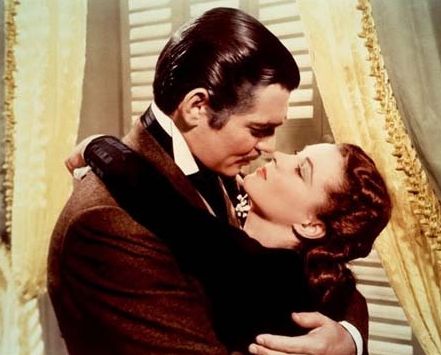
Vivien Leigh with Clark Gable in Gone With the Wind> (1939)

Today being the 100th anniversary of the birth of Vivien Leigh, it's not surprising that TCM is spending 24 hours, more or less, showing her films. (Unlike most 24-hour tributes, it's starting mid-morning because the Story of Film selections run long and going into mid-morning Wednesday.) Leigh of course won two Best Actress Oscars, and both of those movies show up in prime time. The first Oscar was for Gone With the Wind, which is on at 10:15 PM, so at a good time for folks out on the west coast. Not that I was going to be watching it anyway. It's a spectacle, but there are other movies I considerably prefer. And in general, most movies that run over two and a half hours could do with some paring down. Anyhow, the second Oscar was for A Streetcar Named Desire, which starts prime time at 8:00 PM. It's another movie I find a bit of a slog, because Tennessee Williams can be over the top, and I am not the biggest fan of Marlon Brando.

A couple of the movies airing in the next 24 hours are ones I've blogged about before, but which aren't available for purchase from the TCM Shop:

Fire Over England, at 4:00 PM, sees Leigh as a lady-in-waiting to English Queen Elizabeth I (Flora Robson), although the actual star of the movie is Leigh's future husband Laurence Olivier.

I mentioned the wonderful comedy Storm in a Tecaup back in August; that's airing overnight at 2:15 AM and has Leigh paired with Rex Harrison. Leigh plays the daughter of the provost of a Scottish village; Harrison a journalist from London who writes an exposé on the Provost.

Dark Journey (5:45 AM) is one that I'm pretty certain I saw back when Vivien Leigh was Star of the Month on TCM. It's a World War I-set movie that has Leigh and Conrad Veidt getting involved with spying in neutral Stockholm. It's one that probably deserves another viewing.

As for movies I've blogged about before that are on DVD at the TCM Shop, Leigh is in another costume drama as That Hamilton Woman, at 5:45 PM. Leigh's 24-hour salute concludes with Caesar and Cleopatra, tomorrow morning at 7:15 AM.

Friday, August 30, 2013

Storm in a Teacup

TCM's annual Summer Under the Stars concludes tomorrow with a day of movies starring Rex Harrison. You've probably seen the Word of Mouth piece in which Andrew Lloyd Webber gushes about My Fair Lady, but I'd rather mention a movie from much earlier in Harrison's career: Storm in a Teacup, which is airing at 7:45 AM tomorrow.

Harrison plays Frank Burdon, a reporter from England who's going up to Scotland to work for a newspaper there and write some stories about the Scottish political situation. On the ferry to the small, isolated Scottish town of Baikie, he has a chance meeting with Victoria Gow (Vivien Leigh). As you can guess from such a chance meeting, the two characters are going to have a more significant interaction later in the film; since it's a meeting between a man and a woman, you wouldn't be far off if you guess that there's also going to be romance involved, with some complications along the way. Some of those problems come about because Victoria is the daughter of the local Provost (roughly equivalent to a Mayor, played by Cecil Parker).

Frank gets a story almost as soon as he steps off the ferry. Popular resident Mrs. Hegarty (Sara Allgood, a veteran character actress on both sides of the Atlantic in the 1930s) has had her dog caught by animal control. Unfortunately, Hegarty isn't able to pay the license fee for her dog. And since this isn't the first time it's happened, the Provost is insistent that Hegarty be punished. The really bad thing is that the punishment involves confiscation of her dog, with the dog eventually to be put down. Frank has a great human interest story to write about.

Needless to say, this makes things difficult for Frank, Victoria, and the Provost. Frank hadn't intended to do aything particularly antagonistic toward the Provost, but he's got a good story, and there isn't any way he's going to let a good story get away. Once Frank discovers that Victoria is the Provost's daughter, and she discovers that he's the reporter writing scandalous things about her father, it understandably puts a crimp in their relationship. And as for the Provost, he has ideas of higher office; the Scottish National Party wants to run him for a seat in the House of Commons in an upcoming by-election. But siding against Hegarty and her beloved dog is a sure-fire electoral loser. He should have tried stealing candy from babies instead.

Storm in a Teacup has the feel of something Frank Capra might have directed, if he'd emigrated to the UK instead of the US. There's a good mix of comedy and drama, with a plot that very obviously places our sympathies with the little guy. Ah, but what a story! The romance between Frank and Victoria may be a bit predictable, but the dog story is the dominant and more interesting story. Even if you know it's got to have a happy ending, the way there is still well worth the watch. It doesn't hurt that all of the actors -- both human and canine -- turn in appealing performances. Storm in a Teacup is a winner on all levels.

Storm in a Teacup has received a DVD release, but I don't think it's currently in print.

Wednesday, April 17, 2013

That Hamilton Woman

Apparently, I've never bloged about That Hamilton Woman before, although I thought I had. It's airing again tonight at 8:00 PM on TCM as part of the third week of films for Laurence Olivier's time as Ster of the Month.

That Hamilton woman, as the title refers to her, is Lady Emma Hamilton, played by Vivien Leigh. However, when we first see her at the start of the film she's decidedly not a lady. Indeed, she's stealing to live, and is put into prison for it. She meets another female prisoner, which gives Hamilton the chance to tell her story in flashback, because that's such a highly original film technique. Anyhow, we flash back a couple of decades, to Naples in the 1780s. Emma is better off than she was as a prisoner, but not of a particularly wealthy family. She and her mother are going to Naples at the insistence of her lover, Charles, who is the nephew of Lord Hamilton, the British ambassador to Naples (played by Alan Mowbray). It turns out that Charles was sending her away in order to pay off some debts, and never had any intention of marrying her. So what's a woman stranded in Naples to do? Why not marry the ambassador? He needs a wife and she needs money, so it's a match made, if not in heaven, then at least in the land of convenience.

Into all this walks Horatio Nelson (Laurence Olivier). He's in Naples trying to get support from the Kingdom of Naples (remember, Italy wasn't unified until 1870) -- since the previous events, there's been a revolution in France, and now France and Britain are at war. Admiral Nelson meets Lady Hamilton, and as you can guess they hit it off as a sort of friends, especially because she's got a bit of influence with the Queen of Naples. Granted, he's already married back in Britain (and don't forget that Lady Hamilton is still married too), but then Nelson and Hamilton are only friends, right? Sure. Five more years pass, and Nelson returns to Naples, which by now is no longer receiving British warships. So Lady Hamilton goes out to Nelson's anchored ship, and this time, they fall in love. Now there are big problems, especially when Lady Nelson asks why the hell she should get a divorce and lose her position in society just so her husband can run off with this floozy. Who can blame her, even if we're supposed to look at her as the bad one because Lord Nelson and Lady Hamilton are supposed to be tragic figures.

I don't know if I'd call it a problem with That Hamilton Woman, but one thing about movies with historical figures as the leads is that we already know from history when and how they die -- and even if you didn't know history, you know that Lady Hamilton is going to wind up poor since the story is being told in flashback. In the case of Lord Nelson, that death of course comes at the Battle of Trafalgar in 1805. His ships defeated the French fleet, but at the cost of his life. Lord Hamilton had already died, disinheriting Emma along the way, and Lord Nelson couldn't exactly leave anything to her in his will.

I cannot deny that That Hamilton Woman is a very well-made movie with a good cast and fine production values. I have to admit, however, that it's always left me a bit cold. That probably has a lot to do with the casting of Olivier and Leigh, and a bit with the melodramatic nature of the story. I have never particularly been a fan of Vivien Leigh, for reasons that I can't quite verbalize. But there's something about her performances for which I don't really care. Olivier isn't a favorite of mine, either, although I don't have quite the feelings about him that I do about Leigh. There are more of his performances that I like, such as next week's The Entertainer. That having been said, anybody who's a fan of Olivier, or especially of Leigh, is probably going to love this one.

That Hamilton Woman has received a DVD release, although it's courtesy of the Criterion collection, which means it's a bit more pricey.

Saturday, November 19, 2011

Fire Over England

I briefly mentioned the movie Fire Over England back in March on the birth anniversary of Flora Robson, who ably plays Queen Elizabeth I of England in the film. It's airing tomorrow morning at 7:30 AM on TCM, and is an excellent example of a British historical film.

The year is 1587, a year before Spain was to attack England with the Spanish Armada. Spain was the undisputed power of the sea at the time, and England was somewhat of a backwater. Instead of a normal navy, England gained its wealth through the use of what they would call privateers, but what any other country would understandably call pirates. During one of these engagements, young Englishman Michael Ingolsby (Laurence Olivier) and his father get taken prisoner. The Spanish commander has pity on them and lets Michael stay at his estate, but the father eventually gets tried and executed by the Inquisition. Michael escapes to England, where he meets his Queen who discovers that she can put him to use. Apparently, there's a ring of spies among her court, who are sending secrets to Spain where there are some English expat fifth columnists. (Remember that this was only about 50 years after Henry VIII broke from the Catholic Church, so religious differences made it natural that England's Catholics would head to someplace like Spain to fight for the Catholic cause.)

Michael's task is to go to Spain and pretend to be the head of the English spies so that he can get in good with the Spanish court. There's one problem: Michael had been to spain before, and when he was captured, he was nursed back to health by the daughter of the commander who captured him. She's now the wife of one of the members of the court, so she recognizes him. Thankfully, though, she has to help him get away eventually, as otherwise it will be discovered that she had spent a bunch of time helping a foreign agent. By this time, the plot to build the Spanish Armada is on, and only Michael can stop the Armada....

Fire Over England is actually quite a good movie, although I think at times there's a bit much going on. The one thing I haven't mentioned yet is the obligatory romantic subplot, which involves one of Elizabeth's ladies-in-waiting (Vivien Leigh) and Olivier. In real life, they fell in love making this movie, and eventually got married. There are quite a few famous names in the cast. James Mason plays the spy in Elizabeth's court who gets discovered and whose place Olivier takes, while Raymond Massey plays Philip II of Spain. The production values are also quite good. All in all, Fire Over England is one that's well worth watching.