Today saw the opening ceremony for the Beijing Olympics. I'm not all that interested in the Olympics myself, but I figured it would be a good time to recommend a movie set against the backdrop of the Olympic Games: Walk, Don't Run.
This is well known for being Cary Grant's last movie, and in it, he stars as William Rutland, an English businessman in Tokyo for a business deal on the eve of the 1964 Olympics. Because of the Olympics, all the hotels are booked, and since Rutland arrived in Tokyo a few days earlier than planned, there are no hotel rooms available for him until his original reservation. So, he goes to the British Embassy, and finds a classified ad from a British expat willing to sublet half of an apartment. Rutland takes up that offer, only to find that it's been made by a woman -- Christine Easton (played by lovely Samantha Eggar). Worse, it turns out that she's engaged -- to a man who works at the British Embassy, Julian Haversack, whom Rutland knows because he was treated rather officiously by Haversack when looking for a place to stay.
Rutland, having some time to kill before his hotel room becomes available, decides to see a bit of Tokyo with his Japanese business associates. While at their factory, he meets, Steve Davis (played by Jim Hutton), a young American who has arrived a few days early for the Olympics himself -- he's in one of the events, although there's a running joke about exactly which event it is, not being revealed until the plot demands it. Having arrived early, he finds that the Olympic Village is not yet open, and so he too has no place to stay. You can guess what happens next: Rutland (who, it turns out, had an American mother), offers his American friend half of the half of the apartment that he's subletting -- without, of course, telling Miss Easton about it. Hilarity ensues. More hilarity ensues when Rutland realizes almost immediately that Steve is much better-suited for Christine than Julius, and sets about playing cupid for his two flatmates.
Walk, Don't Run isn't Cary Grant's best movie, but it's more than enjoyable. Grant is fine, but it's nice to see that the real couple here -- Jim Hutton and Samantha Eggar -- have excellent screen chemistry together. Eggar's fiancé Julian is played by John Standing, who is perfect as the stereotypically stuffy Brit. The other huge plus is that much of the movie was filmed on location in Japan, and it's wonderful to have a color record of Tokyo as it was in the mid-1960s. One other face to watch for is that of a police desk sergeant who interrogates everybody near the end of the movie. That's George Takei, who would soon go on to play Lt. Sulu in Star Trek.
It's fairly well-known that Walk, Don't Run is a remake of the 1943 movie The More The Merrier, which is also available on DVD. I wouldn't say that one is better than another; each of that has its own superiorities, and to compare the two would take an entire blog post. The result, however, is that they're both well-worth watching, either by themselves, or together. The tagline of Walk, Don't Run was "Run -- don't walk -- to see Walk, Don't Run!" Paraphrasing that, I can enthusiastically say, "Run -- don't walk -- to rent Walk, Don't Run!"
Friday, August 8, 2008
The Olympics
Posted by
Ted S. (Just a Cineast)
at
4:11 PM
0
comments
Labels: Cary Grant
Thursday, August 7, 2008
Nicholas Ray, 1911-1979
August 7 marks the birth anniversary of director Nicholas Ray. In his honor, our movie for today will be his 1952 movie On Dangerous Ground.
Robert Ryan stars as a policeman in the big city. The only thing is, he's nearing the end of his rope, and as a result, he gets a bit violent with the suspects. His bosses finally get so sick and tired of this that they tell him it's in his own best interests that he go up to the mountains for a spell, where he immediately gets involved in a murder investigation. One of the first people he meets is Ward Bond, who is the father of the murder victim, and as such is just about as angry as Ryan, albeit for different reasons. The two, as part of their investigation, eventually end up at the isolated farmhouse of one Ida Lupino. They quickly discover that she's blind, which means that she must have somebody helping her around -- and it seems fairly clear to them that this person, Lupino's brother, is a good bet to be the murderer.
You can probably guess the conflict. The father is out for blood and would be perfectly happy to kill the young man, who is of course in hiding. Ryan can't allow this to happen, partly for professional reasons, since it's bad enough that his violent temper has already gotten him sent out of his normal job. There's also the practical consideration that they're going to need Lupino's help to find the killer -- and the requisite element of romance. While Ward Bond has been too busy being blinded by rage, Robert Ryan has been looking at Lupino and seeing her inner beauty. All this leads to the climax of the two men eventually finding the killer, with the requisite suspense of finding out which of the two is effectively going to get his way.
In some ways, On Dangerous Ground is like two movies in one, in that there's a hard-boiled police drama at the start, and an almost melodramatic thriller in the second half. But Ray's direction, combined with some fine black-and-white cinematography in the mountain scenes, help put to rest any idea that this might be a flaw. It's helped by the fact that Ryan is able to play both sides of his policeman well. Ida Lupino is superb as the blind woman, while Ward Bond is more than adequate as the enraged father of the murder victim.
On Dangerous Ground was a fairly low-budget movie, and was largely forgotten at the time of its release. It took half a century before it got a second look by the critics, who now tend to rate it even more highly than I do. (Not that I don't like it; it's more that if I give it a 9 on a scale of 1 to 10, the critics and auteur-types of today give it an 11.) It's available on DVD, too, so you don't have to wait for TCM to show it.
Posted by
Ted S. (Just a Cineast)
at
3:42 PM
0
comments
Labels: noir, Robert Ryan
Wednesday, August 6, 2008
The postman rings
TCM's Summer Under the Stars continues today with 24 hours of movies dedicated to Anne Bancroft. I've mentioned Nightfall before, and that's already aired, but it's not out on DVD. TCM don't have the rights to too many films from 20th Century-Fox, so one of the Bancroft movies they couldn't air is Don't Bother to Knock.
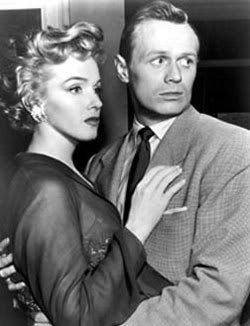
Bancroft isn't really the star; that honor falls to Marilyn Monroe. She plays a baby sitter for a New York hotel who, as we'll eventually see, has a dark past. The male lead is Richard Widmark, who plays an airline pilot who stays in this particular hotel whenever he's in New York. He's got some problems in his life, in that he's carrying on a relationship with Bancroft, who plays the hotel lounge act, but the relationship is quickly going south. So, Widmark looks out his hotel window, sees the lovely Monroe in the room on the other side of the courtyard, and calls her room. He probably shouldn't have.
Poor Richard Widmark soon discovers that Monroe has a screw loose. She only came to the big city to get away from the small town where she grew up: she had married a pilot who fought in World War II, and was killed in action; this caused her to suffer a nervous breakdown and slit her wrists. Her parents put her in an asylum, but after she was released, she went to New York because her uncle lives there; he (played by Elisha Cook) got Monroe the baby-sitting job. However, she's still mentally fragile, and loses it, eventually taking the kid she's supposed to be watching hostage.
Don't Bother to Knock is very atypical work for Marilyn Monroe. She's pretty good at it, although not quite great. It was still early in her career when she made this movie, and if she had decided to try her hand at more serious dramas, she probably could have improved a good deal as a dramatic actress; I think she's even better in Niagara. Part of the problem, though, is that this isn't an easy role to play, and it's quite easy to veer into the maudlin or the parodic when trying to play mentally unstable characters. Widmark is fine, although the script doesn't call for anybody other than Monroe to do too much. Bancroft's role is small enough that there's nothing to be critical about.
The "spot the character actor" game is as fun as always. Jim Backus plays the father of the girl being baby-sat, while the aforementioned Elisha Cook is not only Monroe's uncle, but an elevator operator at the hotel. (An interesting bit of trivia is that he had also played an elevator operator 11 years earlier in Love Crazy.)
Don't Bother to Knock is available on DVD, and is well worth a viewing. Even if it's not a truly great movie, it's interesting to see three talented actors early in their careers.
Posted by
Ted S. (Just a Cineast)
at
2:38 PM
0
comments
Labels: Anne Bancroft, Fox, Marilyn Monre
Tuesday, August 5, 2008
Chick flicks
TCM's offering for tonight is Now, Voyager, which probably contains Bette Davis at her most obnoxiously over-the-top characterization. I've commented on Davis' hamming before, and how fun it is to see, but the bigger problem with Now, Voyager is that it's one of those movies that scream "Chick flick!" and won't shut the hell up. It's usually presented as this great love story, but I can't help but think of Davis' character as pathetically weak, even after spending time at Claude Rains' sanitarium. There's the famous scene in which Davis starts blubbering in Paul Henried's arms, and telling him that "these are only the tears of an old maid's gratitude for the crumbs" he's offering her. Every time I try to watch Now, Voyager, I want to smack Davis at that point.
It might have something to with the fact that I'm a man. Come to think of it, there are a lot of treacly love stories that make me want to retch. (And then there are those, like The Great Lie, which I don't even think of as love stories.) Perhaps the worse of these is Random Harvest, in which Ronald Colman plays an amnesiac World War I vet falls in love with Greer Garson, hits his head and develops a case of reverse amnesia in that he can remember everything that happened before his first case of amnesia, but nothing that happened after it. And you thought Hollywood only had good ideas back in the day.
Then there are the "drawing room" movies of the early days of the talking picture. One example that aired yesterday is 1930's Let Us Be Gay, in which a large portion of the action takes place in and around the same mansion. These seem to me to fit in better with the sensibilities of today's women than they do with the sensibilities of today's men. Sadly, most of the examples I can think of off hand aren't available on DVD. It's probably because these movies play out like filmed versions of stage plays, and seem terribly stilted nowadays.
It could be worse, though: I actually sat through an airing of An Unmarried Woman once so that I could comment on it for another site. I have absolutely no desire to hear Jill Clayburgh talking about getting her first period, thank you very much.
Posted by
Ted S. (Just a Cineast)
at
3:48 PM
0
comments
Monday, August 4, 2008
More Marie Dressler
Marie Dressler was a wonderful actress, and I could go on and on about her movies. Perhaps the best of the movies she was in is Dinner At Eight, which is on TCM tonight at 8:00 PM ET, but I'm not going to blog about that right now because it's available on DVD. (I'll only say to watch Dressler at the end as everybody is getting ready to walk into the dining room.) Instead, I'd like to recommend the movie which won her an Oscar, but which is not available on DVD: Min and Bill, which follows Dinner at Eight at 10:00 PM ET.
Dressler stars as Min, the proprietress of a rooming house at the docks for the fishermen. She's got a thing for Bill, one of the fishermen (played by Wallace Beery, seen in the photo at left), although it's the kind of relationship that by the 1980s would have been labelled with a buzzword like "co-dependent". The dockside life is one of hard work and relatively little money, and is definitely not the place for children. However, Min has a girl, Nancy, she's looking after; one who was abandoned by her mother as a baby (played by Dorothy Jordan). Min wants to do the right thing for Nancy, but at the same time doesn't want the state to take the Nancy from her. They do, however, and send her to a boarding school, where she begins to make good.
Alas, everybody's relatively happy lives are about to come to an end. Although Min has been telling Nancy that her mother is dead, the mother (Marjorie Rambeau) learns not only that Nancy is still alive, but that she's about to marry into wealth. No dummy her, she wants in on that wealth. So one day, she walks straight into Min's place and tries to get Min to tell her the truth about Nancy.
Min and Bill is a fabulous little movie. With a running time of only 66 minutes, it hits all the emotions, with some comedy, some drama, some melodrama, and some heartbreaking moments. Marie Dressler is outstanding as the woman who sadly realizes that she's going to have to make some terrible sacrifices in order to do the right thing for her girl. Despite being singularly unglamorous in a town like Hollywood that's promoted beauty almost to a cult, Dressler defeated much more glamorous nominees like Norma Shearer, Marlene Dietrich, and Irene Dunne. She deserved the award, too, and it's a good thing that Min and Bill won one of the big Oscars, or else it would probably be completely forgotten, instead of just terribly overlooked.
Wallace Beery was also nominated for an Oscar, and he too does a fine job. He's the right fit physically to play Bill, a somewhat rough and hulking, but also charming man. Berry and Dressler seem like they make a believable couple, too. Their popularity resulted in their making several movies together, including Dinner at Eight, although the two don't have too many scenes together in it. One interesting thing is to note how respected Dressler and Beery were in that they were promoted more than most of the rest of the cast of Dinner at Eight (which includes Jean Harlow and two of the Barrymores). In the little-seen Should Ladies Behave, which like Dinner at Eight was made at MGM in 1933, there's a scene about ten minutes in in which some of the characters step out onto a terrace during an intermission of a Broadway show. In the background is a very obvious product placement: Wallace Beery and Marie Dressler in Dinner at Eight.
Posted by
Ted S. (Just a Cineast)
at
5:04 PM
0
comments
Labels: Marie Dressler, Wallace Beery
Sunday, August 3, 2008
Gregory Peck talks!
A quick heads up on something airing during TCM's day of Gregory Peck movies: A Conversation with Gregory Peck, airing at midnight ET tonight (that's 11:00 PM tonight in the Central Time Zone and 9:00 PM out in California).
This 1999 movie is a behind the scenes look at Peck who, as an elderly man, is now making the rounds of speaking engagements, answering questions about his life and career from his devoted fans. If this were just that, a movie along the lines of one of Robert Osborne's Private Screenings interviews, it would be a nice document to have. But there's more to it. We also get a nice look at his family life including his wife of many years, Véronique (they met in Paris when he was on his way to make Roman Holiday), and his pregnant daughter. It's a nice, warm look at a fine actor. It's apparently a bonus feature on one of the DVD editions of To Kill a Mockingbird, but IMDb don't give a link to Amazon to buy it.
Posted by
Ted S. (Just a Cineast)
at
3:50 PM
0
comments
Labels: Gregory Peck
The Hollywood Revue
As part of Marie Dressler's day in TCM's Summer Under the Stars, TCM are showing a remarkable early talkie: The Hollywood Revue of 1929, Monday at 6:15 AM ET. The title is accurate; this is little more than a revue and has no plot. The year 1929 was, of course, a little more than a year after The Jazz Singer became the first talking feature-length movie (although it wasn't completely talking, as sound was only used for several musical numbers); studios were worried about how to make the transition to sound pictures. As a result, MGM decided to give a substantial number of its stars a sort of screen test by putting them in an actual talking picture, but one which wouldn't be too taxing. Thus was The Hollywood Revue born.
Jack Benny and Conrad Nagel serve as the masters of ceremonies, introducing what was essentially a series of vaudeville-style acts mixed in between performances from the main MGM actors. Benny is quite good here, doing what was essentially the same material that would make him popular on radio, and then on television, for the next 30 years. Two notable scenes of his to watch for involve his attempt to play the violin, and a primitive special effects sequence in which he pulls actress Bessie Love out of his pocket. Other MGM stars include Joan Crawford hoofing it; Norma Shearer doing Romeo and Juliet with John Gilbert; Laurel and Hardy doing a comedy bit; and the aforementioned Marie Dressler amongst those who try to sing, some with more success than others. Amongst the few MGM stars not showing up is Greta Garbo, who was apparently still taking elocution lessons, and wouldn't talk on screen for another year, until Anna Christie. (Note that Marie Dressler is also in the cast of Anna Christie, which TCM are showing at 12:30 AM ET Tuesday.)
It would be unfair to judge the "serious" actors on their singing abilities; after all, one didn't need to be able to sing in order to act. However, there are also acts here that aren't very funny -- and frankly, I wonder whether the audiences of the late 1920s would have found them funny. One notable such act involves several women trying to play broken musical instruments.
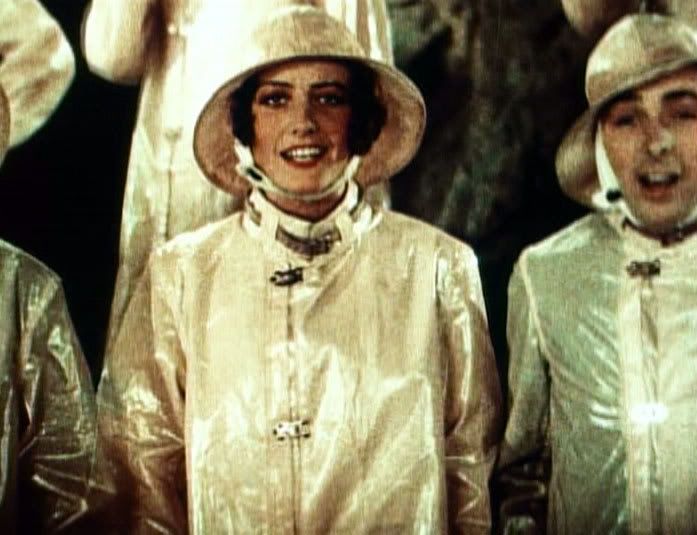
The most interesting number comes at the end, however. There are two sequences in two-strip Technicolor that comprise the movie's finale; the first being the song "Orange Blossom Time", the second is the entire cast getting together and singing "Singin' In the Rain". The Hollywood Revue is the movie that premiered the song "Singin' In the Rain", and it actually shows up twice in the movie. The finale is more interesting, however, because of the Technicolor and because all of the cast shows up. They're all wearing yellow raincoats, and that's not a bad thing, as yellow is one of the colors two-strip Technicolor displayed reasonably well.
Posted by
Ted S. (Just a Cineast)
at
3:36 PM
0
comments
Labels: Early Color
Saturday, August 2, 2008
Harold Lloyd is underrated
TCM's "Summer Under the Stars" salute for August 2 is Charlie Chaplin. It's probably heretical to say this, but I think Chaplin is overrated. Sure, many of his earlier movies are inventive, as is the case with much of went on in silent cinema, but later on, he got tedious. Watch, for example, the scene in The Great Dictator where Chaplin plays with the globe. It's not funny, and I can't help but wish it would end -- much like the entire movie. When the AFI released its 2007 list of the Top 100 American Movies, three of Chaplin's movies were on the list, with City Lights all the way up at #11.
Buster Keaton finally got a mention in the 2007 list; The General was #18. Keaton was snubbed in the 1998 list, while Chaplin has multiple entries in both lists. The bigger surprise, however, is that Harold Lloyd is absent from both lists.
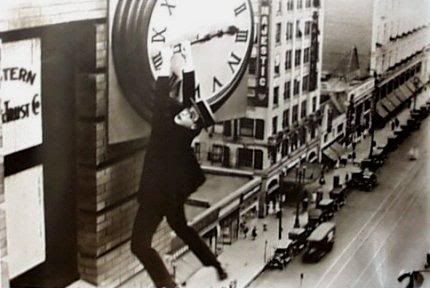
Lloyd is, of course, best known for Safety Last!, the comedy in which Lloyd, in trying to make good in the big city so that he can bring his girlfriend to live with him, gets roped into climbing up the side of a building to make $500. Even though everybody knows about the iconic image of Lloyd dangling from the hands of a clock, this is by far not the only good part of Safety Last!. Other things to watch out for include a very clever sight gag about Lloyd and his roomate dodging the rent, and an extended sequence of Lloyd trying to deal with competetive women in his job at a department store.
Lloyd's general character was as a bright, earnest, eternally optimistic man; a role that he certainly was playing in Safety Last!. But it's not just there that he would play it; another of his great roles is as
The Freshman. Here, 32-year-old Harold Lloyd plays a young man going off to college who will do anything to fit in, and eventually becomes the waterboy for the football team. Of course, this being a comedy, things go wrong for the team, eventually requiring the coach to put Lloyd in the game. Lloyd, of course, saves the day in another very clever, very comedic sequence, and gets the girl (Jobyna Ralston, seen in the picture above with Lloyd).
Both of these, and many other Harold Lloyd movies, are available on DVD.
Posted by
Ted S. (Just a Cineast)
at
2:39 PM
0
comments
Labels: Harold Lloyd, Silent
Friday, August 1, 2008
Summer Under the Stars
Today begins TCM's annual August feature, Summer Under the Stars, in which each day is devoted to 24 hours of movies wiht one particular person in the cast. The star for August 1 is Michael Caine; perhaps the best-known of his movies showing up on TCM is Alfie, which airs at 10:30 PM ET.
In my experience, a lot of people on the TCM message boards complain about Summer Under the Stars, and any time somebody starts a new thread about it, you can be certain that one of the results is going to be people posting about which obscure stars ought to have their own days devoted to them. However, I find myself very much of two minds about this.
I believe I've made my feelings fairly clear during the six months I've been blogging that I'm a fan of the character actors. I think they add a lot to the movies of the studio era. I personally believe that a channel like TCM could use the character actors as a good way to repackage the material in their libraries. Sure, we've all seen Casablanca before, and it's a wonderful movie. How many people recall that John Qualen was in it? As I myself admitted when I blogged on Our Daily Bread, I couldn't recall Qualen's appearance. Having seen Casablanca since posting on Our Daily Bread, I can now point out that Qualen is the man who approaches Victor Laszlo and shows him the signet ring. By the same token, who here remembers Spring Byington in Mutiny on the Bounty? (She plays Franchot Tone's mother.) The point is that character actors can be a good way to introduce films to everybody: the more prominent films can be aired during the prime time hours when TCM might want to try to attract new people to the channel, while lesser-known movies can be screened during the other hours for those of us who think we already know more about the movies.
But as for Summer Under the Stars, should TCM focus only on the character actors? I'm not so certain. As I've commented with TCM's series for families, Essentials, Jr., I think that to lure new viewers, one has to spend some time showing the "all-time" classics like a Casablanca that those of us passionate to comment on blogs about the movies have seen a dozen times, but which are amongst the smaller group of movies that the average person is more likely to have heard of. By the same token, TCM has to spend at least some of its time with Summer Under the Stars celebrating the more famous people.
Posted by
Ted S. (Just a Cineast)
at
9:56 AM
0
comments
A Blueprint For Murder
Today's movie is the 1953 Fox mystery/suspense film A Blueprint for Murder, airing at 2:30 PM ET on the Fox Movie Channel.
Joseph Cotten stars as Cam Cameron, a businessman who is shaken by the deaths of his brother and his niece. He returns home to visit the family, and quickly comes to the conclusion that his sister-in-law (played by Jean Peters) may have murdered them! Worse, he gets the distinct suspicion that she's also trying to kill his nephew, in order that she can get his inheritance. Matters continue to escalate when she suddenly decides to take her step-son on a cruise to Europe, away from the prying eyes of the now suspsicious Cameron. Is she guilty, or not? Well, that's what we'll find out after the climax of the movie.
Joseph Cotten was good at movies like this, especially when he was playing the bad guy. Unfortunately, however, A Blueprint For Murder falls short. It seems as if they spent quite a bit of the budget getting a good cast; in addition to Cotten and Peters, Gary Merrill plays Cameron's lawyer who prods Cameron into investigating matters further. Having spent this money on the cast, however, the producers apparently had little left over to come up with a good plot.
The movie is OK, but not much more. However, it was eventually released on DVD, allowing more people to judge for themselves.
Posted by
Ted S. (Just a Cineast)
at
9:43 AM
0
comments