Showing posts with label Charlton Heston. Show all posts

Saturday, April 19, 2025

Oh, tomorrow is Easter

Tomorrow, April 20, is Easter Sunday, at least for those who follow western strands of Christianity. There's a set of Hollywood films dealing with the biblical tellings of Jesus' crucifixion and resurrection that seem to get trotted out every year, one of which is the 1959 sound version of Ben-Hur, which kicks the day off at 6:00 AM.

This version of the story runs something like 3½ hours, depending on how you want to count the overture and intermission. Judah Ben-Hur (Charlton Heston) is a reasonably well-off man in Jersualem during the era when Pontius Pilate was the Roman governor and that famous carpenter was roaming around Judea preaching the gospel. He lives with his mom and sister, as well as servant to whose daughter Esther (Haya Harareet) Judah has been betrothed. Judah learns that his childhood friend and Roman citizen Messala (Stephen Boyd) is coming back to Judea. Unfortunately, Messala wants to exploit his friendship with Judah to get Judah to betray rebellious Jews, which Judah refuses to do, knowing fully well this will mean trouble should things go any more sour.

Of course they will, as a good 50 minutes into the movie the Romans are parading past Judah's villa when his sister knocks a roofing tile off, falling just inches from the governor. That's unforgivable, so Messala makes Judah a galley slave and imprisons Mom and sister, who eventually get leprosy, although that story line is at least another 90 minutes away. Judah is put on the ship captained by consul Quintus Arrius (Jack Hawkins), eventually saves Arrius' life, and gets freed and made Arrius' adopted son as a result, enabling him to go back to Judea to look for his family. Esther, rather than telling Judah his mom and sister are lepers, tells him they died, which leads Judah to seek vengeance on Messala.

That desire for vengeance is why Judah finally decides to take part in the famous chariot race, which we know he'll win, and spend the last 50 minutes or so looking for Mom and Sis since Messala tells him the truth. Along the way at several key points, Jesus shows up, filmed only from the back, and has a profound effect on the various characters in the story, including ultimately Judah.

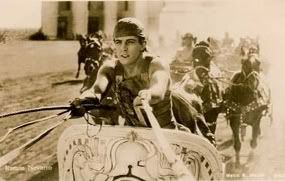
I said at the beginning that this version runs long, and I do mean long. It's a good hour longer than the Ramon Novarro silent, as I mentioned in a brief post in 2013. I stand by the comments I made in that post. The 1959 version of Ben-Hur won a ton of Oscars, and the technical categories it won are probably mostly deserved, since I can't really be bothered to look through the entire list of Oscar nominations to determine whether some other movie had better costume design. The music, art direction, cinematography, and all that stuff are indeed of a very high standard.

But the acting and screenplay? I think they take a back seat to the much tighter Novarro version. A lot of the scenes feel like they go on way too long, notably for me being the time between being sentenced to the galleys to actually winding up rowing a boat. And then there's Best Supporting Actor Oscar for Hugh Griffith playing an Arab sheik and the financial backer of Judah in the chariot race. I'm surprised I didn't come across a bunch of modern reviews arguing he was a bad stereotype.

My criticisms aside, Ben-Hur is considered an epic, and for understandable reasons. Becuase of that, it's one that should definitely be on any film buff's list of "Essentials", even if you only watch it once.

Tuesday, September 17, 2024

Gallant Lucy

TCM had a spotlight some months back on working women. One of the movies they picked that was new to me in spite of the big-name cast was Lucy Gallant. Since the cast sounded interesting, I decided to record the movie and recently got around to watching it.

The movie, which was released in 1955, opens up after the opening credits with a title card reading "Texas, 1941". Now, you might guess that this means the US is about to be pushed into World War II with the Japanese attack on Pearl Harbor and that this is important for the plot of the movie. You'll be half right. War does come and a main male character does fight, but the movie isn't really a war movie, which you also might have guessed considering the movie was on TCM for a "women at work" spotlight.

Specifically, the movie takes place in a place called White Sage Junction, TX, the sort of place that in a western would be a cattle town. And it was at one time. But showing up at the whistle-stop train station is cattleman Casey Cole (Charlton Heston). He's there mostly to complain to the stationmaster (Jay Adler in a bit part) about how oil has been discovered and that with this, everybody else has switched from ranching to drilling for oil or otherwise servicing the people who drill for oil. They are, however, interrupted by an emergency dispatch over the telegraph informing the stationmaster that the bridge ahead is out due to a rainstorm.

Of course, there's a train coming that has to stop suddenly. On that train is the titular Lucy Gallant (Jane Wyman). She was on her way to Mexico after her wedding was called off, and she's got her entire trousseau with her. Casey helps her off the train, and eventually takes her to a house in town where Casey stays from time to time, owned by his friend Mrs. Basserman (Thelma Ritter). It doesn't take much to figure out the two are going to fall in love.

Meanwhile, Lucy being a jilted bride (there's a back story about her dad's financial issues leading to his suicide and her unseen fiancé not wanting any part of Lucy thereafter) from New York, she's got a lot of fancy clothes with her. And when she wears them in town, all the wives of the men who have suddenly gotten money hitting oil wish they could wear something like what Lucy is wearing. So she gets the brilliant idea to stay in town and open a couturier selling the finest of big-city fashion to the other women. She's going to need capital however, so she takes out a loan from banker Charles Madden (William Demarest), and runs the store out of the building that used to house the house of ill repute, run by a Lady MacBeth (Claire Trevor).

The store becomes a success, but Casey wants to marry Lucy and raise a family, and being nine months pregnant isn't really going to do for a businesswoman. So in Casey's mind, Lucy should sell up shop. Fortunately, however, World War II intervenes. Casey goes off to fight, and after the war gives up cattle for the oil business himself. But the store is still there, and despite Casey's having been engaged during the war, you know that the two still carry torches for one another. Casey just might be able to come to the rescue when Lucy's business winds up in danger....

Lucy Gallant is one of those competently-made movies the studio system churned out one after another back in the day, but to be honest it's not exactly a great movie. I think part of that is that despite having been released in 1955, it really feels stuck in the 1930s with a very antiquated attitude toward married women working. And Casey is a bit of a jerk toward Lucy. Plus, romance isn't exactly Charlton Heston's strong point. There's also the odd presence of an ex-governor of Texas playing himself. On the bright side, Lucy hosts a fashion show and present at that show is Edith Head, playing herself as the host of the show.

So Lucy Gallant is an interesting movie, even if it is a bit of a misfire.

Tuesday, August 6, 2024

The Jewel of Seven Stars

I think I've got one more movie left from Charlton Heston's time as TCM's Star of the Month, and I wanted to make sure I watched it before it ran off the DVR. That movie is The Awakening.

The opening credits thank Egypt and a bunch of organizations in the country, also showing scenes from some part of the Nile well upstream from Cairo. We then get to the action, "Eighteen Years Ago", at an archeologicl dig. The dig is being led by British professor Matthew Corbeck (Charlton Heston), who has brought his wife Anne (Jill Townsend) along with him. She's seven months pregnant, so not exactly well-suited to being in such an archeological camp. But she's got a simmering disagreement with her husband about his neglect for her. Indeed, he seems far more interested in his assistant Jane (Susannah York), who is definitely interested in him.

The two are there with all their assistants because of something Matthew read from a Dutch archeology who was writing a century or more ago. That man, van Horn, heard legends about a mythical Egyptian queen, who like King Tutankhamen, died young. If she existed, the belief is that she would be in the valley where they are, although watercourses change over millennia, so who really knows. One day, Matthew and Jane go out alone farther into the valley, and a rockslide reveals some ancient hieroglphyics that somehow survived. The inscriptions suggest that this is the right place, but with an important caveat: the place is cursed if anybody should violate the grave.

Needless to say, Matthew and Jane don't believe in such curses, so they go ahead with opening up the rock face and seeing what's behind it. As they do, Anne goes into labor back at the camp. Matthew finds Anne in pain back at the camp and rushes her to the hospital, where it's strongly implied the baby is a stillbirth, as they cover it with a sheet and won't show it to Anne. But then Matthew and Jane open up the sarcophagus, and the baby, a little girl, is suddenly revealed not to be dead after all!

That's all enough for Anne to be fed up with Matthew, so she takes their daughter Margaret and goes off to America, divorcing Matthew. We then transfer to the present. Margaret is 18, and Dad would like to see her. Margaret (Stephanie Zimbalist), for her part, is curious to meed Dad, so it's off to London, where Dad has re-married Jane.

At the same time, there's some disturbing news about the mummy that was in the sarcophagus Matthew and Jane opened up 18 years prior. There's the possiblity that bacteria have gotten into the hermetically sealed, climate-controlled case in which the mummy has been places. Also, an eclipse hits, and that causes things to get more crazy with the mummy.

People start dying, and Matthew gets the sinking feeling that perhaps the old queen's curse was accurate and that the queen's soul has entered Margaret's body. Matthew thinks some sort of exorcism might be in order. But at the same time, people around Margaret start dying in all sorts of terrible ways reminiscent of The Omen from a few years earlier. Is Matthew right about the queen taking over Margaret? If so, will he be able to reverse it?

The Awakening is based on a novel by Bram Stoker, who is of course much better remembered for Dracula. Having seen this movie, it's no surprise that Dracula is remembered. The Awakening isn't exactly a bad movie; it's more that it feels like it's not terribly original. There's a lot that reminded me of The Omen, as I mentioned earlier, but also a lot that would have been in any of the other older mummy films.

Still, for fans of horror, The Awakening is worth one watch.

Monday, July 1, 2024

The Mountain Men

I've got a few more Charlton Heston movies to get through from when he was TCM's Star of the Month last October. One that I hadn't heard of before it showed up last year was The Mountain Men.

If you pay attention to the opening credits, you'll see that the screenplay is by one Fraser Clarke Heston, who is in fact the son of Charlton Heston, and that collaboration may have something to do with why the movie got produced at all. Charlton Heston plays Bill Tyler, a trapper in the days when the Oregon trail was only beginning to become a thing with a miniscule number of people going that far west to farm. It was a time when the white man was still badly outnumbered by the various Indian tribes in the region, and for Bill and his friend Henry (Brian Keith), the Indians in question are Blackfoot and Crow.

One day, Cross Otter, a Crow, and a couple of his companions from the tribe go out looking for Henry and Bill, because the Crow claim the white guys stole their horses. The white guys, for their part, say they're only taking back what had been theirs before the Crow took the horses. This somewhat tense meeting is interrupted by some Blackfoot showing up to start an attack on both groups. In the resulting melee, Bill incapacitates a woman, Running Moon.

Running Moon is the wife of the Blackfoot chief Heavy Eagle, although she's none too happy with the marriage, having been sold into marriage. In fact, that's why she was at the melee: she was trying to run away from Heavy Eagle. She wants Bill to help protect her, but he's only willing to take her to the point where he's supposed to meet the people to whom he's selling his pelts. He's had a squaw accompany him before, and he found her too much work. Never mind that in this case, Heavy Eagle is going to be coming after her. But at the same time, she gives the two trappers information about the legend of a valley that's incredibly rich with beaver pelts. Needless to say, Bill and Henry want to find the place.

Heavy Eagle does in fact find the group, but it is not the climax of the movie, as there's a lot more to go. Running Moon gets taken back by Heavy Eagle (or kidnapped, depending on your point of view), and she vows to escape again. Henry, not being the star, gets badly injured in the attack and may or may not die. Bill is going to have to go through a lot more. Who will survive, and who will end up with whom?

I think it's not hard to see why Charlton Heston would be interested in making this movie, and it's not just because the screenplay was written by his son. The potential is easy to see here. However, at the same time I can see why The Mountain Men isn't a very well-known movie. It doesn't feel all that original, and also feels a bit like a boy's fantasy of the thrilling adventures of life in that era must have been like, instead of the incredibly dangerous grind it most likely was. One big plus is the cinematography, having been filmed in part in Yellowstone and the Grand Tetons in Wyoming and the surrounding national forests.

Fans of westerns will probably enjoy The Mountain Men; for people who aren't the biggest fans of westerns I'd introduce them to other parts of the genre first.

Tuesday, May 21, 2024

Eight years before The Hawaiians

Charlton Heston was TCM's Star of the Month some months back, and it gave me the opportunity to record several of his movies that I hadn't seen before. Among them is Diamond Head, which, having been released by Columbia, also shows up from time to time on Cinevault Classics. Recently, I watched it, and now you get the review.

After some nice widescreen and color opening credits showing the beauty of the new state of Hawaii, we cut to a shot of King Howland (Charlton Heston) riding to his large plantation house on a horse. He's met by a local judge to discuss several things, chief among them being the fact that Hawaii is now a state (the movie was released in early 1963 but set just after statehood in 1959), so it gets to send two Senators to Washington. King would be just the person to serve as Senator.

Meanwhile, there's other exposition to be done. Also waiting for King is Laura (Elizabeth Allen), who is King's sister-in-law. King's wife and young son died in a tsunami some years back. King also has a rather younger sister, Sloane (Yvette Mimieux), who is about to come back from college on the mainland. On the ship coming back with her is an old friend of the family, Paul Kahana (James Darren), a native Hawaiian whose mixed-race half-brother Dean (George Chakiris) is a doctor of some renown on the island. Paul tells King that he'd like to have a chat with King.

Indeed, Paul and Sloane have the same thing on their mind: they've fallen in love, and would like to get married. Nowadays, that wouldn't be such a big deal. But in 1959, interracial marriage (never mind that none of the actors playing Kahanas are real-life Pacific Islanders) was something that a lot more people considered scandalous. King is somewhat more progressive than a lot of whites, and while he thinks the local country club shouldn't be closed to ethnic Hawaiians, and no problem being friends with them, mixed marriage is out of the question. Laura is even more bigoted in that regard.

Of course, we eventually learn that King is being a bit of a hypocrite in this regard. Well, a lot of a hypocrite, since he's in a relationship with a Hawaiian woman himself, Mai Chen (France Nuyen, who at least is of Asian descent). King is OK with sleeping with the locals -- and even knocking them up -- but marriage, no sirree. No wonder Sloane and the Kahanas feel so much resentment. As for King, he's worried about the whole matter of race relations and how it might affect his Senate campaign.

Diamond Head is one of those soap opera type potboilers that were a thing in the late 1950s and early 1960s, when movies were still trying to differentiate themselves from TV. One way to do so was with widescreen and lush settings in color, all of which Diamond Head has in spades. As for the plot? Oh dear. The plot twists get increasingly ridiculous, almost as much as Aline MacMahon playing the Kahana matriarch. She's also opposed to interracial marriage, but on the grounds that she sees it as destroying the native culture.

Ultimately, I think Diamond Head is more a product of its time, and a time that was soon to change really radically. Much like The Liberation of L.B. Jones from several years later that I blogged about a couple of months back, it comes across as wanting to be more daring and open-minded, but not really succeeding. Interesting, but certainly not great.

Friday, March 22, 2024

I'm not the only person who thought of The Citadel

The centenary of the birth of actor Charlton Heston was last October, which is why he was named TCM's Star of the month instead of someone who might have a relationship with horror movies, October being the month of Halloween and all that. In any case, this gave me the chance to record a couple of Heston's movies that I hadn't seen before. I recently watched one of them: Bad for Each Other.

Charlton Heston plays Col. Thomas Owen, MD. He graduated from medical school before World War II, and enlisted with that war and wound up serving both through that war and the Korean War. Having been away from his home town of Coalville, PA, for quite some time, he's decided to return following news of the death of his brother. But when he returns, he finds that the locals blame his brother for what happened, since the death was in a coal mine explosion that killed people besides his brother as well. To make matters worse, the locals are perfectly willing to carry that blame over to Tom, even though he had nothing to do with what happened!

Thomas' mother (Mildred Dunnock) doesn't seem too happy that her son left to join the military all those years ago. Thomas, for his part, wanted to escape a town where, like in How Green Was My Valley, it seemed as if the only real source of work was down in the coal mines. He's only back to try to settle any debts his brother might be responsible for, or at least that's what he claims. With that in mind, he wants to see Mr. Reasonover, who owns the mine, to try to find out exactly what happened.

Before that, however, he has an encounter with the local doctor, Dr. Scobee (Rhys Williams). Scobee wants him to look at some of the X-rays from miners who are developing spots on their lungs from all that time spent down in the mines. I didn't realize it while watching, but apparently the movie was made at the time that what we now know of as black lung disease was first really being investigated; at the time they apparently thought silica dust rather than coal dust was causing the damage. Scobee also suggests that Dr. Owen is welcome to join him in his practice, since Scobee is thinking of retiring soon. The only thing is, it's not very rewarding financially.

Dr. Owen eventually finds Reasonover at a party being held at the house of his wealthy daughter, Helen Curtis (Lizabeth Scott), who is currently unmarried after having been through a series of husbands. Reasonover tells Thomas that his brother was actually embezzling money that was supposed to be used for safety equipment. At this point, however, that plotline largely fizzles out in favor of a different one, involving Thomas and Helen. One of the younger female guests at the party winds up in need of a very discreet doctor, and Dr. Owen is there, since they can't get her regular doctor, Dr. Gleeson. Dr. Gleeson is the sort of doctor who makes a ton of money by ministering to hypocondriac wealthy women who really don't have that much of a medical problem for the most part.

Helen then suggests Dr. Owen meet Dr. Gleeson, and perhaps even go into practice with Gleeson. Owen does eventually join the practice, but he hires an idealistic nurse who discovers what the practice is really about and is horrified by it. She's also horrified by the idea that Dr. Owen is falling in love with Helen. And surprisingly, Helen's father is horrified by it as well. Dr. Owen appears to be selling his soul for money. But thanks to the Production Code, something is going to happen to give him a chance to redeem himself....

I mentioned The Citadel in the title of this post. If you remember that movie, Robert Donat plays a British doctor who starts off working for coal miners, but moves to a London clinic for the wealthy only to find that it's destroying his soul. So it's not hard to understand why I'm not the only person who found himself comparing Bad for Each Other to The Citadel. Unfortunately, this is a movie where the script really lets Heston and the rest of the cast down. They try, but the resulting mess isn't really their fault.

As always, however, judge for yourself whether the movie is that bad. Thankfully, it's not overlong, so even if you don't like it it's not as if you've wasted too much of your time.

Saturday, February 17, 2024

Charlton Heston does comedy!

Charlton Heston is the sort of actor that when you think of him, you don't necessarily think of comedy, at least not intentional comedy. But he did do at least one, which TCM showed when Heston was their Star of the Month back in October: The Private War of Major Benson.

Heston plays Maj. Benson, who as the movie opens is commanding a bunch of men in some sort of training exercise. He's a decidedly by-the-books officer, making the men drill the portion they're working on over and over until they get it right. In response, one of the men gives Maj. Benson some choice words. The only thing is, Benson can't really do anything about it, since the words are his own words, that he had said in confidence some time back. Except that those words which weren't supposed to go anywhere wound up in Newsweek magazine for all the world to see.

For that, Benson gets called to Washington, where Maj. Gen. Ramsey (Milburn Stone) is exceedingly displeased. To punish Benson, Ramsey gives him a new assignment. Ramsey knows a school that has a junior ROTC program, except that it's not going very well. It's to the point where if they don't pass their next inspection, they're going to lose their ROTC affiliation, and that's going to drive the parents to pull their boys out of the school, putting it in jeopardy. Perhaps Maj. Benson can make the students pass inspection.

And then Benson gets to the school and finds... it's a Catholic military school, run by Mother Redempta (Nana Bryant), who also happens to be the sister of Maj. Gen. Ramsey, which would explain why he knows about this school and its problems. Also there are the new doctor, Kay Lamber (Julie Adams), who is also clearly there as a love interest to Benson; and John (William Demarest), the school's janitor/handyman since the nuns can't do that stuff themselves; and the boys, ranging in age from high single digits to high school age.

Oh, the boys. At this point the movie becomes a fairly predictable piece in which Maj. Benson is strict in part because that's the only thing he knows, while the boys are partly incompetent and partly rebelling against Benson's authority. It's a bit of a surprising cast of boys, too, considering what they went on to: Sal Mineo, David Janssen, and Tim Considine are among them. Considine plays Cadet Hibler, whose father knows a bunch of people in Washington. When Hibler has had it with Maj. Benson's discipline, he and the other boys write to his parents. They come for the parents' weekend, and, finding what Maj. Benson is like, take it to Washington, which threatens Benson's career in the Army.

Charlton Heston is one of those actors who I think wouldn't have been that adept at most comedy. But The Private War of Major Benson is a lot closer to the sort of movie where he's not being so funny as much as having everyone else around him be funny, as well as having a script structured to take Heston's talents and build the humor around that. The movie turned out to be a commercial success, and I think it's easy to see why. It's the sort of material that's comforting because it's predictable.

The Private War of Major Benson was never going to turn Charlton Heston into a comic actor. But it's a good enough movie that's worth a watch.

Tuesday, October 10, 2023

The Hawaiians

Edited to note: I originally had this post scheduled to run early on October 11, in conjunction with a movie airing in the overnight hours between October 11 and 12. Only later did I notice another movie on my DVR that was getting another airing on TCM in the mid-afternoon hours of October 12, or too early for me to put up a post to go very early on October 12. Given the choice of having multiple feature-length posts per day for the next few days -- there are several more movies on my DVR scheduled to air in the next few days and I have a feeling that Kagemusha isn't getting a full-length post until later considering that it's on DVD and will probbly get at least one more airing on FXM -- or moving posts around, I decided to do the latter. Thus, a post for a movie that's not airing for another 36 hours.

I mentioned last week with the post on Charlton Heston being Star of the Month that there were a couple of his movies I had on the DVR but hadn't blogged about before. The Four Musketeers was one; I didn't notice until after composing that post that TCM was actually starting the salute in the daytime of October 4. The Heston programming only kicks off in prime time on Wednesday (October 11), but includes a movie I hadn't blogged about before, The Hawaiians, overnight at 1:30 AM (October 12 in the Eastern time zone and October 11 in the Pacific). As always, with an airing coming up I made a point of watching it to do a post on in conjunction with the upcoming airing.

I knew that The Hawaiians was based on a novel by James Michener titled Hawaii, and of course knew that Michener's novels are mostly, if not all sprawling. I didn't recall that this is the second movie based on that novel. The first, Hawaii, was made a few years before The Hawaiians and deals with an earlier part of the novel. I haven't read the book or seen the movie Hawaii, but I can say that you don't need to have done so in order to follow the story and characters here.

Heston plays Whip Hoxworth, grandson to the main character of Hawaii and one-quarter Hawaiian. It's probably about 1870 or so (the movie spans close to 30 years and ends sometime after the 1898 annexation of the islands by the US), and Grandpa has just died, so everybody's gathering for the reading of the will. Whip has spent his time at see sailing and transporting Chinese (well, actually Taiwanese Hakka, who are decidedly not Han Chinese) across the Pacific to work as laborers in Hawaii. This has made Whip unpopular in the family, such that his cousins inherited the good stuff and Whip only gets a bunch of unproductive land on an island where getting enough water is going to be tough.

Whip hires a well-driller to try to find water, and amazingly, the guy does, making Heston's plantation salvageable and, with enough work, giving Whip the potential of becoming a wealthy man, even though neither the whites nor the native Hawaiians care much for new money. Meanwhile, at the beginning of the movie, a woman was found among the laborers Whip was transporting, Nyuk Tsin (Tina Chen). She's saved by another laborer, Mun Ki (Mako), claiming she's his wife; Whip's own wife Purity (Geraldine Chaplin) makes Whip take the two on as house servants.

Nyuk Tsin and Mun Ki become trusted advisers to Whip, and both wives have children at close to the same time. Whip and Purity have a boy, Noel (adult Noel played by John Philip Law), while Nyuk and Mun have a daughter. Since this is one of those sprawling stories and the two families spend a lot of time together, you can guess that the two kids wind up falling in love with each other once they reach adulthood and that this is going to be a problem because of the differing racial backgrounds.

Meanwhile, as I said above, Whip having a plantation and water, he needs something to grow. At the time, sugar cane was the big thing, but the old money that hates Whip don't want to help him. So he goes off to French Guiana to smuggle some pineapples out of the territory since they ought to grow well in equally tropical Hawaii. Sure enough they do, and that's how Whip makes his money.

As I said a couple of times, The Hawaiians is one of those would-be epics, so there's a lot more going on here. It's easy enough to follow, and more than adequate entertainment, but it also not the world's greatest movie. The material really feels more like it the screenwriters should have written with the idea of a TV miniseries in mind, where commercials can be put in at the appropriate points. Of course, I don't think that sort of miniseries really took off until Roots later in the 1970s.

Still, The Hawaiians is definitely worth watching, and now is your chance.

Wednesday, October 4, 2023

TCM Star of the Month, October 2023: Charlton Heston

Charlton Heston in Ben-Hur (Oct. 4, 8:00 PM)

Now that we're into a new month, it's time for a new Star of the Month on TCM. This time out, it's Charlton Heston, who was honored quite a few years back. I'm not certain how far back; a search of the blog didn't reveal any previous Star of the Month post like this one for Heston, but then, in the earlier days of the blog I didn't do posts like this for every Star of the Month. In any case, Heston's movies will be airing every Wednesday in prime time on TCM, starting tonight with Heston's Oscar-winning performance in Ben-Hur.

I'll admit that I don't have that many pictures of Heston on my hard drive. One of the obvious ones was of him playing Moses in The Ten Commandments, which I used when Heston died back in 2008. This even though it was always obvious that TCM wouldn't be running The Ten Commandments considering how ABC runs it pretty much every year in the run-up to Easter. I haven't looked in great detail at the line-up of Heston movies, other than to search for ones that are currently in my YouTube TV library in order to watch them and do posts on them. That means in a week's time, you'll be getting a post on The Hawaiians (1:30 AM, Oct. 12, or late in the evening of Oct. 11 in the Pacific time zone).

I figured (correctly) that among the movies that would show is Soylent Green, since it's fairly famous and it's also a late MGM movie; as a result, I looked for a photo of Heston in it, and found a good one of him and Edward G. Robinson, this being Robinson's final role. Soylent Green kicks off the final night of Heston programming, at 8:00 PM on Oct. 25.

Tuesday, October 3, 2023

Four of the musketeers

About six weeks ago, I mentioned the 1970s version of The Three Musketeers, and how because the producers really made too much material, they decided to split the movie into two, even though this would piss of the actors. The second of those movies got the name The Four Musketeers (sometimes also subtitled Milady's Revenge or The Revenge of Milady), and that movie will be on tomorrow (Oct. 4) at 10:30 AM. in honor of Charlton Heston.

If you remember the first movie, as it ended the musketeers had just saved the bacon of Anne (Geraldine Chaplin), the Queen of France, who was haing an illicit relationship with the English Duke of Buckingham (Simon Ward), even though their two countries were at war. Part of that war was religious in nature, and French Protestants were in rebellion in the Breton port of La Rochelle. Cardinal Richelieu (that's Charlton Heston) had figured out that it's the queen's dressmaker Constance (Raquel Welch) who has been passing the message between Anne and Buckingham, well, with help from D'Artagnan (Michael York) who is her boyfriend. So Richelieu orders his men to capture Constance.

Meanwhile Milady de Winter (Faye Dunaway) wants to gain revenge on the musketeers as well, so she goes in with Richelieu by seducing d'Artagnan to get him away from Constance. D'Artagnan can't be bothered to think with his big head, so he takes the bait. D'Artagnan also finds out that Milady has a brand, which was a sentence for a crime she committed. It's also a sign that she had been in a relatonship with Athos (Oliver Reed), but he killed her -- or he thought he did -- when he found out about Milady's criminality.

Anyhow, the musketeers set out to find Constance, and all of them but D'Artagnan eventually do, sending her to Armentières for safe-keeping until the musketeers can do their other duties and go back and fetch her. Milady, for her part, still wants to kill d'Artagnan and Constance, and the rest of the movie is one long series of adventures and action scenes as Milady's right-hand man Rochefort (Christopher Lee) pursues the musketeers across western France.

The plot of The Four Musketeers is not hampered as much by the editing of the movie into two separate features as I thought The Three Musketeers was. That having been said, I thought the main plot was fairly thin, and more or less a hook on which all those action scenes were hung. Now, it does feel like the stars making this are having a blast doing it, since they didn't know yet they were to get shafted by only getting paid for one movie while making two. Oliver Reed is well cast; Heston is getting into the eminence grise phase, and all of the women feel slightly miscast. But The Four Musketeers is ultimately just about entertaining enough to be worth a watch.

Monday, August 21, 2023

Three of the Musketeers

Tomorrow's (Aug. 22) star in TCM's Summer Under the Stars is Geraldine Chaplin. I happen to have recently watched one of her movies that's not part of tomorrow's tribute. But then, I noticed that I happen to have one of tomorrow's movies on my DVR, so I made a point of watching that: the 1973 version of The Three Musketeers. You can see it at 12:30 PM.

Chaplin isn't the star here, and she's certainly not one of the musketeers. Top billing goes to Oliver Reed as Athos, and to Michael York as d'Artagnan. This version of Dumas' story presents d'Artagnan as a naĂŻf from the countryside during the reign of Louis XIII who gets the crazy idea that he could become one of the King's Musketeers. So he sets off for Paris, eventually running into the three men we know from the book: the aforementioned Athos, Porthos (Frank Finlay), and Aramis (Richard Chamberlain). And wouldn't you know it, but d'Artagnan immediately gets himself challenged to duels by each of them.

However, they're interruped by some of the guards representing Cardinal Richeliue (Charlton Heston). Richelieu was the power behind the throne in 17th century France, and wanted to consolidate that power even more, so he had a thing about the Musketeers and wanted to destroy them. The Musketeers and d'Artagnan win the battle with Richelieu's men, and the other three make d'Artagnan an honorary member of their merry band. On to Paris and the king and queen (that's Geraldine Chaplin playing the part of the queen).

In addition to the adventure, there's a lot of love in the movie, as this version of the film is more true to the original novel and thanks to the end of the Production Code even bawdier than previous versions could be. D'Artagnan has started an affair with the queen's dressmaker, Constance (Raquel Welch), while the queen herself is about to get involved with an old boyfriend, the English Duke of Buckingham (Simon Ward). As a token of remembrance, the queen gives the Duke of Buckingham an old necklace that the king had given her but that she doesn't wear anymore.

What the queen doesn't know is that Milady (Faye Dunaway), one of her ladies-in-waiting, saw this, and Milady lets Richelieu know, so that he can get one over on the king by putting him in an embarrassing situation involving the necklace that's no longer there. It's up to the Musketeers to get the necklace back to the queen, but the Duke of Buckingham is already back in England and Richelieu's men are waiting along the way to kill the Musketeers....

When director Richard Lester started shooting The Three Musketeers, the producers' original plan was to make an epic film. But the producers realized that wouldn't work and decided to split things up into two features (which ticked the actors off no end since they sure didn't get paid for two features). As such, it feels like there's some plot missing. Or, at least a lot of what would be plot is instead replaced by ever more elaborate set-piece swashbuckling. What's left isn't exactly bad, but it does feel slightly off, as if it's both too complex and having gaps at the same time.

The swashbuckling, however, means that the action rarely stops, and if you like swashbuckling, then you're definitely going to like this movie. Also, the second movie made from the rest of the material, The Four Musketeers, follows at 2:30 PM. I haven't seen it yet; maybe it will fill in some of the gaps from the first movie.

Tuesday, March 29, 2022

The country of size

Gregory Peck was honored in TCM's Summer Under the Stars last August. That gave me the opportunity to record one of his films that I hadn't blogged about before, The Big Country. Actor Burl Ives picked up a Supporting Actor Oscar for his role, so TCM can use it during 31 Days of Oscar as well. Indeed, it shows up again this year, getting its airing tomorrow (March 30) at 11:15 AM. So as always, I made a point of watching it with an eye to doing a review on it here.

Gregory Peck stars as Jim McKay (but would not go on to host Wide World of Sports), a man who had worked as a captain in his family's shipping company but is now going west. That's because in port one of those times, he met Pat Terrill (Carroll Baker), who was going east for some reason not specified, since all of that took place before the action depicted in the movie. The two fell in love and McKay proposed to her, so now he's coming out to marry her since her father Maj. Henry Terrill (Charles Bickford) owns a substantial ranch.

McKay meets Pat in town, where Pat is staying with friend Julie Maragon (Jean Simmons). Julie is the local schoolteacher, but she owns a spread of her own that is fallow since the death of her father. The big thing about her spread, however, is the "Big Muddy", a lake which has a good deal of water on it that's important for watering one's cattle. Julie is intent on letting everybody water their cattle, but for obvious reasons various landowners want the lake for themselves.

On their way out to Maj. Henry's ranch house, Jim and Pat run into the Hannassey brothers, whose father Rufus (Burl Ives) is one of the ranchers who wants Big Muddy and has been trying for years, obviously unsuccessfully, to get Julie to sell. Rufus at heart does have a sense of honor, as we'll see in the finale, but he's raised his kids badly as eldest brother Buck (future Rifleman Chuck Connors, getting to play one of his bad-guy roles) leads the rest of the brothers in trying to waylay Jim and Pat. Indeed, there's long been a feud between the Hannasseys and the Terrills.

Further complicating matters is the presence of Maj. Terrill's ranch foreman, Steve Leech (Charlton Heston). He has a feeling his position is going to be in jeopardy once Pat marries Jim, since the major has no sons to take over the ranch. Steve also isn't so sure an easterner who spent a lot of time on the ocean is one to know much about ranching, so he doesn't have much respect for Jim.

Things get more complicated for Jim as he begins to learn about all the things that have been going on in the time before he got to the area. Things get even worse when the major decides he's going to try to prevent the Hannasseys from watering their cattle, resorting to force if necessary. As mentioned earlier, Rufus Hannassey has been trying to get Julie to sell, and she hasn't. But Jim, unsurprising for a character played by Gregory Peck, has an uncompromising and unerring sense of right and wrong. After seeing first-hand the conflict between the major and Rufus, Jim decides to buy Julie's ranch, with the proviso that he's going to let everybody water their cattle there.

When Pat finds out about that wrinkle and that the ranch isn't a wedding present to her, she gets furious. Rufus understandably thinks that if Jim has bought the ranch, it's going to screw him over since everybody knows Jim and Pat are supposed to get married. (Well, nobody knows yet that the engagement has been broken off.) It leads to the final battle between the Hannasseys and the Terrills.

The Big Country is a big movie, running 166 minutes. And frankly, that's the one big problem with the movie. It's unsurprisingly well acted, with very nice cinematography. But at its heart it's a fairly simple western story that had no need to be expanded to 166 minutes. The writers could easily have distilled this down to around two hours and come up with something just as good. Still, the quality of the other parts of the movie is good enough that its length is less of a flaw than in some other movies.

So definitely give The Big Country a go. Just be aware that you're in for the long haul.

Tuesday, December 29, 2020

Skyjacked

Charlton Heston was one of the stars in TCM's Summer Under the Stars back in August. One of the movies that I recorded, not having done a review on it before, was the all-star disaster movie Skyjacked. Having been released by MGM, it's one of those movies that got a DVD release courtesy of the Warner Archive.

Charlton Heston plays Hank O'Hara, pilot of a Global Airways flight to Minneapolis that is carrying a disparate group of passengers consisting of Holywood newcomers and veterans looking for one more paycheck. There's a US Senator, Arne Lindner (Walter Pidgeon), hoping to go on a fishing trip; a pregnant woman Harriet (Mariette Hartley) so you know she's going to go into labor later on in the movie; and older couple the Shaws where the wife is played by Jeanne Crain; and a jazz cellist Gary Brown, played by football player Rosie Grier.

Hank has a backstory involving the woman who gets assigned to be chief flight attendant on this flight, Angela (Yvette Mimieux). As Hank is at the counter talking to the folks from the airline, an army officer, Lt. Jerome Weber (James Brolin), comes up, trying to get a ticket on the flight because he's got to get to his sister's wedding. They're out of tickets in coach but there's room in first class; Gary, who normally travels with his cello in the seat next to him, graciously offers to let Weber have the seat if there's enough room for the cello elsewhere in first class storage.

Of course, you can probably guess that Weber is up to no good, although that will only be revealed later in the movie. One of the passnegers, Elly (Susan Dey who at that time was still on The Partridge Family), goes to use the lavatory and finds that there's been a message written in lipstick that there's a bomb aboard the plane. She's obviously distressed. Gary figures out that it's Weber behind this, because he's been getting Weber drunk and Weber lets slip that he doesn't have a sister or a wedding to go to.

Somehow, Weber sobers up enough to hijack the airplane and demand that it be flown to Anchorage. He has flashbacks about getting honors for his military service in Vietnam which suggest he's got some sort of PTSD or other mental illness as a result of his time in the military. He's got some sort of remote control device that could easily detonate that bomb, if Hank doesn't do Weber's bidding. So they're on their way to Anchorage.

While there, Hank tries to come up with a plan to get some feds onto the plane, and also get all the passengers off. Not that Weber wants the passengers to deplane. His plan, however, is not to have a standoff, but to have the plane refuelled so that he can have Hank fly him to... Moscow, where he plans to defect, because he knows the Soviets need his military prowess!

Yes, Weber's plan is nutty, but all of Skyjacked is nutty. It scrapes the bottom of the barrel of disaster movies, but unfortunately doesn't get to be as consistently entertainingly bad as some of the others (The Concorde: Airport '79 comes to mind here). Jeanne Crain in particular is underused. Grier actually doesn't do badly for a football player with limited acting experience, while Brolin goes way over the top. There is stuff to laugh at in Skyjacked, but like a lot of MGM in the era just before That's Entertainment, there's also an extremely threadbare feel of a studio that's completely lost its luster.

If you want to laugh at something that's a mess, you'll certainly have a chance to do that with Skyjacked. But you'll have more chances to do it with some other movies out there.

Sunday, November 1, 2020

Number One

With this being football season, I recently had the chance to watch a new-to-me movie about football: Number One.

Charlton Heston plays Ron Catlan, quarterback for the New Orleans Saints. As the movie opens, it's the week of the final preseason game, and Catlan isn't doing very well. He's pushing 40, and although he led the team to a championship in the past, there's a young gun looking to take his place, and all the hits have been taking their toll. However, Catlan insists he can still lead the team to another championship.

Ron's long-suffering wife Julie (Jessica Walter), a successful fashion designer, wants to pick him up right after the game because they're supposed to be hosting a party, but Ron would rather drown his sorrows at a local restaurant. He does get picked up, however, by Ann (Diana Muldaur), a guest at a party being held by one of Ron's old, now-retired teammates, Richie Fowler (Bruce Dern).

Richie, having retired, has made the brilliant decision of going into business with a car dealership, leasing luxury cars to well-heeled clients. He suggests to Ron that perhaps Ron should hang it up and join him hawking cars. Later on, an executive at a computer company (these being the days of room-sized mainframes) offers Catlan a job, but he's going to have to take it now; it might not be there in even just a few months.

Ron, for his part, decides to sleep with Ann, something that's going to piss of Julie when she finds out, except that she's seen it before. In some ways she's to the point that she just doesn't care. Eventually, we get to opening week, at home against the Cowboys....

Number One is a movie that in theory has a lot going for it, but ultimately winds up falling well short of anything that it sets out to do. Probably the best thing is the vintage look at late 1960s football. The movie was released in 1969, and was made with the full cooperation of the New Orleans Saints (and presumably the NFL). Real Saints players and coaches of the time appear, although I don't think any of them are major characters. We also see the old Sugar Bowl stadium, since the Superdome wouldn't start construction until 1971.

As a narrative movie, however, the film is a mess. I suppose it's supposed to be more of a character study of Catlan, and anybody who's reached the end of the line should probably be able to identify with the character. But there's not much narrative here, and not much character in Catlan either. The structure of the movie isn't helped out much by an overuse of flashbacks. It ultimately feels more like a series of disconnected scenes rather than a coherent whole.

Still, I think anybody who's interested in vintage football when the sport was really beginning to take off thanks to color TV will probably be interested by the internal look at the Saints, as well as what the movie gets wrong because Heston was decidedly not a football player. Heston was 45 at the time and looks it. Also, although Heston had the size to be a football player, the Saints involved in the making of the movie said that he didn't look like a football player at all and certainly didn't have the ability.

Number One finally got a DVD release a few years back.

Monday, August 24, 2020

The Last Hard Men


Our next installment in "movies back in the FXM rotation" is The Last Hard Men. It's going to be on again tomorrow at 11:10 AM, with another airing Wednesday morning at 3:00 AM.

James Coburn plays Zach Provo, who at the beginning of the movie is on a chain gang laying down some rails, or otherwise maintaining them, somewhere in the desert of southwest Arizona a few years before statehood. There are only two guards with guns, and a ruse is created for one of the guys to get his chains broken and overpower one of the guards. The other guard soon follows, and the prisoners can at make their escape.

At least, that's the theory. They're in the middle of the desert, so figuring out where to go is tough. Provo is able to make himself the leader of a group of seven of them, and head for parts unknown; among the group are Lee Roy (Robert Donner) and Gant (John Quade) who are only following out of convenience, looking for a chance to take over if they could.

Meanwhile, in town, we see Sam Burgade (Charlton Heston). He's the retired sheriff, and the man who was responsible for putting Provo behind bars. Sam understands that Provo is going to be gunning for him now. Sam has a daughter Susan (Barbara Hershey) who is loved by Hal Brickman (Christopher Mitchum). Susan was thrilled with her father's retirement and decidedly displeased that Dad is going to be sucked in to "just one more" case.

Dad has a good idea to set a trap for Provo. Provo had been convicted for bank robbery and absconded with a bunch of gold that was never discovered; Provo being half-Indian, Sam thinks that the gold is buried on the reservation where Sam and the rest of the white authorities have no jurisdiction. So Sam tries to draw Provo in to town by getting a shipment of gold on a train coming in, and having word of that leak out where Provo is bound to hear it.

Provo does come to town, but he's no dummy. He gets the distinct impression that this is a trap, and while Sam is out at the train station waiting for Provo to show up, Provo heads over to the Burgade place. He tells Susan that he's been sent over to keep Susan safe from people out to get her, but she's no dummy. Provo is telling a half-truth; there are people out to get Susan, but he's the people out to get her. So he forces his way in to the house and kidnaps Susan, heading off for the mountains.

Meanwhile, the other escapees see this nubile young woman, and want her for themselves because they haven't had carnal relations in a long time; this holds especially true for Gant and Lee Roy who see this as another way to get back at Provo. A posse headed by Sam and Hal heads off to find Provo and rescue Susan....

The Last Hard Men is a nice little 1970s western. Being made well after the breakdown of the Production Code, there's much more scope for violence and the natural adult theme of sex. There's nothing particularly memorable about the acting or the cinematography, but it's all in service of a perfectly serviceable story. If you were looking to introduce people to classic westerns, The Last Hard Men wouldn't necessarily be high up on my list, but if you want to sit down with some refreshments and watch an eminently entertaining movie, I don't think you'll go wrong with The Last Hard Men. Definitely worth a watch.

TCM lists it as being available on a cheap box set of Fox westerns from the 60s and 70s.

Wednesday, October 30, 2019

Don't call me "Crocodile"!


Another of my recent watches off the DVR was Major Dundee.

The time is the end of 1864, which as you'll know is near the end of the US Civil War; the setting is a prisoner of war camp for captured confederates somewhere out in the New Mexico territory. The Apaches have attacked one of the nearby ranches, killing the parents in the family along with an army patrol; they've also taken the three children in the family. The only survivor was the young bugler, Tim Ryan (Michael Anderson Jr.).

The commander of the POW camp, Maj. Amos Dundee (Charlton Heston), is none too happy. This isn't just because of the Apache attack; he doesn't even really want to be in command here, having been sent out west because he screwed up at Gettysburg. Also, all those Confederates are restless because there's a war on and under their commander Capt. Tyreen (Richard Harris), they feel an obligation to make life as difficult for the Union as possible even if they're out in the middle of nowhere in a place that's not going to affect the Civil War one bit.

Maj. Dundee decides that he needs to capture Sierra Charriba (Michael Pate), the Apache warrior who led the raid, not only to teach the Apache a lesson and to prevent further attacks, but to earn back a bit of the glory he lost at Gettysburg. The only problem is, he's way to short-staffed to do anything. The only possible way he can get more people is to recruit from among the Confederate prisoners. And they, understandably, have no desire to help.

But it turns out that one of the Union soldiers the Confederate leaders attacked died, so now they're facing murder charges and a death sentence Joining up in going after the Apache might not be the worst option if it commutes their sentence. So Tyreen reluctantly joins Dundee, along with the Hadleys (Warren Oates and L.Q. Jones) for the Confederates. Lt. Graham (Jim Hutton) is part of the Union contingent along with Dundee and Ryan; a bunch of nameless soldiers and the guide Potts (James Coburn) also join in.

Finding the Apache is going to be hard. Not only do they know the land better than the white man; they decide to escape by going south across the undefended border into Mexico. That presents big problems for Dundee, who follows the Apache into Mexico nonetheless. This being the turn of the year 1864/5, there's not just the Mexicans to deal with but the French as well, this being the period when Napoleon III tried to install a puppet state in Mexico. And the French soldiers are much better than the Mexican soldiers.

Major Dundee goes on like this, and if the movie has a problem, it's this: that it goes on... and on... and on. It only runs a little over two hours, but was apparently edited down quite a bit by the studio over objections from the director, Sam Peckinpah. It's still not tight enough, and has some plot holes. Or, if they're not plot holes, they made the movie more confusing to follow.

The cinematography is nice, helped by location shooting in Durango, Mexico. The actors do as well as they can with the script, although I found Richard Harris to be a bit miscast. All in all, Major Dundee isn't bad, but I find it could have been much better. It's available on DVD should you wish to watch.

Friday, July 20, 2018

No, this isn't the 74th sequel

Part of my last batch of DVD and Blu-ray purchases at Amazon was a four-disc set of the Airport movies. I'd already seen the first of the Airport movies, so last night I popped in the disc of the second, Airport '75 (which actually premiered in theaters in October 1974).

The movie starts off with a lengthy list of stars in the opening credits, some near the top of their career, some who were old enough to retire if they had wanted to, and a few names who became famous later. As for the actual action of the movie, flight attendant Nancy (Karen Black) meeting her boyfriend, pilot instructor Alan (Charlton Heston), at Dulles International Airport just outside Washington DC. Nancy apparently has some Big Issue she wants to discuss with Alan, but he has to get the next plane out to LAX in Los Angeles while Nancy is on the red-eye several hours later.

This being a disaster movie, we then get to see the famous names you should already be watching out for if you paid close attention to the opening credits. In no particular order, there's Mrs. Patroni (Susan Clark), wife of George Kennedy's character from the first Airport movie, a role Kennedy reprises here. There's older nun Martha Scott traveling with more modern nun Helen Reddy(!); little old lady Myrna Loy getting harassed at the airport bar by Jerry Stiller, Norman Fell, and Conrad Janis; Sid Caesar is a bit-part actor who hits on Loy during the flight; and Linda Blair as a kidney transplant patient traveling with her mother (Nancy Olson). Oh, and there's Gloria Swanson playing herself. As for the crew, Efrem Zimbalist Jr. is the pilot, Roy Thinnes the co-pilot, and a young Erik Estrada(!) the navigator.

Now for the disaster. There's thunderstorms and fog all up and west coast meaning that our jet is going to have to land in Salt Lake City while the weather clears. Meanwhile, traveling in a small plane from Albuquerque to his home in Boise is Dana Andrews, who's actually a veteran of air disaster movies, having made Zero Hour! and The Crowded Sky many years earlier. He's desperate to get home because he's got a huge business deal to conclude in Boise the next day, one that's going to fall through if he doesn't get home. He's never going to get home. He suffers a hilariously overacted heart attack, causing him to lose control of his plane and crash into the cockpit of the 747. That crash sucks out Thinnes and Estrada, and leaves Zimbalist with cuts that because of the bleeding, temporarily blind him. Poor Karen Black is going to have to land the plane with help from her boyfriend telling her over the radio what to do. And when that doesn't work, they're going to have to rappel a pilot through that hole into the cockpit to land the plane himself!

To be honest, I find Airport '75 to be a difficult film to give any sort of a grade to. The plot strains credulity to the point that I found myself laughing at the idiocy of it. Most of the characters' story lines don't get any fleshing out because there are just way too many of them. And the characters are pretty much archetypes from all the all-star disaster movies that had preceded it.

Yet I found Airport '75 immensely entertaining. A lot of the characters get terrible dialog, but it's hilariously funny, and not even in a "so bad it's good" way. I suppose Dana Andrews' heart attack isn't dialogue, but that's one good example. The elder nun's distaste of Gloria Swanson, along with Swanson's constant name-dropping about old Hollywood, are another. And then there's Helen Reddy's having to sing an awful song about how you are your own best friend to Linda Blair. Myrna Loy by comparison doesn't acquit herself any worse than her character in From the Terrace, with the exception that this one likes to drink boilermakers, only she doesn't call it that.

Airport '75 may not be as good as the original Airport, but it's a hell of a lot better than things like The Swarm or Beyond the Poseidon Adventure.

Monday, October 23, 2017

The Agony and the Ecstasy

Another movie that I recently watched off my DVR to make room for other stuff is The Agony and the Ecstasy. It's available on DVD, so I'm comfortable doing a full-length post on it.

Based on the book by Irving Stone, who was also responsible for the book that became Lust for Life, this one tells the story of Michelangelo (played by Charlton Heston) and his painting of the ceiling of the Sistine Chapel. In and of itself that's not much of a story. But as it turns out, there's quite the backstory which is really what the movie tells.

First of all, Michelangelo was a sculptor. He would take a piece of fine marble from Carrara, Italy (known for its fine marble), and tease a beautiful sculpture out of it. Indeed, the movie opens up with a long prologue showing us a bunch of these sculptures. He wasn't a painter by nature or training. So he understandably didn't feel he was up to doing the Sistine Chapel. Except that he was more or less ordered to by the Pope, Julius II (Rex Harrison).

The bigger part of the backstory is about Julius. Back in those days, a Pope was actually in control of a fairly substantial amount of land, known as the Papal States. This was a time when what is now Italy was mostly city-states and small kingdoms; the country wouldn't be unified until 1870. As for the papal holdings, eventually a treaty known as the Lateran Treaty was signed between Italy and the Pope in 1929 giving him what is now the Vatican. Julius was Pope at a particularly difficult time, with a bunch of Italian city-states, backed by France, lined up against the Papal States, who were hoping for backing from Spain. Julius wanted to make Rome great again, and being a patron of the arts was part of that. So he tapped Michelangelo to paint that ceiling, and when Michelangelo, not being a painter, understandably demurred, Julius insisted on it. As one of the lines in the movie that shows up repeatedly states:

Pope Julius: When are you going to make an end of it?
Michelangelo: When I'm finished!

Indeed, much of the dramatic tension in the movie is over Michelangelo's difficulty in coming up with what he thinks is a suitable painting for the ceiling, especially as it conflicts with both the Pope's ideas and even more so those of some of his cardinals. There's another dramatic arc, which is Julius' constantly being at war to protect the Papal States and, ultimately how it nearly kills him.

The Agony and the Ecstasy is a beautiful movie to watch, but one that's not without its problems. First is the fact that it runs really long. Part of that is an inherent problem with the theme of Michelangelo spending years painting a ceiling. I don't know if there's really any way to make the movie without making that grueling task not seem long. But the movie isn't helped by the prologue and then an intermission and exit music. All of these together take up close to 20 minutes and without them, the movie probably would clock in under two hours, just barely.

There's also an issue with Michelangelo and Julius being such strong characters that everybody else is almost an afterthought. Raphael (Tomas Milian) would probably be an interesting character in his own right; here he's just an afterthought. The Countess di Medici (Diane Cilento) is brought in to serve as a possible romantic interest, but Michelangelo is too damn interested in his art to have any real time for her.

The Agony and the Ecstasy is certainly worth a watch, but I think I prefer Lust for Life.

Friday, August 19, 2016

Will Penny

Last autumn, when I had the Starz/Encore channels as part of a promo, I had the opportunity to record Will Penny. I think it's out-of-print on DVD although you can stream it at Amazon. But it's going to be back on Starz/Encore Westerns, or whatever the channel is calling itself these days, twice tomorrow, at 5:20 AM and 6:05 PM. So if you've got the premium channel package or Amazon access, you're in luck.

Will Penny, played by Charlton Heston, is a cowboy doing the cattle drive thing at the end of the 19th century in Montana, a place that holds a fairly bleak existence back in the day since it gets so unbelievably cold after the cattle drive is over. So he and two of his friends, Blue (Lee Majors) and Dutchy (Anthony Zerbe), head off for town. Along the way, they find an elk, but it turns out that another family, the Quints, headed by a preacher patriarch (Donald Pleasance) have also spotted it and after somebody shoots it both sides are trying to claim it. Dutchy gets shot, as does one of Quint's sons, the latter of whom dies.

Blue stays with Dutchy either to nurse him back to health or bury him, depending on what happens, while Will takes a job for the winter as a "line rider", that is, somebody who stays in an isolated cabin to watch the land and find any stray cattle lost in the snow. At least it's a job for the winter.

However, when Will gets to the cabin, he finds... that it's already occupied! Catherine (Joan Hackett) and her son HG (Jon Gries) had met Will and his friends already when Will was looking for a doctor for Dutchy; it seems she's trying to head west but her husband went ahead to pay for a trail guide who never showed up. Will presumes that the husband is dead, or possibly just left her, but in any case, there's no way Catherine is going to make it all the way west before winter sets in. However, it's a huge no-no for any guests to be at the line riders' cabins.

Still, with winter setting in, Will realizes there's not much he can do. Sure enough, there's an attraction beginning to form between Will and Catherine, and even more so between HG and Will, the son seeing Will as the father he no longer has. But there's one more big problem: the Quints are out there somewhere, and sure enough Will runs into them. Thankfully they don't know about Catherine. Yet.

Apparently, Will Penny was one of Charlton Heston's personal favorite movies of all the ones he made. It's not outsized the way that certainly Ben-Hur or The Ten Commandments are. And that's something that really works to the benefit of the movie. There's just a little story here, made real by some good acting performances and some lovely, evocative cinematography. This Montana is really a forbidding place, with none of the romantic ideas of a more active western, and it's well shown from the beginning with shots of the cold, treeless high plains.

The fact that Will Penny isn't outsized probably has a lot to do with why it's not as well remembered as either other Heston movies, or other westerns. But it's one that should be remembered, and is a pretty darn good movie. It's well worth a watch.

Monday, August 5, 2013

Charlton Heston vs. Ramon Novarro


Today, TCM is honoring Charlton Heston in Summer Under the Stars with 24 hours of his movies. (Well, one of them, a 1980s version of A Man For ALl Seasons, in which Heston plays Thomas More, is actually a TV movie, if I understand correctly.) Heston won n Oscar for Ben-Hur back in 1959, and it's not surprising that TCM chose to include Ben-Hur for their salute to Heston. Slightly interesting is that it's coming on at 10:30 PM, which is an incovenient time for those of us on the east coast, but is great for those out west, since that's 7:30 PM in California.

Not that I'm a huge fan of the 1959 version of Ben-Hur, to be honest. Oh, sure, it's well made, and the chariot race scene is spectacular. But at 220-something minutes, it's needlessly long, about an hour and 20 minutes longer than the 1925 Ramon Novarro version, which itself is long for a silent epic. I can't help but wonder if director Fred Niblo, who did the 1925 version, wouldn't have been able to come up with some stunning images of his own if he'd had wide-screen photography back in his day. I'm always reminded of this when TCM shows that piece about letterboxing, with Sydney Pollack saying he gets the heebie jeebies thinking about Ben-Hur panned-and-scanned. After all, there is a 4:3 chariot scene, and one that was designed that way. And it's just as well done as the one in the 1959 version, once you take into account that there were technical limitations in the 1920s.

If you want to compare the two versions of Ben Hur, Ramon Novarro is getting his Summer Under the Stars spotlight day on Thursday, and his 1925 version of Ben-Hur is airing at the much more civilized hour of 8:00 PM ET.