Showing posts with label Myrna Loy. Show all posts

Monday, October 12, 2026

The Thin Man Goes Home

Myrna Loy is the Star of the Month on TCM for October, presumably because of her well-known association with the horror genre that's appropriate for Halloween. Or maybe not. Anyhow, six of her movies were part of the Thin Man series with Willam Powell, and unsurprisingly TCM are showing all six of them in a row, tonight in prime time. The fifth movie in the series, The Thin Man Goes Home, comes up overnight at 3:30 AM.

Nick Charles (William Powell again) grew up in a typical-for-Hollywood small town called Sycamore Springs, where his father Bertram (Harry Davenport) is a prominent research doctor hoping to get the money to build a new hospital with more laboratory space for him. You'd think Dr. Bertram would be old enough to retire, but he still works and his wife (Lucile Watson) is alive, the two of them living with maid Hilda who seems obnoxiously nervous all the time.

Nick and Nora (Myrna Loy, again) are returning with Asta, but not with their son who was conceived at the end of the second or third movie, the excuse being that the son is in kindergarten and Nick and Nora don't want to disturb that. Just running off and leaving him with the hired help, is, however, perfectly OK apparently. Nick has father issues, or perhaps it's Dad who has Nick issues, as Dad isn't too happy about Nick's drinking and being a police detective. But in one of this film's running jokes, Nick has given up drinking for the duration, since the film was made in 1944 at the height of World War II.

And with the war on, it's unsurprising that the murder that Nick winds up investigating is going to involve the war effort, although that's not totally revealed until the end of the film. The first night Nick and Nora are in Sycamore Springs, a man shows up at the house and wants to see Nick, only to get shot for his troubles. Obviously not by Nick, although that might make for a more interesting movie. The man in question is Peter Berton, a young but not very talented artist. In fact, Nora buys one of Berton's paintings not knowing it's by the guy who got shot in Dr. Charles' living room.

As you might guess, there are several suspects. Berton was seeing a young woman, Laura Ronson (Gloria DeHaven) although Laura's father Sam (Minor Watson) doesn't exactly like Peter as a suitable romantic match for Laura. Meanwhile, when Nick goes to the auto camp where Peter is staying to investigate Peter's death, he gets hit over the head by Crazy Mary (Anne Revere). He doesn't seem to suffer much of a concussion, however. Then there's Crump (Donald Meek), the art store owner who deals Berton's paintings, as well as the Draques, who had purchased one of Berton's paintings. There's a fairly convoluted mystery that Nick solves, bringing together all of the suspects for the final reveal that this time is a bit self-referential as Nora explains to the local police how Nick brings everyone together and how these reveals generally go.

I found The Thin Man Goes Home a rather weak entry in the series. Part of it is that the murder doesn't happen until a third of the way into the movie, and it seems unlikely that anybody would be able to put all the pieces together to solve this one. The humor isn't as funny as you might expect from a Thin Man movie, with the portion before Nick and Nora arrive in Sycamore Springs as well as every scene involving Hilda being particular weak points.

Still, the movie was a success because fans were so happy to see Nick and Nora Charles back together, and it is still William Powell and Myrna Loy.

Thursday, July 9, 2026

Three years before, and a century after, Becky Sharp

TCM ran a night of movies dedicated to the UCLA Film and Television Archive, and I've already written about several of the movies that I recorded that night. One that I haven't mentioned yet is the 1932 version of Vanity Fair.

The interesting thing about this version of Vanity Fair is that it takes Thackeray's story and moves it to contemporary times, more or less, since it doesn't really mention the Depression. Myrna Loy plays Becky Sharp, and as the movie opens she's going to celebrate the holidays with school friend Amelia Sedley (Barbara Kent) who is much richer, never mind having a family unlike poor Becky. Becky is going to be going to a job as a governess, something Amelia absolutely doesn't have to do.

But Becky has ideas of getting rich by marrying up, and immediately starts putting the moves on Amelia's brother Joseph (Billy Bevan). Worse, she also starts putting the moves on Amelia's fiancé George, which causes Amelia's none-too-stupid mother to take notice. She sees what a threat Becky is and tells Becky in no uncertain terms that perhaps she should go become the governess for the Cawleys like she was supposed to.

When Becky gets to the Cawley place, what does she do? You guessed it: she immediately starts putting the moves on yet another man, young Rawdon (Conway Tearle) who is the son of Sir Pitt, the head of the Cawley family. Rawdon actually seems to like Becky, but Dad isn't happy with the relationship. So when Becky and Rawdon tell his dad that they've eloped, Dad cuts them off financially.

It's the start of the downward spiral for Becky, which you knew was coming if you've read the book or seen Miriam Hopkins in Becky Sharp. She and Rawdon try to continue living in a glamorous part of London, but that's going to require more money than they have, and more than they can earn through legitimate means. So they start cheating people at cards and through blackmail, while Becky continues trying to seduce legitimately rich men. This last move unsurprisingly ticks off Rawdon, who basically kicks her out once his Dad dies so he can inherit what is supposed to be him.

As Becky's downward spiral continues, she eventually runs into both Joseph and later Amelia. Joseph informs Becky that Amelia's husband George died tragically and that Amelia can't bring herself to remarry. Not that this is going to make Becky's life any happier, as the movie continues to the inveitably unhappy ending.

This version of Vanity Fair runs a brisk 75 minutes, which means that there's a lot that's going to be excised from an 800-page novel, which I'll admit I haven't yet read. Myrna Loy is unsurprisingly good, or at least as good as possible since this version wasn't made by a major studio and feels like a lower-budget movie. Director Chester Franklin tries some interesting directorial touches, especially for the finale, but the movie doesn't really rise above adequate. It's not terrible, by any means, but it's definitely not great.

Wednesday, December 31, 2025

Shadow of the Thin Man

TCM has certain marathons they like to do in conjunction with New Year's, either New Year's Eve or New Year's Day. One of those marathons is to run all six of the Thin Man movies in succession. This time, that marathon is on the morning and afternoon of January 1, together with two more William Powell/Myrna Loy movies that are not Thin Man movies. Seeing this, and seeing one of the movies in the series showing up not too long ago, I recorded that movie: Shadow of the Thin Man, so that I could do a post for the upcoming airing. That airing is tomorrow (Jan. 1) at 2:45 PM.

Shadow of the Thin Man is the fourth film in the series, so after Nick Charles (William Powell) get Nora (Myrna Loy) pregnant which, if memory serves, happened at the end of the second film. The kid, Nicky (Dickie Hall), is now three our four years old, and living in San Francisco with is parents in the sort of house that I wonder how the heck a retired police detective could afford. (If memory serves, the excuse is that Nora comes from money.) Nick takes little Nicky to the park and instead of reading a fairy tale reads from the Racing Form. It's a sign that Nick is still into betting on the ponies. He's also still into drinking, as we'll see later in the film although it's exactly a big plot point.

The Charles family is planning on going to the racetrack, but on the way they get passed by a phalanx of police motorcycles accompanying somebody. That somebody turns out to be a police ambulance, as there's been a murder at the racetrack. Not only that, but the murder victim is one of the jockeys. As you might guess, police lieutenant Abrams (Sam Levene) would like Nick to help, but Nick is reluctant. Also as you might guess, Nick eventually does get involved, and everybody winds up being a suspect -- well, not quite everybody as Nora and little Nicky certainly aren't suspects.

The murder of a jockey is presumed to be because of corruption in horse racing, some sort of corruption that the jockey might have been about to reveal or some other such shenanigans. Link Stephens is behind the west coast syndicate, and one of his underlings, Whitey Barrow (Alan Baxter). Working for Stephens and not realizing what he's really doing is secretary Molly (Donna Reed). She's engaged to crusading reporter Paul Clark (Barry Nelson), and when part of the investigation involves a record book and a possible list of some sort, Molly gives Paul her key to the office so he can do some surreptitious investigation. However, he's caught out, and the person who catches him gets murdered by an unseen third party. Paul is understandably the prime suspect in this murder even though we know he's innocent of the killing.

There are other suspects, such as Claire (Stella Adler), the sugar baby who is being blackmailed, and a third killing along the way. As for who's doing the killing and why, Nick brings all the suspects to Lt. Abrams' office for the finale, where he reveals who the killer is. Or, should we say, the killer outs himself as is a trope in these movies.

Shadow of the Thin Man is entertaining enough. It's not quite as good as the original Thin Man movie, but audiences of the day probably didn't care since they didn't have access to the previous movies the way we do today. For them, the continuing antics of Nick, Nora, and Asta were worth the price of admission while the mystery is, if not beside the point, almost a bit of a macguffin. That said, the mystery is, like a Murder, She Wrote episode, adequate, with the rest of the movie providing sufficient entertainment.

Monday, August 25, 2025

Hiram Maxim

Movies from the classic era of Universal Pictures, especially lesser-known films from the studio, don't show up so often on TCM because of TCM's having to pay for the rights to show them. One old Universal movie that did show up some months back that I recently got around to watching is one that's technically a biopic, or at least about a real person: So Goes My Love.

The movie opens up in 1867 in Massachusetts. Myrna Loy plays Jane Budden, a woman who has been raising pigs but doesn't want to do that any longer. So she sells all her pigs and buys a train ticket to Brooklyn (not yet a part of New York City at the time). She's got a cousin there, and her plan is to find herself a rich man to marry so that she can settle down and live a life of comfort. However, the first man she meets is decidedly not rich, but the struggling inventor who lives next door, Hiram Maxim (Don Ameche).

Even if Ameche and Loy weren't top-billed, you know they're going to wind up together, because of the way Hiram keeps comedically approaching Jane and just coming across as so darn charming, even though he's not particuarly successful and tells her not to marry him since he can't give her what she wants. Hiram keeps it up long enough that Jane eventually asks him to marry her, and they live happily ever after.

Well not quite, and even the movie version doesn't have you believe this. Hiram continues to struggle as an inventor, working on among other things improvements to curling irons as well as arc lighting. Jane bears Hiram a son, called Percy here (Bobby Driscoll) but Hiram Percy in real life. The movie is based on a book written by Hiram Percy, which was basically a series of vignettes about growing up with an unconventional father like Hiram.

Percy is an incorrigible child, and it's his antics, and the way he relates to his parents and his parents' relationship with each other that forms the second half of the movie, concluding with the birth of Percy's kid brother. Hiram, in this movie telling of the story, becomes successful enough that a committee wants to commission a portrait to hang in their museum of advancements in engineering. But the movie ends when Percy is maybe 10.

That's a shame, because as far as it goes, So Goes My Love is an OK nostalgia piece about growing up in the late 1800s. When watching the movie, I thought that the name Hiram Maxim was a real person, and on doing a bit of research, I found out that my suspicion was correct. And that's part of why So Goes My Love is only OK. Hiram Percy's book apparently only goes up to about the time Percy was 12 or so, and Hiram the father had an extremely interesting second act after all this that could make for a much more interesting movie, with inventing advancements to the machine gun, as well as becoming a naturalized British citizen and having a second marriage that may or may not have been legitimate.

Still, Ameche and Loy do a creditable job with the material they're given. It's just that they could have been given so much better material.

Saturday, October 26, 2024

Vol de nuit

A movie that airs fairly rarely on TCM despite being an MGM movie is Night Flight. The movie is based on a novel by Antoine de Saint-Exupéry, who is better remembered for The Little Prince but, having been a pilot himself, wrote books about aviation. Part of the reason for the movie' infrequency on TCM is that for decades it was in rights limbo. I only got to see part of it when it first aired a dozen years or so ago, so was thrilled to see it show up again on TCM to be able to record it and do a post here.

The theme, as you can guess, if flying at night, which is commonplace enough today but in the early days of aviation when instruments weren't so good was a much more risky proposition. MGM got the rights to the book and immediately set about coming up with an all-star cast to fill the roles. The beginning of the movie, however, seemingly has nothing to do with aviation as a mother is worried sick at a hospital in Rio de Janerio in Brazil where her kid is sick with a case of infantile paralysis (polio). However, the doctors find out that there's no serum anywhere in Rio, or in fact anywhere this side of the Andes, which means that the serum is going to have to be flown in special delivery from Santiago. And as luck would have it, the Trans-Andean European Air Mail company, run by Rivière (John Barrymore) is just about to institute flights by night to get mail -- and small packages like polio serum -- out faster. Tasked with flying from Santiago over the Andes to Buenos Aires, where another plain picks up everything from points west and south, is Pellerin (Robert Mongtomery).

Rivière is, unsurprisingly, a strict taskmaster. In his defense, that's in part because he has an exceedingly tight schedule to meet. Everything has to get in to Buenos Aires in time for the plane to Recife in northeastern Brazil to take off and meet a French cargo ship there, as that's the closest main port in South America to Africa, from where planes take off to Africa toward Europe. Although Rivière runs the company, he's not the President, and is up against the President and others who don't want to take the risk that planes might not be able to make it through the night to Buenos Aires.

Pellerin isn't the only pilot whose flight is chronicled. There's also Fabian (Clark Gable), who is flying out of Punta Arenas in the south of Chile together with a radio operator. Their flight takes them over the southernmost part of the Andes before getting to the ports on the Atlantic side of Argentina and making their way up the coast. However, this flight finds itself getting into weather issues that push them off course and threaten the make the flight too long for how much fuel they have on board. And, in addition to having to contend with the company president, Rivière also has to deal with Fabian's terrified wife (Helen Hayes), who just knows something is wrong.

Since the beginning of the movie dealt with a sick child in Rio de Janeiro, and all the planes land in Buenos Aires, there's also going to be a flight from Buenos Aires to Rio. That pilot is a Brazilian, played by William Gargan, and like Fabian, he's got a worried wife (played by Myrna Loy). Rounding out the cast is Robineau (Lionel Barrymore), a former police inspector now dishing out discipline for Rivière.

All of the subplots in Night Flight are reasonably well handled, and yet for some reason the movie feels a bit less than the sum of its parts. I guess that's in part because there are so many stars and a relatively brief running time of under 90 minutes. There's not quite enough time for the characters to be well-developed, particularly Robert Montgomery's pilot. Still, Night Flight is a worthwhile watch with MGM bringing all the production values it could to what for the viewing public of 1933 would have been a novel topic.

Sunday, December 31, 2023

The end, but not of the blog

In the nine months since I moved and have been able to do the whole streaming thing, I've mentioned how PlutoTV seems to be quite good at allowing you to do on-demand viewing. Another of the movies that I watched on Pluto because of the interesting premise was the Burt Reynolds comedy The End. I figured that with today being the end of the year, it would be an appropriate day to finally do my post on the movie.

Burt Reynolds stars as Sonny Lawson, a Los Angeles real estate man who at the beginning of the movie is seeing his doctor, Samuel Krugman (Norman Fell in one of many cameo roles the movie has). Dr. Krugman has some bad news for Sonny: Sonny has a blood disease that will kill him in somewhere from three months to a year. Sonny is quite displeased with the idea of dying, as he's fairly young and expected to live quite a bit longer yet.

Sonny becomes obsessed with the idea of dying, tailing funerals, talking to a priest (Robby Benson in another cameo), and eventually visiting a hospital to see if he can get a more up close look at what death is really going to be like for him. That last visit frightens him enough, and this was the days before euthanasia, that Sonny decides he wants his life to end on his terms, rather than suffering in an ICU or some such. As a result, he decides that he's going to kill himself.

But how? That, and he still has to tie up all his personal affairs like his will and dealing with a complicated personal life that includes oblivious parents (Pat O'Brien and Myrna Loy); an ex-wife (Joanne Woodward) and a somewhat estranged daughter (Kristy McNichol); and a girlfriend (Sally Field). After finally getting those affairs in order, he kills himself by taking an overdose of sleeping pills. The end.

Well, not quite. Sonny does try to overdose, but he doesn't take enough to kill him, with the result that his lawyer has him committed to a sanitarium of the sort you'd see in old movies like The Cobweb. One of the doctors (Carl Reiner) happens to be terminally ill himself and tries to assist Sonny in trying to come to grips with his impending death, ultimately doing it by dropping dead right in front of Sonny. Talk about dark comedy.

And among the patiens is Marlon Borunki (Dom DeLuise), someone who's criminally insane in that he hears voices like a schizophrenic, with one of those voices having told him to commit murder. So when Sonny tells Marlon how he's terminally ill and tried to commit suicide, Marlon has the logical-for-him idea that perhaps he can help Sonny die. But Marlon's efforts don't work -- hospitals dealing with mental patients have all sorts of anti-suicide measures in place -- and Marlon's efforts eventually bring Sonny to the point of thinking that perhaps letting the illness take its course instead might be the better option.

As I said, The End is quite the dark comedy, something that for the most part would fit in well with the George C. Scott movie The Hospital. Unfortunately, however, the movie really begins to falter once Dom DeLuise shows up. He's just a bit too zany for the movie's good, and one or two scenes with him would be more than enough to get the point. However, he fills probably the last third of the movie if not more.

Still, there are going to be people who appreciate Dom DeLuise, and for them they'll probably like all of The End, and not just the first half like I did.

Wednesday, November 29, 2023

The parade of wetness

One of those titles that I saw show up on TCM several times over the years, but that for some reason I didn't think I'd ever gotten around to watching, is The Wet Parade. So the last time it was on, I made a point of recording it, so that I could finally watch it. (In fact, I had never seen it before.) That viewing recently occured, so now you get the review.

The opening credits have multiple screens for the cast, one screen mentioning the southerners, followed by a second screen for the northerners. The action then opens, in Louisiana in 1916, the bucolic Louisiana of plantations, riverboats, and Stephen Foster music where everything moves a little more slowly. Roger Chilcote Sr. (Lewis Stone) is the head of one of those gracious mansions, except that the house is in a more parlous state than perhaps he realizes. The family is apparently heavily in debt, and Dad is exacerbating the situation by drinking heavily and then gambling away the family's savings. His daughter Maggie May (Dorothy Jordan) is terrified of what's going to happen to Dad, but son Roger Jr. (Neil Hamilton) cares more about the book he's working on. Eventually, Dad realizes what he's done financially and, because he's already been drinking himself to death, he's sick and decided to kill himself. Dad's friends want to drink to Dad one last time, but Maggie May is horrified.

Roger Jr. moves north to New York to work on his book just in time for the Great War to come calling, with Woodrow Wilson getting Congress to declare war. Roger Jr. takes a room in a rooming house run by the Tarleton family. Or, more precisely, it's run by Mrs. Tarleton (Clara Blandick) and her son Kip (Robert Young). Dad (Walter Huston) is there too, but like the father in the Chilcote family, he's taken to the bottle much to the consternation of Mrs. Tarleton and Kip.

As I said, the Great War comes, and one of the consequences is the belief in a certain portion of the population is that grain which could go to feeding the soldiers "over there" is being used instead to make all sorts of intoxicating distilled spirits, and that the natural way to deal with this is by the prohibition of alcohol. Woodrow Wilson wouldn't go along with this, so the states realized they needed to amend the Constitution, which of course does happen, bringing the Prohibition era to the land.

Of course, Prohibition didn't stop people from drinking alcohol; it just made doing so illegal, and brought in all sorts of crime to the provision of alcohol to those who still wanted to drink it. Against the backdrop of all this, Maggie May comes north to meet her brother, and falls in love with Kip because both of them hate the demon liquor and are consequently horrified by Roger Jr.'s drinking. Things get worse when Pow is drinking in the basement of the rooming house against his wife's wishes. She tries to stop him, and he responds by beating her to deaath. This leads to the final act of the movie in which Kip joins the Feds to fight bootleggers.

The Wet Parade is an odd little movie, or perhaps I should say an odd big movie because MGM brought out so many of its second tier of stars and gave it a two-hour running time. In addition to those I've mentioned, there's also Jimmy Durante as Kip's parter in the Feds, and Myrna Loy before she became a big star opposite William Powell, here playing a speakeasy boss.

The Wet Parade is also a bit odd in that it rather hedges its bets on what side it's taking in all of the issues it covers. Although on the one hand it has decidedly anti-alcohol lead characters in the two played by Robert Young and Dorothy Jordan, it also has no lack of sympathy for the idea that Prohibition leads to worse consequences than the negative outcomes of alcohol still being legal. All the way, however, it's a compelling movie and a good example of how pre-Code movies could show not just lurid sex, but violence as well. Definitely worth a watch if you haven't seen it before.

Thursday, May 18, 2023

Well, there is a divide

One of the movies that I recorded off of TCM recently because the synopsis sounded interesting, and because I'm always up for an early talkie, was The Great Divide.

There's an opening title card informing us that the movie is set about where the "Great Divide", by which I'm assuming the continental divide that divides waters flowing to the Pacific and those flowing to the Gulf of Mexico, meets the US/Mexican border, which would put it in southwestern New Mexico. Steven Ghent (Ian Keith) owns a mine there, but has just decided to sell it. To celebrate, he goes into town.

At the same time, a bunch of rich folk from back east show up, including Ruth Jordan (Dorothy Mackaill) and her fiancé Edgar (Creighton Hale). They're part of a fast set that a man of hard physical work like Steven doesn't really care for. But things are about to get a lot more complicated. As part of the celebration, Steven dresses up as a Mexican bandit and does a musical number in costume. Ruth sees this, and immediately falls for the exotic-to-her man, even though she's supposed to get married to another man. And Steven of course, has that antipathy for Ruth and her friends at first.

And then there's Manuella (Myrna Loy), who has always had the hots for Steven even though the feeling isn't mutual and he only considers her a friend at best. But she tries to get Ruth to think that Steven is engaged to her, to no avail.

And if you think all that is complicated, there's more. Steven learns that Ruth is the daughter of a man who used to be the co-owner of the mine along with Steven! So Steven decides he's going to give Ruth a quick education in the West, which he does... by kidnapping Ruth and taking here through the mountains of the Old West and eventually back to his cabin up in the mountains. Everybody else has no clue of what's really happened, and thinks that somebody sinister has kidnapped Ruth, so a posse is set up to look for the guilty man, which could put Steven in a whole lot of difficulty.

The Great Divide is really a bit of a mess that doesn't quite work, largely because of the bizarre plot, which I can't imagine not being bizarre even for 1929 when it was released. On the bright side is the presence of Myrna Loy. At this stage of her career she hadn't worked with William Powell, and certainy hadn't become Nora Charles. Instead, she was still typecast as the exotic vamp. She'd still be doing it for a couple more years, but I can't help but wonder whether she already found annoying at this point, because Loy plays Manuella in the most shamelessly overacting style you can imagine. It's hilariously if unintentionally funny, and Loy steals the show every time she's on screen.

Sunday, April 23, 2023

Maybe there's something true here

A movie that for some reason sounded familiar even though a search of the blog claims I'd never posted about it is one that recently ran on TCM thanks to the salute to Warner Bros.: The Truth About Youth. As it turns out, I don't think I'd seen it before; instead, it's more that a lot of these early talkies seem to flow together.

The two youths (no My Cousin Vinny jokes, please) are played by a very young Loretta Young and David Manners. He's Richard Dane, nicknamed "The Imp", and is the orphaned son of parents who died quite a few years in the past. He's being raised by a friend of his father's, Richard Carewe (Conway Tearle), who is one of three guardians, although the one who is the most important in raising young Richard. Loretta Young plays Phyllis Ericson, the daughter of the elder Richard's maid. The elder Richard, and pretty much all of the older adults in this movie, just know that young Richard and Phyllis would be right for each other and should get married now that young Richard is 21, much like the Joel McCrea and Frances Dee characters in One Man's Journey.

But a couple of things happen to make this marriage that the parental types are trying to arrange more complicated. One is that Phyllis likes young Richard as a friend, but doesn't honestly love him. Instead, she loves the elder Richard, which is somewhat creepy considering that in real life there was an alomst 35-year age difference between Young and Tearle. But if that's bad, wait until you see what young Richard gets up to.

There's a new nightclub in town, and that club brings in a singer named Kara (Myrna Loy in the vamp phase of her career) who goes by the nickname the Firefly. Young Richard sees her perform, and is immediately taken by her. Never mind all the warnings that she's supposedly a gold-digger who is into relationships for the money that men can bring her. And never mind that young Richard isn't really rich, even though the elder Richard is and if anything has been throwing money away on other people instead of himself. Young Richard gets a meeting backstage with Kara, and lies about how much he's worth so that she'll keep seeing him.

Indeed, young Richard is so taken with Kara that he prettmy much asks her to marry him on the spot. She writes him a letter in which she basically agrees, but young Richard gets extremely drunk and drops the note at home. Phyllis comes across the letter, and this is where the fact taht two of the characters are named Richard comes into play. In most movies, the writers try to avoid giving the same first name unless it's based on real people or there's a plot need for it. Here, the two Richards having the same name allows the elder Richard to tell Phyllis that the letter was actually for him, not young Richard. The elder Richard doesn't realize that Phyllis wants him and not the younger Richard, and so comes up with a way to try to get Kara to end the relationship with young Richard. We know he only needs to wait until Kara finds out young RIchard isn't rich after all.

The Truth About Youth is an interesting little early talkie, mostly for the presence of Myrna Loy. I think a lot of people who are into old movies, especially from the pre-Code era, will already know that Myrna Loy played a lot of vamps and femmes fatales at that point of her career. For those who aren't so well aware of that, this role may come across as a bit of a surprise. And boy is Loy's character interesting, made up n what is obviously garish makeup even though the movie is in black and white.

The movie may also be interesting for its attitudes about relationships in the early 1930s, although as I was watching I couldn't help but wonder what if any relationship the movie has with the truth. The title is misleading in that I didn't feel like there was that much about truth or about youth here. But The Truth About Youth is still definitely worth watching for fans of early talkies.

Wednesday, March 9, 2022

A Night in Cairo

Ramon Novarro was honored in Summer Under the Stars last August. One of this movies that TCM ran that I hadn't done a post on before was The Barbarian, so I recorded it and only recently finally got around to watching it.

Myrna Loy plays Diana Standing, one of those idle rich types who's able to travel around the world even when there's a depression on, as she and her companion Powers (Louise Closser Hale) travel to Egypt, where she apparently has some ancestry. But the real reason she's there is because she's got a fiancé in Gerald Hume (Reginald Denny), some sort of engineer who is currently working in Egypt. The wedding isn't quite scheduled yet, as they could get married in England, or perhaps even here in Egypt.

Meeting Diana at the train station in Cairo is her uncle Cecil (C. Aubrey Smith), as well as Jamil (Ramon Novarro), a dragoman, which basically means somebody who is able to assist travelers who don't speak the language in various parts of the Middle East. He, unsurprisingly, is taken by Diana's beauty, and we know the two are going to meet again beacuse they're the stars of the movie. Also falling for Diana the first time he sees her, sometime later in the movie, is the Pasha (Edward Arnold), who has a much higher status than a mere factotum like Jamil.

Jamil also turns out to be a bit of a jerk, as he comes up with a ruse to see Diana again. Diana is traveling with her lapdog as well, and said dog is lost by the time they get to the hotel. Ah, but Jamil was able to find it -- or did he snatch it before Diana could get it as an excuse to go to Diana's hotel room? Diana gives him a monetary reward, and that ought to be the last time the two meet.

Except that Jamil keeps coming up with excuses to see Diana again and try to make things "convenient" for her, which includes making all sorts of trouble for Diana by showing up in the bedroom of her hotel suite unannounced, while Diana is still in bed! It should be clear to every viewer that Jamil is simply trying to put the moves on Diana, and won't take "no" for an answer, and gets increasinly forward about it. Yet another character who deserves to be smacked. Thankfully she does finally dismiss him.

But things get even worse when Diana decides to go for an excursion by camel to see Gerald, who has been called away by his work on an aqueduct. Jamil finds out about it, and gets the guide to leave so that he can take the other guide's place! Jamil then basically kidnaps Diana and takes her across the desert, still trying to woo her. She gets away, but it's only to Pasha's desert place, and Jamil, manipulative bastard that he is, gets Pasha to believe that Diana is lying about having been kidnapped.

The big problem with The Barbarian is that all of this is supposed to taken as a love story! Maybe in the days of silent movies, when the first film version of the story was made, people might have been less offended by exotic passions. And from a friend of mine who has some romance novels published to her pseudonym, I know that there are women who have some sexual desires involving some fairly taboo subjects. (Men do too, of course, but we have different taboo desires.) So I suppose some people would be turned on by the thought of Jamil ravishing Diana. But I know that there are a lot of people who wouldn't, and I'm in that group.

But if this sort of stuff is up your alley, have at it.

Sunday, August 1, 2021

The Ambassador's Daughter

If you've ever watched Three's Company, one thing you can't help but admit is that the plots of mistaken identity and misunderstandings are thoroughly unoriginal. For some reason, I found myself thinking of Three's Company as I was watching The Ambassador's Daughter.

Olivia de Havilland plays the daughter here, and frankly she's much too old for the part, but that's another story. She's Joan Fisk, daughter of post-war US Ambassador to France William Fisk (Edward Arnold). They're visited by a US Senator, Jonathan Cartwright (Adolphe Menjou) and his wife (Myrna Loy), doing the sort of visit that Jean Arthur was making to Berlin in Billy Wilder's A Foreign Affair. Specifically, Sen. Cartwright is concerned about the plethora of American GIs who are taking their furloughs to go to Paris and cause difficulty for all the French folks there. So he thinks the military should make Paris off-limits to American servicemen, and is trying to get General Harvey (Minor Watson) to do just that.

The ambassador isn't so sure, and his daughter decides that she'll offer to do some undercover research to discover just what American serivcemen are like, by pretending to be French and dting a visiting serviceman for the duration of his furlough. And wouldn't you know, she's quickly going to get the chance to do just that. A charity fashion show is going to be given to raise money for the American Red Cross' work in France, with various socialites playing the part of the models. Crashing their way into the audience for the show are two GIs, Sgt. Danny Sullivan (John Forsythe) and his best friend Cpl. Al O'Connor (Tommy Noonan).

Danny sees Joan, who is one of the models, and falls for her, while she puts on her best French accent and does nothing to disabuse Danny of the belief that she's a model for Christian Dior. So she willingly goes around Paris with him, although we of course know the real reason she's doing it. Gen. Harvey, meanwhile, brings Al back to the US Embassy, where he promptly has too much to drink and spills the secrets of things American servicemen do to try to win the hearts of European women.

Unsurprisingly, Sgt. Sullivan unwittingly does some of the same things, but out of pure innocence, having no idea that he's falling into a trap that Cpl. O'Connor has unintentionally set. When Joan learns of what Al has told the Senator and the Ambassador, she's ticked off because she wanted to help the servicemen keep their right to visit Paris, and look what they've done to her. But she also does something which leads to a misunderstanding. Danny decides to go to the Christian Dior house to look Joan up, and she, not actually being a model, shows up with the Senator to try to get him to buy a dress that he saw at the Red Cross fashion show for Mrs. Cartwright. Danny sees this, and thinks that Joan is two timing him with a sugar daddy.

Eventually, it all gets worked out for the best, although there's also the added complication of Joan having a fiancé in the form of a now-stateless prince (Francis Lederer). But boy does it take a long time to get there and do so unoriginally.

Olivia de Havilland had recently married a Frenchman and started living in Paris at the time the movie was made, which I'm sure is a large part of the reason why the movie got made at all. She was there, and it was a way for everybody else to get a working vacation in the City of Light. The establishing shots of Paris are lovely, but that's probably the best thing that can be said about the movie. The plot strains credulity and feels like a mish-mash of romantic misunderstanding movies that had been done at least since the start of the screwball era (although The Ambassador's Daughter is not a screwball comedy by any means).

Completists of any of the main cast members may want to see The Ambassador's Daughter, but for everybody else, I'd recommend a whole bunch of their other movies over this one.

Monday, August 17, 2020

The Warner Bros. Revue of 1929


The advent of talking pictures threw Hollywood into a tizzy, as many people who had no stage acting experience needed time to learn how to do dialog naturally for the cameras; some people of course had voices or thick accents that didn't translate well to talking pictures. MGM made a movie called The Hollywood Revue as a sort of screen test for most of its contract stars (the major exception being Greta Garbo). Warner Bros. responded with Show of Shows.

Frank Fay is the master of ceremonies here, following a prologue of an execution scene that looks like it could have come from A Tale of Two Cities but as far as I know didn't. Fay thinks he's got a lot of talent, and wants to do a musical number or two. But it's his job to introduce the other acts, with somebody else certain to stop him if he does try to sing.

Warner Bros. used most of its contract players here, like MGM did, although I have to admit that a lot of them I didn't recognize, such as Richard Barthelmess. A few are identified, notably a young Myrna Loy whom I also didn't recognize in her first number, a song asking "What Became of the Floradora Boy", the "Floradora Girl" being a Gay Nineties chorus girl and soon-to-be subject of a Marion Davies movie. John Barrymore is also instantly recognizable giving a soliloquy from Shakespeare's Henry VI Part III.

But most of what we get is song and dance numbers that go on for a long time. For people watching 90 years on, a lot of it will be dated at best, and slow at worst. Frank Fay is nowhere near the level of Jack Benny in The Hollywood Revue, and as far as I can tell he didn't become a particularly big star.

The one highlight of Show of Shows is the two-strip Technicolor number, a Chinese-themed song starring Loy (much more recognizable here) and Nick Lucas, and introduced by Rin Tin Tin (seriously). The color is quite good for two-strip.

If you're curious for a time capsule of 1929, I think I'd recommend The Hollywood Revue or even The King of Jazz (although if memory serves, that's actually from 1930), and save Show of Shows for later. But I'm still glad I finally watched it. Having been released by Warner Bros., it's no surprise that the movie is available on DVD courtesy of the Warner Archive collection.

Tuesday, October 8, 2019

Parnell


The movie Parnell has a reputation for being a huge misfire for its star, Clark Gable, during his days as the king of the MGM lot. It aired on TCM not too long ago and, not having done a post on it before, I decided to sit down and watch it.

Gable plays Charles Stewart Parnell, an Anglo-Irish politician who served in Parliament in Westminster in the 1880s, this being the era when all of Ireland was still a part of the UK. One of the key issues in Ireland at that time was the question of "home rule", which would have meant something somewhere betweem what Scotland has now and full independence. Parnell is seen in the film's opening raising support for the issue in America, before returning to Ireland and being arrested (at least in the movie; I can't tell whether he was arrested in real life).

There's a general election coming up, and an ambitious politician named William O'Shea (Alan Marshal) gets Parnell to endorse him. It's also here that Parnell meets William's wife Katie (Myrna Loy). She no longer loves her husband, but he's not about to give her a divorce because she's got an elderly aunt "Ben" (Edna May Oliver) and knows that Ben is going to leave a substantial inheritance to Katie that he wants to get his hands on.

The election of 1885 produced a hung parliament, in which William Gladstone's (Montagu Love) party won the most seats but did not have a majority, in no small part because the Irish party that Parnell led won the vast majority of the Irish seats. Parnell used this to try to get Gladstone to get a home rule bill passed. However, it wasn't going to be easy as Parnell had some powerful political enemies.

One was a man named Pigott, who forged some letters ostensibly from Parnell that showed Parnell supporting the murder of a prominent British official in Ireland, something that could have had Parnell facing charges of conspiracy to commit murder himself. He calls for a trial in the Commons and wins. The other enemy turns out to be William O'Shea.

Katie, as mentioned, felt herself in a loveless marriage to William that she could not get out of. She sits in the gallery in the Commons and watches Parnell's great speeches, and when the two meet again a friendship develops that grows into something more than friendship. Now, this is a 1930s MGM movie, so they weren't about to give the whole story, which is that Parnell was the father of three of Katie's children while she was still married. Eventually, William has had enough and tries to blackmail Parnell, who refuses, letting William make the affair public.

As I said at the beginning, Parnell was Gable's biggest flop during his 1930s stardom at MGM. To be honest, though, it wasn't nearly as bad as I would have thought. It's certainly not without its flaws, notably that it's way too talky and Gable was probably not the right actor to be playing Parnell. He really should have been playing somebody more radical. The love affair isn't much of a love affair, and the Irish scenes are your typical Hollywood doe-eyed view of Ireland.

Still, if you don't know much about the drive for "home rule", which I didn't, a movie like Parnell isn't a bad place to start before looking for the real history. It's available on DVD courtesy of the Warner Archive should you wish to watch it for yourself.

Sunday, August 12, 2018

Too Hot to Handle

Another movie available from the Warner Archive that I recently watched off my DVR is Too Hot to Handle.

Clark Gable plays Chris Hunter, a newsreel photographer for the Union Newsreel Co. currently working in China, where there's a war going on because of the Japanese occupation of parts of the country. Chris hasn't been able to get any good footage of bombings in part because it's tough to be in the right place at the riht time, and in part due to the new anti-aircraft guns; all this is much to the consternation of Chris' boss Gabby (Walter Connolly). Actually it's not just Chris who isn't getting any usable footage; all the other newsreel guys (who are stationed in the same place and follow a herd mentality not unlike today) aren't getting any footage either.

Chris has an idea to create some fake news (again, not unlike today) by staging an attack with model planes and a phony crying child, but Chris' main rival Bill (Walter Pidgeon) knows about Chris' penchant for fake news. So Bill and his colleagues cook up a story about a cholera epidemic and a pilot Harding bringing in a critical supply of serum; the hope is that Chris will fall for the story. Chris shows up at the airport and gets in everybody else's way, not realizing this was their intention. And Chris' interference results in the plane running off the runway and catching fire. At this point, Chris rescues Harding and discovers that Harding is actually a woman, Alma Harding (Myrna Loy).

Chris falls in love with Alma, and through a series of subterfuges gets her to work for Union, but eventually she's going to find out about Chris' deception at which point she's going to be very pissed with him. She was only in on the fake news story back in China because she was trying to raise the money necessary to start an expedition to find her brother. Apparently, her brother was also an exploring aviator, except that he went down somewhere in the Brazilian rain forest. Everybody else thinks he's dead, but she's convinced he's alive.

Chris engages in some more deception to raise the money necessary for Alma to get down to South America, mostly because he still wants her love and if he helps her find her brother he can win her back. Well, to be honest there's also the possibility of getting a great newsreel out of the story, and heaven knows Chris will do anything for a story. Now, there wouldn't be much of a climax to the movie is Alma's brother were dead, so you can assume that he's alive and that Chris is going to help Alma save her.

Too Hot to Handle is one of those MGM movies that's entertaining and competently made, but at the same time looks like it's got something wrong with it because of the studio gloss. Hollywood's portrayal of China doesn't look like China at all, and it gets South America even more wrong. The natives that captured Alma's brother practice "voodoo", and yet they speak the mix of Spanish and Portuguese that Chris' sound man Joselito (Leo Carrillo) speaks. Oh, and I thought those newsreel cameras didn't necessarily pick up sound without a real mike hooked up.

With that said, everybody does a good job with their roles, at least insofar as the script lets them. Probably best of the whole lot is Marjorie Main playing Gabby's executive secretary Miss Wayne. Connolly has to play Gabby as too much the dyspeptic; Gable starts to annoy as the smooth operator, Pidgeon has to struggle with his character being written blandly, and Myrna Loy is probably a bit too glamorous to play anybody stuck in a tiny cockpit for hours on end.

Overall, you should be aware that you're going to have to suspend disbelief to watch Too Hot to Handle. If you can do that, it's quite the entertaining little ride.

Friday, July 20, 2018

No, this isn't the 74th sequel

Part of my last batch of DVD and Blu-ray purchases at Amazon was a four-disc set of the Airport movies. I'd already seen the first of the Airport movies, so last night I popped in the disc of the second, Airport '75 (which actually premiered in theaters in October 1974).

The movie starts off with a lengthy list of stars in the opening credits, some near the top of their career, some who were old enough to retire if they had wanted to, and a few names who became famous later. As for the actual action of the movie, flight attendant Nancy (Karen Black) meeting her boyfriend, pilot instructor Alan (Charlton Heston), at Dulles International Airport just outside Washington DC. Nancy apparently has some Big Issue she wants to discuss with Alan, but he has to get the next plane out to LAX in Los Angeles while Nancy is on the red-eye several hours later.

This being a disaster movie, we then get to see the famous names you should already be watching out for if you paid close attention to the opening credits. In no particular order, there's Mrs. Patroni (Susan Clark), wife of George Kennedy's character from the first Airport movie, a role Kennedy reprises here. There's older nun Martha Scott traveling with more modern nun Helen Reddy(!); little old lady Myrna Loy getting harassed at the airport bar by Jerry Stiller, Norman Fell, and Conrad Janis; Sid Caesar is a bit-part actor who hits on Loy during the flight; and Linda Blair as a kidney transplant patient traveling with her mother (Nancy Olson). Oh, and there's Gloria Swanson playing herself. As for the crew, Efrem Zimbalist Jr. is the pilot, Roy Thinnes the co-pilot, and a young Erik Estrada(!) the navigator.

Now for the disaster. There's thunderstorms and fog all up and west coast meaning that our jet is going to have to land in Salt Lake City while the weather clears. Meanwhile, traveling in a small plane from Albuquerque to his home in Boise is Dana Andrews, who's actually a veteran of air disaster movies, having made Zero Hour! and The Crowded Sky many years earlier. He's desperate to get home because he's got a huge business deal to conclude in Boise the next day, one that's going to fall through if he doesn't get home. He's never going to get home. He suffers a hilariously overacted heart attack, causing him to lose control of his plane and crash into the cockpit of the 747. That crash sucks out Thinnes and Estrada, and leaves Zimbalist with cuts that because of the bleeding, temporarily blind him. Poor Karen Black is going to have to land the plane with help from her boyfriend telling her over the radio what to do. And when that doesn't work, they're going to have to rappel a pilot through that hole into the cockpit to land the plane himself!

To be honest, I find Airport '75 to be a difficult film to give any sort of a grade to. The plot strains credulity to the point that I found myself laughing at the idiocy of it. Most of the characters' story lines don't get any fleshing out because there are just way too many of them. And the characters are pretty much archetypes from all the all-star disaster movies that had preceded it.

Yet I found Airport '75 immensely entertaining. A lot of the characters get terrible dialog, but it's hilariously funny, and not even in a "so bad it's good" way. I suppose Dana Andrews' heart attack isn't dialogue, but that's one good example. The elder nun's distaste of Gloria Swanson, along with Swanson's constant name-dropping about old Hollywood, are another. And then there's Helen Reddy's having to sing an awful song about how you are your own best friend to Linda Blair. Myrna Loy by comparison doesn't acquit herself any worse than her character in From the Terrace, with the exception that this one likes to drink boilermakers, only she doesn't call it that.

Airport '75 may not be as good as the original Airport, but it's a hell of a lot better than things like The Swarm or Beyond the Poseidon Adventure.

Sunday, May 13, 2018

Test Pilot

Another recent movie watched off the DVR that's available from the Warner Archive is Test Pilot.

The movie starts off with Gunner (Spencer Tracy) checking a plane to make certain it's in good working order. Gunner's best friend Jim Lane (Clark Gable) is goin gto be getting in that plane to try to fly it across the country to set a new coast-to-coast speed record, these still being the days when aviation was young enough that coast-to-coast records and aviation records were still a thing. Anyhow, Gunner goes to get Lane, only to find that he's got one woman waiting for him, with Jim eventually showing up with another woman hanging from one arm. You get the impression that these aren't the only two women by any means.

Sadly for Jim, the attempt at the speed record is doomed to failure, as an oil line is going to break and Jim is going to be forced to crash land in a field somewhere in the middle of the country. As he's trying to fix the plane, he's approached by young Ann (Myrna Loy), a college graduate who lives with her parents on the farm where Jim crash landed, 20 miles outside Wichita KS. Jim immediately falls for Ann and the feeling is mutual. Ann, however, has conflicted feelings as she doesn't know whether she should go off with a pilot or take the safe way out of going with the man who's been pursuing her.

We all know there wouldn't me much of a movie if a leading lady like Loy walked off with the third wheel 20 minutes in, so we shouldn't be surprised that Jim and Ann elope and Jim shows up back at the office of his airplane-manufacturing boss Drake (Lionel Barrymore) with a wife, much to Drake's chagrin. Drake wants Jim to test a new plane before the big race, but Jim wants a honeymoon. Eventually, it leads to Jim quitting despite the financial hit he's going to take.

Being in constant financial straits is just one problem that Ann finds she's going to have in the marriage. There's a bigger problem, however, in that Ann is in many ways not Jim's wife but his mistress -- the real love of Jim's life is the sky, and Ann worries that the sky is never going to let Jim go, ultimately leading to Jim's doom. It goes on like this for the better part of two hours.

Test Pilot is the sort of movie that left me with no small amount of mixed feelings. It's well made, and yet there was something about it that just didn't seem quite right, and I couldn't quite put my finger on that something. One definite problem is with Jim's character, who for much of the movie comes across as a spoiled jerk. He wins a big air race, and then immediately squanders every last cent of the prize money on the bender to end all benders. If I had been in Gunner's position on finding Jim at the end of the bender, I probably would have beat the shit out of him and looked for a better job elsewhere, probably back with Drake.

Yet that I don't think was the only issue I had with the movie. For what is for large stretches an action movie, it has a very sterile feel to it. There's also a pretty big plot hole in the climactic flight also saying what it is gives some plot points away. The problem wasn't with the performances, I don't think. Gable does well in a caddish role; Spencer Tracy was still in his pre-Hepburn persona; and Myrna Loy is good as a wife who suffers a lot more than Nora Charles ever did. Ultimately, I can recommend the movie, although I think it could have been rather better.

Test Pilot is one of those movies that probably would benefit from being in a box set than only as a stand-alone DVD from the Warner Archive. It also looks as though they've increased the prices on the Warner Archive DVDs, as this one is listed at $21.99, although it's on sale at both Amazon and the TCM Shop.

Monday, April 9, 2018

From the Terrace

FXM Retro brought From the Terrace back into the rotation a month or so ago, and it's getting another pair of airings tomorrow, at 3:30 AM and 12:35 PM.

Philadelphia, 1946. A train pulls into the station, and there's a passenger in need of medical assistance. Or maybe not. Martha Eaton (Myrna Loy) is simply dead drunk again (probably the result of 25 years of drinking with William Powell in all those Thin Man movies). Her husband Samuel (Leon Ames) has to pick her up and take her to the hospital. Meanwhile, returning to this lovely family scene is their younger son Alfred (Paul Newman). Since a title card showed us it was 1946, you can guess that he's returning from World War II, ready to start life. Frankly, he wants to get away, and who can blame him? Mom drinks because Dad doesn't love her, or anybody, ever since Alfred's elder brother died. And Mom has been looking for love with some guy in Philadelphia.

So Alfred goes off to New York, becomes an aircraft engineer together with his friend Porter (George Grizzard) and goes into business out on Long Island. But Alfred dreams of more. One night, at a fancy party, he meets Mary St. John (Joanne Woodward), daughter of parents even wealthier than his, but engaged to a shrink, Dr. Roper (Patrick O'Neal). Still, Alfred is obsessed with Mary, so he keeps seeing her every chance he gets, including surprising her at her family home down in Delaware. Eventually, she breaks off the engagement with Roper and marries Alfred.

It's an OK marriage, but could be better considering that Alfred is constantly obsessed with work. And he's about to get even more obsessed. One day while he and Mary are out driving, he sees a kid fall through some thin ice into a small pond. Alfred risks his own life to save the kid, and it's fortuitous, because the kid's grandfather is James MacHardie (Felix Aylmer) head of an investment banking firm and even more fabulously wealthy than the St. Johns. The elder MacHardie quickly offers Alfred a job.

Of course, the job is going to take Alfred away from home even more, so Mary spends evenings on the town with her friends, a coterie that just happens to include Roper. Alfred isn't happy, but the idiot should have been spending more time with his wife. But Alfred has his own way of dealing with the loneliness; on one trip to investigate a coal mine in Pennsylvania, he meets the mine owner's daughter Natalie (Ina Balin), and the two of them fall in love.

It goes on like this for about 140 minutes. It's all faintly ridiculous, as you want to take most of the characters and smack some sense into them. The movie was based on a book, and you have to wonder how much of the book didn't make it onto the screen considering some of the characters (Alfred's mom especially; Dad dies) just get written out without being fully developed. The actors all try, but they're hampered by that leaden script. From the Terrace is also one of those rare movies where I noticed the score in a bad way. Elmer Bernstein was normally better than this, but I consistently noticed the music swelling to outrageous levels every time the viewer was expected to feel strong emotion.

Still, there are ample parts when you can just laugh at the ludicrousness of the characters. It's too bad Myrna Loy gets written out early because she looks like she realized the script is a mess and decided to go as far over the top as the rest of the script. Oh, and the ending is nutty too. I sat through 140 minutes to get this?

From the Terrace does seem to be available on DVD, as well as via Amazon streaming if you can do that. Watch once and judge for yourself.

Tuesday, June 6, 2017

Midnight Lace

I watched Midnight Lace some months back because I'd seen TCM hawk that four-film Doris Day box set from Universal and figured since I hade Midnight Lace on my DVR, I'd watch it and do a full-length post on it. It turned out that the box set is now out of print. But a standalone DVD was in the works, and that DVD is being released today.

Doris Day plays Kit Preston, an American in London who's living there because she got married a few months back to businessman Anthony (Rex Harrison). They're well-to-do, as Kit doesn't need to work, and they even have a maid. Anyhow, today she's dealing with her new passport and then is going to do some shopping. But she's warned that it's one of those days where London's stereotypical fog has rolled in, and if she wants they'll call a taxi for her.

Kit decides to walk home, which sets in motion a series of events that changes everybody's lives. While going through Grosvenor Square, she hears a voice that tells her he's watching her, and that he's coming to get her. Needless to say, this sends Kit into a panic -- I mean, who wouldn't be shocked by some strange voice calling you out in the fog where you can't see it?

So Kit tells everybody when she gets home, but of course people don't particularly believe her. At most, it's just the sort of practical joke that people play on each other when the fog rolls in and nobody can see who's doing what. But then Kit gets a call at home from the same guy, which really stuns her. After all, who has their phone number? And why would anybody call her at home. But still it always seems to happen when there's nobody else around to confirm it.

On Kit's side are her husband, fellow tenant Peggy (Natasha Perry), and Kit's Aunt Bea, about to visit from London (Myrna Loy). Oh, and there's the Scotland Yard inspector (John Williams). And of course, there are several obvious suspects. First off is the son of her housekeeper, Malcolm (Roddy McDowall). He seems to be short of money all the time, and frankly, his constant attempts to grasp for money bother Kit. She liks the housekeeper, but not Malcolm. Then there's Brian (John Gavin), a construction foreman at a building site next to the Preston's building. He always seems to be in the right place at the right time. Finally, there's a man who seems to be following Kit, but always just out of sight.

Doris Day didn't get too many chances to do serious drama, and for the most part she does well. This is a part in which the character has good reason to question her own sanity, which is a tough role for anybody to play. It's easy to go too far over the top and turn things into an unintentional parody. Day comes close to the line at times, but generally gives a good performance. (It may just be that I don't like her vocal quality and it's this that makes her sound like she's going over the top.) Rex Harrison is good but nothing special. Myrna Loy does her usual fine job in a supporting role while John Gavin is solid in a role that calls for him to be nothing more than solid. McDowall probably comes closest to going over the top, as he makes his character too much of a jerk. Herbert Marshall and Richard Ney also lend support.

Midnight Lace is a pretty good thriller. Sure, there are plot holes, but it entertains right up until the end. And the standalone DVD is relatively inexpensive.

Friday, December 2, 2016

TCM Star of the Month December 2016: Myrna Loy


Myrna Loy (l.) with William Powell; don't ask me which of their dozen or so movies it's from

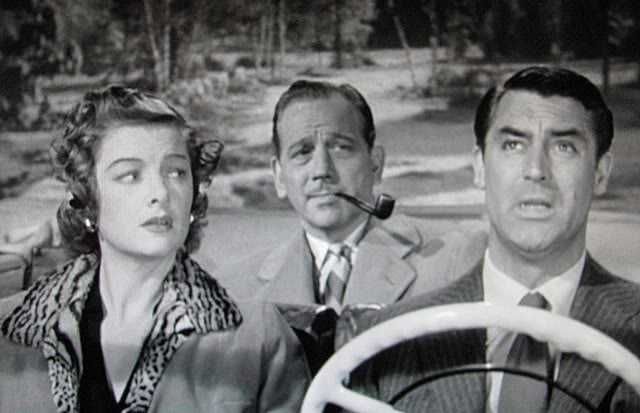
For the people who paid ridiculous sums to join the TCM Backlot, TCM ran a contest to pick the Star of the Month for December: they had a choice between Bette Davis and Myrna Loy, and Loy won. (It probably should have gone to centenarian Kirk Douglas, but that's another story.) Loy's movies will be airing on Fridays, mostly in prime time, although actually starting earlier. Loy is probably best remembered for all those movies with William Powell, through which she became known as the "perfect wife". It wasn't just with Powell that she had that on-screen reputation; she would be the wife opposite Fredric March in The Best Years of Our Lives and then opposite Cary Grant in Mr. Blandings Builds His Dream House:


But her career actually started with small roles in silents; I for example am looking forward to Noah's Ark coming on at 3:00 PM which I've never seen before. And then up until about 1934, Loy played a lot of exotic vamp types. It's these earlier roles that are getting the spotlight this first Friday in December. I'm also curious about The Squall, overnight at 2:15 AM. And at 7:00 PM, there will be a 1990 documentary, Myrna Loy: So Nice to Come Home To.

Monday, September 28, 2015

Consolation Marriage

An interesting and little-known pre-Code is coming up on TCM tomorrow morning at 6:15 AM: Consolation Marriage. It deserves a viewing and a blog post.

Irene Dunne plays Mary, a working girl trying to make her way through the late 1920s with her boyfriend Aubrey (Lester Vail). Unfortunately, he decides that he would be happier marrying into wealth. So he runs off with a rich girl and leaves poor Mary alone. While Mary is licking her wounds, she runs into Steve (Pat O'Brien). He's a newspaperman who has just suffered the same fate as his girl Elaine (a young Myrna Loy) has left him for a better-off partner. There's an obvious solution for these two jilted lovers that you should be able to figure out.

Ah, but there's a twist. Mary and Steve do decide to get married, but they have an agreement that it's going to be a more or less "open" marriage. Not so much in the sense that they're going to be sleeping around, but more that if either of them decides they don't want to be in the marriage any longer, they can just up and end the marriage. Seems like a pretty daring idea for the early 1930s, even taking into account that Hollywood movies probably had more divorces in them than America as a whole. That having been said, the marriage seems to be a reasonably happy one, and one that obviously includes sex, since Mary ultimately has a baby. (I suppose that in true Hollywood tradition, they could have had sex exactly once and that's what produced the baby.)

For a movie like this to be interesting, however, there's going to have to be some dramatic conflict. In Penny Serenade, that conflict involved killing off the poor little child. Consolation Marriage isn't going to be so mean here. And, in fact, it comes up with a more interesting dilemma. Aubrey and Elaine both return to announce that they're not happy with their marriages, and both of them would be happy running off with their old lovers. A fun solution would be for Aubrey and Elaine to marry each other and then live together with Mary and Steve, but the cinema of the early 1930s couldn't be that daring. Instead, what we get is a dramatic conflict over whether Mary, Steve, or both of them will go back to their old lovers. And who's going to take custody of the baby?

Consolation Marriage is an interesting idea, even if the execution isn't always perfect. But it's that idea that makes it so well worth watching, at least once. Most of us who are into old movies know well about Joe Breen's enforcement of the Production Code in 1934 and how, before then, movies could do things that were more daring. But even then, a lot of what was done is pretty tame compared to what you can show on screen today. The sort of marriage practiced by Mary and Steve, however, is different, and that's one of the things that makes the movie worth a watch.

I don't think Consolation Marriage has been released to DVD here in North America, so you'll have to catch the rare TCM showing.