Showing posts with label Michael Powell. Show all posts

Sunday, September 21, 2025

Hoffmann's tales

TCM did a spotlight on Michael Powell and Emeric Pressburger late in 2024. One of their movies that I hadn't seen before was The Tales of Hoffmann. With that in mind, I made a point to record it so that I could eventually get around to watching it and doing a post on it. I did, and having enough movies in the queue, it's only been scheduled for now.

For those who don't know, The Tales of Hoffmann is based on three short stories by 19th century German writer E.T.A. Hoffmann that were turned into a play and then intended to be turned into an opera. Jacques Offenbach, German-born French composer, spent the last several years of his life working on the opera, although he didn't finish it before he died, with work being completed by others. This movie version is, from what I've read, not having seen a production of the opera, reasonably faithful to the opera's adaptation of the three short stories, although it looks like the second and third stories are told in the opposite order from the opera.

There's a prologue in which the writer Hoffmann himself, played by opera singer Robert Rounseville, goes to a ballet in Nuremberg where he sees the love of his life, Stella (Moira Shearer, who appears in all three acts although her singing is dubbed). During the intermission, Hoffman gets up and goes to a local tavern where the college students hang out. There, he tells the youngsters the stories of his three loves.

The first one is "Olympia", in which Olympia (played by Shearer) turns out to be an automaton, a mechanical doll much like the one in the ballet Coppelia, since they're both based on the same short story. Coppelia was also made into a movie with Walter Slezak with two versions, the original titled Dr. Coppelius and the later with an animated sequence added and re-titled The Mysterious House of Dr. C. which has shown up on TCM in the past. Obviously, this can't end well for poor Hoffmann.

Second, we get "Giulietta", which might be the best known of the stories because of the barcarolle that Offenbach wrote for it that I think is known outside of its use in the opera. Giulietta (not Shearer, but Ludmilla Tchérina) is a courtesan whom Hoffmann loves, although the feeling is not returned. She's only working for evil magician Dapertutto who wants Hoffmann's reflection for some reason.

Finally is "Antonio", about a doomed singer who is tricked into singing by an evil doctor, hastening her death.

I'm not the biggest fan of opera so this version of The Tales of Hoffmann is not exactly to my taste. I do have to say that in terms of the technical production values, it is, like Powell and Pressburger's earlier The Red Shoes, extremely well-made, with brilliant colors and fine choreography combining ballet and opera. But the movie also feels extremely slow at over two hours, and for some it may feel overly stylized.

However, I can certainly see why many people would like The Tales of Hoffmann and give it high praise. So if you're up for opera, certainly give The Tales of Hoffmann a try.

Wednesday, July 30, 2025

Hour of Glory

TCM had a spotlight late in 2024 on the professional partnership of Michael Powell and Michael Pressburger. This gave me the chance to record a couple of movies I hadn't seen before, as well as one I had seen but hadn't done a post on according to a search of the blog. That latter film is The Small Back Room.

The movie starts off with a title card telling us the setting is London, 1943, which of course is smack in the middle of World War II. A man walks into a building that looks like it could be used by the War Department or some other military-adjacent organization. The man walking into the building is indeed military: army captain Richard Stuart (Michael Gough), and he's looking for explosives expert Sammy Rice (David Farrar). The Nazis have apparently come up with some new type of booby trap that's killed several civilians, and Capt. Stuart thinks that perhaps Sammy would come up with some idea of how the Germans may have set the traps so that future types of this bomb can be defused without going off and killing anybody.

This is a welcome change for Sammy, who has a difficult personal life. Sammy isn't fighting in the war, which is entirely because he has a prosthetic foot. Worse, that foot causes him all sorts of pain, and the painkillers the doctors prescribe don't do anything for him. As a result of not being able to serve in active duty Sammy takes pity on himself; as a result of the pain, Sammy has turned to drink and become a raging alcoholic much to the chagrin of his girlfriend and co-worker Susan (Kathleen Byron).

It's also not only personal life that's tough for Sammy. He works for a company that tries to design new weapons systems as part of the war effort. One thing that the War Department is working on is something called the Reeves gun, that may not work out in the field as well as is needed for the soldiers to be able to use it effectively and survive. This is leading to all sorts of political infighting. It doesn't help that Sammy's boss Waring (Jack Hawkins) is basically useless, trying to flirt with the secretaries while bamboozling the politicians and taking credit for things that really should be the responsiblity of Sammy and the other men in the laboratories. It's all amost enough to make Sammy start drinking the bottle of Scotch he's got ready for victory day.

And then the climax comes when Sammy gets a telegram from Stuart that another of the German booby traps has been found at the coast without having gone off, which will give Sammy and Stuart a chance to figure out what the Germans have done. Except that Sammy gets to the coast only to find out that one of the two booby traps when off while Stuart was trying to defuse it, killing Stuart and forcing Sammy to defuse the other one with no help from anybody else.

As I was watching The Small Back Room for the first time in many years, I realized that in some ways it's almost two movies in one, somewhat along the lines of Just the Way You Are that I did a post on a couple of days ago. However, I think that Powell and Pressburger handle the two disparate parts much better. It helps that the material is stuff that naturally lends itself to dark suspense, and that Farrar is up to the task of dealing with it.

The Small Back Room is a smaller film than what one might normally think of when it comes to Powell and Pressburger, and as a result, it's a bit of a shame that this one isn't nearly as well remembered as the pair's other movies. It definitely deserves to be better known.

Wednesday, January 22, 2025

U-Boat 29

TCM ran a tribute to Michael Powell and Emeric Pressburger a few months back, and I've already done a post on one of the movies I recorded then since it showed up a few weeks back, The Red Shoes. Another of the movies is now on the TCM schedule again: The Spy in Black, airing tomorrow (January 23) at 9:00 AM. (Ben Mankiewicz said in his intro that when the movie was released in the US it was retitled U-Boat 29, and that's the title on the IMDb page, but the print TCM ran had the title The Spy in Black.)

The movie opens up in March 1917 in Kiel, which was the big port for the Imperial German naval fleet in the Great War. (The movie was released in August 1939, just before the start of World War II in Europe.) Hardt (Conrad Veidt) is a U-boat commander who has just returned to port. The propagranda press is saying England is in trouble, but Hardt knows otherwise, especially when the hotel restaurant can't serve him meat or much of any other food. On the way up to his room, Hardt is stopped by a junior sailor, who informs him that the Navy has more orders for him, and that he's going to have to go out to sea. The next day in the submarine, Hardt and his officers learn that their orders are to proceed to a point just off one of the Orkney Islands off the north coast of Scotland, where they'll put Hardt ashore on the isle of Hoy to meet and English contact, Miss Tiel, who is getting information on the British fleet movements in the area.

Cut to someplace in mainland Scotland. Anne Burnett (June Duprez) is a woman in her early 20s who's going to Hoy to be the new schoolmistress, at least until her fiancé, Rev. Harris, marries her. She's worried about missing the train, so when two women stop at the teahouse where Anne is, they offer to take her. It's a ruse, as the older lady chloroforms poor Anne and the younger woman is actually Miss Tiel (Valerie Hobson). They forge Anne's passport, that being necessary to enter a sensitive area like the Orkneys, and send her on her way, throwing poor Anne over a cliff.

Tiel gets to the island and, although nobody knows why she's really there, everybody wants to offer her the sort of hospitality that would prevent her from carrying out her mission. She says she's an independent woman who can take care of herself, and gets to her residence near the school just before Hardt gets off the boat. Hardt is able to evade the constabulary and get to Tiel. Joining them is a Lt. Ashington (Sebastian Shaw), a former ship's captain who was demoted for drunkenness, and is now willing to help Germany to get back at his commanders.

Their plot is going along fairly well, at least until an unexpected visitor shows up: Rev. Harris. This is a big problem since it's supposed to be Anne Burnett staying at the house. There is of course a woman there with a passport identifying her as Burnett, but Harris is the one person on the island who is going to know that this is not in fact Burnett. So the three people working for Germany have to start working much more quickly before everybody figures out that there's trouble afoot on the island. There are a lot of twists and turns before the resolution, although you can probably guess that since the movie was released in 1939, the British are going to win out in the end.

Despite the necessity of having the British triumph and that dictating some of the twists and turns, The Spy in Black is actually a pretty darn good movie. As with Powell and Pressburger's later 49th Parallel, it also portrays the Germans as intelligent and human, instead of the over-the-top evil that Hollywood films portrayed Germans as. Granted, these are not World War II Germans, but still, with it being obvious that there was a war coming, and soon, it was obvious that the Germans were going to be a big enemy in fairly short order.

The production values are also on a level with the movies Alfred Hitchcock had been making in the UK before leaving for Hollywood, which is to say not quite as high as what you'd get from a Hollywood studio film, especially the prestige productions. But the sort of material here means that a non-prestige level of production actually works in the movie's favor. The Spy in Black is a winner all around, and definitely a movie that should be better known.

Saturday, January 11, 2025

The shoes of color

I've briefly mentioned the movie The Red Shoes a couple of times before, most recently when the team of Michael Powell and Emeric Pressburger were part of a TCM spotlight back in November. The Red Shoes is back on the TCM schedule again quite soon, tomorrow (January 12) at 11:45 AM, so I made a point of re-watching the film so that I could do a full-length post on it.

The movie opens up with what feels like suprisingly long exposition. The ballet company run by impresario Boris Lermontov (Anton Walbrook) is performing in London, and a bunch of starving artist types from the ballet/classical music world have spent their hard-earned money to get balcony tickets to watch the performance. Among them are dancer Victoria Page (Moira Shearer) and composer Julian Craster (Marius Goring). Julian hears the music, and is shocked to discover that one of his professors of composition from the conservatory has basically lifted themes that Julian himself wrote. Julian writes a letter to Lermontov to complain, and eventually goes to meet Lermontov when he decides that perhaps he doesn't want to burn his bridges that way. The bad news is that Lermontov already read the letter; the good news is that he admires Craster's talent and drive.

As for Victoria, she's about to meet Lermontov as well because her aunt is putting on a party for Lermontov after the show. Lermontov asks her about dance, and she of course gives the obligatory answer that dance is her one true love and that she'll sacrifice everything else just to be able to dance professionally, as opposed to someone like Shirley MacLaine in The Turning Point who opts for motherhood. It's the answer she needs to give if she wants to advance in her career, but you suspect she really means it at least at this point in her life. As for Lermontov, he has a policy that nobody in the troupe can keep their job after getting married since it'll put too much strain on the dancers and take away from their dancing; indeed, he's going to have to replace his prima ballerina later in the movie.

And, unsurprisingly, it's going to be Victoria who becomes the new prima ballerina. She starts off in the corps de ballet, getting noticed when she does a charity version of Swan Lake for the old company she grew up with performing at a grimy theater in a decidedly unglamorous part of London. The joy she shows in dancing, however, is enough to get Lermontov to hire her and bring her on the company's tour of first Paris and then the French Riviera. Julian has wound up with the company, too, as an assistant to the conductor. He and Victoria have a rocky relationship since they both have their own ambitions, but they fall in love eventually.

In the film's highlight, which is somewhat surprisingly only halfway through the movie, Julian writes a score for a new adaptation of the Hans Christian Andersen story The Red Shoes, about a woman who gets a magical pair of red ballet shoes that have the curse of forcing the wearer to dance until the wearer drops dead. The ballet is a hit, and Virginia is the only one to dance the lead role. She eventually decides to get married to Julian, forcing her to leave the company, and leading Lermontov to decide not to re-stage The Red Shoes without Virginia.

Virginia's career stalls, however, and she eventually goes back to the Riviera to beg Lermontov to let her dance again. But Lermontov is ruthless in trying to get Virginia to conclude that she's going to have to give up Julian to regain the passion for dance she first had. Julian, meanwhile, has had a more successful career, writing a new opera that's about to premiere in London. But when Victoria leaves him to resume her dance career, he decides to go to France to try to win her back....

In watching The Red Shoes, the movie that I was reminded enough was one that may surprise you: A Clockwork Orange. The reason why I thought of it is that I had the same visceral reaction to both of them. That reaction is that it's easy to see why all the critics -- at least latter-day critics -- heap such high praise on the movie. It's a technical marvel, with gorgeous color and stunning dance scenes. However, it's also a movie that leaves me emotionally cold, which I think it in no small part down to the fact that I'm not into ballet at all. That's not to say that The Red Shoes is a bad movie at all; indeed, I'd highly recommend it to all those who enjoy dance movies. It's more that I feel like I'd need to have a more intimate knowledge of the world portrayed here to empathize with the characters' motivations.

Monday, June 3, 2024

Ill Met By Moonlight

Dirk Bogarde was TCM's Star of the Month last September, and it's taken me a while for me to get around to all of his movies that I put on the DVR. But we're getting close to the end of them, with one that I haven't mentioned yet being the World War II movie Ill Met By Moonlight. (TCM had it on the schedule as Night Ambush, but that was the title on the original American relese and, according to Wikipedia, the original US release was cut by about 10 minutes. The print TCM ran was the running time of the British version, and had the title card Ill Met By Moonlight.)

A bit of opening narration tells us how Crete is an ancient island in the Mediterranean Sea, but that in World War II it was occupied by the Nazis. Some of the Cretans joined the underground, but they were also joined by some other islanders, those being from the island of Britain. One of the Brits is a man named Maj. Patrick Leigh Fermor (Dirk Bogarde). Fermor was a real pesron, as was W. Stanley Moss (David Oxley), who wrote the book on which the movie was based. Fermor is also known by the code name Filedem. He could speak Greek, well enough to fool the Nazis, although he believes he's got enough of an accent that it would give the game away if the Nazis' Greek collaborators heard him.

Fermor tells Moss about German general Kreipe (Marius Goring), who is the head of the German paratroopers stationed on the island, presumably for running operations all over the eastern Mediterranean and disrupting the British who were still in control of Egypt at the time. Fermor has heard that the plan is to ambush Kreipe, kidnapping him and taking him to a cove where a small British ship is set to anchor, taking Kreipe to Egypt. It sounds like a daft plan but then there were a lot of odd schemes that actually did happen during the war. And this is one of them.

In any movie, there is a buildup to the actual operation, as the people carrying it out prepare a meticulous plan. In Ill Met By Moonlight, however, that planning stage seems a bit shorter compared to some other movies in the war movie, or the heist genres. Eventually, the time comes for the operation. The kidnapping seems to go OK, but then they have to get him out of the mountains to where they're supposed to rendezvous with the ship. There are a ton of Nazis looking for Kreipe. And he's got an injured arm to boot, making the operation more complicated.

Ill Met By Moonlight was the final film together for Michael Powell and Emeric Pressburger, and unfortunately it's not quite as good as their earlier works. To be fair, however, many of their earlier collaborations are widely considered outstanding films such as The Life and Death of Colonel Blimp or The Red Shoes. Ill Met By Moonlight is competent enough, but something about it feels like it could have been better. I can't help but wonder whether Powel and Pressburger didn't have as much of a budget as they would have liked.

Not that Ill Met By Moonlight is a bad movie by any means; it's just that it's another of those movies that isn't as good as it might have been.

Saturday, February 12, 2022

One of Our Aircraft is Missing

There is/was an outfit (Reel Vault, if memory serves), that produced gray-market versions of lesser-known British films on DVD and sold them here in the States. I got to blog about some surprisinly good films I'd otherwise never have heard of, such as Cottage to Let with Alastair Sim and Home at Seven with Ralph Richardson. Somehow, some better-known titles also showed up, such as Michael Powell and Emeric Pressburger's collaboration of One of Our Aircraft is Missing.

The title takes its name from reporting on British bombing raids during World War II, when an aircraft in a squadron would fail to return as a result of having been shot down. In this case, that aircraft is the bomber "B for Bertie". The crew, flying out of southeastern England, consists of two pilots, Haggard (Hugh Burden) and Earnshaw (Eric Portman); two gunners, Hickman (Bernard Miles) and Corbett (Godfrey Tearle); navigator Shelley (Hugh Williams); and radioman Ashley (Emrys Jones). Now, we know the plane is going to go missing, not just from the title of the movie, but because we're shown a plane going down right at the beginning of the movie, before the main action sets in.

So after all of that, the crew gets aboard the plane for a nighttime bombing raid of the Daimler-Benz works in Stuttgart. That bombing goes well, but on the way back, while the crew is flying over the Netherlands, the plane is shot. All six men are able to parachute out of the plane, but somehow the plane doesn't actually crash over the Netherlands, so the Nazis wouldn't know that they've got a bunch of British airmen in their midst.

This actually presents a problem for our airmen. After the make it to ground safely, they bury the parachutes to escape detection, and try to hide until they're discovered by a group of children playing. Well, five of them are discovered; the sixth couldn't find the other five. The children take them back to their village, where the villagers are generally anti-Nazi, but have to keep that a secret lest the Nazi occupiers destroy them. And the villagers debate what to do with these airmen for a fairly long time, for one good reason: there's no plane to prove that there are missing British airmen! For all the villagers know, these could be Nazi plants trying to rat out the Dutch underground. It's been known to happen.

Eventually, the villagers, represented by schoolteacher Els (Pamela Brown) since she speaks English, do accept the airmen and formulate a plan to get them out of the country by consistently moving them west from one gathering to another whenever groups of people can move, something that the Nazis control fairly tightly. The first move is to a Catholic Mass, where the priest is played by a very young Peter Ustinov right at the beginning of his career. Then there's a soccer game, and finally, close to the coast, the home of Jo de Vries (Googie Withers) who has a reputation of being pro-Nazi but that's actually a front.

If there's a problem with One of Our Aircraft is Missing, it's that most of the action is perfunctory. It's supposed to be a suspense movie, with us wondering whether any or all of the airmen are going to make it out of the Netherlands alive. In fact, there doesn't seem to be all that much suspense here as the airmen are able to move toward their destination fairly easily. Perhaps the Nazis of the movie (not much shown) didn't realize they had British airmen in their midst. Other than that, the movie is very competently made, thanks to a pretty stellar crew. In addition to some actors early on in their careers and the collaboration of Powell and Pressburger, there's also a young David Lean as film editor, along with another future director, Ronald Neame, doing the cinematography. No wonder the production values are so good.

I just wish that the story in One of Our Aircraft is Missing could have been fleshed out better. Still, it's definitely worth a watch to see the sort of war movie the British were making during World War II.

Tuesday, November 2, 2021

The Life and Death of Colonel Blimp

I implied last week when I did a post on the three-hour movie The Sand Pebbles that for me there's a running time beyond which most movies could probably stand some editing down; for me that point is usually about two and a half hours. It's something I was thinking of again as I finally got around to watching The Life and Death of Colonel Blimp.

The movie starts off at the height of World War II in the UK. The Home Guards are doing training exercises, with the "war" they're going to fight set to start at midnight. However, the young commander suggests that since this is supposed to be as realistic as feasible, and the enemy doesn't hold to a set of gentlemanly rules of war, why should they? Therefore, the war will start early and they'll have the element of surprise in capturing the enemy commander.

That commander is General Wynne-Candy (Roger Livesey), who lives in one of those gentlemen's clubs that populated movies of the 1930s where men could go to spend the night if they've ticked off their wife or if they've gotten too drunk to make it home without creating a scene or somesuch. He's in the Turkish baths, unaware that he's about to be captured. But when he does get captured, it makes him think back on the last 40 years of his life....

In 1902, the much lower-ranking Candy, having recently returned from the Boer War where he earned a Victoria Cross, hears from an Englishwoman living in Berlin that the Germans are using him as propaganda to put out a bunch of lies about the way the British are treating the Boers in South Africa. So he proposes that he should go to Berlin and tell the Germans the truth. Not that they'll listen, of course. And not that his commanders think this is a good idea for his career.

So he goes off to Berlin to meet that woman, Edith Hunter (Deborah Kerr). He falls in love with her, but also falling in love with her is a German officer, Theo Kretschmar Schuldorff (Anton Walbrook). Candy's comments cause all sorts of controversy which eventually leads to Candy being challenged by a duel, where he fights Theo. The duel is inconclusive as they both wind up with scars from which they need to convalesce, although they also wind up about as good friends as possible for people who don't really speak each other's language.

Fast forward to 1914, and the start of the Great War, said fast-forward being done with a montage of hunting trophies. Candy goes back into service and winds up in France in 1918, where the troops under his command have taken some Germans prisoner. Candy has reason to believe Theo is among them, and sure enough Theo does wind up a POW in England, only heading back to Germany in 1919. But more importantly, Candy is trying to get back to England on leave. His attempts to get a train bring him into contact with one of the English nurses, Barbara Wynne, who looks amazingly like Edith Hunter from Berlin all those years ago, which is unsurprising considering Barbara is played by Deborah Kerr as well. As you can guess from Livesey's character being named Wynne-Candy in the opening scene, Candy and Barbara get married.

It's not exactly a happy marriage, at least in the sense that they don't live happily ever after as Barbara dies tragically young. This leads Candy to do a lot more hunting, until the start of World War II. He's old by this point, and the Army would like to pension him off, although as a VC winner he's got enough clout to make that a problem for the younger command, which is why they put him in charge of the Home Guards instead. He gets an army driver in the form of Angela, nicknamed "Johnny", who reminds him of Barbara and Edith, which is again unsurprising since Angela too is played by Deborah Kerr.

The Life and Death of Colonel Blimp is one of those movies that's well-acted and competently made, and looks lovely in Technicolor, but man does it seem slow. That's not much of a surprise since the movie runs 163 minutes. Director Michael Powell was trying to make a statement about a certain type of Briton -- at least in the eyes of Prime Minister Winston Churchill, who wanted to ban the movie. Blimp, to me at least, represents the sort of old-fashioned colonial soldier we saw from C. Aubrey Smith in The Four Feathers, or the older generation getting pushed aside 15 years later in I'm Alright Jack, people who thought they'd win the war by being gentlemanly, as Candy himself says about the first World War.

I happen to know any number of Brits who take the relatively tedious to me attitude that if Johnny Foreigner does it one way, that way must be automatically wrong. But the people who take the diametrically opposed view that if John Bull does it one way, that way must be old-fashioned and wrong always come across as equally tedious to me. And that second sort of tedium really does bubble to the surface at times.

Still, the acting performances in The Life and Death of Colonel Blimp are definitely to be recommended. It's just that if I were going to recommend Michael Powell movies to people who don't know much (if anything) about him, there are other movies I'd pick first.

Tuesday, April 7, 2020

Narcissus of Color


I had Black Narcissus on my DVR for a while, it being one of those movies that the critics all think everybody should watch. So finally I watched it to do a review here.

The movie is set in India, presumably in the late 1930s since that's when the book on which it's based was published. In Calcutta, there's an order of Anglican nuns known as the Order of the Servants of Mary. They run a school as their missionary work, and the Reverend Mother has a mission for Sister Clodagh (Deborah Kerr). Apparently there's an old palace up in the Himalayas that the order thinks would be perfect for starting a remote mission, and Clodagh is the perfect one to run it as the Sister Superior.

Sister Clodagh takes four nuns with her, and they go to meet Mr. Dean (David Farrar), the agent for the palace's owner, an old general (Esmond Knight). It's difficult to get to the palace, it being high on a cliff above the village in the valley below, and it's going to be a hard life for the nuns. A group of monks tried to make a go of the place some time back, and they left after a whopping five months. As in the old Lillian Gish movie, the wind is supposedly going to drive everyone crazy.

Still, Clodagh goes up to the palace with confidence, leading the other four nuns: Sister Briony (Judith Furst) is going to run the infirmary; Sister Honey (Judith Furse) for morale and teaching the making of lace to the local girls); Sister Philippa for gardening; and Sister Ruth (Kathleen Byron), partly as a teacher and partly because the Reverend Mother thinks getting the already unstable Ruth away from Calcutta will be a good thing for Ruth.

Along the way, the nuns deal with the old caretaker Angu Ayah, and take custody of a young woman Kanchi (Jean Simmons). As Mr. Dean predicted, the location has a somewhat adverse effect on all of the nuns. Clodagh seems the most stable, but she starts remembering an old relationship back in her native Ireland that led her to join the order, one she hadn't thought about in ages. Ruth goes further nuts. Briony tries to help a sick baby, but the baby is beyond saving. So when she gives the baby medicine that's really harmless castor oil, the baby still dies and the locals in the valley below think the nuns caused the death.

Ruth decides she's going to leave the order and marry Mr. Dean, although he has no desire to marry her, and this finally pushes Ruth over the edge, literally and figuratively.

Black Narcissus is a beautiful movie to look at, which is a good thing because it's not exactly beautiful to think about. This is partly because of the dark story line, and partly because as with Camille, it feels as though there's a whole lot of nothing going on. The stunning visuals, however, make up for this to an extent, helped by the cinematography of Jack Cardiff and some extremely impressive matte paintings.

So, I can recommend Black Narcissus if you know going in that it's psychological and less on plot. It's available on a pricey Criterion Collection DVD and Blu-ray.

Tuesday, September 29, 2015

A heads-up on Something Always Happens

Tommorow, September 30, is the birth anniversary of British-born director Michael Powell, who was born on that day in 1905. TCM is running a morning and afternoon of his movies, and one of the highlights for me would be another airing of Something Always Happens, which is on at 7:00 AM.

The reason I consider it a highlight is that it was never intended to be seen in America. As I mentioned in the post linked above, the movie was made at the Teddington Studio, which was Warner Bros.' British arm. Back then, the UK had a protectionist system wherein a certain percentage of movies shown in British cinemas had to be British films. The Hollywood studios dealt with this by setting up shops in the UK to make cheap B movies which they could pair with the prestige movies from Hollywood. TCM got the rights to half a dozen of them several years ago, and the quality ranges about as much as wth Hollywood's B movies. Some of it wasn't all that good; some of it was highly entertaining even if not on a par with the prestige movies. For me Something Always Happens is in that latter category. If you haven't seen Something Always Happens before, I can definitely recommend it. There's a synopsis somewhere in between the length of a brief post like this and a full-length post at the link above.

Saturday, October 4, 2014

A Catnerbury Tale

There are some movies where you probably shouldn't trust the one-sentence blurb that the TV listings sites use to describe what it's about. An excellent example of this -- both because the synopsis doesn't capture the essence of the movie well at all and because the movie turns out to be extremely good -- is A Canterbury Tale, which is on TCM tomorrow morning at 6:00 AM.

The movie starts off with a few scenes of bucolic England, set against the words of Georrfey Chaucer's Canterbury Tales, before shifting to the present day, that being 1943/4. That date of course implies that there's a war on, and that war figures heavily in the action of this movie. Real-life American army sergeant John Sweet plays Bob Johnson, a US GI on a couple days' leave who is trying to get to Canterbury to see one of his friends as well as photograph the cathedral. He's taking the train at night to get to Canterbury, but because of the war on, there are blackout conditions. So when Bob hears "Canterbury" mentioned, he gets off thinking he's arrived, but is in fact a stop early because they were announcing future stops. So he's in the middle of some small town somehere in the middle of south-east England. At least he's not alone, as having gotten off the train as well is the young, lovely Alison Smith (Sheila Sam, the widow of Richard Attenborough), who is here as part of the labor program to send people to work with the farmers. Also there is the young Londoner Peter Gibbs (Dennis Price), so the three of them start to look for a place to spend the night.

The three are waylaid, however, by a surprising event. Not only does some mystery person accost them; that mystery person dumps glue in Alison's hair! So the three get to the local inn, where Alison can have her hair washed, these being the days where staying in to wash one's hair was actually a real thing, especially with the war on. There, the three newcomers also learn that Alison isn't the first woman who's suffered the indignity of having glue dumped on her. So who the heck would do such a thing? And why? It's this that more or less forms the one-sentence blurb you'd see in the TCM schedule or on your box guide. And yet, the investigation into who is assaulting women with glue is really not what the movie is about at all.

No; A Canterbury Tale is partly about life in this rural English town, and partly about the four main characters and the journey they take both within the town and as they try to make their way to Canterbury. Canterbury has long been a pilgrimage town as the seat of Christianity in England; indeed, Chaucer's original story was about a group of pilgrims. As the story goes along and especially once we get to the end, the main characters all wind up having taken a sort of metaphorical pilgrimage. Bob, the American, is from a farming family out in Oregon, and he's somewhat disappointed that his girlfriend back in the States has stopped responding to his letters. Alison is also alone, but that's because her boyfriend has gone missing in action. She's trying to get to Canterbury because that's where her trailer is; she's more or less hoped to sit out the war by going camping in the middle of nowhere. As for Peter, he's been working in London as the organist at a movie house, but he really wants to play a magnificent church organ. The fourth main character is the one the focus on as the likeliest candidate for having dumped the glue on the women's heads: local air-raid warden and prominent lawyer Colpeper (Eric Portman). There's not much mystery over whether he did it, but why?

It sounds as though there's not much going on in this movie, and as you watch it, you get the distinct impression that there's not much going on other than a weekend in a rural English backwater that's simply had the dubious honor of being the locale for a strange crime. But as we get to know the characters and the life of tht little town where they've all wound up, we find that there's so much more going on under the surface as these people make their way to Canterbury that will stick with you long after the movie is done. Whether it be Bob playing iwth the children on a late summer afternoon as he enlists them in his scheme to find the guilty party, or the resolutions to Alison's and Peter's stories, the little things going on wind up being very affecting. John Sweet had no real acting experience prior to this movie, and would not make another movie, but he's fine as the American. The British actors all turn in good performances too, setting up a depiction of small-town life that was utterly destroyed by the war. Michael Powell does a good job as always with the directoin, but as so often happens with his films, it's more the story than the direction that winds up staying with you.

A Canterbury Tale is a modest, unassuming movie, but one that is really rewarding and well worth a viewing.

Sunday, November 15, 2009

Stairway to Heaven

After Piccadilly and tonight's TCM Import, you can tune in for another excellent movie at 4:00 AM ET: A Matter of Life and Death.

Left-aligned photo David Niven stars as British pilot Peter Carter, returning from a bombing mission in the final days of World War II. Unfortunately, his plane has been stricken and is on fire, with everybody else in the crew either already dead or having bailed. That option isn't available for Carter, as his parachute has been ripped to shreds. He calls for help on the radio, getting June, a young American WAAC operating the radio on the other end (played by Kim Hunter), eventually telling her that he's going to jump out anyway, because he'd rather die in the fall than be burned to death.

Fast forward to morning. Peter is shocked to discover that he's woken up, and is apparently not in heaven, but still on terra firma. In heaven, we discover that there's a problem: the Mr. Jordan-like character (played by Marius Goring) who was supposed to accompany Peter to heaven was unable to do so: it seems as though that blasted English fog caused him to lose track of Peter and let him get away. Peter, having seemingly cheated death, heads for town, where he finds June, and falls in love with her.

But, this isn't a happy ending for the two hunters. Heaven isn't about to allow an administrative error to keep Peter from his appointed date in heaven, as this would cause chaos in the cosmic order, and the heavenly guide eventually finds Peter, informing him that he's going to have to go to heaven as he's supposed to be dead. Peter is unwilling to accept this, as it wasn't his fault that the afterlife screwed up, but he's also not able to make anybody believe his predicament. Eventually, though, he's able to get June and Dr. Reeves (Roger Livesey) to -- possibly -- believe him, and make a deal with the folks in heaven: there will be a trial to decide whether or not Peter should get a reprieve because of Heaven's error.

A Matter of Life and Death is an outstanding romantic fantasy, even better than Here Comes Mr. Jordan. All the main leads turn in excellent performances, and the cinematography is wonderful. The movie has the conceit of being partly in color and partly in black-and-white, like The Wizard of Oz; unlike Oz, however, the use of color is reversed, with Heaven getting the black-and-white scenes and the real world getting color. It's an interesting idea, and one that, combined with the cinematography and excellent set design, makes the afterlife look timeless. All this excellence, however, shouldn't be a surprise considering that the movie was directed by Michael Powell and has a screenplay by him and his frequent collaborator Emeric Pressburger.

A Matter of Life and death has been released to DVD.

Saturday, October 25, 2008

Who wants to be a pervert?

Karlheinz Böhm
Karlheinz Böhm in Peeping Tom

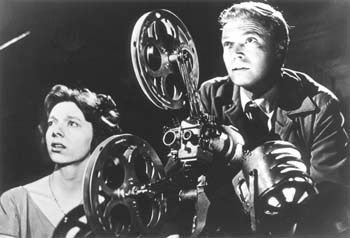
One of tonight's featured movies on TCM is the very interesting, and somewhat controversial, Peeping Tom, airing at 10:00 PM ET. Directed by Michael Powell, Peeping Tom tells the story of cinematographer Mark Lewis (played by Karlheinz Böhm) who has some secrets in his life. In addition to working for one of the London film studios, he's got a second job as a porn photographer, and a hidden interest on top of that: he rapes women and kills them, filming it all. It is this hidden interest that we first see at the beginning of the movie, and I can only imagine how shocking it must have been for movie audiences back in 1960 when the movie was made.

Unfortunately for Mark, his life is closing in on him in more ways than one: first, the police are naturally investigating the work of a serial killer, and slowly but surely, they're going to catch Mark. Perhaps worse for him, however, is that a young woman who is one of Mark's housemates (named Helen, and played by Anna Massey) has fallen in love with him. It's here that we begin to learn why Mark has turned out the way he did. His father was a scientist, performing experiments on him, and filming the results. Actually, he wasn't just filming the results; he was filming every aspect of poor Mark's life. It's easy to see how this could warp poor Mark's mind. Helen seems horrified but thinks she still loves Mark, while her mother has other ideas. The mother is blind, but she's one of the smart blind, able to see what other people can't see; although she can't see what's on those reels of film Mark is keeping in a spare room, she's figured out he's up to no good.

As I mentioned briefly above, Peeping Tom, in its presentation of a whole host of uncomforable topics -- rape, murder, and voyeurism just to name three -- was shocking for its time. Despite Michael Powell's fame, the movie shocked critics so much that the reviews were poor, and the British Board of Film Censors ordered quite a few cuts to the movie. It also made it impossible for Powell to get anybody to finance movies for him.

Tuesday, July 1, 2008

Canada Day

July 1 marks Canada Day, marking the 1867 anniversary of the UK's granting of dominion status to Canada. Canadians celebrate by being thankful they're not Americans, while we Americans celebrate by repeating our favorite Canadian stereotypes. That, and we celebrate all the famous Canadians who escaped to America to become successful in the movies, from Mary Pickford to Mike Myers, and then some. Perhaps the best known Hollywood movie set in Canada is Johnny Belinda, although it wasn't filmed in Canada: the coast of northern California substitutes for Nova Scotia. However, it's not just Americans who have stereotypes about Canadians; Brits do, too. The British look at Canada can been seen in one of the more remarkable movies from World War II, 49th Parallel.

The genesis of this movie is that World War II started in Europe two years before the Japanese bombed Pearl Harbor, meaning that for the first two years, the Americans were officially neutral. The British government wanted to encourage Americans to get behind the British, and so commissioned director Michael Powell, and his frequent collaborator Emeric Pressburger, to make a propaganda movie aimed at Americans. The result was 49th Parallel, but it's a very atypical propaganda movie. The basic story line is that a Nazi U-boat gets stuck in Canadian waters and, while a landing party goes ashore to get provisions, is bombed out of the water, leaving six of the Nazis stranded at a Hudsons Bay trading post. These six then try to make their way south to the still-neutral United States (the 49th parallel being the line of latitude that forms the US-Canada border from Washington to Minnesota), where they can be repatriated to Germany.

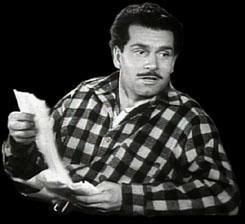
This being officially part of the war effort, quite a few stars appeared, taking on small roles for less pay than normal: Laurence Olivier (seen in the photo at left) is first among them, playing a hilariously miscast Québecois trapper (complete with horrendous accent and about a dozen siblings; thank you Catholic stereotypes); Leslie Howard plays one of his usually weak roles, as an anthropologist with a taste for modern art (what the Nazis call "degenerate") who only cares about the fight against the Nazis when they try to destroy his paintings; and Raymond Massey as a soldier who's gone AWOL but still loves his country.

The propaganda, such as it is, is sometimes blatant, notably in a sequence set at a commune of the pacifist Hutterite sect (the young Hutterite girl is played by a gorgeous Glynis Johns in one of her earliest performances). However, a lot of the time, it's much more below the surface, requiring viewers to think. The Nazis aren't portrayed as simply evil; they're also shown to be clever and manipulative, trying to play on what would have been natural divisions within Canada. Watch how the Nazis appeal to Olivier with a mention of the latent Québecois irredentism; that's something a Canadian filmmaker would probably never have done. One can only imagine what the America Firsters would have thought about this movie.

Ironically, 49th Parallel was ultimately not needed: Japan bombed Pearl Harbor before the movie was released, so by the time Americans could see it, the US was already in the war. Having said that, though, the movie was still wildly successful, in no small part due to the fact that it's much more than just propaganda. It's a darn good thriller. True, since it's supposed to be propaganda, you know the Nazis are ultimately going to fail in their attempt to make it to America. But seeing exactly how they fail is still a surprise. In addition to the excellent story, there's also a majestic score by Ralph Vaughan Williams, and wonderful location photography. 49th Parallel is available on DVD, and a movie I strongly recommend.