Showing posts with label Montgomery Clift. Show all posts

Friday, September 6, 2024

The Secret Passion

Montgomery Clift was honored in Summer Under the Stars, and one of his movies that I somehow neglected to DVR was the biopic Freud. Fortunately, it was on Watch TCM for a while, so I was able to watch it there before it expired and write up and schedule this post.

As you might guess, the movie is about Sigmund Freud, one of the key names in psychoanalysis, even if a lot of his ideas were oversimplified when he proposed them, simply because nobody else had proposed such ideas before and most theories wind up needing a fair bit of refinement. Freud, played here by Clift, had a long and complicated professional life -- much too long for one movie, in fact -- so the movie only deals with a decade or so in the early part of his career.

The movie opens in Vienna in 1885, where he's engaged to Martha (Susan Kohner), and working at a hospital under Dr. Meynert (a real person, played here by Eric Portman). However, the two doctors get involved in a professional dispute over the treatment of hysteria, a disorder which for a good portion of history was thought to be centered in the uterus ("hysterectomy" comes from the same Greek root). The dispute causes Freud to leave the hospital, delay his marriage to Martha, and go to Paris to study further.

In Paris, Freud studies under Jean-Martin Charcot (another real person who did research into several neurological conditions including ALS). At this point in his career Charcot was studying the possibility of treating hysteria through the use of hypnotherapy, a fairly radical idea at the time, and one which I think the movie treats rather too simplistically, as if you can just hypnotize someone by snapping your fingers. But the idea intrigues Freud, and he starts using hypnotherapy to try to treat some of the more unusual cases he encounters when he gets back to Vienna.

For better or worse, the cases Freud encounters all seem to involve odd sexual hangups. One, Cecily (Susannah York), is being treated by Freud's partner in practic Dr. Breuer (Larry Parks). Her father died in Naples and ever since then she's had partial paralysis and insomnia and a host of other problems. Worse, she starts showing an attraction to Dr. Breuer that results in his handing the case over to Sigmund. In turn, Cecily starts feeling attracted to Freud.

The other case involves young Carl (David McCallum) who describes some really weird dreams and an odd relationship with his parents, with the final result of the first session being that Carl tries making out with a dressing mannequin. Creepy stuff, and it starts giving Freud bad dreams of his own. Physician, heal thyself, some would say, but in a case like this Freud might want to try discussing his dreams with another professional.

However, in dealing with all these cases, Freud starts developing ideas about child sexuality and how not being able to deal with these childhood thoughts properly is one of the underlying causes of neuroses. It's a controversial idea, and needless to say when Freud tries to present it at a medical conference the other doctors are radically opposed to it because, as is also said, science advances one death at a time. Of course, Freud is a well-known and influential name today, so we know how his ideas eventually become a part of the public consciousness.

This biopic of Freud was directed by John Huston, who I think I've mentioned was not my favorite director, certainly not in the later part of his life when the movies became more self-indulgent. I can see why people would be interested in the idea of making a biopic on Sigmund Freud. Huston does, I think, about as well as possible with the material, but I still think Freud isn't going to be a movie for everybody.

Thursday, July 11, 2024

Raintree County

Eva Marie Saint is TCM's Star of the Month for July 2024, and one of her movies that's been on my DVR and that I haven't posted about before is Raintree County. It's on TCM again tonight at 10:00 PM, so I made a point to watch the movie to do a review on it now for the upcoming showing.

Once again, Eva Marie Saint is only a supporting actress here, although she shows up a lot earlier than the actual lead actress. The movie opens up in 1859 in Raintree County, Indiana, which is partly a sign that the Civil War is about to hit the US and change everybody's life. Everybody is about to graduate high school, and this being 1859, it's a huge deal that the class is going to be... photographed. Head of the class is John Shawnessy (Montgomery Clift), who is a bit of a dreamer. He's kinda-sort going steady, at least by 1859 standards, with fellow student Nell (that's Eva Marie Saint if you couldn't tell), and everyone expects them to get married relatively soon since younger marriages were much more common in those days.

Except that one of their teachers, Prof. Stiles (Nigel Patrick), tells the class the legend Johnny Appleseed, He went through the midwest planting trees, and supposedly he planted on specific raintree after which the county is named, somewhere in the county's forbidding swamp. Find the tree, and you'll find the secret of life. It's a ridiculous idea, but this is the 1850s when there was more ignorance in the world, and young John is impressionable. So he blows off his girlfriend to go into the swamp looking for the tree.

Visiting the county for some reason is southern belle Susanna Drake (Elizabeth Taylor). Johnny is immediately taken with her looks, and continues to blow off Nell in order to spend time with Susanna. Enough time alone with each other, in fact that there might be the opportunity for Johnny to knock up Susanna before she leaves to go back home. Indeed, they must have had sex because some time later Susanna shows up back in town to tell Johnny that she's with child and he's the father of the child. I'd guess Johnny knew enough about sex to know that if he hadn't done it with Susanna, there's no way she could be bearing his child.

Johnny does the honorable thing and marries Susanna before heading south with her to live in her part of the country. The two stop in a plantation where Susanna grew up, at least before the place burned down in a fire. Johnny, in talking to the people who still live there, learns that Susanna's mom went insane, and Susanna may in fact be inheriting her mom's mental state, not that they quite understood genetics at the time. But it's the reason for the insanity that's a problem: The woman who went insane might not have been Susanna's biological mother, and that Susanna is in fact the product of a relationship between Dad and one of the family's slaves!

Oh, the movie is going to get a lot more ridiculous. John and Susanna move back north, and the Civil War breaks out. Johnny doesn't volunteer, at least not until Susanna runs off with their child to someplace in the south, leaving Johnny to join the Union Army just so he can spend all his time looking for Susanna, which I'd think might involve a bit of desertion. Meanwhile, Nell is still around, and still pining away for poor Johnny.

Raintree County was based on a novel publised a few years after World War II that was a commercial success. It's not hard to see why MGM would want to buy the rights and think that this sort of melodramatic material that has shades of Gone With the Wind would be a big hit. But the movie wound up in production hell in part because the novel's writer killed himself. And then when it finally did get made, nobody seemed to undertand just how wacky the material is. It also didn't help that this is the movie Clift was making when he had the very serious car crash that nearly killed him and delayed production for months.

Raintree County is certainly not the best film for anybody involved in the production, I'm sorry to say.

Wednesday, January 12, 2022

The old lions

A movie that had been sitting around on my DVR for quite some time that I finally got around to watching is The Young Lions.

The movie opens up on New Year's Eve in 1938, with American tourist Margaret Freemantle (Barbara Rush) visiting Germany. She's met an army officer, Lt. Christian Diestl (Marlon Brando), and the two discuss the political situation in Germany, as this would have been a few months after the Munich Conference and several months before Europe would be officially plunged into war. Lt. Diestl is apparently a career officer, since he's not the biggest fan of the Nazis although he can't really say that very directly lest he be overheard by Germans who would happily turn him in to the Nazis.

Some time passes, as it's now early 1942. The Americans are now in World War II, and among the guys who get drafted is Michael Whiteacre (Dean Martin). He's a successful stage actor and singer, who had just signed on to do a new play on Broadway. Sorry, but his understudy is going to have to take over for him. Perhaps he can get one of his friends in Washington to give him a cushier job in the Army doing goodwill tours to entertain the regular schlubs.

The other American is Noah Ackerman (Montgomery Clift), a Jew who doesn't have much family left and doesn't have much of a life, having come back east from California and only getting a job as a department store clerk. But he doesn't particularly want to be drafted earlier, so when Michael meets Noah, Michael immeidately befriends him and invites him to a party at his swanky apartment.

There, we find that Michael's girlfriend is one Margaret Freemantle. She's not particularly happy about Michael trying to avoid his duty by using his influence to get a desk job. Michael introduces Noah to another guest at the party, Hope Plowman (Hope Lange). She seems like one of those young women you'd meet in 1930s or early 1940s films who came to New York from a small middle America or New England city. They immediately fall in love and get married and even get Hope pregnant lickety split, if you try to calculate dates based on the way the plot goes.

The rest of the story cuts back and forth between the various characters' development during the war, mostly Noah and Lt. Diestl. Diestl ends up first in Paris, and then in Africa, with his commanding officer, Capt. Hardenberg (Maximilian Schell); Hardenberg grows increasingly suspicious of Diestl since Diestl seems as though he'd rather sit this war out if he could find a way that wouldn't kill him. Noah gets bullied by everybody in boot camp except Michael for no good reason, but eventually goes over to Europe and fights with some distinction. Michael leaves boot camp when his transfer to a cushy job goes through, but pangs of guilt eventually overwhelm him and send him to the regular troops. You know he's going to meet up with Noah again.

The big problem I had with The Young Lions is that it really feels as though it should be two separate films, one focusing on Diestl and one focusing on the two Americans. As things stand, it goes on for 167 minutes and doesn't really give enough character development to either Diestl or Michael. It also feels at times as though it has some plot points it wants to tick off, and does so in a rather perfunctory way. We just have to have the big reveal of a concentration camp liberation, don't we? And Diestl returning to a bombed-out building.

All three of the male leads do their best, and Martin shows that he was capable of taking on dramatic roles, something he did relatively rarely in his career. But ultimately, all three are done no justice by the script. Still, other people may be more able to overlook the script problems thanks to the good performances.

Monday, November 18, 2019

Terminal Station


One of the movies that TCM ran during the "Short and Sweet" spotlight back in October was Indiscretion of an American Wife. Not having done a post on it before, I decided to DVR it and watch.

Jennifer Jones plays Mary, an American in Rome who's apparently been visiting relatives there or something. At the start of the movie, she's writing a note saying that she can't see someone any longer -- but chickens out on delivering it. Instead, she goes to the central train station in Rome, looking for the earliest train out of the country to Paris. She's obviously escaping something. But what?

Before the train leaves, two people show up. One is her nephew Paul (a very young Richard Beymer). The other is Giovanni (Montgomery Clift), who was the intended recipient of that letter that Mary never delivered. The two were having a love affair, but Mary is maried with a husband back in Philadelphia. One would think Giovanni should have known about this and that the affair could never last, but he doesn't care or is stupid or something, because he keeps pressuring Mary to stay with her.

They talk about it in the station's restaurant, in a section that's closed so that they deservedly get kicked out. Then they talk about it in the corridors. Then they go outside and into one of the stopped train cars, where they have the sort of romantic tryst that we saw Bette Davis having in Now, Voyager in the flashback to what brought on her nervous breakdown, only the scene in Indiscretion of an American Wife isn't a flashback.

The two lovers get caught out and brought to the train station's police department, where they're going to have to face justice which is going to cause Mary to miss her train. Not that Giovanni cares, probably, since he still seems to want Mary to stay in Rome with him.

Indiscretion of an American Wife is a movie that has a bad reputation from the critics, and frankly, now that I've watched it I understand way. It's talky and tedious even though it runs barely over an hour. The movie was directed on location in Rome by Vittorio De Sica, and the locations are the film's one bright spot. De Sica's original work ran 89 minutes, and American producer David O. Selznick edited it down to about 63 or 64 for distribution in America. Some people suggest it's Selznick's ham-fisted handling of the movie that's the problem, but I can't help but think another 216 minutes of the stuff we do have wouldn't make it much better.

That having been said, it is possible to get that longer edit, called Terminal Station. Both edits (more or less) are on pricey a Criterion Collection release. (Note that the Criterion site says the American version is 72 minutes, including an overture by Patti Page that wasn't on the 63/64-minute print that TCM ran.)

Sunday, October 13, 2019

The Defector


A few weeks back, TCM ran what would turn out to be Montgomery Clift's final movie, The Defector. Not having done a post on it here before, I decided to record and watch it.

Clift plays James Bower, an American physicist who has flown to Germany with the intention of going to Esat Germany to see a few museums and how some art restoration is going on, fine art being his hobby. In Germany, he's met by Adams (Roddy McDowall), an agent for the CIA. It wasn't Bower's idea to meet with Adams, and when he finds out why Adams wants to meet him, he's really unhappy.

Apparently, prominent Soviet physicist Groschek is in East Germany, and he has some important information about the Soviet space program that he wants to transfer to the west. Since Bower is going to East Germany anyway, and since he translated Groschek's books into English, Adams would seemingly be a natural person to meet with Groschek in the East and bring that information back to the West. Bower isn't a spy (and indeed, that's part of the reason why his being the one to get the information from Groschek is a plus), and doesn't want to do spy work. But Adams blackmails him, saying that if Adams doesn't do it, his government funding for research will dry up. (This is one of the many reasons government shouldn't be in the business of funding science.) So Bower reluctantly accepts.

The Communists already know that Bower is coming, and that he's going to be getting this information from Groschek. Commander Orlovsky (David Opatoshu) is nominally in charge of the operation, but he's given a lot of responsibility to one of Bower's fellow scientists, Peter Heinzmann (Hardy Kruger). Heinzmann's job is not only to prevent Bower from getting that information from Groschek, but to try to get Bower to defect to the East.

To do this, there's both physical violence brought to bear against the people Bower meets, as well as mental violence against Bower, who is subjected to some sort of psychedelic-looking trip in his hotel room. Bower eventually decides that he wants to get back to the west, but trying to get there is going to be extremely dangerous.

I stated above that The Defector was Montgomery Clift's last movie; it was four years after his previous work and released four months after he died. That is probably the biggest reason why the movie is still known today. To be honest, it's not particularly memorable for any other reason. The Defector came across to me as a very formulaic movie in the 1960s spy genre, with absolutely nothing to make it stand out against any of the other movies. It's not bad, mind you, even though it does have a few flaws in its slow pacing. It's much more that there's nothing memorable about it other than the trivia surrounding Clift.

Still, The Defector is available on DVD from the Warner Archive, and the vintage cinematography of 1960s Germany is mildly worth mentioning. So watch and judge for yourself.

Sunday, December 2, 2018

River of color

I've been blogging for almost 11 years, and I note that I've never done a post on Red River. Since it was on TCM recently, I DVRed it and re-watched it to do a full-length post.

John Wayne plays Thomas Dunson, who at the start of the movie is a scout in a group of pioneers going west sometime in the 1840s. However, he's reached a point where he feels going west isn't a good idea, and he goes south with his friend Groot (Walter Brennan). It's a fortuitous decision, as not long after the leave they see a bunch of smoke coming from the direction of the wagon train, which can only mean they've been attacked by Indians.

Dunson talks of setting up a big ranch even though he doesn't quite have the cattle yet to do it, and because somebody further south claims the land. And a few days later, young Matt Garth (Mickey Kuhn as a boy; he'll grow up to be played by Montgomery Clift) shows up. He passed by the pioneers who were in fact annihilated, and has nobody left in the world, so he becomes a sort of foster son to Dunson.

Quite a few years pass, and now it's 1865, which if you know your American history you'll recall is the end of the Civil War. Texas being part of the Confederacy was destroyed, leaving all of the ranchers in the region destitute. Worse, the southern rail stock was destroyed because it was a strategic objective by the north, so it's not as if there are any stockyards nearby in a place like Dallas to deliver the cattle to. The nearest would be Kansas City, although that has its disadvantages, too.

Still, it's drive the cattle or starve, so the other farmers go along with Dunson and set out toward Missouri. But there are also sorts of problems, with Indians and the threat of dissension within the ranks being the biggest. The second one is a bigger problem because Dunson is obsessive about continuing the drive and everybody else is thinking he's going too far. That, and there are rumors of the railroad having made it to nearer Abilene KS, and Dunson not wanting to go someplace where there's no concrete proof of a railroad. These may sound like clichés, but I'm trying to think of a big cattle drive movie that came before Red River.

Red River is one of those movies that is pretty well done, although to me it falls a bit short of the masterpiece status that some critics want to give it. Part of that is due to Brennan's character, who is just obnoxious. But there's also the ending, which felt rushed to me (and to a fair number of reviewers I've seen). The movie is entertaining, however, and certainly well worth watching if you've never seen it.

Sunday, December 11, 2016

The Search

Over the weekend, I watched The Search off of my DVR, having recorded it during Summer Under the Stars when there was a day of Montgomery Clift's movies. It was released to DVD courtesy of the Warner Archive, and can be purchased at Amazon, although surprisingly, the TCM Shop has it listed as being on backorder. (Other Warner Archive movies aren't listed as being on backorder.)

The scene is Germany, 1946. The Allies have won World War II and are occupying Germany, and also dealing with all the problems that the war caused. Specifically, there are a lot of refugees from those people who survived the concentration camps, and most tragic of all are the children, most of whom probably lost their parents. Mrs. Murray (Aline MacMahon) works for the UNRRA, the United Nations agency dealing with the refugee problem, and finds that a lot of the children are terrified, simply because any time they see somebody in uniform, they immediately think concentraton camp guard. One young refugee (Ivan Jandl) seems to have no name and doesn't say much of anything, so they can't even figure out what his native language is. And then, when the UNRRA is shuttling children from the reception center to their next refugee camp, this kid and one of his friends make a break for it. The other kid drowns but this kid escapes, although the authorities see his hat floating on the water so they presume he drowned too.

Enter Ralph Stevenson (Montgomery Clift). He's a GI working with his superior Fisher (Wendell Corey), waiting to be demobbed because he's got a good engineering job waiting for him back in the States. He spots this lone little kid, and takes him in. It's difficult at first, since the kid won't speak at all, and wants to make an escape attempt every time he gets the chance. Eventually, though, Ralph begins to form a bond with the kid, whom he names "Jim", and even hopes he could take the kid to the States with him, although there's all sorts of red tape inherent in that.

Meanwhile, there's Mrs. Maliková (Jarmila Novotná). She survived the Holocaust and lost her husband and daughter, but is certain that her son survived. So she's been going from one refugee camp to another, looking for that son. Now, of course, we know that the kid survived. The name Karel Malik is briefly mentioned in the opening sequence, while the movie wouldn't be focusing so heavily on "Jim" having survived if he weren't in fact Mrs. Maliková's son. And we can also presume that the two are going to get together in the end, mostly because if the movie had any other ending, the audiences would have rioted.

So, as many movies in other genres (romantic comedies), we know where the journey is going to wind up. Watching this one is about how the movie gets to that ending, not what the ending is. And in that regard, the movie succeeds in spades. Montgomery Clift does well as the nominal star, even though we don't see him until almost a third of the movie has gone by. He was Oscar-nominated, even though I don't think the role has him do enough for that. Aline MacMahon really deserved a Supporting Actress nomination, although she didn't get it. I think she's even better than Clift, playing a woman who has a fairly thankless job of dealing with hordes of traumatized children and trying to find a future for them. It's a job that could harden anybody, and MacMahon shows the right mix of weariness and tenderness. Best of all is young Ivan Jandl. He wasn't a professional actor, and he's never cloying. It's a naturalistic and believable performance, and one that got Jandl a special juvenile Oscar.

One other thing worth noting is that a good portion of the movie was filmed on location in the bombed-out parts of Germany, just a few years after the end of the war. It was one of the first movies to do so, although this would happen several more times over the next few years before a lot of the ruins disappeared.

All in all, The Search is a movie that's highly worth watching.

Wednesday, January 21, 2015

Have I not blogged about A Place in the Sun before?

Tonight on TCM is a night of "Bob's Picks". Robert Osborne's first selection is A Place in the Sun at 8:00 PM. Apparently I've never done a full-length post on this one before, and the TCM schedule claims it's not available from the TCM Shop, so now might be a good time to recommend the movie


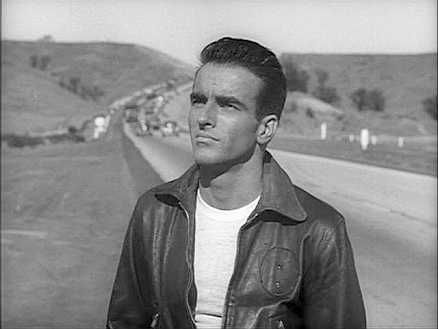
As the opening credits come up, we see Montgomery Clift hitchhiking along a highway trying to get to town. It turns out that the young man's name is George Eastman, and the place that he's going to is a business called... Eastman Industries. No, George doesn't own the place. Instead, it's his uncle Charles who owns the place, and George is looking for a job at the bottom of the ladder. Apparently, George's father and the rest of the Eastmans didn't get along all that well: Mom is working at the mission in one of the big cities in the midwest while the rest of the familiy is wealthy. It's not just that George's parents (Dad presumably died as we don't see him) are doing charity work; they really seem to belive the whole probably non-mainstream branch of Christianity stuff. But uncle Charles and his son Earl give George a job on the assembly line boxing shirts and blouses.

Most of the workers here are women, and Earl lets George know about the company policy in no uncertain terms: no romantic liaisons between the male and female employees. Not that they thought about sexual harassment back in those days; it was just easier not to have to deal with workplace romances. You can argue that it's good advice, but the policy is given so obviously that you just know George is going to fall in love with one of the workers there, which soon enough happens as he's walking home from work with Alice Tripp (Shelley Winters). In theory, a workplace romance might not be such a bad thing if one of them can get a job someplace else or if they can get married and the woman can become the housewife as would have been the expected thing back in 1951 when the movie was released. But of course the movie isn't going to work out that way.

George, being the nephew of the factory owner, eventually goes to meet his uncle Charles at the Eastman estate. While waiting for Charles in the billiard room, in walks young debutante Angela Vickers (Elizabeth Taylor). She's taken by George's raw manliness gained from having worked blue-collar jobs instead of a life of leisure that all the other young men she's ever known would have had. George falls for Angela because, well, she's played by Elizabeth Taylor, who really was a stunning looker up until about Butterfield 8. Of course, there's a problem in that George already has that relatinoship with Alice Tripp, and probably another problem in that George isn't really the right social class for Angela and her family. That latter problem could probably be solved, or at least ameliorated, if George can get his uncle to give him a promotion.

But the former problem is about to get much bigger. Alice informs George that she's going to have a baby! George is trying to have a relationship with Angela now, but having knocked up one's ex really throws a monkey wrench in the works. And Alice is making no bones about it. Do something now, or I'm telling everybody about our relationship. What's a young man to do? George decides to take Alice up to the lake for Labor Day, where he's going to rent a canoe, and let nature take its course, or perhaps push nature along. The story strongly implies that George is planning to murder Alice, but the way the scene is played deftly makes it ambiguous as to whether he murdered her, or whether she really fell out accidentally and then George committed negligent homicide by doing nothing to try to save Alice. Either way, though, George is going to have to pay, thanks to the Production Code.

Even though we know where the movie is going to wind up thanks to the strictures of the Production Code, it's still an excellent movie even after is starts the path along that preordained denouement. The story before that is top-notch and the last third is not bad at all. Elizabeth Taylor is OK, although her character is for most of the movie given fairly little to do other than look good and make it obvious why George would fall for Angela. And when you look as good as Elizabeth Taylor did back then, that's not hard. But then Taylor gets her finale and shows that was was going to blossom into much more than just a juvenile actress. Montgomery Clift is very good, playing the difficult role of the man who's gotten himself caught between two women and between two worlds, and has made a complete mess of his life. I've never considered myself the biggest fan of Clift's work, and yet every time I see one of his movies I find that there's an extremely high-quality movie to be had, and it's not as if he's detracting from that one bit. The reveltion, though, is Shelley Winters, who is very, very good, up until she announces that she's pregnant, at which point she's fabulous. It's just too bad that her character has to die off two-thirds of the way through the movie. Winters and Clift were both nominated for Oscars, although they both lost (to Humphrey Bogart in The African Queen and Vivien Leigh in A Streetcar Named Desire respectively). The movie won several awards, however, for George Stevens' direction, the screenplay, and the lovely black-and-white cinematography, among others.

If you haven't seen A Place in the Sun before, I strongly recommend it.

Monday, April 4, 2011

But the tribute is still six days away!

TCM has any number of programming blocks that it wouldn't have been a good idea to ditch and replace with the eventual salute to the recently-deceased Elizabeth Taylor, which is why it's not coming until Sunday, April 10. Tonight, for example, sees the start of an eight-night series on the 150th anniversary of the US Civil War. (I hope I'm not spoiling anything by pointing out that the North wins.) Every Monday and Wednesday in April, TCM will be showing movies about the war, of which there are many. I think it's 34 movies that are being shown, and many others, such as The Raid don't make the cut, probably in part because TCM wouldn't have been able to get the rights to them.

With that in mind, I note that one of tonight's selections, Raintree County is an Elizabeth Taylor movie, in which she plays a southern belle with Montgomery Clift as her love interest; it's coming on at midnight. Interestingly, it's also part of the salute to Taylor that will be coming up on Sunday, which makes me wonder a bit why the people programming TCM selected it. Raintree County (which isn't all that good in my opinion, but that's another story) is a 173-minute movie which on Sunday will be put into a three-and-a-quarter hour time slot. You'd think that the programmers could easily find a movie to fit into a 90-minute time slot, and one to fit into a 105-mintue time slot. But, looking at Elizabeth Taylor's work, there's surprisingly little that fits well into the 105-minute slot that TCM would easliy have the rights to.

Wednesday, February 2, 2011

Dear Montgomery

Today's recommended movie on TCM is the interesting and slightly odd Lonelyhearts, at 4:30 PM ET.

Montgomery Clift plays Adam White, a young man trying to restart his career in the world of journalism. The only editor who will give him a job is William Shrike (Robert Ryan), who's got a mean streak a mile wide, and a loveless marriage to a wife (Myrna Loy) who has decided she'd rather spend her days getting drunk on Cinzano. Shrike's sadistic side leads him to give Adam that job -- but only as the "Miss Lonelyhearts"-style advice columnist!

Montgomery Clift was never a Dear Abby, but still, after a while he takes to his job conscientiously, trying to give the best advice he knows how to the poor saps who write in to the newspaper. Things, however, take a turn when he rather stupidly decides to meet one of the people who's actually written him, a housewife named Fay Doyle (Maureen Stapleton). Like the boss' wife, Mrs. Doyle feels trapped in a crappy marriage and reaches out to poor Adam for love, despite the fact that he's already got a girlfriend (Dolores Hart). Worse, she's got a husband whose jealousy is matched only by our editor's malice! What's a poor advice columnist to do? (Perhaps he should try writing in to the advice column for help.)

Lonelyhearts isn't the greatest movie out there by any stretch of the imagination, but it's enjoyable enough as all of the actors are really professionals. You can't help but think most of them had seen their characters several times in the past: Ryan's meanness in Crossfire; Loy in Wife vs. Secretary; and Clift's brooding in A Place in the Sun. Only Stapleton, making her movie debut, is fresh, and she got a Supporting Actress Oscar nomination for her work.

Lonelyhearts has never made it to DVD as far as I'm aware, so you're going to have to catch the infrequent TCM showing.

Saturday, November 13, 2010

The Hitchcock completist

Back in 2004 or 2005, TCM had an Alfred Hitchcock week, running the famed director's movies every night in prime time, and into the wee hours of the morning. Some of the director's early work in Britain got aired, but most American viewers will recognize Hitchcock for movies from Rebecca onwards, that being the first movie Hitchcock made for David O. Selznick after coming over to the US. By my reckoning, of the movies Hitchcock made from Rebecca onwards, TCM is now down to two that haven't gotten shown since before the Hitchcock festival: Lifeboat, which is a Fox film; and Under Capricorn. One that only recently got stricken from the list is I Confess, which is getting another airing tomorrow at noon ET.

As with many of Alfred Hitchcock's films, I Confess is not a mystery, but a suspense film: Hitchcock lets us in on the secret early on. In this case, that secret is Otto Keller's (O.E. Hasse) murder of a lawyer in Québec City. Keller is a caretaker at one of the church rectories, and after committing the deed, he returns to the church, where he summons Fr. Logan (Montgomery Clift) to the confessional, and under the seal of confession, confesses to having killed this man. This sets up a fairly trite conflict, that of a priest not being allowed to violate the sanctity of the confessional. (Personally, I'd think that part of the penance ought to be admitting the crime to the police, and that God cannot grant salvation until the sinner does so. Apparently that's not the way the Catholic Church works.) Logan can't reveal what he knows, which turns out to be a huge problem, as he knew the victim. Inspector Larrue (Karl Malden), who has the task of investigating the murder, knows not only that Fr. Logan was acquainted with the victim, but that Logan is trying to hide something, which naturally places suspicion on Logan.

What Logan is hiding is a relationship he had had a decade earlier with Ruth (Anne Baxter), who is now married to a member of the Québec legislature. Before World War II, Logan had not taken the priestly vows, and was in love with Ruth. The war changed all that, and while Logan was facing the horror of war that caused him to become just friends with Ruth and want to join the priesthood, Ruth, realizing Logan was no longer in love with her, entered into a marriage of opportunity. Logan returned from the war and wants to tell Ruth what happened but, before she can tell him she's gotten married, the two get caught alone together by the eventual murder victim, who proceeds to blackmail Ruth (which conveniently also gives her and Logan the motive for the killing).

Now, we know that because of the Production Code, the real killer is going to get revealed to the authorities. But how it happens is what makes the movie interesting. I Confess is generally considered one of Alfred Hitchcock's "lesser" movies, but that's a bit unfair. If the movie has any problem, it's only that it's nondescript in that there's not really anything to make it stand out the way Alfred Hitchcock's other movies do. Still, Montgomery Clift and Karl Malden both deliver excellent performances. As with most of Hitchcock's movies, it's gotten a DVD release, so even if it doesn't show up on TCM all that often, you can watch it whenever you want.

Wednesday, November 10, 2010

Elia Kazan box set

Yesterday saw the release of a huge, 18-DVD Elia Kazan box set. Of course, having 18 DVD's isn't exactly cheap, and there's a list price approaching $200, although at Amazon you can get a 30% discout making the set cost "only" $140.

Unsurprisngly, Kazan's major works, such as Gentleman's Agreement, A Streetcar Named Desire, and On the Waterfront, are all part of the set. Five of the movies are new to DVD, including Wild River, which I blogged about back in April 2009. There's also the underrated anti-Communist drama Man on a Tightrope, which is currently in the Fox Movie Channel rotation, getting two airings later in November and one in December; it's going to be the subject of a blog post when one of those future airings is scheduled. Appaarently, A Tree Grows in Brooklyn never made it to DVD in the US before this.

Sadly, the information on the box set says that at the present time, there are no plans to make any of the DVDs from this box set individually available. Still, if you're looking to start a DVD collection, I suppose there could be worse places to start.

Friday, August 27, 2010

De Havilland's second

Today's TCM star in Summer Under the Stars is Olivia de Havilland, who won a brace of acting Oscars in her career. Both of those performances are airing in prime time tonight, although in reverse order. Her first Oscar performance, for To Each His Own is second at 10:00 PM ET; kicking the night off at 8:00 PM is the movie that won Olivia her second Academy Award: The Heiress.

De Havilland plays the title role, that of heiress Catherine Sloper. It's the 1850s, and Catherine is a young woman on the verge of becoming a spinster because her widowed father (Ralph Richardson) has been at best overprotective, at worst manipulative. Things change when Catherine meets Morris Townsend (Montgomery Clift). He's an heir himself, but he's fallen on hard times, having squandered all of his inheritance in Europe. The two fall in love, but father thinks that Morris isn't a good match for Catherine, and that he's in it only for the money. To that extent, he changes his will to disinherit Catherine if she marries Morris. Catherine will still have a nice inheritance from her mother, but what her father could leave her is even more. Still, Morris and Catherine plan to elope, but at the last minute, Morris gets cold feet....

Several years pass, during which Catherine's father dies. All of a sudden, Morris returns, claiming to have worked his way out west and then worked his way back. The implication is that he wanted to prove to Catherine that her father was wrong about him, and that he wasn't a fortune hunter in it for Catherine's money. Catherine still hasn't married, and is now faced with the difficult question of whether or not Morris is honest in his intentions....

The Heiress is an excellent, yet underrated movie. I think that's partly because it's one of the many Paramount movies for which the TV ended up being controlled by Universal; as such, it doesn't show up on TV as much as movies from MGM or Warner Bros. Secondly, the movie doesn't have anything obviously memorable. Unlike a disturbing movie like The Snake Pit or a great comedy or historical movies with lots of action, The Heiress depends upon its dialogue and portrayals, not really providing easily noticeable visuals. That, and it's the sort of movie that requires the viewer to think and be engaged. Having said that, the performances are quite good, not only from de Havilland, but from Richardson, Miriam Hopkins (playing Catherine's aunt), and even Clift; the last despite the fact that he really wasn't the best casting decision for a movie set in the 1850s. He's much better than John Lund in To Each His Own, however.

The Heiress has been released to DVD.

Friday, January 22, 2010

Katharine Hepburn vs. the New Wave

The passage of time leads to some movies losing their shock value, despite still being pretty darn good movies. Such is the case with the 1959 film Suddenly, Last Summer, which is airing at 6:00 AM ET tomorrow on TCM. The ending must have been shocking to viewers back in 1959, but today, it's more the main story that might surprise people.

Elizabeth Taylor stars as Catherine, a young woman who went to Europe for an extended vacation with her cousin. However, her cousin died on vacation, which has necessarily caused stress for poor Catherine. Enter Catherine's wealthy aunt Violet Venables (Katharine Hepburn), the mother of the deceased cousin. She has apparently learned the truth that Catherine knows about her son's death, and she doesn't want that truth to come out for whatever reason. So, she's put Catherine in a sanatarium to which she is a major donor, and is trying to pressure the doctors into giving Catherine a lobotomy, with the obvious intent to wipe the memories of the son's death out of Catherine's mind forever. This, frankly, is more shocking today than the ending.

Enter Dr. Cukrowicz, played by Montgomery Clift. He doesn't yet know the secret of the young man's death that's led to Mrs. Venables to want to lobotomize her niece, but he's determined to investigate to try to figure out whether or not Catherine really needs the lobotomy. Eventually, the truth will out, and if anybody, it might be the old aunt who belongs in an institution....

The two possible shortcomings that this movie might have are the fact that the subject material has become dated, and that there's a lot more dialogue than action. In fact, that shouldn't let you have a lesser opinion of the film. While I'm not a particularly big fan of any of the three leading stars, all of them do give good performances. Also, the flashback scenes in Europe are very stylistically done, reminiscent of something like the dream sequences in Spellbound. It's also made it to DVD, and the fine folks at Amazon only seem to be charging five bucks for it. Not a bad pickup if you ask me.

Tuesday, April 21, 2009

Wild River

The Fox Movie Channel is showing the relatively little-seen movie Wild River at 10:30 AM ET on April 22. It was apparently released on DVD in France at some point in the past, but doesn't seem to be available on DVD here in the US, so if you want to watch it, you'll have to catch an airing on FMC.

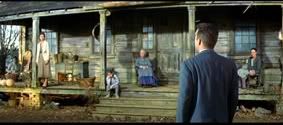
The story is a relatively simple one: in Tenessee during the New Deal, Chuck Glover, an agent of the Tennessee Valley Authority (played by Montgomery Clift), has the unenviable task of making sure one of the dam projects is finished on time. The reason that this task is unenviable is because the dams flood people off their propery, and although the government has used its power of eminent domain to purchase the land and is paying to help relocate people, there are some who don't want to move. Matriarch Ella Garth (Jo Van Fleet), who lives on an island in the river with her sons and their children, is one of those people, and it's Glover's job to convince the entire Garth family to leave.

It's quite understandable that Ella doesn't want to leave, as it's the only home she's known in her entire long life. Some of the relatives are willing to leave though; notably Ella's granddaughter Carol (Lee Remick), whose husband has died. Along the way, she falls in love with Chuck, which makes matters considerably more complicated. This being 1930s Tennessee, there's also the requisite racial tension, and the townsfolk's understandable mistrust of outsiders.

I've mentioned in the past that Montgomery Clift isn't my favorite actor. He's adequate here, but not the reason to watch this moie. There are two big draws in this movie. One is the cinematography, in lovely color and widescreen, nicely capturing the essence of rural Tennessee in the 1930s. Wild River is a movie that wouldn't work as well in black-and-white, or in the older more rectangular format that had been the norm until the introduction of Cinemascope. Just as good, though, is Jo Van Fleet. She was in her mid-40s when she made Wild River, but was made up to look like she was 80. Van Fleet is fabulous playing the tired old lady attached to her land, no longer having anything else to live for. She completely overshadows Clift, and the tired love story between him and Remick.

Wild River is a movie that deserves broader recognition, and this is your opportunity to see it.