Showing posts with label Rod Taylor. Show all posts

Friday, October 10, 2025

The dominator of the seven seas

Sometimes, TCM runs a bunch of movies that have nothing thematically in common other than using a certain word in the title. One example from some months back was a day of films with the number "seven" in the title; this gave me the chance to record at least one version of Seven Keys to Baldpate as well as a completely new to me movie, Seven Seas to Calais.

The movie opens in 1577 in a port city. A man is looking for Francis Drake (Rod Taylor), but it's dangerous business as the man has a map that other people want, and for obvious reasons. The map has the locations of places on the Pacific coast of the Americas where the Spanish have supposedly gone ashore to mine for gold and silver. This is important for geopolitical reasons: England is militantly Protestant under Queen Elizabeth I (Irene Worth), while Spain is one of the guardians of the Catholic faith and has been agitating Catholic Mary, Queen of Scots into trying to start a coup against Elizabeth. Stopping Spain from getting all that New World wealth would really help England.

So Drake, with the help of that man from the opening scene, assembles a crew and heads for parts unknown, at least unknown to the crew who aren't quite happy about that, not that they have much choice. But the English are the virtuous ones here, so of course Drake is able to defeat the Spanish over in the New World and even liberate a bunch of the indigenous before heading back to England where he'll be knighted. This, of course, really pisses off the Spaniards since they know full well how he's been responsible for the depredations against the Spanish shipping crossing the Atlantic, which is part of why they're trying to help Mary.

History tells us that Mary was eventually beheaded in early 1587 for her presumptive part in what's known as the Babington (played by Italian actor Terence Hill) Plot to try to assassinate Elizabeth. Drake here helps foil the plot, although the foiling of it is what's going to lead the Spanish to try something much more dramatic, which is to send an entire armada to attack England and try to destroy the English fleet. Drake commands the English fleet against Spain and of course wins, saving England and enabling them to head across the Atlantic to start their own colonies.

What I didn't realize until starting to write up the review is that Seven Seas to Calais is actually another of those Italian historical action movies that used a popular Hollywood star along with a bunch of Italians and what were presumably funds a Hollywood studio (this one was distributed by MGM) was required to spend in Italy. Rod Taylor is rugged and handsome enough to play Francis Drake. Beyond that, the role isn't particularly demanding in terms of acting range although it does require some physicality. Seven Seas to Calais is also not breaking any new ground in the presentation of history, any more than most Hollywood historical dramas of the era did. Instead, it's simply meant as entertainment; in that regard, it more or less works. Seven Seas to Calais is nothing great by any means, but it's also not terrible.

Thursday, July 11, 2024

Raintree County

Eva Marie Saint is TCM's Star of the Month for July 2024, and one of her movies that's been on my DVR and that I haven't posted about before is Raintree County. It's on TCM again tonight at 10:00 PM, so I made a point to watch the movie to do a review on it now for the upcoming showing.

Once again, Eva Marie Saint is only a supporting actress here, although she shows up a lot earlier than the actual lead actress. The movie opens up in 1859 in Raintree County, Indiana, which is partly a sign that the Civil War is about to hit the US and change everybody's life. Everybody is about to graduate high school, and this being 1859, it's a huge deal that the class is going to be... photographed. Head of the class is John Shawnessy (Montgomery Clift), who is a bit of a dreamer. He's kinda-sort going steady, at least by 1859 standards, with fellow student Nell (that's Eva Marie Saint if you couldn't tell), and everyone expects them to get married relatively soon since younger marriages were much more common in those days.

Except that one of their teachers, Prof. Stiles (Nigel Patrick), tells the class the legend Johnny Appleseed, He went through the midwest planting trees, and supposedly he planted on specific raintree after which the county is named, somewhere in the county's forbidding swamp. Find the tree, and you'll find the secret of life. It's a ridiculous idea, but this is the 1850s when there was more ignorance in the world, and young John is impressionable. So he blows off his girlfriend to go into the swamp looking for the tree.

Visiting the county for some reason is southern belle Susanna Drake (Elizabeth Taylor). Johnny is immediately taken with her looks, and continues to blow off Nell in order to spend time with Susanna. Enough time alone with each other, in fact that there might be the opportunity for Johnny to knock up Susanna before she leaves to go back home. Indeed, they must have had sex because some time later Susanna shows up back in town to tell Johnny that she's with child and he's the father of the child. I'd guess Johnny knew enough about sex to know that if he hadn't done it with Susanna, there's no way she could be bearing his child.

Johnny does the honorable thing and marries Susanna before heading south with her to live in her part of the country. The two stop in a plantation where Susanna grew up, at least before the place burned down in a fire. Johnny, in talking to the people who still live there, learns that Susanna's mom went insane, and Susanna may in fact be inheriting her mom's mental state, not that they quite understood genetics at the time. But it's the reason for the insanity that's a problem: The woman who went insane might not have been Susanna's biological mother, and that Susanna is in fact the product of a relationship between Dad and one of the family's slaves!

Oh, the movie is going to get a lot more ridiculous. John and Susanna move back north, and the Civil War breaks out. Johnny doesn't volunteer, at least not until Susanna runs off with their child to someplace in the south, leaving Johnny to join the Union Army just so he can spend all his time looking for Susanna, which I'd think might involve a bit of desertion. Meanwhile, Nell is still around, and still pining away for poor Johnny.

Raintree County was based on a novel publised a few years after World War II that was a commercial success. It's not hard to see why MGM would want to buy the rights and think that this sort of melodramatic material that has shades of Gone With the Wind would be a big hit. But the movie wound up in production hell in part because the novel's writer killed himself. And then when it finally did get made, nobody seemed to undertand just how wacky the material is. It also didn't help that this is the movie Clift was making when he had the very serious car crash that nearly killed him and delayed production for months.

Raintree County is certainly not the best film for anybody involved in the production, I'm sorry to say.

Wednesday, June 14, 2023

Do Not Disturb

There are a couple of movies in the FXM rotation that I don't think I had gotten around to seeing the previous time they were in the rotation. So now, I made a point to record the couple I hadn't seen before so that I could do reviews of them when they show up on the schedule. One such movie is Do Not Disturb. It's got a pair of airings tomorrow (June 15), at 3:05 AM and 1:15 PM.

Doris Day is the star here, as Janet Harper, an American who's having difficulty adjusting to the UK since this is before the decimalization of the currency. She's only in London because her husband Mike (Rod Taylor) is there for business. He works for an apparel company that makes woolen goods, and trades in ideas from fashion shows as well as showing off ideas of the company's own. This means he has to do a fair bit of travel, which is going to cause issues later in the movie.

But in the early stages of the movie it's purely Janet who's causing all the problems. Since they've just moved to London, they're being put up temporarily in the middle of town on the company dime, not far from the office and all the business engagements Mike is going to be involved in. Mike wants Janet to find a place not far away for the two of them to rent, but she decides to do her own thing and rent a house out in county Kent complete with housekeeper Vanessa (Hermione Baddeley). This unsurprisingly ticks Mike off, since the commute is going to be a bitch and keep him away from Janet.

Janet does other things to tick Mike off, like screw up his commute and take in a bunch of stray animals without even consulting Mike about it. She, meanwhile, is worried that he's going to forget their wedding anniversary. And she's also afraid that Mike might be having an affair with his personal assistant Claire (Maura McGiveney). Mike has to go off to Edinburgh and Paris for business meetings, and when interior decorator Paul (Sergio Fantoni) shows up, that gives Janet the idea to follow Paul to his other office in Paris without telling Mike.

As you can guess, Janet and Mike are going to find each other in Paris, and it's going to lead to more complications since Mike's more experienced colleague Simmons (Reginald Gardiner) knows that everybody at these fashion shindigs doesn't want wives along for the ride. It's sexist nonsense, and Simmons knows it, but that's just the way the culture is. (On the one hand you can argue that these men are supposed to be working, so the wives shouldn't be close at hand but seeing the sights if they're non-working women. But that of course is not the way the men mean it.) Once again you can guess that Janet is going to get the idea to pose as Claire and be at the big function in Paris, leading to a conclusion in which Mike and Janet find out that everything's been a big series of misunderstandings.

Do Not Disturb is the sort of movie Doris Day had made several times by now, especially with Rock Hudson. Now it's old hat, and worse thanks to a subpar script that writes Janet as a character who's really not that likable in the first half of the movie, even though the script expects us to think her quirks are charming. I mean, if you're posted to London for business and tell your spouse to get a flat near where you're working, aren't you going to be pissed if your spouse without telling you rents a place out in the country?

If you haven't seen any of Doris Day's romantic comedies, there are a lot that are better to start with, such as Pillow Talk. Save Do Not Disturb for later.

Sunday, July 4, 2021

The Glass Bottom Boat

I hadn't quite intended to do two posts on Doris Day movies within a relatively short amount of time, but I notice that The Glass Bottom Boat is going to be on TCM tomorrow at 4:00 PM, so I figured that now would be a good time to watch it and do a post on here.

Day plays Jennifer Nelson, a widow living with her dog Vladimir who does some work for her father, Axel Nordstrom (Arthur Godfrey). He runs a tourist boat doing cruises off of Catalina Island, the glass-bottomed boat of the title, and when he tells the tourists that they might even see a mermaid, Jennifer is supposed to dive under the boat wearing a mermaid costume. The two communicate by radio, each having transmitting equipment in their houses.

On one of the cruises, Jennifer accidently gets hooked by fisherman Bruce Templeton (Rod Taylor). As you can guess, Jennifer isn't very happy about it and at first doesn't necessarily like Bruce. But you know that Jennifer and Bruce are going to meet again in fairly short order. That meeting comes because they both work at the same firm, an aerospace comapany doing research for NASA and the space race. Jennifer is in public relations, while Bruce is doing the heavy lifting on scientific research.

And indeed, Bruce has discovered a secret formula which will allow NASA spaceships to overcome some of the problems that stem from weightlessness. The importance of the formula means it's naturally something that America's rivals like the Soviet Union would love to get, so there's substantial security around Bruce and business partner Zack Molloy (Dick Martin) in the form of General Bleecker (Edward Andrews) and security guard Homer Cripps (Paul Lynde). And unsurprisingly, trying to get the secrets is bumblinb spy Julius Pritter (Dom DeLuise).

Homer overhears Jennifer on the phone calling up her dog to get him some exercise running around the house, and that's one of the first things that gets people to think that perhaps Jennifer might be one of the spies. She isn't of course, and Bruce doesn't want any part of believing it as he and Jennifer fall in love. But there's a true bad guy who can use that to his advantage by making certain the CIA go off in the wrong direction in pursuit of the spy.

Eventually, the Three's Company-style misunderstandings lead the authorities to believe that the information drop is going to happen at a party Bruce is giving at his fabulously 1960s house. At that party, Jennifer overhears the authorities first suggesting that she's the spy, and then arguing that she might be too stupid to do it well, which enrages her and has her try to turn the tables on everybody. Except that she winds up with the secrets, and running for her life from the real spies.

The Glass-Bottom Boat was directed by Frank Tashlin, who got his start in World War II making cartoons (indeed, he directed one of the Pvt. Snafu shorts made to train servicemen during the war). As such, the movie is directed not just as a romantic comedy, but an over-the-top spy spoof -- watch for the cameo from Robert Vaughn, who at the time was the star of The Man from U.N.C.L.E. Unfortunately, the movie doesn't always work, as some of the comedy feels too frenetic and forced. It also goes on a bit too long, being about 110 minutes when it probably should have been 10-15 minutes less.

On the plus side are the sets, with great 1960s houses and fashions, and the futuristic look of Bruce's kitchen, especially the pre-Roomba robotic vacuum cleaner which is used in several scenes. Doris Day and Rod Taylor are also a very appealing couple. It's not Day's best movie, but anybody who's already a fan of hers, as well as people who are into vintage 1960s set designs, will find a lot to like in The Glass Bottom Boat.

Monday, January 27, 2020

Young Cassidy


Er, not that Cassidy....

One of TCM's daytime themes back in December was of "young" characters, that is some famous people earlier in their lives. The movies included Young Cassidy, which is on DVD courtesy of the Warner Archive collection. Not having blogged about it here before, I decided to watch and do a post about it.

Rod Taylor plays the title role, a man named John Cassidy who ultimately becomes the Irish playwright Seán O'Casey, whom you may recall from Alfred Hitchcock's version of his play Juno and the Paycock. (He was born John Casey, and among his pen names was apparently Cassidy and a Gaelicized version of Cassidy.) He's a laborer in Dublin circa 1910, a time in Irish history which was about to get very turblent, something that you may again remember from another classic movie, Clark Gable's Parnell. A lot of the Irish are getting radicalized due to the grinding poverty and want home rule if not outright independence. As for Cassidy, he tries to add to the support of his family by writing revolutionary pamphlets and short stories.

Along the way, Cassidy meets the prostitute Daisy (Julie Christie) and has a brief affair with her; he also meets bookstore employee Nora (Maggie Smith) and has an affair with her to. A couple of the events in the run-up to the 1916 Uprising are depicted, but Cassidy rejects joining the military arm of the revolutionaries because he thinks their military tactics are stupid. Eventually Cassidy sells a short story but is apparently too stupid to know what a check is or how to open a bank account, and he needs that money to pay for the funeral of his dear beloved Irish mother (Flora Robson).

Cassidy continues to struggle and eventually writes a play Shadow of a Gunman, which the famous writier and Abbey Theatre proprietor W. B. Yeats (played by Michael Redgrave; the name rhymes with mates and not meats) accepts for staging. It's not much of a success, but Cassidy eventually writes another play, The Plough and the Stars that causes a literal riot at the Abbey Theater (this was based on a real incident), and Cassidy has to leave for England, eventually becoming Seán O'Casey.

There's probably enough material in O'Casey's life to make a good biopic, but we don't really get it in Young Cassidy. That's because it was produced by John Ford, who was supposed to direct as well before illness got in the way. Ford had a nauseatingly doe-eyed view of Ireland culminating in the ultra-treacly The Quiet Man. Irish politics of the era was incredibly complex, since there was all that difficulty with Britain followed by a Civil War (to this day, the two biggest parties in Irish politics don't fit into the standard left-right spectrum seen in most other countries). But with the large number of Irish-Americans, we only seem to get a view of the country that says "Britain Bad, anti-Britain good" and generally avoids the complexity. (Granted, I probably go too far in the opposite direction from growing up with a mother of Irish descent and seeing the inveterate whining of the sort of Irish-Americans still claiming to be fighting against bigotry that hadn't existed for generations.) John Ford is probably the worst of the lot when it comes to the subject.

Still, some of the acting is good, as should be expected when you've got people like Maggie Smith and Michael Redgrave in the cast, and the production values with Irish location shooting are good. And some of you will probably like this one more than I did. So as always, watch and judge for yourself.

Wednesday, December 18, 2019

Where's the Kenny Loggins song or the shirtless volleyball?


Over the Thanksgiving weekend, DirecTV had a free preview weekend of all the movie channels, so I got the chance to record a bunch of stuff I otherwise wouldn't have. (Having a brand new empty DVR helped, too.) One of the movies I recorded was the 1955 western Top Gun.

Sterling Martin plays Rick Martin, who doesn't seem to be into superstion, black cats, or voodoo dolls. Instead, he's a gunfighter who's returning to his hometown in the Wyoming territory where his mom is buried. The townsfolk don't like him because they know his reputation and consider him responsible for a couple of the bodies in the cemetery. Indeed, people like Lem Sutter (a young Rod Taylor) would like to take Martin down in a gunfight.

But Martin has other ideas. He'd been spending some time with outlaw gang leader Tom Quentin (John Dehner), and has learned that Quentin and his gang plan to raid the town tomorrow to make it an open town safe for all sorts of vice. He tells the marshal, Bat Davis (James Millican), and the marshal is sympathetic. But is the town council, led by big landowner Canby Judd (William Bishop) going to listen to Martin?

It turns out that there's a lot more going on between between Martin and Judd. First is the matter of Martin's dead mother. The offical story is that she mortgaged the family ranch for $5,000, and the night she did so the money was taken from her and she was shot, enabling Judd to get his hands on the land. But a look at the records office shows that somebody had glued a mortgage declaration on top of what was really a bill of sale, do Judd used dirty tricks to get the Martin ranch.

The other big thing is Laura (Karin Booth). She was Martin's girl before he had to leave town the last time some years back, and in the meantime she decided that she didn't want to be married to a gunfighter, even though Martin's plan was to pick her up to head west for California and start a new life there. Instead, Laura has gotten engaged to... Canby Judd, a wedding that's supposed to take place in a few days' time.

That is if the Quentin raid doesn't do terrible things to the town. Two strangers walk into the town bar, and Bat quickly figures out they're from Quentin's gang, trying to get information. And Judd is still trying to figure out ways to get ride of Martin, the sort of keeping your eye off the ball that could make the Quentin raid more likely to succeed.

Top Gun, as you can probably figure out, has absolutely nothing to do with the Tom Cruise movie of the same title or the coming remake, but is just a standard-issue 1950s programmer western. There's nothing notably bad about it, but also nothing that will make it stand out. It's available on DVD as well as Amazon streaming if you get the Starz package. Note that when StarzEncore Westerns ran it, the put it in a 16:9 format when IMDb claims it's still in the Academy ratio (not surprising for a B western even though it's after the introduction of Cinemascope). Indeed, the StarzEncore presentation looked badly stretched until I was able to adjust the aspect ratio.

Wednesday, May 15, 2019

Fate is the Hunter

The second of the two new-to-me movies that showed up on FXM at the beginning of May is Fate Is the Hunter. It's going to be on again tomorrow at 11:20 AM, as well as twice over the Memorial Day weekend.

The movie starts off rather spectacularly. Rod Taylor plays Capt. Jack Savage, who is a pilot for Consolidated Airlines Flight 22, from Los Angeles to Seattle. 49 passengers board, along with a rookie stewardess and more experienced stewardess Martha Webster (a very young Suzanne Pleshette). The plane takes off, and shortly into the flight, one of the two jet engines blows out, forcing the plane to head back to Los Angeles for an emergency landing that should be routine since the planes were designed to land with just one engine. But they'll be delayed a bit by three planes coming in for a landing that are going to have to move out of the flight path. And then the alarm comes on for the other engine being out, and the radio goes dead. They're going to have to do a crash landing. And it would have worked too, if it weren't for that goddamn pier on the beach. Everybody but Martha dies.

Glenn Ford plays Sam McBane, the director of flight operations for Consolidated and up for an executive position. He used to be a pilot, having served during part of World War II alongside Savage, so this crash has hit him personally. It's about to get a lot more personal, though, as the vulturous media are circling. They want answers so that the lawyers can start suing somebody. Sabotage is quickly dismissed, as is mechanical error. More worrying, during the recovery process it's determined that the second engine did not in fact blow out, despite Martha having reported it. The only explanation left is pilot error.

Sam starts doing his own investigation before the Civil Aeronautics Board can crucify Savage, and finds that his old friend's reputation precedes him. Savage was a Jack Carson-like manipulator during the war, taking a cavalier attitude and taking other people's women, as with Sam's date with Jane Russell (playing herself). It's continued, with Savage having broken off an engagement with Lisa (Dorothy Malone in an uncredited role) to take up with ichthyologist Sally (Nancy Kwan). Savage was also seen cruising a series of bars with friend Mickey, whom Sam does not know.

The first day of the hearing into the crash doesn't go well (or realistically) at all, which gives Sam the ridiculous idea of taking another identical plane up into the air to determine what might have happened. (They didn't have nearly the quality of simulators then that they do now.) Will this reveal whether Savage was not in fact at fault?

Fate Is the Hunter isn't a bad movie, but I have to admit that as I was watching it, I found myself thinking that the material might have been better-suited to a TV Movie of the Week. There's a lot of talk going on, and much of the movie seems designed to give each of several names one big cameo scene. Still, it's entertaining enough if nothing spectacularly good.

As far as I'm aware, Fate Is the Hunter is not available on DVD, so you're going to have to catch the FXM showings.

Monday, October 30, 2017

Endless World

One more movie that I watched off my DVR because you can get it on DVD and Blu-ray is World Without End.

The movie starts off in the sometime not too far in the future from when the movie was made (1956), but far enough in the future that the first manned mission to Mars is going on, with four astronauts in the rocket: Dr. Galbraith (Nelson Leigh), John Borden (Hugh Marlowe), Herbert Ellis (Rod Taylor), and Hank Jaffee (Christopher Dark). The mission, which is really just a reconnaissance mission, seems to have gone successfully. At least, until it's time to turn around and head for home. At that point, they lose radio contact and something happens to send the rocket to a superfast speed, knocking all four men out. When they come to, the ship crash lands.

They discover that the atmosphere of the world outside is like that of Earth, so they head out. Indeed, the place seems strangely like Earth, except that there are no people. They find a cave, only to discover that there are giant spiders in it! And then they get to a cemetery and discover the truth: they're in Earth's distant future, at some point after a nuclear war. Far enough that the radiation has dissipated, but they're still not certain quite far. Einstein's theory of relativity and the idea that an observer going extremely fast will see time pass much more slowly than a stationary observer at least from a fixed reference point like planet Earth. (The fact that Earth is moving doesn't matter here, as the time dilation really doesn't start to matter until you get close to speed of light. Even at 10% of the speed of light, the difference is only about one second every three minutes.)

They've got bigger problems than the fact that they're centuries in the future. The nuclear war left survivors, but they're all mutants. Not just those spiders, but mutant humans that live like cavemen except that some of them look more like cyclops. Our astronauts have to fight them, but they won't be able to hold off forever.

There's a bit of luck for them in that in one cave they come across a stainless steel door. It turns out that there are survivors who aren't mutants, and in order to survive the war they moved underground, staying there to escape the mutants. Timmek leads the underground people, while his daughter Gamet shows quite the interest in the astronauts from the past. In fact, all of the men seem to have no ambition, while the women are impossibly beautiful and friendly to the astronauts.

The astronauts eventually learn that this underground civilization is dying, and that the only way they can live is to move back above ground. They should have the technology to defeat the mutants, but the menfolk don't want any more violence. And they don't even want to help the astronauts start the new above ground civilization.

World Without End is quite good for what it is, which is a 1950s science fiction B movie. It's moderately intelligent, what special effects there are are generally not that bad (except for the spider in one scene), and the production values are high: the movie got the color and Cinemascope treatment. Sure, compared to prestige movies it's still low-budget and just science fiction. But it works and is more than entertaining enough.

Tuesday, February 2, 2016

The Train Robbers

Yesterday, I mentioned that none of the movies I've watched recently seem to be available on DVD. It turns out that I was wrong. The Train Robbers does, in fact, seem to be available on DVD, so I can feel comfortable doing a full-length post on it.

The movie starts off in some desolate place that is apparently a town where somebody lives, since there's a hotel there, and the train does make a stop. In fact, there are two people waiting for the next train to stop, Jesse (Ben Johnson) and Ben (Bobby Vinton). The train eventually arrives, and off get Mrs. Lowe (Ann-Margret) and Lane (John Wayne). It is these two for whom the two men have been waiting, becuase Mrs. Lowe has a job for all of them.

It seems as though a few years earlier, Mrs. Lowe's husband was part of a group of 10 people who robbed a train of its Wells Fargo strongbox, with a large amount of gold in the box. Needless to say, while the robbery itself did go well, the aftermath didn't go so well, and Mr. Lowe wound up being killed. However, his murder wasn't before Lowe was able to hide the money somewhere, and Lowe told his wife about the location. Now, Mrs. Lowe wants to go get the gold and... return it to Wells Fargo so that she can claim the reward and clear her husband's name for the sake of her son! Lane and the rest of the men she's hired will get a cut of the reward.

Of course, such a scheme is not without its problems. Mr. Lowe was killed, but he was part of a group of 10 people, and not all of those 10 are dead. So when Lane and company head south into Mexico to get the location (which not even Lane knows precisely) where the gold has been hidden, the other people who were in on the robbery are bound to take an interest in getting that gold for themselves. And sure enough, every time we get a sequence of the Lane gang on their horses, it seems to be followed by the people chasing Lane and his crew. But there's also one person who seemingly stands alone, as though he may be following both groups, a man played by Ricardo Montalbán who doesn't get any speaking lines until the film's finale.

Eventually, Lane and his group get to where the gold is stashed, and the other men get there too, so there's a shootout as each group tries to get the other group's horses to run off, which would mean the other group can get away and get a good head start. But since Lane is the good guy here, we can probably guess who's going to get the money.

The Train Robbers is entertaining, if nothing new. Well, for the most part it's entertaining. If you've seen a bunch of westerns before and are a fan of John Wayne, then you'll probably enjoy this one just fine, like sitting down with an old friend. If you're the sort of person who's new to westerns, I think I'd recommend quite a few other movies first, only because there are other westerns that are notable, while The Train Robbers is more like pleasant background music. The by-the-numbers production is one of the few problems the movie has; the other one is that it has too many long scenes of the players on horseback. The Train Robbers is only about 90 minutes, and you could probably shave a good 10 minutes off fast-forwarding through all those montages, which have no dialog so you won't miss anything.

Thursday, January 29, 2015

TCM's Rod Taylor Tribute

They didn't have hot tubs in Victorian England
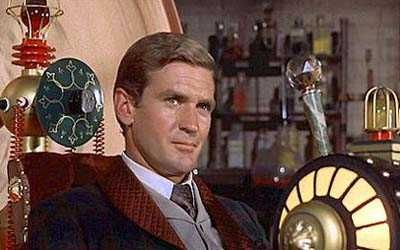
Rod Taylor in The Time Machine (1960)

Rod Taylor died three weeks ago, and TCM is finally getting around to a night where it could ditch the previously scheduled movies. TCM will be running five of Taylor's movies in prime time tonight:

First, at 8:00 PM, is The Time Machine, in whihc Taylor travels 800,000 years into the future and finds that mankind has devolved into two races;
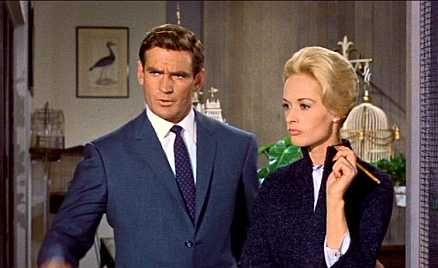
Next, at 10:00 PM, Taylor goes to Bodega Bay, CA, and finds that the birds there don't like him or Tippi Hedren in Alfred Hitchcock's The Birds;
At 12:15 AM, Taylor spends a Sunday in New York with Cliff Robertson and Jane Fonda;
Taylor plays Irish playwright Sean O'Casey under the pen name Cassidy in Young Cassidy, at 2:15 AM; and
Taylor gets to do a comic turn with Doris Day in The Glass-Bottom Boat at 4:15 AM.

Friday, January 9, 2015

Rod Taylor, 1930-2015


Rod Taylor and Tippi Hedren in The Birds (1963)

The news came in overnight of the death of actor Rod Taylor. Taylor, who was born in Australia but moved to Hollywood early in his career after landing a part in a Hollywood-financed movie filmed in Australia. Taylor worked in supporting roles in movies such as The Catered Affair and Separate Tables before getting his chance to be a leading actor in the 1960 science fiction classic The Time Machine.


Rod Taylor in The Time Machine (1960)

For those who don't know, The Time Machine is based on HG Wells' novel about a Victorian-era man who invents a time machine and travels to the distant future, 800,000 years ahead, and finds that human life on Earth has devolved into a childlike race of Eloi living above ground, and the evil Morlocks. Taylor's character falls in love with one of the Eloi. I have to admit this movie has never quite been a favorite of mine, but it does show up a lot on TCM.

Taylor actoed regularly throughout the 1960s, playing alongside a cast of big stars in The VIPs; opposite James Garner in 36 Hours, and opposite Doris Day in The Glass Bottom Boat>. There's also Sunday in New York, which was just on the other day.

I don't know that TCM has announced any programming tribute for Taylor yet.

Wednesday, January 23, 2013

The Catered Affair

I'm somewhat surprised to see that I haven't blogged about The Catered Affair before. It's showing up tomorrow morning at 9:45 AM as part of a salute to Ernest Borgnine, who would have turned 96 tomorrow.

Borgnine plays Tom Hurley, a working-class father of a family living in a cramped apartment in New York City. Tom is a taxi driver, and has been saving up money to get his own cab and license to run it -- something that takes a lot of money due to the limited number of cab licenses. (Don't get me started on the economics of taxi medallions.) It's taken a long time because being a cabby in a one-income family isn't exactly the road to wealth, and they've got a bachelor uncle Jack (Barry Fitzgerald) living with him, his wife Agnes (Bette Davis), and their daaughter Jane (Debbie Reynolds).

Jane's about to throw a monkey wrench into all of this, however. She approaches her parents one day and tells them that she's gotten engaged to her boyfriend Ralph (Rod Taylor). Ralph is a teacher and decidedly of a higher social class than Jane, and especially her parents. Now, this is no big deal for Jane. She's perfectly comfortable having a small wedding with a few friends, not wanting to cause problems for anybody and wanting to get on with life. Any sane groom-to-be ought to be happy with such an arrangement, too: if you can get a low-mainenance bride, take her! (OK, I apologize for the insults to any married women her who think I'm describing them as high-maintenance brides. But having seen both of my sisters get married, and having had to bury grandparents and multiple uncles and aunts, I've seen how stressful things can get when you've got a family member who wants things to be just right.)

The problem, it turns out, isn't so much Jane; it's mother Agnes. She's disappointed that she hasn't been able to provide as much in life for Jane as a mother thinks a daughter should be provided for, and dammit, she's determined to see that the last thing she does for Jane is a big thing. As Agnes keeps wanting to do more and more for Jane, Jane gets horrified. But even more than her, it's Tom who's aghast. He's the one who's going to have to pay for the wedding party, and there's only one source of money: the savings that Tom has been planning to use to get his own cab and medallion.

There's not much more to all of the plot than this, and yet The Catered Affair is a wonderful little movie. Borgnine is an underrated actor, I think. Sure, he won the Oscar for Marty, and yet in a lot of his roles he doesn't get the attention a lead actor should deserve. Indeed, The Catered Affair is much more Bette Davis' movie than it is anybody else's. And yet, Borgnine's father character here is eminently believable. The same holds true for Davis, who I think is clearly playing a woman who wants something she couldn't have when she got married. People like to mock the later careers of actresses who were big in the 1930s and had to suffer the ignominies of aging concurrent with the breakdown of the studio system in the 1950s, and point to Bette Davis' work in the 1950s and beyond as a good example of this. Whatever you can say about Davis in a movie like Hush, Hush, Sweet Charlotte, however, doesn't apply to The Catered Affair. Debbie Reynolds was good in those musicals she did, but in The Catered Affair, she's a surprise, as she more than capably plays the sincere daughter who doesn't want to burden her father, and can't get this point through her mother's thick skull. And even Barry Fitzgerald isn't quite as irritating as he normally is when he's playing the Lovable Irish Stereotype character.

The Catered Affair was based on a teleplay by Paddy Chayefsky, who also did Marty and Network, among others. The screenplay, however, was reworked for the movie version by Gore Vidal. I obviously don't quite know what working-class New York City was really like in the mid-1950s, but the depiction here certainly seems realistic. The Catered Affair is also available on DVD.

Thursday, April 5, 2012

Another night of Doris Day comedies

TCM's week-long salute to Doris Day has several 1960s comedies tonight, starting at 8:00 PM with previous recommendation Please Don't Eat the Daisies. As I said in 2010, it's nice enough. Another comedy that's nice, but rather more inane, is The Glass Bottom Boat, which airs at midnight tonight.

Doris Day plays Jennifer, whom we see at the start of the movie working for her father's tourism business, playing a mermaid who swims under Dad's titular glass-bottomed boat for the tourists to see. Unfortunately, her costume gets hooked by recreational fisherman Bruce (Rod Taylor). It turns out the two have something in common besides being out to sea that day: Jennifer is an employee at the aerospace company Bruce runs. The only thing is, there's a problem at the company: they're doing defense work, but it seems as there's a mole somewhere in the company trying to pass secrets to the Soviets. Jennifer's getting close to Bruce, combined with some other misunderstandings, such as Jennifer's constantly making phone calls to a mysterious "Vladimir" (who turns out to be her dog), lead to her being suspected as the spy.

The problem that The Glass Bottom Boat has is that it's formulaic fluff. After the release of Doctor No, the first James Bond movie, both spy thrillers and spoofs became popular genres in the decade. Indeed, both of our leads here made another movie that could be considered a spy spoof: Taylor's The Liquidator, and Day's Caprice. Unfortunately, one of the drawbacks is that a lot of these movies now come across as rather severely dated. (Granted, it's not the moviemakers' fault that the USSR collapsed.) Also, you know that Day and Taylor's characters are going to fall in love, but thankfully they're both good enough at fluff that they pull off the romantic part well. And particular to The Glass Bottom Boat, and unlike The Liquidator or Caprice, the bad guys just aren't believable enough to cause the requisite tension.

Still, The Glass Bottom Boat is entertaining enough, especially if you're a fan of Doris Day or Robert Taylor. Both did much better work, however.

Thursday, January 26, 2012

The Liquidator

A couple of weeks ago when I was mentioning TCM's tribute to Jack Cardiff, I said that there was going to be a night of movies directed by Cardiff. These include The Liquidator, which is coming on overnight at 1:30 AM.

Rod Taylor stars as "Boysie" Oakes, who at the start of the film is a British tank commander in World War II, leading his tank into the Paris which is just being liberated from the Nazis. While trying to get his bearings, Boysie sees a man getting chased by Nazis, who are trying to kill the man for presumably being a spy. Boysie kills the two assailants, and earns the enduring gratitude of this man (Trevor Howard).

Fast forward many years, and Howard's character, Mostyn, is now in charge of British intelligence. They've got a problem of various British citizens being traitors and selling secrets to foreigners. They could put these double agents on trial, but the problem with that is that it would be a public relations disaster and would also reveal state secrets. So British intelligence gets the brilliant idea of starting a dirty ops campaign of bumping off these agents. And Mostyn knows just the man to recruit to do the killings: Boysie.

It turns out that Boysie is running a pub in the English countryside, and keeping up relations with quite a few women to boot. Mostyn woos Boysie with the promise of high pay and a wonderful flat in London in exchange for becoming a secret agent, although he doesn't first tell Boysie that his work is going to involve killing people. Boysie goes to London with Mostyn, only to find out too late that the job involves murder, which Boysie really doesn't like.

At this point, The Liquidator starts to take a more darkly comic turn. Boysie, not wanting to kill anybody but being duty bound to do so, hires a contract killer to do all the killings for him. Meanwhile, Boysie still continues his womanizing ways, trying to bed Mostyn's secretary Iris (Jill St. John) despite the fact that this is highly illegal. To get around being spotted having a relationship with Iris, Boysie arranges for the two to meet in the south of France and have a weekend fling there. Unfortunately, Mostyn finds out. And then to make matters worse, Boysie gets captured as part of a real spy drama.

The Liquidator is a movie that has in interesting premise, but ultimately falls flat. Rather like The Big Street, it's a movie that tries to straddle two genres -- in this case comedy and a spy thriller -- and never really knows which side it wants to plant both feet in. The thriller parts aren't thrilling enough, and the comic parts aren't comic enough. The casting is quite right, I think: Rod Taylor is just the right person to cast as a dashing ladies' man who can also do masculine spy work. Trevor Howard seems to be reprising his role in Faher Goose, but doing a good job of it. And Jill St. John is easy on the eyes in a role that's really not very demanding. The spy scenes in France have quite a few character actors who are entertaining enough. But in the end, I think they're all let down by a flawed script.

The Liquidator doesn't seem to have gotten a DVD release, so you're going to have to catch the TCM showing.