Sunday, March 8, 2009

Tokyo Story

I mentioned the 1953 Japanese classic Tokyo Story back in September and again in November. Tokyo Story is this week's selection for TCM Imports, and is airing at 2:00 AM ET on March 9. It's well worth watching, even if it is a bit too long.

Saturday, March 7, 2009

A new season of TCM's Essentials

Now that 31 Days of Oscar is over, TCM is starting the 2009 season of The Essentials, in which Robert Osborne sits down with a guest host to discuss some movies that are "essential" for any movie buff to see. This year's guest host is Alec Baldwin, and their first selection is the 1935 Marx Brothers' movie A Night at the Opera; tonight at 8:00 PM ET.

To be honest, I'm not that big of a fan of the Marx Brothers. However, I do think that The Essentials is a good idea. As I have mentioned before, not everybody knows the classic movies all that well, and for those of us who would consider ourselves serious film fans, our taste in movies might seem a bit obscurantist when viewed from the eyes of an average person. (After all, we get the Korda brothers on Thursdays this month.) Consequently, it's a good idea for TCM to do things to introduce some of the better-known classics to people who might not realize they'll like such movies.

Friday, March 6, 2009

Horton Foote, 1916-2009

Horton Foote, the playwright who also won two Oscars for his screenplays, has died at the age of 92. Foote's Oscars were for adapting the novel To Kill a Mockingbird for the screen, and for his screenplay for Tender Mercies. Interestingly enough, I haven't posted about either of these movies, but have mentioned two other of Foote's works: Tomorrow, which is based on a story by William Faulkner; and The Trip to Bountiful, in which Foote adapted his own play.

Thursday, March 5, 2009

The Runaway

On Friday, March 6, at 1:45 PM ET, TCM is showing a movie that took 45 years to see the light of day: The Runaway.

Roger Mobley plays the title role, Felipe, a Mexican boy with a very poor life. He crosses back and forth between the US and Mexican sides of the border, claiming that he's got family in the US, but keeps getting deported to Mexico. As the movie opens, he's living with an older couple that breeds dogs but, due to having committed some petty crime, has to leave. As he leaves, he takes one of the greyhound puppies with him. Felipe stows away on the truck of a Catholic priest, Father Duke (played by Cesar Romero), who lives on the American side of the border but does a lot of work on both sides. Unfortunately for Felipe, he's found out at the border. There's a bright side, though, which is that he is remanded to the custody of Fr. Duke, who takes him to his rectory in America.

What happens next is fairly predictable: the good father takes this boy under his wing, using the dog as a way to get to the boy's heart and turn him into a much better-behaved boy than he's been before. The dog being a greyhound, you also know that the two are going to turn to racing the dog (never mind the fact that greyhound racing is much less glamorous than it's portrayed to be in the movie).

The Runaway is a good family movie, although in the grand scheme of things it's nothing special. While much of what happens is predictable, that's not necessarily a bad thing when dealing with movies for your kids to watch. Mobley turns in a good performance as the boy, while Romero is equally good as the priest. And dogs are always nice to look at on the screen. The credits also claim that the nun in the movie is played by Anita Page. However, she hadn't made a movie for 25 years, and wouldn't make another movie for 35 more years afterwards

For some reason, the makers of this movie couldn't get a theatrical release at the time they made it (a fact which might have something to do with the paucity of credits). It lay languishing somewhere for 45 years, until TCM resurrected it and gave it its premiere in the fall of 2008. As a result, it also hasn't made its way to DVD, and it's probably not likely to any time soon. Still, if you've got kids, this is a good movie to record for them.

Wednesday, March 4, 2009

Ronald Reagan, Part 3: The Shortcoming

I've mentioned Reagan's better qualities as an actor in two previous posts, while also claiming that he wasn't exactly the greatest actor. Our next selection highlights that shortcoming: Night Unto Night, 1t 10:45 AM ET on March 5.

Here, Reagan plays scientist John Gaylord, who's been diagnosed with epilepsy, and is sent to Florida because the air down there is allegedly better for his health. He rents a large house so that he can continue to do his research, and while in Florida, meets prominent artist C.L. Shawn (played by Broderick Crawford). Meanwhile, Gaylord learns that Ann Gracy, from whom he's renting the house (played by Swedish actress Viveca Lindfors) has some secrets of her own. She's a widow, and thinks she heard the voice of her dead husband in that big house while she was packing up her things.

Well, you can guess what's going to happen next: John and Ann fall in love. There are a bunch of problems, however. First, John doesn't want Ann falling in love with him, because his epilepsy is leading him to believe that he's got a much reduced life expectancy, meaning Ann is about to lose another she loves. Also, Ann's sister has a thing for him. So, John becomes moody and withdrawn, not wanting Ann to have anything to do with him -- especially when he has another seizure.

Just when you thought things couldn't get any worse, they do, as a hurricane is threatening to come ashore, making life a mess for everybody....

Night Unto Night has so many problems. Reagan, being the lead here, has the biggest problem, which ironically is the boundless optimism that served him well in the B movies a decade earlier. John Gaylord is a much darker character, and Reagan seems wholly unable to tap into any emotions that could bring out such darkness in John. Instead, Reagan comes across as stiff and wooden. It's the sort of role that really should have been played by somebody like Gregory Peck, or even James Stewart after he came back from serving in World War II.

But to say that Reagan's casting made this movie a failure is a bit unfair to Reagan. Broderick Crawford was an excellent actor, having won an Oscar for All the King's Men, and later appearing in the outstanding Born Yesterday. But Crawford is all wrong in Night Unto Night, being wholly unconvincing as an artist. Lindfors was brought in by the studio specifically to be the new Swedish thing, and it seems as though the studio bosses paid no mind to whether she was in fact given any good material for her first Hollywood project. So perhaps the fault lies with director Don Siegel, or maybe even with the people who wrote the formulaic screenplay which seems to be cobbled together from bits and pieces of plot devices from old movies.

Or perhaps the production Night Unto Night was doomed by events outside its control: At the time of filming, there was a strike involving one apparently corrupt union trying to muscle another less corrupt union out of Hollywood. Night Unto Night was effectively breaking the strike by virtue of simply making the movie. Whatever the problem, though, Night Unto Night is a deeply flawed movie that's all the more fascinating for those flaws. Like much of Reagan's work, however, it's not available on DVD.

Ronald Reagan, Part 2

Ronald Reagan's likeableness and eternal optimism made him an obvious choice to be the leading man in several of Warner Bros.' B movies of the late 1930s other than the action movies in which he played Brass Bancroft. The one which most clearly shows this is Accidents Will Happen, airing overnight, at 4:30 AM ET March 5 on TCM. Here, Reagan is the leading man, playing an insurance investigator who has to face a fraud ring: a group of criminals are staging fake accidents, and then claiming the insurance money. It's Reagan's job to prove that they are in fact committing fraud. Along the way, he has to deal with his wife, who wants the better things in life that the fraudsters are getting, and that Reagan can't because he's just too gosh-darn honest. Despite a completely different plot, it shares a lot of foundation as the Brass Bancroft movies: it's breezy and full of activity, and always fast-paced at a short 62 minutes. Is it a great movie? Not by any means. But as I've mentioned a lot with the B movies that Hollywood was making back in the 1930s, the studios needed a lot of product to put on their screens as part of the double feature with the big movie, and Accidents Will Happen is a fine example of that. You could find a lot worse ways to spend those 62 minutes than to watch Accidents Will Happen. Heck, just try watching some of the musicals that Hollywood put out before 42nd Street if you want to see some bad movie-making.

A much more interesting movie than Accidents Will Happen with Reagan in the cast is Girls On Probation, airing at 2:00 AM ET on March 5. Here, Reagan is only in a supporting role; the star is Jane Bryan. She plays a "good girl" working at a dry-cleaners, who falls afoul of the law when her bad-girl friend (Sheila Bromley) working there borrows two of the dresses for them to wear to a party. Instead of being sent to jail, however, she's shown pity by insurance adjuster Reagan who, having fallen for her, gets her probation and a job in another town. In that other town, Bryan meets Bromley again, and decides to give her a piece of her mind, climbing into Bromley's car to do it. Unfortunately for Bryan, Bromley's driving the getaway car for her bank-robber boyfriend, and Bryan's being there for it has some pretty serious legal ramifications! The plot twist is ludicrous at best, but typical for the late-30s B movie; in fact, it's one of the things that makes some of these B movies so much fun. Reagan is adequate here, but he doesn't have much to do.

Tuesday, March 3, 2009

Jean Harlow, 1911-1937

Marie Dressler and Jean Harlow in 'Dinner at Eight' (1933)

Jean Harlow was born on this day in 1911. Sure, any day is a good day to post photos of the lovely Miss Harlow, but the anniversary of her birth is the most approriate day.

In the photo above, from the 1933 movie Dinner at Eight Harlow is seen with Marie Dressler, after just having told Dressler that she's read a crazy sort of book. If you haven't seen the movie, Dressler goes on to deliver one of the great one-liners.

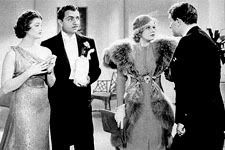
I've also recommended Harlow in Libeled Lady, from which this second photo is taken. Harlow, of course, is the blonde second from right, talking with Spencer Tracy who has his back to the camera. Harlow, of course, died tragically young, at the age of just 26. It's interesting to think about what might have come in her career later, but also a shame that she died young enough to allow this.

Ronald Reagan, Part 1

TCM's Star of the Month for March 2009 is Ronald Reagan. Reagan has come in for a lot of criticism as an actor by those who opposed his political career, and I think those criticisms are somewhat misplaced. Sure, Reagan spent the better portion of his career making the "B" movies that Hollywood needed to churn out in the studio era, but so did a lot of the other people. A lot of those Reagan performances are serviceable, even if they're nowhere near as good as what you'd get in a "prestige" movie.

TCM's look at Reagan starts off on Wednesday, March 4, with the four movies he made playing Secret Service agent "Brass" Bancroft. These are all solidly B pictures, and as such they're of varying quality. But when they go wrong, it's not Reagan's fault. They all run about an hour, and Reagan is likeable as the Secret Service agent who maintains his optimism in spite of whatever troubles befall him. In Code of the Secret Service, airing at 9:15 PM ET Wednesday, for example, Reagan's Bancroft has to head to Mexico to figure out what happened to one of his colleagues who was murdered investigating a counterfeiting ring. There, Bancroft meets a priest played by veteran character actor Moroni Olsen, who just happens to be the bad guy. It's no great shakes, but it's enjoyable enough entertainment.

Perhaps the best of the four movies might be Smashing the Money Ring, at 10:30 PM Wednesday. Again, Bancroft has to deal with counterfeiters. (This isn't the fault of the writers; the Secret Service was founded to deal with counterfeiting, not protecting the President. It was originally part of the Treasury Department, but its became part of the Department of Homeland Security in 2003. The writers couldn't possibly have anticipated this.) This time, Bancroft goes undercover in a prison to investigate rumors that money plates are being smuggled through the prison printing press. The plot quickly turns to a gambling ship, though, in a typical example of a B-movie's plot suddenly veering from one thing to another. Still, it's fast-paced, and more than enough fun.

The worst example is probably the last of the movies, Murder in the Air, at 11:30 PM ET Wednesday. This time, Bancroft ends up on a blimp (years after the Hindenburg disaster effectively put a huge crimp in blimp research), and gets involved with a device that can stop engines via remote control. It's far more laughable than the previous Brass Bancroft movies. But the fault is largely that of the script writers. Reagan tries his hardest with impossible material.

Monday, March 2, 2009

More on The Philadelphia Story

I mentioned The Philadelphia Story about a year ago, specifically in reference to Katharine Hepburn's playing a self-absorbed jerk. It's airing again at 10:00 PM ET on March 2, and if I weren't in the Eastern Time Zone, I'd stay up to watch it to the end. From Franz Waxman's opening piano theme to the photographic ending, it's a movie that glitters with MGM class in every single shot.

Today, though, I'd like to mention a different cast member's performance: Virginia Weidler. She plays the kid sister of Katharine Hepburn, and she's perfect. She's precocious and bratty, even before the grown-ups get the idea to put on an act for the tabloid reporters played by James Stewart and Ruth Hussey. As such, she gets some really choice lines in the movie. Their father has been doing something (presumably fooling around and drinking) that causes Hepburn not to want him at the new wedding, and Weidler knows fully well that something is up: "The papers are full of innundo," she says. And she knows about what happened between her sister and the first husband (Cary Grant): "Is he going to slug her again?" she asks her mother. And then, there's her rendition of "Lydia, the Tattooed Lady", which has to be seen (and heard) to be believed....

Sadly, Virginia Weidler retired young from the movies and suffered a lifelong heart ailment that eventually caused her premature death when she was only in her early 40s. However, we still have her movies, and The Philadelphia Story is one of her best.

Sunday, March 1, 2009

Lions and Lambs

Today being the first day of March, I'm reminded of the proverb about March "coming in like a lion and going out like a lamb". (Or is it the other way around?) If you want lions in the movies, you can't miss. Just watch any MGM movie.

Seriously, for lions in the movies that are real characters, there are still quite a few. The old fable of Androcles and the Lion has been made into a movie a bunch of times, most notably by Hollywood in 1952 with Victor Mature and Jean Simmons. Lions in Roman times are a suitable combat partner for gladiators, as in Cecil B. DeMille's outrageous The Sign of the Cross.

There are more contemporary lions in 1960s movies such as Clarence, the Cross-Eyed Lion, or the true story Born Free. And for a completely different kind of lion, you can't go wrong watching Paper Lion, about George Plimpton's tryout with the Detroit Lions football team.

Lambs don't seem to show up as much, simply because they're not as interesting as lions. The good people of the island of Foula herd sheep in Michael Powell's excellent The Edge of the World, but other than shepherds, I can't think of sheep showing up too often. I suppose I could mention Lambada, but that has nothing to do with sheep....