Wednesday, February 17, 2010

Arthur Kennedy, 1914-1990


Arthur Kennedy (at the podium) drumming up support for a wrongly accused boy in a way that disgusts Glenn Ford in Trial (1955). Photo courtesy Life magazine

Today marks the birth anniversary of Arthur Kennedy, a veteran supporting actor who, like Thelma Ritter, was nominated several times without ever winning an Oscar. I've recommended his work in Trial before, one of his four Supporting Actor nods. Apparently, it still hasn't been released to DVD, not even to the TCM Vault Collection, which is a real shame. Another of the nominations came in Peyton Place, where he plays the drunken stepfather of Hope Lange. One of Kennedy's earlier roles came as the wrongly accused man that Dana Andrews gets off the hook in Boomerang!, although this didn't earn him attention from the Academy.

Unlike Ritter, Arthur Kennedy did get one Best Actor nomination, for playing a blind World War II veteran in Bright Victory.

Five Star Final

I've briefly mentioned the movie Five Star Final a few times in the past, notably for the fact that it's the original version of Humphrey Bogart's early One Fatal Hour. It doesn't air too often, but TCM is showing Five Star Final tomorrow morning at 8:45 AM ET.

Tuesday, February 16, 2010

Reacting is acting, too

Sometimes, the purpose of a role in a movie is to serve as a bouncing-off point for the actions of the main character. I've mentioned the movie The Bellboy before, in which Bob Clayton's function as Jerry Lewis' boss is pretty much just an impetus for Lewis to perform each of his funny sketches. A different type of impetus comes in the comedy The Sunshine Boys, which TCM is showing overnight tonight at 12:15 AM ET.

Walter Matthau stars as aging actor and former vaudevillian Willy Clark, who was part of the famous comedy team Lewis and Clark back in the day, but is now struggling to find work even though he doesn't want to retire. Fortune smiles upon him though (or at least, seems to) when a TV producer wants to do a special on the history of American comedy, and bring back Lewis and Clark for one performance as part of that special.

The only problem is, Lewis and Clark haven't seen each other in a decade, and the duo broke up in part because of the death of Lewis' wife, and in part because they ended up at each other's throats. Lewis (played by George Burns) is retired now, and it takes quite some convincing for Clark's agent (also his nephew, played by Richard Benjamin) to convince Lewis to come out of retirement. We can see why when the two old comics first meet again. They quickly return to their old bickering ways, threatening the whole production.

It's here that George Burns really shines. In real life, he had played the straight man to his wife, Gracie Allen, and his role here is in many ways a straight man role, with a bit of a twist. That twist is that Lewis' deadpan, straight-guy delivery seems habitually to do nothing more than wind up the manic and almost scheming Clark (Matthau played variations on that theme many times). And boy does it get Clark wound up. Matthau is supposed to be the star here, and he's quite funny, doing an excellent job. But in many ways, it's Burns' understated delivery that really makes the movie work; indeed, while Matthau was nominated for a Best Actor Oscar (losing to Jack Nicholson in One Flew Over the Cuckoo's Nest), Burns walked away with the Supporting Actor statuette. The Sunshine Boys is a movie that's warm at heart, although as a movie from after the studio era, it does contain some bad language.

That having been said, if you're a fan of classic entertainment, I think you'll love The Sunshine Boys. One benefit in addition to the story is that the opening features some footage from The Hollywood Revue. The movie has also been released to DVD.

Monday, February 15, 2010

Oscar loves the mentally unstable!

There's something about playing against type, and playing uncomfortably troubled people, that the folks doing the nominations for the Academy Awards seem to like. In more recent years, we've seen Oscars go to killers in movies like Monster and Silence of the Lambs, and a psychotic fan in Misery, among others. But even generations ago, fighting personal demons could get you Oscar notice, as happened to Olivia de Havilland in The Snake Pit, which TCM is showing tonight at 8:00 PM ET.

De Havilland stars as a young wife in New York who ends up in a state mental institution, for reasons that aren't entirely clear to her. She's had some sort of breakdown, but she isn't as bad off as some of the other patients. This allows her to see more clearly the horror that mental patients had to go through: The Snake Pit is, above all else, a stinging indictment on the treatment of the mentally ill. She and the other patients are pretty much caged up, with treatment in many cases given to them whether they want it or not -- although for quite a few of the patients, they wouldn't have known what was going on. In other words, this is a view of mental institutions diametrically opposed to that in a movie like Love Crazy. Indeed, in one of the more harrowing scenes of the movie, de Havilland is subjected to electroshock therapy. The whole thing must have been deeply disconcerting to the audiences of 1948, much the same way Ray Milland's ugly alcoholic Don Birnam in The Lost Weekend challenged audiences a few years earlier.

De Havilland was nominated for a Best Actress Oscar, but didn't win, in part because she had won a few years earlier (for To Each His Own) and because there was an equally outstanding performance to vote for that year, that being Jane Wyman's deaf-mute in Johnny Belinda. That having been said, de Havilland is superb here, but not the only one. The other patients, including Beulah Bondi, Lee Patrick, and a brief appearance by Celeste Holm are equally worth watching, as is the doctor who tries to help them (Leo Genn) and the nurse who thinks force needs to be used to keep the patients in check. (Shades of The Caretakers here.)

The Snake Pit has been released to DVD and, despite being 60 years old, is still a powerful look at mental hospitals, especially as it's based upon a real story.

Sunday, February 14, 2010

TCM celebrates Valentine's Day, too

TCM is showing some romantic movies for the Valentine's Day holiday. One that I don't think I've ever recommended before is Ball of Fire, airing at 6:00 PM ET tonight.

Gary Cooper stars as Professor Potts, one of a group of bachelor professors working on an encyclopedia at the behest of a wealthy benefactor. They're living in the benefactor's old house, where they can be cloistered away from anything that will distract them from their work on the encyclopedia, notably women. The scholars are going through the encyclopedia alphabetically, and have reached the letter S, where they're struggling on an article about slang. How are a bunch of old fuddy-duddy professors going to learn about the hip slang of today? (Hollywood's fuddy-duddies have always had a problem figuring out how to appeal to the youth of today, but that's a different story.)

Their problems are solved when into their life walks moll Barbara Stanwyck. Her boyfriend, the gangster Dana Andrews, is involved with crime, and she could be subpoenaed to testify against him. In order to prevent that, she finds the old house with the professors and, when she discovers just who is living there, she figures it's the perfect place to hide. The fact that the professors can use her because she knows all the crazy new language of today is a plus. Now, the viewer can figure out what's going to happen next, which is that Cooper and Stanwyck are going to fall in love with each other, and that this is going to cause a whole host of problems. First, it disrupts work on the encyclopedia, and could cost the professors their jobs; second, there's that gangster boyfriend, who wouldn't like it if somebody horned in on his girl. Finally, there's also the legal problems that could still land the moll in jail....

Ball of Fire works on so many levels. It's one of the many great romantic comedies based on mismatches between the male and female love interests. The fact that this time, one of the characters has an interest in language means that there's a lot of opportunity for some interesting dialog. Cooper and Stanwyck were both capable actors who could do comedy even if that's what they weren't best known for. Last but by no means least, the actors playing the other professors are a great set of character actors of the early 1940s. There's S.Z. "Cuddles" Sakall (the connection to the following movie, Casablanca, at 8:00 PM); Henry Travers (the father from Shadow of a Doubt and Jimmy Stewart's guardian angel in It's a Wonderful Life); and Oskar Homolka, among others.

Ball of Fire is a sparkling comedy that has been released to DVD.

Saturday, February 13, 2010

Another Fox love story

As I mentioned yesterday, the Fox Movie Channel is airing romantic movies all Valentine's Day weekend. One that aired this morning, and is airing tomorrow at 6:00 AM ET, is Me And My Gal.

The movie stars a young Spencer Tracy, who, as I mentioned in April 2008, spent the beginning of his movie career working at Fox Films (before they merged with 20th Century Pictures). Here, he's playing an Irish-American cop working the waterfront beat in New York City. He meets the cashier at a local seafood joint (Joan Bennett), and meets her again when he's called in to investigate a noise complaint at the wedding of her sister. This sister provides the dramatic plot line of the movie: she had been dating a gangster, but after he got sent to prison, she decided to marry right and got hitched with a sea captain whose father was wounded in the Great War and is now paralyzed. Unfortunately, while the husband is at sea, the old gangster boyfriend breaks out of prison, and comes to her place to plan a bank heist.

Me and My Gal has a little bit of everything, making it quite a curious little movie. The plot with the hiding boyfriend bizarrely comes together with the paralyzed father. He sees the gangster in the mirror when his daughter-in-law tries to spirit him into their garret, and when he tells the sister (ie. Bennett) and Tracy about it, he does so by blinking and winking his eyes in Morse Code! You'd think they'd devise an easier system of blinks for yes and no, and spell out the message that way, since they both make it clear they don't know Morse Code. The movie was released in 1932 and as such, has some pre-Code stuff, including an odd love scene on the lunch counter in the joint where Bennett works, and one where Bennett shows off her can when she adjusts the radio. There's a comedy element in the first 10 minutes involving a chronic drunk which doesn't do much to advance the plot other than giving a reason for Tracy to get promoted off the waterfront beat. And, there's a parody of an 1932 movie from MGM, Strange Interlude (which was based on a Eugene O'Neill play), in which the characters say one thing to eatch other, but the audience hears a second line from each, which is what the characters really think.

Tracy does about as good a job as he can with the material, but it's not all that great. It is, however, interesting in its flaws, and that makes it worth watching. It doesn't seem to be available on DVD, so you'll have to catch this FMC airing.

Murder on the Orient Express

I mentioned Murder on the Orient Express briefly a long, long time ago. TCM is showing it again, overnight at 4:00 AM ET on February 14.

The brief rundown is that Richard Widmark plays a businessman taking the Orient Express from Istanbul to Paris in those glamor days of the 1930s when taking a train like the Orient Express was elegant. However, the train gets stuck in the snows of the Yugoslav Alps, and Widmark is found murdered in his cabin. It's up to detective Hercule Poirot (played by Albert Finney) to find the killer.

And, it seems as though everybody in the car could have been the killer. Not only that, but it's quite the all-star cast; as I mentioned back in April 2008, the suspects range from a nun (Ingrid Bergman, in a role that won her her third Oscar) to a Russian princess (Wendy Hiller) to a Hungarian count (Michael York) to a British colonel (Sean Connery). They're a motley crew of head-cases, and they make the movie utterly charming. It's helped by the art direction; there's something about the demise of the studio system that made period pieces better. As much as I like a lot of the historical dramas from the 1930s, the studio system makes the sets and locations look inauthentic.

Thankfully, Murder on the Orient Express is on DVD, so you don't have to get up in the middle of the night to watch this one.

Friday, February 12, 2010

A Fox Valentine's Day

The Fox Movie Channel usually doesn't do much of a job a programming its lineup. Once in a while, though, they come up with a special block of movies that actually does a fairly good job. This weekend, for example, sees a bunch of more romantic movies, what with the Valentine's Day holiday, and a reasonable mix of old movies and more recent stuff. One of the older movies I haven't recommended before is The Ghost and Mrs. Muir, which FMC is showing at 12:15 PM Saturday.

The always-lovely Gene Tierney stars as Mrs. Muir, who's recently been widowed and left with a young daughter (Natalie Wood). She takes a vacation on the English coast, and finds a little cottage with which she falls in love. She finds that the house is being sold at a bargain basement price. She buys the place, and soon finds out why it was such a steal: the house is haunted. (Sound familiar?)

The big difference between this ghost and the ghosts in The Uninvited is that this house's ghost (played by Rex Harrison) is at heart not a bad man. The man was a sailor, and died when he accidentally left the gas on. He still thinks the place is his, and only wants to scare away people who want to turn it into something of their own. Mrs. Muir, however, refuses to be cowed, and eventually she and the ghose come to an agreement: he'll stop trying to haunt her, as long as she keeps the place having a maritime theme, and if she'll write the man's memoirs. Mrs. Muir sets out to write the book, and begins to learn that those stereotypes about sailors are apparently true. (Thanks to the Production Code, the salty nature of the memoirs are only implied, although that probably makes the movie work better than if it had more explicit language.) Along the way, Mrs. Muir and the ghost fall in love, too.

That is, until she meets fellow author Miles Fairley on one of her trips to London to meet with her publisher. The two begin to fall in love, and he takes a place by the sea, too, much to the consternation of our friendly spirit back at the cottage. However, Mrs. Muir eventually discovers that Miles may not be the man for her after all.

The Ghost and Mrs. Muir is a charming love story that's got something in it for almost everyone. For the women, it should be obvious: that love story. Younger girls should also enjoy the romantic story and the fantastic nature of it. I don't think teenagers would like it that much -- especially the boys -- although younger kids who enjoy boats or ghosts may tolerate it. As for the adult men? Well, they've got Gene Tierney to look at!

The Ghost and Mrs. Muir is available on DVD, as is the soundtrack, which is a score by Bernard Herrmann. Amazingly, the DVD is cheaper than the music.

Thursday, February 11, 2010

Alexander's Ragtime Band

Yet another Fox movie is showing up on TCM tonight: Alexander's Ragtime Band, kicking the night off at 8:00 PM ET. I've already blogged about it, and almost everything I'd want to say about it I said back in July, 2008.

One point I didn't mention back then is that, although it's got a lot of the songs of Irving Berlin, one that it doesn't have is "Puttin' on the Ritz". Originally used in a 1930 movie of the same name, "Puttin' on the Ritz" had a different set of lyrics than the ones that are well known today. (After all, Gary Cooper wasn't really that famous back in 1930.) The original lyrics refer to the black hired help strutting around on their night off, and perhaps the folks at Fox didn't want to use it for whatever reason. MGM, however, had no qualms about having Clark Gable sing it in Idiot's Delight a year later, with the original lyrics. The lyrics that are famous today were reworked by Berlin so that he could include the song in the 1946 movie Blue Skies, where Fred Astaire does a famous dance to "Puttin' on the Ritz". It should be pointed out that the song "Blue Skies" is not original to the 1946 film; indeed, it's one of the many to show up in Alexander's Ragtime Band.

Wednesday, February 10, 2010

Kiss of Death

I see that TCM is showing Kiss of Death tonight at 8:00 PM, and that I've never done a full post on the movie. Time to correct that oversight.

Kiss of Death is generally remembered for being the movie that sees the screen debut of Richard Widmark, and made him a star. But more on that later, since he doesn't get top billing. The starring role goes to Victor Mature, who plays small time hood Nick Bianco. Nick is part of a gang of thieves who gets caught in a jewelry store heist while the others escape. When he gets sent to prison, the DA (Brian Donlevy) offers him time off in exchange for giving the authorities information on various crimes. In part because he shares a cell with Tommy Udo (the aforementioned Widmark), who has a hatred for "stoolies", Nick refuses to do so. That is, until he learns that his wife has committed suicide, and his two daughters have been put in an orphanage. Nick, wanting to be the one to raise his kids, relents, decides to name names in order to gain his release, and make right by his children. He gets let out, gets remarried (to Colleen Gray), and tries to live on the straight and narrow -- until he finds that the information he's given, on Udo, isn't enough to convict him.

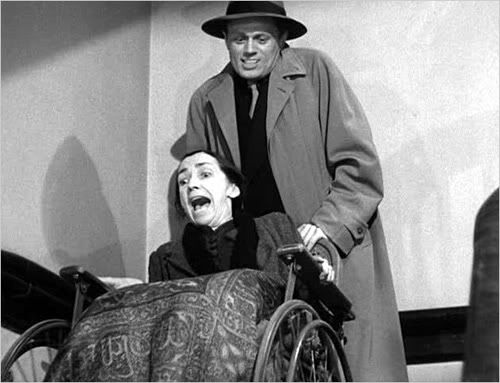
Nick fears Tommy, and is right to do so. Tommy quickly begins looking for Nick, and will seemingly let nothing get in his way. Udo isn't just menacing, he's downright sadistic. In what is probably the most famous scene in the movie, Udo goes to the apartment of the wheelchair-bound mother of a fellow gangster (the mother is played by Mildred Dunnock). He wants information, and when she refuses, Tommy takes the poor old lady, ties her up, and pushes the wheelchair down a flight of stairs in order to kill her. Not only that, but Udo has a sinister giggle that quickly became the stuff of parody. Richard Widmark is just that good here. The role earned him an Oscar nomination for Best Supporting Actor, but he had the bad luck of being up against Edmund Gwenn playing Santa Claus in Miracle on 34th Street. Widmark never got another nomination.

Despite stealing the show, Widmark isn't the only reason to watch Kiss of Death. The plot isn't a bad one, and Victor Mature does a pretty good job as well. Watch also for a youngish Karl Malden in one of his earlier roles, playing a police sergeant. (Thankfully with that nose of his, you can't miss him.) I've mentioned in the past that Fox released a lot of its noirs to DVD, and this is one of them.