Tuesday, December 16, 2014

Destination Murder


TCM is showing a bunch of crime films made in 1950 tomorrow morning and afternoon. Most of them are decidedly B movies, which isn't necessarily a bad thing. As an example of how that's not bad, you can watch the interesting movie that opens the day's proceedings, Destination Murder, at 6:00 AM.

The basic plot is simple, but the way it unfolds is rather complex with a bunch of twists and turns. The movie starts off with a bang, almost literally. Jackie Wales (Stanley Clements) is at a movie with his girlfriend. During the intermission, he gets up, presumably to go to the restroom or the concession stand. In fact, he's picked up by a boss of sorts named Armitage (Albert Dekker). Armitage drives Jackie to a house where Jackie, having changed into a uniform worn by telegram delivery boys, rings the doorbell and shoots Mansfield, who answers! It's the perfect crime, except for one thing: during the getaway Mansfield's daughter Laura (Joyce Mackenzie) shows up having returned from boarding school or something. She sees Jackie, and can even identify him from a police lineup, but... nothing else happens!

What's a woman to do? Why, this woman decides that a little ingenuity might be a good thing. She strikes up a relationship with Jackie, who is apparently more than willing enough to dump the girlfriend he had at the movie theater in favor of Laura. Laura eventually learns that Jackie has some dealings at Armitage's nightclub, so Laura goes to the club along, looking for a job! Of course, her real reason is so she can get inside and try to get some inside information on what's going on with Jackie and Amritage so that she can get the people responsible for her father's death. After all, Jackie only pulled the trigger; certainly somebody ordered the hit.

What follows is a twisty plot with blackmail; a double-dealing moll (Myrna Dell); a vicious, scheming assistant (Hurd Hatfield); torture set to classical music; and some plot turns that you you should probably expect to exist because of the genre of film, but the specifics of which you may not see coming. The ending is one that conforms to the Production Code, so you know the bad guys are going to get theirs. And since we know from the beginning who the bad guys are, there's a bit less suspense than there otherwise might be. Overall, though, Destination Murder is a fun little B movie that entertains just fine, even if afterwards it may blend in with all the other B crime movies from the era.

Destination Murder has received a DVD release courtesy of the Warner Archive collection.

Monday, December 15, 2014

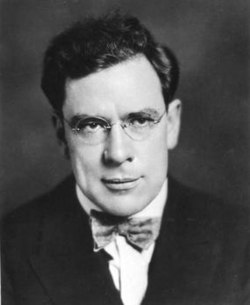
Maxwell Anderson, 1888-1959


Today marks the birth anniversary of playwright Maxwell Anderson. Several of his plays have been turned into movies. Probably the best known of those movies would be Key Largo, which I never realized was based on an Anderson play, although to be fair John Huston apparently changed the play almost beyond recognition. I've seen the movie but never seen or read the play, so I wouldn't know.

Perhaps a better example, then, of Anderson's work might be his play Elizabeth the Queen, which was adapted for the screen as The Private Lives of Elizabeth and Essex in 1939. The ending of Elizabeth the Queen can also be seen being performed on stage by Alfred Lunt and Lynn Fontanne in the delightful film The Guardsman; the rest of the play is a Ferenc Molnar work. Anderson actually wrote several plays about that period of English history, including Mary of Scotland which was turned into a movie in 1936, and Anne of the Thousand Days, which didn't become a movie until a decade after Anderson's death.

Anderson did more contemporary work, too, writing the play Saturday's Children, which became a film twice, with the better known version being the early 1940s version starring John Garfield, and The Bad Seed, which in fact was the subject of a post on Anderson's birthday back in 2008.

Anderson also did screenplays from other authors' work too; perhaps the best known among these would be the Joan Crawford version of Somerset Maugham's story Rain, or the Fredric March version of Death Takes a Holiday.

Sunday, December 14, 2014

Silentology

TCM is airing The Camerman overnight tonight at 12:30 AM as part of the regular Silent Sunday Nights feature. I was looking for a good picture to illustrate the post I was going to do on the movie, and found that one of the pictures linked to a post about the film at the blog Silentology. Lea, from the looks of that and the other posts I've read, clearly has a much greater love and knowledge of silents than I do. Not that I dislike silents, mind you; it's just that I'm not particularly well-versed in the topic compared to those who are avid fans. I also have to admit that I've really preferred silent comedies to silent dramas. To me, the physical humor necessitated by having to do comedy without dialog holds up better than the outsized melodrama that the dramas tend to have.

At any rate, I notice that Silentology not only has a bunch of interesting posts about the movies, it's still a going concern. Those two qualities -- especially the latter -- are the two things that make me want to put a blog into my blogroll over on the right side of the screen, so Silentology has been added.

Lea will be running a Buster Keaton blogathon in February; I'm undecided as to whether I'm going to take part. Most likely I'll do what I normally do when I see a blogathon: think it's a neat idea; spend several days coming up with an interesting idea, and then forget about it until after the blogathon has come and gone.

Saturday, December 13, 2014

Circle of Deception

A worthwhile little World War II spy movie is showing up on FXM Retro: Circle of Deception, tomorrow morning at 4:00 AM.

The movie starts off in London in the spring of 1946, as a parade honoring the soldiers who served in the recent war are marching down the street receiving their well-earned heroes' welcome. Up in one of the apartments overlooking the street are a bunch of people who served as well, but not in a combat capacity. Lucy Bowen (Suzy Parker) served under Captain Rawson (Harry Andrews), and it's fairly quickly made clear that Lucy has some issues regarding the time she served with Rawson. Rawon, for his part, doesn't seem concerned at all: there was a war on, after all, and the Nazis would have done stuff far worse than anything Rawson or the rest of the British signed off on. Specifically, Lucy wnoders what happened to one Captain Raine, who was in France the last she knew. Rawson has Raine's post-war address, which is a seedy bar in Tangier, Morocco. Cut to an establishing shot of Tangier....

Lucy goes to the address given, and at first the proprietor of the bar claims that he hasn't seen Raine in some time, as he goes in an out keeping odd hours. Soon enough, though, it's revealed that Raine is in fact there, and he has good reasons for not wanting to see Lucy. They talk a bit, and we're about to get a flashback to what happened with Raine, Rawson, and Lucy that made Raine so sour on Lucy.

But first, we get a flashback to occupied France, in 1944. In the town of Marignan somewhere not far from the English Channel, the Maquis are operating as apparently they were in lots of little French towns. The Nazis are onto this particular Maquis cell, however, and capture most of the members of the cell. This is bad news for the English, who were looking to use the Marignan-area Maquis as a diversion from where the real invasion of Normandy was going to be. They still want to do that, but to do so, they're going to have to get new instructions to the Maquis, which involves sending a British spy. Or at least, that's what they want the Nazis to think they're doing. More specifically, the English want the Nazis to find the British spy and break him through torture so that he'll reveal the information that Marignan is important when, unbeknownst to the spy, Marignan is only a diversion. But if the spy believes in the importance of Marignan, so will the Nazis, and they'll move some troops away from the areas that are really important to the allies. (They couldn't use a dead body for this purpose, because they had already done that in Operation Mincemeat, as told more or less in The Man Who Never Was.) But, paradoxically, the British need a spy who is likely to break when of course they've been training their spies not to break for obvious reasons. Raine's psychological profile suggests that he's the right man for the job.

Raine gets parachuted into France and fairly quickly gets caught by the Gestapo, who unsurprisingly begin to apply totrure on him. Exactly what happens next forms the climax of the film, so I won't give it away, other than to say what because the movie is told in flashback, we know Raine is going to survive the war. As for the movie as a whole, the acting is nothing special, but the story makes this movie. Parker is relatively wooden, while Andrews does a reasonably good job of coming off like a jerk who rationalies he has to be like this because of the war. The torture scenes are surprisingly brutal, depicting several rounds of waterboarding and attaching electrodes to Raine's ears (I'd assume in real life the Nazis would have attached the electrodes to his testicles, but obviously they couldn't show that on screen back then). There's also the standard issue beatings. The final scene is one I found a bit implausible, but other than that the movie is well worth a watch.

Unfortunately, Circle of Deception doesn's seem to be on DVD at all. And the print FXM showed is panned and scanned.

TCM Remembers 2014

So I finally got a chance to see this year's parade of the dead, better known as TCM Remembers on TCM, yesterday evening. It's as well down as it alays is, which means it's a heck of a lot better than anything I would have been able to think up, even if there are a few omissions. Although, with as many people as TCM is remembering, how far down the list of fame is somebody if TCM isn't remembering them? Errol Flynn's widow Patrice Wymore is not in the salute, even though she did make some Hollywood movies. I also remember the death of Tatyana Samoilova from The Cranes Are Flying this spring, although she didn't make so many movies and with her being foreign it's not a surprise that TCM might have overlooked her. But they did remember people like Menahem Golan and Alain Resnais, which is nice to see.

One name that threw me for a loop was Dickie Jones. When I saw that I thought to myself that if he had died, I certainly would have seen the news either on Wikipedia or on the TCM Forums. It turned out that Dickie Jones was the voice of Pinocchio, and yes, I did remember seeing that obituary over the summer. The reason I had some confusion is that I was getting the name Dickie Jones mixed up with Dickie Moore, who is still alive at the age of 89.

TCM have put the video up on Youtube and allowed embedding, so I've put it up here for you to watch. It's probably better to watch the embed than to read the whining from the Youtube commenters.

Friday, December 12, 2014

The Last Gangster

No; this isn't the last blog post about a gangster movie; it's about the movie The Last Gangster, whith TCM is running today at 6:00 PM as part of a birthdy salute to Edward G. Robinson.

Robinson stars as Joe Krozac, a mob leader of Yugoslav descent who lives the good life, apparently saving the violence for the little people. Joe wants a family, so he goes back to the old country to find himself a wife, which he does in the form of Talya (Rose Stradner, whom MGM were apparently grooming to be their next European star but who never quite made it). They get married and have a seemingly happy life, Talya knowing nothing of what Joe really does because he's keeping her in the dark; being a foreigner with a limited command of the English language helps. Of course, you know that the authorities are eventually going to get Krozac, because the Production Code demands it. That arrest and conviction comes on a tax evasion charge, much as happened to Al Capone. So there's a trial and Joe is found guilty and sent to Alcatraz.

Ah, but there's a catch. In the meantime, Joe has successfully knocked up Talya, who is with child as the whole legal falderal against him goes on. Joe gets a ten-year sentence and vows to fight it every step of the way, as well as coming out of prison better than ever and having a great family and all that stuff. Needless to say, it's not going to happen this way. Talya doesn't want her son to know that Dad is a prisoner. And when the newspaperman Paul North (James Stewart) writes a story that puts Talya in a bad light, he takes pity on her. The two of them fall in love, leaving Talya to file for divorce from Joe, marry Paul, change her name, and move to one of those peaceful small cities that you can find anywhere on MGM's back lot.

Of course, Joe only got a ten-year sentence, not a life sentence. Those ten years are going to run out and Joe is going to get out of prison, wanting to see his wife and son. Only they're not his wife and son any longer, which of course is going to be one of the dramatic tensions of the second half of the movie. There's another, however. When Joe gets out of prison, his old gang is still there. They've been waiting for their payoff for ten years, and they're convinced that Joe has been holding out on them and has a secret stash of money somewhere. They're going to get that no matter what. And if torturing Joe won't get him to reveal the location, then perhaps they'll have to kidnap the son he loves but has never met....

There's some hoary material here, but unsurprisingly based on who we've got in the cast, it's all handled fairly well. Robinson did better work, to be sure, but he's more than capable as the man whose world crumbles around him over the course of the movie. Stewart was still fairly early in his career, and is a good second lead, neither having the "aw shucks" persona from films like Harvey or the hard-boiled post-war persona from something like Rope. Rose Stradner isn't much, and you can see why she never became the star MGM had hoped for. It's also worth watching the 30s character actors who show up in Joe Krozac's gang. Overall, the story is done well, if nothing groundbreaking. It's not as good as the Warner gangster movies, but I liked it more than MGM's Johnny Eager. The Last Gangster is more of a programmer than a prestige film, and that's to the movie's benefit.

Thursday, December 11, 2014

Walk of Fame interview

So some Kiwi filmmaker received a star on the Hollywood Walk of Fame earlier this week. I don't really follow these things, since it's really no more meritorious than ome actor or another being honored by his hometown. Sure, it's nice to have, and everybody involved gets to have a good time, but in the grand scheme of things it doesn't amount to a hill of beans, if I may mix my movie quotes. I recall many years ago seeing a TV feature on the Walk of Fame stop and show us the star that Strongheart earned many years ago. Yeah, I'd never heard of strongheart either, but apparently some of his work is on Youtube if you care to look it up and watch.

At any rate, I'm really writing this post because Radio New Zealand took the opportunity to do an interview with Ana Martinez, who produces the Walk of Fame ceremonies. The MP3 file can be downloaded here; it's a little under nine minutes and a little over 3MB.

Wednesday, December 10, 2014

The Art of Collaboration

I mentioned another documentary yesterday; this evening we have a TCM premiere, of a new episode in the AFT series on the "art of collaboration". I have to admit that I have no idea if this series is any good, since I haven't been bothered to watch any of the previous episodes. This particular episode looks at the collaboration between director Rob Reiner and editor Robert Leighton, and comes on at 8:00 PM.

As is usually the case when TCM presents a new documentary in the 8:00 PM time slot, the schedule will see one movie pertaining to the documentary. This time out, that movie is The Sure Thing at 9:00 PM, in which a college student (John Cusack) takes a road trip with a woman (Daphne Zuniga) he doesn't like at the start of the movie, only to find himself falling for her along the way. Ah, the road trip is such a time-tested formula in Hollywood. Perhaps TCM should devote the Friday Night Spotlight to road trips some month. ;-)

After the one film relating to the documentary, we get a repeat of the documentary, at 11:00 PM. If you have a copy of the monthly schedule, note that it has everything an hour off following the first showing of the documentary. What's on the daily schedule but not on the monthly schedule is another showing of Cat on a Hot Tin Roof, tomorrow morning at 5:45 AM.

Handle With Care

TCM is putting the spotlight on the great character actor Thomas Mitchell all morning and afternoon. (His birthday, however, is in July.) The spotlight concludes with one of Mitchell's last movies, Handle With Care, at 6:30 PM.

The star here is a young Dean Jones, before he started doing all those Disney movies in the 1960s. Here, Jones plays Zachary Davis, who is a third-year law student at a small law school where all the students seem to be in one class and all of them but Zachary come from the same small town where everybody has known each other for generations since whenever the town was founded. As part of the class' final project, they are to do a mock trial. Zachary, however, wants to reenact a real trial, preferably something from the town's history. He probably saw Peyton Place and realized that every idyllic small town has a hotbed of iniquity under the surface, or something. But Zachary's father was a disgraced toofficial in another town; that's part of why he came here and why he wants to do a trial about a real event from the town. There's some dissension, but eventually everybody agrees, and the students go off to examine the town's history.

Zach finds something he doesn't like. While looking through the early 1930s, Zach discovers that the town's tax collector, Dick Williston (that's Thomas Mitchell), handed out receipts for the full amount of taxes owed, but didn't deposit that much money into the town coffers. The obvious conclusion is that Williston was embezzling! Making matters worse is that a quarter of a century on, Williston is now the town's mayor, and everybody loves him, because everybody loves everybody else in these small towns. It seems, however, as though there may be other corruption from the 1930s that was never made public. This all causes quite a rift in the town and Zachary, being the outsider, is a convenient lightning rod. But the townsfolk agreed to have a mock trial about something from the town's past, so they're going to have a trial about this.

Now, this is the sort of movie that could go in the direction of one of two Walter Pidgeon movies from the beginning of the decade: either The Sellout, where it turns out that the officials accused of corruption really are corrupt, and the hero saves the day; or Scandal at Scourie (which I haven't blogged about), which has a little girl falsely accused and there's some simple explanation that results in the accusers realizing how wrong they were and learning to love her. I won't say which ending Handle With Care takes. I mention Walter Pidgeon however, because even though he isn't in Handle With Care, he damn well should be. This was one of those programmers made at MGM in the 1950s presumably to subsidize the more prestigious color movies, and it has all the imprints of MGM's moralizing. Pidgeon would have been perfect as the law professor (actually played by Walter Abel) or some other prominent town citizen like a town judge. The tone that the movie takes on once the mock trial starts is certainly a strike against it.

In some ways, that's a shame, because Handle With Care has some interesting ideas. Dean Jones might be a bit too earnest in his role, but I think a good portion of the blame can be put on the script. Mitchell is professional as the man who understanbly fears his life's work might be pulled out from under him, while the rest of the cast feels like a bunch of players from a stock company: nothing particularly memorable, but they don't detract from the movie. It's just that darn script again. On the whoe, though, Handle With Care is not a bad movie. It's just one that I think could have been better. I don't think it's available at all on DVD, so you'll have to catch the rare TCM showing.

Tuesday, December 9, 2014

Hollywood: The Dream Factory

I've mentioned quite a few times before that I like how TCM runs documentaries on Hollywood history. One that I haven't seen before is Hollywood: The Dream Factory, which is coming up tomorrow morning at 6:00 AM on TCM.

The reviews on IMDb diverge wildly, but I have a feeling the less positive ones are going to be closer to the mark. This is apparently one of the earlier Hollywood-on-Hollywood documentaries, dating to 1972, and focusing on MGM two years before That's Entertainment! came out. It was a time when the studios were facing difficult cicrumstances, and MGM would be a few years away from selling off the backlot -- I think That's Entertainment! was one of the very last movies made on the MGM backlot. Hollywood: The Dream Factory apparently has as its framing story the auction of some MGM movie memorabilia. In some ways, it would have been a shame for a studio to have to sell off its memorabilia like that, but to be fair, what was anybody going to do with a mock-up of the HMS Bounty?

The film runs 51 minutes, which I think is probably the biggest reason it would deserve a criticism. It's tough to do a history of an entire studio in that little time, and with TCM having been around for 20 years, I can't believe there would be anything new to those of us who watch the channel faithfully and have seen a whole bunch of the documentaries TCM runs. For audiences in 1972, I suppose the material would have been rather fresher, what with the subject not really having been covered before. And of course there are a lot of clips; sometimes part of the fun of watching a movie like this is trying to identify the films or faces in the clips.