One of the movies the Fox Movie Channel has pulled out of its vault after not showing it for years is Dangerous Crossing, which is scheduled for 10:30 AM ET tomorrow.
Jeanne Crain stars as a woman who's gotten married after a whirlwind romance, and is about to go on her honeymoon -- a transatlantic voyage. However, just before the ship is set to leave port, her husband disappears. Not only that, but there's no evidence that he had booked passage on the ship, or that she was even married; apparently, nobody even saw the man (except for one maid who's lying). Naturally, everybody begins to think that Crain is perhaps going a bit off her rocker, something that's not helped by her having had psychological problems in the past.
Eventually, though, Crain does hear from her husband. He's on board the ship, but in hiding, claiming that he's in danger, and that she shouldn't tell anybody about the danger he's in. Of course, by now we're beginning to expect that Crain is the one who's really in danger....
Dangerous Crossing comes toward the end of the mystery and noir cycle of movies popular from the beginning of the 1940s through the early to mid-1950s. As such, it comes across as being a bit formulaic at times. This is a repeat of a 1932 movie, and just a few years earlier, the late Jean Simmons had made a similar movie in So Long at the Fair. Still, a boat is a good place to set one of these mysteries, as there surely can't be any place for the man to hide -- or can there? Also, by the early 1950s, Fox was making most of these mysteries and noirs as slightly shorter movies, clocking in at under 90 minutes (Dangerous Crossing is, in fact, a brief 75 minutes). So, there's not really time for them to run out of steam. Crain is fairly good, helped out somewhat by an eventually sympathetic doctor played by Michael Rennie (The Day the Earth Stood Still).
Fox has been releasing a lot of their noirs to DVD, and Dangerous Crossing has already gotten the DVD treatment. So, you don't have to wait for it to show up on the Fox Movie Channel.
Sunday, January 31, 2010
The Crain Mutiny


Saturday, January 30, 2010
Charles Dickens
One of the movies TCM showed last night as part of its salute to Jean Simmons was a 1946 adaptation of Charles Dickens' novel Great Expectations. I read the book in one of my English classes back in junior high or high school many years ago, but had never seen the movie before.
I'm not certain if it's the best adaptation of a Dickens novel out there. I argued when I recommended Chariots of Fire that one thing latter-day moviemakers have an advantage in is location shooting being able to make pictures look more authentic. I mentioned the Merchant/Ivory movies and that period of British history in connection with Chariots of Fire, if only because most of those stories are set in the interwar period. But I think the point also holds with works from the Victorian era and earlier. TCM is showing the 1939 adaptation of Wuthering Heights this evening at 8:00 PM ET and, while it's a well-made movie, there's something about it that seems wrong. Well, maybe not wrong, but studio-bound or limited in some way compared to things like the more recent adaptations of Jane Austen's works (yes, I know Wuthering Heights wasn't written by Austen).
Getting back to Dickens, TCM is showing another adaptation of a Dickens work: the 1958 Dirk Bogarde version of A Tale of Two Cities, at 8:00 AM Sunday. Dickens has proved to be one of the more popular writers to adapt as well, with everything from short movies to TV miniseries. Which is your favorite film adaptation of a Dickens work?
Friday, January 29, 2010
Cotton anniversary!

There have been any number of movies set against the backdrop of either slavery or sharecroppers, which naturally have scenes of people picking cotton. Gone With the Wind would be an obvious candidate, while the early all-black musical Hallelujah! is another. Later movies deal with the textile industry, such as In the Heat of the Night, or Norma Rae. All of them are available on DVD, too.
Thursday, January 28, 2010
TCM's Jean Simmons tribute
TCM has announced its programming changes to mark the death of Jean Simmons. They've selected a three-film salute in prime time Friday (January 29):
Great Expectations, one of her earliest movies, kicks off the night at 8:00 PM ET;
Elmer Gantry follows at 10:15 PM; and
The Happy Ending will air at 12:45 AM Saturday.
Wednesday, January 27, 2010
Donna Reed, 1921-1986

Despite having won the Oscar for From Here to Eternity, that might not be Reed's most famous role, simply because she had the great luck to show up as Jimmy Stewart's wife in the Christmas classic It's a Wonderful Life.
Tuesday, January 26, 2010
George Sanders, Nazi
The distinguished British actor George Sanders played quite a few elegant and respectable characters in his career. However, he also played a Nazi once. That movie is Man Hunt, which TCM is showing at 10:00 PM ET tonight.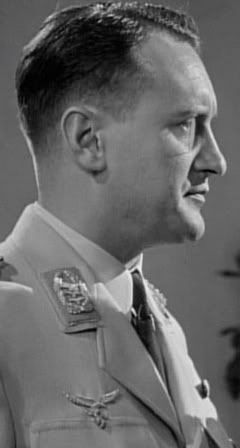
But, Pidgeon doesn't die: the straps of his rucksack get caught on a branch, breaking his fall. Pidgeon then proceeds to try to escape back to England, only for Sanders to be in hot pursuit, considering what failure to kill Pidgeon would do to his career. Pidgeon does eventually make it back to London, with the help of some people who may not really be helping him after all; if you saw Night Train to Munich, you'll recognize the type. Among the supporting characters are Joan Bennett as a London prostitute; Roddy McDowall as a cabin boy, and John Carradine as an Englishman on the ship where Sanders is a stowaway. The rest of the movie is the sort of chase movie reminiscent of Alfred Hitchcock classics like The 39 Steps, but it's not directed by Hitchcock. Instead, that honor befalls Fritz Lang, who is almost every bit Hitchcock's equal when it comes to creating a taut thriller.
Man Hunt has been released to DVD.
Monday, January 25, 2010
Was he wearing a Diestrong bracelet?
The IFC has the rights to a few good foreign movies, which they show from time to time. One of those movies, the Spanish film Death of a Cyclist, is airing at 8:00 AM ET tomorrow.
Death of a Cyclist is the movie that answers the question of what a Franco-era version of Double Indemnity might look like. A college professor is having an affair with the wife of a prominent member of the Spanish upper class. This naturally involves meeting in out-of-the-way places, and one rainy day, on their way back to Madrid, they accidentally hit and kill a cyclist. Reporting it means possible criminal charges, but, much more importantly in their minds, discovery of the extramarital affair! Wanting to keep the affair a secret, and having determined that nobody could have seen the accident, the two lovers head back to Madrid.
Of course, that is by no means the end of the crime. In Double Indemnity, Fred MacMurray realized that he and Barbara Stanwyck were now tied irrevocably together, and would have to go straight down the line, all the way to the end.
Death of a Cyclist was directed by Juan Antonio Bardem (uncle of actor Javier Bardem), a noted opponent of the Franco regime. As such, the film inevitably has political overtones, both for the good and the bad. The discussion of class status, especially how the two lovers feel they need to hush up the accident in order to preserve their social standing -- even though they could probably beat the rap on the accident since there weren't any witnesses -- is fine. However, there's also a subplot involving the man's college students protesting the failing mark given to a female student who happened to run afoul of the professor when he was in a bad mood over seeing a newspaper story about the car accident. That subplot seems a bit tacked on and doesn't really fit with the rest of the movie. One other problem is for people who don't speak Spanish. Normally, I have no problem with foreign films, and having to read subtitles. However, in the case of Death of a Cyclist, two of the main male characters have pencil moustaches that make them look enough alike that it's a bit tough to keep track of which is which while reading the subtitles at the same time.
All in all, though, Death of a Cyclist is a pretty good movie, up there with most of Hollywood's noirs. It's available on DVD, but as is often the case with foreign films, it's also more expensive than DVDs of most Hollywood movies from the same period.
Sunday, January 24, 2010
Somewhere in the Night
One of the movies in the current Fox Movie Channel rotation that I haven't recommended before is Somewhere in the Night, which is airing tomorrow morning at 10:30 AM ET.
John Hodiak stars as a World War II veteran who got injured pretty badly in the war, and is suffering a case of amnesia as a result. The only things he knows is that his girlfriend was going to leave him for some reason, and his friend Larry Cravat left him $5,000 in a bank in Los Angeles. So, he heads off to Los Angeles, only to find out that he's unable to see Mr. Cravat, despite the fact that a lot of people out there would like to see Larry. And being a friend of Larry Cravat's might not be such a good thing for him. The other people looking for Cravat send thugs after Hodiak, leading him to escape into the dressing room of nightclub singer Nancy Guild (an actress who never really made it to the big time). She might be willing to help him, and thinks that her boss, Richard Conte, can certainly help him. Even better for Hodiak is the fact that there's a kindly police detective (Lloyd Nolan) who also wants the goods on Cravat -- apparently, that $5,000 Cravat had promised is part of a cool million.
Thus begins our tale of mystery and murder. The bad news is, it's an extremely twisty tale, one that you have to pay close attention to if you don't want to get confused as to what's going on. Also, the cast is mostly people who are OK, but not great. That having been said, it's not notably bad, either. If you're willing to put in a little effort, it's more than entertaining enough. But if you're trying to interest somebody who isn't already a fan of 40s movies and noirs in either genre, there are a lot of better movies with which to start off.
Fox went through a phase of releasing a lot of their noirs to DVD, with the result that there are a lot of 40s films from them on DVD that you might not otherwise expect. Somewhere in the Night is one of them.
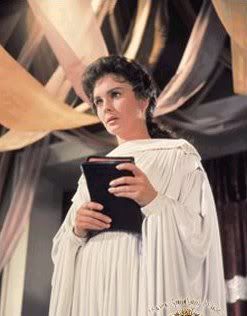
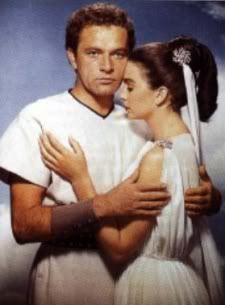
Jean Simmons, 1929-2010
Saturday, January 23, 2010
I Love You Again
If you enjoy the comedy of William Powell and Myrna Loy, you'll certainly like I Love You Again, which TCM is showing at 6:00 AM ET tomorrow.
William Powell stars wealthy businessman Larry Wilson, on a transatlantic ship back to his wife in New York. He got to be rich by being an inveterate penny pincher, to the point that his wife (Myrna Loy) is thinking about filing for divorce when he gets back, not that he knows. And not that he's going to find out, anyhow: things are about to change for him when Doc Ryan (Frank McHugh) falls overboard. Larry jumps in to save Doc, but suffers a concussion in saving Doc. This results in amnesia which has several effects....
First, Larry is no longer Larry, but George Carey, a man who was a con artist who would do almost anything to bilk a buck out of people. Of course, he's come into a bunch of money (Larry's), but George doesn't know that he's married, or that the marriage is on the rocks. George, however, isn't a penny pincher like Larry was, and when George gets back to the States and finds out about the wife, he begins to fall in love with her. And, his new spendthrift ways are something that the missus could begin to love. The only problem is that the missus might not like a conman....
I Love You Again is in some ways reminiscent of Random Harvest, in that the main character gets amnesia twice, falling in love with the same woman both times. But the idea works much better as a straight up comedy, instead of the dreadfully melodramatic love story that Random Harvest is. It also helps that you've got William Powell and Myrna Loy doing the material. They worked amazingly well together and fit the stuff like a hand in a good glove.
I Love You Again has made it to DVD, as part of a box set of Powell/Loy films. Sure, that makes it more expensive. But than, you can't really go wrong with William Powell and Myrna Loy.


