Showing posts with label Gangster. Show all posts

Thursday, August 17, 2023

The Roaring Twenties

I'm pretty certain I had already seen the movie The Roaring Twenties once before, and I even thought that I had blogged about it here. But a search of the blog suggests that while I've mentioned the movie in passing a couple of times in conjunction with either Humphrey Bogart or James Cagney, and even posted the trailer. But apparently I'd never done a full-length post. That's why, when TCM ran the movie again recently, I made it a point to record it so that I could finally rewatch it to do an appropriate review here.

As you can guess, Cagney and Bogart are the two lead stars, with Cagney being the lead since this was released in 1939 and Cagney hadn't been eclipsed by Bogart movies like The Maltese Falcon and then the changing public tastes with World War II. And since the movie was released in 1939, there's no mention of any upcoming war, instead starting off with a scene set toward the end of the Great War. Cagney plays Eddie Bartlett, serving alongside George Hally (Bogart) with whom he's become a bit of a friend. The third friend in the group is Lloyd Hart (Jeffrey Lynn). All of them talk about what they're going to do when they get home from the war, with Eddie talking about a girl he's corresponded with, actress Jean Sherman.

The war ends in November 1918, but it takes until 1919 to get all the soldiers home. Eddie returns to his best friend from the pre-war days Danny Green (Frank McHugh), working as a taxi driver. Eddie plans to return to his job as a mechanic, and hopes to open his own garage, but when he returns to the business he finds his job has been given away. You can't really blame the manager for not being financially able to hold a job open for two years. Worse, 1920 was a year of an economic downturn, making it hard for Eddie to get a job in general and forcing him to drive second shift on Danny's taxi. Worst of all is that Eddie mees Jean (Priscilla Lane), who exaggerated her talents and is little more than a recent high-school graduate working girl.

In addition to the economic crisis I mentioned, 1920 also brought Prohibition to the US, along with the rampant attempts to get around the law. Eddie gets caught up in it when he's asked to deliver a package not realizing that it's liquor. But the club owner to whom he delivers it, Panama Smith (Gladys George), befriends him, and the two wind up going into business together. Eddie has been trying to open his own taxi business, and realizes that using the taxis to deliver hooch would be a good way to make money on the side.

Unsurprisingly, he gets hubris. He meets Jean again and still carries a torch for her, getting her a job singing in Panama's club even though she's really not much of a singer. And he steals a shipment of booze from Nick Brown (Paul Kelly), a competing gangster. This brings George back into a business partnership with Eddie, and George is eventually going to stab him in the back. Eddie brings in the one lawyer he knows, Lloyd Hart, to keep him "clean", but Lloyd is eventually going to chafe at that, falling in love with Jean along the way.

The Roaring Twenties is a very good film, but it was released in 1939, Hollywood's annus mirabilis in which so many all-time classics were made that it's so easy to overlook the movies that were only very good. I think it also doesn't help that with the US not too far from entering World War II, this sort of gangster movie was soon to go out of fashion with the viewing public. That's a shame, because Warner Bros. knew how to make a good 1930s gangster movie and had absolutely no difficulty churning out a top-notch movie with its big stars like Cagney. The Roaring Twenties is definitely a film that should be better known, and one that you should absolutely watch if you get the chance.

Tuesday, July 25, 2023

Zinc coffins for gold boys

There was an app on Roku called Movieland that got removed because, as I understand it, it didn't really have the rights to show the things it had on. That's a shame, because there was some interesting-looking foreign stuff on there that I haven't seen anywhere else. One of the movies I got to watch before the app was removed was a West German "gangster" movie called Battle of the Godfathers.

Henry Silva, the only recognizable name if you don't know German cinema (and even though I speak German, I don't know German cinema well enough to recognize the rest of the cast), plays Luca Messina, an American mobster who has decided that he's going to expand by going from the US to... Hamburg. Needless to say, he doesn't really know the West German market, but he just knows that he can use overwhelming force to take over the underworld there. So he packs up his American cars and his mom, and also brings over his sheltered adult daughter Sylvia who doesn't really seem to know how her father has made his money.

As for the Germans, they're led by Otto Westerman, who has two adult sons. One is into boxing; the other one, Erik, knows fully well what his father is doing and knows that he's being groomed to go into the family business, which is something he doesn't particularly want to do. This explains why he's sent south to one of the industrial cities in the Ruhr valley and is able to avoid a good deal of the violence.

While Luca and Otto are using their mobs against each other, there's a plot twist that's not much of a plot twist at all, which is that Erik and Sylvia meet and fall in love, not realizing until much later who each other's father is the danger it poses for the two of them. Indeed, Otto even tries to kill Sylvia at her birthday party, which Erik had been invited to. And when they try to break free from their respective fathers' influences, they're still in danger even as Otto and Luca are still going after each other in the climactic chase.

Battle of the Godfathers is a movie that I'm probably being a bit harsh on, largely because of the production values. The movie itself looks like it was made on the cheap, but it definitely wasn't helped by the fact that the print Movieland had was badly dubbed, with some places leaving in the German dialog for several seconds at a stretch. (No wonder Movieland got removed from Roku.) It's fun enough if you like the low-budget European stuff that's not what Criterion thinks you should be watching in the world of foreign-language movies. And as I was watching, I coudln't help but think of an old American movie called The Guilty Generation that has much the same idea of the children of two gangsters falling in love with each other, not realizing who the other's father is.

If you could find a good copy of Battle of the Godfathers, I'd suggest giving it a watch, but the trouble is going to be in finding that good copy.

Saturday, March 18, 2023

Dillinger (1945)

Many years back, TCM ran a night of Lawrence Tierney films, including the 1945 version of Dillinger. I sat down to watch it, but unfortunately a thunderstorm screwed up satellite reception and I never got to see the end. I noticed that it's on Watch TCM through the end of the month, and even got an Oscar nomination so TCM could run it in 31 Days of Oscar, so I finally sat down to watch the movie.

The movie opens up with an establishing sequence of what looks like an audience at a picture show, watching a newsreel about John Dillinger and his gang. But it's really more of a public lecture, as John Dillinger's father strolls out onto the stage after the movie and tells the assembled audience that little John started out like any normal boy in Indiana farming country, but didn't want to be tied down to the farm, so he went off to Indianapolis to try to make it big.

Dillinger (that's Lawrence Tierney if you couldn't figure it out) claims to be a stockbroker, but he sounds like he's more talk than action, considering the speakeasy where he's chatting up a girl and the class of waiter serving them. When the waiter wants cash up front for drinks, Dillinger walks out and goes into the nearby grocery store, where he holds up the cashier for a whopping $7.20, which wasn't all that much even in the mid 1920s.

Unsurprisingly, Dillinger gets caught and sent to prison, where he's put in the same cell as Specs Green (Edmund Lowe), a much older man but one who commands the respect of the other prisoners as he's a more intelligent criminal mastermind and not a hothead like Dillinger. But this Dillinger is no dummy, and decides to learn from Specs. The rest of Specs' gang is also in prison with them: Kirk Otto (Elisha Cook Jr.), Marco (Eduardo Cianelli), and "Doc" Madison (Marc Lawrence). Dillinger has a shorter sentence than the other guys, having committed a lesser crime, and gets out before Specs' gang. By this time, he's gotten into Specs' good graces, and promises to spring the rest of the gang.

Once out of prison, Dillinger returns to a life of crime, starting by holding up a movie theater box office. However, he flirted with the cashier, Helen Rogers (Anne Jeffreys) before holding her up. This little bit of flirting is enough to make her fall in love with him, so she doesn't identify him in a police lineup, enabling him to go free and break Specs and the gang out of jail.

The rest of the movie is in some ways the standard crime movie arc of a younger guy getting into a gang and then deciding to take it over, all while going on a crime spree, before the man's hubris gets the better of him. Of course, in the case of John Dillinger, we know the real ending, as he was exiting the Biograph Theater in Chicago after a showing of Manhattan Melodrama. (Surprisingly, Monogram was able to get the rights to show a Disney short from 1933 as part of the scene showing Dillinger's night at the Biograph, but MGM had no desire to let a movie like this use Manhattan Melodrama. Instead, we get made-up audio clips.)

The ending may be the only part of this version of Dillinger that's accurate. Having looked up biographical information on John Dillinger, it seems that most of the screenplay bears little resemblance to reality. However, the screenplay is more than entertaining enough for a B gangster picture, and Tierney was born to play a gangster like Dillinger. This one is definitely worth watching.

Friday, March 18, 2022

Once Upon a Time in America

I've had Sergio Leone's Once Upon a Time in America on my DVR for a long time, since TCM ran it as part of the spotlight on the Roaring 20s two years ago. I'd been a bit reluctant to sit through another four-hour movie, but it's on TV today, at 10:49 PM on StarzEncore Suspense, so I gritted and bore it to do a review here.

The movie starts with a prologue, in 1933. Somebody's looking for "Noodles" (Robert DeNiro) in New York City. They're so desperate to find him they're willing to kill people who won't give them the information leading to his whereabouts. It turns out that Noodles has picked up a yen for opium at some point along the way, and he's in an opium den (in Chinatown, I'd guess), where the proprietors are willing to usher him out to keep the bad guys from finding him. Noodles makes his way to a bar owned by "Fat Moe", who has been keeping a key there for some time. Noodles gets the key, goes to the train station, and eventually takes the first train out of town.

Flash forward to 1968. Noodles is returning, because he's gotten a letter from the local synagogue that the place has been sold off, necessitating the removal of the graves to someplace else. And since this creates obvious religious issues, the survivors need to be notified. However, while the synagogue and cemetery were sold off, this actually happened some months earlier, leading Noodles to realize that somebody has found where he's been hiding all these years and wants him back in New York for, well, reasons. Also in 1968, there's a cabinet secretary David Bailey who is about to get into serious legal problems due to his relations with a corrupt Teamster boss Jimmy O'Donnell (Treat Williams).

We then flash back to around 1920, when Prohibition was about to be introduced, which really jumpstarted organized crime in America. Noodles is young and one of those street thugs who would work for the somewhat higher-up people in the syndicate. Together with friends Patsy (James Hayden), Cockeye (William Forsythe), Dominic, and Max (James Woods), the five start a sort of mini-gang of their own that's going to become bigger as Prohibition and the 1920s roar on.

But it's not all a bed of roses. Noodles has a girl his loves in the form of Fat Moe's sister Deborah (Elizabeth McGovern), but she has dreams of becoming an actress. Meanwhile, Max falls in love with platinum blonde Carol (Tuesday Weld), who Noodles thinks is going to mess up all of the gang's operations.

The movie keeps switching back and forth between the Prohibition era and 1968, until Prohibition is repealed and the gang has to pull one last job which winds up breaking up the gang and leads to Noodles' leaving town which we saw in the opening. Then we spend the last bit of the movie in 1968 where Noodles has been invited to a party at Bailey's Long Island mansion which should wrap up all of the loose ends.

It didn't really occur to me until about the time the movie was ending that I was also reminded of Whistle Stop, which I blogged about a few days ago. The reason is that both movies start off very slowly until the get to the finale that is supposed to be the main conflict of the movie. Whistle Stop is a B movie, but also only 81 minutes. Once Upon a Time in America, however, is about 229 minutes, at least the 2012 restoration print which is what I believed TCM showed and what is likely showing up on StarzEncore this evening and was pretty darn close to the original European theatrical release. That means there's a lot to sit through. Once Upon a Time in America, however, has much stronger production values, as well as much stronger acting, none of which should be surprised since this wasn't conceived as a B movie at all.

But is Once Upon a Time in America good? Well, there's the rub. Apparently when it was first set to be released in the US, the studio was antsy about releasing a movie that long, so they cut out a lot and then re-edited everything else into chronological order, winding up with a movie that ran about 140 minutes, and was a box-office flop. Critics who get paid to do this stuff, pretentious lot that they mostly are, had seen the 229-minute version and unsurprisingly praised it. I, however, am somewhere decidedly in the middle.

It's easy to understand why some people would love this. And the movie is clearly of a high technical standard. But at the time time, I can also see that the movie needed a much tighter script. I'm reminded of the comment I made about Erich von Stroheim's Greed: there was a good 140-minute movie to be made from the story, but Stroheim gave the studio a 10-hour film, making editing it down to 140 minutes a near impossible task. Likewise, Sergio Leone originally came up with something a lot longer than even the 229-minute cut, and that too probably made it extremely difficult to cut it down. Also to be fair to the studio, there are two rape scenes that probably would have required editing to avoid an X rating in the 1980s.

So certainly, give Once Upon a Time in America a go, but be warned that it's not going to be for everybody.

Wednesday, February 26, 2020

Joe Pistone


During one of the free previews of the premium movie channels, I had the opportunity to record Donnie Brasco, not having done a post on it here before. It's available on DVD and is going to be on the Epix channels in the comind days if you have the premium channels and wish to watch it.

Johnny Depp plays Donnie Brasco, a jeweler in Brooklyn in late 1978. Or at least that his story that everybody believes. In reality, his name is Joe Pistone, and he's an undercover FBI agent who's been given a job of infiltrating the New York Mafia. He meets Lefty (Al Pacino), a mid-level mobster working under Sonny Red. It's a difficult case that requires Joe to be away from his wife Maggie (Anne Heche) and kids for long stretches, without his being able to tell her why he's away. (You'd think she knows he works for the FBI, since the real life Pistone had been in the FBI for several years before the Donnie Brasco operation.)

Lefty befriends Donnie, and brings him into the organization, which doesn't seem to be particularly successful since it's engaging in small-time fencing of stolen goods. Donnie is fitting in with them, to the point where one of his FBI handlers wants Sonny Black (Michael Madsen) to expand to Florida so that the FBI can get more sources. Donnie is able to do this, and in the process, become a direct underling of Sonny Black rather than Lefty.

However, there are problems brewing. One is domestic, where Maggie is getting increasingly irritated with only seeing Joe irregularly and at unannounced times. It gets to the point that she's ready to ask for a divorce.

More worrisome is the business side. Lefty is reading a story in Newsweek on the Abscam affair, and sees the same yacht that they had been on together down in Miami, so he knows something is up. This, combined with a raid on the bar Donnie has opened down in Florida leads Sonny Black to realize there's a stoolie in their midst. This leads to some rubouts, and Donnie becoming more like the men he's supposed to be surveilling, making him increasingly frightened of what he's becoming.

Donnie Brasco is a pretty darn good movie, with an excellent performance from Depp in what is more of a stretch for him than the other actors faced, I think. That it's all based on a true story makes it even more fascinating. The only problem I had is that I found myself looking for anachronisms. There's a fair amount of period music used, although several of the songs were released months to a year or so after the events depicted. (I listened to a lot of Top 40 radio growing up.) More humorous for me was a newspaper mentioning the death of John Wayne while Donnie and friends were in Miami. I thought Wayne died in 1978, but in fact he died in June 1979, so this wouldn't be an anachronism. But: during that same scene, Donnie/Joe is calling his wife back in New Jersey, who is complaining about it being 12 degrees with a bunch of snow on the ground. In June!

Of course, those anachronisms are a very minor nitpick and things most people wouldn't stop to think about. Even if you do, Donnie Brasco is still excellent.

Wednesday, January 8, 2020

The Widow from Chicago


A movie that I thought I had recorded as part of Joan Blondell's turn as Star of the Month last month, but which in fact does not have Blondell in the cast, is The Widow from Chicago.

The star is actually Alice White, although we don't meet her at first. Instead, we see gangster "Swifty" Dorgan (Neil Hamilton), who's traveling from Chicago to New York via train. However, a couple of people show up to meet him and push him off the train to his death! In New York, one of those people, Jimmy Henderson, turns out to be a policeman on an undercover mission.

That undercover mission is to replace Swifty in order to infiltrate the underworld leader Dominic's (Edward G. Robinson) sphere of influence. Polly (that's Alice White), it turns out, is Jimmy's sister. And poor Jimmy, for his part, has been found out by somebody from Dominic's gang, as he gets shot gangland style.

Polly decides that she's going to be the one to infiltrate Dominic's gang, so she goes to his club, claims to be Swifty's widow, and gets a job presumably as part of the show but I don't think we actually see her doing any singing. At any rate, she seems like she might be making some progress in getting the good on Dominic, until something unexpected happens.

Swifty was in fact not killed when he was pushed off the train, and he shows up, which presents a bit of a problem since Swifty isn't married and has no idea who this Polly who's been claiming to be his widow is. The two of them sort of have to form an uneasy alliance as they try to fool Dominic long enough to obtain that evidence....

The Widow from Chicago is one of those early talkies, dating from 1930, when talking pictures were still finding their way. So this one isn't as good objectively as some later programmer gangster movies would be. Still, it's not bad, even if Robinson doesn't get to be as bombastic as he would be in some of his other gangster roles.

The Widow from Chicago is available on DVD from the Warner Archive, but is another of those movies that probably ought to be on one of those four-movie box sets that Warner Home Video in conjunction with TCM used to put out.

Saturday, June 1, 2019

Blondie Johnson

My latest movie viewing was the pre-code Blondie Johnson.

Joan Blondell plays the title role, a woman who at the beginning of the movie is suffering from the effects of the Depression having hit her in just about every way possible. She's at a relief agency looking for help because she hasn't worked in four months; her sister died tragically; and her mom is deathly ill with the owner of the building possibly about to evict them because Mom might be contagious. But because she wasn't fired, instead having quit her job because her boss was trying to use her for sexual favors, the guy at the relief agency says no help for you.

When Mom dies, Blondie realizes she has to make money in a different way. With the help of very small-time grifter Red (Sterling Holloway), a cabbie when he's making money honestly. The two combine in a scam that has richer guys paying for an emergency taxi ride across town; he only takes her around the block and pocket the difference. They shouldn't keep trying it in the same area, because when she's in a diner at the end of the meeting, one of the guys she scammed runs into her.

That man is Danny (Chester Morris), a middle-level gangster, and he tries to convince her to go in with him. She wants to take down the bigger bosses, and do it on her own terms, so although she likes Danny, she has no intentions of being subordinate to him. Eventually she does make it to something resembling the top, but her group has some indiscretions in the past that threaten to bring her down.

Blondie Johnson feels likes a slew of the other pre-Code Joan Blondell and gangster movies that Warner Bros. was churning out like an assembly line in the early 1930s. In many regards, it's not bad at all. But it also feels as though something is missing, as you might have inferred from my perfunctory synopsis.

It didn't take me too long to realize that the something that was missing is James Cagney. Morris is adequate as a guy who is really a second banana, but in all those Cagney/Blondell movies, the two had a zest that just jumped off the screen. There's very little of that in Blondie Johnson, which is why the whole thing feels routine and just not quite right.

Blondie Johnson is available on DVD from the Warner Archive, but it's really one of those movies that should have been put on those old four-film TCM-branded box sets that Warner Home Video was putting out. As a standalone, I'd look for a lot of other things first.

Thursday, February 4, 2016

I don't think I've ever done a full-length post on White Heat before


I notice that the classic movie White Heat is on the TCM schedule tomorrow morning at 10:15 AM. A search of my blog suggests that I've never done a full-length post on the movie, which isn't that surprising since I've always felt a bit uncomfortable blogging about movies that are so well-known that it's kind of pointless rehashing the plot. And I think the famous photo of James Cagney at the end of the movie, with the oil tank burning behind him while he says, "Made it, Ma, top of the world!"

So as I was thinking about the movie today, I found myself thinking whether one should try looking at it once as a character study. Oh, the plot is a pretty good one, but Cagney as Cody Jarrett so overrides all the proceedings that I don't think the nature of the heist at the end is that important. Anyhow, for a brief plot summary, Cody leads a gang that at the start of the movie holds up a mail train. Eventually he gets arrested and sent to prison for another crime; one of the prisoners Vic (Edmond O'Brien) is actually a plant by the cops to infiltrate Jarrett's gang, which happens when Vic helps Cody break out of jail. Jarrett then organizes that climactic payroll heist.

But along the way there are a couple of things that are much more important. One is that Jarrett is exceedingly brutal, and the other is that he is incredibly devoted to his mother (Margaret Wycherly). During the train hold-up, one of the underlings is burned by steam, and Jarrett doesn't seem to care. In fact, even though he's married to Verna (Virginia Mayo), he doesn't seem to care for anybody in a positive way except for his mother. Everybody else, he only cares that they don't get on his bad side. Watch, for example, what Jarrett does when a fewllow prison escapee complains about being stuck in the trunk of a car.

But it's that devotion to his mother that gives Cagney as Jarett the other defining moment of the movie. Jarrett is in the prison mess hall when he learns that his beloved mother has died, and he goes mental, climbing atop the table and more or less losing it emotionally. Trying to do away with her is just as bad as trying to do away with him.

In some ways, it's almost a shame that James Cagney so dominates White Heat. The reason I say this is because the other basic story is pretty good, and the other performances are even better. In terms of mothers dominating to a bad end, Margaret Wycherly is up there with Angela Lansbury in The Manchurian Candidate or Jackie Weaver in Animal Kingdom. Virginia Mayo, as the woman who comes second in Cody Jarrett's life to Jarrett's Ma, is coldly calculating when she needs to be, too. O'Brien does well, as does Steve Cochrane, playing the guy in Jarrett's gang who has too much of an eye on Verna for his own good.. Still, it's Cagney whom you'll remember long after the movie ends, for a host of good reasons.

Tuesday, September 8, 2015

Gang War (1958)

I briefly mentioned the film Gang War back in December 2011. It's finally showing up again on FXM Retro, tomorrow morning at 10:35 AM.

Charles Bronson stars as Alan Avery, a high school teacher living the middle-class life in Los Angeles together with his pregnant wife Edie (Gloria Henry). One night, he has to go out to the pharmacy to pick up a prescription for her. Unfortunately, while he's in the parking lot after picking up the prescription, he sees two guy knifing a third to death. Who wants to see that? Well, Alan is a good citizen, so he goes to the nearest pay phone and calls up the police anonymously, to report that he saw a murder. He may be a good enough citizen to tell them he saw the murder, but he's not good enough to identify himself. And who can blame him? Nobody really wants to get involved as an eyewitness to murder.

However, Alan left the prescription behind in the phone booth, and since the police were able to figure out where the call came from, they were able to find the prescription and ultimately find the man who called in the news of this murder. The police ask him to come down to the station to file a report, and that's where the trouble really begins for poor Alan. It turns out that the murder was committed by a couple of henchmen of the gangster Maxie Meadows (John Doucette). Apparently, some bigger gangs from the national syndicate are trying to horn in on Meadows' territory, which is what led to the murder. But Meadows is still powerful enough to have sources in the police department who are beholden to him, not to the public. So Meadows finds out who's been ratting on his henchmen.

Meadows response to this is take another of his henchmen, boxer Chester, and have him go to the Avery place to smack Edie a bit -- just enough to give Alan second thoughts about testifying against Maxie's henchmen. Unfortunately, Chester has taken a few too many punches in the ring, to the point that he's not quite so good at following instructions any longer, or even recognizing his own strength. He hits Edie hard enough that he kills her. Oops.

Of course, Alan finds out about this, and it's enough to send him over the edge. He's now hell-bent for leather, and willing to get Maxie, consequences be damned....

Gang War is one of those B movies that Fox was making a lot of in the late 1950s and early 1960s, running under 75 minutes in length and using a lot of people who weren't established stars at the time. Gang War is one of the better ones. The story is interesting, it's got Bronson, and it's got a lot of location shooting in Los Angeles. Notably, the old Capitol Records building in Los Angeles, the one that was designed to be round and look like a stack of records, can be seen in the early sequences when Alan first witnesses the fatal knifing.

I don't think Gang War is available on DVD at all, so you're going to have to catch the FXM showing.

Monday, January 5, 2015

Mixing up gangster movies

There's a subset of gangster movies that involves the families of the gangsters. Or, more specifically, children of the gang heads who grow up and want to live their lives in a way that involves turning their backs on the gang, and how this is a lot more difficult than it might sound. I'm not talking about a movie like The Public Enemy. In htat, even though James Cagney's gangster character has a brother who's a policeman and is trying ot convince Mom not to take the dirty gang money, it's still the Cagney character who's the main character. No; in the movies I'm thinking of, the gangsters are important to the plot, but not the main focus per se.

I mention this because as part of a birthday salute to Loretta Young tomorrow, TCM is running The Ruling Voice at 10:15 AM. Loretta Young plays the daughter of Walter Huston. Dad is the head of a "businessmen's association" which is a polite way of saying he runs the protection racket. Don't pay them, and you can't do business. Dad's been keeping his daughter relatively in the dark by having her study abroad at European finishing schools, which is where she met David Manners, whom she wants to marry. That is, until she learns the truth about what her father does.

The Ruling Voice sounds like one of those movies that I think I've seen before, but I'm not quite certain. I know that I'm not mixing it up with The Guilty Generation, another movie from around the same time. In that one, Robert Young and Constance Cummings play children in families on either side of a gang war. Young's character has been studying architecture to try to get out of the mob business; Cummings bieng a daughter isn't so involved in the game. They meet and fall in love, and the consequences are predictable. This one doesn't seem to be scheduled on TCM any time soon.

There's a third movie from the beginning of the sound era that I remember fairly distinctly, except that I can't remember the title. In this one, the gangster father had two sons. One had been raised to take over the business, the other grew up more or less clean. Mom's dying, and wants to see the other son before she dies, so the elder brother rounds up the kid brother, who ultimately winds up in the bootlegging business himself. I know this is an early talkie because I remember how much the sets fit the whole early talkie time frame in terms of production values, which were often on par with those of late silents like The Racket. But dammit, I just can't remember the title of this particular movie.

Enjoy the Loretta Young pre-Codes tomorrow!

Friday, December 12, 2014

The Last Gangster

No; this isn't the last blog post about a gangster movie; it's about the movie The Last Gangster, whith TCM is running today at 6:00 PM as part of a birthdy salute to Edward G. Robinson.

Robinson stars as Joe Krozac, a mob leader of Yugoslav descent who lives the good life, apparently saving the violence for the little people. Joe wants a family, so he goes back to the old country to find himself a wife, which he does in the form of Talya (Rose Stradner, whom MGM were apparently grooming to be their next European star but who never quite made it). They get married and have a seemingly happy life, Talya knowing nothing of what Joe really does because he's keeping her in the dark; being a foreigner with a limited command of the English language helps. Of course, you know that the authorities are eventually going to get Krozac, because the Production Code demands it. That arrest and conviction comes on a tax evasion charge, much as happened to Al Capone. So there's a trial and Joe is found guilty and sent to Alcatraz.

Ah, but there's a catch. In the meantime, Joe has successfully knocked up Talya, who is with child as the whole legal falderal against him goes on. Joe gets a ten-year sentence and vows to fight it every step of the way, as well as coming out of prison better than ever and having a great family and all that stuff. Needless to say, it's not going to happen this way. Talya doesn't want her son to know that Dad is a prisoner. And when the newspaperman Paul North (James Stewart) writes a story that puts Talya in a bad light, he takes pity on her. The two of them fall in love, leaving Talya to file for divorce from Joe, marry Paul, change her name, and move to one of those peaceful small cities that you can find anywhere on MGM's back lot.

Of course, Joe only got a ten-year sentence, not a life sentence. Those ten years are going to run out and Joe is going to get out of prison, wanting to see his wife and son. Only they're not his wife and son any longer, which of course is going to be one of the dramatic tensions of the second half of the movie. There's another, however. When Joe gets out of prison, his old gang is still there. They've been waiting for their payoff for ten years, and they're convinced that Joe has been holding out on them and has a secret stash of money somewhere. They're going to get that no matter what. And if torturing Joe won't get him to reveal the location, then perhaps they'll have to kidnap the son he loves but has never met....

There's some hoary material here, but unsurprisingly based on who we've got in the cast, it's all handled fairly well. Robinson did better work, to be sure, but he's more than capable as the man whose world crumbles around him over the course of the movie. Stewart was still fairly early in his career, and is a good second lead, neither having the "aw shucks" persona from films like Harvey or the hard-boiled post-war persona from something like Rope. Rose Stradner isn't much, and you can see why she never became the star MGM had hoped for. It's also worth watching the 30s character actors who show up in Joe Krozac's gang. Overall, the story is done well, if nothing groundbreaking. It's not as good as the Warner gangster movies, but I liked it more than MGM's Johnny Eager. The Last Gangster is more of a programmer than a prestige film, and that's to the movie's benefit.

Sunday, December 1, 2013

Please pronounce the last name correctly!

TCM is running the immensely entertaining The Amazing Dr. Clitterhouse tomorrow morning at 8:30 AM.

Edward G. Robinson stars as the titular Dr. Clitterhouse, a well-to-do society doctor. You might think he's not well cast to play such a character, but in real life Robinson was an art collector with very refined tastes, so this is actually a good role for him. Besides, the script allows for Robinson to play a variation on all those gangster characters he had been playing for much of the 1930s. In this case, that means Dr. Clitterhouse has an interest in figuring out how the criminal mind works, as he's writing a scholarly work on the subject, presumably wanting to use psychology to get the minds that want to commit crimt not to do so. But this is a movie about crime, not psychology, so Clitterhouse has come up with an idea that breaks all the rules of scientific propriety, but without which we wouldn't have a movie. He's going to investigate the criminal mind -- by committing crimes himself! Really. He starts off by pilfering the jewels of his society friends, but that isn't good enough. He needs some experience with real criminals.

To this end he looks for Joe Keller, supposedly a well-known fence for those jewels he's stolen. It turns out, however, that Joe Keller is actually Jo Keller -- a woman (played by Claire Trevor)! And she's not just a fence, she's practically running the gang, or at least co-leader with her boyfriend "Rocks" Valentine (Humphrey Bogart). Against Rocks' better judgment, Jo lets Clitterhouse into the gang, where he earns the nickname "The Professor". Rocks is right to question whether the Professor should be a part of their gang. He's got some different ideas, but even worse, Jo is falling for him. This, unsurprisingly, causes Rocks to get even angrier, to the point that when the gang is commiting a fur heist, Rocks locks the Professor in a cold-storage locker. Either the Professor will die, or the poilice will catch him there, but either way, it's the end of Rocks' problems with the Professor.

Oh, of course it's not the end. Clitterhouse figures a way out of the place, and eventually goes back to his real job, working on that book about the criminal mind. Everybody can live happily ever after, Clitterhouse as a society doctor, and Rocks and company getting rich on all that stolen loot. Yeah right; that's not going to happen either, as there's no way the Production Code could ever let Rocks get away. Rocks eventually figures out that the "Professor" was in fact the society doctor, and goes to confront Clitterhouse. Clitterhouse offs him, and since he used a drugged drink to do it there's no way anybody is going to be able to claim self-defense.

The movie climaxes with one of those 1930s vintage courtroom scenes, which bear no resemblance to any reality, but which can serve as a convenient deus ex machina to get the desired ending as long as it's OK by the Productoin Code. But don't let the courtroom scene dissuade you from watching this movie. It's a breezy, fun ride, expertly mixing comedy and drama. Robinson could have pulled off roles like this in his sleep, and is as always a joy to watch. Humphrey Bogart supposedly really disliked this film, as he knew he was ready for bigger things but couldn't get Warner Bros. to give him those bigger parts. And yet he's fine here. Claire Trevor is pretty good, although she's also clearly the thrid character. The rest of the cast has a bunch of standard supporting players, including Donald Crisp as a police detective, and Allen Jenkins as one of the gang members.

I've briefly mentioned The Amazing Dr. Clitterhouse in the past, suggesting that it wasn't available on DVD. That is of course wrong, as you can find it as part of the Warner Gangsters box set, Volume 4.

Monday, March 18, 2013

It All Came True

Yet another movie I thought I'd blogged about in the past, but which a Blogger search claims I haven't, is It All Came True. TCM is running it tomorrow afternoon at 12:45 PM.

Humphrey Bogart only gets third billing in the movie, but he is more of the star than the two leads. Bogart plays Chips, a gangster who, like a lot of Hollywood's gangsters, tries to look respectable by running a nightclub. Needless to say, he's going to get involved in a crime, and it's that crime which will drive the plot forward. Specifically, it's a murder. But, Chips isn't that stupid: he did the deed with a gun registered to the club's pianist, Tommy Taylor (Jeffrey Lynn). Taylor's a struggling composer playing the piano to make ends meet, and now he's over a barrel. Since he could be implicated in the murder, Tommy is in a spot to be blackmailed by Chips, and Chips takes that opportunity, making Tommy find him a place to stay that the cops don't know about.

That place happens to be his mother's house, and a very interesting place it is. Mrs. Taylor (Jessie Busley) runs a boarding house for people trying to break in to the entertainment racket -- the sort of place you'd see in Stage Door, together with Mrs. Ryan (Una O'Connor), who also happens to be the mother of struggling singer Sarah (Ann Sheridan), who is Tommy's friend since childhood, and could become Mrs. Tommy Taylor if only the two of them could make a success of life. They're not the only ones struggling, though; the mothers' boarding house is in constant financial difficulty, mostly because the mothers are renting out rooms to old time entertainers who are no longer in fashion.

What happens next is something you might be able to guess, but also something that needs to be seen to be believed. Chips wants to be left alone so that nobody will recognize him; in fact, Sarah does know who he is but has her own reasons for not turning him in just yet. Chips is also eventually introduced to all the other residents of the house, and gives the mothers the idea that turning their place into a Gay Nineties-themed nightclub could be just the thing they need to make the money for the back taxes they owe. After all, the mothers have the talent right under their noses. All the good people will live happily ever after, and the criminals will get caught by the virtuous law enforcement, as demanded by the Production Code, at which point the title card reading "The End" can finally pop up.

It All Came True isn't your typical Humphrey Bogart gangster movie, in that it's more light-hearted than any of the others, what with all those quirky old-fashioned variety acts more or less around. The talented tenants are all played by character actors whom you've seen dozens of times before; once the Gay Nineties nightclub opens for the movie's finale, there are some real acts as well. The movie has an air of unreality because of that, and also because of those Production Code restraints that evetually require people to act in ways they wouldn't be motivated to do in real life. But It All Came True rises above that to be an entertaining little film. It may not be as great as The Petrified Forest or High Sierra, but it more than does its job of entertaining the viewer.

It All Came True has received a DVD release courtesy of the Warner Archive.

Thursday, October 4, 2012

Marked Woman

I don't think I've ever blogged about the movie Marked Woman before. It's airing overnight tonight at 1:30 AM on TCM.

Bette Davis stars as Mary, a woman who is more or less an escort at a club run by gangsters. Her job is to lure men in, and make certain that they get involved in the high-stakes gambling that goes on -- gambling that is really designed to fleece the men. She leaves the club with one of the men, who hasn't paid off his gambling debt. Eventually, he gets killed and the body discovered with her address, which leads to her being the chief suspect for District Attorney David Graham (Humphrey Bogart). Well, not quite. David logically suspects that it's really Vanning, the guy who runs the club (played by Eduardo Ciannelli), who knows who carried out the murder, and on whose order the murder was committed. But Mary refuses to put the finger on him.

Meanwhile, Bette's apartment is a fun place. It's really more of a rooming house, with Mary and all of her escort friends sharing the premises. Into all this walks Betty (Jane Bryan). She's Mary's naïve kid sister, having just arrived from the small town where they both grew up, thinking that Mary must lead a terribly exciting life. Up to this point, Mary has felt confident, believing that she can handle whatever either Vanning or Graham tries to throw at her, and stay one step ahead of everything, as she says. That wasn't quite the case before, and with her kid sister in town, it's certainly not the case now. Betty is wholly unprepared for the sort of life Mary leads, with the result that when she starts to try the same lifestyle, it's going to get her in a lot of trouble....

But that sort of trouble might be just what was needed to push Mary into cooperating with the DA against Vanning. The problem is that, if Mary does cooperate, it's going to put her in a lot of danger -- unsurprisingly, Vanning doesn't like the idea of anybody turning state's evidence against him.

By the time Marked Woman was made in 1937, Bette Davis was queen of the Warner Bros. lot. (Bogart, still a ways away from truly becoming a star, only gets second billing.) So it's a bit odd that she's in a movie like this that comes across as less than a prestige movie and more in tune with the sort of gangster moviess James Cagney was starring in before the clampdown of the Production Code. (I think the prestige movies at WB at this time were all going to Paul Muni.) Still, Davis takes her role and makes a very entertaining movie out of Marked Woman. It's far from being her most prestigious work, but it's just as entertaining, if not more so, as many of those "big" roles she's get from Jezebel on.

Amazon lists Marked Woman as being available on DVD, but TCM doesn't. You'd think Marked Woman is the sort of movie that would be perfect for the Warner Archive, or one of the TCM shop's Bette Davis box sets.

Monday, August 13, 2012

Note there's no S on the end

A Google search of my blog suggest that I have never blogged about the movie Lady Killer (not to be confused with The Ladykillers) before. It's airing tomorrow morning at 9:00 as part of TCM's Summer Under the Stars day of James Cagney movies.

Cagney plays Dan Quigley, who at the start of the movie is a movie usher. Actually, he's much more than an usher; he's a small-time con artist and gambler to boot, running a dice game in the restroom among other things. One day he meets Myra (Mae Clarke, who had been with Cagney in The Public Enemy, which airs just before Lady Killer at 7:30 AM), just as she's dropping her purse. He picks it up and follows her back to her apartment, where he finds that her brother-in-law Spade (Douglass Dumbrille) is running a poker game. Dan, being the keen gambler, gets in on the poker game, but gets cleaned out. On leaving, however, he finds that he's been scammed, and extorts his money back from his opposing con artists, getting in on the gang in the process. Quigley eventually becomes the leader of the gang, but they're incompetent and accidentally kill somebody during a botched robbery, forcing Dan and Myra to go on the lam to California.

In California, Dan gets arrested but there's not enough evidence to convict him. Free but broke, Quigley gets picked up by a talent scout because the scout thinks Quigley could play the sort of gangster that the movies wanted back in those days in spades. Quigley starts off as an extra, meets leading lady Lois (Margaret Lindsay), and because of his charisma, he immediately becomes romantically involved with her and starts to rise the ladder of fame in Hollywood. Well, he does so by engaging in a con but when has Hollywood ever been authentic. Of course, there's one thing Dan hadn't considered: if he were to become famous, certainly his old gang would recognize him in one of his movies, and come looking for him. Sure enough, that eventually happens.

Lady Killer is a movie that I think would make a good double bill with Picture Snatcher, or possibly The Mayor of Hell. In all three of them, Cagney plays a gangster who tries to go straight, but also has to use his con skills to make it a bit easier to get ahead in honest life as they're the only way he knows how. By 1933, when all three of these movies were made, the moral scolds were getting uncomfortable with the traditional gangster movies, but audiences still loved them, so the studios tried to find different ways to use their gangsters. Having the gangsters go straight was one way. Lady Killer and Picture Snatcher both have a fair bit of comic relief in them, while The Mayor of Hell doesn't have nearly so much. In all three, however, Cagney is charismatic as ever and makes the movie zip forward by leaps and bounds. Lady Killer, like the other two, is certainly not a "prestige" movie, and has the look of a lesser movie. But it's also immensely entertaining and a heck of a lot of fun.

All three of the Cagney movies I mentioned are available on the same Warner Gangster Movie box set.

Saturday, March 12, 2011

Gary Cooper, gangster?!

Yes, actually. It happens in the interesting pre-Code City Streets, which is aiirng at 1:15 AM ET tonight. (Note: Daylight Savings Time begins tonight, and the movie straddles the "skipped hour" in the Eastern time zone, but not in other time zones, where the skipped hour comes later.)

Cooper plays "Kid", who starts off the movie working the shooting gallery at Coney Island. He's got his eye on Nan (Sylvia Sidney), who loves him too and has a good source of money. Unfortunately, it's not a clean source: she's the daughter of a mob hitman (Guy Kibbee) who's working for the beer racket (this being Prohibition and all), and often assists her father in disposing of the weapon he uses to commit his murders. This is a source of tension between our two lovers, but with it being Prohibition and the Depression, people have to make a living somehow. One such hit goes wrong, and Nan winds up getting caught with a weapon on her person, which means big trouble for either her or Dad. The only way Cooper can help his girl is to get involved in the racket himself, so he goes in with Kibbee as one of the underlings of boss Paul Lukas.

Cooper shows himself to be an adept gangster, risking fairly quickly up the hierarchy, although this creates tension among the other racketeers, as well as even more with Nan, who decides that she really liked him better when he was just a poor carny at Coney Island. That, and the molls. Wynne Gibson plays a woman kept by Lukas, and when she gets fed up with it all, she comes up with a scheme that will get both Lukas and Cooper out of the way. Cooper is no dummy, however, and comes up with a plan of his own....

City Streets is a really interesting movie that unfortunately has a few plot holes. Cooper hadn't really hit his type yet, with the movie having been made in 1931. Today we know him for westerns and being the sturdy good guy, but he's really not bad here as the good-guy gangster. I don't know that he would have done so well as an anti-hero like Edward G. Robinson or James Cagney, though. Sidney is good, and gets some interesting scenes in prison when her thoughts are revealed in voiceover, a technique which apparently hadn't been used before. Today it's a cliché, but then it was new. You'll probably remember Guy Kibbee for the roles he played in movies like 42nd Street or Gold Diggers of 1933 where he was the dirty old man, but a likeable one. Here, he's quite good playing a character with few or no redeeming qualities. As good as the performances are, however, they come up a bit short in the end, as screenwriter Dashiell Hammett seems not to have had any idea how to resolve the plot conflicts. Still, City Streets is worth recording.

You're going to have to record it, since it doesn't seem to be avaiable on DVD.

Friday, January 21, 2011

The Shame of a Nation

TCM's gem for this evening is a night of early gangster movies. I've already recommended Little Caesar before; that's airing at 11:45 PM ET. James Cagney isn't getting showcased with The Public Enemy; instead, at 12:45 his gangster film The Mayor of Hell is getting a showing. Surprisingly, one that I haven't recommended before, if only because it hasn't shown up on TCM in quite some time, is the original version of Scarface, at 9:30 PM.

Paul Muni plays Tony Camonte, a small-time gangster in Chicago who's modeled on Al Capone, although Capone wasn't really like this. Tony actually started out as a bodyguard to a bigger gangster, but with the big guy rubbed out, Tony decides to become a head honcho himself, and gain revenge the only way he knows how, which is to kill, kill, kill! And when he's done with that, he's going to kill some more!

Of course, we learn that life at the top isn't as nice as it's made out to be. Tony has all sorts of problems to deal with. Not only are there the other gangsters who don't like Tony's muscling in on their territory. Most notable among these is the Irish gangster Gaffney, played by Boris Karloff(!). Gaffney gets it in the end in a bowling alley of all places in one of the film's many interestinc scenes. There's also the henchman Guino (George Raft), who might just decide to stab Tony in the back. And then there's Tony's sister Francesca (Ann Dvorak), who has ideas of getting above her station in life. Tony is protective of her, but perhaps just a little too protective of her. First and foremost, though, is the threat of being the victim of violence, and boy is that threat omnipresent. Tony obviously feels that killing first before being killed is the best strategy (who can blame him?), and the result is a vilm that's surprisingly violent (if not gory) by today's standards.

Which of the 1930s gangster movies is the best? I'm not certain; they're all quite good. If you haven't seen Scarface before, it's well worth watching. It's also gotten a DVD release, so you don't have to wait for the rare TCM showings.

Saturday, May 15, 2010

Edward G. Robinson, florist

The hook connecting all of tonight's TCM movies is the fact that they've got flowers in their titles. This includes the comedy/drama Brother Orchid, airing overnight at 3:30 AM ET.

Edward G. Robinson stars as gangster Johnny Sarto. Although he's a gangster, what he really wants is class, so he leaves behind his girlfriend (Ann Sothern) and leaves the racket to second in command Jack Buck (Humphrey Bogart), going off to Europe. Unfortunately, he finds that you can't just buy class, and, having been unable to obtain class in Europe, he returns to the States having spent all of his money and wanting control of the racket back.

Of course, Buck is in no mood to give up the racket, and he uses Johnny's old girlfriend and her new suitor (Ralph Bellamy) to try to set up Johnny. The plan is to get Johnny out in the middle of nowhere one night, and shoot him where it will take the authorities quite some time to find the body. Johnny naturally has no intentions of dying, and tries to run away from his pursuers, eventually escaping wounded when he winds up in... a monastery!

This being a monastery, they're all isolated from the world, and don't know about Johnny's past. Instead, they spend their time raising flowers, which allows them to make a living, as well as beautify the world around them. And it's good for Johnny, too; not only does it afford him a place to hide, but he finds that he's got a green thumb as well, causing the monks to call him "Brother Orchid". All good things can't last, though, and soon enough Buck comes along looking for protection money. The monks don't know what to do, but they also don't know they've got a gangster in their midst who does know what to do....

Brother Orchid is an interesting movie that constantly veers back and forth between comedy and drama, and that is ultimately the thing that keeps it from being a great movie. Robinson and Bogart are both pretty good, as they always are, but the material doesn't really allow them to shine. That's not to say that Brother Orchid is a bad movie by any stretch of the imagination. It helps, of course, that the studios back in those days were able to call upon a great range of character actors to fill out the supporting roles. Here, that includes Allen Jenkins as one of the gangsters, Donald Crisp as the head of the monastery, and Cecil Kellaway as another of the monks.

Brother Orchid has been released to DVD, as part of the same Warner Gangsters box set that gave us Picture Snatcher.

Tuesday, April 13, 2010

MGM's Gangsters


Tonight continues Robert Taylor's turn as TCM's Star of the Month. One of his more interesting movies shows up at 11:45 PM ET: Johnny Eager. It's MGM's idea of a gangster movie, made after all of the great gangster movies had already been made over at Warner Bros., and that alone makes it interesting.

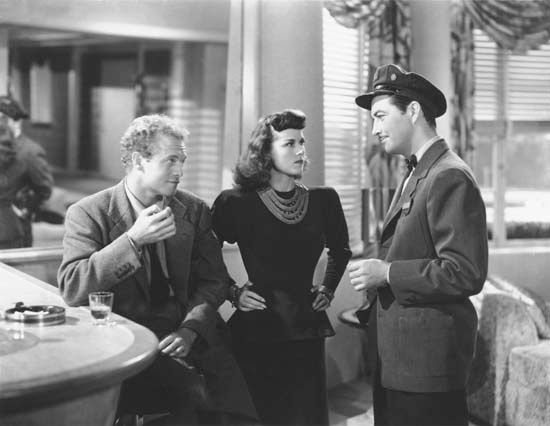
Taylor plays the title role, a paroled gangster who is operating a taxicab by day, and a crime syndicate by night. This is, of course, quite illegal, and DA John Farrell (Edward Arnold) is sure to put him back in jail if he were to find out what Johnny is doing. Still, Johnny has a palatial hide-out at the dog track he's running (gotta love those MGM sets!). There's a bit of a problem though: Farrell's daughter Liz (young and lovely Lana Turner) is a college student doing a project on the workings of the parole system, and she's out to cover Eager as part of that assignment. What happens next should be painfully obvious: she falls head over heels for him even though it's a Really Dumb Idea, and he begins to fall in love with her, despite the fact that he's got another woman (Patricia Dane, the one in the picture above). The other problem is that Johnny does have a conscience, too, although it's a disembodied conscience, in the form of Johnny's friend, the now-alcoholic cynic Jeff, played by Van Heflin.

The big problem with Johnny Eager is that almost everything seems slightly wrong. Warner Bros. did a great job on its gangster movies, uing their back lot effectively, and being able to cast stars like James Cagney and Humphrey Bogart was a big help. At MGM, on the other hand, everything looks too darn glitzy. MGM was able to make a lot of great movies, but that glitz -- at least the early 1940s version of it -- doesn't work. Perhaps if it had been the Prohibition era with some ridiculous art deco sets, it might have looked right. Also, Robert Taylor is unconvincing as a gangster. Lana Turner is OK as the young woman who falls for him, and it's obvious why anybody would fall for her. Edward Arnold is fine, although his is a fairly easy role. It's Van Heflin who steals the show from everybody; he's brilliant in playing the man who's had too much, both figuratively and literally. He's so much better than everybody else here that it isn't funny, and is frankly to the detriment of the movie: we want to see him, and don't care so much for the rest of the characters. It's no surprise that this movie won Heflin his Oscar for Best Supporting Actor. Watch also for Glenda Farrell in a small role as a policeman's wife.

Johnny Eager got a release to DVD as part of the Warner Archive Collection, so you can get a copy of it, although not as cheaply as many other classic movies.