Showing posts with label Edward Arnold. Show all posts

Monday, April 28, 2025

The Yellow Cab Man

Tonight's final night of TCM's Star of the Month salute to Red Skelton includes a pair of movies that are already on my DVR, although I'm only doing a post on one of them today. That movie is The Yellow Cab Man, which you can see at 9:45 PM.

The opening credits are done somewhat differently, with the names of the cast printed on, well, plaster casts. Those casts are worn by a character named Red Pirdy (Red Skelton) who, as you might guess, is accident-prone, to the point that insurance companies don't want to insure him. After the credits, he's trying to carry an oversized cuckoo clock down the sidewalks, when he accidentally starts crossing the street when the traffic has the right of way, not the pedestrians. This causes him to get hit by a taxicab from the Yellow Cab Co.

Now, Red is an honest, and inconceivably stupid man, so he's open about the accident being entirely his fault. Ellen Goodrich (Gloria De Haven) works for the cab company's insurer, an she tries to get Red to sign a waiver. Also showing up is a lawyer, Martin Creavy (Edward Arnold), who seems to have a way of committing insurance fraud and realizes he can use Red to make a ton of money, or so he thinks. Well, he will have that chance, but in a completely different way.

As part of Red's seeing Ellen and Creavy, Red reveals that not only is he one of those tinkering inventors who nowadays would be the target of those scammy commercials about getting a patent for your invention. But because of Red's stupidity, he also mentions that he's invented, but not yet patented, something called Elastiglass, which I suppose isn't that much of an invention since things like Plexiglas/Perspex and Lucite had been invented a good decade before the movie was released. Elastiglass is, like those other acrylics, shatter-proof and therefore much safer than traditional glass.

Ellen, and the executives at Yellow Cab, think that installing safer glass would be a good thing for the cab company's insurance bills, and hiring Red wouldn't be a bad PR move either. Martin, for his part, sees dollar signs if he can get the formula out of Red's mind. To that end, Martin hires a quack psychiatrist named Dokstedder (Walter Slezak) who uses drugs and hypnosis to try to obtain the formula. Murder is also involved, leading to a madcap climax.

I'm guessing that The Yellow Cab Man was conceived as a way for MGM to use Red Skelton's brand of physical comedy and sight gags. There's certainly a lot of that in the movie. Unfortunately, they didn't bother to come up with an intelligent enough script. Red is just way too stupid, to the point that you wonder how he's been able to live independently as an adult, never mind the concussions. The bad guys are cartoonishly bad, although I suppose that befits the cartoonish nature of the whole film. But to me it often came across more as grating than as working well.

Sunday, April 13, 2025

Pat O'Brien grows a moustache

Ever since moving and getting access to reliable high-speed internet two years ago, I've been able to watch the FAST services. Tubi seems to have access to a whole bunch of stuff that wound up in the public domain. One that I hadn't heard of before seeing it in the "classic" movies section was Slightly Honorable.

The movie starts off with the idea that perhaps there's an island somewhere in the South Pacifc that doesn't have corruption, but we're in America, 8,000 miles away. Cut to a shot of the highway commissioner in some state getting killed in a road accident, which is the height of irony because the commissioner was the one more or less responsible for the shoddy state of the roads, what with all the graft in the highway department. At his funeral are newspaper publisher Vincent Cushing (Edward Arnold), who is in on the graft and getting wealthy from it; and attorney John Webb (Pat O'Brien), who wants to eliminate corruption and graft.

Complicating matters is that one of Webb's clients, Alma Brehmer (Claire Dodd) just happens to be the mistress of one Vincent Cushing. Webb and Cushing are brought together again when Alma invites Webb to a swanky party at a nightclub hosted by Cushing. It's also a place for Webb to meet chorine Ann Seymour (Ruth Terry), who thinks of Webb as someone to look up to as well as woo once he saves her from one of the brutes at Cushing's party trying to slap her around because he's jealous of her dancing briefly with Ann. Ann, however, seems mostly to be comic relief, which is surprising considering that Eve Arden is also in the film playing the part of Webb's secretary.

Up to now the movie has been more comedy than drama, although things are about to take a turn. Alma being one of Webb's clients, she wants him to see her about some jewelry Cushing gave her and that she wants appraised so she can have it added to her insurance policy. Webb goes up to her swanky apartment, and finds that somebody's stabbed her! Needless to say, since he's the one to have found her, he's an obvious suspect. Cushing's wife has good reason to worry that perhaps her husband could be held responsible, what with his having an obvious motive of trying to silence poor Alma. So she tries to keep anything bad about Cushing from being released. Worse for Webb is that Cushing's daughter actively wants to implicate Webb. Helping to save Webb is his legal firm partner Sampson (a young Broderick Crawford).

I mentioned above that the movie starts off on a somewhat humorous tone, and in the years before the US got involved in World War II there was quite a cycle of comic murder mystery-type movies. However, Strictly Honorable takes a slightly different tack of being humorous up to the murder and then tacking a much darker turn. It's an odd strategy, and one that doesn't always work. However, the flaws in the movie are also in part to it being a low-budget independently produced movie.

Not that Strictly Honorable is a bad movie; it's more that it's the sort of thing where it's easy to see why it's fallen through the cracks and become largely forgotten.

Sunday, April 6, 2025

Fate Without Music

I was looking at the upcoming TCM schedule, and noticed that tomorrow, April 7, at 8:00 AM, you can catch the Howard Keel musical version of Kismet. It's from 1955, based on a then-recent musical, with the musical being based on an old stage play from the turn of the last century. That play had already been turned into a non-musical movie on multiple occasions, most notably a 1944 MGM Technicolor production also titled Kismet. I have that 1944 version sitting on my DVR, so I figure that now wouldn't be a bad time to do a post on it.

Thankfully, the movie has some opening narration that greatly helps to explain everything that's going on in the movie. The setting is Baghdad in its golden age, or "old Baghdad when it was new and shiny" as the narrator tells us. Hafiz (Ronald Colman) is a beggar by day who has somehow obtained some fancy clothes that enable him to go out at night disguising himself as a prince, calling himself Prince Hassir. It's as his prince that he makes his way into the palace of the Grand Vizier where he meets the Vizier's Macedonian wife Jamilla (Marlene Dietrich). But we're getting ahead of ourselves here.

Also given prominence in the opening narration is the nominal ruler of the empire, the Caliph (James Craig). The Caliph is smart enough to know that his advisers are going to engage in toadyism and tell him whatever they think he wants to hear, and that those things aren't necessarily going to be the truth. So he escapes from his own palace at night, dressing in regular clothes and passing himself off as the son of the royal gardener. This he does in order to be able to find out what his subjects honestly think. What they think isn't pretty, of course. But this going out at knight is also what brings him into contact with Hafiz as Hassir. One other person the Caliph meets is Marsinah (Joy Page). He falls in love with her, not knowing that she's really the daughter of Hafiz. Hafiz, meanwhile, has been feeding Marsinah a bunch of lies about how she's going to marry a prince and her life will be one of luxury.

Now, as I said earlier, Hafiz meets Jamilla, and is taken with her. The feeling is mutual, although Jamilla is smart enough to know that Hassir is a disguise as there's no real Prince Hassir in Baghdad. After all, the arrival of a prince would be big news, especially in the palaces. In any case, Jamilla is also the wife of the Vizier, played by Edward Arnold. Edward Arnold's casting is a sign that the Vizier is the baddie in the piece. While the Caliph is the nominal power, the Vizier fancies himself as the real power, and he's going to get into a power struggle with the Caliph. He also meets Hassir when Hafiz gets himself invited to the Vizier's place by posing as the prince. This is, unfortunately, going to cause a great deal of legal difficulty for Hafiz when the Vizier figures out the deception. But it also is what really puts the plot into motion for the second half of the movie.

Kismet received four Oscar nominations (which is why TCM aired it -- as part of 31 Days of Oscar) in various technical categories. It's easy to see why the movie picked up those nominations, but not for any of the more traditionally prestigious categories like acting or direction. The movie is certainly lovely to look at, and to be fair to the actors they do a reasonably good job with the material even if none of them look Arab. What makes this version of Kismet a movie that's not as well remembered as other 1940s classics is, I think, the screenplay, which is slow to develop and tends to meander, as if the screenwriters couldn't quite decide what to do.

That isn't to say this version of Kismet is bad. It's more to say that you wonder whether a truly classic movie could have been made from the material. I have yet to see the musical version, so maybe that musical will be the classic.

Sunday, April 9, 2023

Janie

One of the things that World War II did was give audiences a taste for movies that would boost their morale, even if there was no actual fighting in the movies. I think I've mentioned Fox's more homespun musicals, but for something that was more contemporary, you could watch a Warner Bros. family movie like Janie.

Janie Conway (Joyce Reynolds, who didn't go on to have that much of a career) plays Janie, a high school student in Hortonville, one of those small to medium-sized cities that populated Hollywood movies back in those days. She's typical of the middle class teens who were the focus of a lot of such movies, since Hollywood generally didn't want to show movies about the dirt poor for fairly obvious reasons. Janie has a boyfriend in Scooper (Richard Erdman), but things are about to get a lot more complicated for the two of them.

Janie's father Charles (Edward Arnold) is editor of the local newspaper, who also has a lot on his hands. Professionally, he needs a new printing press, but with the war on the government get to control which businesses get which goods. And at home, Dad has to deal with Janie. She, being a typical teenager, makes life difficult for him in all sorts of ways, from constantly hogging the telephone to having an interest in boys. This latter causes a big issue when she and her friends go to a "blanket party" with a bunch of boys, a party that gets published in Life magazine.

And then there's the war coming to their hometown. A bunch of servicemen get stationed at a base near Hortonville either on their way out to the European or Pacific theaters, or on their way back. So a bunch of young men who are still older than the high school boys and consequently a lot more mature are in town, cutting a fine picture in their uniforms. So of course the girls start falling for these men, even though I'd think the solderis would want an adult instead of a 16-year-old girl. In any case, Janie meets Pfc. Dick Lawrence (Robert Hutton), and the sparks start to fly between the two of them, much to Scooper's consternation.

But how to meet Dick alone? There's the rub. The other girls have the same problem, although in some ways even bigger because of the editorials that Janie's father has published. As a result, none of the other girls' fathers will let them fraternize with the servicemen. They get the bright idea to do so surreptitiously, at Janie's house, one even when Janie's parents go out to a grown-up function and Janie thinks she'll have the house more or less to herself. One thing leads to another, and it seems like the entire base is at Janie's house.

Janie is the sort of movie where you can see why audiences of the day would have liked it, but looking back on it 80 years later, boy is it dated. It doesn't help that most of the characters are unappealing. Janie is selfish, Mom (Ann Harding) is too ditzy, and Dad is close to the stereotypical out-of-touch dad. And then there's kid sister Elspeth, who is given the sort of role Virginia Weidler had in The Philadelphia Story, only turned up to 11 and made much more obnoxious. I wanted Bette Davis to come in and shake her the same way she did to Miriam Hopkins in Old Acquaintance.

So while Janie is a curio that will appeal to some people, I don't think it will appeal to everybody.

Sunday, August 1, 2021

The Ambassador's Daughter

If you've ever watched Three's Company, one thing you can't help but admit is that the plots of mistaken identity and misunderstandings are thoroughly unoriginal. For some reason, I found myself thinking of Three's Company as I was watching The Ambassador's Daughter.

Olivia de Havilland plays the daughter here, and frankly she's much too old for the part, but that's another story. She's Joan Fisk, daughter of post-war US Ambassador to France William Fisk (Edward Arnold). They're visited by a US Senator, Jonathan Cartwright (Adolphe Menjou) and his wife (Myrna Loy), doing the sort of visit that Jean Arthur was making to Berlin in Billy Wilder's A Foreign Affair. Specifically, Sen. Cartwright is concerned about the plethora of American GIs who are taking their furloughs to go to Paris and cause difficulty for all the French folks there. So he thinks the military should make Paris off-limits to American servicemen, and is trying to get General Harvey (Minor Watson) to do just that.

The ambassador isn't so sure, and his daughter decides that she'll offer to do some undercover research to discover just what American serivcemen are like, by pretending to be French and dting a visiting serviceman for the duration of his furlough. And wouldn't you know, she's quickly going to get the chance to do just that. A charity fashion show is going to be given to raise money for the American Red Cross' work in France, with various socialites playing the part of the models. Crashing their way into the audience for the show are two GIs, Sgt. Danny Sullivan (John Forsythe) and his best friend Cpl. Al O'Connor (Tommy Noonan).

Danny sees Joan, who is one of the models, and falls for her, while she puts on her best French accent and does nothing to disabuse Danny of the belief that she's a model for Christian Dior. So she willingly goes around Paris with him, although we of course know the real reason she's doing it. Gen. Harvey, meanwhile, brings Al back to the US Embassy, where he promptly has too much to drink and spills the secrets of things American servicemen do to try to win the hearts of European women.

Unsurprisingly, Sgt. Sullivan unwittingly does some of the same things, but out of pure innocence, having no idea that he's falling into a trap that Cpl. O'Connor has unintentionally set. When Joan learns of what Al has told the Senator and the Ambassador, she's ticked off because she wanted to help the servicemen keep their right to visit Paris, and look what they've done to her. But she also does something which leads to a misunderstanding. Danny decides to go to the Christian Dior house to look Joan up, and she, not actually being a model, shows up with the Senator to try to get him to buy a dress that he saw at the Red Cross fashion show for Mrs. Cartwright. Danny sees this, and thinks that Joan is two timing him with a sugar daddy.

Eventually, it all gets worked out for the best, although there's also the added complication of Joan having a fiancé in the form of a now-stateless prince (Francis Lederer). But boy does it take a long time to get there and do so unoriginally.

Olivia de Havilland had recently married a Frenchman and started living in Paris at the time the movie was made, which I'm sure is a large part of the reason why the movie got made at all. She was there, and it was a way for everybody else to get a working vacation in the City of Light. The establishing shots of Paris are lovely, but that's probably the best thing that can be said about the movie. The plot strains credulity and feels like a mish-mash of romantic misunderstanding movies that had been done at least since the start of the screwball era (although The Ambassador's Daughter is not a screwball comedy by any means).

Completists of any of the main cast members may want to see The Ambassador's Daughter, but for everybody else, I'd recommend a whole bunch of their other movies over this one.

Sunday, May 23, 2021

Mrs. Parkington

I've argued before that there's a certain sort of opulent movie that MGM was quite good at making. An excellent example of this is Mrs. Parkington.

Greer Garson plays Mrs. Susie Parkington, a widow living in a big house in New York City in 1938, complete with servants and the works. It's Christmas Eve, and she's brought together all of her descendants to come celebrate the holiday with her. Her daughter Alice (Gladys Cooper) is stuck up and doesn't like the children caroling outside her house or her Mom's dogs. Her grandson-in-law Amory Stilham (Edward Arnold) is a businessman with two adult kids, Jack (Dan Duryea) and Jane (Frances Rafferty), who is about to be engaged to be married to Ned (Tom Drake). Amory's wife has a sister Madeleine (Lee Patrick), who has gotten serially married, currently to rancher Al Swann (Rod Cameron). Most of the relatives don't care much for the matriarch, only for her money; the exception is Jane.

So when Jane tells her great-grandmother that she's planning to elope with Ned, Susie starts thinking back to when she got married.... She was living out in Leaping Rock, Nevada, as the daughter of a woman who runs the local rooming-house, which serves as the place where a bunch of workers at the silver mine live. That mine is owned by Maj. Augustus Parkington (Walter Pidgeon), who is a bold risk-taker as a businessman, skimping on mine safety to get the silver out more quickly. Sure enough, a mine accident kills not just the workers but Susie's mom, so the major marries the orphaned Susie and brings her back to New York.

There, Parkington builds Susie a big house and introduces her to the Baroness Aspasia Conti (Agnes Moorehead), who loved Augustus in the past and, as a companion to him, helps Susie adjust to her new life. It's a difficult life for her, as the members of the Four Hundred, the social elite in New York, blackball Augustus for his actions in the Civil War that killed an ancestor of one of the Four Hundred, as well as his business practices.

Those business practices have continued to the present day; even though Augustus is long dead, Amory has been running the family business and speculating with the business itself, to the point that he's lost some $30 million that he's not going to be able to replace. The auditors are going to find the hole, arrest Amory, and bring shame to the Parkington family. In fact, that's why Ned wants to elope with Jane: he's seen Amory's criminal actions, and doesn't want to have to testify, thereby hurting his wife-to-be.

The financial hole could be plugged if the company could float an issue with Mrs. Parkington's fortune, but when she puts it to a vote of the other heirs, they all say no, because they want to keep their inheritance. It prompts Susie to have another flashback to the time when she finally reformed her husband's own shady business practices, as well as to a time after her son's death when it seemed another woman might take Augustus away from her.

Mrs. Parkington is a workhorse of a movie, taking a fairly familiar story idea -- the elderly person looking back at his or her very eventul life -- and imbuing it with all the class MGM could bring to it. Walter Pidgeon especially, and to a lesser extent Garson, were solid if unspectacular actors who could take this sort of material and make a professional, quality product. Both leads are the sort of actor it can be a bit hard to warm up to, not because of anything bad they're doing but because they're working with material that's really of its time. Everybody else is frankly much too old to be playing the characters they are, at least if you believe the opening that implies Mrs. Parkington is in her 80s, but they all do well enough, Arnold taking the honors among the supporting roles. But it's Greer Garson's movie all the way, even more than Pidgeon's.

Mrs. Parkington is available on DVD courtesy of the Warner Archive.

Monday, January 18, 2021

Thirty Day Princess

Getting through the backlog of movies on my DVR, I recently sat down to watch Thirty Day Princess, which TCM ran back in August as part of Sylvia Sidney's day in Summer Under the Stars.

Sidney doesn't quite show up at first. Instead, the action starts at the spa baths in the capital city of the Central European kingdom of Taronia. American banker Richard Gresham (Edward Arnold) is on vacation there, and just happens to be in a bath next to the regining monarch, Anatol XII (Henry Stephenson). Anatol strikes up a conversation with Gresham, as His Highness has admiration for a country like America where even the peasants have electricity and running hot water. Taronians are a good people, but the country is underdeveloped.

Ah, but Gresham is a banker! He could figure out a way to fund a bond issue that would help Taronia be able to develop. But there's one catch. Americans don't know anything about Taronia, and would need a public relations campaign to be persuaded to purchase the bonds. Anatol can't do a state visit to America, because there's always the possibility that somebody will start a coup and Anatol won't be able to get back to Taronia.

But Anatol has a daughter, Crown Princess Catterina (Sylvia Sidney), who would be perfect for going to America for that PR tour. The Americans would love a charming princess who has just enough difficulty with English to be lovable. She's up for it, especially since it will get her away from obnoxious fiancé Nicholaus, to whom she's only engaged for political reasons.

So Catterina and some of the King's advisers take the ship to America and, on arrival, Catterina gives a speech. But she collapses at the end of the speech and is taken to the hotel feeling slightly ill. It turns out that she has the mumps, requiring her to quarantine for 30 days, and threatening to put the kibosh on the grand tour.

The bond issue failing would please Porter Madison III (Cary Grant) to no end. He's a newspaper publisher, and his paper prints the sort of populist stuff that generates dislike of bankers like Gresham, who Madison would argue is responsible for that little economic depression that's going on.

Gresham comes up with a backup plan. There are 8 million people in New York; surely, one of them has to look enough like Catterina that they can substitute her with a little training and pass her off as the Princess until the bond issue can be subscribed. It's the sort of daft plot you only see in the movies, of course, but don't think too hard.

Nancy Lane is a struggling actress who can't even pay the rent. She goes to an Automat, where she's accosted by two guys who she thinks are the police wanting her for trying to get a turkey leg without paying for it. Instead, they're actually representatives of Gresham, hired to find a lookalike for Catterina. Nancy, unsurprisingly, looks exactly like Catterina, because Nancy is also played by Sylvia Sidney. (There's one scene of Nancy and Catterina together toward the end.) Nancy could use the money, and who wouldn't like to try out being royalty for a month, so she takes the job.

You can probably guess what happens next, which is that Nancy-as-princess meets Madison, and the two fall in love, while Madison's associates at the paper thinks there might be something fishy and try to prove it. Nicholaus eventually shows up in America to try to prove that the woman Gresham has been trotting out in public isn't actually Catterina. But this being a light comedy, you can suspect that the plot isn't really going to work and people are going to live happily ever after.

Thirty Day Princess is a nice little programmer. Sidney was a fairly big star for Paramount at the time, while Cary Grant was still on the rise, not yet getting the roles that would really make him a big star. They make an appealing enough couple. The plot is nothing earth-shattering, but it's got the sort of predictability that would probably have made Depression-era audiences happy. It all works pleasantly enough, entertaining for the roughly 75 minutes that it runs.

You could do far worse than to watch a movie like Thirty Day Princess. It got a DVD release courtesy of Universal's MOD scheme, and TCM also shows it as being available on a couple of Cary Grant box sets.

Saturday, September 12, 2020

Sadie McKee

I thought I had blogged about Sadie McKee before, but a search of the blog claims I haven't. Having recently watched it and it being available on DVD courtesy of the Warner Archive, now you get a review of it.

Joan Crawford plays Sadie, who at the start of the movie is a domestic, having grown up with her cook mother in the home of the Aldersons. Their son Michael (Franchot Tone) is a lawyer who is in love with Sadie, but she's in love with a man from her social class, Tommy (Gene Raymond). Michael bad-mouths Tommy, so what does Sadie do? She gets together with Tommy and runs off to New York to elope with him!

But perhaps there was a reason Michael bad-mouthed Tommy and Sadie should have been with Michael. Sadie and Tommy arrive in New York too late to get married that day, so they get a room in a rooming house with the plan to get married the next day. Sadie looks for a job in the morning and plans to meet Tommy who is going to get the marriage license. But while she's out looking, Tommy meets a traveling performer who offers Tommy a job on the spot, which he takes even though it requires traveling and separation from Sadie.

Sadie, being in need of a job, gets one in a nightclub as a dancer. This is the sort of 1930s clubs that rich guys went to and threw away lots of money, including on dancers and waitresses who hoped to snag a rich man. Not that Sadie was expecting that, but it's going to happen anyway. Rich guy Jack Brennan (Edward Arnold) shows up one day and immediately falls in love with Sadie, who sees things more in terms of how this might be beneficial to her, not that she wants to hurt Jack.

There are two problems with Jack, however. One is that he's an alcoholic. The other is that among his friends is... Michael Alderson! So now he knows what Sadie's done with herself, and he knows (or at least is convinced) that it's going to be bad news for Sadie if she hooks up with Jack. Still, she does so, and even tries to help Jack sober up when she learns that if he doesn't sober up it will kill him. But she's still in love with Tommy....

Sadie McKee is one of those 1930s melodramas that are interesting if you don't focus too much on the plot, which really doesn't make that much sense. Crawford plays a lot of characters like this at MGM in the first half of the 1930s, and she does a perfectly fine job with it. Edward Arnold is also surprisingly good both as a drunk and as the fundamentally decent human who doesn't want to hurt Sadie. Raymond isn't around much, and Franchot Tone is acceptable at least.

Sadie McKee is nothing special, but there's also nothing really wrong with it. It works well enough as a vehicle for Joan Crawford, and is enough to hold the interest of anybody who's already a fan of 1930s melodrama.

Saturday, March 28, 2020

Biogaphry of a Bachelor Girl


TCM ran the movie Biography of a Bachleor Girl not too long ago. It's going to be on again tomorrow morning at 6:00 AM if you want to watch it for yourself.

Ann Harding plays the titular unmarried woman, an artist named Marion Forsythe. She apparently gained some fame while she was over in Europe, and is now returning to her native America. Richard "Dickie" Kurt (Robert Montgomery in an odd pair of spectacles for him) is a magazine editor who has come up with a great idea to pitch to his publisher to help shore up the magazine's flagging fortunes. He'll get Marion to write her autobiography, which will be serialized in their magazine, and that will boost circulation.

Kurt goes to the boat Marion is sailing in on and finds that he's not the only one who wants her attention. There's also Feydak (Edward Arnold), brother of an artist Marion knew, but for whatever reason Feydak seems to drop out of the movie fairly early on. Eventually Kurt is able to talk to Marion about the biography, and since she's in need of money, she reluctantly accepts.

But this is going to cause other problems. Earlier in life, she met lawyer Leander "Bunny" Nelson (Edward Everett Horton) and apparently had a torrid affair with him. This shouldn't be a big deal nowadays, but for the mid-1930s such affairs probably were more scandalous. Bunny wasn't married at the time, but now he's engaged to Slade Kinnicott (Una Merkel), daughter of a newspaper publisher back in her and Bunny's home state. And Bunny is now running for the US Senate, so if news of that affair were to come out, he fears it would sink his candidacy.

So Bunny has what he feels is a perfectly good reason for trying to convince Marion not to write that memoir, while Kurt has own job to think of in trying to get Marion to fulfill their agreement. Eventually Marion goes back to a small town to consider her prospects, with everybody following her.

Biography of a Bachelor Girl came out in the beginning of 1935, and it really feels like the sort of movie that was badly neutered by the enforcement of the Production Code, which began in July 1934. There's a fair amount of potential in the material, but none of it was realized as the movie can't seem decide whether it wants to be a comedy or a drama. There's also the disappearance of Feydak, and the whole small-town thing not working here the way it did in many other movies.

Biography of a Bachelor Girl does not seem to be on DVD as far as I can tell, so you're going to have to watch the TCM showing.

Saturday, February 1, 2020

John & Mary & Fred & Lilly


Patricia Neal was TCM's Star of the Month in January, and one of her movies that I hadn't mentioned here before is her movie debut, John Loves Mary. So I recorded it to do a review on it here.

Neal plays Mary McKinley, daughter of US Senator James McKinley (Edward Arnold) and living with the whole family in an apartment hotel. John Lawrence (Ronald Reagan) is a US Army soldier who has just been demobilized from World II and is returning home from Europe. Mary knows he's returning home today, and is anxiously waiting because she's expecting they'll get married. John would be perfectly willing to get married, and frankly it would make sense if they waited long enough to organize a wedding suitable for a Senator's daughter, which would take several weeks. But Mary wants to get a marriage license now, wait the requisite three days, and then get a civil ceremony, because she's already waited long enough for John what with him serving overseas for the past few years.

John, it turns out, has other reasons for wanting to wait. While in Europe, he was shot and saved by his army buddy Fred Taylor (Jack Carson). Fred having done a big favor for John, John wants to return that favor, and found a way to do so. While the two were in England waiting to be shipped over to France, Fred fell in love with music hall singer Lilly (Virginia Field). They lost contact when the music hall was bombed in a raid and Fred, believing Lilly had died, returned to America some time before John. But John was able to find Lilly, and since she loved Fred as much as he loved her, John would like to help Lilly and Fred get together again.

There are a few catches, however. The first is that getting Lilly into America isn't going to be easy, since transatlantic travel at that time was more expensive and Lilly doesn't have a work visa. John did figure out one way to get Lilly here, though. He could marry Lilly which would allow her to come over as his wife! Then they'd go off to Reno for six weeks at which they could get a quickie divorce and Lilly would be free to marry Fred. This would explain why John wants to wait before getting married to Mary -- in fact, he can't marry her right now, at least not legally. And one can understand, I suppose, why John wouldn't want to tell Mary this.

Ah, but I said at the start of the paragraph that there were multiple catches. The other one is that when Fred couldn't find Lilly and she was presumed dead, John told him no to be stuck in the past and move forward in life. Fred moved forward by returning to America and... getting married. Some time ago, too, as his wife is now nine months pregnant (the wife is never seen, but this is obviously Fred's child; no shenanigans going on with that part of the story). So Fred can't marry Lilly.

And Lilly is on a boat a few days behind John, so she's about to show up right in the middle of this big mess that John has made for himself trying to make everybody else's lives happy. How is John going to get himself out of this.

John Loves Mary was based on a Broadway play, and you can see both where it had its origins on the stage as well as why some people would really like this one. The cast is good and mostly well suited to comedy. However, I found myself quite put off by the film, for a reason that I've discussed in relation to several movies I've reviewed over the years. John Loves Mary is one of those films in the genre that I'd call the "comedy of lies", where a character starts off with a little white lie that might even be well-intentioned, but has to build lie upon lie on top of it to keep out of bigger trouble. I understand that transatlantic communication was much more expensive in those days, but I can't help but wonder whether John would have been better served sending a telegram to Fred and/or Mary when he found Lilly. As it is, John's lying and Fred's helping him are more grating to me than funny.

But since this is a genre I'm not fond of, it's also the sort of movie that is really something the rest of you should watch and judge for yourself. It's available on DVD courtesy of the Warner Archive Collection.

Saturday, August 17, 2019

Not-so-delightful idiots

In July's TCM spotlight of movies from the year 1939, one of the movies they ran that I hadn't blogged about before is Idiot's Delight. So I decided to DVR it and sat down to watch it so I could do a post on it here.

The movie starts off with the end of World War I and soldiers returning home. Among those soldiers is Harry Van (Clark Gable), who had been working in vaudeville before the war. The war has changed things, and he's constantly bouncing from gig to gig, eventually winding up as the straight guy to phony psychic Madame Zuleika (Laura Hope Crews). One night in Omaha she gets drunk and the show goes south. Irene Fellara (Norma Shearer), an acrobat with a different act, figures out what's going on and after the show tells Harry that she wants to learn the secret of the act and be the psychic. Harry says no, and the two eventually go their separate ways.

Fast forward to 1939. Harry has continued to work a series of gigs, with his current one being the front man for a group of chorus girls called Les Blondes. They've been performing all over the place, and are now in the Balkans, returning back to western Europe. But the political situation in Europe is unstable; as we know World War II in Europe would begin in September of 1939. (The movie was actually released in 1939 and is based on a play that hit Broadway back in 1936.) So when the train gets to what would be roughly Slovenia in modern geography if it had been an independent country at the time, they're forced to stop because the borders are temporarily closed.

Harry, Les Blondes, and a bunch of other passengers are forced to wait in an Alpine resort hotel while the uncertain situation resolves itself. Among the passengers are the scientist Dr. Waldersee (Charles Coburn), who is doing cancer research on his rats; the newlyweds Mr. and Mrs. Cherry; pacifist Quillery (Burgess Meredith) who used to work in the arms industry; and Achille Weber (Edward Arnold), a titan of the armaments industry who has as his companion Russian exile Princess Irene [sic -- in Russian it would be spelled Irina]. Harry sees Irene, a platinum blonde, and realizes she's a dead ringer for the Irene he knew back in Omaha.

Harry tries to figure out whether Princess Irene is the same woman he had met all those years ago, while some of the other people have their own dramas of greater or lesser importance played out. Weber tries to send a bunch of telegrams, while Quillery eventually goes nuts and breaks up a performance of Les Blondes screaming about the upcoming war, not caring what the authorities are going to do to him.

Eventually, the border is reopened -- but Irene's passport is not in order. She had what was probably a Nansen passport, since her real birth location wasn't known and even if she were Russian she would likely not have been able to bring her passport with her when she escaped and it would have expired anyway. The problem with being forced to remain is that at the bottom of the hill where the hotel is, there's an air base where some of this country's air force has its planes. And they might well have started the war by carrying out an air raid.

I have to admit that I found Idiot's Delight to be a curious misfire. There's a whole lot of nothing going on for much of the movie, and frankly there's not much reason to care about any of the characters besides Harry and Irene. Irene in particular is irritating in the second half of the movie.

But there's also quite a bit interesting. One thing is that the fictional country where everybody is stranded uses Esperanto. (Apparently the original play used Italian and Italy objected when the movie was being made. And since they were still a market for Hollywood movies....) Another interesting thing was that Les Blondes (and Harry) perform Irving Berlin's "Puttin' on the Ritz", which still has the original lyrics about the hired help going back to Harlem on their night off and voguing. I was surprised to see an Irving Berlin song used like this, since I thought by this point he wanted complete control over how his music was being used, hence the whole creation of the movie Alexander's Ragtime Band.

The final thing of note is that MGM created two endings, one for Europe and one for the US. When TCM ran it, they showed the European ending. But after the closing titles, the print has a card pointing out there were two endings, and proceeds to show the American ending.

Idiot's Delight is available on DVD courtesy of the Warner Archive, if you want to watch it and judge for yourself.

Monday, February 29, 2016

The Jim Fisk story, more or less

Over the weekend, I got the chance to watch The Toast of New York off my DVR. It's available on DVD from the Warner Archive, so I'm comfortable doing a full-length post on it.

Edward Arnold stars as Jim Fisk, who at the start of the movie is seen in the old South just before the Civil War began. He's there with his business partners Nick Boyd (Cary Grant) and Luke (Jack Oakie) selling soap in a scam. Just as the scam is about to be discovered news arrives of the firing on Fort Sumter, and the three northerners have to beat a hasty retreat north. Jim, however, gets an idea: with the Civil War, the North is going to blockade the south making it difficult to get cotton out of the South. Jim can smuggle to cotton out, and make a financial killing doing so.

Fisk and Boyd do more or less make a killing, but after the war is over they return to Luke in Boston, only to find out that he was stupid enough to invest all of their profit in Confederate war bonds. So, the partners are more or less broke, unless they can use those bonds to scam somebody, which of course Jim is fairly easily able to do, getting involved with the shipping company of Daniel Drew (Donald Meek, wearing one of the worst fake beards you'll ever see in the movies). Fisk uses his new partnership with Drew to go up against the magnate of the time, Cornelius Vanderbilt.

Meanwhile, Fisk and Co. go to the theater to see the latest sensation from Paris, Fleurique. Fisk wants to meet her back stage, but due to an error, he really winds up meeting Fleurique's maid, Josie (Frances Farmer) who is a maid only because it's what's getting her into the theaters. She really has dreams of becoming an actress. Jim falls in love with her, but she's really in love with Nick, who has ambivalent feelings for her. Fisk is rising in the business world at the same time he's carrying on the romance with Josie, and Nick is worried that Jim is letting his love for Josie blind him to the financial perils he's going to face.

Eventually Jim develops a serious case of hubris, deciding that he can corner the gold market. Nick thinks this is a step too far, since the US Treasury is bound to release gold into the market, thereby driving down the price of gold and bankrupting Jim. And while the attempt to corner the market is going on, it's going to create a market panic anyway. As the movie presents things, Fisk's attempt to corner the market is what finally ticks off his shareholders irrevocably.

Too bad it didn't quite happen that way. In real life, James Fisk did indeed love a Josie Mansfield. But he could never marry her because he already had a wife. They weren't living together, but were enough of friends that they'd spend the summers together at their old summer place. And Josie was also seeing another of Fisk's associates, the one that the Nick Boyd character is more or less based on. Well, that's a bit off too, since the movie completely omits Diamond Jim Brady from the plot. It's this other business associate who finally puts an end to all of Fisk's dealings because of the relationship with Josie. Fisk, in fact, came out of the gold panic relatively unscathed.

But while The Toast of New York gets some key points of history wrong, it's still a pretty entertaining movie. Edward Arnold brings a lot of energy to the role of Jim Fisk, something that's necessary for a man who wanted to be bigger than life. Grant is pretty good in what is clearly a supporting role, something he was soon to graduate from. Jack Oakie provides the comic relief very comically, and Frances Farmer does OK as the love interest. RKO also went to great expense by RKO standards to make this movie look good, and succeed there too.

I'd recommend both watching this movie, and reading up on the real Jim Fisk.

Saturday, January 4, 2014

Design for Scandal

TCM is showing a night of Walter Pidgeon movies to go with this week's Essential, The Bad and the Beautiful at 8:00 PM. The second of these movies, Design for Scandal, comes on at 10:15 PM.

Edward Arnold plays newspaper magnate JM Blair. Blair has a wife, Adele, who isn't quite being wifely, so Blair decides he's going to get a divorce with cause: if he can prove she's at fault, he won't have to give up any of his fortune in the divorce settlement. (Didn't they have prenups back in 1940?) Unfortunately, there's a problem. Blair gets in divorce court, Judge Cornelia Potter (Rosalind Russell). Yes, a lady judge. There are men nowadays who claim that famiy court is severely biased against men, although they at least have the claim that it's normal for women to support themselves financially. Back in the 1940s when women were expected to stay home and be housewives, there might have been more of a need for women to get alimony. But the movie plays it more as though of course Cornelia is going to be biased toward the wife, since the judge is a woman.

Blair, being forced to pay a princely sum in alimony, decides that the best way to get out of it is to dig up some dirt on the judge, which would presumably get her brought up on ethics violations or something like that. So he calls on his best reporter, Jeff Sherman (Walter Pidgeon), to get to know Judge Potter and get the dirt. Well, except that Sherman isn't Blair's best reporter right now because he's just been fired again. (How much of this shtick have we seen in Libeled Lady or It Happened One Night?) Sherman takes on the job in exchange for a hefty raise, and follows Judge Potter off to Cape Cod where she's about to go on vacation with her sister and nephew.

You can probably guess what's going to happen next. Cornelia avoids Jeff at first. But then the two finally meet, and you just know they're going to fall in love. That, of course, means serious plot complications: The love affair itself might actually be the dirt on her, since Jeff already has a lady friend he was intending to marry. But Jeff, falling in love with Cornelia, will have moral qualms about giving that dirt to Blair. (Gee, didn't we see some of this in Libeled Lady too?)

When I blogged about Johnny Eager back in April 2010, I suggested that it looks like what you'd get if you put MGM's glitz on a Warner Bros. gangster movie. By the same token, I might say that Design for Scandal could be what you'd get if you took MGM's other values of being oh so morally upstanding and tacked those onto a screwball comedy. And yet, with Libeled Lady five years earlier, MGM had already made one of the great screwball comedies. Design for Scandal, on the other hand, comes across as a bit tired and tedious. Walter Pidgeon and Rosalind Russell try, but they've got such leaden material. They're not bad; it's just that they don't really get the opportunity to show how good they really could be. On its own it's not terrible, but compared to all those other screwball comedies it really begins to pale.

Design for Scandal has received a DVD release from the Warner Archive.

Sunday, April 28, 2013

Eyes in the Night

I believe I have never blogged about the film Eyes in the Night before. It's airing tomorrow morning at 6:00 AM on TCM.*

Edward Arnold stars as Duncan MacLain, a blind detective with a seeing eye dog, an assistant Marty (Allan Jenkins), and butler Alistair (Mantan Moreland). Into Duncan's life walks an old friend, Norma Lawry (Ann Harding). She's got a step-daughter Barbara (Donna Reed), who doesn't exactly appreciate her step-mother for having gotten married to dad Stephen (Reginald Denny). As such, Barbara is rebelling against Dad and stepmom by going out with older men who, Norma realizes, aren't right for Barbara. Specifically, it's an actor in a traveling theater troupe who many years ago was also Norma's boyfriend. (What a way to rebel.) Is there anything Duncan could possibly do to prevent Barbara from making a big mistake? Later that evening, Norma and Barbara each separately go to the actor's apartment and find him dead, a murder which is never quite fully explained.

Norma tries to get away from it all by going to her house in the country, which is where the real action of the story begins. Duncan follows her there to investigate, using the ruse that he is Norma's uncle. Barbara shows up with the director of the theater troupe who, it turns out, has other reasons for wanting to be there. The murder was almost a Macguffin. Stephen, in fact, is working for the US government as part of the war effort, having developed a secret formula for something that obviously has to be important in the fight against the Nazis, because the Nazis want it, and have gotten a whole bunch of spies in that big house trying to get the formula. Can Duncan save the day? Well, thanks to the Production Code, you know the answer is "yes", so seeing how he saves the day, with some help from that seeing eye dog, is what makes the movie worth watching.

Eyes in the Night is quite entertaining, despite a plot that's rather problematic. I already mentioned that the murder is never really cleared up. How the Nazis were able to get so many spies working as Stpehen and Norma's servants, or how they got the one other spy, all to show up together and get involved with the various parts of the Lawry family, is also left as an exercise to the viewer. And how did this blind guy get so wealthy? (Presumably he was wealthy before going blind.) What makes the movie entertaining is a strong performance from Edward Arnold as the blind man. He's assertive, and quick-witted: in one scene where he gets stowed in a basement, he foils a gunman by taking his cane and smashing all the lightbulbs to make the gunman just as blind as him; it's an idea that would be used a generation later in Wait Until Dark.

Eyes in the Night has received a DVD release, but from one of those low-budget companies, implying that it entered the public domain at some point and wound up with a crummy print.

* (Eyes in the Night is listed as having a running time of 80 minutes, which means that the next film ought to begin at 7:30 AM. However, TCM's on-line schedule has the following film, Kid Glove Killer, as starting at 7:15 AM, and having a running time of 74 minutes, which makes the day's third film, Little Mister Jim scheduled to begin at 8:30 AM. Even my satellite box guide has the same schedule. Either the running time for Eyes in the Night is wrong, or the other movies are going to get pushed back.)

Tuesday, April 13, 2010

MGM's Gangsters


Tonight continues Robert Taylor's turn as TCM's Star of the Month. One of his more interesting movies shows up at 11:45 PM ET: Johnny Eager. It's MGM's idea of a gangster movie, made after all of the great gangster movies had already been made over at Warner Bros., and that alone makes it interesting.

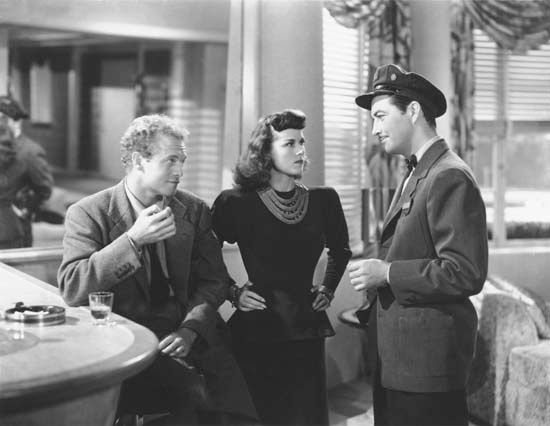
Taylor plays the title role, a paroled gangster who is operating a taxicab by day, and a crime syndicate by night. This is, of course, quite illegal, and DA John Farrell (Edward Arnold) is sure to put him back in jail if he were to find out what Johnny is doing. Still, Johnny has a palatial hide-out at the dog track he's running (gotta love those MGM sets!). There's a bit of a problem though: Farrell's daughter Liz (young and lovely Lana Turner) is a college student doing a project on the workings of the parole system, and she's out to cover Eager as part of that assignment. What happens next should be painfully obvious: she falls head over heels for him even though it's a Really Dumb Idea, and he begins to fall in love with her, despite the fact that he's got another woman (Patricia Dane, the one in the picture above). The other problem is that Johnny does have a conscience, too, although it's a disembodied conscience, in the form of Johnny's friend, the now-alcoholic cynic Jeff, played by Van Heflin.

The big problem with Johnny Eager is that almost everything seems slightly wrong. Warner Bros. did a great job on its gangster movies, uing their back lot effectively, and being able to cast stars like James Cagney and Humphrey Bogart was a big help. At MGM, on the other hand, everything looks too darn glitzy. MGM was able to make a lot of great movies, but that glitz -- at least the early 1940s version of it -- doesn't work. Perhaps if it had been the Prohibition era with some ridiculous art deco sets, it might have looked right. Also, Robert Taylor is unconvincing as a gangster. Lana Turner is OK as the young woman who falls for him, and it's obvious why anybody would fall for her. Edward Arnold is fine, although his is a fairly easy role. It's Van Heflin who steals the show from everybody; he's brilliant in playing the man who's had too much, both figuratively and literally. He's so much better than everybody else here that it isn't funny, and is frankly to the detriment of the movie: we want to see him, and don't care so much for the rest of the characters. It's no surprise that this movie won Heflin his Oscar for Best Supporting Actor. Watch also for Glenda Farrell in a small role as a policeman's wife.

Johnny Eager got a release to DVD as part of the Warner Archive Collection, so you can get a copy of it, although not as cheaply as many other classic movies.

Saturday, December 20, 2008

You Can't Take It With You

TCM's Essential movie for this week is the Best Picture Oscar winner of 1938, You Can't Take It With You, airing tonight at 8:00 PM ET. This is a movie that shows just what a good comedy should be.

Jean Arthur stars as Alice Sycamore, the granddaughter of a once-wealthy businessman, Martin Vanderhof (played by Lionel Barrymore). He decided to quit the rat race and devote his life to the things that really matter, and now lives in a big house with all his relatives, who have also (more or less) taken up his philosophy. Alice loves her family, but is working, as the secretary to banker's son Anthony Kirby, Jr. (James Stewart) The Kirbys are as well-to-do as the Vanderhofs used to be, and the father (Edward Arnold) is extremely concerned not only with his money, but also with his family's social status.

It should be obvious what happens next: Boy loves Girl, but is worried that the father won't approve of Girl's family. And Heaven knows that Girl has one warped family. Grandpa Vanderhof, despite having started it all, is probably (apart from Alice) the sanest of the bunch. There's daughter Spring Byington, who has become a writer despite the fact that nothing she writes ever gets published; her husband, a fireworks maker; granddaughter Ann Miller, a wild ballerina; her husband the xylophone player; and a cast of well-known character actors that includes Mischa Auer, Donald Meek, and Halliwell Hobbes. Amongst all this, the patriarch of the bohemians teaches the blue-blood banker a few things about life.

This is a great movie, largely because it's so outrageous in its characterizations. And despite the fact that Edward Arnold is portrayed as clearly being the bad guy here, caring more about his place in the world than his son's happiness, it's easy to understand his motivations. A family like the Vanderhofs may make for excellent viewing, but would you really want to live with such people? In reality, such a family would probably have a dynamic more like the first son Art Carney stays with in Harry and Tonto.

Needless to say, a movie as classic as You Can't Take it With You, having been made by a director as prominent as Frank Capra, is available on DVD. Still, it's just as much worth watching when it shows up on TCM as it is waiting for the DVD at the rental store.

Friday, May 16, 2008

Catching up with Easy Living

I've got half a dozen movies that I saw the last time they were on TCM, and could write a post about, but since I don't have time to write truly in-depth posts for more than one movie a day, I keep falling behind. (You should see how I fall behind in the movies that I've taped. One Independence Day weekend, I watched a tape of a Loretta Young movie from TCM's birthday tribute to her. Loretta Young was born in January.) Not being terribly interested in the movies for today or tomorrow on TV, or having blogged about them already, I can finally get to one of them: Easy Living.

Paramount released this screwball comedy in 1937, and since it's part of Universal's library, it doesn't get seen much on TV. However, TCM were able to show it in cunjunction with its release on DVD. Jean Arthur stars as Mary Smith, a woman in New York City making a meager living writing for a magazine. One day, her life changes literally out of the blue: while she's riding to work, a fur coat falls out of the sky and lands on her. (Sure, it sounds odd, but the same plot twist of a discarded fur coat was used in Make Mine Mink.) It turns out that the fur coat has been thrown out of a high-rise apartment window by wealthy banker J.B. Ball (Edward Arnold), peeved that his wife has been overspending. (What husband isn't irritated by his wife's overspending?) Smith tries to return the coat to Ball, but he tells her to keep the coat, and even buys her a fine new hat to replace the one that was destroyed when the coat landed on it.

All this leads to a whole bunch of problems: Smith loses her job, but makes a whole lot of new "friends"; people who saw her in the fur coat accompanying Ball, believe that she is Ball's mistress, and want to use this "fact" to gain influence with Ball. In her new life, she's only made one real friend, a worker at an automat played by Ray Milland. What she doesn't know is that he is actually Ball's son, working at the automat to prove that he can make it without Daddy's money. (Also, he doesn't know that she got her coat from his father.) To call the movie wild might be a bit of an understatement. There's slapstick, constant humor created by the mistaken identities, and a pacing that gives the viewer near non-stop action, and non-stop laughs. Jean Arthur had done comedy before, and wsa quite good at it; Edward Arnold is also a joy to watch in his comedy roles. Ray Milland, on the other hand, isn't very well-known for doing comedy. Yet he's fine here, even if outshone by Arthur and Arnold. (Not that that's a slur on Milland.)

Easy Living was directed by Mitchell Leisen, who isn't so well remembered today, although he made a number of really funny movies. The name you're more likely to recognize is that of the screenwriter, Preston Sturges.