Showing posts with label Gene Tierney. Show all posts

Sunday, August 9, 2026

The attic around toys

I think I've mentioned quite a few times in the past that Southern Gothic is not one of my favorite genres of movies, in part because of how "loud" the movies are, and even more because they tend to be full of characters for whom it's difficult to have any sympathy. In any case, another Southern Gothic movie was on my DVR and getting a TCM airing at the end of Gene Tierney's day in Summer Under the Stars: Toys in the Attic, early tomorrow (August 10) at 4:15 AM.

Carrie (Geraldine Page) and Anna (Wendy Hiller) Berniers are a pair of sisters living together in the old family house in New Orleans, neither of them ever having apparently married. They've got an itinerant brother Julian (Dean Martin) who's gone north, supposedly to earn money, although the source of the money is a big point of discussion over the course of the movie. In any case, Julian is expected to return to New Orleans as the movie opens together with his new bride Lily (Yvette Mimieux).

Except that Julian is already in New Orleans, holed up at a hotel with Lily with the hotel owner expecting him to pay off a substantial bill. Julian has business to attend to with Cyrus Warkins, the nature of which will be revealed later in the movie. But the business ends with Julian in possession of a very thick envelope full of cash, which Julian in an incredibly stupid move does not deposit into a bank account.

Julian arrives at the old family home, bringing a whole bunch of gifts since one of the things the two sisters had hoped for was to be able to take a trip to Europe together. However, the sisters wonder about the source of the money, with one theory being that Julian was paid to marry Lily. Lily, you see, is the sort of woman who acts as though she's never going to grow emotionally beyond being an adolescent: she's physically marriageable, but not mentally. The two Berniers sisters even ask Lily's mother Albertine (that's Gene Tierney) directly about it.

There's also the suggestion that Julian earned that money by selling a factory up in Chicago, which he may well have done although he probably didn't earn that much money. He's also been way too profligate with the money he does have, the way that some poor people who win the lottery spend themselves into bankruptcy.

Meanwhile, Julian has also been seeing Cyrus' wife Charlotte, who as it turns out also has something to do with the money that Julian got although that's only going to be revealed later in the movie. But continuing to see her after Julian's got married to Lily is now going to be twice the issue: where it might only have been a problem with Cyrus, now there's Lily to worry about too. And Carrie, who seems to look up to Julian much more than Anna does. This warped relationship is ultimately going to lead to the climax of the movie....

There's a lot in Toys in the Attic that I can't really mention since it would give away too much information. But let's just say that Toys in the Attic is an overheated movie. Julian comes across as a dishonest grifter. Lily and Carrie are both obnoxious blankety-blanks who deserve to be slapped. Anna is the closest to a sensible person, but even she is not quite a prize. The crazy plot and unlikable characters make Toys in the Attic a difficult movie to warm up to.

But, as always, watch and judge for yourself.

Thursday, October 26, 2023

A Bell for Adano

I think I've mentioned in passing a couple of times over the years about how I'd seen Fox's World War II movie A Bell for Adano, but it was long enough ago and didn't seem to be showing up anywhere to do a post on it. With the refreshing of the FXM rotation at the start of Octber, the movie is not back in the schedule, so I made a point of putting it on the DVR so that I could watch in anticipation of the next FXM showing. That next showing is finally here, tomorrow (October 27) at 9:35 AM.

The movie starts with a US Army jeep pulling up in what looks like a fairly deserted town that has a lot of rubble. That town is Adano, on the Italian island of Sicily, which was the starting point of the Allied invasion of Italy. In the jeep are Maj. Joppolo (John Hodiak), an Italian-American whose parents came from the northern part of Italy, along with Joppolo's two subordinates, Sgt. Borth (William Bendix) and Captain Purvis (Harry Morgan, in the early part of his career when he was still being credited as Henry). Maj. Joppolo is to be the temporary military governor of Adano, at least until the situation stabilizes and civilian rule can be brought back to places like Adano after 20 years of Fascist rule.

Joppolo is looking for somebody he can liaise with, but has a difficult time of it because all he gets is toadying and the same kind of guff John Wayne's character gets at the beginning of The Quiet Man. However, after quite a bit of discussion, he finds a couple of things. One is the sort of usual concerns about the people running low on food in part because the bakery is only open intermittently and in part because the fishermen can't go out to fish what with the war on and Mussolini having extorted them up to now. But a lot of the people also complain about the lack of a bell in the bell tower of the municipal hall. Everyone in town ran their day by that bell, at least until Mussolini ordered it removed and melted down to make more munitions for the war effort. Getting it back would be a sign of faith from the new authorities, as well as a signal that the rebuild is truly on.

Joppolo tries to do what he can, although getting a new bell seems like a bit of a fool's errand. After all, who has a spare bell lying around. And there are more practical concerns, like trying to get those fishermen back out to sea so that the town can eat better. Through the head of the fishermen Tommasino, Joppolo meets Tommasino's daughter Rosa (Gene Tierney with a horrendous and out-of-place blonde hairdo). They begin to develop feelings for each other, even though Joppolo has a wife back in the States and Rosa has a boyfriend who went off to fight.

Joppolo does the best he can for the locals, in part because it's a better way to gain their loyalty than trying to force them into submission. People higher up the chain of command, however, are unable to see (and in some ways need not to be focused on) the situation in a small town like this and how a general order might affect them. So when the distant General Marvin orders the Adano locals off the main road and to use side roads, there's a problem. The locals have no side roads, and need to use the main road to get to the water and fuel sources as well as the lands they farm. Joppolo wants to let them use the road, but countermanding a general's order is serious business.

On the bright side, when some naval officers stop in Adano, they inform Joppolo that they know a ship that carried off a bell that would be just the thing for Adano. They can probably even get it to Adano and installed, but will they be able to do that before Gen. Marvin figures out what's going on?

A Bell for Adano is one of those movies where you can see why audiences of 1945 would like it. It's mostly a feel-good story that the US needed even with the war winding down. It's also loosely based on a real story. On the minus side, nowadays you look at the depiction of the locals and somebody would be complaining about stereotypes. Overall, howeer, A Bell for Adano is a solid war movie effort and a movie that definitely deserves a watch. Definitely better than something like The Secret of Santa Vittoria.

Friday, February 3, 2023

Penny Serenade meets Room for One More

I recently watched a Gene Tierney movie I hadn't heard of before: Close to My Heart.

Tierney plays Midge Sheridan, a housewife who at the start of the movie learns that she is going to be unable to have children, something that unsurprisingly leaves her disappointed, especially because she and her reporter husband Brad (Ray Milland) had a room of their house that they'd always planned to be the nursery even if they never put any furniture in it yet since she'd never gotten pregnant. Then again, you still couldn't use the word "pregnant" in a Hollywood movie of those times.

So when Brad placates Midge by telling her that yes, he still does want to have children, Midge goes to the adoption agency run by Mrs. Morrow (Fay Bainter), seemingly without telling Brad first. Midge finds out that there are a lot of parents who want a nice healthy baby to raise, not being so willing to take an older, hard-to-place child as is the subject of Room for One More. Midge is going to have to wait up to two years, and even then it's possible she and Brad might not be deemed suitable parents.

But somehow through the women's gossip network, Midge hears that some woman just dropped off a baby at the police station, and police have been unable to find the woman. Midge gets the crazy idea in her head that she can jump the line to adopt this child, since a lot of parents are a bit hesitant about adopting a child when the agency doesn't know who the mother is -- I'd guess the more resonable thinking behind this would be the possibility of a hereditary illness. Mrs. Morrow informs Midge that there's still a lot to be done before Baby Danny can be adopted out, and even then, the Sheridans might not be considered suitable parents. Especially after Midge has already decorated the nursery to be for a baby named Danny.

Brad, meanwhile, decides to use his reporter skills to find out about the provenance of the baby, if he can. He speaks to a woman who is not the mother, but who know the baby's mother, who is apparently dead now; this woman doesn't know who the father is. But things really hit a snag when the son of a prominent town citizen gets arrested for robbery. The son was, it just so happens, not only adopted, but in one of those adoptions where it was only found out after the adoption that the boy's biological parents were of bad moral stock. So now Brad is going to worry that if Danny also came from such stock, Danny might be doomed to the same fate. Or, at least, that's what the movie wants us to believe. And Mrs. Morrow understands that holding that kind of attitude really makes Brad unsuitable to adopt Danny.

Close to My Heart felt a lot like the sort of programmer Dore Schary would have made when he took over for Louis B. Mayer at MGM. But, in fact, the movie was made at Warner Bros. This might explain why the movie consistently feels somewhat off in tone. I don't think it helps that it's Gene Tierny and Ray Milland cast as the couple. They don't have the greatest chemistry together, and I don't know that either of them is quite right for the role they're asked to play. Bainter, however, shines in support.

Close to My Heart is an interesting artifact of how Hollywood looked at adoption in the early 1950s, even if it isn't the greatest of movies.

Tuesday, April 21, 2020

On the Riviera


A movie that reappeared in the FXM rotation a month or two back is On the Riviera. It's going to be on FXM again tomorrow morning at 6:00 AM, so what better time to blog about it than now?

Danny Kaye plays Jack Martin, a nightclub entertainer doing a show in the south of France, at one of the fashionable seaside resort cities. His biggest draw is doing celebrity impersonations, and his act is aided by his girlfriend Colette (Corinne Calvet). One night, the show is interrupted by everybody running out to see the landing of the first non-stop flight around the world, which is landing in the south of France and piloted by Frenchman Henri Duran.

The landing and a brief press conference are broadcast on TV (I actually checked and apparently France already had TV at the time the movie was released in 1951, although not color TV of course), which is why everybody gets up from their tables. Jack and Colette watch too, and Colette makes the point that Jack looks amazingly like Henri, which is unsurprising since Henri is played by Danny Kaye. Perhaps Jack should do an impression of Henri?

It just so happens that there's going to be a gala for Henri the next night, and Jack is one of the people asked to perform, so he comes up with a routine impersonating Henri, which turns out to be a big success, well-received by both Henri and his wife Lili (Gene Tierney). Lili especially wants to meet Jack. Henri, meanwhile, has some other, more pressing things to do. Apparently he's trying to get the airplane he used for his flight mass-produced, but needs an investor for that. He can't find that man down here, so he's going to go to Paris and London if need be.

But that causes problems of its own. Lili was planning to hold a big soiree at the couple's villa, and the absence of Henri is definitely going to raise eyebrows, with people realizing his business might be doomed. So Henri's two business partners, who saw how successful Jack's impersonation was, offer him a large sum of money to pretend to be Henri for the night. Eventually, he agrees, but on the condition that Lili not be told.

The business partners tell Lili anyway without informing Jack; since Lili knows it's Jack this results in some complications of a sort you can imagine. Further problems come when Periton (Jean Murat) shows up at the soiree looking to negotiate, something Jack definitely can't do because he doesn't know anything about the business deal. Henri, realizing going to London won't work, returns, and now with Henri and a lookalike there it's going to cause more confusion for both Periton and Lili, with consequences for Jack and Henri.

On the Riviera is a pleasant enough movie, although it's one that I think is more obviously not going to be for everybody. The stage show musical numbers definitely slow the movie down, and Danny Kaye can be a bit of an acquired taste (although I find him much more tolerable here than in other movies). The story works reasonably well, even though there is for me the inevitable problem of people having to add lie upon lie to keep the ruse going. Still, it's the sort of pre-Cinemascope fluff that Fox was pretty good at churning out, and you could find worse examples.

On the Riviera is not avaiable at the TCM shop, but does seem to be available at Amazon. (Note that the Blu-ray packaging really doesn't give a good impression of what the movie is about.)

Saturday, August 24, 2019

Dragonwyck

A search of the blog suggests that I haven't posted about Dragonwyck before. It's going to be on FXM tomorrow morning at 8:05 AM, and it doesn't seem to be in print on DVD, so you're going to have to catch the FXM showing.

Gene Tierney plays Miranda Wells, eldest daughter in a family working a tiny farm in Connecticut in 1844. One day, the family gets a letter from a distant cousin, Nicholas Van Ryn. Van Ryn is what was known as a patroon, that is, a Dutch-descended landowner in New York who held large tracts of land farmed by tenant farmers. Nicholas has a wife and daughter, and wants Miranda to be a governess to the daughter. Miranda wants to escape her life in Connecticut, but her ultra-religious father Ephraim (Walter Huston) has a very dim view of the outside world, especially people like Van Ryn who are rich enough to be wasteful.

Still, Dad ultimately relents and lets Miranda do the Van Ryn's estate of Dragonwyck on the Hudson River. At first it's a sort of big adventure for Miranda, but it's not going to be a bed of roses for her. On her very first night, the maid gives off some very bad vibes that lead the viewer to understand things aren't right. The other members of high society look down on Miranda for not knowing anybody or anything, and there's trouble brewing with the tenant farmers, led by Bleecker (Harry Morgan) who doesn't want to pay the annual rent. The only adult who seems to have Miranda's best interests at heart is Dr. Turner (Glenn Langan), who is Mrs. Van Ryn's personal physician.

Mrs. Van Ryn seems a bit sickly, and one night she gets a sudden attack of something and dies right then. Dr. Turner is worried because he can't figure out what killed her, while for Miranda, it means the end of her time at Dragonwyck, or so she thinks as she goes back to Connecticut. Nicholas comes calling with unrevealed sinister intentions. The first Mrs. Van Ryn had not been able to bear Nicholas a son to take over as the patroon, and Nicholas, desperately wanting a son, asks Miranda to marry him. She doesn't realize how much danger she's about to be in....

Dragonwyck is a good enough gothic drama, although not quite what I had remembered it as being from my previous viewing many years ago. Tierney is as lovely to look at as always, and Price is suitably sinister. I do, however, prefer their pairing in Laura and their work together in Leave Her to Heaven. Dragonwyck is, by comparison, lesser stuff.

This is not to say that Dragonwyck is bad. If you like the actors, or historical drama released in back of those days, you'll definitely enjoy it. It's more that if I were going to introduce people to either these actors or the genre, there are other movies that I would start off with, and leave this one until later for people who are more receptive.

Monday, July 23, 2018

The WWII movie; not the one with the puppets

FXM Retro is running Thunder Birds: Soldiers of the Air (often shortened to just Thunder Birds) tomorrow morning at 9:15 AM.

Steve Britt (Preston Foster) is a man who served as a pilot in World War II but is much too old to fly now that it's World War II. So he's made his way to Thunderbird Field out in Arizona, where the Americans are helping to train Chinese and British men to become pilots. His intention is to do his part in the war effort by becoming a flight instructor. Well, that's one of his intentions; the other one is to be closer to his girlfriend Kay (Gene Tierney).

One of the British trainees is Peter Stackhouse (John Sutton). Peter is a doctor from the upper crust of British society, and frankly was doing a good part in the war effort in the medical corps. But all the men in his family had played a much more "obvious" part in the war efforts in this and the previous world war, so Peter feels the need to do so as well. In a flashback, we learn all of this with his grandmother (Dame May Whitty) finding out that another of her grandsons was killed in action.

As you can probably guess from the two paragraphs above, there are going to be two main plot themes throughout the rest of the movie. One is Stackhouse's attempt to become a pilot, which isn't going to go smoothly; in fact he's consistently in danger of washing out and getting sent back to medical work. Not that there should be anything wrong with this, and frankly, you'd think the military would never have let him go to flight school in the first place.

The other plot strain involves Gene Tierney's Kay character, who has to be in the movie for a reason. Kay thinks that Steve has been rather slow in romancing her, so when Stackhouse comes along, she's certainly willing to spend some time with him and suggest that there's going to be some romantic tension. But is her heart really with him?

Thunder Birds is another of those movies that treads over familiar ground, and does so competently. One of the big reasons for the movie was morale-boosting, what with it having been released in late 1942. There's nothing particularly wrong with Thunder Birds, but when it comes to wartime flight training, I preferred The Eagle and the Hawk which I reviewed here not too long ago. One thing that Thunder Birds has going for it, however, is the lovely Technicolor cinematography.

Thunder Birds is, as far as I know, not in print on DVD, so you're going to have to catch the FXM showing.

Friday, July 31, 2015

Never Let Me Go

Tomorrow is August 1, which means the start of another month of Summer Under the Stars on TCM. As usual, every day brings 24 hours of movies starring a different person. This first day of August will feature somebody who did much of her work over at Fox, but who made enough movies elsewhere that TCM can get enough things to make a day of it: Gene Tierney. One of the Tierney movies that I haven't blogged about before is Never Let Me Go, kicking off the day at 6:00 AM.

Top billing goes to Clark Gable, who plays Philip Sutherland. Philip is a newspaper correspondent, working the Soviet beat. He had been stationed in Moscow for some time, going back to the days when the US and the USSR were uneasy allies since they were both fighting the Nazis. Of course we know who won that fight, and when victory was achieved Philip got the chance to take in a celebratory ballet. There, Philip saw ballerina Marya Lamarkina (Tierney), whom he had fallen for, at least from a distance. But to his surprise, Marya apparently noticed him, as she was trying to learn the language so she could meet him. They have a whirlwind romance and get married.

But there's a problem: getting an exit visa for Marya. State artists are a national treasure, and the Soviet government wants to keep a tight leash on them. If they let Marya go off with Philip, there's a high likelihood that she'll never return. Indeed, one of Philip's colleagues, Christopher (Richard Haydn), is in the same boat. He married a Soviet woman (Belita) and the government won't let her go to to England with Christopher despite the fact that she's pregnant. To make matters worse, the spirit of comity that the US, UK, and USSR had during the war is rapidly evaporating as an iron curtain is descending across the continent from Stettin to Trieste. Eventually Philip's visa runs out, and he's forced to leave the country without his wife. And there's no way the Soviets are going to give him another visa to enter the country.

Philip gets an assignment in London, which at least allows him to be a bit closer to Marya. But it also allows him to be closer to Christopher, and eventually he gets an idea: the two of them can sail to the coast of the USSR and arrange to pick up their wives there. Highly illegally, of course. It's another of those daft ideas that you could only think of in a movie, and which would never work in real life. After all, letters from the western husbands to their Soviet wives would be censored. And could either side in the marriage even get close to the coast? Well, since this is a Hollywood movie you can assume that the answer is yes, they actually can do it. Marya and the ballet go to Tallinn (remember that Estonia was part of the USSR at the time), which just happens to be on the coast. And Philip arranges to pick her up there....

Never Let Me Go is one of those movies where you really have to suspend your disbelief to watch it. That having been said, the movie just about works. Tierney had already played a Soviet wife in The Iron Curtain, and she does reasonably well doing that again here, even if she isn't that realistic as a ballerina. Clark Gable was never less than professional, and gives a solid performance that only pales if you consider all the other great movies he did earlier in his career. Again, if there's any problem with the movie, it's with the plot. But overall, it's entertaining enough.

Never Let Me Go did get a DVD release courtesy of the Warner Archive, although there's a more recent film with the same title, so be careful if you look for the DVD online.

Saturday, April 19, 2014

More Fox premieres on TCM!

This week's TCM Essential is Laura, airing at 8:00 PM this evening. I believe it's a TCM premiere; at least, I have the monthly schedules going back to July of 2007 and a search of them didn't yield any other matches for Laura other than this month's showing. Gene Tierney stars as the beautiful model Laura, whose murder police detective Dana Andrews is brought in to investigate. Laura kicks off a night of movies starring both Tierney and Andrews, with three movies all of which I've blogged about before.

TCM showed Where the Sidewalk Ends back in 2010 when Gene Tierney was one of the stars in Summer Under the Stars; it gets another airing tonight at 9:45 PM.

The last of the three movies is, I think, also a TCM premiere: The Iron Curtain, at 11:30 PM. (Figuring out whether this one was a premiere was a bit more difficult because several movies have the phrase "Iron Curtain" as part of the plot synopsis.) I recommended it before, although didn't do a full-length post on it as I thought I had, for which I apologize.

Saturday, January 18, 2014

Sinuhe egyptiläinen

If you've already got copies of everything that TCM is running tonight, you could switch over to the Fox Movie Channel and catch The Egyptian at 3:30 AM. Or, this being FMC, you could wait for the repeat, which is going to be tomorrow afternoon at 12:35 PM.

Edmund Purdom plays Sinuhe, the title character in the original novel by Finnish writer Mika Waltari; the "Sinuhe" was removed from the title when translated to English. Sinuhe is, at the beginning of the movie, writing his memoirs at the end of his life sometime around 1350 BC, where he's in exile somewhere near the shores of the Red Sea. Flash back to the early part of his life....

Sinuhe was abandanoned by his birth parents, being sent down the Nile on a reed boat ostensibly to die, but being discovered by foster parents who raised him. Sinuhe's foster father was a physician, such as they were in the ancient world, but regardless of the quality of doctors back then Sinuhe follows in Dad's footsteps and becomes a doctor himself. One day, together with his friend Horemheb (Victor Mature), who wants to be in the military, he goes hunting for lions but instead saves the life of a man attacked by a lion. Horemheb and Sinuhe are arrested because hunting lions is only for royals, but what is only discovered later is that the man they saved was the new Pharaoh, Akhenaton (Michael Wilding). Sinuhe become the Royal Physician, while Horemheb gets a plum posting in the army.

This gets Sinuhe into the ancient Egyptian version of the smart set, which is where he meets Nefer (Bella Darvi), who seems to be ancient Egypt's equivalent of a socialite who's famous for being famous, or something. Sinuhe falls for her, hard, even though he'd be much better off with tavern owner Merit (Jean Simmons). Merit loves him, but he doesn't return the favor, instead sacrificing all his worldly good for Nefer, eventually being forced to go into his first exile as a result. In this first exile, Sinuhe meets the Hittites, who have developed a new metal that's tougher than any of the metals they have in Egypt, and which the Hittites are turning into swords with which they're going to conquer the known world! Sinuhe has to warn his people.

So he goes back to Egypt, only to discover that the place has changed. Akhenaton, despite being Pharaoh, is also somewhat of an apostate, at least in that he only believes in one god, as opposed to the plethora of gods that made up Egyptian theology. The military doesn't like this, and they plan to stage a palace coup with the help of Akhenaton's sister Baketamon (Gene Tierney). However, in the meantime, there is a portion of the regular population that has taken up Akhenaton's monotheism, and the military is going to have to deal with them, too. And this includes Merit -- that's also not her only secret....

Sinuhe has the chance to take part in the palace coup by poisoning Akhenaton, who for his part is perfectly ready to die. And, in fact, we know that whatever action Sinuhe takes, it's going to lead to his eventual exile, since that's where he was at the start of the movie. But since we're getting close to the climax of the movie, I'll spare the plot details so as not to give everything away.

The Egyptian isn't the world's greatest movie, but it's not terrible either. There are nice sets and nice cinematography, although it's too bad Fox couldn't come up with more location shooting, at least for establishing shots. The ancient Egyptian monuments would probably look good in Cinemascope. The plot is meandering and a bit of a mess at times. For example, I don't see exactly what Sinuhe sees in Nefer, and the palace coup section goes on a bit too long. As for the acting, everybody is ostensibly playing ancient Egyptians although they could just as easily be playing archetypes, as the story could almost be set in Rome or possibly Henry VIII's England or any of a number of other places and times. Nobody is terrible -- not even Bella Darvi -- but nobody particularly shines, either. All in all, The Egyptian is certainly worth a viewing. It's no worse than most of the other ancient epics that Hollywood was making in the mid-1950s.

Amazon suggests that The Egyptian has been released to DVD, but it's either imports or out-of-print stuff.

Thursday, December 27, 2012

Humphrey Bogart's dud

I've suggested before that every actor, even the great ones, have at least one not-very good movie in their career. Now, I don't want to criticize actors for movies they made on their way up, when they didn't have so much control over what parts they were given. Besides, something like The Return of Doctor X is much too much fun to be considered a dud. On the other hand, you have to feel bad for Bogart and everybody else involved with The Left Hand of God, which is airing tonight at 9:45 PM on TCM.

Bogart starts the movie showing up as Fr. O'Shea, the new priest for a Catholic mission in one of the more remote areas of China, during the war-torn years before the Communists succeeded in throwing the Nationalists out to Taiwan in 1949. The mission is in a parlous state because there's local warlord activity going on, and the doctor in charge of the mission (EG Marshall), together with his wife (Agnes Moorehead), are thinking about closing up the mission. Their nurse Anne (Gene Tierney), for her part, finds herself attracted to Fr. O'Shea, which is a bit of a problem since Catholic priests are supposed to be celibate.

Anne should be wary of Fr. O'Shea, but not because he's a Catholic priest. In fact, O'Shea isn't a priest, but a man with a past. His real story is that he's Jim Carmody, a fighter pilot who was working for the Nationalists in the war against Japan, but his plane got shot down, and he wound up being taken prisoner by the local warlord (played by Lee J. Cobb, of all people). Jim was them impressed into service as the warlord's second-in-command . When he saw that O'Shea had been murdered by the warlord in a raid, however, Carmody decided that this might be a good chance at an escape, by assuming O'Shea's identity. Of course, you know the deception is eventually going to be discovered by the warlord....

The idea behind The Left Hand of God isn't a bad one, and you've got a bunch of well-known actors, including character actors who were good in a lot of the things that they did. However, The Left Hand of God doesn't reach the level you'd think it should. Instead, the movie gives of an atmosphere that everybody is going through the motions. This is one of Bogart's last movies, so I don't know how his health was by this time. Gene Tierney would eventually suffer a nervous breakdown, although again I'm not certain how long after this movie that occurred. But that ought not excuse the character actors. Cobb is miscast, and perhaps everybody else doesn't get much chance to have fleshed-out characters.

Although The Left Hand of God falls flat, it's still worth a viewing. It's on TCM tonight as part of an entire night of movies Tierney did at Fox, which perhaps should give us hope that TCM is going to be able to get the rights to more movies from Fox. The other five movies are in print on DVD, and I've also blogged about all of them before. The Left Hand of God got a DVD release at some point since you can find it at Amazon, but it doesn't seem to be in print.

Wednesday, April 11, 2012

It's inaccurate, but at least it's in Technicolor

TCM has been doing fairly well recently when it comes to getting the broadcast rights ot old movies from 20th Century-Fox. Another one that I think is a TCM premiere is Belle Starr, airing at 5:00 PM today.

Belle Starr, for those who don't know, was one of the few famous lady outlaws in the decades following the Civil War until her murder in 1889. Starr was born in Missouri in 1848. Missouri was one of the "border states" in the Civil War, specifically, that refers to the states that stayed in the Union but still practiced slavery. In the movie, Starr (played by Gene Tierney) sees her homestead burned to the ground by Union forces, led by a Major Crail (Dana Andrews). This more or less happened in real life, but not for the reasons given in the movie. (In real life, the Union and Confedracy fought multiple battles over Starr's home town of Carthage, MO.) In the film, Belle and her family are hiding the pursued rebel Sam Starr (Randolph Scott), and it's the Union's attempt to find Starr. This enrages Belle so much that she joins with Starr to become outlaws, raiding in order to gain revenge on the Union, ith the Major in pursuit, also infatuated with Belle.

In real life, after the battles for Carthage, Belle and her family moved to Texas. Belle married another man who was also an outlaw; she apparently knew a quite a large bunch of outlaws. After that husband was killed, she eventually married Sam Starr, who in real life had nothing to do with the Civil War but was a Cherokee Indian living in the Indian Territory that is now Oklahoma. Sam and Belle were both tried and convicted of horse theft. This more or less ended Belle's career as an outlaw, although Sam would eventually be killed in another gun battle. Belle in real life was murdered under mysterious circumstances; the murderer is not known to this day. That's not what happens in the movie, where she gets killed as part of a plot to kidnap the Governor of Missouri.

So, the movie is wildly historically inaccurate. What a surprise. But is it entertaining? It's passable enough, although nothing particularly ground-breaking. Randolph Scott was always more than adequate when it came to westers. Dana Andrews acquits himself well, and Gene Tierney seems to be doing much the same stuff she did in The Return of Frank James. She wasn't really suited for westerns, but gives it a good try.

Belle Starr hasn't gotten a DVD release, so you're going to have to watch it in its rare TV showings.

Sunday, November 20, 2011

Pilgrims' Progress

Apparently I have never done a full-length blog post on the film Plymouth Adventure before. It's coming on TCM at 8:00 PM tonight, so now would be a good time to give it that full-length post.

As you can probably guess from the title, Plymouth Adventure is a film about the Pilgrims, who fled England fearing religious persecution. They went first to Holland, and then back to England in order to obtain ship passage to the New World. The Jamestown colony had been founded a dozen years earlier, and apparently it was considered to be a good idea to get these people of a different religion leave England proper, while still working for the crown company charged with developing the New World; meanwhile, the Pilgrims could follow their wacky religion to their hearts' content in the Americas. Christopher Jones (Spencer Tracy) is the captain of the Mayflower, and he's offered a bribe: a substantial sum of money to take the passengers several hundred miles north of Virginia, where they thought they would be going. (Whether or not that happened in real life is questionable.)

Soon enough we get onto the Mayflower, and it sets off on its voyage that we know is going to be successful since this is a historical movie, at least in the basic facts. But they have to make a movie out of this material, so we get a good deal of extra drama. One of the standards is a storm, which is plausible: considering that the voyage took three months and started in late summer, they would likely have had to deal with the outer bands of a former hurricane somewhere along the way. The Pilgrim's religiosity causes a few plot problems deaing with their desire for cleanliness. In reality, fresh water would probably have gone bad over the course of a transatlantic voyage, so passengers, including the children, would have drunk something with a low alcohol content just to kill off all the nasty bacteria. Worst of all is the love story between William Bradford's (Leo Genn) wife Dorothy (Gene Tierney), and Capt. Jones. This almost certainly didn't happen in real life. But again, we wouldn't have a movie without such stuff.

To be fair, Plymouth Adventure is a pretty good movie. MGM made this one, which means we get a lot of very competent stars and high production values, as scene in the storm sequences. (Perhaps the production values are too high; people months into a transatlantic voyage wouldn't look this glamorous.) As for the rest of the cast, Van Johnson plays John Alden, going after Priscilla (Dawn Addams); Lloyd Bridges plays one of the sailors; and rather humorously, there's a line in the credits for the Mayflower as itself.

Thursday, June 2, 2011

China Girl

The Fox Movie Channel has brought the movie China Girl back to its lineup after a long time in the vaults. For some resaon I thought I had blogged about it before, but apparently not. It's airing at 7:30 AM ET tomorrow morning.

George Montgomery plays Johnny Williams (don't call him Johnny Jones), an American news service photographer working in Burma in late 1941 when it's taken over by the Japanese. He and two fellow ex-pats Bull and Fifi (Victor McLaglen and Lynn Bari respectively) escape from detention and just oh-so-conveniently happen to find a plane with which they can make a getaway to the northern part of the country where they'll find the Free Chinese. At this point the story begins to take two turns. First, it turns out that Johnny's friends aren't really friends, or even well-meaning amateurs; they're spies working for Japan. And Johnny manages to get some information off of them. Second, in Mandalay, Johnny meets the lovely Miss Young (Gene Tierney), whose father runs a school for orphans in Kunming, which is in that part of China that's in a war zone. Johnny falls in love with Young, and tries to help the poor Chinese orphans, while also trying to get back to the US with the vital information he has (I think it's about the upcoimng attack on Pearl Harbor, but it's really a Macguffin).

To be honest, China Girl is a bit weak as a movie, largely because looking back on it, I can't help but see a pale imitation to Foreign Correspondent. Alfred Hitchcock's movie was set just before the outbreak of World War II in Europe and came out shortly afterwards; China Girl follows the same pattern surrounding the attack on Pearl Harbor. There's spies who aren't what they seem to be, a dashing American newsman, and a love interest for him. But Alfred Hitchcock was a master storyteller, and knew how to put the story first; only the scenes at the end are really propagandistic. In China Girl, it feels more as if the movie was rushed into production precisely to make propaganda and boost the morale of Americans on the home front.

I don't think China Girl has gotten a release to DVD, so you're going to have to catch this one on the Fox Movie Channel.

Saturday, September 18, 2010

Laura

I've commented a few times before about the Fox Movie Channel's philosophy of taking a limited number of the studio's movies out of the vault, showing them over and over for a brief period, and then putting them back in the vault for years. The noir classic Laura was pulled out of the vaults at the beginning of August, and has had quite a few showings in August and September. One of those showings is tomorrow morning at 6:00 AM.

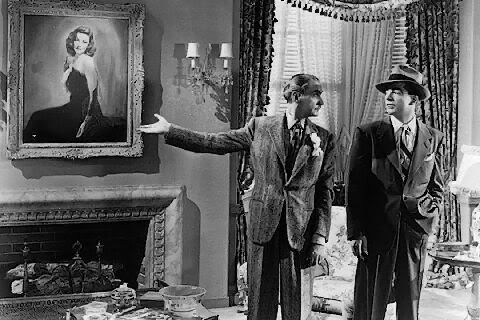
Falling in love with an image is worrisome, even if it is as gorgeous as LauraDana Andrews plays police detective Mark McPherson, who is investigating the murder of lovely advertising executive Laura Hunt (Gene Tierney, whom we see as Laura in flashbacks). The first witness Mark interviews is Waldo Lydecker (Clifton Webb in the debut of his real movie career), a newspaper columnist whom we could call arrogant, except that that would be a huge understatement. If you thought George Sanders' Addison de Witt in All About Eve was a manipulative, hubristic bastard, Waldo Lydecker might be even worse. You see, he plucked Laura from obscurity as an advertising illustrator and made her the glamorous lady she would become -- and he thinks he should have first dibs on marrying her, to the point that he's willing to use his poison pen to destroy the career of anybody who gets in his way.

And there are a lot of such people, such as the artist who first painted Laura's portrait, which Laura had on the wall of her apartment, and which Det. McPherson is so attracted to. Then, there's Shelby Carpenter (Vincent Price). He's a southern trust fund baby who has unfortunately lost his inheritance in a swindle, but can't bring himself to do any real work. So, he mooches off of socialite Ann Treadwell (Judith Anderson), and although Ann would probably be better for him, he too falls in love with Laura. The investigation proceeds like this until there's a sudden twist about 50 minutes into the movie. This being the Hollywood of the Production Code, however, you know that regardless of any twists the writers were allowed to throw at us, the police are still going to solve the case.

The acting here is quite good, especially in service of the story which is the bigger thing in a murder mystery. Laura isn't expected to be much more than glamorous, but Gene Tierney pulls off glamour well. Dana Andrews excelled at playing characters who had something troubling brewing underneath. He did it as Fred Derry in The Best Years of Our Lives, and would later go on to do it again in Where the Sidewalk Ends (which, like Laura was directed by Otto Preminger). Vincent Price never gets the credit he deserves as an actor, probably because he's better remembered for all those silly horror movies he made starting with the remake House of Wax and beyond for the rest of his career. Here, he's more than passable as a ne'er-do-well who might be a murderer, and certainly has things to hide. (Well, his accent isn't so good, but that's easy enough to ignore.) The real star, however, is Clifton Webb. He had appeared in a few silent movies, but this was his first role in decades, and he's quite frankly brilliant. You can almost see Sanders watching this movie to prepare for All About Eve. Clifton Webb was nominated for a Best Supporting Actor Oscar, but suffered one of the bigger injustices of Oscar history as he lost to the irritating Barry Fitzgerald in the horrid Going My Way. Still, Webb's work in Laura was more than enough to get him noticed, as he was almost constantly active for another 18 years when he finally retired from moviemaking.

Laura has, like many of Fox's noirs, been released to DVD, so you really don't have to worry about when the FMC is going to put the movie back in its vault.

Saturday, August 14, 2010

The Last of Mrs. Tierney

TCM's Summer Under the Stars salute to Gene Tierney concludes overnight at 3:30 AM ET with the 1962 political drama Advise and Consent. Tierney is one of many members of an all-star cast.

The story concerns a dying president (Franchot Tone), who is trying to get his nominee for Secretary of State (Henry Fonda) confirmed. There's a problem, though, and it's a big one: Fonda had some dalliances with Communism when he was younger. So, it's obvious that senators like South Carolina's Seabright Cooley (Charles Laughton) are going to be strenuously opposed, while others, such as the Majority Leader (Walter Pidgeon), try to get the nomination through.

Advise and Consent is from a time where the Republicans and Democrats didn't have nearly as rigid ideologies as they do today; the Senate committee that was going to investigate Hollywood just before World War II was supported by Senators of both parties and opposed by Senators of both parties. Indeed, in Advise and Consent, any mention of what political party most of the senators belong to is assiduously avoided. Instead, what the movie is about is the high-stakes poker that people on all sides go through to try to get their viewpoint to be the one that carries the day. As such, all matter of blackmail is considered acceptable, as we see when young hotshot Senator Brig Anderson (Don Murray) is confronted with a secret from his past as a World War II hero.

As I mentioned at the start, Advise and Consent has an all-star cast, consisting of people who were stars in the 30s (Tone) to people who were to become new stars. Among the names I haven't mentioned are future TV star Betty White who gets a small number of lines as a Senator from Kansas; Peter Lawford playing a Kennedy-like Senator (ironic, since he was a Kennedy in-law at the time); Lew Ayres (Johnny Belinda) as the Vice-President; Burgess Meredith as one of the witnesses who appears before the Senate committee; and future Benson cast member Inga Swenson (also of The Miracle Worker) as Senator Anderson's wife. Gene Tierney fits into all this as the doyenne of the Washington social scene.

Advise and Consent is quite good, although a few parts of it have become dated, such as Sen. Anderson's war secret. Still, it's more than satisfying, as you get to see a whole bunch of people you'll recognize from other movies and TV shows working together and pulling it off marvelously. The ending, with a roll call vote on whether to confirm the nominee or not, winds up having a surprising outcome as well. And even if you miss this overnight showing, don't worry: Advise and Consent has been released to DVD.

Friday, August 13, 2010

Gene Tierney in Summer Under the Stars, Part 1

I've recommended quite a few Gene Tierney movies before, but a lot of them don't air all that frequently simply because they're Fox films: the Fox Movie Channel keeps most of them in the vaults, and TCM doesn't often get the rights to them. With August 14 being Gene Tierney's day in TCM's Summer Under the Stars, however, TCM was able to get the rights to quite a few of Tierney's movies at Fox. One that I haven't recommended before is Where the Sidewalk Ends, which airs at 11:15 AM.

Where the Sidewalk Ends isn't Tierney's movie, but Dana Andrews'. Andrews plays Det. Mark Dixon, a New York police detective who, like Kirk Douglas' character in Detective Story, has a mean streak in him a mile wide. It's reached the point where Dixon's superiors have given him an ultimatum -- stop being so violent, or we'll get you off the force. (Reminiscent of Robert Ryan in On Dangerous Ground, I suppose, although Where the Sidewalk Ends came out earlier.) Dixon is the detective investigating the crime of an apparent murder at a craps game. Gangster Tommy Scalise (Gary Merrill) has been targeting rich businessmen visiting town. One of them takes offense to getting so bilked, but when he tries to protest, Scalise's heavy, Ken Paine (Craig Stevens) punches him, which results in fatal injuries to the rich old man.

Dixon, as part of the investigation, meets Paine's girlfriend, Morgan Taylor (Tierney), and immediately falls in love with her. This is a problem in a whole bunch of ways, and gets a hell of a lot worse when Dixon, in trying to question Paine, roughs him up so badly that he accidentally kills Paine! Not only that, but Morgan's father will be left as one of the prime suspects in the death of Paine. Not only didn't he like his daughter cavorting with Paine, but he's a taxi driver who drove Dixon to the place where Paine was killed.

Complicated, isn't it? To be fair, Where the Sidewalk Ends is one of those movies that's more complicated when it's described on paper than it is when you actually watch it. In fact, it's a pretty darn good movie, thanks to a hugely professional crew. Andrews and Tierney are re-teamed with director Otto Preminger, who had worked with them six years earlier on the classic Laura. In addition to the cast members mentioned above, don't miss Karl Malden in a brief role as a police lieutenant. (You can't miss his nose, of course.)

Several years back, Fox went through a phase of releasing a lot of their noirs to DVD; Where the Sidewalk Ends is one of the many noirs that got such a DVD release.

Wednesday, July 14, 2010

The Secret of Convict Lake

The Fox Movie Channel is showing the interesting western The Secret of Convict Lake tomorrow morning at 7:30 AM ET.

Glenn Ford stars as Jim Canfield, leading a band of escaped prisoners in a remote area of rural Sierra Nevada mountains. They get to a settlement during the middle of a snowstorm, and find out that all of the men have gone out -- presumably, as part of the posse looking for them. The women naturally have the dilemma of what to do: there's a worry about the men trying to overpower them, but one of the men is sick and besides, can they really let the men escape? So, the men are allowed to stay in one of the cabins while the women take turns guarding it.

Of course, Canfield, as a cat among the pigeons, is going to start trying to manipulate the women. He quickly falls for Marcia Stoddard (Gene Tierney), who happens to be engaged to the brother of spinster Rachel Schaeffer (Ann Dvorak). Canfield tries to convince Stoddard that he is in fact innocent, and was framed by somebody, but Rachel will have none of it. Meanwhile, the other escapees try to form their own romantic attachments, but only for the purposes of turning on the women: they're not gentlemen like Canfield. Trying to oversee all of this is elderly Ethel Barrymore, who's getting infirm but has more smarts than all the other women. It all leads to a tense standoff that can't possibly be resolved until the town's menfolk return.

That having been said, as much as Canfield and the rest of the escapees are trying to manipulate the women, the escapees aren't operating from a position of unanimity themselves. Canfield, although he professes his innocence, was convicted as part of a robbery of a large sum of money, and fellow escapee Johnny Greer (Zachary Scott) thinks that Canfield has led them to this town because that's where the money's been hidden. All will be revealed in the climax, of course....

The Secret of Convict Lake is a moderately satisfying western, if by no means a great one. It doesn't really tread any new ground, but the performances are all more than adequate. Ford is doing here a lot of the same things he would later do in 3:10 to Yuma, except that in this case, he might actually be innocent. Gene Tierney is lovely as ever, as suitable as the somewhat naĂŻve younger woman. Dvorak is nasty as her future sister-in-law, and Ethel Barrymore seems to be reprising the philosophical role she took on in Portrait of Jennie, albeit one that's a bit hardier. It all adds up to a movie that's good, but not as memorable as other movies in the genre.

The Secret of Convict Lake seems not to have been released to DVD, and the print that FMC showed the last time it aired wasn't the greatest, which is unfortunate. Still, that's about all we're going to get.

Wednesday, June 23, 2010

Night and the City

Yet another movie I'm somewhat surprised to see I haven't recommended before is the 1950 original version of Night and the City. Truth be told, that's because it's a Fox movie, and when I started blogging, it was out of the Fox Movie Channel's rotation. It recently got put back into the FMC rotation, and is airing again tomorrow at noon ET, so now is as good a time as any to recommend it.

Richard Widmark stars as small time hustler Harry Fabian, who starts off the movie touting nightclubs to rich tourists in London. Widmark is hard up for money, wanting to use his girlfriend Mary's (Gene Tierney) stash to start up one of his many ideas for a business scheme, but she's saving for the proverbial rainy day.

Things change when he meets Kristo (Herbert Lom), who is trying to promote his father as a wrestler. The modern day wrestling promoters don't want the old style, and besides, much of the wrestling world is run by the underwold, but Fabian disagrees and sees a huge potential to turn the tables on the underworld. The only thing is, he needs that money. If he can't get Mary's money, then perhaps at least he can get it from his boss, nightclub owner Nosseross (Francis L. Sullivan).

At this point, things start to get really complicated. Mrs. Nosseross (Googie Withers) can't stand her husband, and wants to get away, and thinks that the money her husband is lending Fabian can help her get away. Fabian takes the bait, but doesn't realize that Mr. Nosseross gets wise to the game, learns that Fabian is going to double-cross him, and decides to turn the tables on Fabian.

To be honest, the plot of Night and the City is nothing special, in that it's not particularly superior to other great noirs like Gilda or Road House. What makes Night and the City special is director Jules Dassin's use of London as the location. The movie was filmed on location. It gives the movie a much different atmosphere than any of the American noirs that were shot on Hollywood soundstages, or even other movies of the late 1940s that were shot on location. The atmosphere feels even more gritty, realistic, and inglamorous than what Hollywood put out.

Fox have released a lot of their noirs to DVD, and Night and the City is no exception. The one thing you have to be careful about is that the movie was unfortunately remade in the early 1990s. Find the original version, and watch a great one.

Monday, May 31, 2010

How many Fox docudramas can I mention?

One of the first posts I made about the docudramas that Fox produced starting after World War II was in January 2009, regarding the story of Soviet defector Igor Gouzenko, whose story was turned into the movie The Iron Curtain. I mentioned at the time that it wasn't available on DVD; in fact, it still hasn't been released to DVD.

I've also commented in the past about how the Fox Movie Channel seems to be programmed: they take a few of their old movies out of the vault, run them over and over for a relatively short time, and then return them to the vault, not to be seen for quite a few years. The Iron Curtain is such a movie, having shown up quite a bit back in 2006 or 2007, only to go missing for a long time. Well, tomorrow being the first day of a new month, it seems a time to introduce a few movies back to the FMC lineup, with The Iron Curtain being one of them, at 1:00 PM ET.

It's followed by another movie I don't think has been on the Fox Movie Channel for quite some time: Pickup on South Street, at 2:30 PM June 1. Indeed, Pickup on South Street is scheduled for a good half-dozen airings on FMC in June and July.

Thursday, March 25, 2010

Wacky Tabacky

An interesting movie that's recently returned to the Fox Movie Channel's lineup is Tobacco Road, which shows up again on the Fox Movie Channel tomorrow morning at 8:00 AM ET.

Charley Grapewin stars as Jeeter Lester, a hardscrabble farmer in Georgia's tobacco country who's got problems both professionally and personally. He's about to be dispossessed of his land since he can't pay the rent to the former owner's son (a young Dana Andrews) or the banker (veteran character actor Grant Mitchell). If he can't come up with $100 by the end of the week, it's off to the poor farm for him and his wife (Elizabeth Patterson). Worse, he's still got to of his children living at home with him. Son Dude (William Tracy) hasn't found a girl yet, while daughter Ellie May (Gene Tierney) is too old to be marriageable. Indeed, Jeeter tried to marry her off to Lov (Ward Bond), but he thought she was too old, and married one of Ada's younger sisters instead. Unfortunately, Lov doesn't care for his wife, since she's too independent-minded. Finally, enter into all of this "Sister" Bessie (Marjorie Rambeau). She's a widow who's found God, and a bit of money from her late husband. Dude, not having anything better to do, runs off with Sister Bessie, and Jeeter thinks he might be able to wheedle the money out of his new daughter-in-law....

Tobacco Road is interesting stuff, although it deals quite heavily in stereotypes. As such, it makes some of the scenes seem wildly over the top. Notable in this regard is the opening scene of the movie, in which the Lesters are hungry, when someone comes walking by with a bag of turnips -- poor Gene Tierney is reduced to rolling around in the dirt, apparently trying to offer her sexuality in exchange for those turnips! Still, some of the actors try their hardest, and give pretty good performances, Grapewin notable among them. Patterson does a good job, too, although she doesn't have enough of a role. The same could be said about Dana Andrews, although this was very early on in his career; and Grant Mitchell, although he was only a lead in B movies, and the banker role isn't a difficult one to play anyhow.

Tobacco Road was released to DVD, as part of the box set of John Ford's films at Fox. (Unfortunately, it only seems to be available as part of that box set.) Ford directed this a year after making The Grapes of Wrath, another movie that deals with famers who fell on hard times during the Depression. But while The Grapes of Wrath is fully serious, Tobacco Road delves into the comic, having been based not only a novel (by Erskine Caldwell), but the stage version of that novel, which had been a huge hit. Ultimately, Tobacco Road is interesting in its own right, as well as for those who might be fans of Gene Tierney or John Ford; but while interesting, it's also certainly not without its flaws.