Showing posts with label Van Johnson. Show all posts

Saturday, June 6, 2026

Under the bluebirds

June Lockhart died last year at the age of 100. For some reason I thought I mentioned the programming tribute TCM gave to her a some months back, but a search of the blog says I didn't. In any case, I had a movie with her in it on my DVR which TCM ran before she died, but which I didn't get around to watching until rather more recently, largely because I didn't realize she had a role in it: The White Cliffs of Dover.

The star here is Irene Dunne, and as the movie opens she's working as a nurse in Britain named Susan Ashwood, tending to the soldiers who are returning home from wherever it is they were bravely fighting World War II. (The movie was released a few weeks before the D-Day invasion, so perhaps these were bomber crews or people evacuated from North Africa.) Once again, as you might guess, she's about to have a flashback as to how she wound up in the situation she's in....

Let's go back to the spring of 1914. Obviously, if you know your history, you'll know that this would be shortly before World War I began in Europe, although of course it would be a good three years before that piece of shit Woodrow Wilson got the US involved in the war. Susan, at the time Susan Dunn, is traveling on an ocean liner with her father Hiram Dunn (Frank Morgan) over to England to spend a couple of months on vacation where they'll be staying with Col. Forsythe (C. Aubrey Smith) and his family. While there, Forsythe introduces Susan to a nice youngish nobleman, Sir John Ashwood (Alan Marshal). The two have a bit of a romance, although there's the question of whether it can work out since Hiram expects his daughter to return to America with him.

Susan eventually decides more or less to elope with Sir John instead of going back to America, but she has the great bad luck of marrying John just as war is being declared between Britain and Germany. Sir John comes from a long line of men who did military service, so of course he gets mobilized, and it's off to those horrid trenches of France for him to fight.

Lots of time passes, and Sir John gets brief leave as part of a program to reunite men in service with their wives, which brings Susan to Normandy for an all-too-brief weekend together. And wouldn't you know it, but a) Susan gets knocked up that weekend, and b) it's the same time that the US announces its entry into the Great War. Sadly, Sir John won't survive the war, leaving Susan a widow and mother, but a wealthy one.

Susan's son, John II (played by Roddy McDowall as a boy and Peter Lawford as an adult), grows up on the estate next to that of the Kenneys, who have a daughter his age named Betsy (played by Elizabeth Taylor as an adolescent and June Lockhart as an adult). They're going to fall in love but, as the 1930s go on Susan understands that there's another war coming and dammit, she doesn't want her son to be involved. She already gave up one man for Britain and she's not about to give up a second. Young John, however, intends to uphold the family tradition of going into military service. Since this movie was released in the spring of 1944, and since the story is told in flashback, you know whether mother or son is going to be the one to get their way.

To me The White Cliffs of Dover was one of those obvious message movies where the point of it is to show Americans at home why the US is fighting in Europe, and why they were making the sacrifices that they were. There's nothing subtle about this one at all, and that may affect your opinion on how good the movie is or isn't. It's almost as though Mrs. Miniver wasn't enough for MGM and they had to come up with more pro-Britain stuff.

Friday, January 9, 2026

Men of the Fighting Lady

There are a pair of movies on the TCM schedule for tomorrow, January 10 that were on my DVR. Thankfully, one of them is in prime time, so I feel more comfortable putting the post for it up tomorrow morning. The first of the two movies is Men of the Fighting Lady, which you can see tomorrow at 5:00 PM.

The opening credits suggest that this is based on two stories, one true and the other one by James Michener. Because of this, to make the movie a bit more accessible, Michener has been turned into a sort of expository character, although Michener is sadly not playing himself. Instead, Michener is played by Louis Calhern. As the movie opens, he's being sent onto the USS Oriskany, an aircraft carrier fighting the Korean War toward the end of the war (the movie itself wasn't released until 1954, after the war had ended). There, he meets ship's doctor Kent Dowling (Walter Pidgeon), who has a story of a "Christmas Miracle" to tell Michener....

This being an aircraft carrier, the job of the men is to run bombing missions over North Korea. The main group among the men are Lt. Thayer (Van Johnson), a sort of second-in-command; Lt. Cmdr. Dodson (Keenan Wynn); and young Ens. Schechter (Dewey Martin). Actually coming up with the missions and flying along with the men is Lt. Cmdr. Grayson (Frank Lovejoy). Their mission is more or less the same one every day, which is to bomb a particular North Korean railhead. The reason it's the same railhead over and over is the no matter what the Americans do, the North Koreans and their allies seem to be able to repair the damage overnight.

One effect of this is that Grayson decides that the way to make the bombs more accurate is to drop them from a lower height. This increases the danger both in having to avoid mountains, but more importantly in being closer to the anti-aircraft positions. Indeed, the climax of the movie is going to come when Schechter gets hit, although before him Grayson also gets shot. In Grayson's case, he's able to fly the plane back out to the ocean, where he has to eject and be rescued -- quickly, because otherwise he's going to succumb to hypothermia what with the water temperature being only a few degrees above freezing.

There's quite a bit of stock footage here, both of the bombing raids over Korea as well as planes taking off and landing on the deck of the aircraft carrier. Those take-offs and landings are dangerous as well, and that's going to become a plot point in the movie along with planes getting shot down. The "Christmas miracle" involves Ens. Schechter, and his attempt to get back to the ship after his plane is shot.

Men of the Fighting Lady was apparently successful at the box office and garnered reasonably good reviews. These surprise me somewhat, as I wouldn't have thought a Korean War movie would be something to the public's taste in 1954. This wasn't quite the "good war" that World War II was. Also, Men of the Fighting Lady is little more than a programmer, padded out with that stock footage. It's not that Men of the Fighting Lady is a bad movie; it's more that it came across to me as pedestrian. Competently made, and the sort of thing that had it been made during and about World War II would have been seen as a morale-booster for the homefront before the following week's picture, but nothing more.

Tuesday, June 24, 2025

Another ensemble hotel picture

Some months back I did a post on the movie Hotel Berlin, which is based on a story by Vicki Baum but is not the remake of Grand Hotel. As I mentioned at the time, the remake is Week-End at the Waldorf, and with that having been on my DVR, I eventually watched it in order to be able to do a review of it here.

It's mildly unfair to refer to Week-End at the Waldorf as a remake of Grand Hotel, since it's not so much a remake as a reworking, with the story lines all getting substantial reworkings. The setting is moved from Weimar Berlin to New York's Waldorf-Astoria in the latter days of World War II as well. Walter Pidgeon is the nominal male lead here, and his character doesn't really exist in Grand Hotel. Pidgeon plays Chip Collyer, a war correspondent who's returned stateside for some rest and wants exactly that. His editor, however, wants Chip to get the goods on shady businessman Edley (Edward Arnold), who is trying to secure the oil rights from the Bey of Stock Arab Country (George Zucco), possibly by trying to involve non-shady businessman Jessup (Samuel S. Hinds) who has an apartment at the Waldorf. Except that Jessup doesn't use the apartment on a full-time basis, so he's decided to let a war hero and his newlywed wife use it since with the war on hotels are fully booked up with people moving in and out of the city.

Another connection to World War II is wounded soldier Capt. James Hollis (Van Johnson) who wants to go back to his old home town and start a business there. He's also written a song which, though a mix-up, winds up in the hands of Xavier Cugat. James meets the hotel stenographer Bunny (Lana Turner, since Joan Crawford was now much too old for the role and besides had already decamped to Warner Bros.) and the two fall in love, although Bunny wants financial security and thinks she sees that in Edley who keeps calling her up to his suite on actual work matters. He's also got the financial security -- or so she thinks -- to get her to do his bidding.

One of the main story lines from Grand Hotel is that of the world-weary actress, played in the original by Greta Garbo which is why the role is so big. Here, that actress is played by Ginger Rogers, a woman named Irene Malvern who is in town for the opening of her new film before heading back to Hollywood. Chip shows up in her suite thanks to a botched attempt to get the story on Edley. Instead, Irene thinks Chip might be the jewel-thief who is rumored to be in the hotel and rumored to want Irene's jewels. Chip uses this as an excuse to get involved romantically with Irene, as she has to use him to help out somebody else as well as explain how he wound up in her room.

There's more to the cast of characters, notably a young Keenan Wynn as the reporter Chip's editor sends in Chip's place to get the story on Edley when Chip claims to need that rest, along with story lines coming together and drifting apart until the final reel when the good guys get the requisite happy ending and the bad guys get their comeuppance.

Week-End at the Waldorf runs 15-20 minutes longer than Grand Hotel, and frankly, it shows in the final product. It consistenly feels long, in the sense that nobody was able to find the spark that made Grand Hotel one of the classic all-star movies of the early 1930s. Walter Pidgeon is, I think, not quite right as that war correspondent, while Ginger Rogers doesn't really give off the sense of wanting to be left alone.

Having finally watched Week-End at the Waldorf, I think it's with good reason that it's not as well-remembered as Grand Hotel.

Thursday, May 22, 2025

Scene of the Crime

TCM is running a bunch of movies tomorrow (May 23) that are police procedurals or fairly close to that. MGM did a whole series of shorts in the genre with the Crime Does Not Pay shorts of the second half of the 1930s and the first half of the 1940s, but feature-length procedurals weren't so common for the studio, being better known for the polished prestige material. One MGM movie that definitely fits the genre is Scene of the Crime, which TCM is running at noon.

The movie opens up with a murder in cold blood and in public, on the streets of Los Angeles. The murder is witnessed by a married couple who didn't exactly see much since they were in the shadows and wanted to avoid detection, but they heard the getaway driver refer to the killer as a "lobo". That's Spanish for "wolf", although in the context of late 1940s crime it apparently refers to a hired gun. The victim was a cop named Monaghan, and worse, Monaghan had a bunch of cash on him that wasn't taken and which he wouldn't normally have been able to account for.

Given the task of investigating is police detective Mike Conovan (Van Johnson). He's got a new partner in young C.C. Gordon (Tom Drake), since old partner Piper (John McIntire) is at the age where he really should be on desk duty. Conovan also has a long-suffering wife, Gloria (Arlene Dahl). The theory is that one of the national syndicates is trying to muscle its way into the local betting rackets, and that if Monaghan was on the take, as the money might suggest, he got caught up in it. Mike does good old-fashioned legwork, such as finding names and numbers that could be phone numbers or street addresses, as well as talking to police informants who don't want it known they're informants, such as Sleeper (Norman Lloyd).

One lead suggests guys named Turk Kingby and Lafe Douque may be lobos, while another lead suggests that Turk has an ex-girlfriend named Lili (Gloria DeHaven) who works in the burlesque show in one of the local clubs. However, neither Turk nor Douque fit the description of the murder given by the two witnesses. Mike tries to gain the trust of Lili, which makes Gloria really nervous, especially once the bodies start piling up. She sets him up with the possibility of getting a job handling security for a prominent industrialist, but Mike is just too damn honest to quit the force.

That, and there's also the rule that, thanks to the Production Code, the guilty parties will not be allowed to get away with it and the cops will get their man in the end. So you can expect the requisite happy ending in the final reel.

Scene of the Crime isn't exactly a bad movie, although it definitely has the MGM stamp all over it as a movie that's more than competently made but in a genre where they didn't really give the impression of knowing how to make a great film in that genre. The story and production feel by-the-numbers, and lacking the grit necessary to make a movie like this truly memorable. Ultimately, it comes off as the sort of material that would be fodder for well-done episodic TV a decade or two later, but at the MGM of 1949 is just ever so slightly off. It's still worth watching, but you can't help but think someone at another studio could have made a truly great movie.

Friday, March 21, 2025

Oh, right, musicals aren't my favorite genre

I've metioned before that musicals aren't my favorite genre, although I don't necessarily mind the backstage musicals or the musical biopics. So it's not a surprise that I didn't particularly care for this week's selection for the TCM Musical Matinee: Brigadoon, tomorrow (March 22) at noon.

Musical star Gene Kelly is the star here, as Tommy Albright, an American who's decided to go on a hunting trip to the Scottish highlands together with his best friend Jeff Douglas (Van Johnson). It's partly to get away from America for a while to try to figure out whether he really wants to marry his girlfriend back home, Jane Ashton (Elaine Stewart, fourth-billed in a surprisingly small role). While hunting, Tommy and Jeff get lost, and come to the crest of a hill overlooking a village that doesn't seem to be on their maps.

So, naturally, curiosity gets the better of them, as well as the idea that perhaps if you go into town the locals might be able to tell you where on the map you are and how to get back to where you were originally going. The town is called Brigadoon, and and it looks like it could pass for one of those places that's deliberately been restored for the historical purpose of showing the way things used to be.

But it's a real village, all right, and more than that, the place is about to celebrate. Young Jean Campbell is about to get married to Charlie Dalrymple, and the whole village is taking part, and willing to have Jeff and Tommy join them in the celebration. Jeff isn't terribly thrilled with the place, but Tommy takes to one of the locals, Jean's older sister Fiona (Cyd Charisse), which is of course a bit of a problem since he's got that girlfriend in America.

There are bigger problems, however. Not only do Jeff and Tommy wonder why the village wasn't on the map. When Tommy goes off with Fiona to pick heather, she's absolutely terrified when she gets to the bridge leading out of the village. And then Tommy and Jeff find the Campbell family bible, which has Fiona and Jane's dates of birth back in the 1730s, which makes no sense. The town elder, Mr. Lundie, then tells them that Brigadoon is a special place, saved by a miracle 200 years prior. When the villagers go to sleep, they'll wake up the next morning having only aged one night, while the rest of the world has spent 100 years. But the price is that none of them can leave the village. While outsiders can spend a day, if they want to stay it will have to be forever. If one villager leaves, the rest of the village will cease to exist.

This is a big issue because, as if you couldn't tell, Tommy falls in love with Fiona. Worse is that Jean had a suitor other than Charlie Dalrymple, that being one Harry Beaton. and he, having lost Jean, decides that no one else should have her and that he'll leave the village as a result.

One of the problems I have with Brigadoon, not having seen any stage version of the musical, is how it feels even more artificial than other movie musicals. I think that comes down to the fact that while Gene Kelly and director Vincente Minnelli wanted to do a location shoot, preferably in the Scottish higlands, MGM felt they needed to save money and really wanted it done on soundstages. That doesn't work here at all, although a secondary fact that only occured to me after watching is that I don't think the Scottish highlands are as forested as the film version of them. I get the impression that having to do the movie on a soundstage may also have taken Kelly's heart somewhat out of the picture. Van Johnson isn't really the right star for a movie musical, either, unless it were one of those biopic films where everyody else was doing the singing and dancing.

Sunday, November 24, 2024

Tokyo under half a minute

Another of the movies that I think I recorded during 31 Days of Oscar and have been meaning to watch before it expires, is the World War II film Thirty Seconds Over Tokyo.

The movie is based on a book, which is based on a true story. As everyone knows Japan bombed Pearl Harbor on December 7, 1941, sending the US into World War II. The surprise attack was a shock to American morale, and something needed to be done to improve that morale, both among troops who were going to be sent into the Pacific theater, and civilians on the home front. Lt. Col. James Doolittle (played in the movie by Spencer Tracy), came up with the daring idea to try a raid on the Japanese Home Islands.

Of course, this wasn't going to be easy. With the fall of the Philippines and Japan having effective control over a good portion of the western Pacific, there was no land base from which bombers could take off. And over in Europe, bombers could fly from the UK, drop their payloads over Germany or one of the occupied countries, and return to the UK. That's not something that could be done in the Pacific. Instead, bombers would have to take off from an aircraft carrier, which has a notoriously short runway. That, and they wouldn't be able to fly back to the carrier, instead having to fly on and hope they could reach the part of China that hadn't been taken by Japan yet.

Doolittle sets out to recruit men for the mission, with the caveat that they don't know yet what the mission is going to be because of the fact that it has to remain top-secret until the last minute. Among them is pilot Capt. Ted Lawson (Van Johnson), who as the movie opens has recently been married and is about to start a family (Mrs. Lawson is played by Phyllis Thaxter), or at least was hoping to before the attack on Pearl Harbor. Lawson is the main character here mostly because he's the one who in real life after the raids wrote the book Thirty Seconds Over Tokyo. Gunner on Lawson's plane Cpl. David Thatcher (Robert Walker).

Lawson's crew, and the crews of a couple dozen more planes are sent to Florida for training, since they have to practice short takeoffs at low speed. Some of the men are smart enough to figure out part of what's going on, but they have to keep it a secret for obvious reasons. Eventually they fly west to San Diego, before the planes get loaded onto ships taht are going to be transported across the Pacific until they can get close enough to Japan to attack -- at least if they can avoid Japanese subs. This portion of the movie, however, is the part for a bit of comic relief as there's a sort of friendly rivalry between the flyboys who are part of the Army air corps (the US Air Force as a separate branch not being founded until after the War) and the Navy men on the ships.

Eventually, the raiding planes take off, earlier than planned once the element of surprise has been lost. They bomb Tokyo and some other places in Japan, and make their way across the Sea of Japan to China, barely making it and in some cases having to ditch just before getting to shore. Lawson and several of his men are pretty substantially injured. How are they going to get to safety? Well, of course we know they do and that Lawson gets back to America since he wrote the book. But it's actually a surprising amount of the film that's set in China.

Thirty Seconds Over Tokyo was filmed in the first half of 1944, with the movie being released late in the year. This was while the war was still raging. As a result the movie is fairly formulaic and more designed to be a morale-booster than something even-handed. Then again, that's in part because what actually happened was fairly well known by the public of the day. Even with all that in mind, watching 80 years later, Thirty Seconds Over Tokyo is a pretty good movie.

It's also interesting to see the credits list of the movie as it opens up. This was one of Robert Mitchum's first movies. (Wikipedia says it's his debut, although I could swear that The Human Comedy came out earlier. Perhaps it's his first screen credit.) Several B-listers, like Don DeFore and Leon Ames show up, while Wikipedia says a very young Blake Edwards has a small role.

Tuesday, November 5, 2024

TCM Star of the Month November 2024: Ruth Roman

Unfortunately, as of this writing, The Baby is not part of the Roman tribute

We're into a new month, which as always means new programming features on TCM, including a new Star of the Month. This month, that star is Ruth Roman, and her movies will be airing every Tuesday in prime time. I currently have one of her films on my DVR, and that one is airing overnight tonight at 1:15 AM (so still Tuesday in the Pacific time zone): Invitation.

Roman is not the star here; that honor goes to Dorothy McGuire. McGuire plays Ellen Pierce, recently married to architect Dan Pierce (Van Johnson) and having a father Simon (Louis Calhern) who spoils her rotten; as the movie opens he's just bought her another fur coat. However, Dad has a reason for spoiling his daughter. She's sickly, subject to bouts of shortness of breath. In fact, that goes back to a case of rheumatic fever Ellen had as a kid. Normally, resting for a few minutes helps, but in her last episode, Ellen actually passes out!

Ellen get picked up by Dad's chauffeur to go to his palatial estate on Long Island wher eshe also meets with family doctor Pritchard (Ray Collins). They insist that she's going to get better, and in fact, they've just heard about a possible new treatment for her condition. On the way home, she stops off to see another doctor who is a friend of the family, Dr. Redwick. This visit is a bit tougher thanks to Redwick's daughter Maud (Ruth Roman). Maud was Dan's girlfriend, or at least she thought she was. She loved Dan and he only considered her a friend. Maud expected Dan to marry her until Dan decided to marry Ellen in what was seen as a big surprise to everybody, as we learn in a flashback. Maud hasn't forgiven Ellen, and tells Ellen that she's only got a year with Dan, after which Maud is going to win him back forever.

Of course, Maud has reason for making this comment. We eventually learn, again in part through flashbacks, that Ellen's childhood rheumatic fever has left her with a damaged mitral valve. Nowadays, it's the sort of thing that could be cured with routine surgery, but in those days such a surgery would have been considered a dangerous experiment. Indeed, such a surgery is the "possible new treatment" everyone else is discussing, but so far it hasn't had anything close to a 100% success rate. As things stand right now, but nobody has been telling Ellen, her mitral valve is deteriorating and will probably kill her in a year or so, hence Maud's nasty comment.

As for Dan, business hadn't been going well for him, until Ellen's father contacted him. Dan always liked Ellen as a friend although as with Maud he didn't honestly love her. When Ellen's father learns that Dan doesn't have any love interest, he suggests that perhaps Dan could marry Ellen and make her last year of life happy. In exchange, Dad would use his extensive contacts to get good jobs for Dan. Of course, all of this is to be kept a secret from Ellen. And, of course, as in Dark Victory, the doomed patient is going to find this out. At least in the case of Invitation, however, there's the possibility of that new treatment.

Invitation was made at MGM, and to be honest, it comes across as one of those MGM movies where they still had all the gloss in the world but couldn't use it to make a mess of a plot come out any better. Ruth Roman's character is way too mental; Ellen similarly goes off the deep end when she discovers the deception; and Calhern doesn't come across as particularly fatherly here. It's once again a script problem and not the fault of the actors.

Monday, September 9, 2024

Till the Clouds Roll By

I had some more movies that were about to expire from YouTube TV's cloud DVR, so I had to make a point of watching them to do a review now. The latest is the musical "biopic" Till the Clouds Roll By.

The movie opens with one of those old-style forewords informing us that the action begins on December 27, 1927, the opening night of the musical Show Boat. The music was written by Jerome Kern (played here by Robert Walker), a composer who had already had a string of Brodway hits in the 1920s, although getting to the top wasn't easy. On his way back home after the show, he asks the cab driver to detour and look for a particular brownstone. Since the movie opens up at the height of Kern's career, we know that we're about to get an exceedingly original plot device... the flashback to the beginning of the subject's career.

This time, we go back around 20 years (the real-life Kern got his start fairly young, around age 20 in 1905). Young Jerome is a budding composer, but he doesn't know so much yet about lyrics or good arrangements. To that end, he's been sent to the brownstone that older Jerome asks the driver to stop by. There (in 1905) lives an arranger, James Hessler (Van Heflin). Now, this leads to why I put the word "biopic" in sneer quotes above. James Hessler is the other main character of the movie along with Kern, but Hessler is a completely made-up person! Hessler is an arranger who would like to be a symphonic composer. He's also a widower with a young daughter Sally (grown-up Sally is played by Lucile Bremer). In any case, Hessler becomes Kern's mentor.

Kern writes good music, and would like to write for Broadway, but when they try to get a foot in the door, they learn that it's still the fad on Broadway to import revue-type shows from the UK and that the music of London is more popular to the Broadway crownd than the new American sounds bubbling up. So it's off to London.

Kern eventually meets British producer Charles Frohman (a real-life person, and his death along with Kern's tangential relationship to that being more or less accurately portrayed), and is able to sell one of his songs to Frohmann's London Gaieties. This also leads to Kern getting hired to write more songs for a show that's going to open in New York. Also while in the UK, Kern met Eva (Dorothy Patrick), the woman who would become Mrs. Kern.

Kern goes back to America with the Hesslers and Frohman, and I'd guess it was the US being out of the Great War for a couple of years while the European powers were fighting it that really boosted the careers of composers like Kern. Sally, now grown up, has always considered Jerome like an uncle, and wants to follow Jerome into musical theater. To that end, Jerome even writes a song for a musical that would give Sally her first solo even though she's not going to be the star of the show. The producer, however, thinks the song would be a better fit for the show's star, Marilyn Miller (another real-life person, played by Judy Garland). Sally has a hissy fit and... runs away!? Dad, by now ill with heart problems, wants Jerome to find Sally, but Dad dies before father and daughter can be reunited.

Jerome, like a lot of other composers and lyricists, went off to Hollywood once sound comes to movies, and wrote more memorable songs for movies in addition to adapting some of the old musicals for Hollywood. The last 10 minutes or so is a montage of various MGM stars doing numbers of a bunch of different songs, giving MGM a chance to put those stars into a big-budget musical if they hadn't already been used in a production number earlier in the movie.

If you like the Great American Songbook, you'll love Till the Clouds Roll By. The songs are unsurprisingly quite good. There's a reason why things like Show Boat or the song "Smoke Gets in Your Eyes" from Roberta endure. The production numbers MGM did, at least up until the finale which is a bit more bland, are also very well done. The dramatic story, however, is something best not discussed. To be fair to MGM, however, the real life Jerome Kern story was mostly something not cinematic or dramatic enough for a biopic. But that's part of why Till the Clouds Roll By is a bit of a mixed bag.

If you like the Freed Unit, then Till the Clouds Roll By is definitely for you.

Thursday, November 30, 2023

Easy to Wed

I recorded a surprising number of Lucille Ball movies that I hadn't seen back when she was honored in Summer Under the Stars, and have been watching them on an irregular basis. The most recent one that I watched is Easy to Wed, and now I'm getting around to doing the post on it.

The movie starts of with a scene of newspapermen trying to collect a bunch of copies of a newspaper out of circulation, and getting all of the early edition except for 40. The problem is that the newspaper published a story about a socialite that's not true, and the paper's publisher is worried that J.B. Allenbury (Cecil Kellaway), father of the socialite, is going to sue for libel. Sure enough Allenbury does sue.

With that in mind, the publisher calls his managing editor, Haggerty (Keenan Wynn) in. Haggerty isn't exactly happy, because he's about to get married to chorus girl Gladys (Lucille Ball). And if Haggerty isn't happy, Gladys is even more pissed, because this is just one more time that Haggerty has put the newspaper ahead of her. But Haggerty's job is going to be on the line, and he needs to come up with an idea to save the newspaper and his job quickly.

His idea is that, since the article that engendered the lawsuit claimed that Allenbury's daughter, Connie (Esther Williams), broke up a marriage, Haggerty will engineer a case where the paper can catch her actually doing so, and then sue her for alienation of affection. The big problem is that Haggerty doesn't have a reporter good enough to get the story, and one who's married. The best reporter would be a former reporter for the paper, Bill Chandler (Van Johnson).

Haggerty does eventually find Chandler, and somehow does convince Chandler to work for the paper again, although a large payday has something to do with that. The bigger problme is that Chandler is not actually married. Haggerty has just the woman for him however: Gladys. Not that Gladys really wants to go along with it.

Chandler gets in with the elder Allenbury, but as things go on you get the sneaking suspicion that Chandler is falling in love with Connie and doesn't want to hurt her to win the lawsuit. Meanwhile, Gladys and Haggerty are getting more and more displeased with Chandler. How is the script going to resolve all this in a way that makes the Production Code office happy?

If the plot sounds familiar, that's because Easy to Wed is a remake of MGM's earlier movie Libeled Lady. Needless to say, Libeled Lady, with its glittering cast, is rather the better movie. It also doesn't help that Easy to Wed is bogged down by a bunch of musical numbers. Still, Easy to Wed is not without its appeal, especially those who like the MGM gloss. Lucille Ball in particular is well cast as the brassy chorus girl and long-suffering girlfriend of Haggery. Keenan Wynn, it should be pointed out, is also a natural as the oily operator who came up with the nutty scheme at the heart of the movie. Easy to Wed was also filmed in lovely Technicolor.

So while Easy to Wed isn't as good as Libeled Lady, it's still definitely worth watching.

Tuesday, October 4, 2022

Wartime Love Triangle #8470351207509

Another of the movies that was on my DVR that I recently watched was Two Girls and a Sailor. Having been produced by MGM, it's unsurprisingly made its way to DVD courtesy of the Warner Archive.

The Deyo sisters -- Patsy (June Allyson) and Jean (Gloria DeHaven) -- are sisters born of vaudeville parents. They've grown up and their parents have died, so they decide to start a double act of their own, singing and dancing. Of course, vaudeville as their parents would have known it had more or less died by this point, but there's still a war on and soldiers and sailors to be entertained. The Deyos would like to open a canteen for the men going off to war, but of course, that takes money they don't have.

You just know somebody with money is going to come into their lives, and you can probably guess right away who that person is. An anonymous benefactor the sisters refer to as "Somebody" sends a lawyer their way to let them know they own the building next to their apartment, a heretofore vacant building that they can refurbish and turn into that canteen. The two sisters try to figure out who their benefactor can be, while dealing with romantic involvments from the servicemen.

John Brown (Van Johnson), about to go back and fight more with the Navy, is one of those servicemen. Patsy is really in love with him and Jean certainly likes him, with John first choosing Jean. It turns out, however, that Jean meets another serviceman, soldier Frank Miller (Tom Drake), and she could see herself with him, except that she doesn't want to hurt poor John. John realizes that he really prefers Patsy, but again, he doesn't want to hurt Jean, and this causes a whole lot of heartache for Patsy before we get to the big finale where the right couples wind up with each other.

Two Girls and a Sailor was released in the middle of 1944, so don't expect an original plot here. Instead, it was designed for the morale of the people on the homefront, combining a Hallmark Channel-type story with a whole bunch of musical acts, the latter being what people would have gone to see above the story. Indeed, there are a lot of people who get more or less their own title card, appearing as themselves. There's José Iturbi and his lesser-known sister doing a two-piano piece; Harry James leading an orchestra; Lean Horne singing; and Gracie Allen, without George Burns, making life a nightmare for José Iturbi and Xavier Cugat. She plays a piano number with one finger, over the objections of the two men, reminding them, "Don't you know there's a war on?"

One person not playing himself is Jimmy Durante, as a fellow vaudevillean whose wife walked out on him ages ago, leaving him to quit the business and live as a squatter in the building that the Deyos convert into the canteen. When everybody finds out who he is, he's going to be cajoled into coming out of retirement....

As I said, the plot is nothing to write home about. The musical numbers, however, are, at least for the sort of people who like movies of the 1940s and are interested in the sort of movies Hollywood was making during World War II to try to brighten everybody's day. People not into that sort of thing are probably not going to enjoy the movie all that much, other than as a sort of museum piece.

Saturday, April 25, 2020

When in Rome


Er, not that "When in Rome"

Some months back, TCM ran a little movie called When in Rome, which I recorded but didn't watch because it doesn't seem to be available on DVD. It turns out that there's another airing tomorrow morning at 4:30 AM (or overnight tonight if you're on the west coast), so now's the time to watch and blog about it.

The movie was released 1952, but points out that it is set in 1950, which was considered a Holy Year in the Catholic Church that led a lot of people to visit Rome. (That would explain the stock footage of mass religious gatherings in Rome.) Going to Rome to take part in the Holy Year is Father John Halligan (Van Johnson), a Catholic priest from Coaltown, PA. His pilgrimage is considered a big deal in that sort of small-town Catholic community. So big that he's actually bought a new cassock for the occasion.

Fr. John is taking the boat over to Genoa and making his way to Rome from there, and to cut costs he's sharing a cabin with a stranger, who turns out to be the very nice Joe Brewster (Paul Douglas). Joe isn't Catholic, and probably not religious at all, but he and Fr. John get along well, helping each other with seasickness and stuff like that.

Of course, we already got some foreshadowing from the intro that Joe has a past, which we see when he makes off with Fr. John's new cassock, leaving John with Joe's loud suit. (You'd think Fr. John would have multiple changes of clothes.) This is because Joe was a prisoner back in the States, having escaped from his latest incarceration. Somehow, unlike Call Northside 77 the authorities couldn't send a photo or even a good description of Joe, only what Joe was wearing. So he makes it through customs no problem and is accepted by a couple of fellow priests picking him up, while Fr. John is arrested and placed in custody until he can prove his innocence.

As I mentioned, Joe isn't religious at all, which is going to become a problem when it comes time to practice any number of Catholic rituals. (Mass was still in Latin at that time, still a dozen years before Vatican II, so in theory Fr. John could have been asked to perform a Mass.) Somehow he bluffs his way through it all, and when he meets Irish Fr. McGinniss on the way to Rome and then helps him carry a cross during a procession, Joe begins to have some pangs of conscience.

Not enough to go back to America, however. Fr. John eventually finds Joe and Joe gets Fr. John to take him on a tour of some of Rome's churches that together are part of a well-known penitent's journey. Joe begins to open up, confessing his sins to Fr. John and showing a lot of admiration for the priests' pureness. They're still being pursued by the police, though, forcing them to make escapes, as they do when the wind up in a monastery where the monks have taken a vow of silence.

When in Rome is the sort of interesting programmer that MGM was making in the early 1950s that I've long felt were helping to subsidize the more expensive Freed Unit musicals. There's the obvious, if gentle, moralizing about doing good works, for example. But the story largely works even if it's old fashioned, and both of the leads are appealing in their roles. If you want something old-styled and family-friendly, you could do a lot worse than to watch When in Rome.

Saturday, February 15, 2020

The Hangover of Size


When I recommended Whisky Galore! a few weeks back, I think I mentioned that it was part of a night of movies commemorating the 100th anniversary of the start of Prohibition. Another of the movies that ran was The Big Hangover.

Van Johnson plays David Muldon, a man about to graduate from law school and, being at the top of his class, getting a spot at the bottom of the ladder at a prestigious law firm. One of the partners, Belney (Percy Waram), is celebrating his birthday today, and his daughter Mary (Elizabeth Taylor) is bringing him to the firm for the party.

Unfortnately for David, the party means that everybody is celebrating with a cup of punch that has most definitely been spiked. Logically, David should just say he's a tee-totaler, but no, he has to think he can reform himself and start drinking again. The predictable result is that David starts talking to one of the lamps.

Mary notices this and takes David aside. David tells her his unusual story. He's not really an alcoholic or anything like that; instead, he was in World War II and get a spot in law school thanks to the GI Bill (hence why he's an older starting lawyer). While he was fighting in France, he was injured and recuperating in a monastery. The monks there produced a fine brandy, but the Nazis staged an air raid that left David trapped in a cellar with burst bottles of brandy, up to his neck in the stuff. Apparently his pores soaked up enough brandy that he got some sort of alcohol poisoning that results is his becoming a wacky drunk every time he takes even a sip of alcohol. Mary likes David and decides to try to help him.

Meanwhile, the David is about to get in trouble with the law firm, not that he realizes it. The firm represents a tony property management company that has decided to keep one of its upscale developments whites only if they can help it. However, somebody has sublet to a Dr. Lee (Philip Ahn) and his wife, and the company is trying to renege on the contract. City Attorney Bellcap (Leon Ames) is trying to force the company to abide by the terms of the contract. David takes the side of Dr. Lee, not realizing that the law firm is taking its client's side.

The Big Hangover was produced at MGMin 1950, I'm guessing under the aegis of Dore Schary, since I can't imagine Louis B. Mayer approving the anti-discrimination subplot. The movie is an odd little mishmash with the lawsuit plot being social drama but the rest being almost slapstick comedy. It doesn't always work, largely because I found one of the law firm partners, Parkford (Gene Lockhart) to be shockingly mean-spirited. Not because of the Dr. Lee case, but because he's learned about David's alcohol problem -- and decides he's going to surreptitiously spike David's food at a serious banquet just to watch him become a wacky drunk!

As for the stars, Johnson and Taylor are both appealing enough, and the supporting actors are as good as the script allows. It's just that the script is a mess. trying to do two wildly disparate things and not really doing either of them as well as it could.

The Big Hangover got a DVD release courtesy of the Warner Archive collection, and is currently on the Amazon streaming service.

Saturday, December 28, 2019

The Purple Rose of Cairo


I notice that the Woody Allen movie The Purple Rose of Cairo is going to be on TCM tomorrow afternoon at 2:15 PM. So this morning was the perfect time to sit down to watch it again and do a blog post here.

Mia Farrow plays Cecilia, a struggling waitress in New Jersey in 1935 who lives with her husband Monk (recently deceased Danny Aiello), an unemployed factory worker (remember, this being 1935, there's a depression on). It's not much of a life, so to deal with the humdrum existence, Cecilia likes to go to the local movie theater for some escapism, seeing a movie called The Purple Rose of Cairo multiple times.

She's about to start seeing the movie more, because she finds that Monk is cheating on her while a dispute with her boss at the diner gets her fired. So after leaving Monk she decides to spend all day at the theater watching this formulaic movie. The plot of the movie-within-a-movie, such as it is, has some socialites going on a trip to North Africa where they meet adventurer Tom Baxter (Jeff Daniels) and bring him back to New York.

If the movie-within-a-movie is less than exciting for those of us who have watched a ton of 1930s movies, imagine how it must have been for the actors who had to do take after take. So one day, while Cecilia is watching the movie for the umpteenth time in a row, something strange happens. Tom Baxter decides he's tired of this lame story, and decides to step off the screen, having seen the way Cecilia eyes the dashing young adventurer! The two then run out a side door of the theater.

Now, this doesn't seem to be a fantasy or dream sequence, because odd things start happening at the theater. The other characters in the movie-within-a-movie start complaining about the absence of Baxter, and start showing up as though they're actors on the set back in Hollywood, between takes. And other patrons in the movie theater start complaining about what they're seeing, since they paid to see an actual movie after all.

News of this all hits Hollywood, where Gil Shepherd (Jeff Daniels again), the actor who plays Tom Baxter, is horrified because of this and what his character's refusal to keep doing the story will mean for his career. So Gil heads off to New Jersey to try to find Tom, meeting Cecilia along the way since she's more or less protecting Tom. As for Tom, he begins to have problems since he's still not a real person despite having stepped off the screen....

It's an interesting premise, and one that's handled pretty well by Allen and the actors. Daniels, with the double role, has the most to do here and shows again that he's actually a capable actor. Farrow is good as well, although I find it difficult to think or her apart from the personal problems in her relationship with Woody Allen. Watch for Van Johnson in a small role as one of the characters in the movie-within-a-movie; I also could have sworn one of the complaining patrons looked and sounded a bit like Broderick Crawford, although IMDb and Wikipedia say no. I think fans of 1930s movies will really enjoy Allen's homage to the genre here.

The Purple Rose of Cairo seems to be out of print on DVD, although you can watch it at Amazon streaming if you can do the streaming thing.

Friday, February 24, 2017

23 Paces to Baker Street

I watched 23 Paces to Baker Street off my DVR recently because I knew it was coming up on the FXM Retro schedule. In fact there are two airings: today at 11:15 AM and tomorrow morning at 7:45 AM.

The movie starts with Phillip Hannon (Van Johnson) dictating into a tape recorder in his flat in London. Obviously he's a writer of some sort; although we never see the outcome of his writing we learn pretty quickly that he's a playwright, and that his latest play was a hit on the other side of the Atlantic and is now being produced in London. We also learn that he went blind from some sort of accident. This blindness has turned him bitter, because he had a fiancée in the States, one Miss Jean Lennox (Vera Miles), whom he dumped after going blind because who'd want a blind guy like him? Anyhow, Phillip leaves his secretary Bob (Cecil Parker) to do up the typing while Phillip nips off to the pub down the street.

While at the pub, Phillip sits next to a glass wall dividing two parts of the pub, so we can see two people come in on the other side, and start talking. Phillip only hears part of the conversation, but it's clear that the woman in the conversation is being asked to do something that she doesn't want, and something that sounds as though it could be criminal! And since Hollywood has the trope of the blind man who can see more than all the sighted people put together, we know that Phillip's belief that there's a criminal plot afoot is going to be borne out to be true. This even though he goes to the police and is rebuffed.

Phillip is undeterred, and sets out to stop the crime himself, with the help of Bob, who can see and follow a nursemaid who might have something to do with the plot, as well as Jean, who clearly still carries a torch for Phillip, having come all the way over from the States at a time when transatlantic travel wasn't so easy to be here. Of course, it's not an easy search, as this nursemaid could be working for any of dozens of people. It also doesn't take all that long for the bad guys to figure out that somebody is on to them, leading to one killing and another attempted killing. But will Phillip be able to stop the plot before it happens?

Actually, the part of the story about uncovering the criminal plot is wrapped up a good 10 minutes before the end of the movie, except that one member isn't caught, giving us ample time to have a climax reminiscent of the later Wait Until Dark. But you know that Phillip is going to survive and wind up with Jean, because Hollywood wouldn't give us a movie that offed him after making him the unbelieved hero for the rest of the film.

If 23 Paces to Baker Street has problems, it's that it's treading territory that's all too familiar. I mentioned the trope of the blind man who sees more than everybody else; there's also the trope of the person nobody believes, but is of course right, and the nefarious plot, and Hollywood's stereotypes of London. That having been said, everybody plays their parts well and the result is a movie that works without being anything special. I think you'll be entertained, but left with a feeling that there are movies out there that are a lot better.

There's one other problem, and that's that the print FXM showed the last time they ran it was panned and scanned from Cinemascope (which we see in the opening credits) down to 4:3. The movie did get a DVD release from the Fox MOD scheme, and is even on Blu-Ray. Amazon reviews say that the DVD is panned-and-scanned; I can't tell about the recent Blu-Ray release.

Wednesday, October 8, 2014

Meat the Professor

After Dory Schary took over at MGM, the studio started making a bunch of little pictures in order to subsidize those big prestigious musicals they were putting out. I've mentioned some of those little movies before as being quite good, but some of them leave you scratching your head wondering what they were thinking making the movie. A good example of this latter category is Confidentially Connie, which will be on TCM tomorrow morning at 5:45 AM as part of Janet Leigh's turn as TCM's Star of the Month.

Leigh plays Connie Bedloe, and we first see her in a doctor's office, where we find out that she's pregnant. Oh, that's not a problem, since she's got a good husband Joe (Van Johnson) who is an English professor at the local college. The problem is that English professors at small New England liberal arts colleges don't make all that much money. And never mind what the couple is going to do when the baby comes. The good doctor wants Connie to eat lots of red meat so that the baby will be born strong and healthy. Red meat, however, costs money, and that's something the poor professor doesn't have enough of. So it looks like it's going to be fish, until Connie gives up her cigarette money to buy some good meat.

What's a poor couple to do? Well, both spouses have an idea. There's a chance at a promotion at eh college, as Dean Magruder (Gene Lockhart) is planning to raise somebody to a fuller professorship. If Joe can get that, it means more money for him and Connie. But there's a problem here in that his chief rival for the promotion is inviting the dean over for a dinner party, and planning to tip the scales by providing some good meat at the dinner, a cut that Joe and Connie can't possibly match. Connie's idea is different, and involves Joe's father Opie (Louis Calhern), who is a wealthy Texas rancher. Going into ranching would make far more money than being a crappy English professor.

Opie, meanwhile, has decided to take a few weeks off to visit his son and daughter-in-law. Unsurprisingly, he's appalled by what he sees; more specifically, it's the lack of red meat that appals him. So when he gets there, he hits opun a scheme involving getting the local butcher to claim he got a shipment of excess meat that allows him to lower the price of red meat, enough that Connie will be able to afford it. Opie will then pay the butcher under the table. Unfortunately, that plan backfires because all the other housewives in town find out about the low low prices and start storming the butcher shops.

It's all thoroughly ludicrous, even more so than a lot of Hollywood movies. I'm reminded of the Barbra Streisand film For Pete's Sake, which has as its climax Streisand trying to smuggle a truckload of cattle into New York. It's nuts, but the whole movie is set up as being silly so that when you have such a zany scene it works. Confidenially Connie, however, is firmly in the early-1950s MGM tradition of earnestness and a bit of a social conscience that turns out painfully pathetic. The "Black Americans" sequence in It's a Big Country comes to mind here. The result is comedy that doesn't work, and whatever message the movie is trying to send doesn't work either. Still, it's a movie that deserves a viewing just because of it's off-the-wall theme. And being one of the lesser movies that MGM was making to pay for the prestige movies, it's mercifully brief at 72 minutes.

Confidentially Connie is available on DVD from the Warner Archive collection, but I'd think it's much too expensive.

Saturday, August 16, 2014

Apparently I haven't blogged about Battleground before

Tomorrow's star for TCM's Summer Under the Stars is John Hodiak. I didn't realize until just this morning that I have yet to blog about his 1949 film Battleground, which is coming up tomorrow morning at 11:45 AM.

The titular battleground is the Battle of the Bulge, which occured in Belgium around Christmas 1944, when the Germans staged a counteroffensive in the Ardennes forest in the southeast of the country. Battleground the movie looks more or less at the members of one infantry division and how they try to survive the battle. This is particularly difficult as the soldiers get caught up in the Nazi siege of Bastogne.

Hodiak plays one of the American soldiers, who together form a cross-section of American society, excluding of course black soldiers since the military wouldn't be desegregated until 1947, after the war had ended. Hodiak is Jarvess, the small-town man; alongside him are the red-blooded all-American Holley (Van Johnson); the young kid Layton (Marshall Thompson); the older guy Stazak (George Murphy); and the Roderigues, Mexican-American who wants to show everybody that he too is fully American (Ricardo Montalbán).

There's not too much to say about the plot, other than the fact that it's pretty much only about the battle and the siege, with what little there is in the way of subplots being the characterizations of the soldiers and the things that happen to them in their day-to-day attempts to survive the battle, such as Holley's having an egg and trying to scramble it for breakfast, only for real life to intrude constantly. There's also the dealing with the Nazis who are trying to get the allies to surrender, in a scene that more or less happened in the actual battle, not only in the movie. When the Nazis tell the American general they expect him to surrender and ask him for his response, he simply says, "Nuts!" Understandably, the Germans are nonplussed by this use of colloquial American English. So the Nazi bigwig gets a translation from his interpreter, who translates the response as "Nüsse", which is a literal translation for nuts that you would eat, not giving any sense that the American general isn't just saying no, he's saying hell no. This humorously leaves the Germans even more nonplussed.

I was never in the military, and am certainly too young to have been in World War II, but several of the reviewers on IMDb claim that Battleground does a surprisingly good job of portraying the difficulties of war, up to a point. Being under siege wouldn't be pleasant in the first place, but having to suffer it in the dead of winter would have been doubly so. The movie displays this despite being done mostly at MGM's studios and backlot. Obviously, though, the movie couldn't show the true gore of dead people, so the ultimate effect is of a movie that's pretty darn good but still has some of the MGM sheen, as opposed to The Steel Helmet just a few years later. Still, Battleground is well worth watching.

Friday, August 16, 2013

TCM honors Ann Blyth on her 85th birthday

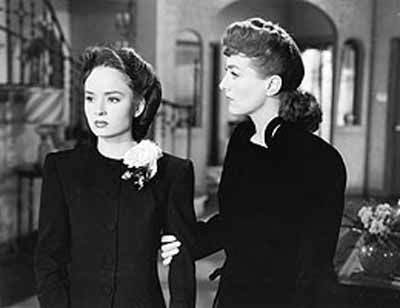
You're just waiting for Mildred to smack her, aren't you?
Ann Blyth (l.) in a tense scene with Joan Crawford in Mildred Pierce (1945)

I didn't realize that today was the 85th birthday of actress Ann Blyth, who is probably best remembered for playing ingrateful daughter Veda in the 1945 classic Mildred Pierce, for which Blyth was nominated for an Oscar. That's airing tonight at 8:00 PM on TCM, as TCM has made Blyth today's star in Summer Under the Stars. If for some bizarre reason you've never seen Mildred Pierce before, I can strongly recommend it. However, having blogged about it before and having recommended it on a number of other occasions when TCM aired it, I'd like to mention a different Ann Blyth film: Slander, which is airing at 6:30 PM.

Blyth plays Connie Martin, a housewife and mother who is married to Scott Martin (Van Johnson). Scott is a successful puppeteer, working on one of those kids' shows that were a staple of local television back in the 1950s when there was a lot of locally-produced non-news programming. (News is a cheap moneymaker for local broadcasters, which is why there has been such an increase in the amount of news on most local stations. That, and it can be passed off as a public service for the FCC licensing reviews. But that's another story.) Scott, however, has a secret, which is that before becoming a puppeteer, he had a past life that included a stint in prison for armed robbery. For understandable reasons, Scott doesn't want this to become public, as he'll lose his audience when parents freak out over a criminal entertaining their kids. Connie knows, and still loves him.

Enter HR Manley (Steve Cochran). Manley is the publisher of one of those gossip rags from the era that predated even the National Enquirer. Nowadays, Scott Martin's story would wind up on TMZ, but back then there was no internet. And frankly, Manley isn't all that interested in Martin's past on its own. Scott, however, grew up in the same town as some woman who has gone on to become a famous actress, and knew her fairly well when they were both young. Surely there must be some dirt on her. So Manley comes to Connie, and tells her of Scott's prior conviction. Connie of course knows about this, but Manley has a trump card: either Scott and spill the beans on the famous actress, or Manley can spill the beans on Scott. Nice.

Slander is one of those shorter black-and-white movies with a conscience that MGM was making a lot of in the 1950s. For the most part, it's an OK movie, although the movie's sympathies are obvious, as Manley is too much of a one-dimensional character. I mean, even his mother (Marjorie Rambeau) hates him for printing the scandal sheet. And yet, there have always been a lot of people who read the stuff then, and watch it now. Manley's magazine was based on real magazines like Confidential, which even used juvenile armed robbery convictions in the case of Rory Calhoun. Ironically, I don't think there's any slander in the movie. If the magazine were guilty of anything, it would have been libel and not slander. But truth is a defense to libel, and the movie never suggests that there are any lies to be printed about Scott Martin.

All of the actors give competent performances, even if the movie has the decided feel of a second-tier production while the executives would have been more interested in something like Silk Stockings that MGM released in the same year. The movie is also hurt somewhat by an ending that seems unrealistic. Still, it's more than worth a watch. Even though it's stuck firmly in the 1950s, Slander is about a theme that will always be with us. As far as I'm aware, Slander hasn't received a DVD release, not even from the Warner Archive.

Sunday, February 24, 2013

Divorce American Style

About a month ago, TCM ran Divorce American Style as part of a salute to actor Dick Van Dyke on getting the Screen Actors' Guild (I think) lifetime achievement award. The movie has received a DVD release, but it seems to be out of print based on the ridiculous price Amazon is asking, as well as TCM's on-line schedule not listing it as available for purchase from their online shop. It's receiving another airing on TCM tomorrow morning at 6:30 AM.

The movie starts off with a montage of couples bickering in their suburban tract housing, because, well, that's what American middle-class married couples do. Cut to one particular couple, Richard and Barbara Harmon, played by Dick Van Dyke and Debbie Reynolds. They hold a dinner party for their friends one night, but things don't go well, because afterwards, the two wind up at each other's throats as they clean up and then get ready to go to bed. Their adolescent son Mark (Tim Matheson in his movie debut) has obviously heard this all before, as when he hears the argument through the ventilation ducts, he's got a checklist of the things Mom and Dad use against each other.

What's a bored housewife to do? Barbara goes to her therapist, who has gotten Richard to agree to come in to one of the appointments in an effort to patch up the relationship, but that doesn't work, at which point Barbara calls her lawyer cousin who suggests a separation. Separation turns into divorce, with Barbara getting the house and everything in alimony, leaving Richard with the princely sum of $87.50 a week. Trying to put together the pieces of his life, Richard meets divorcée Nancy Downes (Jean Simmons). She's on relatively good terms with her ex-husband Nelson (Jason Robards), and likes Richard. This is wonderful for Nelson, since he'd love to see Nancy get remarried: there go his alimony payments. Of course, there's a problem wih the fact that even if Richard gets remarried, he still has to pay alimony. The only way he can get out of alimony is if Barbara remarries.

So, Nelson and Nancy immediately proceed to try to find a suitable husband for Barbara. Eventually the see an advertisement from used-car dealer Al Yearling (Van Johnson), whom Nelson had tried to hook up with Nancy, except that Al had a mother he was looking after. Mom has since died, so that means Al would quite possibly be good for Barbara, if the two can hit it of together. So, it looks as though everybody is going to live happily ever after: Richard with Nancy; Barbara with Al; and Nelson with his fiancée. Or will something come about to prevent the various couples from hooking up this way?

Divorce American Style has some potential. Parts of it come across as reminiscent of The Awful Truth, as you -- and Barbara and Richard -- wonder whether it was such a good idea for the two of them to get divorced in the first place. But this is not meant to be a screwball comedy; instead, it's trying to be more like a Paddy Chayefsky dark comedy. And there are times where that works too, as in the opening montage. There's also a very well choreographed sequence in the bank, when both Richard and Barbara have been advised by friends to clean out the joint bank account and remove the contents of their safety deposit box. Both go to the bank at the same time, with one going to empty the safety deposit box and the other going for the bank account, neither ever noticing the other.

Ultimately, though, Divorce American Style comes across as a bit of a mess; not quite sure of what it really wants to be. There's also something about the movie that seems firmly dated in the 1960s as opposed to The Awful Truth or Chayefsky's The Hospital or Network, all of which come closer to timeless. Debbie Reynolds comes across as a bit unappealing; the relationship between Nelson and Nancy seems a bit hard to believe; and the movie resolves its problems in a way that seems decidedly like a deus ex machina. It's a bit odd that the movie winds up as a mess, considering how much talent there is in it. In addition to all the actors, the screenplay was written by Norman Lear, while the director is Bud Yorkin: two men who went on to achieve great success together with the TV show All in the Family.

Sunday, November 20, 2011

Pilgrims' Progress

Apparently I have never done a full-length blog post on the film Plymouth Adventure before. It's coming on TCM at 8:00 PM tonight, so now would be a good time to give it that full-length post.

As you can probably guess from the title, Plymouth Adventure is a film about the Pilgrims, who fled England fearing religious persecution. They went first to Holland, and then back to England in order to obtain ship passage to the New World. The Jamestown colony had been founded a dozen years earlier, and apparently it was considered to be a good idea to get these people of a different religion leave England proper, while still working for the crown company charged with developing the New World; meanwhile, the Pilgrims could follow their wacky religion to their hearts' content in the Americas. Christopher Jones (Spencer Tracy) is the captain of the Mayflower, and he's offered a bribe: a substantial sum of money to take the passengers several hundred miles north of Virginia, where they thought they would be going. (Whether or not that happened in real life is questionable.)

Soon enough we get onto the Mayflower, and it sets off on its voyage that we know is going to be successful since this is a historical movie, at least in the basic facts. But they have to make a movie out of this material, so we get a good deal of extra drama. One of the standards is a storm, which is plausible: considering that the voyage took three months and started in late summer, they would likely have had to deal with the outer bands of a former hurricane somewhere along the way. The Pilgrim's religiosity causes a few plot problems deaing with their desire for cleanliness. In reality, fresh water would probably have gone bad over the course of a transatlantic voyage, so passengers, including the children, would have drunk something with a low alcohol content just to kill off all the nasty bacteria. Worst of all is the love story between William Bradford's (Leo Genn) wife Dorothy (Gene Tierney), and Capt. Jones. This almost certainly didn't happen in real life. But again, we wouldn't have a movie without such stuff.

To be fair, Plymouth Adventure is a pretty good movie. MGM made this one, which means we get a lot of very competent stars and high production values, as scene in the storm sequences. (Perhaps the production values are too high; people months into a transatlantic voyage wouldn't look this glamorous.) As for the rest of the cast, Van Johnson plays John Alden, going after Priscilla (Dawn Addams); Lloyd Bridges plays one of the sailors; and rather humorously, there's a line in the credits for the Mayflower as itself.

Monday, June 6, 2011

The old(ster) college try

I've blogged about a couple of movies in which I point out that Loretta Young either chose or got put into some not very good stuff toward the end of her career. If you want another example of this, you could watch Mother Is a Freshman, which is airing tomorrow morning at 9:00 AM on the Fox Movie Channel.

Young plays Abigail Fortitude Abbott, a widow who's got a daughter Susan (Betty Lynn) in college. Unfortunately, Susan spends like a fish to mix metaphors, to the point that Abigail is out of money from the current installment of the trust fund that was set up for the two women and Susan might have to drop out of college. Abigail's attorney and the executor of the will, Mr. Heaslip (Rudy Vallee), is in love with Abigail and wants her to marry him because that will make everybody's financial situation so much easier. Abigail doesn't love Heaslip, and comes up with an idea. Several generations back, her family set up a scholarship that could go to anybody named Fortitude. Obviously Susan can't use it, but Abigail can! So she'll get into college and use the scholarship to support Susan for one semester until the next installment of the trust fund.

If you've seen one unrealistic college movie, you've seen plot themes that show up over and over in the genre. The boys seem more interested in the co-eds than in their studies, to the point that some of them are actually interested in Susan, who would have to have been in her late 30s according to the plot. Susan, on the other hand, is interested in her English professor, Prof. Michaels (played by Van Johnson). He's not that interested in her, of course. Things go from bad to worse when Abigail enrolls in Prof. Michaels' class, and he takes an interest in Abigail! You'd think this would violate all sorts of norms of propriety, but it's Hollywood. The Production Code frowned on a lot of things, but not this.

You can probably guess where things are going to go. At first it will look like Abigail will end up with the right man, and then romantic complications will ensue, but all of them ought to be sorted out by the end, and everybody will live happily ever after. Frankly, I think the professor and the lawyer ought to end up together; that would be a much more interesting plot twist. But the Production Code wouldn't allow that. Mother Is a Freshman is mildly diverting, but nothing special. But if you want to see it, you'll have to watch it on the Fox Movie Channel, as it's not on DVD.