Showing posts with label Joan Fontaine. Show all posts

Monday, April 29, 2024

Ivanhoe

I mentioned yesterday that TCM would have two movies showing on April 30 that were on my DVR but that I hadn't blogged about before. The second of them is the 1952 adaptation of Ivanhoe, which shows up at 11:45 AM.

I haven't read Walter Scott's book on which this movie is based, so I can't say anything on how different the movie is. In any case, it starts off at the end of the 12th century. If you remember The Adventures of Robin Hood, you'll recall that English king Richard the Lionhearted went off to fight in one of the Crusades, only to be captured on the way home by Leopold of Austria and held for ransom. As the movie opens, a man looking like one of the old troubadours is riding his horse past various castles, singing a song in English. Eventually, at one of the castles, the man gets a response, followed by a small bag being thrown from a window high up. The man who threw the bag is Richard, as you can tell by the three lions crest on the bag, which contains a letter stating that he's being held for ransom, and that his brother John (Guy Rolfe) is aware of this and deliberately not paying the ransom.

The man who's been riding arouind looking for Richard is Wilfred of Ivanhoe (Robert Taylor), and he returns to England. However, there are all sorts of problems for him in England. One is that he's a Saxon, and the English monarchy are all Normans, descended from the invaders of 125 years prior. Prince John has been brutal in his desire to make the Saxons bend the knee to him, while Richard was more conciliatory about wanting to bring everyone together. It's because of this that Wilfrid's father Cedric (Finlay Currie) has disowned him for going off on a Crusade with those nasty Normans. But Wilfrid wants to see Cedric's ward Rowena (Joan Fontaine), with whom he has been in love. So when the unrecognized Wilfrid as troubadour runs into a group of Norman knights who are in Sherwood forest looking for a place to spend the night, Wilfrid directs them to his father's place nearby.

Wilfrid hides from his father, anad at the house one other guest shows up. Isaac (Felix Aylmer) is a Jew, having been forced to flee from Spain because the Jews are being persecuted pretty much all over Europe, much like they are even today for not willing to let Hamas extirpate them. Isaac meets Wilfrid, who tells him about Richard's captivity, and gives Isaac an assurance that Richard will let Jews in England live in peace. So Isaac takes Wilfred back to his place, Wilfrid bringing a jester he liberated, Wamba (Emlyn Williams) along in exchage for making Wamba a squire.

Isaac has a very lovely daughter, Rebecca (Elizabeth Taylor). Neither of them has anything close to the wealth needed to pay Richard's ransom, but Rebecca does have a way to help Wilfrid. Prince John wants a series of jousts in which the Normans will best the Saxons, thereby finally subjugating them. Wilfrid is the one Saxon who could beat them, but he doesn't have a suitable jousting horse or suit of chain mail. Rebecca has the wealth at least to purchase those. She falls in love with Wilfrid, but of course he's a Gentile, and is already in love with Rowena anyway.

Wilfrid does best the Normans, but picks up a fairly serious injury in the process. He also gains an enemy in Norman knight De Bois-Guilbert (George Sanders), who vows to destroy the Saxons once and for all, and that's what the rest of the movie is about.

Ivanhoe is the sort of literary adaptation MGM was generally pretty good at making, combined with vibrant Technicolor and location shooting in the British Isles. Robert Taylor isn't a particular favorite of mine, but once again he gives a professional performance, as do Elizabeth Taylor and the underused Joan Fontaine. George Sanders gets to play another of his villain roles, and the British supporting cast is uniformly good. The story is a rousing one, full of action and easy to follow.

Ivanhoe may not be as good as Warner Bros.' The Adventures of Robin Hood, but not a whole lot of films are. It's eminently watchable in its own right, however.

Friday, April 26, 2024

Distress Around a Damsel

I'm not the biggest fan of musicals, but there are any number that I should probably watch because they're famous for one reason or another. Among these is one of George Gershwin's final works, doing the songs in the musical A Damsel in Distress. So the last time it was on TCM, I watched it with a view to getting around to doing a post on it.

The movie starts off at Totleigh, an estate in the English countryside. Lady Alyce, the adult daughter in the family, is in love and it's thought that she's about to be betrothed to somebody, but nobody really knows who that somebody is. To that end, the head of the house staff, Keggs (Reginald Gardiner) starts a betting pool among the staff members. Each one antes up and picks from among the men who are known to be known to Alyce and could possibly be the suitor. However, there are more staff members than suitors, so a young boy says that he'll put his money on a "Mr. X", an unknown American.

Cut to an office in London, where American stage actor Jerry Halliday (Fred Astaire) has an office where he can keep his PR guy George (George Burns) together with George's secretary Gracie (Gracie Allen) while Jerry is performing on the London stage. Jerry is certainly not Mr. X, and Alyce doesn't even know him. At least, she doesn't know him yet. Jerry exits his office one day and gets into a taxicab, and wouldn't you know it, but Alyce (Joan Fontaine) is in London too to meet an actual American suitor. Sure enough, she gets into the same cab as Jerry even though he's not the suitor. However, it suits both of them to take the cab together for a while since Alyce is trying to get away from her handlers.

Albert, the young boy who's got The American in the betting pool, sets the cat among the pigeons by writing a phony letter to Jerry as he was in London along with Keggs when Alyce got in the cab with Jerry. The fake letter suggests that Alyce needs help that Jerry can somehow provide. He can come under the pretense that Totleigh is open for guided tours one day a week, and if Jerry comes on that day....

However, Keggs recognizes Jerry and won't let him in the house, but Albert helps him get in courtesy of a visiting choir of madrigal singers. When he gets in, Albert takes him up to Alyce's chambers. The two talk about the "help" Alyce needs in seeing her American suitor, and both of them wind up talking at cross purposes in the sort of way that would lead to the sort of confusion you'd see in a TV sitcom of a later era.

It doesn't take much to guess that Jerry and Alice wind up developing feelings for each other, and that various people are going to try to hinder the relationship or help it out for their own purposes. That, and the sort of misunderstanding you'd get in any of Fred Astaire's musicals with Ginger Rogers. And you can probably guess where everything is heading in the final reel.

As I said at the start, I'm not the biggest fan of musicals, so the material isn't quite my favorite. However, it's easy to see why fans of musicals and the Astaire/Rogers pairings would like this even if it's Joan Fontaine standing in for Rogers. The music having been written by George and Ira Gershwin, it's not surprising that multiple songs have since become standards, notably "Nice Work if You Can Get It".

A Damsel in Distress is inoffensive enough and will probably delight fans of musicals. Definitely worth watching.

Monday, August 9, 2021

Toxic femininity

Hollywood made a lot of movies with idle rich women in the 1930s. How grounded in reality the are or aren't is an interesting topic for discussion, but in any case the genre probably reached its peak with the 1939 movie The Women.

Norma Shearer is the innocent little deer in the headlights, playing Mary Haines, a woman happily married to Steven, who is unseen because the movie's gimmick is that every part in the movie is played by a woman, even the animals as studio publicity back in 1939 would have had you believe. Not even Grant Mitchell, who was in seemingly every other movie Hollywood made in the 1930s, shows up here. But we don't see Mary first. Instead, we see a high-end beauty salon where women go with their little murse dogs and get everything from haircuts to mud baths to exercise on 1930s equipment. They also gossip incessantly, and the latest bit of gossip is that Stephen Haines is seeing a shop girl, Crystal Allen (Joan Crawford).

Mary's cousin Sylvia (Rosalind Russell), also married, is catty, and decides to make certain the gossip spreads in a way that Mary is bound to hear it, ultimately getting Mary to go to the same salon and see the same manicurist from whom Sylvia heard the juicy gossip. Wow what a piece of work. Mary's mom (Lucile Watson), the one sensible woman in the movie, advises Mary to do nothing but wait and eventually Stephen will stop straying. If he really is, I don't know that that would be the best advice, but I'm not the person to ask for advice on matters of romance anyway. In any case, the two go to Bermuda for a vacation.

Things haven't changed much when Mary gets back, and at a fashion show, she finally meets Crystal and finds out that the rumors of Crystal and Stephen's seeing each other are true. It winds up in the gossip columns (although the one scene where it's on the front page seems thoroughly unrealistic). This is what finally gets Mary to decide she's going to go to Reno and get a divorce, much to the sorrow of her daughter also named Mary (Virginia Weidler).

Mary goes to a place in Reno that's specifically set up for women looking to get a divorce, letting them stay there until the divorce goes through, and run by straight-talking Lucy (Marjorie Main). Also there are Countess (Mary Boland), who goes through one husband after another; a chorus girl Miriam (Paulette Goddard); and, surprisingly, Mary's good friend Peggy (Joan Fontaine). Even more surprising is that Sylvia eventually shows up, and it turns out that Sylvia's husband is planning to get married to a chorus girl... who just happens to be Miriam.

Eventually Mary's divorce goes through and she seems to be reasonably happy living the single life with her mom and daughter. Crystal seems happy too, but daughter Mary is mighty unhappy and passive-aggressive toward her step-mother. Clearly she's learned from all the other adult women in her life.

There's a lot to like about The Women, but there are also things that aren't going to appeal to everybody. Anybody who's had to put up with other people's gossip in real life knows that it's exhausting, and do you really want to spend 130 minutes watching a fictionalized version of it? There's certainly quite a few moments of comedy here, and the performances are all well done, but part of me wanted to shake these women the way Bette Davis does to Miriam Hopkins in Old Acquaintance and tell them to shut up already. They're not nearly as clever as they think they are.

Still, because of the movie's reputation, The Women is a movie that definitely ought to be watched by anybody who's a fan of old movies.

Friday, January 8, 2021

Technically, nobody's forcing you to stay happy

In the last week or two, I've inadvertently watched several movies which have aviation as a theme, as we saw with Conquest of the Air which I recommended at the beginning the week. Recently, I popped in a DVD from a Universal James Stewart box set and watched You Gotta Stay Happy, which I have to admit was a new-to-me title when I first saw the set on Amazon.

Stewart plays Marvin Payne, a cargo pilot who has just flown into New York and shows up at a hotel looking for a friend of his who is able to get a cheap rate on one of the rooms because Payne always leaves well before checkout time. Meanwhile, also showing up at the hotel is Dee Dee Dillwood (Joan Fontaine). She's one of those flighty heiress types who were common in screwball comedies of the 1930s, but this movie was released in 1948. She's finally agreed to get married to lawyer Henry (Willard Parker), but she doesn't really want to do it. So she runs out of the bridal suite and into... the suite that Payne has for the night.

Dee Dee obviously doesn't want Payne to know the truth of what's going on, and doesn't want to get caught by Henry either, so she makes Payne's life a bit of a living hell by delaying him from getting out of the room. She's like to go west like Payne is, but of course Payne is running a cargo airline, and they're not supposed to take paying passengers. So Dee Dee winds up becoming technically an employee of the company until she can get off in Chicago.

Payne co-owns the company with "Bullets" Baker (Eddie Albert), who at this point in his career was playing sort of the lighter and not quite so oily Jack Carson types. He's the co-pilot for the flight, and in order to make a little extra money, he too takes on a couple of illicit passengers. There's a newlywed couple (Marcy McGuire and Arthur Walsh), and an embezzler (Porter Hall) who had a blonde secretary. Dee Dee is a blonde, too, although I'm giving a bit away, not that she's an embezzler. Rounding out the cargo is a coffin with a dead body that needs to be at its funeral in Los Angeles by a certain time, and a cigar-smoking chimpanzee.

If you've seen any of the 1930s screwball comedies, you can figure out much of what happens well before it does. Dee Dee doesn't stay in Chicago, getting back on the plane instead, and then further west the plane has to make an emergency landing, where everybody is forced to spend a night on a farm owned by Mr. Racknell (Percy Kilbride). Payne and Dee Dee find out that night that they might just be in love. Since they're the two leads, we sort of expect them to get together in the final reel, but how is that going to happen.

You Gotta Stay Happy is modest stuff for both Stewart and Fontaine. Not that it's terrible; it's more that the material is old-fashioned and uninventive. Both players try their hardest and the movie is entertaining enough for one watch, but it's also the sort of thing that's forgettable after you've watched it. I'm glad it's on the box set, but I don't think it's something I'd pick up as a standalone unless it was at bargain bin prices.

Sunday, August 4, 2019

Gunga Din

Last month TCM did a retrospective of the movies of 1939 since this year is the 80th anniversary of what is often considered Hollywood's greatest year. I hadn't blogged about Gunga Din before, so since that was part of the spotlight, I decided to DVR it and watch it.

Based on a character created by Rudyard Kipling, the movie is set in India under the British Raj late in the Victorian era. Parts of the subcontinent, especially those in the northwest near what is now the Afghanistan-Pakistan border, are still a fraction region, and there is all sorts of anti-British activity going on.

Cutter (Cary Grant), Ballantine (Douglas Fairbanks Jr.), and MacChesney (Victor McLaglen) are three friends who are serving together in this part of India and also getting in a few scrapes. Apparently, Cutter tried to buy what is purported to be a map leading to a large stash of gold which would leave Cutter set for life, and that's gotten the three in a spot of trouble. But up to this point they've always been able to fight their way out of it in cartoonish fashion.

Currently, a group known as the Thuggees (from which we get the word "thug") is rebelling, specifically downing telegraph lines but also attacking towns where the telegraph offices were. The three friends are given the task of dealing with it. It might just be their last mission together, since Ballantine is planning to get married to Emmy (Joan Fontaine) and leave the service.

Meanwhile, the three soldiers have a friend in their water carrier, the titular Gunga Din (Sam Jaffe). He also has his ear to the ground so knows a bit about what's going on, and also has a strong desire to be more British, specifically to be a British soldier. He helps Cutter escape from the brig after Cutter is put their to prevent going looking for that gold.

What they find is a temple which they ultimately realize has gold-plated (if not solid gold) sculptures, so Cutter would be engaging in a form of looting even worse than just leaving the Elgin Marbles to rot in the elements. But this being a 1939 movie, nobody thought of those things. Instead, this is also the temple where the Thuggees are planning their big rebellion. After Cutter is waylaid by the Thuggees, Ballantine and MacChesney follow to find him. The four eventually realize that when the British army as a whole comes, they'll be walking right into a trap. They have to figure out a way to escape and warn the British.

Gunga Din is a rousing action picture well suited to younger boys who want their action dished out with obvious heroes and villains; anybody looking for cultural subtlety isn't going to find it here. If you know that going in -- and you should probably expect it considering that the movie is from 1939 -- it works. I'll admit that I personally prefer the Errol Flynn swashbucklers for their action to Gunga Din, but this one isn't too bad.

Gunga Din is available on DVD.

Friday, May 31, 2019

Until They Sail

I recorded quite a few of the movies TCM ran during the salute to Star of the Month Paul Newman, so it's time to start getting through them. First up is Until They Sail.

Newman plays Capt. Jack Harding, a US Marine who at the start of the movie is testifying in a criminal trial in Christchurch, New Zealand, in November 1945. If you guessed that he was involved in World War II, you'd be right. The US stationed a lot of men in New Zealand as part of the staging to send them north to fight the Japanese, and many of them wanted to take on local women as wives, what with all the Kiwi men being away fighting the war. Harding's job was to investigate to make certain the women wouldn't be "undesirables" in America.

Flash back to the events that necessitated Harding's testimony. Well, actually, let's go back further than that. The Leslies are a family of four sisters -- both parents are deceased -- in Christchurch, with second-oldest sister Barbara (Jean Simmons) having a husband off fighting in North Africa. Eldest sister Anne (Joan Fontaine) seems to have something against men, while youngest sister Evelyn (Sandra Dee in her movie debut) is too young for that stuff yet.

Then there's third sister Delia (Piper Laurie). She seems desperate for any man. The only adult male of marriageable age is Phil, nicknamed Shiner (Wally Cassell). Anne and Barbara think he's terrible for Delia, but she doesn't care; she wants a man. So she marries him, and when he gets called to fight, she decamps to Wellington. Ostensibly, it's to do her part for the war effort; really, though, it's because there's a greater number of US soldiers stationed there.

Barbara goes up to Wellington to see Delia and learns the truth of what Delia is doing. But also there, she meets Harding. They strike up a bit of a friendship, but it's clearly nothing more than that because she's married and he's been through an emotionally difficult divorce that led to him taking up heavy drinking. But all sorts of events are going to turn Barbara against the Americans the way Anne seems to be.

I say seems, because eventually Anne meets a soldier of her own, Capt. Bates (Charles Drake), with whom she eventually falls in love and could get married if the authorities (with Harding investigating) approve. As you can see, in life things have a way of turning out differently than one might expect.

But back to the beginning of the movie, and Harding's appearance in court. Why is he testifying? Well, all that cavorting with American servicemen Delia did causes her to realize she made a dumb move in marrying Shiner. When he finally gets released from a POW camp after the war, she plans to tell him that she's going to get a divorce from him. He's going to contest it and never let her get it, which leads to... well, that's why Harding is testifying.

Until They Sail is a well-made drama, although if there's one flaw, it's that most of the characters' story lines are wrapped up a bit too neatly. Life isn't always so straightforward. But the road there is a bit twistier, like real life. And the performances are mostly quite good. It's an interesting look at a part of World War II that's probably not quite so well known to Americans.

Until They Sail is available on DVD courtesy of the Warner Archive collection.

Monday, May 4, 2015

Beyond a Reasonable Doubt

TCM is running a night of death row-themed movies tonight, including Beyond a Reasonbale Doubt at 12:15 AM.

Dana Andrews stars as Tom Garrett, a writer who's moving up in the world. He's gotten himself engaged to Susan Spencer (Joan Fontaine), who is the daughter of the influential newspaper publisher Austin Spencer (Sidney Blackmer). Mr. Spencer campaigns tirelessly against the death penalty, and has a particular interest in doing so right now since the local prosecutor recently obtained a murder conviction on circumstantial evidence.

To that end, Spencer has an audacious idea. There's been another murder that the cops have been completely unable to solve, so he wants Tom to help him solve the murder for everybody's benefit. Well, they're not really going to solve the murder; they're going to plant evidence that will lead to a murderer, with that murderer being Tom himself. Once they do that, they'll have Tom be arrested, put on trial, and convicted, and hopefully even sent to the gas chamber. Only once all that happens will Spencer produce their documentary proof that the evidence pointing to Tom's involvment in the murder has all been fabricated.

Now, as I wtore the paragraph above, I found myself thinking of one of the TCM "Word of Mouth" pieces that runs every time they're going to be showing the 1960s version of King of Kings. Screenwriter Philip Yordan says he was called by the producer to be a script doctor, and when he flew over to Spain where the movie was being filmed, he saw what passed for a script and said, "This is insane!" Indeed, Spencer's plan for his future son-in-law is nonsensical, and who in his right mind would want to engage in a plan like that? At least Susan is in her right mind. Either that, or she'd spill the beans, so Dad and Tom decide to keep the knowledge of what they're doing from her.

So far, so good. And then the time comes for Spencer to produce the evidence which will exonerate Tom. He gets it from his safe, and then... gets into a car accident, which kills him and in the resulting fire destroys all the evidence! You'd think that if the two men had planned their actions as carefully as they did, they would have made certain to have a second copy of the evidence available somewhere. How will Tom be saved? Do we really want him to be saved, for after all, faking all this evidence is rather criminal in and of itself?

Beyond a Reasonable Doubt is one of those movies that has a really interesting premise, but in which the ultimate payoff isn't quite as good as you'd hope for. If the cops were good enough to solve murders, you'd think they'd be good enough to realize that all this evidence was faked. The plot is full of unbelievable twists, right up until the very end. And it often feels as though everybody is going through the motions. It's the sort of thing where, it it had been a B movie with a bunch of unknowns, we'd probably praise it for being a little-known gem. But it's got fairly big stars and a big director in Fritz Lang, who already did similar stuff before with Fury. The result is a movie that does remain interesting, but winds up slightly disappointing.

Saturday, December 28, 2013

TCM's Joan Fontaine programming tribute


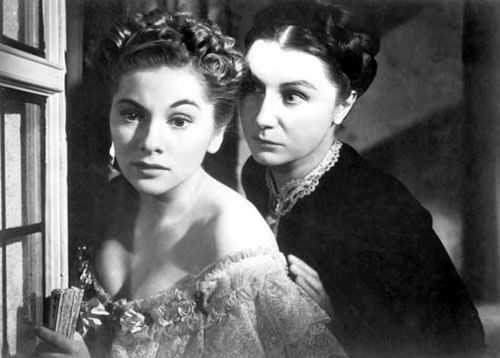
Joan Fontaine (l.) with Judith Anderson in Rebecca (1940)

TCM has set aside its previously scheduled programming to honor the recently deceased Joan Fontaine with seven of her films. Those movies will be airing tomorrow, December 29, during the morning and afternoon:

Blond Cheat, one of the B-comedies she made at the start of her career, kicks things off at 6:30 AM.
That's followed by The Women at 7:45 AM;
Fontaine as a bad girl in Born to Be Bad at 10:15 AM;
The costume drama Ivanhoe, based on the novel by Sir Walter Scott, at noon;
The Constant Nymph finds Fontaine in love with Charles Boyer at 2:00 PM;
Fontaine wins an Oscar for Suspicion at 4:00 PM; and
Fontaine becomes Laurence Olivier's second wife in Recebba, at 5:45 PM.

Suspicion was already on the schedule for tonight at 10:00 PM. As for the availability on DVD, TCM lists all of them as being on DVD with the exceptions of Blond Cheat (not too surprising) and Born to Be Bad.

Monday, December 16, 2013

Joan Fontaine, 1917-2013


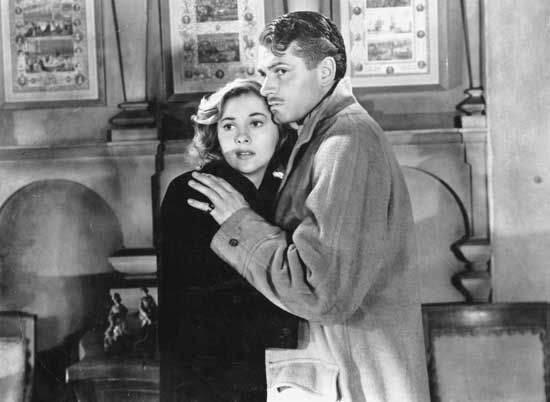
Joan Fontaine and Laurence Olivier in Alfred Hitchcock's Rebecca (1940)

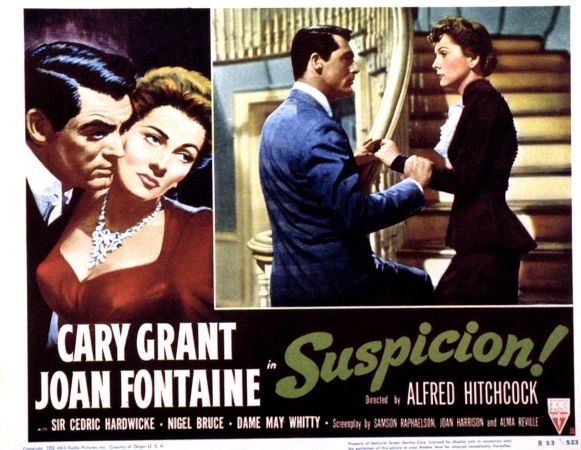
The death has been announced of Joan Fontaine, who won the Best Actress Oscar for her portrayal in the Alfred Hitchcock movie Suspicion. She was 96. Fontaine is survived by her sister, fellow Oscar-winning actress Olivia de Havilland, who as of this posting was still alive in Paris at the age of 97.

Fontaine started her career not all that long after her sister, in the movie No More Ladies. Not wanting to ride on her sister's coattails, she took the name "Burfield", apparently from a road sign, before settling on using her stepfather's last name. Fontaine continued to toil at RKO, making B movies such as Maid's Night Out, and getting cast opposite Fred Astaire in A Damsel in Distress, which is coming up at 2:00 AM Thursday as part of the Star of the Month salute to Astaire. This, even though singing and dancing weren't Fontaine's strong suits. Small roles in bigger movies like Gunga Din and The Women followed, before she really hit it big being cast as the second Mrs. de Winter in Rebecca, pictured above.


Rebecca earned Fontaine an Oscar nomination, but it was next year with Suspicion that she won. To be honest, I'm not a huge fan of Suspicion, because they had to redo the ending and the ending we have is a mess. Allegedly, it was beating her sister Olivia for that Oscar that caused their long-time feud, although according the obituaries they weren't particularly close growing up anyway, Fontaine made about a movie a year through the 1950s, stuff like The Bigamist or Island in the Sun.

I'm sure there's going to be a TCM programming salute for Fontaine as well as Peter O'Toole, and it should be easier for TCM to get movies for it since she started off at RKO, even if those aren't her best movies. I don't know when it's going to be, what with TCM having to schedule multiple tributes, and having to do all this after coming back from a weekend and the TCM Cruise.

Wednesday, June 19, 2013

No More Ladies

What if MGM took another look at The Divorcée five years later, and saw that, with the imposition of the Production Code, there's no way they could make such a movie in the same way? And what if, having seen that, they tried to make an urbane comedy instead? The result might be something like No More Ladies, which is airing at midnight tonight on TCM.

Joan Crawford stars as Marcia, a socialite-type living with Grandma Fanny (Edna May Oliver). She's in love with Sherry (Robert Montgomery), even though he's a notorious playboy. Grandma warns Marcia about Sherry, as does marcia's cousin Edgar (Charlie Ruggles). But to no avail. Even though Sherry continues to stand up Marcia, she still keeps going back to him. After a while, Sherry proposes marriage to Marcia, and she accepts, even though they both admit that the chances of their having a successful marriage are rather low!

Sure enough, Sherry continues to be a playboy, on their honeymoon no less. And it's not as if he's a very convincing liar. On one of his trysts, he's seeing Edgar's date Theresa (Gail Patrick). Sherry lies to Marcia about it, claiming he's looking after Edgar, who's fallen ill. Marcia, and we, know that this is an utter lie, for an obvious reason: she's talking to Edgar in her room!

So, what's a woman who's being treated like this to do? Why not try getting revenge by treating her husband the same way he's been treating her? It's no more unreasonable than any other idea. And so Marcia finds Jim (Franchot Tone), whose wife Sherry romanced in the days before Sherry married Marcia. Suddenly, though, when the wife does it, it's not as acceptable when the husband does it.

No More Ladies is, to be honest, not much more than a little piffle. It's the kind of movie that I saw several years ago, but didn't register much more than all of the other mid-30s stuff I've seen. That's both bad, and good. Bad, of course, because it means the movie didn't do all that much special to be worth remembering. But good as well because it didn't do anything to make me remember it as a movie I wouldn't want to watch. In fact, one thing that makes the movie worth noting is the presence of the character Caroline. She's played by an 18-year-old actress credited as Joan Burfield. Burfield would soon take her stepfather's surname: Fontaine. Joan, despite having a surname of her own, wanted to distinguish herself from sister Olivia de Havilland. The rest, as they say, is history.

No More Ladies has received a Warner Archives release.

Friday, March 1, 2013

Voyage to the Bottom of the Sea

Another movie that's returning to the Fox Movie Channel lineup in March is Voyage to the Bottom of the Sea. It's airing today at 1:00 PM, but don't worry if you don't read today's post until later in the day. You have another chance to catch the movie tomorrow at 9:30 AM, and then Sunday at 4:00 AM. (There are also several airings in April.)

Walter Pidgeon stars as Adm. Harriman Nelson, the designer of the Seaview, the newest and best submarine in the US Navy's nuclear fleet. At the beginning of the movie, he's putting the sub through its paces up in the Arctic, when something surprising happens: pieces of icebergs are breaking off and "raining" down on the sub below. This is, to put it mildly, highly unusual. The reason for the icebergs breaking up is even more unusual. Solar flares or something have caused the Van Allen radiation belts (which had only been discovered a couple of years before the movie was released) a couple thousand miles above the earth to catch fire! It's a problem that could doom mankind to a fiery death, and nobody knows how to solve it!

So, the scientists of the world have been brought together by the United Nations to figure out what to do, and understandbly, they can't reach any agreement, since this is a problem they've never seen before, and there's no way to do experiments. But, the scientists that the political leaders of the world consider the "best and brightest" minds, tend to think that the fire will burn itself out, and that mankind should be able to survive until this happens. Adm. Nelson, on the other hand, has a different idea. He thinks he can use the missiles on board his ship as a sort of fire extinguisher, but to do so requires getting to the bottom of the Marianas Trench, the deepest point in the ocean, at a precise time to fire the missile. It goes without saying that the scientific establishment thinks this is cockamamie, and may only make the problem worse.

Adm. Nelson, for his part, sets off for the Marianas Trench, with the navies of the world sending subs after the Seaview to try to prevent Adm. Nelson from carrying out his plan. Adm. Nelson has his old friend, Commodore Emery (Peter Lorre) along, who supports Nelson's scientific belief. Many of the crew, however, aren't so certain, led by the ship's commanding officer (Robert Sterling). Joan Fontaine plays a psychologist who had come aboard to study the stress submarine crews face, and God knows they're going to get a lot of stress on this mission. Barbara Eden was along for eye candy in Five Weeks in a Balloon, which I recommended yesterday; she's here as well, playing Nelson's secretary who is also the fiancée of Sterling's character. And for the teens, there's not Fabian, but Frankie Avalon.

The movie is scientific nonsense for the most part. This does not, however, mean that the movie can't be entertaining. It recycles a lot of clichés about ship- and submarine-bound films, to be sure, and there are also some terrible effects, notably with the giant squid. Some of the plot points are also badly telescoped. A point is made of making certain everybody on board the Seaview has a radiation detector clipped to their shirt, so you know at some point one of those detectors is going to indicate a fatal dose of radiation poisoning. Still, as with yesterday's Five Weeks in a Balloon, Voyage to the Bottom of the Sea is one of those popcorn movies: sit back with a bowl of popcorn and prepare yourself for an implausible by entertaining enough ride.

Sunday, October 21, 2012

I didn't know anybody was lost

Tomorrow marks the 95th birthday of Oscar-winning actress Joan Fontaine. TCM is spending all morning and afternoon with her, including some of her early stuff, such as The Man Who Found Himself at 7:30 AM.

The putative star of the movie isn't Fontaine, but John Beal. He plays Dr. Jim Stanton Jr., the latest in a long line of prominent and respectable doctors at some fashionable big-city hospital. The only problem is, Jim Jr. also likes to fly airplanes. Why this should be a problem is beyond me, but apparently Dad (George Irving) has a problem with it, and the rest of the medical community listens to Jim Sr. After performing an appendectomy on Dick Miller, the pilot and old friend who taught Jim Jr. how to fly (Philip Huston), Jim Jr. hops on his plane to fly down to Philadelphia. He meets a lady friend who wants to get out of the city, and innocently takes her along, even though the weather is terrible.

You can guess what happens next: the plane crashes in the bad weather, and it kills the woman, despite seeming to leave Jim Jr. unscathed. Oh, and the woman was married and running away from her husband, so all the polite society thinks that Jim Jr. was having an affair with her, which causes a huge scandal. The medical board wants to discipline Jim Jr., but he basically says to hell with it (not in those words, of course: the Code enforcers would have had an apoplectic fit) and decides to become a hobo! He falls in with a bunch of other hobos and makes his way out west to Los Angeles, where unfortunately they're all held on a vagrancy charge and sentenced to work on the road-building detail. While building the road, who should come along but Dick Miller. Dick helps Jim get a job as a mechanic for the airline where Dick works, but on the proviso that nobody should learn about Jim's true identity.

It's only here that we finally meet Joan Fontaine. She plays Doris, the nurse for the airline. The airline runs an air ambulance service, and when they send out a plane, it's Doris who does the EMT stuff. Doris immediately takes a liking to Jim, and is convinced that there's more to Jim than he's letting on. For his part, he's doing all he can to make Doris suspicious. Eventually she figures out that he had learned how to pilot a plane at some point in the past, so she rigs it that the next time the airline needs to run the air ambulance, Dick won't be around and Doris can have Jim make the flight. Unfortunately for Jim, the patient gets hysterical during the flight and Jim has to use the medical knowledge he foreswore to help Doris, which leads her to suspect even more....

This is all decidedly B stuff, but for the most part, it's quite entertaining. There's a lot of stuff with the airplanes that I think probably doesn't reflect real life: the airplanes seem to be able to land anywhere, no matter how little room for a runway there seems to be. And the scene with Doris alone on the air ambulance with just Jim flying it is something I don't think would have happened that way in real life either. That sort of stuff is more good for a laugh than detracting from the movie, however. Joan Fontaine does her best attempt at channeling Glenda Farrell, taking charge of every situation and driving Jim back to doing what he was destined to do. Therein lies part of the problem with the film. Why is it such a bad thing that Jim should work at what he loves, and not what his father and old girlfriend want him to do? And yet, thanks to the Production Code, we have to get a morally upright ending that I don't think really works so well.

The closing credits have RKO trumpeting Fontaine as their new actress, but even the presence of Fontaine hasn't been enough to get this movie a release from the Warner Archive. So, you'll have to catch tomorrow's showing on TCM.

Thursday, June 21, 2012

The Bigamist

TCM is marking the birth anniversary of Ida Lupino today, so it's unsurprising that TCM is spending the day with a bunch of her movies. I've mentioned a few times in the past that Lupino became a director, but what I didn't realize is that she was actually only credited as the director of six films. To be fair, though, this doesn't count On Dangerous Ground, and she did a lot of directing for television as well. TCM is showing the movies in which Lupino is one of the stars, but that does happen to include one movie which she also directed: The Bigamist, at 4:45 PM.

At the start of the movie, our bigamist, Harrison Graham (played by Edmond O'Brien), is living in San Francisco with his wife Eve (Joan Fontaine). He's a successful salesman of commercial freezers and she's his secretary, but his work constantly takes him to Los Angeles so the two rarely see each other. They don't have any children and she seems to have trouble conceiving, so they decide to adopt. Here comes Mr. Jordan (played Edmund Gwenn, and the lousy pun was intended), the adoption agency investigator. What he discovers shocks him, although it shouldn't shock any of us since we know from the title what's coming.

Harrison Graham, is, in fact, a bigamist! How could such a thing happen? Well, let the movie tell you. As I said earlier, Harrison travels a lot for business, which has made him lonely. One day in Los Angeles, he takes a tour of the stars' houses, which is where he meets Phyllis (Ida Lupino), a waitress at a local café. (Her being on the tour is about as realistic as Priscilla Lane's character prtending to be a department store salesgirl and winding up in the Statue of Liberty for the climax of Saboteur, but that's another point.) At first it's just friendship, but you know that things are going to get more serious than that. Eventually, Phyllis tells Harrison that he's knocked her up. Well, she doesn't use that sort of language; the Production Code would never allow it. So he proposes to her, even though he's married to another woman. Since I mentioned the Production Code, you also know that it means Harrison is bound to be caught, and since Mr. Jordan has found out about the bigamy, Harrison is going to face a court trial.

If you're looking to see why people talk about Ida Lupino as a director, I don't think this is the movie to start with; something like The Hitch-Hiker would be better. The problem with this movie is, I think, not really Lupino's fault; to me it seems more a problem with the script. The whole movie is just kind of there. It comes and goes like one of those old TV movies trying to highlight an important issue. Lupino as director and actress does a capable job, and to be fair to the rest of the actors, they do as well. But they're doing their jobs in the service of mediocre material. The ending is also left hanging, but again that's a script problem.

I believe The Bigamist hasn't gotten a DVD release. It's worth a watch, but everybody involved with the film has done much better.

Saturday, December 10, 2011

Peyton Place goes calypso

I don't quite know what to say about the sprawling drama Island in the Sun, which airing tomorrow morning at 10:00 AM on the Fox Movie Channel. It's not the greatest movie by a long shot, but it certainly bears one viewing.

The movie is set on the fictional island of Santa Maria in the Caribbean in the mid-1950s. Santa Maria is a British colony, but the mid-1950s was the beginning of the period when Britain was giving is colonies home rule. As such, there's a large black underclass on the island itching to take power, and a smaller wealthy class of whites running the place with a colonial governor still heading things. Indeed, one of the story lines in the movie is going to involve a black and a white character running against each other for the legislative assembly, but that's actually a relatively small storyline compared to what the box guides might say. We first see the whites, as the wife Sylvia (Patricia Owens) and sister Jocelyn (Joan Collins) of wealthy planter Max Fleury (James Mason) return home with a friend Hilary (Michael Rennie), a man who's rather drifted through life in the British Foreign Office. Hilary smokes Egyptian cigarettes, and when Max returns home, he notices one of those in the ash tray, which makes him think his wife is having an affair.

Meanwhile, the Governor is hosting a party where the Fleurys have been invited, as well as labor leader David Boyeur (Harry Belafonte). Boyeur brings a lovely cashier with him (Dorothy Dandridge), but she falls for the governor's white aide. The governor's son (Stephen Boyd), meanwhile, falls for Jocelyn. Along the way, David falls for Sylvia's sister Mavis (Joan Fontaine) -- or more accurately, she falls for him, not realizing what life is really like for the black people on Santa Maria.

If things sound less than exciting so far, keep watching; things happen that should theoretically make the action level pick up. The first of those big things is when Max finds Hilary and realizes he's the one who's left his cigarette in Max's ash tray. He confronts Hilary, who suggests that Max may have some black ancestors in his family tree, which causes Max to strangle Hilary to death. This causes us to get two more plot lines: a murder mystery that's much like Dostoevsky's novel Crime and Punishment (and indeed, the police chief gives Max a copy of that novel to read); and, a discussion of racial heritage as both Max and Jocelyn discover the truth about their ancestry, which may or may not involve black ancestors.

Island in the Sun sprawls and meanders, but never quite goes anywhere. None of the romances is that intense, possibly in part due to two of them being interracial and the problems of depicting interracial relationships when you still had a Production Code that didn't like such stuff. Another big problem is Harry Belafonte. He was a more than capable singer, but not the best actor out there. The one big song he does get to sing is also problematic, in that it depicts the blacks as happy with their lot in life despite living a life of grinding poverty and no political power. (Compare this to the opening scenes of Hallelujah! from 1929, which has sharecroppers singing.) The revelations about characters' pasts seem contrived, only to make the plot work out neatly; in fact they also make you question the motivations of some of the characters earlier in the film. On the bright side, the movie was filmed on location in Barbados, and has a lot of lovely wide-screen color cinematography.