Showing posts with label Norma Shearer. Show all posts

Tuesday, December 16, 2025

I've finally seen the MGM Romeo and Juliet

Pretty much everybody does Shakespeare plays in their high school English classes, although which plays depends on the teacher. In my case one year we did Romeo and Juliet, and supplemented it by watching the Franco Zeffirelli version from the late 1960s. I've known for a long time that MGM did a version in the 1930s in response to Warner Bros. making A Midsummer Night's Dream, but for various reasons I hadn't ever gotten around to seeing this 1936 version of Romeo and Juliet in its entirety. So when TCM ran it during 31 Days of Oscar, I finally recorded it and watched it to do a post on here.

Now, with a movie like Romeo and Juliet, pretty much everybody already knows the story. Romeo Montague (played here by Leslie Howard) and Juliet Capulet (played by Norma Shearer) are adolescents (more on that later) from families where the older generation are rivals with a sort of blood-lust in the medieval Italian city of Verona. But Romeo and Juliet meet at a masquerade ball without knowing who each other is, and most definitely not knowing that the other is from that rival family who is supposed to be off limits. So they fall in love and meet each other surreptitiously, at least until Juliet's father (C. Aubrey Smith) insists on marrying Juliet off to somebody of an appropriate social standing who is not a Montague. Juliet's attempt to get out of this arranged marriage leads to tragedy.

Since the story is already known, any attempt to review a Shakespearean movie comes down to other factors. First up is the casting. I think I mentioned when I posted about A Midsummer Night's Dream ages ago that Warner Bros. was able to use mostly more classically-trained actors for the "serious" roles, while putting a lot of their contract players into Nick Bottom's acting troupe. MGM didn't quite achieve that, notably in the opening scene where hey have Edna May Oliver as Juliet's nurse and Andy Devine of all people as the nurse's assistant. Devine's character who is the Capulet who kicks off the fight in the opening scene between the Capulets and Montagues, is more of a man-child, especially in the medieval wardrobe.

Many of the main characters are way too old for the parts by cinematic standards, although back in the day it wasn't as uncommon on the live stage for people a few years older than the parts to be playing roles like Romeo and Juliet. Traveling stage companies wouldn't have had a 15-year-old girl available to play Julet. Shearer doesn't come off badly, while Howard has no difficulty with Shakespearean dialogue although he decidedly looks way too old. Ditto John Barrymore as Mercutio. Basil Rathbone as Tybalt is another one who can handle the dialog, and got an Oscar nomination for his trouble.

The production design is lovely, which is no less than can be expected from a studio like MGM. For music, much as Warner Bros. turned to Felix Mendelssohn's incidental music for A Midsummer Night's Dream, MGM also turned to pre-existing classical music; in this case mostly from Tchaikovsky's Romeo and Juliet. Unsurprisingly the music works well.

In the final analysis, MGM did about as well as could be expected from a Hollywood studio in trying to make Shakespeare, although you can see why Hollywood studios would start staying away from Shakespeare for a while. But, it's also not quite to the standard that Warner Bros. had set with A Midsummer Night's Dream.

Monday, August 9, 2021

Toxic femininity

Hollywood made a lot of movies with idle rich women in the 1930s. How grounded in reality the are or aren't is an interesting topic for discussion, but in any case the genre probably reached its peak with the 1939 movie The Women.

Norma Shearer is the innocent little deer in the headlights, playing Mary Haines, a woman happily married to Steven, who is unseen because the movie's gimmick is that every part in the movie is played by a woman, even the animals as studio publicity back in 1939 would have had you believe. Not even Grant Mitchell, who was in seemingly every other movie Hollywood made in the 1930s, shows up here. But we don't see Mary first. Instead, we see a high-end beauty salon where women go with their little murse dogs and get everything from haircuts to mud baths to exercise on 1930s equipment. They also gossip incessantly, and the latest bit of gossip is that Stephen Haines is seeing a shop girl, Crystal Allen (Joan Crawford).

Mary's cousin Sylvia (Rosalind Russell), also married, is catty, and decides to make certain the gossip spreads in a way that Mary is bound to hear it, ultimately getting Mary to go to the same salon and see the same manicurist from whom Sylvia heard the juicy gossip. Wow what a piece of work. Mary's mom (Lucile Watson), the one sensible woman in the movie, advises Mary to do nothing but wait and eventually Stephen will stop straying. If he really is, I don't know that that would be the best advice, but I'm not the person to ask for advice on matters of romance anyway. In any case, the two go to Bermuda for a vacation.

Things haven't changed much when Mary gets back, and at a fashion show, she finally meets Crystal and finds out that the rumors of Crystal and Stephen's seeing each other are true. It winds up in the gossip columns (although the one scene where it's on the front page seems thoroughly unrealistic). This is what finally gets Mary to decide she's going to go to Reno and get a divorce, much to the sorrow of her daughter also named Mary (Virginia Weidler).

Mary goes to a place in Reno that's specifically set up for women looking to get a divorce, letting them stay there until the divorce goes through, and run by straight-talking Lucy (Marjorie Main). Also there are Countess (Mary Boland), who goes through one husband after another; a chorus girl Miriam (Paulette Goddard); and, surprisingly, Mary's good friend Peggy (Joan Fontaine). Even more surprising is that Sylvia eventually shows up, and it turns out that Sylvia's husband is planning to get married to a chorus girl... who just happens to be Miriam.

Eventually Mary's divorce goes through and she seems to be reasonably happy living the single life with her mom and daughter. Crystal seems happy too, but daughter Mary is mighty unhappy and passive-aggressive toward her step-mother. Clearly she's learned from all the other adult women in her life.

There's a lot to like about The Women, but there are also things that aren't going to appeal to everybody. Anybody who's had to put up with other people's gossip in real life knows that it's exhausting, and do you really want to spend 130 minutes watching a fictionalized version of it? There's certainly quite a few moments of comedy here, and the performances are all well done, but part of me wanted to shake these women the way Bette Davis does to Miriam Hopkins in Old Acquaintance and tell them to shut up already. They're not nearly as clever as they think they are.

Still, because of the movie's reputation, The Women is a movie that definitely ought to be watched by anybody who's a fan of old movies.

Friday, December 25, 2020

If you like Noël Coward....

"Noël" happens to be the French word for "Christmas", but it's just a coincidence that I recently got around to watching Private Lives so that I could do a review on it here.

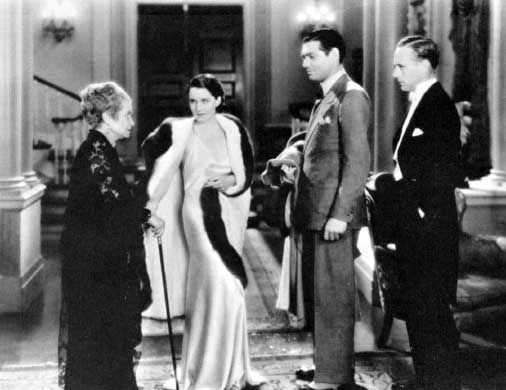
The movie starts out with a wedding, that of Elyot Chase (Robert Montgomery) getting married to Sibyl (Una Merkel). It's a fairly big British wedding. Cut to a second wedding, this one a much more modest affair in France, but betweeen two Britons, Victor Prynne (Reginald Denny) and Amanda (Norma Shearer), as though they're eloping. There's some fairly obvious foreshadowing here that the two couples are going to meet, even if you don't already know the plot.

After the two weddings, we cut to what is probably the French Riviera for the honeymoon. Elyot and Sibyl have booked a nice suite overlooking the Mediterranean, while Victor and Amanda have also booked a nice suite with a Mediterranean view. Again, you can guess that they're going to meet out on the terrace even if you didn't know anything about the plot or what to expect from a Noël Coward movie.

Victor and Elyot could probably get along together, and Sibyl and Amanda could probably also get along together. But there's one minor little problem. OK, it's not so minor. Elyot had previously been married to Amanda, and you can imagine not wanting to meet your ex-spouse on your honeymoon with your new spouse!

There's a bigger problem, however, which is that in some ways, Elyot and Amanda never really fell out of love. Or, they fell out of love but back into love repeatedly, with the divorce coming during one of those times when they were out of love. Now that the two have met each other again after a separation of some time, they realize that the old passion has returned, which really ought to create problems.

Technically, it does, as the two decide to run off with each other to enjoy a ski resort in the Swiss Alps. This time, they say, things are going to be different. Of course, that's not going to happen, and the couple is soon going to realize why they got divorced in the first place, as they start bickering in between bouts of falling back into love. But since they already got divorced once, you have to assume that they're going to reach the breaking point again.

Indeed they do, but this time things get more complicated in that while they're in separate bedrooms of a suite waiting the night out so that can part for good, Victor and Sibyl show up after having searched for the couple for some time. You can only imagine how awkward things are going to be in the morning after everybody wakes up....

I have to admit that I didn't particularly care for Private Lives, but at least I can understand why people who are fans of Noël Coward would enjoy the play in general and this version of it as well. To me, the dialogue came across as Coward thinking he was witter than he actually was, at least when he was writing this play. (Apparently, he originally wrote it for himself to be in the Elyot part, which he did on the stage.) There's a rapid-fire sense to the plot that even Howard Hawks would find impressive, although in my view it doesn't work as well as it does in a Hawks movie like His Girl Friday. I also found the characters irritating, as Elyot and Amanda's bickering quickly grew thin.

But there were also some plot difficulties that I had. I couldn't help but think that the play might be more interesting if Elyot and Amanda didn't run off when they first spotted each other in the adjoining suites, but instead found their old feelings coming back slowly over the course of the play while dealing with their current spouses. And then when Victor and Sibyl show up for the final act, I would have had them see the destruction Elyot and Amanda had wrought upon them and each other, and decided that Elyot and Amanda deserved each other while Victor and Sibyl can live happily ever after together.

Still, a lot of the IMDb reviews really like this movie, so I'm sure a lot of readers will probably enjoy it, too. Watch for yourself; the movie should be available from the Warner Archive although the TCM Shop has an odd tendency to claim some of the Warner Archive standalones are only available on backorder.

Friday, October 2, 2020

The Last of Mrs. Cheyney (1929)

Some months back TCM ran the 1929 movie version of The Last of Mrs. Cheyney. Knowing that I hadn't blogged about it before, I made it a point to DVR it so I could do a blog post on here.

Norma Shearer plays Fay Cheyney, a woman who is displaying all of the trappings of wealth although, as we soon learn, she's not really wealthy. Instead, she's gotten what wealth she has by stealing other people's jewels. She gets invited to a party being hosted by wealthy Mrs. Webley (Maude Turner Gordon), whom she met in Monte Carlo back when going to the Riviera for a season was a thing. So she brings her nominal butler Charles (George Barraud), who's really her partner in crime, to the party, with him supposedly being a society person too.

Mrs. Cheyney is very popular with the other guests, since she's claiming she's an Australian widow, something that I'm guessing would have been a bit uncommon in the England of the 1920s where this movie is set. Among the guests are Lord Dilling (Basil Rathbone) and the much older Lord Elton (Herbert Bunston), both of whom take a more romantic interest in Mrs. Cheyney, not realizing her true nature.

Lord Dilling is about to figure it out, however. He sees Charles and recognizes that Charles is somebody who had been caught out in Monte Carlo last season. If Charles is here with Mrs. Cheyney, it can obviously only mean one thing, which is that somebody is about to have their jewels stolen, and that Mrs. Cheyney is in on it.

So how to handle the situation discreetly, since this sort of British high society wouldn't be about to let the police make a public case of such things if they could avoid it? Lord Dilling decides he's going to confront Mrs. Cheyney alone. Except that he makes what might be a bit of a mistake in doing it in her private bedroom. If everybody were to find him there in the middle of the night, that too would be a bit of a scandal, at least among their social circle. And Mrs. Cheyney, not really being a part of that social circle, decides that perhaps she might just not care what happens to the rest of them socially.

Ultimately, it's revealed to the other guests that Mrs. Cheyney does in fact have Mrs. Webley's jewels, but returns them to her. There was still a robbery, though, and the party guests do think something might have to be done. Mrs. Cheyney still does have a trick up her sleeve, though. Lord Dilling recognized Charles from Monte Carlo, but it transpires that Dilling might not have been a perfect gentleman in Monte Carlo, and that allows a way out for everybody.

The Last of Mrs. Cheyney is an interesting movie for several reasons. One is that it's an early talkie, a genre that's known for having the technical issues of trying to get dialogue on film properly. While most of the scenes are set in the chambers of an English country house, I found the movie to be surprisingly not static. Now, it's certainly not as open as something like Norma Shearer's The Divorcee from the same year, but there are a lot of movies that I find more static.

The bigger problem, I think, is with the story, which seems to me as though it would have been old-fashioned even back in the mid-1920s. It's based on a play and the dialog feels rather stagebound. The plot is also a bit unrealistic. But at least the production code wasn't in effect yet, as I shudder to think of the constraints the movie would have been over if it had been in effect.

Then again, I don't really have to think. The movie was remade in 1937 with Joan Crawford as Mrs. Cheyney, and again in the early 1950s under the title The Law and the Lady starring Greer Garson. All three movies, having been made at MGM, are available on DVD courtesy of the Warner Archive, so one can see for oneself how the story was handled in different eras.

Wednesday, January 29, 2020

Smilin' Through (1932)


One of the TCM Spotlights in December was remakes, and one of the movies I hadn't mentioned here before is Smilin' Through, which has been done multiple times, although the one I DVRed was the 1932 talkie. (The sub-theme that day was movies with musical remakes, allowing TCM to show the 1941 version with Jeanette MacDonald and Nelson Eddy.)

Leslie Howard plays Sir John Carteret, who at the start of the movie is mourning the love of his life, a young woman named Moonyeen (Norma Shearer) who died tragically young many years earlier, back in 1868. We then see that she's a ghost, so there's some unresolved issue in her life/afterlife/death, however you wish to put it.

Cut to about 1897. Relatives Sir John hasn't seen in ages have died, and they left behind a young orphaned girl Kathleen. John takes her in, although he's continuing to mourn for Moonyeen. Fast forward many more years, to 1915, and Kathleen has grown up to be played as an adult by Norma Shearer, so of course John notices the similarity in Kathleen's and Moonyeen's appearance.

One day Kathleen is riding around and ends up at an abandoned estate where two friends show up: Kenneth Wayne (Fredric March), and his friend Willie. There's a war on over on the continent, and both of these young men are going to be fighting in it. But Kathleen falls in love with Kenneth anyway.

Unfortunately, there's a problem with her choice of romantic partners. When Sir John meets Kenneth, he realizes Kenneth looks exactly like his father Jeremy (also played by Fredric March). Jeremy was Sir John's romantic rival for Moonyeen, and when Moonyeen decided to marry John, Jeremy responded by killing Moonyeen on her wedding day. (It's more ironic than rain.)

This explains why Sir John has been so bitter all his life, and why he decides to be such a jerk to Kenneth and Kathleen. If Kenneth's father was a jerk, then Kenneth needs to be made to suffer for it, just so Sir John can be happy that he's utterly screwed somebody's life over. And if he has to screw his foster daughter too, oh well. Thankfully for everybody Kenneth goes off to France and suffers a serious injury that makes him not want to see Kathleen ever again because he stupidly thinks Kathleen is going to suffer by seeing him injured.

Smilin' Through might be a good movie, but it's not the sort of movie geared to somebody like me. It probably belongs on the Hallmark Channel or Lifetime Channel instead. The male characters had motivations that made me want to pull my hair out, while Shearer overacts shamelessly, going into ridiculous histrionics. People who want a romantic tear-jerker are going to love this one, as it does what it does quite well. It just wasn't my cup of tea.

So even more than some movies I don't like, Smilin' Through is definitely one that you need to watch for yourself and draw your own conclusions about.

Saturday, August 17, 2019

Not-so-delightful idiots

In July's TCM spotlight of movies from the year 1939, one of the movies they ran that I hadn't blogged about before is Idiot's Delight. So I decided to DVR it and sat down to watch it so I could do a post on it here.

The movie starts off with the end of World War I and soldiers returning home. Among those soldiers is Harry Van (Clark Gable), who had been working in vaudeville before the war. The war has changed things, and he's constantly bouncing from gig to gig, eventually winding up as the straight guy to phony psychic Madame Zuleika (Laura Hope Crews). One night in Omaha she gets drunk and the show goes south. Irene Fellara (Norma Shearer), an acrobat with a different act, figures out what's going on and after the show tells Harry that she wants to learn the secret of the act and be the psychic. Harry says no, and the two eventually go their separate ways.

Fast forward to 1939. Harry has continued to work a series of gigs, with his current one being the front man for a group of chorus girls called Les Blondes. They've been performing all over the place, and are now in the Balkans, returning back to western Europe. But the political situation in Europe is unstable; as we know World War II in Europe would begin in September of 1939. (The movie was actually released in 1939 and is based on a play that hit Broadway back in 1936.) So when the train gets to what would be roughly Slovenia in modern geography if it had been an independent country at the time, they're forced to stop because the borders are temporarily closed.

Harry, Les Blondes, and a bunch of other passengers are forced to wait in an Alpine resort hotel while the uncertain situation resolves itself. Among the passengers are the scientist Dr. Waldersee (Charles Coburn), who is doing cancer research on his rats; the newlyweds Mr. and Mrs. Cherry; pacifist Quillery (Burgess Meredith) who used to work in the arms industry; and Achille Weber (Edward Arnold), a titan of the armaments industry who has as his companion Russian exile Princess Irene [sic -- in Russian it would be spelled Irina]. Harry sees Irene, a platinum blonde, and realizes she's a dead ringer for the Irene he knew back in Omaha.

Harry tries to figure out whether Princess Irene is the same woman he had met all those years ago, while some of the other people have their own dramas of greater or lesser importance played out. Weber tries to send a bunch of telegrams, while Quillery eventually goes nuts and breaks up a performance of Les Blondes screaming about the upcoming war, not caring what the authorities are going to do to him.

Eventually, the border is reopened -- but Irene's passport is not in order. She had what was probably a Nansen passport, since her real birth location wasn't known and even if she were Russian she would likely not have been able to bring her passport with her when she escaped and it would have expired anyway. The problem with being forced to remain is that at the bottom of the hill where the hotel is, there's an air base where some of this country's air force has its planes. And they might well have started the war by carrying out an air raid.

I have to admit that I found Idiot's Delight to be a curious misfire. There's a whole lot of nothing going on for much of the movie, and frankly there's not much reason to care about any of the characters besides Harry and Irene. Irene in particular is irritating in the second half of the movie.

But there's also quite a bit interesting. One thing is that the fictional country where everybody is stranded uses Esperanto. (Apparently the original play used Italian and Italy objected when the movie was being made. And since they were still a market for Hollywood movies....) Another interesting thing was that Les Blondes (and Harry) perform Irving Berlin's "Puttin' on the Ritz", which still has the original lyrics about the hired help going back to Harlem on their night off and voguing. I was surprised to see an Irving Berlin song used like this, since I thought by this point he wanted complete control over how his music was being used, hence the whole creation of the movie Alexander's Ragtime Band.

The final thing of note is that MGM created two endings, one for Europe and one for the US. When TCM ran it, they showed the European ending. But after the closing titles, the print has a card pointing out there were two endings, and proceeds to show the American ending.

Idiot's Delight is available on DVD courtesy of the Warner Archive, if you want to watch it and judge for yourself.

Saturday, December 26, 2015

A Lady of Chance

I finally got around to watching A Lady of Chance, which I DVRed back at the beginning of November when Norma Shearer was TCM's Star of the Month. Thankfully, it's been released to DVD courtesy of the Warner Archive, so you can catch it any time you want.

Shearer plays Dolly, whom we first see working as a switchboard operator at a swanky big-city hotel. However, that is just a front for what she really does, which is wooing the rich guys who stop by the switchboard desk to ask for a number or place a long-distance call. She then intends to get money out of them, if not quite honestly. In fact, she's definitely quite a bit less than honest, as we learn when Brad (Lowell Sherman) and Gwen (Gwen Lee) come into the hotel. Brad used to be Dolly's partner in crime, back when she was going under the alias "Baby Face" (watch for a great process shot of her with her old Baby Face hairdo). Well, Brad figures that Dolly is angling to get a bunch of money from one of the rich men, and wants some of it for himself. So he blackmails her: she either involve him in her scheme, or he'll go to the police since she's violated her parole.

Needless to say, Dolly eventually decides to go along, if not without a little more "persuasion" from Brad. They bilk th eman out of $10,000, but Brad is just as honest as Dolly, giving the cash to Gwen to hide under the pillow, while telling Dolly that the man stopped payment on the check! She knows better, and beats Brad at his own game, snatching the money with a ploy of her own and running out on the two of them, getting out of town before the two of them realize what happened.

Cut to Atlantic City, which is where Dolly is now plying her trade. That's because there's a cement convention going on, and she figures there have to be some rich men at the convention. Sure enough, while at the telegraph stand, she spots a man named Steve Crandall (Johnny Mack Brown) writing a letter to his mother that he's looking to put through a million-dollar deal. Ah, here's a rich man! Dolly runs into him again and he's clearly smitten with her, it being love at first sight for him and just another job for her. Eventually he proposes marriage to her, which is how Dolly is going to get rich.

Except that she's not. They get back to his home town in Alabama and find out that he's living in a run-down house with a start-up business that hasn't actually made any big deals yet -- he's only invented a better type of cement and is hoping to sell the rights to manufacture it on a large scale. Dolly, realizing that she's not going to be rich, says that she's going to leave. But then she has a change of heart and actually returns home, much to Steve's surprise. Brad and Gwen don't realize either that Steve isn't rich or that Dolly actually does love him. They've tracked her down again, and plan to get some of the money that Steve doesn't have. Except that before Dolly can tell them Steve doesn't have the money, Steve comes home with the good news that he's sold the rights to his concrete for $100,000. So he's going to be rich after all; Brad and Gwen can bilk him; and dammit, they expect Dolly to be in on the act. But of course, she really does love him by now.

A Lady of Chance is a fun movie, if fairly predictable in its plot and with an ending that doesn't quite fit and leaves a gaping plot hole. Norma Shearer is good; Lowell Sherman is wonderful playing the sort of role that a Jack Carson might have had a decade later; and Johnny Mack Brown is extremely photogenic and does a good enough job with his aw-shucks character. All in all, there's not much to complain about here.

Tuesday, November 24, 2015

The final night of Norma Shearer

Today sees the final night of TCM's Star of the Month treatment for Norma Shearer, looking at the movies Shearer made after the death of her husband, MGM producer Irving Thalberg.

The night kicks off at 8:00 PM with Marie Antoinette, a movie that I've briefly mentioned a couple of times. MGM spared no expense in trying to make a movie that would give Shearer a triumphant comback, and that shows. The movie runs over two and a half hours and is filled with all the gloss that MGM was known for back then compared to the other studios. Who ever knew the French Revolution could look that good. I have to admit to not being the biggest fan of the movie, mostly because I find it bloated. It's one of those two and a half hour films that could really use some cutting down to get it under two hours, I think.

That's followed at 10:30 PM by The Women, which is unsurprisingly another movie I don't particularly care for. But then again, as a man I'm clearly not in the target demographic for this movie. There's a reason I've never particularly cared for movies like Random Harvest, either, or laughed at inappropriate times during Dark Victory.

I'm going to have to cop to never having seen Idiot's Delight before. That one comes on at 1:00 AM. Not having seen it, there's obviously not much I can say about it.

The only one of the night's movies I've blogged about before is Escape, at 3:00 AM. It's another movie that's interesting, but does show the MGM gloss on the issues of the day, in this case being that the Nazis were putting dissidents in concentration camps. It's the same issue I have with The Mortal Storm.

Norma Shearer's time as Star of the Month concludes with Her Cardboard Lover at 4:45 AM, and We Were Dancing at 6:30 AM.

Tuesday, November 10, 2015

Their Own Desire

Norma Shearer's turn as Star of the Month on TCM continues tonight with her early talkies. One I don't think I've ever mentioned here before is Their Own Desire, at 2:15 AM.

Shearer plays Lally Marlett, the sort of twentysomething woman who populates early talkies like this: carefree and born to wealthy parents (Belle Bennett and Lewis Stone). Her life seems happy, until one day when Dad suddenly comes home and tells his family that after many years of marriage, he's running off to marry Mrs. Cheever (Helene Millard). Lally, unsurprisingly, blames Dad entirely and she and Mom write Dad out of their lives.

Lally goes on being part of the wealthy set, however, which is where she meets Jack (Robert Montgomery). The two falls in love, because really, what woman in an early talkie isn't going to fall for a dashing young Robert Montgomery, who seems to have been born to play roles like this? They love eatch other, but there's a minor problem. Well, not all that minor. It turns out that Jack is Mrs. Cheever's son. Mrs. Marlett, as you can probably guess, is horrified at the idea that her daughter might run off with the son of the woman who took Mr. Marlett away from her. It's illogical since the affair wasn't Jack's fault, but it's the way human nature works.

There are histrionics, and Lally runs away from Jack to be by her mother's side, but the love that she feels for him can't keep her away from Jack too long. So after Mom recovers from the shock, Lally runs back off and elopes with Jack. They'll live happily ever after. Except that when they take Jack's boat out on Lake Michigan, a storm comes up and strands them on an island. Everybody thinks they're lost if not at sea, then at least at lake.

Their Own Desire is one of those very typical, at least to my thinking, early talkies. Melodramatic, and looking at the idle rich as though everybody really cares about them. (I always find it interesting when an establishing shot uses the "society" column in a newspaper.) It's not a bad movie, however; it's just very dated. Shearer and Montgomery aren't quite as good as they'd be a year later in The Divorcée and The Big House respectively, but Shearer was already an established star and Montgomery shows how capable he was going to be at playing the society types he'd spend a lot of the 1930s doing. It's also fun to watch Judge Hardy being the bad guy.

I think Their Own Desire has been released by the Warner Archive, but for a short early talkie like this, it's a bit pricey.

Tuesday, November 3, 2015

TCM Star of the Month November 2105: Norma Shearer

Now that we're in the first full week of a new month, it's time for a new Star of the Month on TCM, that being Norma Shearer, who was one of the first big female stars at MGM. I would have said that being married to the best producer on the lot, Irving Thalberg, helped, but in fact Shearer started her career before marrying him, and probably would have been a successful actress at the studio even if she hadn't married Thalberg. I suppose Joan Crawford might have gotten one or another of her roles in that case; if Crawford could do something like the 1931 version of Possessed I think she would have ben able to pull off a Shearer role like the one in A Free Soul without any problems.

The photo above is from A Free Soul, although that movie isn't airing until next Tuesday at 9:30 PM. This first evening of the Shearer salute sees four of her silents, ending at 12:45 AM with He Who Gets Slapped. Perhaps the most interesting movie of the night for me would be A Lady of Chance at 9:15 PM. This one sees Shearer playing a con artist who uses her feminine charms to get well-to-do men into jams and then walks off with their money. That is, until she falls in love with one of them (future cowboy star Johnny Mack Brown) who, it turns out, isn't wealthy at all.

Wednesday, May 22, 2013

The Divorcee

Back in August 2010, when Norma Shearer was one of the stars given a day of films in TCM's Summer Under the Stars, TCM ran The Divorcee, which I wrote deserved a full-length post of its own. TCM doesn't run The Divorcee all that often, but it's getting another airing tomorrow morning at 11:45 AM.

The movie starts off at a vacation house somewhere out in the country, where a bunch of wealthy twenty-somethings of the late 1920s have gathered for a party. It's not quite the free love of the 1960s, but it seems as if the romantic attachments between various members of the group could be fluid. Among the leaders of this set are Jerry (Norma Shearer), the vivacious lady every man wants to be with. Paul (Conrad Nagel) loves Jerry, but she eventually secides to marry Ted (Chester Morris), much to everybody's surprise. Paul, for his part, decides to marry another woman, and they all live happily ever after.... Or do they?

You should be able to figure out that they're not going to live happily ever after, at least not until the last reel of the film, if at all. Oh, this movie makes it look at first as though they're going ot live happily. After Jerry marries Ted, the movie fast forwards three years to their third anniversary, bu which point they're living in a wonderfully luxurious New York apartment, and still hanging out with much the same social circle, which is mostly organized by Ted's friend Don (Robert Montgomery). At a party for their anniversary, Jerry learns that Ted hasn't been entirely faithful to her. Jerry's rather more liberal than the Anne Baxter character in My Wife's Best Friend, but Jerry is still hurt by her husband's infidelity, even though he says it means nothing to her. Jerry decides she's going to get back at him.

She does so by going out with the other men in their social circle. But while it's perfectly OK for a man to sleep with other women, a woman who sleeps with other men is apparently a slut or something, even though a movie like The Divorcee released back in 1930 could never use such langauge. Not that this particular movie would use it even if it could; it's much too elegant for that. No; The Divorcee just makes its moral point by having Ted get righteously indignant over Jerry's infidelity because it's somehow different from his. The two get a divorce, and go their separate ways. Jerry goes to Paris, and eventually runs into Paul, who by this time is no longer happily married. So the two of them start up an affair, but you know there's no way it can work out in the long run....

There's something about The Divorcee that I find a bit, if not maddening, then at least not quite right. I'm not certain if it's the morals: The Divorcee certainly isn't accepting of the double standard, and yet the ending does seem to bring everything else Jerry did during the movie into question. There's nothing wrong with ambiguous morality, but here, the morals seem almos indecisive. Also, I get this feeling watching The Divorcee as though there's some action missing, as the movie jumps too quickly from the opening scenes in which Jerry and Ted decide to get married, to their third anniversary, to Jerry's carousing, to Jerry as divorcée. I get this impression that there needs to be something more holding everything together. I don't think it helps that, being an early talkie, you have a few scenes that look slow because of the technical constraints.

That's not to say The Divorcee isn't a good movie. It's excellent, down almost entirely to Norma Shearer's performance. She's the constant center of attention, and deservedly so, as for most of the movie her character's motivations are perfectly understandable, up until that ending. The supporting cast is good, with Robert Montgomery standing out a bit more than the others playing a role that presages all those elegant gentlemen he played throughout the 1930s. The Divorcee received a DVD release on one of Warner's pre-Code box sets, so even though TCM doesn't show it all that often, you can still watch it whenever you want.

Tuesday, April 6, 2010

The Piña Colada Movie

Robert Taylor is TCM's new Star of the Month for April 2010. His movies are airing in 24-hour blocks starting in prime time on Tuesdays. One of this week's lesser-known selections that's worth a look is Escape, airing tomorrow morning at 7:45 AM ET.

Taylor plays Mark Preysing, an American man whose mother had grown up in Germany and emigrated to America. However, some time before the movie opens, she returned to Germany to sell the old family house. However, Mark stopped hearing from Ma, and he's worried about what happened to her. You see, this is Nazi Germany, where people just disappear (well, a bit more on that later). So, Mark shows up in Germany looking for anybody who might have any information on his mother.

This being Nazi Germany, everybody is reluctant to help him, because they don't want to wind up disappeared themselves. That is, until he meets Countess von Treck (played by Norma Shearer, who gets top billing). She's an American who had come to Germany before the Nazi takeover out of love, having married one of the old Counts. He's since died, and she's a widow, running a school for girls. Mark doesn't understand why she stayed behind when all of these nasty Nazis are running the place, but it turns out that she's fallen in love with one of them, General von Kolb (perennial Nazi Conrad Veidt). Mark has already dealt with this singularly unhelpful Nazi, who clearly knows more than he's letting on.

And that more is that Mark's mother (played by former silent screen star Alla Nazimova) is in one of the concentration camps, awaiting execution. Once we viewers learn this fact, it's fairly predictable where the plot is going to go: Mark is eventually going to fall in love with the Countess, and try to convince her to double-cross the General in order to help Mark's mother escape. Meanwhile, one of the Countess' girl students is going to try to double-cross her, by snitching and telling the Nazis what's going on. All this will be followed by the escape, where our heroes will narrowly miss getting captured by the Nazis.

Predictable, except for the fact that the movie even got made in the first place. Escape was released in 1940, well over a year before the Japanese attack on Pearl Harbor pushed the US into World War II, and a time when isolationist sentiment still ran quite strong in the US. Escape was based on a book, but while freedom of the press ensured that people could write novels about whatever, the freedom of Hollywood was nowhere near as guaranteed. As I mentioned back in May, 2008, there were people in Congress concerned that Hollywood was trying to push America into the war, enough so to the point that they eventually opened an investigation. The other surprising thing is that Escape was made at MGM. Yes, they also made The Mortal Storm, but this sort of socially conscious movie had generally been the province of Warner Bros.

Escape isn't on DVD, so if you like piña coladas and getting caught in the rain, you'll have to watch TCM's showing.

Thursday, February 18, 2010

A Free Soul

It may not be Lionel Barrymore's best performance, but it's the one that won him an Oscar: that of alcoholic defense attorney Stephen Ashe in A Free Soul, airing at 9:45 PM ET tonight.

The movie starts off quite provocatively, with the lawyer wondering how his daughter Jan (Norma Shearer) can fit into some flimsy clothing. It turns out that while they have a close relationship, he's the black sheep of the family, due to his heavy drinking and the fact he has no qualms defending gangsters, while her bohemian nature hasn't won her too much sympath, either. Indeed, that work gets him in trouble when, at what is supposed to be a dinner for Jan and her fiancé Dwight (Leslie Howard), Stephen shows up with the notorious gangster Ace Wilfong (Clark Gable, in the role that made him a star), having just gotten Ace off a murder rap.

It's fairly easy to figure out what happens next: Jan finds Ace exciting, especially compared to the strait-laced Dwight, and runs off with him. This won't do for anybody, as Stephen at least has some morals, realizing that Ace is not the right man for his daughter. So, he makes a deal with her: he'll stop drinking, if she promises to stop cavorting with Ace Wilfong. The two go to the mountains to get their respective vices out of their systems. And, it works for a while, until Stephen starts drinking again, at which point Jan decides to go back to Ace. But he's not so good to her any more, and she finds that when she wants to break away from him, he's not about to let her....

The conflict is resolved by poor milquetoast Dwight. Having lost his girl, he feels he has nothing to live for, sohe gets a gun and shoots poor Ace in cold blood. This was Hollywood in 1931. A few years later the Production Code would be strictly enforced, and Dwight would be forced to pay for his sins, with no doubt about it. However, at this time, it was still theoretically possible to get away with murder, and the writers give Dwight an unrealistic self-defense alibi that ought not hold up in a real court of law. And it shouldn't hold up in A Free Soul either -- unless Stephen can make the case for Dwight. Of course, Stephen is a drunk again, and defending Dwight may just kill him.

It's the climactic courtroom scene in which Barrymore defends Howard (and, by extension, his daughter's honor) that won him the Oscar. Norma Shearer was also nominated, although she had won the previous year for The Divorcee. Perhaps the Academy didn't want to award the same person the Oscar in back-to-back years and, fortunately for them, they had another outstanding performance they could award, that of Marie Dressler in Min and Bill. (That's Dressler standing next to Barrymore, each of them holding their Oscars.) Barrymore's and Shearer's acting may seem a bit florid today, but the movie is still worth watching, especially for Gable's performance. It's been released to DVD, as part of one of the Forbidden Hollywood boxsets of pre-Code movies.

(When I wrote about Min and Bill back in August 2008, it had not yet been released to DVD. However, TCM has since put it out as part of the TCM Vault Collection.)