Showing posts with label Rosalind Russell. Show all posts

Sunday, August 16, 2026

What a Woman!

Tomorrow, August 17, is given over to the films of Rosalind Russell as part of TCM's Summer Under the Stars. If I had known this ahead of time, I would have scheduled my post on Roughly Speaking to show up here, since it's airing at 4:15 PM. Instead, I'll post about another of Russell's films that TCM aired around the same time as the last showing of Roughly Speaking but is not getting an airing during Summer Under the Stars: What a Woman!.

The movie opens with the great success of a novel called Whirlwind, a notoriously steamy and scandalous historical romance novel written by an author named Anthony Street. At least, that's the author's pen name; Street doesn't want anyone to know his real identity for professional reasons. At Knickerbocker magazine, they want to cash in on the success of Whirlwind, but there isn't any way they can possibly get an interview with Anthony Street. So the next best thing is decided, which is to write about something and someone tangentially related to Whirlwind.

The book has been optioned for a movie, and Carol Ainsley (Rosalind Rusell) is the agent who has been doing the liaison work between the publisher and the studio to make certain the adaptation goes off well and is a success for all involved. Knickerbocker magazine sends one of their reporters, Henry Pepper (Brian Aherne) to get an interview with Ainsley and do a puff piece on her which really ought to be good publicity for her as well as everybody involved with the adaptation. There is, however, a snag with that adaptation: Hollywood feels it can't find anybody currently in Hollywood who's suitable to play the part of the male lead.

Carol, as the woman who's the go-between between Hollywood and the publisher, so technically also the writer, has access to information on who the real Anthony Street is, although she's supposed to avoid using it if at all possible. But she feels she has to, and she finds out that Anthony Street is actually a professor at Buxton College, one of those small liberal arts colleges that populated Hollywood movies of the era. Carol sets off for Buxton, PA. Henry, who by now is acting a lot like the Melvyn Douglas character in Theodora Goes Wild, gets wind of Carol's travels and follows Carol to Pennsylvania and starts acting obnoxious enough that you wonder why anybody would like him.

As for "Anthony Street, he's really college professor Michael Cobb (Willard Parker), who teaches a course on Elizabethan literature and most definitely doesn't want it known that he wrote the novel. Indeed, his boss is shocked and not entirely happy to find it out. Worse, Carol realizes that Cobb based the physical description of the male lead on himself, and that he would be the perfect person to play that character in the movie, which one supposes would also make a great human interest story. Carol convinces Cobb to come to New York with her and make preparations to train in acting.

Meanwhile, Cobb acts like he's falling in love with Carol, which further complicates the story and sends it to a place where it really starts to lose steam, unfortunately. Cobb, as it turns out, isn't much of an actor, but by now there's too much invested in the movie for him to back out. Henry is still around, continuing to be an obnoxious snoop. Cobb pursues Carol even though she's not certain she wants to marry him, never having been the marrying kind. Eventually the movie gets to the Washington, DC, mansion of Carol's senator father for the finale, which is another plot twist that makes the movie lose steam.

I didn't exactly hate What a Woman!, but it's definitely a movie that's got its fair share of script issues. It was released in late 1943, so at the height of World War II. I can imagine audiences of the day wanting the sort of romantic escapism the movie provides. Eighty years on, however, the characters are a bit too unrealistic for any of this to work well. Besides, everything could have been handled with a Zoom chat and Carol would have been able to prevent Henry find finding out the author's real identity.

Wednesday, June 3, 2026

Roughly Speaking

Tomorrow, June 4, is the birth anniversary of actress Rosalind Russell, so it's unsurprising that TCM is going to be spending a morning and afternoon with her films. One that I hadn't seen before but that was on my DVR was Roughly Speaking, so as is always the case, I watched it in order to be able to write up this post for the upcoming TCM showing.

The opening credits inform us that the movie is based on the then-popular autobiographical memoir of the same title, Roughly Speaking, but author Louise Randall Pierson, who also wrote the screenplay and was credited as a technical advisor on the movie. Fast backward to 1902. Louise Randall (to be played as an adult by Rosalind Russell) is the younger daughter of John Chase Randall (Ray Collins), who unfortunately has just up and died a few weeks after his 25th anniversary leaving behind a wife and two adolescent daughters. Worse, he also leaves behind a mountain of debt, which forces Mom to sell off most of the family's remaining assets and the family to downsize rather severely.

Dad wanted Louise to get an education and shoot for the stars, but this is New Englans in the early 1900s, so Louise goes off to "business school", the sort of place that taught young women to become typists and other secretarial work, something that Louise takes very well to. She gets a probationary job (Alan Hale in a one-scene cameo is her boss) which is a springboard to a nicer position in New Haven, the home of Yale University. There's the possibility of finding a nice Yalie to get married to!

Sure enough, Louise meets nice Rodney Crane (Donald Woods), who is hoping to go into a career in finance as his father was a bank officer. The two have a whirlwind romance and get married, with Louise rather progressively for the time keeping her name. The two live happily, although not ever after. The couple have four kids before World War I comes along. After that comes the family moving out to the suburbs, only for the kids to get polio to varying degrees. Louise remains impossibly perky through all of this. So perky, in fact, that when Rodney loses his job in the post-war recession, it's then that he's had it with Louise's optimism, leaving for another woman. Louise is the one to seek a divorce, which is on rather amiable terms, and Rodney is never to be seen again.

In any case, Louise is able to find another man in the form of Harold Pierson (Jack Carson). Harold is the playboy son of a horticultural magnate; technically he works as a vice-president for Dad's rose greenhouses but he's never going to advance any further. Harold and Louise are a perfect match in that they'll always love each other for richer or for poorer, but with their personalities leading to it always being for poorer. They have another kid (future Oscar-winning screenwriter Frank Pierson), and go through a series of ups and downs. Harold builds his own greenhouses just in time to flood the market to such an extent that they can't pay the mortgages. He then gets a job promoting a new airplane (character actor John Qualen is the designer), again just in time for the Depression to hit.

Still the couple perseveres, until the New York World's Fair of 1939 arrives and presents another opportunity. Except that in the middle of the fair, Germany attacks Poland, leading to the start of the European theater of World War II and the US getting involved a few years later. By this time there are three adult male children for Louise, and since the movie was released in 1945, you know the kids are all going to do their parts....

Roughly Speaking is another of those movies that is episodic in nature and relies much more on the strength of the actors than on the story itself. Unsurprisingly, with Roz Russell and Jack Carson you know that the stars will indeed pull it off. It also has the feel of something that was designed to be a morale-builder. It was released in January 1945, with World War II still raging. The story of a woman who suffered a whole bunch of personal setbacks and persevered is one that I can imagine would have resonated with audiences, capped with her making the sacrifice of seeing her kids go off to war.

Doing a bit of reading, it's interesting to see what liberties were taken with real life, but that's not such a big deal considering that's standard practice and for audiences 80 years on one can easily look at Roughly Speaking as though it weren't in fact about real people. It's a great example of the sort of entertainment Hollywood served up for the home front during World War II, and one you should take the chance to see.

Thursday, January 29, 2026

Reckless

Another of the movies that TCM ran during Mickey Rooney's turn as TCM's Star of the Month because it had a small juvenile role for Rooney is Reckless.

Rooney is obviously not the star here; he only gets about one scene. The male lead is William Powell. Powell plays Ned Riley, a professional gambler and promoter. As the movie opens, an old lady is coming out of his office. That's Granny (May Robson), who is not Ned's grandmother but the grandmother of Broadway star Mona Leslie (Jean Harlow), who at this point is as well known for the antics she's getting into off-stage as well as what she does on stage. Granny is there to ask for Ned's help in getting Mona bailed out of jail. We also learn that Ned has known Mona since she was a kid, and has done some behind-the-scenes help in making Mona famous.

Ned is able to get Mona out of jail under extenuating circumstances, which is that she leave to go to a theater where she's going to perform a charity function. That's a ruse, but not on Ned's part. Insted, the "charity" in question is the "Society for the Admiration of Mona Leslie", which has one member: Bob Harrison (Franchot Tone). Bob is one of those idle rich playboys whose using his wealth in all the wrong ways, much to the consternation of his father (Henry Stephenson). Even though Ned has secretly always loved Mona, he's not going to try to stop Bob from pursuing Mona. Bob keeps taking Mona out on his yacht, and the two have nice times together. Ned finally works up the courage to tell Mona how he really feels about her, only to find out that she's fallen asleep.

And then Bob and Mona get incredibly drunk and run out of town to get married somewhere where nobody will find them, except that of course the press does find them as well as a bunch of Bob's friends and family who send them telegrams, including one from a Jo. The new couple rushes back to the Harrison home, where Mona meets Jo (Rosalind Russell). Jo has been Bob's nominal fiancée for quite some time, but it feels like another of those upper-crust relationships where the older generation just knows which families should be brought together for the next marriage. Bob likes Jo as a friend, and Jo is a decent person who likes Mona. (Mona, for her part, is trying to be a decent person, although her reputation precedes her.)

At this point, the movie really starts taking a turn. Jo gets married, Bob gets drunk enough to start thinking that perhaps he should have married Jo all along, and Mona finds out that Bob's been letting this on to Jo. She's also gotten pregnant with Bob's kid. Eventually, a drunk Bob winds up in Ned's hotel apartment, finds Ned's gun, and shoots himself in a way that everybody in the public thinks Mona is responsible, to the point that she should be forced to give custody of the kid to the Harrisons.

Reckless is an odd little movie because of the way it changes tone in the middle of the movie from what seems like a light romantic triangle comedy into a fairly ridiculous melodrama. A lot of people have criticized the casting of Jean Harlow as not being right for the role, and Harlow herself wasn't sure. Harlow does her best, as do everybody else. And the problems with Reckless aren't really because of the casting of Harlow. Instead, I think the problems it has are down to the script, which really is a mess as it veers from one act of the plot to the next. The comic parts are better than the melodrama, with May Robson shining.

Still, Reckless is interesting to watch to see as the sort of misfire a studio could have when it used its contract players in the wrong way.

Sunday, February 23, 2025

Mourning Becomes Electra

I mentioned back in November that TCM had a double-feature of Rosalind Russell movies I hadn't seen before. One of them was the movie version of Eugene O'Neill's play Mourning Becomes Electra, which I finally got around to watching.

The movie, like the play, is divided into three parts. The first, called Homecoming, is set in April 1865. In a small town in New England, news is reaching the locals that it looks as though the Civil War is finally about to end, although news of Lee's surrender hasn't been made official. The town is dominated by the Mannons, although all of them are out of town. Patriarch Ezra (Raymond Massey) and son Orin (Michael Redgrave) have been off fighting, while mom Christine (Katina Paxinou) and daughter Lavinia (Rosalind Russell) are both off in New York, although not together. Tending the house is groundskeeper Seth (Henry Hull), who serves as a sort of Greek chorus for this tragedy, giving a bit of backstory to some locals who have never been in the house because the Mannons have a complicated relationship and keep outsiders out as much as possible.

In New York, Lavinia spies on Mom, and follows her to the house of ship's captain Adam Brant (Leo Genn). Worse, Lavinia sees Mom kiss Adam. This pisses Lavinia off, in part because Mom's being unfaithful, but also in part because Lavinia herself has the hots for Adam. Further complicating things is a legend that Adam is actually a cousin to Lavinia: Ezra's brother ran off with the nurse ages ago, leading Ezra to destroy the previous iteration of the Mannon house and build a magnificent new one. Adam would be the now adult child of that relationship. Meanwhile, Lavinia's got another man pursuing her in the form of Peter Niles (Kirk Douglas). He's been in love with Lavinia, and his sister Hazel (Nancy Coleman) has been interested in Orin. But Lavinia wanted to put off marriage until she knows that Peter would survive the war.

Dad and brother Orin eventually return from the war, although Dad is in many ways a broken man. He's already getting up there in years considering how he's already got two adult children and he's reaching the age where it's not uncommon for a man to suffer a fatal heart attack, especially if he's spent four years fighting a stressful war. Lavinia knows about Mom's dalliance with Brant, and knows that if Dad learns about it, it will kill him. Worse, Mom is becoming the vindictive sort of person who would tell the husband she hates about this affair just so it will kill him and leave Mom free to marry Brant. And if that doesn't do it, Mom can always try to get some poison that will do the job.

Unbelievable, all of this drama happens just in The Homecoming. We're an hour into the movie, and we've got two more sections to deal with. The Hunted deals with the aftermath of the death of the patriarch. Orin doesn't seem ready to take over the family, especially considering the sort of relationship he had with his mother. He too wouldn't be able to deal with learning about Mom's relationship with Adam. Lavinia tries to turn Orin against Mom by making him see that Mom has been having that affair with Adam, while Christine tries to turn him against his own sister by claiming to him that Lavinia is going insane. And then comes The Haunted. By now, Mom has died, too, but Orin and Lavinia can't escape their respective pasts.

I've never seen the stage version of Mourning Becomes Electra, which as I understand goes on even longer than the movie version, which is long at 159 minutes. At least, it's 159 minutes in the print TCM ran. Supposedly the original cut was even longer (which would make sense if the play was longer), and that got edited down to under two hours for American audiences with the British still getting the 159-minute version. In any case, it's a slog. It's easy to see why the movie was a box office failure.

However, Rosalind Russell gives a fine performance and picked up an Oscar nomination, as did Michael Redgrave. Kirk Douglas was just starting out at this point; I think this is even before Out of the Past. So he doesn't have all that much to do, although he shows he's a more than capable actor. It's just a shame that nobody could figure out how to edit the material down into something that would work if conceived as a two-hour film.

Monday, December 2, 2024

Catholic boy meets Catholic girl

Another of the movies that I have on my DVR which is getting another airing soon on TCM is A Majority of One. That next airing comes up tomorrow, December 3, at 10:00 AM.

In late 1950s brooklyn, Bertha Jacoby (Rosalind Russell) is a Jewish widow living in Brooklyn and displaying all of the stereotypes Hollywood had about Jewish mothers in those days. Her husband died some time back while her adult son was killed in action in the Pacific theater of World War II. She's got an adult daughter, Alice (Madlyn Rhue), who is married to Jerry Black (Ray Danton); he works for the US Foreign Service.

Jerry's job has the young couple moving from country to country as US foreign service officers do, and he's just about to get a new posting: to Japan, where he's going to be serving as a junior member of a committee negotiating a major trade deal with Japanese industrialists. Now that Jerry's mother-in-law is getting up in years, he and Alice suggest that she come along to the young couple with Japan. In the 2020s this would make no sense since Bertha can clearly support herself, but the past is, as they say, a foreign country.

The three fly to the west coast and then take a boat for the voyage across the Pacific. Among the fellow passengers on the boat is Koichi Asano (Alec Guinness). He's a Japanese businessman who meets Bertha and her family, and enjoys Bertha's company. Except that there's a catch, which is that Bertha still has a major issue with the Japanese, what with them being responsible in her mind for her son's death. Then again, Koichi lost his daughter when the Americans dropped that atomic bomb on Hiroshima, so the two are equal, in a way. A bigger problem, however, is for Jerry and Alice. Bertha doesn't work for the foreign service, so she may not be aware of how taking gifts from someone you'll be doing business with might be an issue. Bertha doesn't think anything of Koichi's kindess, but Jerry sees the possibility of Koichi trying to influence the negotations as Koichi is one of Japan's bigger industrialists.

So Bertha drops all contact with Koichi and arrives to Japan a very lonely woman since she doesn't know the language or the culture, and has no reason to be going out to diplomatic functions the way Alice would at least. And then things get far worse when the negotiations on that trade treaty go south and Koichi intimates that Jerry is responsible for the failure of this. Eventually, Bertha realizes that she has to try to put things right again in the name of international frienship.

Her gesture works in one way, but in another produces an even bigger personal problem. Koichi and Bertha like each other enough that Koichi is willing to suggest that the two "keep company" together, which is a euphemism for the first steps toward a marriage proposal. That seems utterly out of the blue, and Jerry and Alice are shocked, because this sort of cross-cultural relationship just isn't going to work, is it?

A lot will have been written in more recent reviews of A Majority of One of the utter horror of having a British man like Alec Guinness playing a Japanese man: yellowface, and all that. Perhaps the screenwriter (Leonard Spiegelglass, based on his stage play) could have written Koichi as the son of a Japanese diplomat who married a western while posted abroad; think Carroll Baker in Bridge to the Sun, which was based on a true story. Surprisingly, much less mention -- and certainly not offense -- is given to one of Hollywood's old arch-Catholics playing the Jewish mother.

In any case, the problems I had with A Majority of One weren't because of the casting, but more down to the writing. The issue that causes the whole diplomatic rift between Koichi and Jerry turns out to be something unrealistically petty. And Koichi and Bertha fall for each other much too quickly. Another problem is that the movie is much too long at 148 minutes; it probably should have been trimmed by a good 40 minutes or so as it's way too slow.

A Majority of One may be interesting as a period piece, but it's not a terribly great movie.

Friday, November 1, 2024

The Velvet Touch

Some months back, TCM aired a couple of Rosalind Russell movies in quick succession. I'd heard about Mourning Becomes Electra before, but don't think I've ever watched it, so I'm hoping to get around to doing that at some point. The other film was a new to me movie called The Velvet Touch. Not having heard of it, I decided to watch that one first.

The movie opens with one of those panning shots of New York City from above which, as is so often the case, winds up focusing on midtown Manhattan. Also unsurprising is that the focus goes to the Great White Way, because studio-era Hollywood loved itself movies about the theater. The theater is the Dunning Theater, where producer Gordon Dunning (Leon Ames) has been putting on the latest in a series of comedies starring Valerie Stanton (Rosalind Russell).

After the performance, Valerie goes upstairs to Gordon's office to have a serious talk with him. Comedies have made Stanton a star, but she wants to prove that she can really act, and so is looking to do a drama like a revival of Hedda Gabler. So when the newspaper reports have come out saying that she's going to do another comedy, reports fed to the papers by Gordon, she's pissed. Not only that, but Valerie has fallen in love with one Michael Morrell (Leo Genn) and is planning to marry him. It turns out that Valerie and Gordon previously had a romantic relationship of their own, and that Gordon is extremely jealous over the idea of Valerie's breaking that off. So jealous, in fact, that he says he'll tell Michael all sorts of nasty gossip that will make Michael never want to see Valerie again. When she tries to leave and Gordon tries to restrain her, she picks up a statuette and hits Gordon over the head with it. He falls to the floor, very much dead.

Now, this is where The Velvet Touch has a big problem. The Production Code is out there, and this isn't one of those cases where there's a struggle for a gun and the victim shoots himself. Valerie could try to claim self-defense, but good luck getting a jury to believe that. More likely is a manslaughter conviction ruining her career, and the Production Code says the killer must be punished. Plus, we're only a couple of minutes into the film. But in any case, Valerie is able to get out of the theater undetected and get home. It's up to Valerie's estranged costar in the play, Marian Webster (Claire Trevor), to find the body.

The papers have the reports of Dunning's death the next morning, and even though Valerie already knows about it, she acts hysterically (well, she is an actress) and has a flashback about everything that led up to the killing. And that's the second problem with the movie, that the flashback is an overused device and in this case only runs about a third of the movie before we catch up to the present.

Back on the morning after the killing, police detective Danbury (Sydney Greenstreet) shows up at the theater to interview everybody. In a group, not separately, which I'd think is a big mistake because this lets the suspects conspire to prevent Danbury from finding out the truth if that's what the suspects want to do. The only person who doesn't show up is Marian, and that's because she's gone into hysterics herself and has been hospitalized. She's also the obvious suspect to Danbury, but we know what really happened. The one bright spot here, I suppose, is that at the theater Danbury is given a very small wooden folding chair to sit in, and the joke is whether or not it's going to support his rather ample weight.

The Velvet Touch is another of those movies where you can see why the people involved in making it would have wanted to be involved, as the story has so much potential. But unfortunately, it winds up being a lot less than the sum of its parts.

Tuesday, September 7, 2021

Gypsy

A couple of months back, TCM ran the movie musical Gypsy. Realizing that I had never done a blog post on it, I made a point of recording it so that some day I could get around to watching it and doing a post on it. I finally did watch it, so here's the post.

The title Gypsy, of course, refers to Gypsy Rose Lee (1911-1970; played as an adult by Natalie Wood), famous for he striptease act. But we don't get any of that until almost the end of the movie. She was born Rose Louise Hovick (called Louise for most of the movie), with a sister June (who in real life became June Havoc). Her mother Rose (Rosalind Russell) had worked vaudeville and was now a single mother with a bunch of ex-husbands, so she's trying to push her two kids into vaudeville. Well, mostly Baby June since she's the one Mom thinks has talent.

An audition run by Herbie Sommers (Karl Malden) goes badly, with Herbie basically walking out on the producer and taking the show on the road, as it were, with the Hovicks. Mom comes up with an idea that has them and a bunch of boys be a child act, but of course they're all going to grow up and the depression is going to come, which is what ultimately kills vaudeville. Mom tries every trick in the book to get bookings for the act, and is also an incredibly pushy stage mother, who seems to care more about the kids' performing than the kids themselves do.

Eventually, they reach the end of the line. The boys are grown up and haven't been paid regularly. One of them has fallen in love with June and the two elope, planning to quit the act, leaving just Rose, Louise, and Herbie. Mom starts all over again, hiring a bunch of no-talent girls to be the new act, and putting Louise in the starring role, even though she doesn't seem to have anywhere near the talent that June had.

Louise's transition to Gypsy comes when Herbie gets the act a booking in Wichita. Only, it's not a vaudeville house but a burlesque house, with the Hovick act, now the Hollywood Blondes, being booked to be the "clean" entertainment between acts, much like Maureen O'Hara in Dance, Girl, Dance or the Britt Ekland character in The Night They Raided Minsky's (in fact, Minsky's Burlesque does get a brief mention in Gypsy). However, Mom is extremely unhappy with this. When circumstances conspire such that the owner needs somebody to do the "striptease" in a pinch, Louise volunteers and becomes Gypsy Rose Lee.

In a montage of her doing her number in a bunch of places, Gypsy becomes successful, enough so that Mom decides to look her up, although that might cause quite a bit of tension.

I think that fans of musicals will probably enjoy Gypsy, while other people will enjoy it somewhat less. Rosalind Russell plays Mama Rose as so obnoxiously pushy that for me she became grating. Wood does well, and Malden provides pretty good support in what I found to be a relatively thankless role. But for me it was the musical numbers, which are of course old-fashioned since the movie is set in the 1920s and 30s, that didn't work for me. I also felt the whole striptease montage was a copout. (I've never seen the stage musical, so I don't know how it's handled there.)

Still, Gypsy shows all the pizzazz that Hollywood studios would try to bring in the 1960s to what was becoming a dying genre, which also makes it a bit of an interesting artifact. It's just one that can be a bit of a slog at times.

Monday, August 9, 2021

Toxic femininity

Hollywood made a lot of movies with idle rich women in the 1930s. How grounded in reality the are or aren't is an interesting topic for discussion, but in any case the genre probably reached its peak with the 1939 movie The Women.

Norma Shearer is the innocent little deer in the headlights, playing Mary Haines, a woman happily married to Steven, who is unseen because the movie's gimmick is that every part in the movie is played by a woman, even the animals as studio publicity back in 1939 would have had you believe. Not even Grant Mitchell, who was in seemingly every other movie Hollywood made in the 1930s, shows up here. But we don't see Mary first. Instead, we see a high-end beauty salon where women go with their little murse dogs and get everything from haircuts to mud baths to exercise on 1930s equipment. They also gossip incessantly, and the latest bit of gossip is that Stephen Haines is seeing a shop girl, Crystal Allen (Joan Crawford).

Mary's cousin Sylvia (Rosalind Russell), also married, is catty, and decides to make certain the gossip spreads in a way that Mary is bound to hear it, ultimately getting Mary to go to the same salon and see the same manicurist from whom Sylvia heard the juicy gossip. Wow what a piece of work. Mary's mom (Lucile Watson), the one sensible woman in the movie, advises Mary to do nothing but wait and eventually Stephen will stop straying. If he really is, I don't know that that would be the best advice, but I'm not the person to ask for advice on matters of romance anyway. In any case, the two go to Bermuda for a vacation.

Things haven't changed much when Mary gets back, and at a fashion show, she finally meets Crystal and finds out that the rumors of Crystal and Stephen's seeing each other are true. It winds up in the gossip columns (although the one scene where it's on the front page seems thoroughly unrealistic). This is what finally gets Mary to decide she's going to go to Reno and get a divorce, much to the sorrow of her daughter also named Mary (Virginia Weidler).

Mary goes to a place in Reno that's specifically set up for women looking to get a divorce, letting them stay there until the divorce goes through, and run by straight-talking Lucy (Marjorie Main). Also there are Countess (Mary Boland), who goes through one husband after another; a chorus girl Miriam (Paulette Goddard); and, surprisingly, Mary's good friend Peggy (Joan Fontaine). Even more surprising is that Sylvia eventually shows up, and it turns out that Sylvia's husband is planning to get married to a chorus girl... who just happens to be Miriam.

Eventually Mary's divorce goes through and she seems to be reasonably happy living the single life with her mom and daughter. Crystal seems happy too, but daughter Mary is mighty unhappy and passive-aggressive toward her step-mother. Clearly she's learned from all the other adult women in her life.

There's a lot to like about The Women, but there are also things that aren't going to appeal to everybody. Anybody who's had to put up with other people's gossip in real life knows that it's exhausting, and do you really want to spend 130 minutes watching a fictionalized version of it? There's certainly quite a few moments of comedy here, and the performances are all well done, but part of me wanted to shake these women the way Bette Davis does to Miriam Hopkins in Old Acquaintance and tell them to shut up already. They're not nearly as clever as they think they are.

Still, because of the movie's reputation, The Women is a movie that definitely ought to be watched by anybody who's a fan of old movies.

Wednesday, June 23, 2021

Live, Love, and Learn

Robert Montgomery did a lot of breezy comedies and other light programmers in his 1930s days at MGM. So some of them get lost in the shuffle because they're like some of the others. A good example of this is Live, Love, and Learn.

Montgomery plays Bob Graham, a starving artist who at the start of the movie is somehwere out in the country, set up next to a stone wall and painting a landscape. Suddenly, a whole bunch of horsemen come jumping over the wall, obviously on a fox hunt, forcing Bob to keep ducking his head so that he doesn't get hit by any of the horses. The last person to jump over the wall is Julie Stoddard (Rosalind Russell), who doesn't make it, getting thrown from her horse and eventually going right through Bob's canvas, understandably ticking Bob off.

So what does Bob do? In the very next scene, we see him and Julie at a justice of the peace getting married! Bob keeps acting as though he's not really going to go through with it, but of course he does, and almost immediately after the wedding ceremony the two are on their way back to Bob's walk-up apartment in the starving artist part of town; Julie seemingly happy with all of this because she doesn't necessarily want the family money.

Not long after getting to the apartment, the couple is interrupted by Oscar (Robert Benchley), a thoroughly obnoxious drunk which probably wasn't that much of a stretch for Benchley to be playing. Oscar apparently kinda-sorta lived in the apartment with Bob or some such, as Bob seems to be quite used to Oscar, and Julie for whatever reason doesn't mind this either. But there's the question of how they're going to pay the bills.

Bob goes out to paint in the park, and a couple of Navy guys don't care for Bob's painting. There are some guys from the Army, however, who like it, and this sets off a fight among the servicemen that makes the front page of the newspapers and brings a bunch of them to Bob's apartment. Not that he wants to talk to any of them, especially once they start lying and passing themselves off as art dealers. Among them is Mr. Bawltitude (Monty Woolley), who actually does own an art gallery but is treated horribly by Bob, Julie, and Oscar because they understandably think he's yet another journalist in disguise.

When they discover that Bawltitude really does on a gallery and can set up a showing for Bob, it opens doors for him that Julie doesn't particularly care to have opened. Bob is able to make enough money to support Julie and not be a starving artist any longer, but Julie thinks that this is going to cause Bob to lose what he had in his character that made him so much fun to be with in the first place.

To me there were a lot of standard tropes in Live, Love, and Learn, and the way they were put together didn't really gel all that well. It's even less understandable why these two got married than in other screwball comedies, for starters. Oscar is a really irritating character and why Julie is OK with him makes no sense. And half the time it tries to be too dramatic, with it never being funny enough when it's trying to be a comedy.

Robert Montgomery and Rosalind Russell both made much better stuff than this. But it's available on a Robert Montgomery box set if you want it.

Thursday, September 3, 2020

Sister Kenny


If you're not sick of the cult-like hero worship surrounding the so-called heroes on the so-called frontlines of coronavirus, you're in luck. TCM has decided to get in on the action with a spotlight on doctors in the movies. Every Thursday in September the prime time lineup will feature doctors. This first Thursday has medical researchers with multiple biopics. (Not all of tongiht's movies are biopics, however, as Arrowsmith is on at 2:15 AM.) One I haven't blogged about before is Sister Kenny, which will be on at 10:00 PM.

Rosalind Russell stars as Elizabeth Kenny, who returns home from nursing school to a small village in Queensland, Australia circa 1910. She's got a boyfriend who would like to marry her, and the feeling is mutual, in the form of Kevin Connors (Dean Jagger). However, on pretty much her first day home, she's called to attend to little Dorrie McIntyre (Doreen McCann). She's suffering from fever and some sort of horrendous muscle cramping that's left her paralyzed.

Now, if you were an audience in 1946 when the movie was released, you can probably guess the diagnosis. But Elizabeth didn't know and was only a nurse, not a doctor, so she telegraphs the doctors in the city hospital, Dr. McDonnell (Alexander Knox) and Dr. Brack (Philip Merivale) the symptoms and awaits the response. They unsurprisingly tell her that the child most likely has "infantile paralysis", which is a euphemism for polio, for which a vaccine wouldn't come until several years after the movie was released (and a few years after the real-life Kenny's death). Their advice is to treat the symptoms as best she can.

For Elizabeth, this means applying heat and then, figuring that one of the muscles in a muscle pair can't relax, use physical therapy to force the muscle to relax and then "re-educate" the muscles. Amazingly, this works, since little Dorrie is eventually able to get up and walk. And the local outbreak has several other cases of children who, with the same therapy, are also able to walk, something that medical science considered extremely abnormal to say the least.

So Elizabeth and the sympathetic Dr. McDonnell take Dorrie to see Dr. Brack to show him the results of her therapy. Dr. Brack, being an expert on poliomyelitis with a library full of books by other learned experts, is sceptical. He suggests that perhaps these children had something other than polio; to be fair, he didn't actually get to examine them personally when they were actually lying in bed paralyzed with fever. But there's also a strong helping of doctors looking to protect their own turf.

World War I comes and Kevin, not yet having married Elizabeth because she's been too busy applying the "Kenny method" to sick children, goes off to Europe to fight. Elizabeth takes time away from treating the children to help the soldiers in France, which is how she gets the title "Sister", that being used in Australia for a military nurse. But when World War I ends, she's still not going to marry Kevin, sacrificing a family for all those children who shouldn't have to grow up wearing leg braces.

As much as Sister Kenny continues promoting the "Kenny method" of treating children with polio, Dr. Brack and the rest of the medical establishment stand in firm opposition. A meeting with all of them doesn't work, with maybe one doctor other than McDonnell showing sympathy. So when America comes calling, off she goes to use the Kenny treatment on America's sick kids.

Sister Kenny is a well-made Hollywood biopic, although you have to be aware that it's a) a biopic and b) a Hollywood studio production, both of which mean there's a lot of baggage in terms of storytelling. I didn't know much about Elizabeth Kenny going in, and I'm not certain how much more I know having watched the movie. The movie clearly takes Kenny's side, seemingly never suggesting that the Kenny method might have had less than a 100% success rate. To be fair to Kenny, however, it seems as though she did have an important role in the field of physiotherapy. I can also see why the film might have resonated with audiences upon its 1946 release.

Regardless of how much embellishment the movie has, Rosalind Russell still does a very good job with her role, picking up an Oscar nomination in the process. The male actors are all in supporting roles and do them well. This being an RKO movie, the production values aren't quite up to what they'd be over at MGM, but they also don't detract from the movie. If you want a good example of a Hollywood biopic for all the strengths and flaws in the genre, Sister Kenny is a good movie to watch.

Monday, November 25, 2019

That time Warner Bros. remade Libeled Lady


Some weeks back TCM ran a day of movies starring Errol Flynn and Olivia de Havilland. One that I hadn't reviewed before was Four's a Crowd, so I watched it to do a post here.

The opening reminded me a bit of Libeled Lady, with the four main characters all walking down the street together. As for the real action, we don't see Flynn or de Havilland first. That honor goes to Rosalind Russell, playing reporter Jean Christy. She's got a great story, but it's not going to be printed, because her publisher, Patterson Buckley (Patric Knowles), is planning on shutting down the newspaper. Jean knows just the editor the paper needs to keep it going, but that's a former editor: Jean's on-again, off-again boyfriend Bob Lansford (Errol Flynn).

Bob, no longer at the paper, made the switch to public relations, handling the affairs of rich people and making them look better in the eyes of a public that didn't necessarily like them during the Depression. He's currently trying to get the biggest target of them all, John P. Dillingwell (Walter Connolly), but Dillingwell has the good sense not to get involved with PR firms.

Bob sees a chance to get a contract with Dillingwell once Jean informs him of what's going on at the paper. He'll have the paper publish a series of nasty stories about Dillingwell, which Bob can then use to get that contract, after which Bob will use the paper to make Dillingwell look good. Of course, that's if he can even get to see Dillingwell in the first place.

When he gets to the Dillingwell place, he mees John's granddaughter Lorri (Olivia de Havilland), and is immediately taken with her. There's only one minor problem: Lorri is currently in a relationship with Buckley! And God only knows what's going to happen if Lorri were to figure out that the PR campaign is solely for the purpose of enriching Bob.

I mentioned in the title of this post, and early on about the opening credits, that the movie kept reminding me of MGM's Libeled Lady from a few years earlier. Unfortunately, Four's a Crowd comes off like the poor cousin of Libeled Lady in any comparison. I can think of a couple of possible reasons for this.

First is that I think Rosalind Russell is really the only one of the four leads who was a natural for the screwball comedy. Everybody else tries, but seems better suited to other genres. Second is the fact that this was made at Warner Bros. Certainly there has to be at least one good screwball comedy to come out of Warner Bros. (maybe The Bride Came C.O.D.?), but Warner Bros. really seemed more adept at social dramas and action, while a glittering comedy like this was more in MGM's wheelhouse.

Still, everybody tries their hardest, and it's not as though Four's a Crowd is a bad movie by any stretch of the imagination. It's just that you get the feeling it could have been so much better. Four's a Crowd is available on DVD courtesy of the Warner Archive, so you can watch and judge for yourself any time you want.

Saturday, June 8, 2019

They Met in Bombay

One of the movies TCM ran in the "meet cutes" romantic comedy spotlight last month was They Met in Bombay. It's available on DVD courtesy of the Warner Archive, so I decided to DVR it and watch later to do a post on it.

Clark Gable plays Gerald Meldrick, whom we see right off the bat is a less-than-honest man. He's having a replica of a famous jewel, the Star of India, made for him. That jewel is owned by the Duchess of Beltravers (Jessie Ralph) who is going to be in Bombay for Empire Day and wearing that jewel. Meldrick passes himself off as an agent of Lloyd's of London who have insured the Star of India, and presents himself at the Duchess' hotel, which is obviously all part of a plot to replace the original jewel with the fake.

Also showing up at the hotel is Anya Von Duren (Rosalind Russell), whom we see reading a book about the Beltravers nobility and trying to memorize it. This is a sign that she's a con artist who is going to use that knowledge to get into the Duchess' confidence and then steal the Star of India. You can probably guess that Anya and Meldrick wind up meeting and have a friendly rivalry over the jewel that lasts for the rest of the movie.

You'd be half right. They steal the Star of India about a third of the way into the movie and are about to get on a boat out of India when the authorities discover what has happened and start going after Meldrick and Anya, who have to team up out of necessity only since they're both implicated in the heist. But they can't get on a regular ocean liner because they'll be caught, so they have to beg passage with cargo ship captain Chang (Peter Lorre). He's going to Hong Kong.

Of course, Chang cares more about money than anything else. He wouldn't care whether he's got two jewel thieves on board if they pay him enough for the passage. But the authorities are offering a much bigger reward, and the venal Chang is more than willing to turn them over for that reward. Meldrick and Anya, under fake names, have to beat a hasty escape into a dinghy and hope they won't get noticed in Hong Kong.

Meldrick has a good plan to get the two of them out of Hong Kong, too. Posing as a Captain Houston, a Canadian soldier in the British Army, he plans to commandeer some men on leave to steal the contents of a safe at a company under criminal investigation by the authorities: evidence, don't you know. And he would have gotten away with it, too, if it were for those meddling... Japanese? Well, this is a 1941 movie, and the Japanese had already invaded China proper and were ready to take Hong Kong. All military officers are pressed into emergency duty, including "Captain Houston".

They Met in Bombay is three movies in one, and an odd little mix at that. The jewel heist plot does get resolved, but other than that, the parts of the movie don't quite mesh. Still, the movie was professionally made, another example of the way studios churned out movies at the time. Gable and Russell are appealing individually and as a pair. The supporting cast is generally good too, and the production values are quite good as befits an MGM movie. There's nothing spectacularly memorable here, however, unless you count the odd mixture of story lines.

If you just want to sit back and be entertained, you could do worse than to watch They Met in Bombay.

Friday, April 17, 2015

China Seas

TCM is showing another evening of movies dedicated to MGM's special effects man A. Arnold Gillespie. Concluding tonight's lineup is China Seas at 4:30 AM.

Clark Gable plays Alan Gaskell, the captain of a ship which is currently taking on cargo in Hong Kong. These are the days before container shipping, so a ship like this has a fair amount of both cargo and paying passengers who expect to have passage in the luxurious manner they've come to expect. Among those passengers are two women: Sybil (Rosalind Russell) is the proper woman, who Alan is supposedly going to be settling down with -- if he ever decides to take a desk job with the shipping line, that is; China Doll (Jean Harlow) is the woman with whom Alan has a past. China Doll is shady, presented partly as a nightclub performer, but likely being a woman of somewhat less repute. Among the men, there's Sir Guy (C. Aubrey Smith), who heads the shipping line, and a man named Jamesy (Wallace Beery), whom we'll get to in a minute. This being an MGM film, there's a supporting cast of various high-caliber actors rounding out the passengers.

This isn't going to be an easy voyage for a couple of reasons. First is the fact that they're going to be transporting gold bullion, which is difficult no matter where a ship is doing it. But this is the 1930s, and they're going from Hong Kong to Singapore, which is going to put them in the South China Sea and the Strait of Malacca. Back in those days, those were the havens for pirates, although in the past few decades international cooperation has largely cleaned up the problem there, with Somali piracy being the big problem. So there's a risk for piracy regardless, but if anybody found out that the cargo includes gold, there's a huge problem. Needless to say, Jamesy has gotten some inside information that there may be a shipment of gold in this voyage. So he 's really there to coordinate with the pirates who are planning to waylay this voyage! Finally, further complicating matters is the presence of crewman Davids (Lewis Stone). He disgraced himself on his last journey by abandoning ship before he should have, so no nobody really wants him on their ship.

You can guess some of what's going to happen in this volatile mix. China Doll is going to hit on Alan, but of course he's going to rebuff her advances at first even though you'd think the two of them are right for each other. After all, Alan does have that fiancée. So once she's jilted, she's going to start working with Jamesy. And you know almost from the beginning -- you don't need my synopsis to figure it out more than about five minutes in -- that there's likely to be a pirate attack. And Daniels' perfidy from his previous voyage really telegraphs that he's going to get an opportunity to redeem himself, although whether he actually takes that opportunity, you'll have to watch the movie to find out.

Although there's a fair bit about China Seas that's predictable if you've watched enough 1930s movies, that's not to say it's not a good movie. It's quite entertaining. MGM had more stars than there are in the firmament, so the claim went, and they use that to good effect here, both with the leads and the character actors. Production values are, as usual, excellent from MGM. The acting is good enough. This is a bit more of an action movie than a serious drama, you you're not really looking for the sort of acting you'd get from Gable or Harlow in something like Wife vs. Secretary.

China Seas is available from the Warner Archive collection.

Monday, March 16, 2015

With Oscar-winner Rosalind Russell

Tonight's lineup on TCM is a night of "Bob's Picks", which is more or less Robert Osborne acting as a GUest Programmer, except of course that he's not a guest. The night kicks off at 8:00 PM with The Oklahoma Kid, which is a fun western mostly because it's got Humphrey Bogart and James Cagney in the cast, and you have to wonder what Warner Bros. was thinking putting those two in a western.

The second movie is China Seas, at 9:30 PM. Ship's captain Clark Gable gets involved in a love triangle with Jean Harlow and Rosalind Russell, while having to deal wiht Wallace Beery and a band of pirates. The Straits of Malacca were a haven for piracy before Malaysia and Indonesia got their act together. Now, the pirates are all operating out of Somalia, as you may have seen if you recall the movie Captain Phillips. The trailer for China Seas is available on Youtube:


I'll admit to not watching the Youtube video, but if it's the same one that's shown up on TCM, it's interesting to see the movie e called an MGM "Hall of Fame" Picture, whatever that's supposed to mean. More interesting, though, is what Warner Bros. has on the Youtube page for the trailer above:

Legendary screen icon Clark Gable (Gone With the Wind) stars as a sea captain who is caught in a romantic triangle and who has to fight off modern-day pirates. Co-starring the Blonde Bombshell Jean Harlow (Dinner at Eight), Oscar-winner Rosalind Russell (Auntie Mame) and Oscar-winner Wallace Beery (The Champ).

Russell may have been nominated for the Best Actress Oscar four times (the last for Auntie Mame), but she only won a Jean Hersholt Humanitarian Award.

Saturday, January 4, 2014

Design for Scandal

TCM is showing a night of Walter Pidgeon movies to go with this week's Essential, The Bad and the Beautiful at 8:00 PM. The second of these movies, Design for Scandal, comes on at 10:15 PM.

Edward Arnold plays newspaper magnate JM Blair. Blair has a wife, Adele, who isn't quite being wifely, so Blair decides he's going to get a divorce with cause: if he can prove she's at fault, he won't have to give up any of his fortune in the divorce settlement. (Didn't they have prenups back in 1940?) Unfortunately, there's a problem. Blair gets in divorce court, Judge Cornelia Potter (Rosalind Russell). Yes, a lady judge. There are men nowadays who claim that famiy court is severely biased against men, although they at least have the claim that it's normal for women to support themselves financially. Back in the 1940s when women were expected to stay home and be housewives, there might have been more of a need for women to get alimony. But the movie plays it more as though of course Cornelia is going to be biased toward the wife, since the judge is a woman.

Blair, being forced to pay a princely sum in alimony, decides that the best way to get out of it is to dig up some dirt on the judge, which would presumably get her brought up on ethics violations or something like that. So he calls on his best reporter, Jeff Sherman (Walter Pidgeon), to get to know Judge Potter and get the dirt. Well, except that Sherman isn't Blair's best reporter right now because he's just been fired again. (How much of this shtick have we seen in Libeled Lady or It Happened One Night?) Sherman takes on the job in exchange for a hefty raise, and follows Judge Potter off to Cape Cod where she's about to go on vacation with her sister and nephew.

You can probably guess what's going to happen next. Cornelia avoids Jeff at first. But then the two finally meet, and you just know they're going to fall in love. That, of course, means serious plot complications: The love affair itself might actually be the dirt on her, since Jeff already has a lady friend he was intending to marry. But Jeff, falling in love with Cornelia, will have moral qualms about giving that dirt to Blair. (Gee, didn't we see some of this in Libeled Lady too?)

When I blogged about Johnny Eager back in April 2010, I suggested that it looks like what you'd get if you put MGM's glitz on a Warner Bros. gangster movie. By the same token, I might say that Design for Scandal could be what you'd get if you took MGM's other values of being oh so morally upstanding and tacked those onto a screwball comedy. And yet, with Libeled Lady five years earlier, MGM had already made one of the great screwball comedies. Design for Scandal, on the other hand, comes across as a bit tired and tedious. Walter Pidgeon and Rosalind Russell try, but they've got such leaden material. They're not bad; it's just that they don't really get the opportunity to show how good they really could be. On its own it's not terrible, but compared to all those other screwball comedies it really begins to pale.

Design for Scandal has received a DVD release from the Warner Archive.

Thursday, December 13, 2012

The Citadel

TCM is running the fine British-American medical drama The Citadel tomorrow morning at 10:00 AM. I don't believe that I've ever blogged about it before, and it's one that's certainly worth watching.

Robert Donat stars as Dr. Manson, a young doctor fresh out of medical school in Britain in the days before the NHS asserted an authoritarian control over the medical provision system. Manson's first job as a doctor is in a small conservative Welsh coal mining town. He's been hired collectively by the coal miners: they pay his salary through a subscription insurance system, and he's basically on call. Dr. Manson is, like a lot of young doctors, an idealist: he actually cares about the deplorable conditions of the miners, and wants to help them. Insert the standard scene in which the doctor from whom Manson is taking over warns him that this idealism isn't going to last. It's cliché, but also foreshadowing. Manson realizes that the conditions down in the mine are hazardous to the miners' health, but discussing that obviously would be a problem for the people wh run the mine. Ah, but Dr. Manson doesn't work for them; he works for the miners! Well, the miners aren't saints themselves. Some of them are given to malingering, and want the good doctor to write them bogus medical slips to get them out of work, something Dr. Manson steadfastly refuses to do. But the miners have paid for him! Dammit, isn't he going to do their bidding? Never mind that if Manson does prove that the conditions in the mines are causing many of the miners' health issues, the miners themselves are liable to be out of jobs. It's obvious that there can only be one outcome, which is Manson not keeping his job there.

Manson, who has by this time gotten married to the lovely Christine (Rosalind Russell), moves to London, but work as an independent general practitioner doesn't make it easy to put food on the table. When Manson meets up Dr. Lawford (Rex Harrison) who is an old friend, Lawford lets him in on a secret: there are a lot of idle upper-class women who need companionship just as much as they need medical attention, and running a medical facility for such women can be extremely lucrative. So, Dr. Manson joins Dr. Lawford at the clinic, and proceeds to become quite well off. But dammit, there's that idealism again! Christine married the good doctor in no small part because he was an idealist, and she hasn't lost any of that idealism. She sees the dishonesty in this, and she's none too happy with it. It's a conflict we've seen in dozens if not hundreds of movies, in no small part because it's an essential facet of human nature. (See the excellent One Man's Journey for another example of this.) You know that, having presented this conflict, there's going to be a crisis to bring matters to a head....

I mentioned at the beginning of the post that The Citadel is a British-American movie. MGM made it at its British studio, with mostly British actors. The exceptions are Rosalind Russell, and also the director, King Vidor. Vidor made quite a few very interesting movies with some sort of social message, such as The Crowd and Our Daily Bread. This one has a message to deliver, too, but it's not as blatant as some movies. As for the cast, it's almost uniformly excellent, from Donat and Russell as the leads down to the British character actors in the smaller roles. The Citadel is a movie that I think isn't too well-known here in the US, largely because it was made over in the UK. But it's one that deserves to be known better.

Friday, June 17, 2011

The most boring birthday since Ralph Bellamy


Today marks the birth anniversary of actor Ralph Bellamy, who was born on this day in 1904. TCM honored him last year in prime time on his birthday, but I'm surprised to see that I didn't mention last year that the day was Bellamy's birthday. I don't think I've ever blogged fully on the sparkling comedy His Girl Friday either, so this would be a good time to rectify that.

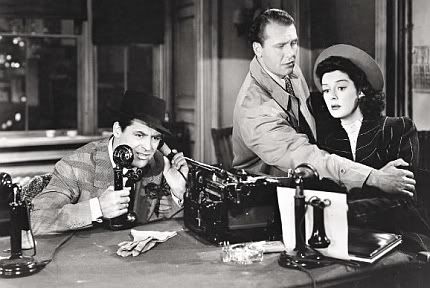
Bellamy, as always, plays the third wheel. The star is Cary Grant, playing newspaper editor Walter Burns. He's got a big story he wants written, that of death row inmate Earl Williams (John Qualen). There's only one person who can get that story the right way: Burns' star reporter Hildy Johnson (Rosalind Russell). There are only two problems: first, Hildy is about to retire from the journalism racket to get married to insurance salesman Bruce (Ralph Bellamy). Second, Hildy used to be the former Mrs. Walter Burns! So, it's up to Walter to come up with some ruse to get Hildy to stay just one more day to do this one last story.

If that were all there is to the movie, it would be a pretty good movie. But there's a lot more going on beneath that. It turns out that Williams' case is controversial. The governor is ordering clemency for the prisoner, but there's an election coming up soon, and the mayor doesn't want to be seen as soft on crime, so he's trying to keep anybody from finding out about the stay before Williams can be executed. Most of the press doesn't care about Williams' possible innocence, seemingly content to let him fry.

The commentary, however, is buried beneath a whole bunch of comedy, thanks to the writing of Ben Hecht and the direction of Howard Hawks. Hawks' style is well-known for being extremely rapid fire, and His Girl Friday might be Hawks at his most rapid pacing; there are constantly characters talking in orthogonal conversations, most often on telephones from the prison news room. All this is certainly helped by having leads who were both quite adept at comedy.