Showing posts with label Mae West. Show all posts

Sunday, January 25, 2026

The Heat's On

Back in the spring of 2025, Mae West was honored as TCM's Star of the Month, even though she didn't make all that many movies. I didn't have much to record, in part because of a box set of hers that I have that has a lot of her stuff from Paramount and TCM's not showing her two 1970s movies. However, before decamping from Hollywood, West made one film at Columbia that was part of the salute: The Heat's On.

Mae West plays Fay Lawrence, the sort of Broadway star loosely based on West herself: for the grown-up audience, but doing the sort of show that some of the more prudish types would consider controversial. With changing times and it being World War II, however, the new show for producer Tony Ferris (William Gaxton) has been a box office flop, and Fay is thinkng of using a clause in the contract to get out of the show so she can do something with rival producer Forrest Stanton (Alan Dinehart) instead. Fay, frankly, is sick of Ferris and his bend-the-rules ways.

Wanting to see Ferris after the show is Hubert Bainbridge (Victor Moore). He works in the supply department of the Bainbridge Foundation, one of those famously prudish moral uplift societies reminiscent of the one Ezra Ounce in Dames a decade earlier was a part of. But Hubert doesn't actually run it; that job falls to his sister Hannah. The two of them have a niece Janey who has some musical and dance talent, and Hubert would like Ferris to give Janey an audition.

Ferris isn't pleased with this intrusion at first, until he realizes Hubert is from the Bainbridge Foundation and what they have a reputation for. The Bainbridge Foundation can get the show raided and shut down without Ferris having to pay off Fay's contract. And then, when Fay starts working with Stanton, Ferris sets about manipulating Hubert to get back at Stanton. Fortunately for Ferris, Hannah has gone off to Seattle for two months to preside over a conference of the foundation's western branch or something. Ferris sees how weak-willed Hubert is, and uses that to get Hubert to do all sorts of things that are dishonest at best and highly illegal at worst, which of course brings up the question of how Hubert is going to get out of this movie both satisfying the Production Code, and staying out of prison.

For most of this section of the movie, Fay is not really a part of the movie, at least not on screen. But then she learns that Ferris has used Hubert to get control of Stanton's musical that she's in, and she takes pity on Hubert and cooks up a scheme of her own to get back at Ferris and have a happy ending.

Having watched The Heat's On, I can see why Mae West got out of movies after this and why this one isn't very well remembered. If it hadn't starred Mae West, it's the sort of movie that would probably have a reputation for a second-tier movie designed to entertain the home front during World War II by not actually making much reference to the war. (Lloyd Bridges has an early role as a solder boyfriend to Janey, and Hannah is asked whether her trip to Seattle is really necessary, but that's about it.) Mae West is terribly underused and doesn't have the best one-liners her. Also, most of the music is forgettable, with the exception of Hazel Scott, the black pianist who is quite good.

The Heat's On is for Mae West completists only, I think. Well, maybe for Lloyd Bridges completists too.

Wednesday, May 11, 2022

Chickadee of size

Not certain what to do a post on, I noticed that on my Mae West box set I had one movie left that I hadn't done a post on, My Little Chickadee. So I put that in the DVD player and watched it to do a post on here.

Mae West plays Flower Belle Lee, who at the beginning of the movie is riding a stagecoach somewhere in the Old West with the other passengers including one Mrs. Gideon (Margaret Hamilton), who seems slightly more pleasant than the character Hamilton played the previous year in The Wizard of Oz, if only because she doesn't have green make-up and isn't actively trying to kill a little girl and her dog. Anyhow, a Masked Bandit waylays the coach, forcing everybody to get and taking the gold. The Bandit absconds with Flower Belle, because who wouldn't abscond with such a voluptuous lady? And it's not as if you'd abscond with Mrs. Gideon.

But because of this, and because the Bandit shows up again at the home where Flower Belle is staying, she's run out of town, the other townsfolk thinking she might be a woman of ill-repute and in cahoots with the Bandit. So she makes her way by train to Greasewood City, in the hopes of starting a new life. Waiting along the tracks to get a ride to Greasewood City is one Cuthbert J. Twillie (W.C. Fields).

The train is waylaid by Indians, with Flower Belle and Twillie saving the day. Also, Flower Belle sees a large stash of cash in Twillie's carpet bag. So she marries him in the hope of having a rich husband and one who's respectable, while Twillie is willing to marry Flower Belle because, again, she's voluptuous, and he hopes he can score with her. This, even though Flower Belle is pretty open about it being a marriage of convenience (especially once she finds out that the cash isn't legitimate).

In Greasewood, two men vie for Flower Belle's attention. One is the newspaper publisher Wayne Carter (Dick Foran), while the other, Badger (Joseph Calleia), is clearly the sort of guy westerns portray as the "owner" of the town, also responsible for permitting the vice if not owning it outright. Badger has been selecting the sheriffs on the basis of who is too incompetent to be sheriff, much like Tom Destry from Universal's release the previous year Destry Rides Again. Badger sees Twillie, and it's obvious that he'd make a suitable sheriff, at least in terms of what Badger wants. There's still a Masked Bandit out there, and it should be pretty obvious who it will be once the mask is removed, but we've got a little ways to get there yet.

My Little Chickadee is an odd little movie. W.C. Fields and Mae West were both sui generis, and pairing their different styles together is something that has the potential to go badly wrong. Mostly, it doesn't go wrong, but it doesn't hit the high notes it could considering the caliber of the two leads. The big thing is that large parts of it feel more like Fields sketches, and other sections feel like West sketches, with the perfunctory plot being bolted on. It also definitely doesn't help how much the Production Code neutered West.

So My Little Chickadee is an interesting curiosity, but it's certainly not the best movie in either Fields' or West's career.

Friday, December 24, 2021

Grow Up With the Country

Not having anything ready for a review today and not wanting to do just a briefs post, I decided to put one of the DVDs from my Mae West box set into the DVD player and watch one of the films I hadn't reviewed yet, Go West Young Man.

West plays Mavis Arden, a Hollywood actress traveling the country to promote her latest film. She's got an exclusive five-year contract with the studio, and one of the clauses is that she not get married during those five years, something that poses no small problem for her PR man, Morgan (Warren William), as she's got a whole bunch of male admirers. And while Mavis says all the right things in her public appearances, in private she'd be more than happy to pay attention to at least some of those male admirers if they're good looking enough.

At her current apparance, in Washington DC, one of the men waiting for her after the show is Francis X. Harrigan (Lyle Talbot), who happened to know Mavis back in the day when they were both in Chicago together. He'd like to meet Mavis possibly for more than just old time's sake. This would be a problem for both of them, however, as it's implied that Harrigan may have some sort of past, and this could be used against him as he's now running for Congress. But the two agree to meet at a rooftop restaurant. Morgan, however, invites the press, to try to scuttle both Harrigan and Mavis, although it only appears to make both of them more popular.

Mavis' next engagement is in Harrisburg, PA, so after everything that happens in Washington Mavis and Morgan, along with her dresser and the chauffeur, pile in to her limo to head north. Unfortunately, mechanical problems beset them and there's no good way to get to Harrisburg on time. They're going to have to wait for the car to get fixed.

Fortunately, there's a nice little service station attached to a rooming house that can set them up while they wait and get the car fixed. The rooming house is run by Mrs. Struthers (Alice Brady), who has some of her family as staff, as well as a maid/waitress Gladys (Isabel Jewell), who is a big fan of Mavis'. At the service station, we initally see the more portly Clyde driving the tow truck, but the place is actually run by aspiring inventor Bud Norton (Randolph Scott).

It's not too difficult to figure out that Bud likes Mavis, especially considering he has an invention that he hopes will increase the quality of sound film recording, something that would get him out to Hollywood if anybody could notice him. And Bud being handsome, of course Mavis notices him. This causes problems for Morgan and some of the people at the rooming house, and leads Morgan to do something that probably ought to have landed him in jail except that the plot resolution requires that he evade jail.

Mae West was known for her sexual energy that she exuded on the screen, and the introduction of the Production Code in July 1934 certainly hampered her later movies, of which this is one. Indeed, a fair amount of the plot doesn't make that much sense, such as driving the Rolls Royce across the country, and the relatively short distance between Washington DC and Harrisburg being overlooked. Mae West, however, does about as well as possible with the somewhat neutered script, and makes Go West Young Man eminently watchable.

Wednesday, July 25, 2018

Annie are you OK?

Some time back I purchased a cheap box set of Mae West movies. One of the movies in teh set I haven't blogged about yet is Klondike Annie, so I recently watched it to do a full-length post on it.

The scene is the Gay Nineties in San Francisco. Mae West plays Rose Carlton, the "Frisco Doll" who is the lover of Chan Lo (Harold Huber), and basically trapped in the relationship. One night Rose gets in a scuffle with Chan Lo, which results in her accidentally stabbing him to death. She could claim self-defense, although whether or not a jury would believe her is an open question. So she takes the easy way out by getting on a tramp steamer headed for Nome, AK, and the Klondike gold ruch.

Bull Brackett (Victor McLaglen) is the captain of the ship, who at first doesn't know anything about Rose's past. Along the way, another passenger comes aboard, Salvation Army missionary Annie Alden (Helen Jerome Eddy). Annie is nice to Rose, and gets Rose to begin thinking about leading a somewhat more virtuous life. But poor Annie has a bad heart, and dies at sea. Meanwhile, the police are still looking for the Frisco Doll, which gives Rose an idea. She'll take Annie's place and head up the mission in Nome! It gives her a chance to atone for her sins, as well as to stay one step ahead of the law.

But by this time Bull has fallen in love with Rose, and knows that she's the Frisco Doll wanted by the police back in San Francisco, a fact that he can hold over her head. Still, Rose goes to the mission and helps run it, even if her methods are sometimes unorthodox. Bull can't understand why she'd do this, but since he's in love with her, he puts up with it.

Joining this happy group is police inspector Forrest (Philip Reed). He's looking for the Frisco Doll not knowing she's right under his nose. He begins to fall for Rose-as-Annie, which brings about its own set of problems, because thanks to the Production Code, Rose is going to have to face the music at some point, even if she really is innocent. This isn't like Sylvia Sidney's character in Alfred Hitchcock's Sabotage.

The Production Code is, I think, the source of the problems I have with Klondike Annie. Mae West had a racy sense of humor with the double entendres flying, but the enforcement of the Code starting in 1934 forced her to tone it down quite a bit. The Code is also what forces this movie into the ending it has. But apparently it also resulted in a few edits that made the movie a bit more confusing than it needed to be. Supposedly there was a scene of Rose actually dressing the dead Annie up as a prostitute, aiding in Rose's getaway. But that was deleted thanks to the Code.

Overall, Klondike Annie is a good example of a 1930s programmer, and not a bad little movie. I'm really glad it was on the box set and at the price it's quite inexpensive. However, thanks to the Code it just isn't up to the standards of earlier West movies like She Done Him Wrong.

Monday, December 25, 2017

Goin' to Town

For Christmas I watched one of the movies off my Mae West box set: Goin' to Town.

The plot starts off looking as though Mae is going to be doing a comic western. She plays Cleo, a woman who is seeing one man in the upstairs part of a saloon, while Buck (Fred Kohler), a rancher accused of cattle rustling, comes in downstairs and wants her. Back and Cleo eventually play dice to determine whether she'll marry him, and he wins. But before the marriage, he's killed in another cattle rustling incident. Still, the agreement the two signed means that she inherits his spread.

And, there's oil on that spread. While inspecting that part of the ranch, Cleo sees engineer Edward (Paul Cavanagh) who is managing the first phase of the oil extraction, and immediately falls in love with him, although he doesn't like the way she shows it. So he's happy to take a job down in Buenos Aires. Cleo, undeterred, follows Edward to Argentina.

Cleo is looking for a place in society to go with that wealth, but nobody will accept her. That is, until she finds a man Colton (Monroe Owsley) with gambling debts who is willing to make a deal with Cleo: a portion of her money in exchange for his good name. His aunt (Marjorie Gateson) however, is decidedly unhappy with this, and vows to get Cleo thrown out of high society. Further complications ensue....

Goin' to Town is probably the least satisfying of the Mae West movies I've seen to this point, mostly because the movie veers wildly from one part of the plot to the next. The western scenes seem as though they should be from around the turn of the century, but the car Cleo drives up to the ranch and the last two-thirds of the movie seem clearly in the present (well, 1935 when the movie was made). And the plot goes from one man to another to another to another at the drop of a hat along with switching locations. Plus, the part of the plot about Marjorie Gateson's character trying to drive Cleo out of the Hamptons is rather rushed in its resolution. Still, Mae gets to deliver some good lines (which of course she wrote herself) such as "I'm a good woman for a bad man."

Although Goin' to Town is one of Mae West's lesser efforts, it's not that bad, and since it was on a cheap box set, it's still worth getting the box set.

Tuesday, March 21, 2017

Every Day's a Holiday

If the introduction of the Production Code in 1934 affected anybody, Mae West would probably be near the top. A good example of this can be seen in Every Day's a Holiday. It's part of that nine-film box set I've mentioned a couple of times, so you should be able to pick up a copy fairly cheaply.

West plays Peaches O'Day, who is expected to show up in New York City on December 31, 1899 as the movie opens because she's got a repuation. Not that the police want her there, since she's somewhat of a con artist. Indeed, she sells the Brooklyn Bridge to Fritz (Herman Bing). Police Chief Quade (Lloyd Nolan) tells Capt. McCarey (Edmund Lowe) to arrest Peaches and makes certain McCarey has a warrant to do so.

Meanwhile, Peaches passes by Lamadou Graves (Charles Butterworth), who happens to be a butler but isn't letting that on. Graves invites Peaches to "his" house (really his boss' house of course), where a committe for clean government just happens to be meeting, led by Graves' boss Van Reighle Van Pelter Van Doon (Charles Winninger). Graves and Van Doon, like every other man in New York, is taken with Peaches' charm. Even McCarey is, as though even though he's supposedly an honest cop, he pays Fritz out of his own pocket so that there's no longer a charge against Peaches.

The political machine intends to run Quade for mayor, and the reform committee eventually gets the idea of running McCarey, but that comes later. McCarey finds Peaches and politely suggests she get out of town, which gives her, Graves, and her partner in crime Nifty an idea: pass her off as Mademoiselle Fifi, the great French actress and put her in a show. The show is a success, but of course McCarey recognizes Fifi (in a dark wig) as Peaches. Quade doesn't and starts a vendetta against Fifi when she doesn't want to meet him, which ultimately leads to McCarey's running for mayor.

I think the problem with Every Day's a Holiday is that it's all over the place. The plot swings wildly from the Peaches as con artist part to Fifi to the mayoral election, and I can't help but think a lot of that is due to having to obey the strictures of the Production Code. Crime isn't supposed to pay, and yet it does seem to pay for Peaches. I also found some of the humor a bit too over the top. But everybody gives it a good shot, which ultimately does make up for the movie's flaws. It's also very interesting to see a young Lloyd Nolan with hair. I saw his name in the opening credits, and didn't recognize him at first.

As I said in the opening, the Mae West box set I have this one on is cheap and has nine movies, some of which are better and are alone worth the price of admission. Every Day's a Holiday isn't bad, but it's not nearly as good as some of West's earlier stuff.

Saturday, December 17, 2016

Night after Night

A few months back, I bought a 3-disc collection of Mae West movies. Among the movies in the collection that I hadn't seen before is Night After Night.

Mae West is neither the star here, nor the female lead, this being her first film. The star is George Raft, playing Joe Anton. Joe owns a speakeasy in New York, assisted by high right-hand man Leo (Roscoe Karns). Joe's doing well enough for himself, but he's got some problems. One is Frankie (Bradley Page), a gangster who wants to buy the place what with this still being the Prohibition era and gansters not wanting competition.

Joe, however, seems more concerned with his romantic life. There's a woman named Healy (Constance Cummings) who comes into the place every night and sits alone. She seems much too high-class for Joe, so Joe has been taking lessons in being classier from Miss Jellyman (Alison Skipworth). Joes past, of course, threatens to make a mess of the whole situation. There's Iris (Wynne Gibson), a flapper type who seems to be a bit too much of ill repute. And then Joe gets a phone call from Maudie (Mae West). She's apparently returned from abroad, and would like to start seeing Joe again. Joe doesn't want this, presumably because it wouldn't look good to Healy or Jellyman, although it's never quite revealed what West's past is. (She does give an explanation, although you have to believe she's making it up.)

The main thrust of the movie has Joe pursuing Healy, who is also being pursued by Dick Bolton (Louis Calhern), and variously winning and losing her heart against backdrops of those other women and the gangsters wanting the place. To be honest, the movie is really a bit of a mixed bag. The main plot never quite goes anywhere -- or, at least, it veers wildly from one place to the next -- and it's more up to the comic relief to try to save the movie. Roscoe Karns does well as Leo, having to fix the messes created by Joe's inattention to detail. Skipworth also does well as Jellyman, both in her early prim-and-proper scenes and then later after she's had too much to drink. But, of course, it's Mae West who steals the show. She has a memorable first scene in which she responds to a coat-check girl who says, "Goodness, what beautiful diamonds!" with "Goodness had nothing to do with it, dearie." She then proceeds to worm her way into a dinner with Healy and Jellyman, teaching Jellyman a few things about how not to be the stuffy part of high-class all the time. West only gets three or four scenes, but she shines in them.

Several of the reviewers at IMDb say that Night After Night would probably be forgotten if it weren't for the presence of Mae West. I have to agree with this assessment. The movie is a run-of-the-mill pre-Code in many ways, up until Mae shows up, and then wow! The box set I got that included this movie is under $20, so it's not much to drop for nine movies. (And you get She Done Him Wrong, too.)

Monday, December 1, 2014

TCM Star of the Month: Cary Grant


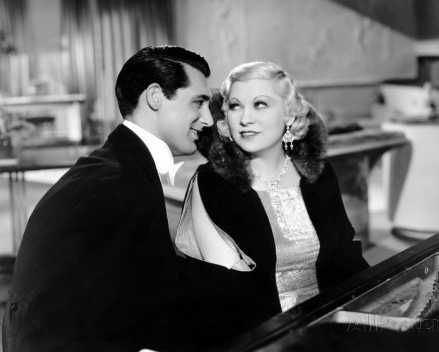
We're in a new month, which means we're getting a new star of the month on TCM. Every Monday in prime time, actually going into Tuesday morning, we'll have the films of Cary Grant. This first Monday in December brings several of the films that Grant made at Paramount at the beginning of his career. One that I thought I had blogged about before, but apparently haven't, is I'm No Angel, at 10:45 PM.

Grant isn't the star here; this was the beginning of his career. Instead, the star is Mae West, playing Tira, who at the beginning of the movie is a dancer in the traveling carnvial show. But she's more than that. She's got a partner in crime in Slick Wiley (Ralf Harolde), a pickpocket who poses as Tira's husband when she lures unsuspecting men into her hotel room for dalliances. One of those dalliances goes wrong, and the mark ends up knocked out, but still able to recognize his two assailants. Slick eventually goes to prison; Tira's case is more complicated.

Tira seeks help from her boss Bill (Edward Arnold) to pay for the lawyer she's going to need to stay out of prison. He agrees, but only under the condition that she'll play a part in his new lion-tamer act that ultimately has her sticking her head into a lion's open mouth. You can understand why she's not so happy about it, but if the choice is between that and jail, what are you going to do? She stays out of jail, and the act becomes a success, enough for the carnival to make it to New York to perform, which is where Cary Grant is going to come in.

New York means high society and wealthy people, and some of them go to see the show since it's at a respectable arena. One of them, lawyer Kirk (Kent Taylor) sees Tira and falls for her, which is a bit of a problem not simply because they're from two completely different worlds, but because Kirk has a fiancée who needless to say isn't very happy about her man going to see this carnival performer! So it's up to Kirk's cousin Jack (Cary Grant) to solve the problem by paying off Tira to leave Kirk alone. The only thing is, Jack falls for Tira too, which presents a whole bunch of complications....

Mae West's bawdy persona suited her well for the pre-Code era as she flings off one-liners full of sexual innuendo, and that allows her to shine in I'm No Angel. This is West's movie all the way; Cary Grant, who gets second biling and is our Star of the Month on TCM, doesn't show up until halfway through the film. Grant gets the chance to play a suitably elegant and dashing young man, and does so as well as he did with his Salvation Army worker in She Done Him Wrong (airing just before I'm No Angel at 9:30 PM). The rest of the cast is adequate, but not particularly standing out.