Showing posts with label Melvyn Douglas. Show all posts

Monday, November 16, 2026

Pair with Toys in the Attic

Another of the movies that had been sitting on my DVR for a while is a film from near the end of Luise Rainer's Hollywood career: The Toy Wife. Having watched it, I can see why TCM doesn't drag this one out all that often.

Luise Rainer stars as Gilberte Brigard, nicknamed "Frou Frou" for no good reason beyond making this movie even sillier that it seems at first glance. She comes from a wealthy plantation family in Louisiana, owning a whole bunch of slaves around the late 1840s I'd guess. (I don't think the movie specifically mentions a time frame, but considering later mention of going to Texas and the New Mexico territory to help institute legal reform, that should place things some time between the end of the Mexican-American war and the Civil War. The movie doesn't otherwise bother itself with politics.) Frou Frou, however, has spent a bunch of time in France where she's been getting a finishing school education that would also explain her accent. Frou Frou returns home to her father Victor (H.B. Warner) and older sister Louise (Barbara O'Neil).

Louise lusts after lawyer George Sartoris (Melvyn Douglas), who gets stabbed for his part in doing the right thing in prosecuting a white man who killed a slave. But George likes Frou Frou, because she seems exciting compared to Louise. As for Frou Frou, she just wants to go to the big city of New Orleans, not particularly caring for life on the plantation. She travels to New Orleans with Mme. Vallaire (Alma Kruger), faking a toothache to see the sort of doctor you can't get on a plantation. There, she meets Andre (Robert Young), the son of Mme. Vallaire, and immediately falls for him because he's the sort of guy who seems "exciting", just like she is.

But Louise, having realized that George seems more intrested in Frou Frou, pushes Frou Frou and George to get married since that might at least tame Frou Frou. The two get married, at which point the movie skips ahead five years. Frou Frou has a four-year-old son, but she spoils him rotten. She's also not a particularly good housekeeper, since part of the job of the woman of the house in those days was to manage all the domestic help be they slaves or just regular servants like those British upper-class movies. Try as he may, George can't get Frou Frou to act more responsibly.

And then Andre returns to the scene. He and Frou Frou still have a thing for each other. And since this is roughly the point where George talks about going west to help the new areas of Texas and New Mexico deal with the changes to their legal system from the old Spanish-style to American common law, Frou Frou decides she'd rather go off with Andre and not be subjected to a boring life out in the hinterlands. As you might guess, this is a tragic decision, compounded by the fact that she's not going to be allowed to bring the child with her.

They spend time up north, but when Andre and Frou Frou return, George has no desire to let Frou Frou see her child. This sends Frou Frou into a further downward spiral, until the sort of inevitable conclusion you can probably guess from a melodrama like The Toy Wife.

Oh dear is The Toy Wife a dated movie. Luise Rainer had already won her two Oscars, but was growing tired of Hollywood. I'm guessing that the movie-going audience was also growing tired of her; certinaly once World War II broke out she'd have been the sort of actress who would have suffered a dramatic fall in popularity like several other 1930s stars. MGM started putting Rainer in lesser scripts, and this one is a particularly bad script, not helped by the fact that Rainer overacts badly.

But, I suppose, you can watch The Toy Wife as an example of Hollywood's changing tastes in the late 1930s.

Thursday, March 14, 2024

Billy Budd

When I was in high school, one of the books we had to read was Herman Melville's Billy Budd. It's really only a novella, because Herman Melville never actually finished it and what we have is what he left behind at the time of his death combined with some compilation and editing by his widow and later scholars. The book was popular enough, however, that in the late 1940s the material was adapted into a stage play; it's that play which is the basis for the 1962 movie Billy Budd.

The year is 1797, and if you remember the movie Damn the Defiant! that I reviewed a several weeks back, you'll recall that this was the year that the British Royal Navy suffered the Spithead mutiny, which was quite a serious thing. Edward Vere (Peter Ustinov) is the captain of the HMS Avenger, and in need of replenishing his crew. Since there's a war on and he's at sea, going to port and impressing the men there, as we've seen from other naval movies like Mutiny on the Bounty, is a non-starter.

Ah, but the laws of war suggest that in a time of war the Royal Navy may impress men from British-flagged merchant ships. After all, they're already sailors. So when the Avenger encounters the Rights of Man, Capt. Vere takes some of the crew, including a young foretopman named Billy Budd (Terence Stamp in his feature film debut).

Billy is considered a naïf by his crewmates, but he also has a strange sort of charisma, where practically everybody he meets loves him because he's just so... something or other. This even though he doesn't seem to have any desire to be a leader of men. He just wants to get on with his work. The only person who soesn't seem to like Billy is the ship's Master of arms, Claggard (Robert Ryan). That, however, is because Claggart doesn't like anybody. In a bit of reversal from Mutiny on the Bounty, it's Claggart who feels the need for iron discipline, while the captain has a more nuanced view.

Still, Billy is just so nice that he's going to try to get in the good graces of Claggart not out of any desire to toady up the a boss who has considerable power over him, but because it seems he's incapable of doing anything else. Claggart isn't stupid, and sees the power that Billy unwittingly has over other crewmen, so Claggart decides he's going to trump up charges against Billy by any means necessary. Knowing of the Spithead mutinies, Claggart gets his loyalists to try to fabricate evidence that Billy is part of an incipient mutiny.

When Vere calls Claggart and Budd in for a meeting, Budd has one of his few weaknesses, which is a nervous stammer. He's incapable of saying what he's thinking because Claggart's bullying has made him so scared. So he instinctively reacts physically, accidentally striking Claggart, who falls backwards and hits his head, killing himself. In a modern-day court of law on dry land, this would probably be negligent manslaughter, but at sea during war, it's a court-martial offense, and the penalty is death, even if everybody is secretly relieved that Claggart is dead and nobody really wants Billy to die if they had their way.

Herman Melville is not my favorite author, so when I had to read Billy Budd back in high school I wasn't too thrilled with it. This movie adaptation, however, really makes the material come to life, thanks in no small part to a series of excellent performances by the three leads. There's also smaller supporting roles for Melvyn Douglas and David McCallum, among others.

If you haven't seen Billy Budd before, do yourself a favor and watch it. It's much better than the Melville novella.

Saturday, February 10, 2024

I bet pi would be lonely too

Some years back, I tuned into TCM in the middle of a then new-to-me 1970s movie called One Is a Lonely Number. I made a point of waiting for it to show up again in order to be able to record it. So when TCM did run it again several months back, I was finally able to get that recording. Recently, I got around to watching it, so as always, here's the review.

"James, what are you doing"? So says Amy Brower (Trish Van Devere) to her husband James in their San Francisco-area apartment as the movie opens. James, however, is not about to be her husband that much longer. He's leaving Amy for reasons she doesn't understand. Indeed, he's called in sick to his job as a professor at the local college, administered the final exam early, and left. And this is the era when a lot of women like her, even if they didn't have children to look after, didn't do actual paid work.

Not only that, but Amy doesn't have much in the way of real friends. The closest would probably be Madge (Jane Elliot). She introduces Amy to Gert (Janet Leigh), who is the head of the local chapter of what she calls the "divorcées' league", and has decided ideas about the value of men, having married and divorced five of them. But having been through so many divorces, she also knows the ins and outs of the divorce process, this being the days before no-fault fivorce was common.

The other "friend" or at least someone who's going to become a bit of a friend, is Mr. Provo (Melvyn Douglas). He runs the local produce stand, and the Browers have been customers of his through their entire marriage, so he sees both of them quite a bit and knows their tastes in fruits and vegetables. He's also a widoer, so he knows a bit about moving on after the end of a marriage, although of course his marriage ended in a rather different way from Amy's.

Still, Amy needs a job, and when she goes to the employment agency, they don't have much for her since she doesn't really have all that much in the way of marketable skills, having gotten the proverbial "MRS degree" in college: there's not much use for art history majors with philosophy minors. The man at the employment agency gets her a job, but it's only as a lifeguard at the municipal pool. And then he shows up one day at the pool trying to put the moves on her, which is really creepy.

Will Amy ever be able to find happiness in life again? Will she need a man to do it? With the destruction of the Production Code a few years prior to this movie, it's easy to see why filmmakers would be interested in something with more grown-up themes. And maybe this was original for 1972 when it was made. But 50 years on, it feels totally unoriginal and the sort of thing that would be made nowadays as a TV movie of the week for one or another of the cable channels or streaming platforms.

One Is a Lonely Number isn't really a bad movie, but there's nothing particularly strong to recommend it, either, not even the presence of Janet Leigh and Melvyn Douglas.

Sunday, October 15, 2023

Well, technically not *my* wife

I was looking through the streaming services recently, and noticed that the Roku Channel's Cinevault Classics channel (which is mostly, if not entirely, the Columbia library) had a new-to-me movie called Our Wife coming up, so I sat down to watch it. Unfortunately, the sub-channels on the Roku Channel don't seem to have schedule listings that go out more than a day in advance, so I don't know when it's going to show up again.

The Drakes -- a college-professor father (Charles Coburn), his adult son Tom (John Hubbard) and adult daughter Susan (Ruth Hussey) are on vacation taking a cruise down to Cuba and nearby Caribbean islands in the days before World War II when Americans could still get to Cuba easily. They meet composer/musician Jerome "Jerry" Marvin (Melvyn Douglas) on board, and then meet him again later on the island, drunk and looking like he's about to miss getting back on the boat. So they do the human thing, which is to look after him enough to get him back on the boat.

Except that they find his cabin is now occupied by someone else. Apparently, Jerry had a one-way ticket and the possibility of a job he was only going to take because he needed the money. Susan keeps trying to come up with a way to get Jerry to take one of the rooms in the suite the Drakes booked; as you might guess, along the way she's going to begin to fall in love with him, although that takes a little while longer than expected. Jerry repays the Drakes by letting them stay in his place in Westchester when they get back to the States.

Jerry, it turns, out, is in the middle of getting a divorce from first wife Babe (Ellen Drew), one of those divorces like in The Awful Truth where the judge has more or less signed off on it but it won't become legal until after a cooling-off period. That period still hasn't passed. And wouldn't you know it, but Babe shows up again, thinking that perhaps there's still a spark left.

Jerry comes up with an idea, which is to have Susan pretend that she and Jerry are engaged, since Jerry's divorce is going to happen anyway, what with it just not being finalized yet. This only serves to make Babe more jealous, and more desirous to win Jerry back. And she sees the perfect opportunity to do so when she suffers a fall on the stairs in Jerry's house, winding up with leg paralysis and having to stay in bed for several weeks. Susan, however, is convinced that Babe is just faking it. And Susan is going to start trying to prove it....

Our Wife is one of those movies from just before World War II (it was released in August 1941) that, had it been made a few years earlier, would have been written as a screwball comedy in the vein of something like The Awful Truth that I mentioned earlier in the post. Columbia may have tried to bill it as a comedy, but it's really more of a light drama than a comedy.

Unfortunately, the main flaw of Our Wife is that it develops slowly, with not a whole lot happening and being way too talky. Reading up on it, the movie was based on an early 1930s play, and the second half of it really belies the stage origins of the material. The material might have worked better on the live stage, and the stars here do the best they can with the material, but the whole time it feels like there's something missing. And then, the movie doesn't know how to resolve the conflict, doing so in a wacky way that I didn't think fit the rest of the movie.

Still, Our Wife isn't terrible, and fans of Melvyn Douglas will find it a mild diversion. I just wish I could point out when the next airing would be to give you all a heads-up.

Monday, February 13, 2023

Mary Burns, Fugitive

One of the 1930s actresses who gave a lot of fine performances but doesn't really get enough love is Sylvia Sidney. One of her films that's been sitting on my DVR for quite a while now is Mary Burns, Fugitive. So recently, I sat down to watch it.

As you can probably guess, it's Sidney who plays Burns, as she's got top billing. And she becomes a fugitive, although she's not one at the start of the movie. Instead, she's working as the owner of one of those small roadside diners that dotted rural America back in the day, kind of like the Aline MacMahon character in Heat Lighting, only Mary isn't escaping a past as far as I could tell and doesn't have the motor hotel either.

She makes the best coffee around, and one of the people who has repeatedly come through to partake of the coffee is "Babe" Wilson (Alan Baxter). Other than possibly Babe Ruth, it seems to me that a man with the nickname "Babe" back in those days was bad news, or at least so in movies. But Mary doesn't know she's in a movie, so she doesn't see the threat. Instead, she's kind of fallen in love with Babe. So one day, when Babe and a friend show up, she doesn't know how her life is about to change. Babe says he has to go to Canada on urgent business, and wants Mary to marry him and go to Canada. In fact, Babe is a criminal fleeing the law with a bunch of stolen money. Before the police can get to Babe, he shoots his partner and makes an escape, but not with Mary in tow.

The police, unsurprisingly, believe that Mary is Babe's moll, and that she knows where Babe was fleeing to. She doesn't know that second half, and since she can't give the police the information they want and didn't exactly stop Babe from leaving, they consider her an accessory to the crime and have her put in prison for 15 years. She could get a much reduced sentence, however, if only she would tell the authorities where Babe went. (As if he went one place and stayed there all this time.)

Mary can't give the authorities what they want, so they try a different tack. They arrange it so that another prisoner, Goldie Gordon (Pert Kelton), will break out of prison and take Mary with her. Mary, of course, doesn't get that it's all part of a plan by the higher-ups, who think that with Mary out of prison, Babe and his gang will find where Mary is and Babe will take the bait, allowing the authorities to catch him.

Eventually, Mary takes a job as a nurse in a private hospital, where she gets the task of tending to notoriously cantankerous patient Barton Powell (Melvyn Douglas). He's a professional explorer, going to places and then doing speaking tours. But he's had an eye operation that's left him with bandaged eyes, and being ticked at all the other nurses and their lousy coffee. Remember, as I mentioned at the top, Mary is known for her good coffee, so when Barton tries is and likes it, the two fall in love. Perhaps Mary could have a relationship with Barton, if only it weren't for Babe....

Babe and his underlings have found where Mary is, and decide to sent Babe's associate Spike (a young Brian Donlevy) to bring Mary to Babe. This is finally going to give the cops the chance, but it's also going to put Mary in some danger....

Mary Burns, Fugitive is one of those great old programmers that studios churned out in the days before television might have made stuff like this fodder for TV episodes. It's an engaging story, if nothing spectacular or ground-breaking, with good performances from all three leads and a few surprises along the way. It's definitely worth watching if you can find it.

One interesting thing is that the print TCM ran had both a Universal and a Paramount opening sequence. Now, it's well known that Universal (well, MCA) got the TV rights to Paramount's talkies up through 1949, and there are any number of movies that have a modern Universal opening before the old-fashioned Paramount opening. Mary Burns, Fugitive, however, had the old early 1930s opening from before the mirrored-ball. Kind of an odd surprise.

Saturday, January 7, 2023

My Forbidden Past

Ava Gardner was TCM's Star of the Month last month, and that gave me the chance to see one of her films that I hadn't watched before: My Forbidden Past. I'm glad I watched it, but not for the reasons the studio would have wanted back in the day.

Gardner plays Barbara Beaurevel, a young belle in turn-of-the century New Orleans. The movie starts off with having a torrid but illicit relationship with Dr. Mark Lucas (Robert Mitchum), who is some sort of research scientist at Tulane University. Mark is about to go to South America for a couple of months on a research expedition of some sort that's not explained, and he'd like Barbara to go with him and perhaps they can get married down in South America or even on the ship since the captain could perform the ceremony.

Of course, there's a catch. Barbara doesn't have any money, even though she lives in one of those grand old houses that the antebellum upper crust of New Orleans lived in. And it's not even her house, but that of her aunt Eula (Lucile Watson). Eula lives there with her son Paul (Melvyn Douglas), and the two of them most definitely don't approve of Barbara's relationship with Mark, him being a northerner to boot, oh the scandal. Barbara plans to elope, but Paul catches her packing her bags, and blackmails her into staying, writing a letter to Mark instead telling him she can't go and that she'll marry him when he gets back.

Of course, any sane viewer would recognize that Paul isn't about to let Barbara out of the house to deliver that letter, and that when he himself offers to deliver it, you know he's delivering it straight to the circular file. But Barbara doesn't get this, and won't be able to understand why Mark, upon his return, thinks Barbara jilted him.

Before that return, however, two things happen. One is that Mark marries the first reasonably good-looking American woman he meets in Latin America, returning to New Orleans with a wife Corinne (Janis Carter) in an entrance that surprises Barbara when she goes to the boat to meet Mark. The other is that a lawyer comes to the Beaurevel house looking for Barbara. Apparently Barbara had a grandmother with the forbidden past of the title, being engaged in some sort of activity that Eula finds so shocking that one doesn't even mention the name of this woman. (I think the family tree would require this to be Barbara's maternal grandmother, because otherwise it would be Eula's mother-in-law. In fact, since Barbara and Eula share a surname but the dead woman doesn't, that would make it the mother-in-law of Eula's brother-in-law.) The last member but one of that line of the family recently died out in California, leaving Barbara as the closest living relative, and set to inherit almost a million bucks, which is quite a sum of money for 1900.

Eula and Paul don't want Barbara to take the money, because everyone will find out where the money came from and this will somehow make the family's social status go down the drain. Barbara has the understandable idea that she doesn't want to be poor any more, and takes the money. And when she finds out a few months after that Mark has gotten married, she comes up with a plan to use that money to get Corinne out of the way.

If the movie wasn't ridiculous enough before that, it's about to get a whole lot more ridiculous, and that's why I enjoyed the movie. This is supposed to be some sort of serious melodrama, but everything is more like an absurdist comedy, even though that's decidedly unintentional. Mitchum is badly miscast, while Gardner does the best she can with the material. Watson is pretty good as the evil matriarch, if not to the level that Madam Konstantine was in Notorious. And Melvyn Douglas looks like he went back and rewatched Mildred Pierce so that he could learn to play the slimy, smarmy schemer role that Jack Carson so brilliantly portrayed. I don't know that Douglas got to play too many roles like this, and he runs with it for all it's worth.

As a serious picture, My Forbidden Past isn't all that good. But as unitentinal comedy, it's a blast.

Wednesday, December 21, 2022

Joan Crawford doesn't quite meet Stephen King

A few months back TCM had a birthday (I think) programming salute to Margaret Sullavan. One of her movies I hadn't seen before was The Shining Hour, so I recorded it in order to be able to watch it later.

Joan Crawford is the nominal star here, not Sullavan, although it's a bit more of an ensemble cast as the two male leads are just as important and we see one of them first. That one is Robert Young, playing David Linden. The Lindens must have become wealthy enough for them to be famous just for being famous, as David is flying cross country having heard the news of yet another marriage for his brother Henry (Melvyn Douglas). Indeed, it's the gossip among some of the other passengers on the plane, and the sort of marriage to an alleged chorus girl that David wants to stop.

In fact, the supposed chorus girl isn't quite a chorus girl, but still a performer. Olivia Riley (that's Joan Crawford) does the sort of finer dancing that you see when movies of this era visit a high-class nightclub and have a couple perform a ballroom type dance. They're nowhere near as good as Vernon and Irene Castle, or even Fred Astaire and Ginger Rogers, but they're good enough to get gigs like this club where Henry saw Olivia and fell in love with her. Olivia, for her part, likes Henry as a friend, and likes his positive attitude. It's easy to see, however, why other members of the family might not approve of the marriage.

That especially goes for Henry and David's nasty sister Hannah (Fay Bainter), who you might think is channeling Judith Anderson's performance as Mrs. Danvers in Rebecca, except that this movie came out two years before Rebecca. But you wonder if Hannah ever loved a man, and that's why she's so damn bitter. Anyhow, she does her best to make Olivia feel unwelcome. The one person who has complete sympathy for Olivia is David's wife Judy (Margaret Sullavan). Judy feels that they're in the same situation, as Judy is in a marriage that in her view has become the sort of loveless marriage that is a trope of movies like this.

Meanwhile, the Lindens own a bunch of land and farm it, with Henry planning to subdivide some of it so that he and Olivia can have a nice house of their own. While that house is being built, one of the workers, Benny Collins (Frank Albertson), tries putting the moves on Olivia, which is a big mistake. Worse, it's David who spots this and stops it, which leads to him developing feelings of his own for Olivia, which may be mutual. That's bad for the marriage between David and Judy, and bad for the marriage between Olivia and Henry. But worst of all is that Hannah is still there, waiting for the right opportunity to drive Olivia away. And you won't believe how Hannah tries to do it.

Joan Crawford, as I understand it, felt like MGM was deliberately giving her poor roles in her last few years to try to get rid of her, which is why she felt Mildred Pierce, her first film at Warner Bros., was so important. Having watched The Shining Hour, it's easy to have sympathy with Crawford. The movie is a thoroughly silly potboiler, and I don't mean silly in a good way here. Well, maybe I do for Hannah as a character since she's so nuts. But everybody else is weighed down by the material. I wonder if that's because one of the screenplay credits goes to Ogden Nash of light verse fame. I wouldn't expect him to be good at writing this sort of movie. The actors do the best they can with the material, however. And, since this was made at MGM, it has extremely high production values. But if anything, it's the sort of movie that should be watched to study how films can go wrong.

Wednesday, February 16, 2022

The Grass Sea

Katharine Hepburn was one of the stars honored in Summer Under the Stars last August. One of the movies they showed that I hadn't blogged about before was The Sea of Grass. Recently, I finally got around to watching it.

Hepburn plays Lutie Cameron, a woman of marriageable age living with her family in St. Louis in 1880. Some time back, cattleman Col. Jim Brewton (Spencer Tracy) had visited St. Louis and fallen in love with Lutie, with the intention of marrying her; indeed, the movie opens up on Lutie's wedding day. Except that Lutie gts a telegram from Jim that his work in the New Mexico territory has kept him there, and she's going to have to take the train out to New Mexico to marry him. Not a very auspicious start.

But Lutie must have really loved Jim, since she gets on that train more or less alone for the journey to Salt Fork, NM. She makes a friend on the train, Selina Hall (Ruth Nelson), who is married to a homesteader out in New Mexico. Now, if you know your westerns, you know that one theme that shows up commonly is that of the struggle between the ranchers who feel they need an open range to graze their cattle, and the farmers who are settling on 40-acre plots of land. Those plots will obviously require fencing off, so you can see why the cattlemen are not too pleased about it.

The train gets in early, so Jim isn't at the station. In going through town, Lutie winds up at the hotel, where she meets Brice Chamberlain (Melvyn Douglas), a lawyer who is definitely on the side of the homesteaders in this new land. In fact, he'd eventually like to get a federal court in this district so that the homesteaders will have the law on their side. Unsurprisingly, too, because of the nature of Hollywood movies, Brice falls in love with Lutie so that there's going to be a romantic conflict throughout the movie.

Lutie eventually makes it out to the Brewton ranch, where she's the only woman. It's not long before they can make the marriage official, and not long after that before Lutie gets pregnant with the first of two kids, a daughter and then a son. But Lutie is still good friends with Selina, and has a lot of sympathy towards the farmers. She's particularly irritated with the idea that the ranchers feel OK about resorting to violence to keep the range open.

Jim is single-minded about keeping the range open for his cattle, and since Lutie isn't backing him 110% there's some fairly obvious tension there, to the point that Jim sends Lutie off to Denver, the biggest city around, to do some "shopping", which is really a euphemism for deciding whether or not she wants to stay in New Mexico. She goes back the first time, but then there's a second time when Jim's violence causes Selina to have a miscarriage that ultimately leads to Lutie's leaving. This even though she's not going to be able to get custody of the children.

Lutie goes off to St. Louis but finds out that her father died and wasn't able to leave her much of an inheritance. Worse, she's got kids she hasn't seen in years, who aren't going to remember her. They grow up into good girl Sara Beth (Phyllis Thaxter) and roué Brock (Robert Walker), both of whom are only seen in the last half hour of the movie. Jim has been a bad father to Brock, much like Spencer Tracy's character in the movie Edward, My Son, and it's only when Brock gets himself into trouble he can't get out of that Jim might finally reform. It's also what brings Lutie back to New Mexico....

The Sea of Grass is another of those movies that has a maddening script. Oh boy are these unsympathetic characters, at least among the leads, with Melvyn Douglas playing the only one I didn't want to shake some sense into. Apparently, it was also a troubled shoot, with a lot of it being done on the back lots and MGM's western village out in the Alabama Hills or wherever they had it. There was also apparently some tension between Elia Kazan on the one hand, and Tracy and Hepburn on the other. To be fair to everybody, however, they're all professional, and The Sea of Grass is a studio-era movie in which everybody does the best they can with a subpar script. Certainly competent, but not the first movie I'd think of recommending for people who want to see the work of anybody involved.

Sunday, January 2, 2022

1930s Romcom Programmer #493524052435243895386893117

Not having a good idea of what to watch off of my DVR, I decided that I'd put in another of the DVDs in my Claudette Colbert box set and watch a new-to-me movie, I Met Him in Paris.

Colbert plays Kay Denham, an American working girl who's got a fiancé in nice but bland Berk Sutter (Lee Bowman). Kay hasn't had much of an opportunity to see the world, so she's decided that before she gets married, she's going to take some of the money that she's saved up and see a little bit of the world, specifically by getting on one of those transatlantic liners that were still a thing in the 30s and go off to Paris. Not that Berk is happy, but it's also not as if he can stop her.

At any rate, Kay gets on the boat and winds up in Paris, because there's nothing particularly interesting happening during the voyage in this iteration of the story. However, she doesn't speak much French and doesn't seem to be enjoying herself very much. That is, until she's spotted in the hotel restaurant alone by Gene Anders (Robert Young, who was of course a staple at MGM's variations on the 1930s rom-com theme). Gene is staying with a friend, writer George Potter (Melvyn Douglas). Gene immediately starts wooing Kay, while George doesn't seem one bit happy with that.

George's unhappiness is in part down to the fact that he finds himself falling for Kay too, although it's going to take her a while to warm up to him for various reasons. The other reason is because George is being less than honest with Kay. In fact, at one point, George threatens Gene that he'll tell Kay that Gene is in fact married! As I was watching the movie, I thought Gene should just point out that George is being a jerk willing to make up stories about Gene in order to get Kay to stop thinking about Gene and instead think about George.

Kay has by this time gotten bored with Paris, and decides that she wants to see Switzerland, so all three dump whatever they're doing and head off to Switzerland and one of those alpine resorts in the middle of winter. This gives the three an opportunity to show some comedic flair with various winter sports, while having a location where they're more or less shut off from the world. Kay finds herself falling a bit out of love with the increasingly jealous Gene, or at least in love with George, who isn't such a bad guy after all. But neither of them is perfect, and Kay has a fiancé back in the States anyway.

If I had a problem with I Met Him in Paris, it's that the resolution of Kay's dilemma isn't handled very well. Beyond that, the movie is a competent movie that fits squarely within the genre of 90-minute romantic comedies the studios were churning out in the latter half of the 1930s: a mix of glamorous locations and sophistication, combined with stars that the studios were trying to keep in the public eye. Apart from an ending I thought wasn't very strong, that's not anything notably wrong with the movie. It just doesn't rise above the rest of the genre, and heaven knows there were quite a few movies in the genre.

I Met Him in Paris is the sort of movie that it would be nice to see show up on TCM on some morning or afternoon as part of a birthday salute or some other theme. But it was made at Paramount and one of those movies that Universal got the rights to, which is why it never seems to show up anywhere. Definitely worth one watch, and nice to have in a box set, but not spectacular.

Monday, November 8, 2021

Strong enough for a man, but made for a woman?

Gloria Grahame had a day in Summer Under the Stars this past August, so I recorded one of her movies that I hadn't done a blog post on before: A Woman's Secret. Recently, I watched it so I could do a post on it here.

Grahame plays Susan Caldwell, a singer and actress who performs on the radio under the stage name Estrellita. She finishes up her radio show one night and goes back to her posh apartment in Manhattan where she lives with her friend who discovered her, Marian Washburn (Maureen O'Hara). Susan announces that she's going to give up performing, which causes an argument between the two women. Susan goes up to her room, Marian following her into the room. We then hear a gun shot, and Susan is gravely injured.

Unsusprisingly, the police, in the form of lead investigator Fowler (Jay C. Flippen) arrest Marian and hold her on a charge of attempted murder. What's much more surprising is that Marian confesses right away, basically shushing anybody around her who might try to stop her. One of those who would try to stop Marian is Luke Jordan (Melvyn Douglas). He's a pianist and bon vivant who also appears on radio shows due to his knowledge of all genres of music. He's convinced Marian couldn't have shot Susan, and is going to try to get Marian cleared of the charges, even if Marian doesn't seem to want to.

To that end, Luke impresses upon lawyer Brook Matthews (Victor Jory), who was apparently romantically involved with both Marian and Susan at different times, to take on Marian's case, even though he'll have a client who doesn't want him to represent her and in spite of that convoluted back story. As you can guess, since all of this happens in roughly the first quarter of the movie, we're going to get a flashback as to what really happened. Well, that only comes after half a movie's worth of Luke giving the back story involving himself and the two women.

Susan had been a singer herself back before the war, but she got some sort of illness that took away the qualities in her voice that made her a good singer, leaving her with a voice that's fine for talking but not singing. Around this time Marian and Luke discover Susan, and since she's got some talent, the start building her up, with Marian becoming a sort of manager. So there's the possibility that if Susan retires, it would take away Marian's meal ticket. Add in a GI they met in France (Bill Williams) and things get even more complicated.

In fact, I think a big part of the problem is that A Woman's Secret is too complicated for its own good. There's also not much of a secret going on here. If it's not attempted murder then there are only one or two other possibilities; it's not as if an attempted murder with a bunch of different suspects. But the biggest problem of them all is that the writing came across as flat. It's just really hard to get emotionially involved in the story of any of these characters, and that's a pretty big failing. All of the stars do the best they can with the material they're given, but in the end it's just not enough.

Sunday, May 9, 2021

I Never Sang for My Father

Today happens to be Mother's Day, but I recently happened to watch a movie that might be more appropiate for Father's Day: I Never Sang for My Father.

Gene Hackman plays Gene Garrison, a college professor in New York who's picking up his elderly parents at Kennedy Airport after they spent what was presumably the entire winter down in Florida. Gene gets a wheelchair for his mother Margaret (Dorothy Stickney), although she's able to walk: some time back she had a heart attack, and dad Tom (Melvyn Douglas) has been doing more of the housework as a result.

Gene has a rather complicated personal life, as his own wife died some time back. He met a gynecologist from California, Peggy (Elizabeth Hubbard) in the mean time, and is thinking of marrying her. But Dad is insistent that if Gene were to move out to California to get married, that this would kill Mom. Mom seems a bit less certain of this, wanting her son to find happiness in life, and pointing out that Dad spends a lot of time sleeping in front of the television with old westerns on the screen.

Things are about to get a whole lot more complicated for Gene when Mom suffers another heart attack, which leaves her in the hospital for a day or two before she finally dies. This brings Gene's sister Alice (Estelle Parsons) back into the picture and puts in sharper relief the problems that Gene has had with his parents, especially his father. Alice fell in love with a Jewish man, and the decidedly Christian Tom couldn't handle this, pretty much throwing Alice out of the house with no mind to how much this might have hurt Mom.

Alice wants Gene to get a housekeeper for Dad, who could certainly afford it, given how he goes on about having worked his way to the top and making $50,000 a year when he retired in the mid-1950s (which would have been a good three times what Jim Blandings was making in Mr. Blandings Builds His Dream House if I ran the numbers correctly). Dad also needs somebody around, as he's clearly beginning to show the signs of early-to-moderate dementia. At some point, he's not going to be able to live independently, and that point is sooner rather than later.

Alice also wants Gene to live his own life, warning him that if he doesn't head off to California now, he's never going to get to live his own life since Peggy isn't going to wait for him. She, of course, also has the experience of having been thrown out by Dad and not particularly caring what happens to Dad as a result. Gene, for his part, feels extremely conflicted, and understandably so. This is amplified by his visit to a "good" private nursing home along with a state-run home which is much more frightening.

I Never Sang for My Father is an always-relevant movie, as everybody is getting older and pretty much every family is going to be faced with the difficult decisions of what to do at the end of life and how to handle the conflicting needs of having to live one's own life (especially if one has children) and how not to abandon one's parents. In the case of the Garrisons, things are made much more complicated by the very demanding nature of Dad's personality, something that was apparently never seen by anybody outside the family. I Never Sang for My Father made me think of Make Way for Tomorrow, but rather more real since Hollywood wasn't really handling most topics with complete candor back in 1937 -- not that they were dishonest; just that Make Way for Tomorrow sugar-coats things in a way I Never Sang for My Father doesn't.

The performances in I Never Sang for My Father are excellent and ring quite true, I think. My own mother most likely had an undiagnosed mental illness that could make her as difficult to be around as Tom Garrison is here, and her own dementia only exacerbated that. Alice may seem like an extremely cruel character herself in the way she simply doesn't care about Dad, but looking at it from her perspective, it's awfully difficult to blame her.

I Never Sang for My Father may be difficult to watch at times, but it's an absolutely worthy movie.

Friday, March 6, 2020

Angel of no particular color


I bought a four-film box set of Marlene Dietrich movies some time back, which I mentioned when I reviewed Seven Sinners a year ago. I recently watched another movie off of it, Angel.

Dietrich unsurprisingly plays the angel, although that's not her real name of course. She's first seen checking into a Paris hotel under an assumed name, which is for a good reason. She's in Paris looking up a friend, a Russian émigrée the Grand Duchess Anna Dmitrievna (Laura Hope Crews) so that she can commiserate about her personal problems.

To be honest, her personal problems could be a lot worse. Her real name is Lady Maria Barker, and she's married to a prominent British diplomat Sir Frederick (Herbert Marshall) who is prominent with the League of Nations in Geneva and is constantly going there because of all the important international political events going on (the movie was released in 1937, so things could still heat up more). Because Sir Frederick is away all the time, Lady Maria feels a bit neglected.

The Grand Duchess runs a salon of sorts where fashionable people meet. One man who goes to the salon is Anthony Halton (Melvyn Douglas), and when he sees Lady Maria, he's immediately taken by her beauty. So he takes her out for a night on the town, although she doesn't say anything about what her identity is, or the fact that she's married. Anthony like her so much that he refers to her as the titular Angel. She likes him too, but isn't certain whether she's ready to be unfaithful to her husband. So she says if she wants to continue the relationship, she'll meet him same place, same time next week.

Lady Maria returns home to Sir Frederick, who has some time off from his business in Geneva. But what Lady Maria doesn't know is that Anthony served in World War I with Sir Frederick and know each other as a result. (Frederick obviously doesn't know anything about what happened in Paris.) And Anthony decides to show up that the Barker estate, not realizing that Angel is his old friend's wife. You can imagine the dilemma for Lady Maria.

Angel is an odd little movie. It was directed by Ernst Lubitsch and has an impressive cast, and yet it feels like something is missing. Maybe it's the script, but everything felt a little flat, as though it was hard to care about any of the characters or their personal problems. There's some comic relief from Edward Everett Horton, but even that doesn't come to as much as it should.

That's not to say Angel is bad at all, just that it could be better and is a fairly minor entry in the filmographies of all the main participants.

Tuesday, October 29, 2019

Fast Company


TCM's "Short and Sweet" spotlight is airing a bunch of detective movie series entries tomorrow morning and afternoon. I think they did the previous week too, since that's where I watched Fast Company.

Melvyn Douglas plays Joel Sloane, who has the interesting hook of being a dealer in rare books. His wife Garda (Florence Rice) is his secretary, which is obviously a way to save on money since the rare book business isn't going well. Instead, he makes most of the money he does by recovering stolen books for the reward money from the insurance company.

There have been several cases of stolen books involving another dealer, Otto Brockler (George Zucco). Ned Morgan (Shepperd Strudwick), who is in love with Otto's daughter Leah (Mary Howard), was arrested and convicted for the thefts, even though the books were never found. Ned has gotten out of prison, but nobody will give an ex-con a job. And Leah's dad says he'll put Ned back in jail if he gets too close to her again.

We then learn that the cases of Brockler's stolen books were an inside job. He's working with Eli Bannerman (Louis Calhern), an agent for book forger Sidney Wheeler (Dwight Frye). Eli is planning to sell some more of Wheeler's forgeries to Brockler, but there's some argument among the three of them over how much should be paid.

Otto Brockler winds up dead, hit over the head with a paperweight on his desk. Obviously Ned is the suspect, because he's known to the police while it's only the viewers who know about Eli and Sidney and their being possible subjects. Joel, and even more so Garda is, friends with Leah, so Garda tries to get Joel to help Ned. This results in his getting shot at, but not by Ned. He's also pursuing Brockler's secretary Julia (Claire Dodd) to pump her for information.

There's a lot in Fast Company that blends into all the other married couple detective movies that became a thing in Hollywood after the runaway success of The Thin Man. Indeed, it was only two months ago that I blogged about Douglas in There's Always a Woman. In that vein, however, Fast Company is a very good example of the genre. It's twisty and turny, with a lot of good characterizations from the supporting actors playing the various suspects.

Douglas and Rice do well together, but oddly enough, when MGM turned this one into a series with two more movies, they picked different starts for Joel and Garda each time. The three movies are on a box set together, which can be purchased from the TCM Shop.

Tuesday, September 3, 2019

There's Always a Woman

During Summer Under the Stars, TCM ran a day of films devoted to Melvyn Douglas, whose very broad range goes from dramas like Hud to screwball comedies. Something much closer to the lattter is There's Always a Woman.

Douglas plays Bill Reardon, a private detective who doesn't particularly like it. Part of that is because he preferred his old job as an investigator for the district attorney, while the other part is because the business is failing due to lack of clients. His wife Sally (Joan Blondell) got him to start his own detective agency in the first place, and wants him to keep at it.

Bill goes out to approach the district attorney about getting his old job back, and wonder of wonders, a woman walks in the door looking for a detective! Lola Fraser (Mary Astor, which made me think a bit of The Maltese Falcon) is worried that her husband is cheating on her with his old girlfriend Anne (Frances Drake). Lola would like a detective to tail the husband and see what's going on. Sally sees that there's good money in this, so she's willing to take the job, even though she doesn't know the first thing about being a detective. That, and the first night of surveillance involves going to an expensive club, and Bill definitely does not know that Sally has taken a client.

At the club, we see a complicated love triangle as Anne has a fiancé in former gambler Jerry Marlowe (Robert Paige), so there are all sorts of reasons for sparks to fly. Except that the sparks don't fly there, but at the Fraser apartment, where the husband gets shot to death. Sally has a feeling she knows who did it, and actually calls up one of the papers to give them her story.

This is a problem for Bill, since the district attorney assigns him to investigate the case. And Sally isn't about to stop doing her own investigating, since she still has Lola as a client. So you can imagine where the comedy is coming from for the rest of the movie as husband and wife both investigate, with Bill trying to stop Sally from investigating, and Sally's moves constantly but unintentinally making life difficult for Bill.

Don't think too much about the mystery in There's Always a Woman, because that's not really the point of the movie. It's more about the give and take between the dueling investigators, and in that it works quite well. Every time I've seen Douglas in light comedy, he's been quite good, and that's the case here. Blondell worked especially well with Cagney back in the early 30s, but here she's able to work off of Douglas well too. She's not quite ditzy in a Gracie Allen way, just well-meaning but having everything backfire.

There's Always a Woman is a fun little comedy from the late 1930s that really deserves to be better known. It's on DVD courtesy of Sony/Columbia's MOD scheme, but that means it's a little pricey.

Tuesday, August 27, 2019

Advance to the Rear

Among the movies I recorded during Glenn Ford's turn as Star of the Month back in July was Advance to the Rear. It's available on DVD courtesy of the Warner Archive, so now you get your review of the movie here.

Glenn Ford plays Capt. Heath, who's serving on an obscure front of the Civil War for the North, under Col. Brackenbury (Melvyn Douglas). It's obscure enough that it doesn't seem to matter who wins. Each side shoots 30 rounds of artillery at a set time each morning, and that's it for the day. No trying to take land or anything like that. That is, until Heath shows some initiative, and on a patrol actually captures a couple of Confederate soldiers. Brackenbury is ticked, because he knows this means the other side will retaliate.

Sure enough, the Confederate commander does, more or less routing the Union. It leads to an inquiry to figure out what went wrong. When General Willoughby (Jim Backus), who is put in charge of the inquiry, finds out what's been going on, boy is he angry. Something has to be done to make certain these soldiers can't do anything to screw up the war effort. So a plan is hatched to find all of the most incompetent soldiers and transfer them into one company under Brackenbury and Heath, with the intention to send that company to an isolated outpost out west where they'll basically sit out the war.

Meanwhile, the Confederates learn what's happening, so they send a spy, the lovely Martha Lou (Stella Stevens) onto the riverboat the Union company is taking (presumably up either the Missouri or Mississippi) and figure out what they're up to. With a little help from madame Easy Jenny (Joan Blondell), it's determined that Martha Lou's back story is a fraud. But she's so good looking that Heath plans to woo her as if that's going to keep her from her mission. Not that there should be much of a mission of course since the company is being kept out of action.

Except that a snafu happens. When the company arrives at their destination, there's another company there that thinks it's getting relieved. And that other company was part of orders to guard a shipment of Union gold, so now it's up to our company of incompetents to do the guarding. The Confederates might be able to score a victory in at least one part of the war after all.

Advance to the Rear is a fairly light comedy, and I saw reading the IMDb reviews that I wasn't the first person to think of the sitcom F Troop, which came out a few years later than this movie. There's nothing particularly groundbreaking with the movie, but it's a pleasant enough way to spend 100 minutes, and everybody looks as though they were enjoying themselves making the movie. Ford was better at comedy than his list of movies might have you think, and Douglas takes his role and runs with it for all it's worth.

If you want a movie you can just sit back with a bowl of popcorn and have fun watching, rather than a "prestige" movie, you could do far worse than Advance to the Rear.

Friday, June 14, 2019

That Uncertain Feeling

In trying to get through the backlog of movies on my DVR, I watched That Uncertain Feeling.

Merle Oberon plays Jill Baker, a woman who has been happily married to her husband Larry (Melvyn Douglas) for six years, but has one problem: she has an intractable case of the hiccups that appear every time she gets nervous. So one of her friends suggests that she see the eminent psychoanalyst Dr. Vengard (Alan Mowbray). One wonders how much the doctor can do for her, but in the waiting room one day she meets a concert pianist, Alex Sebastian (played not by Claude Rains but by Burgess Meredith).

Alexander is a strange guy, as he seems to have backwards opinions about everything just for the sake of being contrarian. But Jill finds him interesting, so the meet each other from time to time at places such as art galleries. (This is actually a chance to show Alexander's character, as there's a Daliesque painting of a clock that's supposedly a portrait of Alexander.) Jill invites Alexander over for a dinner party her husband is holding for some Hungarian-American businessmen who might be buying his insurance.

It's there that Larry realizes he's got a problem on his hands. Jill seems to have an infatuation with Alexander, while she also realizes that Larry is as much married to his business as he is with her. So Larry sets about casually suggesting that perhaps he should grant Jill a divorce, as that will get her to focus her opinion and realize she really wants to stay with Larry.

It eventually does happen, as you can guess from this sort of light comedy, but not without some complications along the way, involving Larry's lawyer Mr. Jones (Harry Davenport) and Jones' secretary Sally (Eve Arden).

That Uncertain Feeling was directed by Ernst Lubitsch, but somehow the famed "Lubitsch touch" that shows up in many of his other movies isn't quite here. I think it's mostly down to the script. The movie is based on a French play from the late 1800s, when this sort of material was probably more daring. The movie was made four years after The Awful Truth, and after any number of glittering Lubitsch movies, so it feels old hat. It also doesn't help that I didn't have much sympathy for the Alexander character. He's not really a bad guy, but he's not somebody you'd want to get close to, either. I also really didn't care for the dinner party scene, which just seemed tedious.

Still, all the actors try their best, and the movie's problems are not any of there faults. This is particularly true for Meredith, with his difficult character. It's not a terrible movie by any means; it's just rather blah. It's also available on DVD, so you're always welcome to judge for yourself.

Saturday, March 9, 2019

Sorry, no Fab Five Freddy here

A movie that started showing up on FXM recently is Rapture. It's going to be on FXM again tomorrow morning at 7:05 AM.

Patricia Gozzi plays Agnès, a teenaged French girl living in Brittany with her widowed father Frederick (Melvyn Douglas). We first see that there might be something wrong with her when Dad brings her to a weding reception and she's not able to handle herself appropriately. Dad takes her back to their isolated place on the Breton coast, where the two live with housekeeper Karen (Gunnel Lindblom). Immature Agnès still likes to play with dolls, and wants to build a scarecrow out of some old clothes up in the attic, somethind Dad doesn't want at all.

This life continues until, one day, they witness a van overturn on the road on the hill below, with several people coming out running and some gendarmes chasing behind. Obviously these are escaped criminals. One of them, Joseph (Dean Stockwell), hides out on Frederick's property, and even uses the old clothes from the scarecrow to change into. This leads Agnès to believe that the scarecrow has come to life -- apparently her problems are more than they seem to be.

Dad turns out to be a retired judge, working on a book suggesting that the law needs to show more compassion, so with that in mind he might be willing to provide some sort of assistance to Joseph. Karen and Agnès are willing to show much more. Agnès especially begins to fall in love with Joseph, the first real man she's ever been close to apart from her father. But Joseph knows fully well he couldn't escape with Agnès in two, so he gets closer to Karen. Eventually, though, she leaves, and when Joseph just can't shake Agnès, he knows the two of them are going to have to run off together. Not that she can handle independent life, however....

Rapture was a movie I had never heard of before seeing it show up on FXM, even though I know I would have run across the title on Douglas' IMDb page. The big reason it's little known has to do with its production. This was an international co-production that Fox distributed in America. The opening title has a cheap-looking clip for "International Classics", whatever that was, and the copyright is to "Panoramic Productions". There's an international cast with the leads being two Americans, the French (despite the Italian-sounding surname) Gozzi, and Swedish Lindblom, with much of the shooting being on location in Brittany. I'd guess they had money that had to be used in France thanks to the old capital controls.

As for the movie itself, it's not bad, but I have to admit that it's the sort of people other people will probably like better. A lot of this has to do with my apathy toward the mentally unstable Agnès character. Still, the acting is generally good, the cinematography is nice even it would have been nice to see these locations in color, and Georges Delerue provides yet another lovely score. The movie isn't available on DVD, probably thanks to its origins as a little international co-production. So you'll have to catch the FXM showings before they put it back into the vault.

Monday, January 29, 2018

The Old Dark House

So I recorded The Old Dark House when it was on TCM last Halloween, and finally got around to watching it. It's available on DVD, so I'm comfortable doing a full-length post on it.

Philip and Margaret Waverton (Raymond Massey and Gloria Stuart respectively) are driving through a rainstorm in the middle of nowhere, with snarky Penderel (Melvyn Douglas) in the back seat. The road becomes impassable, so they stop at the nearest house and ask to spend the night. The house is owned by the Femms, Horace (Ernest Thesiger) and Rebecca (Eva Moore), who have a servant in Morgan (Boris Karloff). They're none too happy about having guests, acting very strangely. Morgan is the worst of the lot, looking frightening with a beard.

Into all this come another couple, Sir William (Charles Laughton) and his girlfriend Gladys (Lilian Bond). Actually, Gladys seems like more of a kept woman, and when she and Penderel meet they fall in love. Still, all of the guests begin to get the impression that there's something wrong going on in the house, although they can't quite put their finger on what. It goes on like this.

I have to admit that I was left a bit cold by The Old Dark House. I found some of the characterizations annoying, and the story never really seemed to go anywhere for me, with it just suddenly ending. Perhaps I wasn't paying close enough attention. There was also a scene where the curtains were set on fire, and that fire didn't get put out from what I could tell.

Having said that, The Old Dark House became a template for a whole sub-genre within the horror film cycle. Also on Halloween, TCM ran a later movie in that sub-genre, The Cat and the Canary, which I reviewed here several weeks back. That one was better because it gave everybody coherent motivations where this original is closer to a slice of life movie in that nobody has any motivations.

The Old Dark House is generally highly-rated, or at least higher than I would rate it, so it's certainly another movie where you should probably watch and judge for yourself.

Wednesday, September 3, 2014

Star of the Month September 2014: Melvyn Douglas


Now that we're done with Summer Under the Stars, we get another Star of the Month again. This month it's Melvyn Douglas, who had a career as a romantic lead in the 1930s and would eventually go on to become a successful supporting actor, winning two Best Supporting Actor Oscars after 1960. In fact, the second of those Oscar wins, for Being There, is the movie that kicks off the salute to Douglas tonight at 8:00 PM.


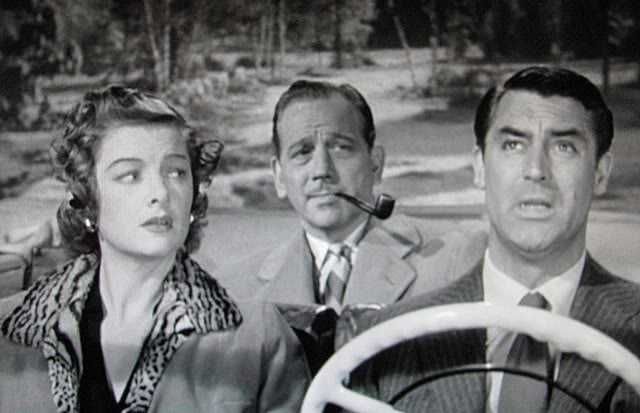
Douglas played the second man in Mr. Blandings Builds His Dream House, which follows at 10:15 PM. In the photo above, Douglas, who plays the Blandings' lawyer (the Blandings, of course, being played by Cary Grant and Myrna Loy), is seen driving out to Connecticut with the Blandings to see the house that they've bought, only to find that it's going to take a lot of work to get from there to the dream house.

The closest thing to a romantic comedy that shows up on this first night of the salute to Douglas is probably Three Hearts for Julia tomorrow morning at 7:30 AM, involving Douglas as a man helping his ex-wife (Ann Sothern) pick between suitors, although everybody knows that Sothern and Douglas are really more right for each other and should wind up together again in the last reel.


For classic Melvyn Douglas romanitc comedy like Ninotchka, you'll have to wait until next week (September 10), when it shows up at 8:00 along with a couple of others.

Tuesday, December 11, 2012

And So They Were Married

A little seen movie showing up on TCM is And So They Were Married, which you can catch tomorrow morning at 8:00 AM.

Melvyn Douglas stars as Stephen Blake, a widower with a young son who is going to be spending Christmas at a 1930s vintage ski resort, with the son soon to join him. Before the son gets there, however, Stephen has a run-in with Edith Farnham (Mary Astor), a divorcée with a young daughter. Because of the initial run-in, their meeting is by no means love at first sight. But with two unattached people, the hotel management is going to try to organize activities to keep them occupied together, and you know that the two are liable to fall in love eventually. There's another issue complicating matters. Edith's daughter doesn't really like Mr. Blake, while when his son arrives, the son finds he doesn't particularly care for Mrs. Farnham. When the two kids overhear the possibility that Stephen might propose to Edith, they decide that they're going to do everything they can to keep that from happening. They're more or less successful in that the two adults decide that if the kids don't want the marriage, then their getting together probably shouldn't happen -- even if they both like each other.

But hold on a minute. Both families go back to the city after their Christmas holiday. At this point, each of the kids realizes that perhaps they liked the other, and certainly their parents are said over not being able to share their love. So the kids decide that they're going to come up with an idea that will bring their parents back together, specifically one which involves the two of them disappearing, forcing their parents to look for them together. Of course, you know that in a movie like this, the kids' plan isn't going to go exactly to plan, and that there will be further complications along the way. You also know that the two adults are most likely to end up together at the end of the movie, but this is one of those movies that's more about how they get there.

And So They Were Married is one of those more-than-capable movies that the studios were churning out in the 1930s. It may have a B movie length of 74 minutes, but it's more of a "programmer" in that unlike the B movies, it's actually got some established stars. The material is nothing special, but Melvyn Douglas (see Ninotchka) and Mary Astor (see The Palm Beach Story) were both good in light romantic comedy fare, and so they make this movie entertaining in spite of its predictability. The end result is a movie that never really hits great, but more than serves its purpose of entertaining you.

And So They Were Married hasn't gotten a DVD release. It would probably be a good double bill DVD set paired with something like If You Could Only Cook: both of them were Columbia programmers from the mid-1930s, eminently entertaining if a bit short of great. (I doubt that's likely to happen, though, since If You Could Only Cook has shown up on a different Columbia box set.)